SUICIDE

“We Are the Nerds” is a story about “Nerdom” and the tragic loss of Aaron Swartz to his loving family and the world of coding.

Books of Interest
 Website: chetyarbrough.blog

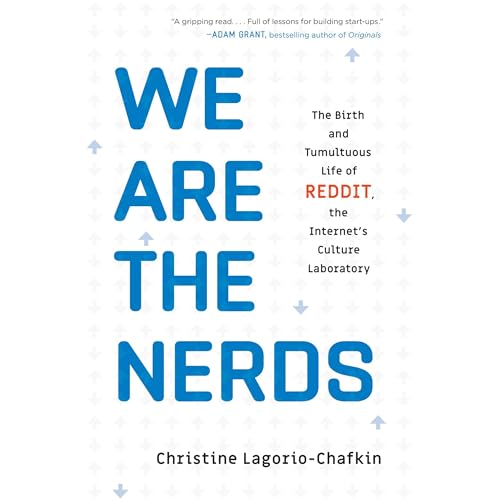
WE ARE THE NERDS (The Birth and Tumultuous Life of Reddit, the Internet’s Culture Laboratory)

Author: Christine Lagorio-Chafkin

Narration by: Chloe Cannon

Christine Lagorio-Chafkin (Author, reporter, podcaster based in New York.)

Relistening to “We are the Nerds” may be reviewed from a perspective of the future of newspapers but that diminishes the tragedy of Aaron Schwarz’s suicide.

The original founders of what became known as Reddit were Steve Huffman and Alexis Ohanian, graduates from the University of Virginia. A third partner, Aaron Swartz, is invited into the company because of his tech experience in creating a company called Infogami which merged with Reddit. With the addition of Infogami, the original founders of Reddit created a parent organization called “Not a Bug, Inc”. Schwartz insists on being called a co-founder because of his contribution to Reddit as a programmer. That insistence rankled Huffman and Ohanian which grew into a resentment that fills the pages of the author’s story.

Steve Huffman on the left with Alexis Ohanian and his wife, Serena Williams, and their daughter on the right.

The author seems to minimize Schwartz’s contribution to Reddit despite the framework he created that made Reddit scale more quickly because of its open access and community-driven cultural impact. Swartz’s contributed code appears to have been an important step in the useability of Reddit by the public. However, in fairness to the original founders, the author infers that contribution pales in respect to the extensive coding and work done by Huffman. The point is that this conflict becomes an irritant that leads to the departure of Swartz from Reddit in 2007, after it was acquired by Condé Nast in 2006. That acquisition made all three original coders millionaires.

Swartz’s life and premature death is a tragic encomium to the story of Reddit’s success as a public forum.

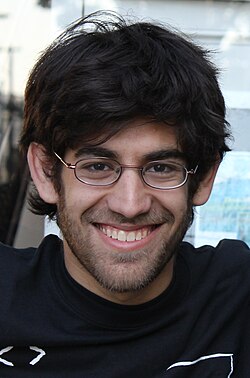
By some measure, Swartz is a brilliant human being, but his intelligence is accompanied by what might be characterized as a self-destructive personality. His ability as a computer nerd is evident in his High School days in Highland Park, Illinois. He goes on to Stanford, but its educational regimen leads him to leave after his first year. He preferred independent learning. Schwartz’s remarkable ability led him to become a research fellow at Harvard University in 2010. He became a self-taught intellectual with an activist belief in academic freedom that eventually led him to rebel against authority. He was arrested in 2011 for allegedly breaking into MIT’s computer network without authorization. He was charged for computer fraud and faced 34 years in prison and a million-dollar fine. At the age of 26, Swartz hung himself and died on January 11th, 2013.

An American mass media company founded in 1909.

Huffman and Ohanian believed Swartz’s contributions to Reddit were less than theirs in creating the company they sold to Condé Nast that made them millionaires. Swartz’s idealism and independence conflicted with the original founders of Reddit who seemed more interested in building a public platform that could make them rich. Though Ohanian believed they sold too soon, all three agreed to Condé Nast’s final offer that made them millionaires.

In retrospect, Ohanian may have been right about the future value of Reddit. Condé Nast spun Reddit out to an independent subsidiary under Advance Publications where it became a 42-billion-dollar success by 2025. Today, Huffman’s net worth is estimated at $1.2 billion as a result of his Reddit shares. Though Ohanian may not have held on to his shares, his net worth is estimated at $150-$170 million. Not bad for two University of Virginia graduates. However, as Plato observed, “The greatest wealth is to live content with little”. Swartz’s life seems to have had little to do with desire for wealth.

“We Are the Nerds” is a story about “Nerdom” and the tragic loss of Aaron Swartz to his loving family and the world of coding.

A.I. TOMOROW

A.I.s’ contribution to society is similar to the history of nuclear power, it will be constructively or destructively used by human beings. On balance, “Burn-In” concludes A.I. will mirror societies values. As has been noted in earlier book reviews, A.I. is a tool, not a controller of humanity.

Books of Interest
 Website: chetyarbrough.blog

BURN-IN (A Novel of the Real Robotic Revolution)

Author: P. W. Singer, August Cole

Narration by: Mia Barron

Peter Warren Singer (on the left) is an American political scientist who is described by the WSJ as “the premier futurist in the national security environment”. August Cole is a co-author who is also a futurist and regular speaker before US and allied government audiences.

As an interested person in Artificial Intelligence, I started, stopped, and started again to listen to “Burn-In”.

The subject of the book is about human adaptation to robotics and A.I. It shows how humans, institutions, and societies may be able to better serve society on the one hand and destroy it on the other. Some chapters were discouraging and boring to this listener because of tedious explanations of robot use in the future. The initial test is in the FBI, an interesting choice in view of the FBI’s history which has been rightfully criticized but also acclaimed by American society.

Starting, stopping, and restarting is a result of the author’s unnecessary diversion to a virtual reality game being played by inconsequential characters.

In an early chapter several gamers are engaged in VR that distracts listeners from the theme of the book. It is an unnecessary distraction from the subject of Artificial Intelligence. Later chapters suffer the same defect. However, there are some surprising revelations about A.I.’s future.

The danger in societies future remains in the power of knowledge. The authors note the truth is that A.I.’s lack of knowledge is what has really become power. Presumably, that means technology needs to be controlled by algorithms created by humans that limit knowledge of A.I.’ systems that may harm society.

That integration has massive implications for military, industrial, economic, and societal roles of human beings. The principles of human work, social relations, capitalist/socialist economies and their governance are changed by the advance of machine learning based on Artificial Intelligence. Machine learning may cross thresholds between safety and freedom to become systems of control with potential for human societies destruction. At one extreme is China’s surveillance state; on the other is western societies belief in relative privacy.

Robot evolution.

Questions of accountability become blurred when self-learning machines gain understanding beyond human capabilities. Do humans choose to trust their instincts or a machines’ more comprehensive understanding of facts? Who adapts to whom in the age of Artificial Intelligence? These are the questions raised by the authors’ story.

The main character of Singer’s and Cole’s story is Lara Keegan, a female FBI agent. She is a seasoned investigator with an assigned “state of the art” police robot. The relationship between human beings and A.I. robots is explored. What trust can a human have of a robotic partner? What control is exercised by a human partner of an A.I.’ robot? What autonomy does the robot have that is assigned to a human partner? Human and robot partnership in policing society are explored in “Burn-In”. The judgement of the author’s story is nuanced.

In “Burn-In” a flood threatens Washington D.C., the city in which Keegan and the robot work.

The Robot’s aid to Keegan saves the life of a woman threatened by the flood as water fills an underground subway. Keegan hears the woman calling for help and asks the robot to rescue the frightened woman. The robot submerges itself in the subway’ flood waters, saves the woman and returns to receive direction from Keegan to begin building a barrier to protect other citizens near the capitol. The Robot moves heavy sacks filled with sand and dirt, with surrounding citizens help in loading more sacks. The robot tirelessly builds the barrier with strength and efficiency that could not have been accomplished by the people alone. The obvious point being the cooperation of robot and human benefits society.

The other side of that positive assessment is that a robot cannot be held responsible for work that may inadvertently harm humans.

Whatever human is assigned an A.I robot loses their privacy because of robot’ programing that knows the controller’s background, analyzes his/her behavior, and understands its assigned controller from that behavior and background knowledge. Once an assignment is made, the robot is directed by a human that may or may not perfectly respond in the best interest of society. Action is exclusively directed by the robot’s human companion. A robot is unlikely to have intuition, empathy, or moral judgement in carrying out the direction of its assigned human partner. There is also the economic effect of lost human employment as a result of automation and the creation of robot’ partners and laborers.

A.I.s’ contribution to society is similar to the history of nuclear power, it will be constructively or destructively used by human beings. On balance, “Burn-In” concludes A.I. will mirror societies values. As has been noted in earlier book reviews, A.I. is a tool, not a controller of humanity.

GENDER INEQUALITY

“Betraying Big Brother” is not wrong about gender inequality but the author’s anger and personal choices cloud the author’s message. Gender inequality is real everywhere in the world. Education is a beginning, but practice is the end.

Books of Interest
 Website: chetyarbrough.blog

Betraying Big Brother (The Feminist Awakening in China)

AuthorLeta Hong Fincher

Narrated By: Emily Woo Zeller

Leta Hong Fincher (Author, American journalist, feminist and writer, first American to receive a Ph.D from Tsinghua University’s Department of Sociology in Bejing., graduated from Harvard with a BA and a master’s degree in East Asian Studies from Stanford.)

The education and experience of Leta Hong Fincher is somewhat betrayed by her anger in “Betraying Big Brother”. Misogyny is an international reality that defies the truth of human equality. This reviewer’s prejudice, like the author’s biases are suspect because of their respective life experiences. This book reviewer was raised by a single parent mother who worked to keep two sons with a roof over their head and food on the table. How women survive inequality is made of the same stuff as that which plagues minorities around the world. The difference is that women are not a minority.

She writes of being a 15-year-old girl who is physically and emotionally abused by two boys who are friends of an older male friend that takes her to a get together of young acquaintances. That event burns a memory into Fincher’s mind that sets her on a journey thru life. One reading/listening to “Betraying Big Brother” recognizes the truth of what the author writes is reinforced by her life experiences. Of course, that is true of all human beings, but anger diminishes the impact of what Fincher says and writes.

Leadership?

Whether living in a democracy or autocracy, sexual inequality is present. Gender discrimination is universal. America and China talk the talk but fail to walk the walk. Fincher writes of Mao’s saying that “women hold up half the sky” implying he believed in gender equality. Mao spoke of marriage reform and labor participation but patriarchal norms were adhered to with women workers not being paid the same as men nor offered similar positions of power.

Xi speaks of gender equality, but no women are on the 24-member Politburo.

Xi also speaks of gender equality, but no women are on the 24-member Politburo while pay and promotions lag behind men. Fincher writes of Big Brother censorship, surveillance, and detention of women in China. (One presumes that is also true of everyone in China.) Like Trump, Xi promotes women’s roles in domestic stability, and their childbearing responsibilities. America has yet to elect a woman as President. Equal pay for equal work is improving in America, but a gap still exists with lower starting salaries, performance evaluation biases, and fewer high-profile assignments or promotions.

“Betraying Big Brother” is not wrong about gender inequality but the author’s anger and personal choices cloud the author’s message. Gender inequality is real everywhere in the world. Education is a beginning, but practice is the end.

VANISHING WORLD

Murata’s satire infers obsession with sex for pleasure, child rearing collectivization, gender dysphoria, and pregnancy equalization are pathways to societal destruction.

Books of Interest
 Website: chetyarbrough.blog

Vanishing World (A Novel) 

Author: Sayaka Murata

Narrated By: Nancy Wu

Sayaka Murata (Author, Japanese novelist.)

Sayaka Murata’s subject is clearly revealed in its title, “Vanishing World”. “Vanishing World” is a provocative assessment of how sexual relationship and sex education has changed. Murata satirically reveals how human reproduction, objectification of life, motherhood, and technology may dehumanize society.

Murata’s fictional story is highly informative in regard to sexual difference and similarity between men and women.

In one sense, Murata’s fictional story is highly informative in regard to sexual difference and similarity between men and women. As a reader/listener, Murata offers a detailed description of the physical difference between the sexes. Many who think they know something about sexual difference will find the author’s candor enlightening. However, her depiction of social relationship is off-putting with a satirical exaggeration of socio/sexual objectification.

Murata writes about a single parent family with a young daughter who lives with her mother and is nearing the age of puberty.

(Though not mentioned in Murata’s story, single family homes in America have grown by nearly 30% in the 21st century.) The main character’s name is Amane and Murata’s story is about Amane’s sexual awakening and how she views social relationship. Amane is infatuated with an animated male character on television. She imagines being married to this character before puberty but holds this character in her mind throughout childhood and later life.

Murata suggests reproduction may evolve into a preferential desire for artificial insemination rather than sexual intercourse between a man and woman.

This idea feeds into a listener/reader’s mind as a diminishment of the need for emotional attachment to the opposite sex for procreation. Sex becomes detached from procreation, evolving into only “hooking up” for sexual stimulation and/or personal gratification. Murata infers desire is no longer needed for procreation but only to experience intercourse as an emotional and physical pleasure. Consequently, it seems perfectly natural to transfer sexual desire to a fictional character because it becomes unnecessary to have emotional attachment to humans when a figment of one’s imagination is available.

Murata creates a bizarre world.

The bizarro world that Murata creates is an extension of a belief that society is becoming less attached to their humanity. Marriage, human relationship, and motherhood are replaced by mindful personal’ inwardness and endless pursuit of physical stimulation without emotional entanglement. By extension, Murata suggests science will create wombs for men so that the difference in sexes equalizes childbirth and care of children. Caregiving becomes bureaucratic and collective because caregiving is no longer personalized.

Murata suggests that a new system of childcare will evolve into collective training camps for working parents who are too self-absorbed to raise their own children.

Collective childcare disconnects parents from the management and development of their children. The sterility of conception by artificial insemination, collective childcare, and social acceptance of multiple sex partners diminishes both familial relations and child development. Birthing and raising children becomes a clinical process, i.e., less personal with both men and women capable of experiencing pregnancy and delivery; all without responsibility or obligation for childcare.

In some sense, this satire illustrates the negative potential of socio/sexual equality.

Murata’s story ends with the birth of their first child from a man who is Amane’s husband. She is torn over not being able to take the baby home because the child is already being “cared for” in a ward meant to raise and nurture all newly born children. A final point is made in the story by a visit from Alane’s mother after the birth. She asks Amane where the child is, and Alane explains the child will not be raised by her and her husband. Alane’s mother is aghast. Her mother falls to the floor and dies without any apparent familial concern for her sudden collapse and presumably, death. The next thing to happen is a visit from one of the children born in this new world. Alane chooses to have sex with him and the story ends.

“Vanishing World” implies 21st century science, organizational bureaucracy, and social change threatens survival of humanity. Murata’s satire infers obsession with sex for pleasure, child rearing collectivization, gender dysphoria, and pregnancy equalization are pathways to society’s collapse.

LSD

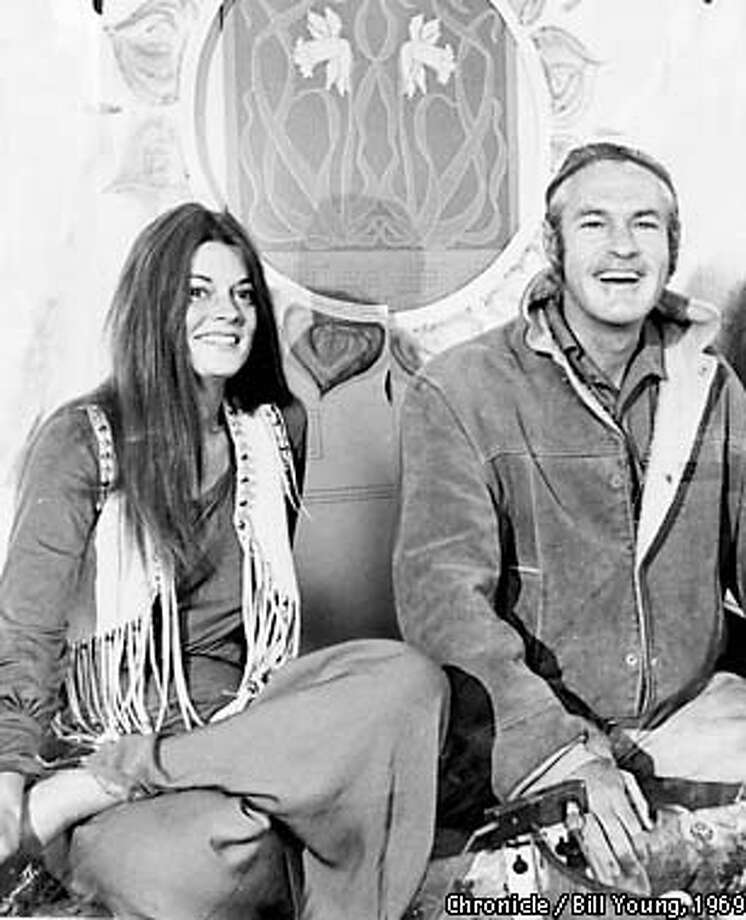
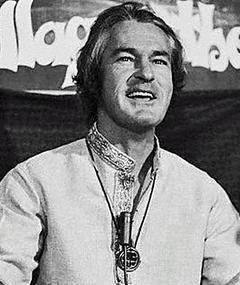
Some academics considered Timothy Leary a visionary thinker who pioneered consciousness expansion, psychedelic therapy, and transhumanism. Others argue he lacked scientific rigor.

Books of Interest
 Website: chetyarbrough.blog

The Acid Queen (The Psychedelic Life and Counterculture Rebellion of Rosemary Woodruff Leary)

Author: Susannah Cahalan

Narrated By:  Susannah Cahalan

Susannah Cahalan (Author, journalist for the New York Post)

Susannah Cahalan has written a titillating story of the 60s and 70s and Americans burgeoning experimentation with illicit drugs. It focuses on Rosemary Woodruff Leary, the fourth wife of the LSD guru, Timothy Leary. Leary’s first wife committed suicide, his second seemed a rebound companion, his third is to Nena von Schlebrugge, and then Rosemary who eventually becomes his lover, fourth wife, and supporter during their 9 years of marriage. His last marriage was to Barbara Chase in 1978 which lasted for 14 years until 1992. Leary died in 1996 at the age of 75.

Timothy Leary’s time with Rosemary is filled with mutual infidelity but with freely given support by Rosemary of a diminishing intellectual who promoted hallucinogens and their mind-altering effects. The handsome Leary became a significant influence on the use of hallucinogens like LSD and psilocybin as tools for expanding human consciousness. He believed psychedelics could unlock deeper levels of self-awareness, creativity, and spiritual enlightenment. An interesting point about LSD and other hallucinogens is how they have become useful drugs for modern treatment of psychological dysfunctions like schizophrenia and PTSD. On the other hand, Cahalan shows indiscriminate use of LSD can diminish social propriety and become an escape from or harmful distortion of consciousness.

Putting aside the value of hallucinogens, “The Acid Queen” is about the life of Rosemary Woodruff Leary.

Rosemary was born in 1935. Growing into a beautiful woman, she was drawn into the counterculture movement of the 60s and 70s in her travels to San Francisco, Southern California, and New York. Her beauty opened doors of opportunity for Rosemary. She became an airline stewardess until retirement in her early 30s that were required by age limits of airlines in those years. Cahalan infers Rosemary’s attractiveness and free-spirited beliefs led her to use sex as a useful way of getting what she wanted through relationships with men. She joined the beatnik generation because it fit her style of living. This is a generation that rejected mainstream American culture with an interest in artistic self-expression, non-conformity, and spirituality. This was in the 1950s and early 60s.

Rosemary meets Timothy Leary in 1965.

Leary’s use of LSD as a transformative experience fit into Rosemary’s lifestyle. She became one of Leary’s devoted followers. They married in 1967. Art Linkletter’s daughter died in 1969 by suicide and blamed it on LSD. Not surprisingly, the conservative President, Richard Nixon, called Leary “the most dangerous man in America”. In 1968 Timothy Leary was arrested in Laguna Beach, California and charged with marijuana possession. He was tried in 1970 and sentenced to 1o years in prison. He escaped prison with the help of the Weather Underground but was recaptured in 1973. His sentence, in conjunction with his former conviction, was extended to 20 years. He was released in 1976, after 3 years, when he cooperated with authorities by offering information on the counterculture movement.

Cahalan shows how Rosemary followed and supporter Leary in his escape from prison and how their relationship fell apart.

It is somewhat unclear from Cahalan’s story about why Rosemary gave up on Leary. One may have been because of his and her self-absorption or their penchant for attachment to others for the support they believe they deserved. Cahalan’s story of Rosemary is interesting because of her association with Leary. Though Rosemary is self-educated, she appears to have limited formal education with her claim to fame largely based on the men with whom she became intimately involved.

In contrast, Timothy Leary earned a B.A. in psychology from the University of Alabama in 1943, a master’s degree in psychology from Washington State University in 1946, and a Ph.D. in psychology from the University of California, Berkeley in 1950.

Leary had many intimate women friends and five wives. He had two children, a girl born in 1947 and a boy born in 1949, with his first wife, Marianne Bush. Leary’s daughter died at age 42. She hung herself with her shoelaces tied to a jail bar while waiting to be charged for shooting her boyfriend. His son Jack, at 25 years of age, is noted in a NYT’s article in 1974. The article clearly implies Jack had become estranged from his father.

“The Acid Queen” is a sad story of two self-absorbed people who had exciting and tragic lives.

Timothy Leary had fame and fortune. Rosemary Woodruff Leary had beauty and tenacity. Neither seem paragons of virtue and both seem much less than they could have been. The underlying message of “The Acid Queen” is we need to be more connected to the world, less self-absorbed, and more other-directed. (Easy to say or write, but unlikely to be.)

Some academics considered Leary a visionary thinker who pioneered consciousness expansion, psychedelic therapy, and transhumanism.

Timothy Leary showed himself to be a charismatic and persuasive speaker. However, critics argue he lacked scientific rigor and had little foresight or objectivity about the effects of drugs on consciousness. Rosemary may have been “The Acid Queen” but never achieved the sobriquet of “Queen of Hearts”.

INTELLIGENCE

After two or three chapters of Huston’s book, reader/listeners will likely complete it. The difficulty, as with all good advice, is following it.

Books of Interest
 Website: chetyarbrough.blog

SHARP (Simple Ways to Improve Your Life with Brain Science)

By: Therese Huston PhD

Narrated By:  Theresa Bakken

Therese Huston (Author, earned an MS and PhD in Cognitive Psychology from Carnegie Mellon University.)

Therese Huston is a well-known public speaker who has written a book that has appeal for those who wish to know what they can do to improve their memory and cognitive abilities. This is not a book some will be interested in either listening to or reading. Many presume they have a proscribed intelligence and memory largely determined by genetic inheritance. Huston infers there is some science-based truth in that opinion but that one’s memory, cognitive ability, and psychological health can be treated, if not improved, at any age.

Huston’s prescription for improved memory and cognitive ability requires effort.

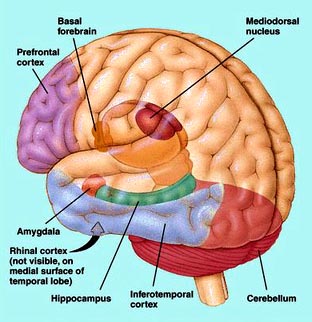
Undoubtedly, we inherit much of our innate cognitive ability but whatever one’s genetic inheritance and age may be Huston argues cognition and memory can be improved. Huston discusses areas of the brain that are the base from which cognition and memory originate, are stored, and then called upon.

Huston notes the hippocampus, amygdala, prefrontal cortex, neocortex, cerebellum, and basal ganglia are key brain areas involved in cognition and memory.

The hippocampus is the primary location of memories, but the other five areas interact with one’s personal experiences in ways ranging from emotion, individual understanding, decision-making, reasoning, skill development, and formed habits. As we age, the way we process, store, and retrieve information deteriorates. We lose some memories, process information more slowly, and find it more difficult to process new information in the context of past experience.

What Huston explains is that exercise, visual, and tactical experience can improve memory and cognition at every age.

Staying active, experiencing the world in ways that stimulate the production of dopamine, and exercising effort to learn and do new things improves cognitive ability and memory. Dopamine is a neurotransmitter in the human body that regulates mood, focus and behavior. It is released by the body when it is stimulated by exercise, engaging experience, and learning new things. Huston offers advice on how one at any age can improve their mental health and care for themselves and others when they are troubled by various common and extraordinary events in life. Life’s events stimulate the release of dopamine which can illicit rage and bad behavior but also provide focus and beneficial behavior.

Huston suggests 14 generally simple ways of helping oneself and others cope with the stresses of life.

Many of her solutions are commonly understood, others less so. Not surprisingly, she notes exercise, proper nutrition, quality sleep, and deep breathing are important for maintenance and improvement of brain function and memory. Some more difficult and less understood aids to brain health and memory are 1) importance of social engagement, 2) learning new things from personal and other’s recorded experience, and 3) practicing ways of reducing the stresses of life in yourself and others you care about.

One who reads or listens to “Sharp” will recognize the value of Huston’s advice for improving memory and cognitive ability.

After two or three chapters, reader/listeners will likely complete her book. The difficulty, as with all good advice, is following it.

PSYCHOSIS

The imagination of Han Kang gives reader/listener’s an explanation of how a human being can become psychotic. Kang’s characters show how psychosis comes from many sources, a major one of which is family relationship.

Books of Interest
 Website: chetyarbrough.blog

The Vegetarian 

By: Han Kang

Narrated by: Deborah Smith, Janet Song, Stephen Park

Han Kang (Author, South Korean writer, awarded the International Booker Prize for fiction in 2016 and the Nobel Prize in Literature in 2024.)

A listener/reader may be tempted to put this book aside with the thought that it is a titillating pornographic tale that is not worthy of one’s time. However, after an hour or two, one realizes this is a journey for something difficult to describe.

In Kang’s fictional story, two sisters are raised by the same parents. One is the older of the two and becomes a successful small business owner with a video artist husband; the other is a housewife who lives with a husband that seems to neither love nor respect her. Both marriages fail but for different but interlocking reasons.

The younger sister becomes a vegetarian later in her married life. She explains her vegetarianism is based on a dream she has about something that is not clearly defined. One gathers the dream has something to do with the source of meat that involves the killing of animals while vegetarian food comes from nature’s abundance. The husband reluctantly goes along with the change but becomes more and more unhappy in his life with the younger sister. The unhappiness grows to something greater when his wife begins to complain about how her meat-eating husband’ smells. The breaking point comes when the husband asks his wife’s mother, father, and sister-in-law to convince his wife to abandon vegetarianism and begin adding meat to her diet. At dinner in their house, the father forcefully demands his daughter to eat meat. She refuses and the conflict becomes violent. Her father pries her mouth open and shoves meat into her mouth. The daughter rebels and cuts her wrist with a knife in an act of defiance. Her brother-in-law grasps the younger daughter who is profusely bleeding and rushes her to the hospital.

The brother-in-law that rushed to save the vegetarian is a video artist.

The main characters of the story and the substance of their conflict is now made clear to the listener/reader. The next portentous development is the older sister’s husband (a video artist) begins to fantasize about the younger sister whom he had rushed to the hospital. His fantasy grows to the point of asking the younger daughter to pose nude for an art video he wishes to create. She agrees. A listener/reader begins to understand the younger sister is slipping into a psychosis. Her brother-in-law paints her nude body with flowers that make her feel that she is becoming part of nature, i.e., something growing like the vegetarian diet upon which she relies. The brother-in-law’s sexual desire becomes more aroused by the video and his relationship with the younger sister.

The deepening psychosis of the younger daughter grows when the brother-in-law hires a nude male model to be a part of a new video.

The male model resists but agrees to pose with her but refuses to go beyond allowing flowers being painted on his nude body and a video of the two without clothes but with painted bodies. The brother-in-law’s sexual fantasy grows from this experience but is disappointed in the male actor who refuses to have sex with the sister-in-law while the video is being filmed. The male actor did not want to be viewed as a porn star.

The brother-in-law’s fantasy leads to the sister-in-law’s agreement to have sex with him on film as long as he allows her to paint flowers on his body that are similar to what he had painted on her body. They become sexually entwined at the sister-in-law’s house. The older sister discovers them in their sexual rendezvous where the video is being produced.

The younger sister has crossed a barrier between sanity and insanity. It is not a matter of remorse for the sexual relationship but from a reinforcement of her obsessive need for being a vegetarian as an integral part of nature. She refuses her humanity. She has crossed the Rubicon between sanity and insanity. She refuses to eat anything and only wishes to drink water to feed her growth as a plant. Both her husband and the husband of the older sister-in-law essentially drop out of Kang’s story. The older sister’s husband does not forgive her husband for his sexual transgression and the younger sister’s husband never loved the vegetarian in the first place.

This amazing book, “The Vegetarian”, offers a vivid portrayal of a human beings’ descent into psychosis.

The imagination of Han Kang gives reader/listener’s an explanation of how a human being can become psychotic. Kang’s characters show how psychosis comes from many sources, a major one of which is family relationship.

PUTIN & UKRAINE

Without checks and balances, autocratic beliefs inevitably lead to conflict and mutually assured destruction, Donald Trump notwithstanding.

Books of Interest
 Website: chetyarbrough.blog

From Cold War to Hot Peace (An American Ambassador in Putin’s Russia)

By: Michael McFaul

Narrated By: L. J. Ganser

Michael McFaul (Author, American academic and diplomat, ambassador to Russia 2012-2014, former Professor of International Studies at Stanford.)

Not since George Kennan’s brief time as Ambassador to Russia in 1952 has an American ambassador been denied access to Russia. Michael McFaul became the second in 2016. McFaul joins the pre- and post-Obama election to become Obama’s ambassador to Russia from 2012 to 2o14. McFaul writes this book to explain his experience in the Obama administration, his understanding of Russia, and his tenure as Ambassador to Russia.

Interestingly, Condoleezza Rice recommends McFaul should join Obama because she was sure he, rather than McCain, would become the next President of the United States.

McFaul follows Rice’s recommendation and joins Obama’s campaign. Mcfaul’s grasp of Russian foreign affairs is insightful and relevant based on his personal experience. McFaul lived in Russia for a period of time when Gorbachev and Yeltsin attempted to liberalize Russia’s autocratic government. McFaul’s time living in Russia, his understanding of Russian language, and his study of Russian history at Stanford make his opinion in “From Cold War to Hot Peace” important.

Gorbachev’ biography shows he experienced the autocratic rule of Stalin’s U.S.S.R. as a young boy and found the courage to open the door to citizen’ freedom.

Mikhail Gorbachev was 22 when Stalin died. His ideal was to maintain the U.S.S.R. but with a system of government that rejected totalitarianism while freeing its citizens to improve their way of life. However, the shock of newfound freedom appeared an economic change too difficult and unfairly remunerative for the U.S.S.R. to survive as one hegemon.

A fundamental ingredient of independence is freedom.

When countries controlled by the U.S.S.R. were offered freedom, they looked to forms of democracy rather than autocracy. Gorbachev’s inability to accelerate economic growth to improve the lives of his country’s citizens doomed his goal to create a freer society within the U.S.S.R. Compounding his failure, Boris Yeltsin usurps Gorbachev’s power by arguing he has a better way of accelerating Russia’s economy to keep the U.S.S.R. together.

Boris Yeltsin talked the talk of democratic government but because of his inability to coopt the underlying authoritarian habits of former KGB operatives, he lost control of the government.

Yeltsin’s rise undermined the influence of Gorbachev, encouraged the departure of U.S.S.R.’ member countries, and gave an opening to Vladimir Putin, a former KGB officer. The KGB changed to the FSB in 1991 (along with Russia’s Foreign Intelligence Service) to become the right and left hand of Putin’s power and influence in the new Russia.

Fifteen countries leave the U.S.S.R. in 1991.

  1. Estonia: August 20, 1991
  2. Latvia: August 21, 1991
  3. Lithuania: March 11, 1990
  4. Armenia: September 21, 1991
  5. Azerbaijan: October 18, 1991
  6. Belarus: August 25, 1991
  7. Georgia: April 9, 1991
  8. Kazakhstan: December 16, 1991
  9. Kyrgyzstan: August 31, 1991
  10. Moldova: August 27, 1991
  11. Russia: December 12, 1991
  12. Tajikistan: September 9, 1991
  13. Turkmenistan: October 27, 1991
  14. Ukraine: August 24, 1991
  15. Uzbekistan: September 1, 1991

Gorbachev effectively ended the cold war, but McFaul argues the cold war turned into a “…Hot Peace”. Gorbachev was the last leader of the Union of Soviet Socialist Republics. His effort to democratize Russia fails even though he fully champions Valdimir Putin to become president of Russia in 2000.

Putin took control of Russia as Prime Minister under Yeltsin in 1999. He later effectively became President of Russia for life.

McFall explains Obama became President of the United States in 2o09. Obama revised America’s relationship with Russia with what became known as the U.S./Russia “Reset” policy.

Obama’s “Reset” policy had some early positive effects. The relationship between America and Russia arguably improved despite their significant political differences. When they disagreed, they agreed to disagree. There were halting steps toward nuclear bomb limitation and greater cooperation on America’s actions in Afghanistan when the Taliban had shown support for Osama bin Laden after 9/11.

Putin rose to the presidency in 2011 and has remained effectively in control of Russia since 1999. Though not argued by McFaul, Putin’s intimate understanding of Russia’s secret service has given him the power to exercise dictatorial control over Russia. The history of U.S.S.R. since the 1917 revolution has been maintained by a secret service used to jail, torture, and murder any opposition to leadership of Russia. Today, that autocratic leader is Putin. There seems little reason to believe kleptocratic control of a massive secret service apparatus will be overcome without revolution. Every Russian knows of the threat the secret service has to any opposition to Putin who controls and has an intimate relationship and understanding of the organizational capabilities of the former KGB.

Gorbachev’s legacy is hope for a better form of government in Russia. Change is possible just as Gorbachev’s history as the secretary of the Communist Party from 1985 to 1991 proved.

One is inclined to believe change will come to Russia from a disaffected communist party leader who rises in the party and taps discontented Russians looking for change. If all one’s life is lived and raised in Russia, a Russian born change-agent like Gorbachev may, once again, be born

As one completes McFaul’s book, the threat of masculine blindness in world leaders is made clear. Leadership entails a power that corrupts leaders who think they know what is best for their citizens. Autocracies concentrate that power in singular human beings. Without checks and balances, autocratic beliefs inevitably lead to conflict and mutually assured destruction, Donald Trump notwithstanding.

AI TRANSITION

The potential of AI is akin to the Industrial Revolution, yet it could surpass it significantly if managed correctly by humans.

Books of Interest
 Website: chetyarbrough.blog

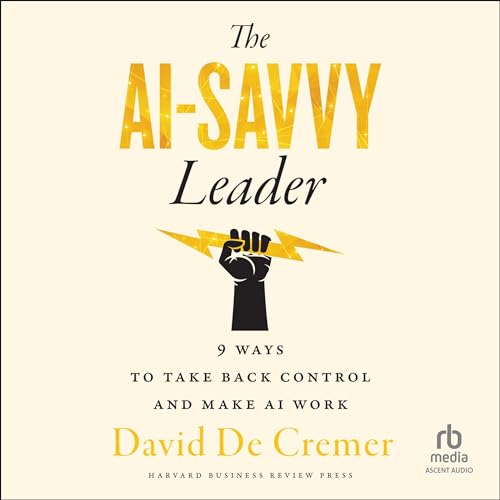
The AI-Savvy Leader (Nine Ways to Take Back Control and Make AI Work)

By: David De Cremer

Narrated By: David Marantz

David De Cremer (Author, Belgian born professor at Northeastern University in Boston, and behavioral scientist with academic studies in economics and psychology.)

“The AI-Savvy Leader” should be required reading for every organization investing in artificial intelligence for performance improvement. From government to business, to eleemosynary organizations, De Cremer offers a guide for organizational transition from physical labor to labor-saving benefits of AI.

AI offers the working world the opportunity to increase their productivity without the mind-numbing physical labor of assembly lines and administrative scut work.

Like assembly line production implemented by Ford and work report filing and writing during the industrial revolution, AI offers an opportunity to increase productivity without the mind-numbing physical labor of assembly line work and after-work’ analysis reports. With AI, more time is provided to workers to think and do what can be done to be more productive.

Arguably, AI is similar to the industrial revolutions transition to assembly line work. Assembly line work improved over time by changes that made it more productive. Why would one think that AI is any different? It is just another tool for improving productivity. The concern is that AI means less labor will be required and that workers will lose their jobs. De Cremer notes loss of employment is one of the greatest concerns of employees working for an organization transitioning to AI. Too many times organizations are looking at reducing costs with AI rather than increasing productivity.

The solution identified by De Cremer is to make AI transition human centered.

His point is that organizations need to understand the human impact of AI on employees’ work process. AI should not only be viewed as a cost-cutting process but as a process of reducing repetitive work for labor to make added contributions to an organization’s goals. AI does not guarantee continued employment, but reduced manual labor offers time and incentive to improve organization productivity through employee’ cooperation rather than opposition. AI is mistakenly viewed as an enemy of labor when, in fact, it is a liberator of labor that provides time to do more than tighten bolts on an auto body frame.

AI is not a panacea for labor and can be a threat just like industrialization was to many craftsmen.

But, like craftsman that went to work for industries, today’s labor will join organizations that have successfully transitioned to AI with a human-centered rather than cost-reduction mentality. Labor productivity is only a part of what any AI transition provides an organization. What is often discounted is customer service because labor is consumed by repetitive work. If AI improves labor productivity, more time can be provided to an organization’s customers.

When AI is properly human centered, the customer can be offered more personal attention by fellow human beings employed by an AI organization.

Too many organizations are using AI to respond to customer complaints. Human-centered AI becomes a win-win opportunity because labor is not consumed by production and has the time to understand customer unhappiness with service or product. AI does not think like a human. AI only responds based on the memory of what AI has been programmed to recall. With human handling of customer complaints, problems are more clearly understood. Opportunity for customer satisfaction is improved.

De Creamer acknowledges AI has introduced much closer monitoring of worker performance and carries some of the same mind-numbing work introduced in assembly line manufacturing.

De Creamer suggests negative consequences of AI should be dealt with directly with employees when AI becomes a problem. Part of a human-centered AI organization’s responsibility is allowing employees to take breaks during their workday without being penalized for slackening production. Repetitive tasks have always been a drain on productivity, but it has to be recognized and responded to in the light of overall productivity of an organization.

AI, like the industrial revolution, is shown as a great opportunity for human beings.

De Creamer suggests AI is not and will never be human. To De Creamer AI is a recallable knowledge accumulator and is only a programmed tool of human minds, not a replacement for human thought and understanding. The potential of AI is akin to the Industrial Revolution, yet it could surpass it significantly if managed correctly by humans.

PSYCHOSIS

Psychiatric illness is disturbingly believable and terrifying. Human psychosis ruins lives if not properly diagnosed and treated.

Books of Interest
 Website: chetyarbrough.blog

The Night Guest 

By: Hildur Ingveldardóttir Guðnadóttir

Narrated & Translated By: Mary Robinette Kowal

Hildur Ingveldardóttir Guðnadóttir (Icelandic Author, classical cellist, and composer –awarded an Academy Award, two Grammies, and an Emmy.)

The multi-talented Guðnadóttir has written a chilling tale of psychosis in “The Night Guest”. In one sense, it is a reflection of sexual equality, but it also reveals how complex and dangerous it is to be human. This fictional story is about an attractive single woman who is unable to peacefully sleep through the night. Every morning, she wakes up with a tiredness that sticks with her through the day. On some mornings she finds bruises or scratches on her arms and has no idea of why she feels so tired. She sees several doctors and finally finds one that takes her symptoms seriously.

Her doctor runs tests and finds nothing seems to explain the tiredness. The doctor asks her if she is depressed. The woman says she feels sad sometimes but not particularly depressed. The doctor recommends she see a psychiatrist, but she chooses to ignore the advice.

The tiredness, odd bruises, and scratches on her body continue to appear, i.e., after sleep and in the morning. She comes across an article that tells her of sleepwalkers that don’t realize they are sleepwalking at night after falling asleep. She is convinced that explains her symptoms and asks her doctor for sleeping pills. The doctor reluctantly agrees and provides a prescription. Initially, the treatment seems to help, and the young woman resumes her life, meets a new boyfriend, and begins to feel everything is okay.

The author explains the young woman is a lover of cats but notices that lately the cats in her neighborhood have become afraid of her.

When she approaches them, they hiss and raise their backs. She is mystified by their response. As the story progresses, listeners find she was involved with the owner of a company for which she works. He is married and the relationship is ended with some acrimony. The two avoid each other at the workplace but the still-married man tries to resurrect their relationship. The young woman is involved with another man and has no interest in resuming a relationship with a married man.

She returns to her belief that her sleeplessness is caused by her sleepwalking and decides to monitor her behavior with a video recording devise.

She reviews the recording to find she wakes up and leaves her bedroom for hours at a time. She is wearing a pedometer to measure the steps she takes and finds it is several thousand steps more than what it was at the end of her day. What makes her discovery ominous is that the recording shows a conscious and alert person that has to be her, but she feels that person is entirely different from herself.

The woman’s tiredness returns, and she finds one morning that all of her sleeping pills are gone. Her former married lover disappears. Her current lover tells her to never contact him again without an explanation. The denouement of the story is horrifying. Explanation of her psychiatric illness is disturbingly believable and terrifying. Human psychosis ruins lives if not properly diagnosed and treated.