Brianna Weist philosophical book is worth listening to as a guide but not as an authority of how one should live their life.
Books of Interest Website: chetyarbrough.blog
101 Essays That Will Change the Way You Think
Author: Brianna Wiest
Narration by: Abby Craden
Brianna Wiest (Author, earned a BA in English and received an Honorary Doctorate in Literature from Elizabethtown College.
This is an odd book because it is written by someone who is not a psychologist, psychiatrist or therapist but presumes to know how one can understand themselves, think differently and become a more psychologically heathy human being. “101 Essays…” has become a popularly read and listened to book by the public. Of course, one can take her observations like one would take the meaning of many non-fiction authors who have a point of view about life and living. They are called philosophers.
One finds Wiest’s essays make sense, but her formal education makes one uncomfortable with her expressed beliefs.
On the other hand, what formal education was there for Socrates? (A. I. generated image of Socrates as a young man.)
Weist is straight forward in her opinions, and she taps into a human wish for one to be psychologically and physically as good as they can be. Changing “…the Way You Think” is no easy task but the idea of consciously understanding ourselves is an oxymoron that limits one’s ability to change. We are as likely to lie to ourselves about who we are or what we believe as to have a true understanding of ourselves.
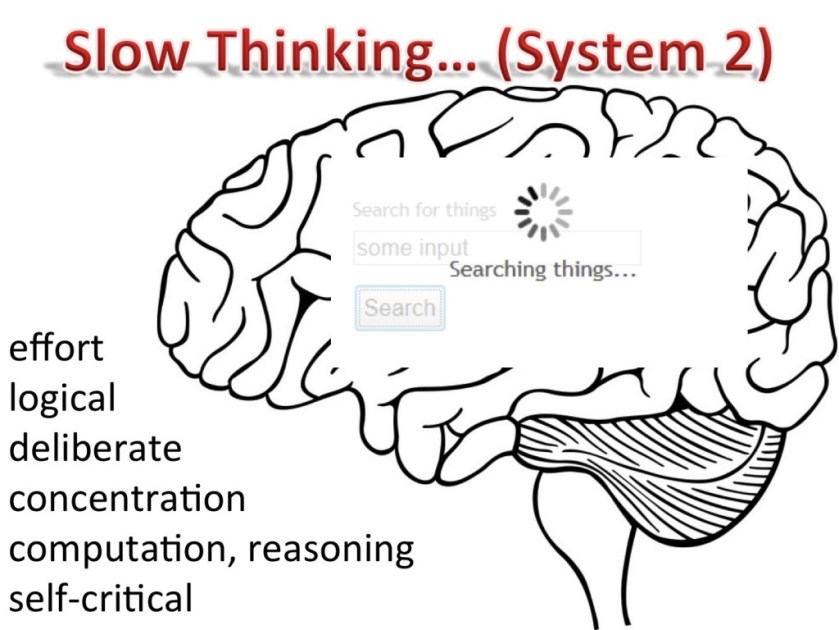
Daniel Kahneman is a renowned psychologist and Nobel laureate. He is an American citizen that served in the Israeli military and used his education, research, and experience to write “Thinking Fast and Slow”. His observations explore many aspects of human decision-making.
Weist logically argues one can become a better human being by changing the way they think. She is not acting as a clinical psychologist but as a philosopher of life and how one may make the most of it. If one understands Weist from that perspective, she is like Marcus Aurelius, Soren Kierkegaard, or Simone de Beauvoir. She has a philosophical point of view but not necessarily a happier or more fulfilling life.
The meaning of experience on one’s life is often too opaque for one’s understanding without the help of others.
Weist writes we should see what hurts others and ourselves and quit doing those hurtful things by changing our mind. This seems a good idea but denies the subjectivity and the unique experiences in one’s life. Many people are unable to understand the impact of experience on their lives. They are unable to change the way they think because they are unable to understand how or why an experience has affected their lives. Only with the help of a qualified psychologist, psychiatrist, or trained therapist can most people objectively understand themselves to constructively change their mind.
Nevertheless, Weist philosophical book is worth listening to as a guide but not an authority on how one should live their life. Most human beings are not introspective enough to find their way through life without the help of a person trained to elicit what we do not know about ourselves. On the other hand, it appears Weist has a genius beyond her years of life.
Like being a New Zealander, Americans are made of many cultures. That is an underlying theme of Hampton Sides interesting biography of Captain Cook.
Books of Interest Website: chetyarbrough.blog
The Wide Wide Sea (Imperial Ambition, First Contact and the Fateful Final Voyage of Captain James Cook)
Author: Hampton Sides
Narration by: Peter Noble
Hampton Sides (Author, American historian Yale graduate with a BA in history. As an editor, Sides has written many articles for national publications. He is awarded an honorary doctorate from Colorado College.)
Hampton Sides has written an interesting history of James Cook’s voyages with a focus on his final expedition to find a Northwest Passage. This is a slightly misleading statement because in the 18th century, a ship sailing from the Atlantic to the Pacific typically had to navigate around Cape Horn at the southern tip of South America. Explorers seeking a northern connection between the oceans attempted to reach a Northwest Passage, but the Arctic route was blocked by ice. Why would one think there was a northwest access from the Pacific if there was no passage from the Atlantic? Apparently, people believed the Atlantic side had been thoroughly searched without finding a passage, but the Pacific had been less explored and might have an unknown channel that would allow passage.
Sides writes the story of an 18th century navigator who had sailed the globe twice and was contracted to find a Northwest route that would shorten the distance between Europe and the North American continent. Called out of retirement by the British Admiralty, James Cook set sail on his third and final voyage in 1776, a propitious year for the American colonies. Cook took command of the HMS Resolution, accompanied by one other vessel eventually commanded by Captain Charles Clerke on the HMS Discovery. (Both Clerke and Cook died on this voyage, i.e., Clerke from tuberculosis and Cook from a melee in the Pacific.) It is interesting to find that the vessels are loaded with animals as well as food provision for long voyages. Sides notes Cook dislikes the requirement of livestock because of the stink from their offal. Cook is a stickler for the cleanliness of his vessels and crew members. However, Cook recognizes livestock’s importance on long voyages for adequate food provision.
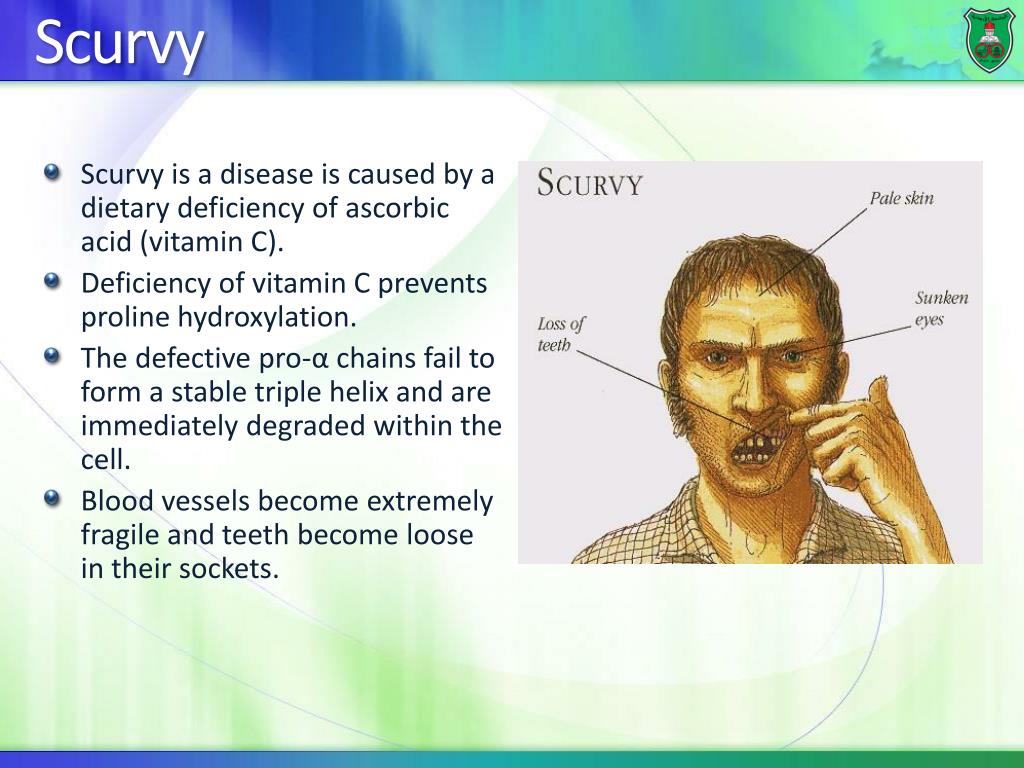
Before science showed lack of vitamin C caused scurvy, Cook required provisioning of fruit on his long voyages.
It is Cook’s observation of other mariners’ health experience that made Cook decide on food provisioning for his voyages. Sides writes Captain Cook only had a village-school education, but he had a practical maritime apprenticeship based on learning by doing as well as by observation of past sailings of other mariners.
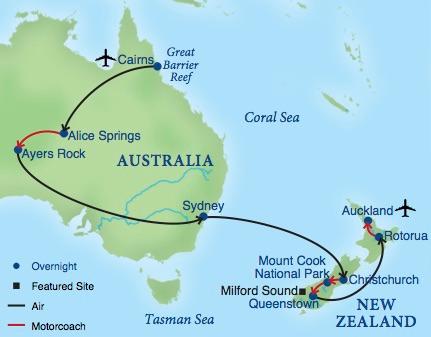
The character of Cook is somewhat revealed in the history of an earlier voyage to New Zealand in 1773.
Sadly, Sides notes Cook’s personally written logs and correspondence are stoic with little insight to his emotions. He notes Cook’s stoicism is even more difficult to pierce because his younger wife destroyed Cook’s personal letters. Nevertheless, Cook’s stern character is illustrated by Sides’ details during his voyages. There is no doubt in a listener’s mind that Cook is a highly competent leader who brooked no opposition from his crew while exhibiting a nascent understanding of the importance of native cultures. Sides shows Cook to be a keen observer of different cultures and, for the most part, avoided criticism of other societies as long as they did not interfere with the Admiralty’s commissioned objectives.
A New Zealand Māori politician, Nanaia Mahuta, serving New Zealand in 2021.
The indigenous Māori live in New Zealand today. Cook’s two ships that visited New Zealand were the Resolution and Adventure. They became separated because of bad weather. The captain of the Adventure, Tobias Furneaux arrives in New Zealand after Cook had already departed. Furneaux dispatched 10 armed men to collect fruited plants for scurvy prevention. The 10 men did not return. In searching for the men, the search party found severed body parts being eaten by dogs. A tattooed hand revealed the remains as one of the 10 men. The 10 mariners had been killed in what is called a whāngai hau ritual which is an act of consuming an enemy’s spirit by eating their flesh. Because Cook had already left, the search party interrupted the ritual and recovered some of the remains. The cause of the 10 men’s killing is unknown but the incident shaped Māori–European relations. When Cook returned, he chose not to retaliate because he did not know what caused the killings and understood the acts of the Māori were a culturally influenced event, presumably caused by something the 10 men did that threatened the indigenous New Zealand tribe. Cook chose to respect the cultural beliefs of the tribe rather than seek a revenge urged by some of his crew.
New Zealand farmland.
Having personally visited New Zealand, one appreciates one of the most beautiful places in the world, but the story of the Māori Grass Cove incident is a shocking reminder of how much civilization has changed over the centuries. One of our guides belonged to the Māori tribe.
Sides explains Cook is commissioned by the Admiralty to settle a question of the existence of a presumed unknown southern continent in the Pacific that was tentatively identified as Terra Australis. Cook’s expedition found there was no great habitable continent to the south, but he crossed the Antarctic Circle many times. Massive ice fields kept Cook from the Antarctic mainland. Anyone who has visited Antarctica knows of the Drake passage and how rough the sea can be. Having visited Antarctica clearly shows year-round habitation would be like living on the moon, i.e. possible but highly inhospitable. Cook found no habitable continents in the south seas because there are none.
Kealakekua Bay in Hawaii.
Cook’s third expedition is the first European contact with Hawaii after passing through the Bering Strait on his way through the north Pacific. Ironically, in his last voyage, he is killed in Hawaii in 1779, one year after he returned to Hawaii. He had spent a year more searching for the passage when he returned to Hawaii on his way back to England. When Cook first landed on Hawaii, he and his crew were welcomed with open arms. Cook appears like a God to many Hawaiians. Cook’s steely personality is two edged in that it made him a great leader of men on long exploratory voyages, but he brooked no insubordinate behavior. When returning to Hawaii after a year of looking for the Northwest Passage, reception by the Hawaiians was less respectful. A boat is stolen by some Hawaiians when they were anchored at Kealakekua Bay. The stolen boat is a major diplomatic and military issue because it was an important piece of the ship’s survival. Sides notes theft is not uncommon in native Hawaiian culture. Cook’s response is to attempt capture of the chief of Hawaii and hold him hostage until the boat is returned. The Hawaiians resist. A fight breaks out and Cook is struck; he falls to the ground and is stabbed and beaten to death by the Hawaiians. Four marines were killed with 17 Hawaiians that died in the confrontation. Cook’s body is ritually dismembered as is the custom of the Hawaiian culture in respecting a high-ranking enemy.
A.I. Generated picture of what Omai may have looked like.
Sides’ story is more than a recounting of historical facts. He writes several chapters about a native of the Society Islands name Omai who became a celebrity in London. Cook had brought Omai to England after his second world voyage. Omai boards the ship on Cook’s third voyage to be returned to his homeland after having lived in London for two years. The Society Islands are an archipelago in the South Pacific Ocean made up of Tahiti and four other islands.
At first, one wonders why the story of Omai is included in Side’s book. One realizes the story of Captain Cook, in broad strokes, is well known but Omai reflects on how history is shaped by those who tell a story that often obscures the complexity of past events.
The story of Omai is obscured by the big picture of Captain Cook’s momentous voyages but Omai’s story shows how cultures are widely misunderstood because of those who tell the story. Omai’s cultural influences are lost because they are interpreted through the lens of a society that sees people of other cultures as noble savages or exotics, i. e., not based on their unique experience and culture. After Omai’s experience in London, he is no longer just a Tahitian. In returning to Omai’s culture, he is a different human being. He becomes an exotic in both societies. He dies only a few years after his return to his native country.
Many cultures have influenced what Americans have become.
One comes away from “The Wide Wide Sea” thinking of today’s immigration policy and the many who have come here to only be rejected for not being born in America. America has lost its historical memory. Many people who immigrated have added their cultures to society in many positive ways that have made America great. Our ignorance and actions that contradict that truth are appalling to many. Captain Cook recognized the murder and dismemberment of ten Englishmen by the Māori was terrible, but his response respected their culture. The Māori remain an important part of New Zealand culture just as American Indians are an important part of American culture. To arbitrarily reject immigrants without due process is unjustifiable in a country made great by many different cultures.
Like being a New Zealander, Americans are made of many cultures. That is an underlying theme of Hampton Sides interesting biography of Captain Cook.
The story of McCandless’s life is that meaning in life comes from people and nature, not one or the other but both.
Books of Interest Website: chetyarbrough.blog
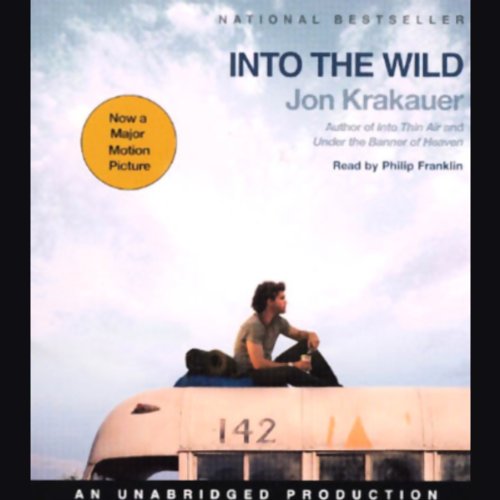
Into the Wild
Author: Jon Krakauer
Narration by: Philip Franklin
John Krakauer (Author, mountaineer, raised in Corvallis, Oregon.)
The main character in “Into the Wild”, tuned in and dropped out. His “tune in” is not to drugs but a wish to understand the meaning of life. Christopher Johnson McCandless chose, after graduating from Atlanta, Georgia’s Emory University, to live off the grid of society, i.e. particularly capitalist society. His degree is a BA in history and anthropology. McCandless chooses to drive around the country, working at dead-end jobs to sustain himself until he finds a place to live in a natural habitat, without the aid of society which he believes keeps him from understanding the meaning of life. He began a “walk about” from Georgia with a plan to explore survival in the frigid wilds of Alaska. McCandless kept a journal of his search for life’s meaning. His journal became the guiding source for Jon Krakauer’s book about McCandless’s brief life.
Christopher Johnson McCandless (1967-1992, died at the age of 24.)
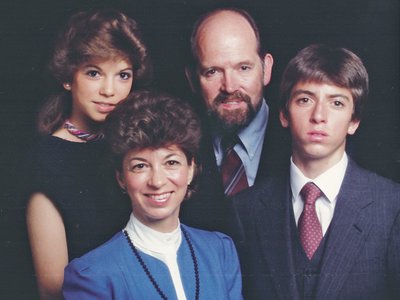
The McCandless family picture with Christopher either before or after enrollment at Emory University.
McCandless came from a solidly middleclass family but rejected capitalism defined by the desire for money, power, and/or prestige. He obviously loved the outdoors and wished to explore the possibility of living off the land with whatever nature had to offer. McCandless rebels against capitalist beliefs when graduating from college. He begins a search for the meaning of life beyond the principles of a capitalist society. He sought understanding by experiencing the attractions and dangers of the American wilderness. McCandless wishes to be free of materialism, his familial relationships, and the conventions of a middleclass capitalist life.
(One wonders if McCandless’s story is part of today’s rising homelessness with people living in tents, sleeping in business doorways and on sidewalks of American cities? Are Americans becoming disillusioned with capitalism because the gap between rich and poor is rising and pushing the middleclass into poverty? Some argue the cost of living is climbing faster than the wages of employment.)
McCandless graduation form Emory University in Atlanta Georgia.
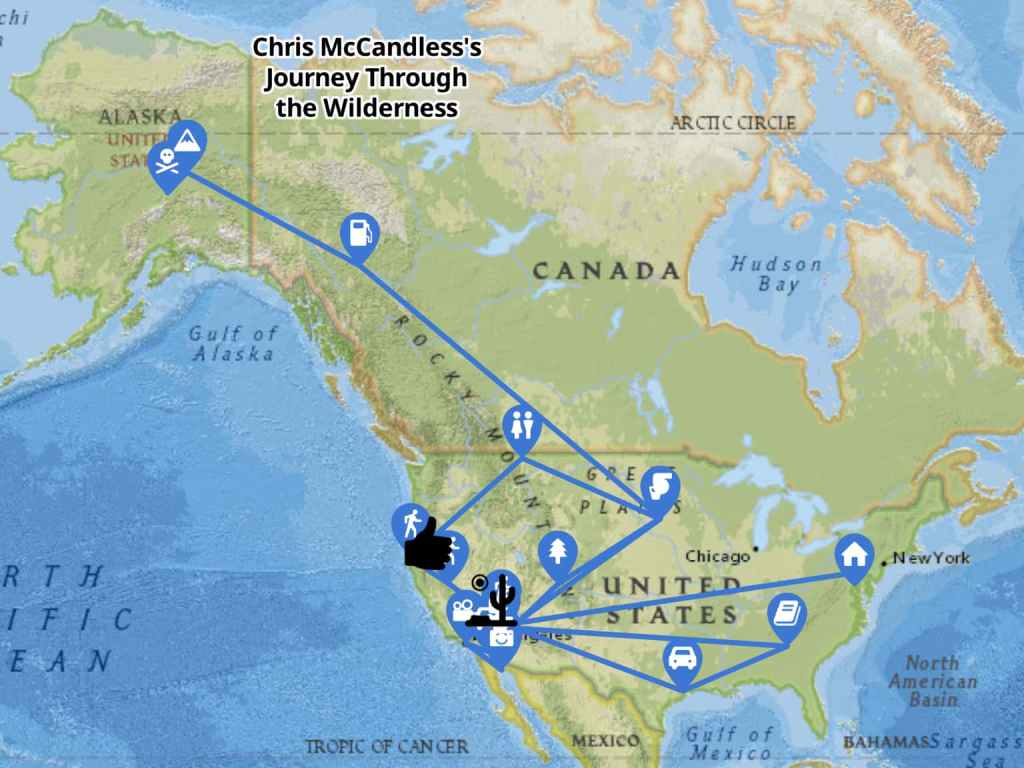
With a BA in history and anthropology, McCandless graduates from Emory in 1990 and leaves Atlanta, heading west. Rather than look for a job or extending his education, he donates his savings to charity, cuts off communication with his family, and journeys to the west in a 1982, B210, Datsun. He heads southwest, traveling to Alabama, Mississippi, Louisiana, Texas, and New Mexico. He spends some time in Arizona with odd jobs and becomes stranded when his Datsun is disabled by a flood. He hitchhikes to California via Las Vegas, goes through South Dakota with his determined destination being Alaska in 1992. Nearly two years have passed since graduating from Emory.
Map showing McCandless’s two years of travel from the East to the West, mid-West, and on to Alaska.
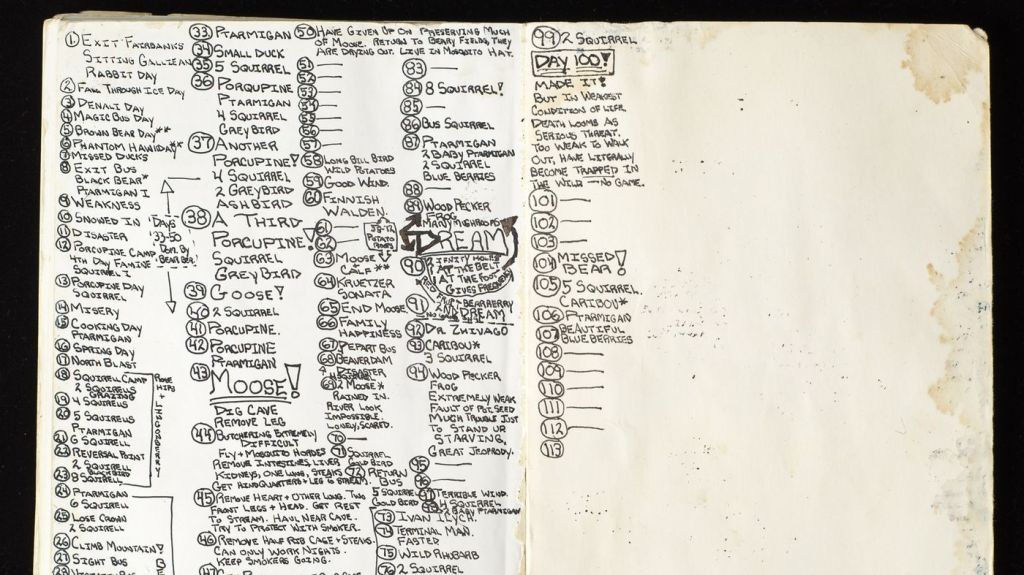
McCandless kept a journal of his travels. The author, John Krakauer, interviews some of the people McCandless meets and/or works for that are noted in his journey. All say he was a nice person and hard worker who dependably showed up for work. However, one employer noted he had to be told to take a shower and wear socks when he came to work at their fast-food restaurant. McCandless was obviously homeless and had no shower facilities in which to bathe. He reluctantly complied as best he could but soon left to find his way to Alaska.
Sample of McCandless’s journal when he called himself Alex Supertramp.
McCandless arrives in southern California. He meets an older (80 something) American named Ronald Franz, a leatherworker, who tries to convince McCandless to give up his wandering life. They become friends but McCandless leaves Franz without saying goodbye as he heads north. The importance of their relationship is shown in a letter sent to Franz by McCandless that explains his inner conflicts. McCandless explains his need for independence and the freedom it gives him to personally connect with himself. By abandoning materialism, wealth, and social expectations, McCandless believes it makes him free. The tension created by McCandless’s belief in social isolation versus human relationship is expressed in his letter to Franz. Being alone is no answer to the conflict one feels toward their family or those who are part of society. Part of one’s identity, belief in who they are, and belief in oneself is reinforced by other people, not in wilderness isolation. This is a lesson of life that McCandless refuses to see or understand. The well-known poet, John Donne, recognizes “No man is an island”. All humans are interconnected which is a truth McCandless refuses to see.
McCandless dies in a Fairbanks city Transit bus he used as a shelter in Alaska. John Krakauer speculates on the cause of death being inadvertent poisoning from eating potato seeds because of McCandless’s hunger, emaciation, and lack of nourishment. If there is meaning in life, McCandless search and isolation is in vain. The story of McCandless’s life is that meaning in life comes from people and nature, not one or the other but both.
There is a risk of pathologizing social skills if one comes away from Clayton’s book thinking that fawning is only a negative characteristic of society.
Books of Interest Website: chetyarbrough.blog
Fawning (Why the Need to Please Makes Us Lose Ourselves–and How to Find Our Way Back)
Author: Ingrid Clayton
Narration by: Ingrid Clayton
Ingrid Clayton (Author, clinical psychologist, trauma therapist)
“Fawning” as described by psychologist Ingrid Clayton can cause an unconscious trauma when a person appeases, pleases, or over-accommodates others to feel safe. Clayton explains it is a survival strategy for one who deals with another person who is physically or emotionally abusive. Clayton recalls her life as a child with a stepfather who is grooming her for an intimate relationship when she is 13 years old. Clayton manages to avoid that relationship but explains the long-term psychological impact in her life is similar to PTSD.
Post-traumatic-stress disorder is a mental health condition caused by experiences, witnesses, or traumatic events that make one feel fear, stress, or danger. Clayton notes that her life when leaving home at 17 had those symptoms. She pursues a college education, graduates, continues her education to receive a PhD and finds employment as a therapist.
Pedophilia.
At the age of 13, her male stepfather created a grooming environment that created a long-term psychological impact on her life. She matured to feel fear, stress, and danger in developing relationships with others. She wrote “Fawning” as an educated PhD clinical psychologist to explain how a child growing to an adult can “…lose themselves…” with a form of PTSD. She believes she has found a pathway back to relationship’ normality after years of broken relationships. The irony of her realization is that all human beings are “fawners”.
Some will be inclined to put Clayton’s book down as an exaggeration of relationship reality but as she tells of her personal experience and therapy of others, both men and women, her beliefs become disturbingly credible. As one examines their own life (if they have lived as long as this book reviewer) know every human being is raised in their own familial circumstances. Children raised with 1, 2, or no parent families, develop behavior toward themselves and others that can lead to abuse of others which diminish their and other’s humanity. What Clayton shows is how her stepfather grooms her and how she responds based on her own grooming ability. She rejects his advances, a grooming behavior that a parent-child relationship allows with the risk of physical sexual abuse.
There is truth in Clayton’s explanation of “Fawning” as a universal relationship modifier, but it is not always linked to either grooming or abuse. People-pleasing behavior is a universal characteristic of society.
There can be good reasons as well as bad reasons for fawning. Looking at grooming as the only lens one views fawning diminishes its social value. That is certainly not Clayton’s intent but one may come away from her book seeing pedophilia as the primary consequence of fawning. The reality is that rigid family dynamics, cultural hierarchy, and high-pressure workplaces are common examples of fawning. Social cohesion and disruption are a general consequence of human nature influenced by fawning.
Clayton outlines a pathway back from PTSD. Prevention of trauma is of course the best solution. However, if one is a child, prevention becomes more problematic.
Clayton argues it is important to recognize fawning is not a people-pleasing choice but a survival strategy. Rather than feeling fear from what appears to be happening, clearly remind yourself of who you are and what you believe to be right. Recognize other’s motives. Respond appropriately by speaking up if your personal boundaries are being violated. Reflect on who you are and interrupt any motives of others that conflict with what you believe about yourself. The weakness of this pathway seems problematic for younger children. The pathway back for a child seems likely to be after the fact.
There is a risk of pathologizing social skills if one comes away from Clayton’s book thinking that fawning is only a negative characteristic of society. Pedophilia is a terrible societal malady, but society cannot function or improve without fawning.
Sorkin’s “1929” makes one think about 20th and 21st century American Presidents who may have set a table for a second economic crisis. As the Turkish proverb says “…fish stinks first at the head.”
Books of Interest Website: chetyarbrough.blog
1929 (Inside the Greatest Crash in Wall Street History–and How It Shattered a Nation)
Author: Andrew Ross Sorkin
Narration by: Andrew Ross Sorkin
Andrew Sorkin (American author, journalist, and columnist for The New York Times.)
“1929” is a history of the build-up to the stock market crash and the advent of the depression with opinions about how today’s economy compares and what should be done to keep it from happening again. Though Sorkin is not an economist, he has written an interesting history of the build-up to the 1929 depression.
Faltering economies.
There is a sense of danger being felt by some today when reading/listening to Sorkin’s history of the 1920s. Few seem to have a clear understanding of world market forces and whether we are heading for an economic catastrophe or a mere hiccup in the growth of the economy. Neither bankers, regulators, nor politicians in the 1920s (or for that matter now) seem to have a clue about the economy’s trouble and what can be done to ameliorate risks. Like 1929, today’s insiders, power brokers, and rich have more options to protect themselves than most of the world’s population.
Increasing homelessness in America.
In America, it seems those in power have no concern about the rising gap between rich and poor or the immense increase in homelessness. Without a plan by those in power, there seems little concern about reducing inequality, the common denominator for the wealth gap and homelessness. Sorkin’s book outlines the reality of 1929 that gives reader/listeners a feel of history that may repeat itself.
Sorkin’s history seems credible as he notes human nature does not change.
Today’s leaders are like yesterday’s leaders. Not because they are venal but, like most if not all human beings, leaders in power are concerned about themselves and what there is in life that serves their personal needs and wants. Of course, the difference is that leaders that are power brokers affect others that do not have the same influence or options to protect themselves. We all have blinders that keep us from seeing the world as it is because human nature is to ask what is in it for me, i.e., whatever “it” is. The 1920s had a merger bubble in manufacturing and communication that is fed by the industrial revolution. Today, we have a merger bubble with mega-corporations like Tesla, Apple, Amazon and others that are mega-corporations capitalizing on a new revolution coming with A.I., the equivalent of the Industrial Revolution. Some critics argue mega-corporations, like what happened with the oil industry could be broken up to increase competition which is the hallmark of improved production, cost reduction, and lower consumer prices.
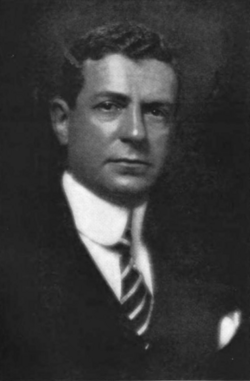
Charles E. Mitchell (American banker, led the First Nation City Bank which became Citibank.)
What makes this history interesting is Sorkin’s identification of the most responsible power brokers who bore responsibility for the stock market crash. Charles Mitchell of Nation City Bank is identified as the central driver of the stock market bubble. Mitchell denied the reality of the financial systems fragility. His ambition and unfounded optimism magnified the systemic risk of the financial crises. He openly defied the Federal Reserve’s warning to curb margin lending that risked other people’s money and their financial stability. He continued to promote purchase of stocks on credit that were fueling the stock market bubble. Mitchell appears to have misled the public in order to increase his power and protect his personal wealth by creating the illusion of market stability and his bank’s profitability. Though Mitchell is not the sole villain, he became the most powerful banker in the nation while breaking the financial backs of many Americans. In general, it is the self-interest of those who listened to him that have responsibility for their financial collapse, but it is always hard to know who is lying to you. Part of the blame is the hesitation of the Federal Reserve Board to act because the people in charge could not agree but that was more a matter of omission than commission which Mitchell was charged with but not convicted. Of course, the political leaders of that time also failed but hindsight is a lot easier than foresight.
Artificial Intelligence is today’s equivalent of the Industrial Revolution of the twentieth century.
Similar to the corporate mergers and investment from growing industrialization of the 1920s, today’s mania is mega corporation’ investment in Artificial Intelligence. Sorkin notes the ease of trading stocks, expectations of crypto investments, and A.I. hype may well move the market beyond its value. He argues for stronger guardrails on speculative investments, more limits on margin lending, and transparency on high-risk investments. He cautions easier credit as seen this Christmas season with buying based on delayed payment incentives and increasing credit card availability, card balance increases, and more liberal repayment terms. In general, Sorkin wants to see more, and better government oversight and regulation of credit offers. He believes too many lenders are overly optimistic about the future with the gap between rich and poor widening and trending to get worse. That inequality threatens the success of capitalism as a driver for shared prosperity, and economic growth.
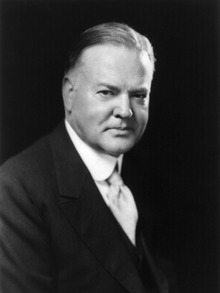
Herbert Hoover (President 1929-1933, though characterized as the primary villain for the depression, Sorkin identifies his role as one of omission rather than commission.)
The Presidents shown below carry some responsibility for where the American economy is today but that would be another book.
Sorkin’s “1929” makes one think about 20th and 21st century American Presidents who may have set a table for a second economic crisis. As the Turkish proverb says “…fish stinks first at the head.”
In the end of “The Life We Bury”, the mystery of a murderer is solved. However, the real reveal of the story is how every human being is guilty of self-absorption.
Books of Interest Website: chetyarbrough.blog
THE LIFE WE BURY (A Novel)
Author: Allen Eskens
Narration by: Zach Villa
Allen Eskens (Author, former defense attorney who lives in Minnesota.)
Reading/listening to a book is motivated by one’s ignorance, public popularity, author reputation, or subject of interest. “The Life We Bury” is similar to an earlier murder mystery by Allen Eskens. “The Life We Bury” deals with a crime but has no famous historical allusions like the mystery in “The Quiet Librarian”. However, it does have a similar theme. “The Life We Bury” is about injustice and a human desire to right what is wrong. As a popular author and an attorney by profession, both novels show Eskens intimate knowledge of the legal system and its faults.
The characters of life.
The main characters of “The Life We Bury” are Joe Talbert, a 21-year-old college student working his way through college, Carl Iverson, a Vietnam War Veteran convicted of raping and murdering a young girl, and Lila Nash, a next-door neighbor to the college student. Hardship of life is illustrated by Joe who lives 2 hours away from a younger autistic brother that lives with their mother. She is an alcoholic. Their mother’s addiction makes care of the younger brother perilous. The mother’s alcoholism and her social life often leave the autistic boy at home to fend for himself. Joe deals with his mother’s neglect as well as he can with a job as a bouncer and college student who lives two hours away from the family home.
Assisted living facility.
An assignment from college for Joe is to interview a senior citizen who is living in an assisted living facility. Joe visits a retirement community near his apartment and asks the manager if he could interview one of their elderly occupants for his college assignment. They agree and Joe meets a terminally ill resident who is staying at the care facility from a prison which could not care for “end of life” needs of an imprisoned inmate who is convicted of rape and murder of a teenage girl.
Autism.
Lila, Joe’s next-door neighbor, becomes aware of Joe’s younger brother’s autism and is drawn into their awkward lives. She goes to the same college and by happenstance has some knowledge of the American justice system which leads her to help Joe with his interview and writing assignment. With her knowledge of the justice system, Joe is able to get the police file of the convicted rapist/murderer. The file is damning but a friend of the convicted and terminally ill patient tells Joe that his interview subject would not and could not have murdered the young girl.
Influence of others on our lives.
“The Life We Bury” is a person we know from our past that we no longer know but who has had a profound influence on our lives. “The Life We Bury” are people we know but often never reconnect with for either thanks or explanation of their effect on our lives. Eskens creates a story that on the one hand reveals how ignorant we are of other people’s lives and on the other how little we realize the impact others have had on our lives.
We all have some kind of guilt.
Carl Iverson is not guilty of killing and raping a young girl for which he is convicted and imprisoned. The search for the real killer is what moves Esken’s story along, but its theme is about guilt, and our ignorance about others and ourselves. Human beings live in their own worlds and often are unable to see others with the same clarity we think we see in ourselves. Eskens shows we neither understand ourselves, the people we think we know, or what impact they have on our lives.
In the end of “The Life We Bury”, the mystery of a murderer is solved. However, the real reveal of the story is how every human being is guilty of self-absorption. The race is on to arrest and convict the guilty rapist and murderer before the death of Carl Iverson. The last chapters of Eskens’ book are a nicely written denouement of his interesting story.
In the pre-A.I. age, democratic socialism is unachievable, but A.I. may resurrect its potential. However, as Orwell noted, the risk is a “Brave New World” rather than a hoped-for democratic socialism.
GEORGE ORWELL (Author, 1903-1950)
In Norm Chomsky’ ‘s and Nathan Schneider’s book, “On Anarchy”, George Orwell’s book “Homage to Catalonia” is called one of Chomsky’s favorite books. “On Anarchy” infers Orwell believed in anarchy because of his role in the war (1936-1939) against the Franco government. Though Orwell’s risk of life in Spain’s war is inconceivable to me, it seems prudent to listen to his story and point to the significant difference between what Chomsky and Schneider infer about Orwell’s belief in “…Anarchism” and what Orwell really wrote and believed. Though Orwell takes anarchism seriously as a political working-class movement, he believes it is impractical and that democratic socialism (with “1984” reservations) is what he believes could be the best form of government. The idea of abolishing all forms of coercive authority and hierarchy with a government anarchy is impractical because of the nature of human beings.
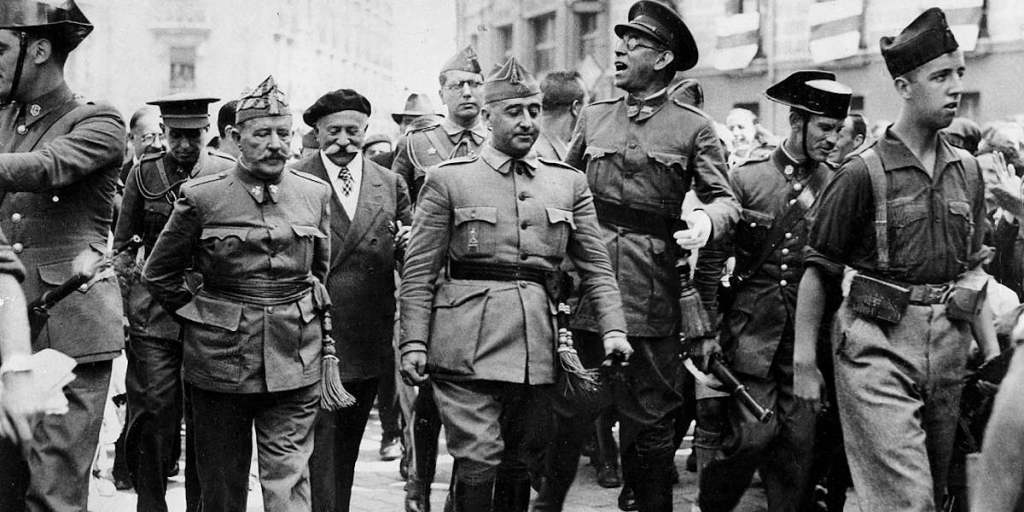
Francisco Franco with his soldiers in 1936.
Because of Orwell’s belief in democracy and equality he chooses to join the fight against Franco’s fascism. He joins the resistance at the age of 33 because of his belief in democratic socialism. He felt he needed to join the ideological struggle against Franco’s regime. It is a remarkable decision considering he is married, and relatively unknown. He is oddly driven by his moral belief in democracy and equality. Presumably, he entered the war to understand what it means to fight a war against a government he felt was immoral and totalitarian. Orwell served for approximately six months beginning in December 1936. He was shot in the throat and nearly died.
Anarchy and human nature.
It seems inconceivable that anarchism is a reasonable way of governing human nature. It is interesting to contrast what Orwell believes and what anarchists argue. This is particularly relevant in the 21st century because of the inevitable change in society that is occurring with artificial intelligence. A.I. has an immense potential for creating Huxley’s “Brave New World”. However, his writings reject the ideal of “Anarchy” espoused by Chomsky and Schneider because of its impracticality. Huxley shows that human nature contains both heroism and weakness tied to the material world. Even though human nature is basically decent, it is easily corrupted. That corruption makes humans hope and fear human decisions designed by consensus. It is not to say democratic socialism would be infallible, but it offers a structure for regulation of different governments at chosen intervals of time.
Human nature will not change. Human nature is a set of relatively stable psychological, biological, and social tendencies that are shared by all human beings. These tendencies shape how humans think, feel, and act even as culture and governance changes. Artificial intelligence will only intensify the strengths and weaknesses of human nature. The principles of anarchy in an A.I. world is frightening:
No centralized government, police, or standing armies.
Society organized through federations of communes, cooperatives, or councils.
Emphasis on direct democracy, mutual aid, and local autonomy.
Suspicion of any coercive authority — even democratic majorities.
Change often imagined as revolutionary, not incremental.
A more rational alternative to Anarchy is Democratic Socialism believed by Orwell and espoused by MLK.
The state remains, but becomes more egalitarian and accountable.
Markets may still exist, but are regulated or supplemented by public ownership.
Political parties and electoral competition are central.
Emphasis on universal programs: healthcare, education, housing, worker protections.
Change is gradual, through reforms, not revolution.
Differences of opinion.
There are obvious differences between Chomsky’s and Orwell’s beliefs. Both have social weaknesses. Human nature gets in the way of both forms of governance. Orwell seems to have recognized the weaknesses of his belief in democratic socialism in his writing of “Brave New World”. In contrast, Chomsky’s and Schneider’s pollyannish view of anarchy as “…a better form of government where power is decentralized and citizens can and should collectively manage their own affairs through direct democracy and cooperative organizations” is absurd. The difference is that Huxley foresees the dangers of his idea in “Brave New World” which anticipates something like A.I. that has the potential for society’s destruction. “On Anarchy” ignores the truth of human nature, “Brave New World” does not.
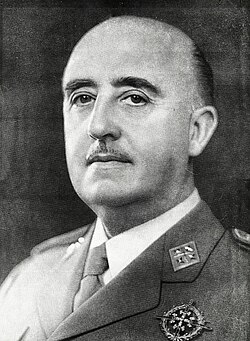
Franciso Franco (1936-1975, died in office.)
Orwell’s decision to join opposition to Franco’s dictatorship fails. Their right-wing beliefs in authoritarianism, anti-communism, and pro-Catholicism prevails. Spain’s 1930s opposition leaders (Manuel Azaña, Largo Caballero, and Juan Negrín) were pro-democracy with anti-fascist, socialists, communists, anarchists, trade unions, urban workers, and peasants who Orwell joined to support democratic socialism, not anarchy.
In the pre-A.I. age, democratic socialism is unachievable, but A.I. may resurrect its potential. However, it is the risk of a “Brave New World” or “1984” rather than a hoped-for democratic socialism.
Like America’s Civil War and the issues of slavery and independence, peace will only come to Israel with a political and territorial agreement based on human equality.
Books of Interest Website: chetyarbrough.blog
BEING JEWISH AFTER THE DESTRUCTION OF GAZA (A Reckoning)
Author: Peter Beinart
Narration by: Malcolm Gladwell
Peter Beinart (Author, journalist, political commentator, professor, former editor of the New Republic, born in Cambridge, Mass. to Jewish immigrants from S. Africa.)
This is a surprising Jewish author’s analysis of Israel’s response to the horror of Hamas’ murders/rapes of 1200 people and the taking of 251 Jewish hostages on October 7, 2023. Peter Beinart appears to be a devout Jew and journalist who criticizes Israel’s response to Hamas’s brutal attack and hostage taking. He believes, as current news reports confirm, Hamas will return to control and influence Gaza and West Bank Palestinians after Israel’s brutal response to the Hamas’ atrocity.
NYT’s Picture of Grief over the Hamas attack on October 7th, 2023.
Without reservation, Beinart condemns Hamas for their war crime on October 7th. However, his book equally condemns Netanyahu’s response. Beinart points to the Israeli government’s destruction, murder, and starvation of thousands of Palestinian men, women, and children who had nothing to do with the planning or execution of the Hamas horror of October 7th. The author argues Israel must focus on a political, non-military solution to Palestinian human rights. He believes Netanyahu’s actions only perpetuate a cycle of violence in Israel which will not achieve security for either the Israeli or Palestinian people.
One wonders how unpopular Beinart’s opinion may be among Israel’s Jewish population. As a blogger who received written comments from a devout Jewish person who supports Trump and Netanyahu’s actions in Israel, it is surprising to hear Beinart’s analysis of the Gaza war and his criticism of Israel’s actions. As the reviewer of this book who admittedly has little respect for religion and its history of atrocities, it is encouraging to hear from one who believes in their religion and condemns those who have no empathy for other religions. God is a universal concept with religions that worship His existence in different ways. Beinart makes one wonder why there is so little room for a “let it be” attitude toward different religious beliefs.
Empathy.
Beinart argues for Jewish empathy toward Palestinians while condemning Hamas’ actions in Israel. He believes long-term peace requires political compromise and a recognition of Palestinian rights. Military actions only guarantee rather than deter future violence and injustice. Beinart’s plan is to end Israeli’ occupation of Gaza and expand the rights of Palestinians to control Gaza and the West Bank. He argues it can be either a one-state or two-state solution. Beinart argues ground invasion by Israel in Gaza must stop. He recommends forthrightly engaging the humanitarian crises in Gaza by providing aid and rebuilding what has been destroyed.
Pursuit of peace is not easy.
None of this is easy because of the enmity that remains. The complications of political opposition, and security are ongoing concerns for Israelites and Palestinians, but Beinart believes the risks of a negotiated political, religious, and territorial settlement is worth it. Human equality is a work in progress for all nations in the world. Beinart persuasively argues a political and territorial agreement between Palestinians and Israelites is the only possible path to peace. Like America’s Civil War and the issues of slavery and independence, peace will only come to Israel with a political and territorial agreement based on human equality. Of course, the drive for equality remains a work in progress for America. That will be true in Israel for generations to come, but peace can be restored with pursuit of equality for Palestinians and Jews.
“The Silent Patient” deserves its popularity. The ending is a surprise and offers a credible picture of how extreme human behavior comes from both nature and nurture.
Books of Interest Website: chetyarbrough.blog
THE SILENT PATIENT
Author: Alex Michaelides
Narration by: Jack Hawkins & 1 more
Alex Michaelides (Author, British-Cypriot writer, won the Goodreads Choice Award for “The Silent Patient”, studied psychotherapy, and worked at a mental health clinic.)
Michaelides wrote a clever mystery about a 33-year-old wife named Alicia Berenson who is accused, convicted, and committed to an asylum for shooting her husband in the face with his own rifle. Alicia becomes “The Silent Patient”. She is arrested by the police with blood on her clothes in a non-speaking catatonic state. A psychotherapist, Theo Faber, is hired by the asylum and becomes interested in Alicia’s silence. On the one hand, it reminds him of his troubled childhood and a reaction to his wife’s infidelity in his own life. On the other, there is an undisclosed reason for his interest in Berenson’s silence and her judicial’ commitment to an asylum. “The Silent Patient” implies infidelity is in the nature of all human beings but that it can lead to violence and, in extraordinary circumstances, murder.
Michaelides infers infidelity is an inherent quality of all human beings.
Maybe infidelity is because of human nature’s intent to preserve itself but the consequences of, when experienced personally, can lead to mayhem. The primary characters of “The Silent Patient” are Alicia Berenson, a 33-year-old painter accused of murdering her husband–Theo Faber, a psychotherapist who tells the story of Alicia’s life–and Alicia’s husband who appears to love his wife but chooses to have a passionate extramarital affair. In the course of Theo’s story, he writes about infidelity of his own wife and his response to her betrayal.
Who shot Alicia’s husband?
The principle mysteries are revealed at the end of Michaelides’ book. Who murdered Alicia’s husband and how infidelity affects humanity are primary subjects of “The Silent Patient”. The cleverness of the story is in its twists and turns and the truth it reveals about human nature. We grow up to be adults from parents who create us while instilling all the contradictions of life that no child, who becomes an adult, escapes. Every human being and all societies are flawed. Societies and individuals pass on both the good and bad qualities of life to their children.
Coming to grips with infidelity is different for every child grown to adulthood.
A younger person who falls in love with another sometimes searches for someone to live with through the experiences of their future lives. Those who choose to be together bring their own life experiences to the relationship that may or may not be the same. It seems those life experiences that are similar are likely to preserve a relationship while those that are different cause conflicts. Michaelides shows how those conflicts, as well as the nature of human beings, can lead to destructive human behavior.
“The Silent Patient” deserves its popularity. The ending is a surprise and offers a credible picture of how extreme human behavior comes from both nature and nurture.
The broad theme of Flournoy’s story implies being an identifiable minority means navigating social discrimination, gender difference, and physical violence in America.
Books of Interest Website: chetyarbrough.blog
THE WILDERNESS (A Novel)
Author: Angela Flournoy
Narration by: Angela Flournoy & 2 more
Angela Flournoy (Author, American writer won the First Novelist Award for “The Turner House” in 2015 and was shortlisted for the National Book Award for fiction.)
As a white person, “The Wilderness” offers a glimpse of what it is like to be a Black American woman in the prime of her life in today’s America. Flournoy creates a story of five adult Black women in their twenties in the years from 2000 though 2022. She reflects on their irreverent and tumultuous lives that show how friendships grow and fall apart between young Black Americans who are underestimated and face societal inequality. The friendships of these five women are a kind of bulwark against the experience of living in America as a racial minority.
American life.
Everyone faces challenges living in America, but friendship seems less important to white Americans because they are a majority of the population with assumed privilege that depends less on friendship than on economic opportunity. White American economic opportunity is taken for granted. A white listener/reader’s interest may make Flournoy’s story less interesting because it is singularly based on a minority. One might make the mistake of returning Flournoy’s story, rather than sticking with it, because it is different from its reader/listener’s life. Flournoy offers a view of life seen through the eyes of a person who lives as a minority in a white majority.
Friendship of women.
Desiree’s, Danielle’s, Monique’s, Nakia’s, and January’s stories are of 5 twenty something, well educated, Black American women and their lives through 20 years of friendship. Their friendship is a bulwark against the harshness of American life. Friendship is characterized as it is, i.e. not as smooth and unchanging but on again, off again, and renewable based on common experiences of being Black in America. Flournoy shows how these five friends balance their ambitions and relationships in a society that often gets in the way of their drive for economic success and/or happiness. When faced with discrimination, their friendships becomes an island of consolation. This island is not necessarily peaceful because of their different lives and personal circumstances, but it is a refuge from American discrimination.
Added to American police discrimination toward minorities is gender violence which is a problem for both white and Black American women.
Violence is endemic in America, but racism and inequality underlie greater vulnerability for Black Americans. Too many assumptions are made by police who racially profile Black Americans without justification. That profiling leads to unjustified police brutality based on the color of one’s skin. Sexual relationships may seem “ok” to an outside observer, but Flournoy shows it sometimes hides the reality of physical or psychological abuse between mated partners. January’s story is an example of coercion, instability, and harm that can occur in an intimate relationship.
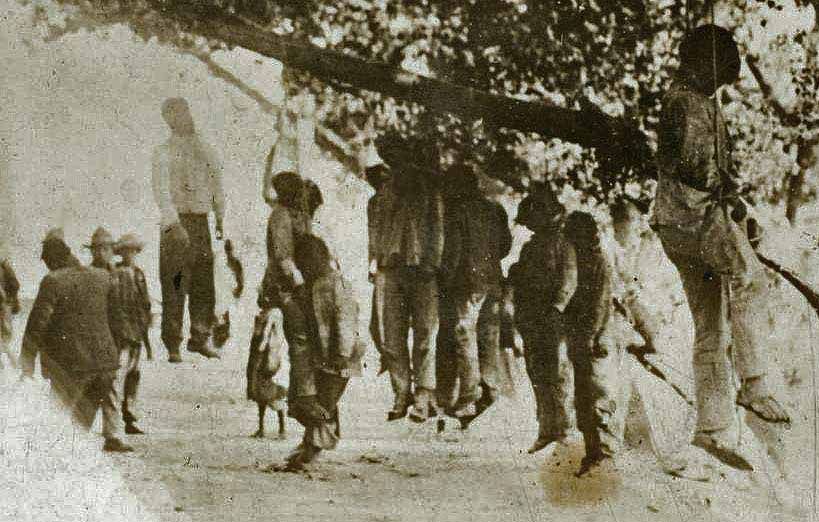
The depth and horror of discrimination in American history.
The broad theme of Flournoy’s story implies being an identifiable minority means navigating social discrimination, gender difference, and physical violence in America. Flournoy’s opinion is that friendship is the bulwark upon which Black women protect themselves. The reality of Flournoy’s story is that social discrimination, gender difference, and violence exist in every country of the world. The way people deal with discrimination, gender difference, and violence ranges from adaptation, reluctant acceptance, or revolt. Her point is important, but her story is too long.



























































 REVIEWS AND VIEWS OF LIFE