EDUCATION’S BOUNTY

Ibram Kendi’s book is about Malcolm X’s transformation from a poorly educated Black youth to man of erudition and importance–a remarkable tribute to the equality of all human beings.

Books of Interest
 Website: chetyarbrough.blog

Malcolm Lives! (The Official Biography of Malcolm X for Young Listeners)

Author: Ibram X. Kendi

Narrated By:  Ibram X. Kendi

Ibram X. Kendi (Author, American professor and historian of race at State University of New York.)

Though Kendi’s book does not have the erudition of Manning Marable’s “Malcolm X”, his book reveals much more about Malcolm Littles’ challenging childhood and his pilgrimage to Pano-Africanism, global human rights, and belief in Sunni Islamism. The Sunni belief in community and the scholarship of study, along with the rough early experience of Malcolm Little’s life, changes him and, to a degree, America’s racist belief in human inequality.

Malcolm X (born Malcolm Little, 1925-1965, human rights activist.)

Kendi's book is about Malcolm's transformation from an uneducated Black youth to man of erudition and importance is a remarkable tribute to the equality of all human beings.

Kendi explains how Malcolm Little was an uneducated hoodlum when young. Manning Marable shows how insightful and intelligent Malcolm became as a man. A listener/reader of “Malcolm Lives!” gives listener/readers a glimpse of how great they can be if they put their minds and hearts into a life that can make a difference in flawed society. Little becomes self-educated by reading and adopting a belief in something greater than himself.

In some ways, Malcolm is aided by his innate ability to separate the kindness of people he knew from the ignorance of their prejudice.

Interestingly, it is a helpful teacher that changes the direction of Malcolm’s life by encouraging him to be a part of society. On the other hand, this early teacher discourages Malcolm from becoming a Lawyer because he believed the color of Malcolm’s skin would get in his way. Malcolm learned lessons of self-reliance and independence that diminished his regard for the help of a teacher he formally admired. Kendi explains this is just the beginning of Malcolm’s life that evolves from hoodlumism to caring about society that is riven with inequality, but capable of change. Kendi explains how Malcolm’s life exemplifies that capability.

Malcom Little’s life begins in 1925 in Omaha, Nebraska. This is a time in America when the Ku Klux Klan is at its greatest strength.

Malcolm is in the eighth grade experiencing disillusionment from a teacher he respected. He drops out of school and learns how to live off the land by working minimum wage jobs. The work is at night clubs and pool halls that feed his hunger for excitement while growing angrier and angrier about a world of injustice. He covets a white girlfriend who is seduced by his charm but lets him down when she rats him out for house robberies while she and two girlfriends are parties to the crimes. Little is sentenced to eight years in prison for the crime. The lesson he learns from that experience is that friendliness is no protection from the ignorance of prejudice.

John Elton Bembry (aka Bimbi, an inmate who befriended Malcolm and encouraged him to read and educate himself while serving his sentence.)

The irony of Little’s imprisonment is that the teacher he needed when young came in the guise of a fellow prisoner who is recognized by others as someone who commanded respect because of his book learning, intellect, and eloquence. His name was John Elton Bembry, aka “Bimbi”. Bimbi’s leadership by example and eloquence led Little back to what was seen by his early teacher, the capability of a young man willing to work hard to better himself. Little began re-educating himself by reading books from the prison library. Soon after, one of Little’s brothers introduces him to the Nation of Islam.

Elijah Muhammad (1897-1975, American religious leader and self-proclaimed Messenger of Allah)

Kendi reveals the spotty history of the founding of NOI, which ultimately leads to Little’s break with NOI and his adoption of the Sunni faith. Though religion means nothing to some, Little’s adoption of Sunni beliefs and his self-education through reading and travel (when released from prison) changes his life. NOI gave Malcom purpose and discipline while in prison because it reinforced his belief in Black pride and self-reliance. However, the rigidity of its teaching of Black separatism and the personal conduct of its leader, Elijah Muhammad, who fathered children out of wedlock, alienated Little. In 1964, Malcolm went on a pilgrimage to Mecca. He found Muslims of all races praying together. The universality of Sunni Islam showed the narrowness of NOI’s view of society.

This is the capture of the NOI follower who is convicted of Malcolm X’s assassination. He is paroled after serving 45 years in a prison cell.

In the last chapters of Kendi’s book there is mention of the establishment of the nation of Israel and the resistance of Palestinian’ Muslim followers to the taking of land for the formation of Israel. The land that became Israel and Gaza were occupied by an early ethnic group known as the Canaanites. Many Palestinians and Israelites descended from the Canaanites. What some may argue is that people of the Jewish faith were first to create a religious force and formal government in the holy lands of Jerusalem. In Malcolm X’s opinion, the rights of the Palestinian people were being violated in the same way as Blacks in America. Whether that is fair judgement remains a question.

Without hegemonic control by the Palestinian leadership of disputed holy lands, no Palestinian State could be created. Today–Jews, Palestinians, and the world are paying a price for that disagreement.

An argument can be made that in ancient times Jews chose to create a form of government in Jerusalem while Palestinians did not. The same is true today. Yassa Arafat and his followers refused an opportunity to create a separate Palestinian State. Arafat would not agree because of conflicts over full sovereignty over holy lands that were disputed by both Jews and Palestinians.

Kendi ends his book with a story about NOI and Malcom X’s assassination. Malcolm had split from NOI and formed his own movement. The fact that members of NOI were involved in the murder of Malcolm X seems damning. However, Kendi’s book is about Malcolm X’s transformation from a poorly educated Black youth to man of erudition and importance–a remarkable tribute to the equality of all human beings.

FEAR & TREMBLING

America made many mistakes after the 9/11 terrorist attack. One hope’s Israel does not make the same mistakes after the 10/7/23 atrocity. Most Americans’ hearts go out to Israel despite fear and trembling for the world’s future.

Books of Interest
 Website: chetyarbrough.blog

On Democracies and Death Cults (Israel and the Future of Civilization)

Author: Douglas Murray

Narrated By:  Douglas Murray

Douglas Murray (Author, Bristish political commentator, cultural critic, and journalist.)

“On Democracies…” is an important book because it offers perspective on what happened in Gaza on October 7, 2023, and the aftermath that leads to the bombing of Iran by Israel. In that October day, over 1,200 Israelis were killed including civilians, children, and elderly people. At least 251 hostages were taken. Photos of the aftermath show multiple signs of sexual assault. A woman survivor reports seeing Hamas fighters gang rape a woman before the last of her attackers shoots her in the head. The terror and destruction of the attack is as horrible as one can imagine. It reminds one of men and women jumping out of windows at the New York World Trade Center on 9/11.

As one listens to Murray’s book, one begins to understand why Israel is responding to the October 7th atrocity by attacking Gaza and bombing Iran.

Murray explains the idea of a proportional “tit for tat” response is absurd. Does a rational person expect Israel would respond to the Gaza atrocity by killing and/or raping 1,200 men, women, and children. What is not understood by many is that Israel recognizes October 7th as an attack on its existence as a nation. It is the same concern Ukrainians have in their war with Russia. The fundamental issue is sovereignty, not revenge.

Like Osama bin Laden on his 9/11/01 attack on America, Yahya Ibrahim Hassan Sinwar, organized the massacre of 10/7/23. Both men were stateless terrorists who believed the U. S. and Isreal had no right to exist. Neither terrorist had an interest in the hard work of creating their own nation but only in destroying another. In the early days of the establishment of Israel, there was a drive to create an independent Palestinian state. Both Palestinian leaders and Arab states rejected proposals for a Palestinian state. In contrast, Israel chose to accept an opportunity to become an independent state in 1948. With the leadership of David Ben-Gurion, Israel declared independence and began the hard work of creating a nation. With a beginning population of 806,000, Israel grew to a prosperous nation of 9.7 million with over 73% being Jewish and the remainder being Arab or other nationalities. One must ask oneself, why have the Palestinians not taken the same path as Israel?

Murray makes one understand Israel is fighting for their lives to remain an independent nation.

It is the same fight Ukraine is waging. The bombing of Iran is based on Israel’s belief that Iran has supported Hamas throughout their terrorist war against Israel. Without honest recognition of Israel’s right to be an independent nation, there can be no peace. The continuing massacre in Gaza is a terrible consequence of the destructive intent of Hamas leadership that wishes to destroy Israel.

The sad realization coming from Murray’s book is that Palestinians and their supporters are not willing to do the hard work of creating an independent nation. The time may be past for that to ever occur because Israel is unlikely to agree to another neighboring nation being hostile to Israel’s existence.

America made many mistakes after the 9/11 terrorist attack. One hope’s Israel does not make the same mistakes after the 10/7/23 atrocity. Most Americans’ hearts go out to Israel despite fear and trembling for the world’s future.

INNOVATION

Steven Johnson notes how innovations and societal change does not come from a singular genius. Innovation and social change come from a confluence of geniuses, managers, and consumers.

Books of Interest
 Website: chetyarbrough.blog

How We Got to Now (Six Innovations That Made the Modern World)

Author: Steven Johnson

Narrated By:  George Newbern

Steven Johnson (Author, journalist)

Steven Johnson has written a moderately interesting book about innovation. He writes of six discoveries that came from the experience of everyday life. Glass, temperature, sound, health, time, and light are taken for granted in the 21st century. What Johnson explains is how these six elements were the basis of extraordinary human innovation and change in society.

Barovier Art Deco Murano glass pendant.

Glass has been around for centuries with the earliest found in Ancient Egypt. The heat of desert sands created glass in the form of beads that became jewelry in pre-Christian times. As the world industrialized, glass gathered new uses. Glass became mirrors to reflect human images, lenses for glasses, windows, and structural components of buildings. From the art of 15th-century to Leeuwenhoek’s creation of microscopes to Galileo’s telescopes to strengthening and lightening of high-rise construction materials to invention of fiber-optic cables, glass changed society.

Willis Carrier (1876-1950, designed the first modern air conditioning system in 1902.)

The benefit of cold temperatures helped preserve food and led to wider exploration of the world to avoid the cold. In warmer climates, experience of food preservation and human shelter from heat incentivized society to invent refrigeration for food and air conditioning for buildings. Public health and food safety improved with refrigeration. The cold preserved blood for future medical use and food for later consumption. The value of extreme cold led to cryogenics that aided fertility treatments by freezing sperm, eggs, and embryos for long term biological storage.

Heddy Lamarr (1914-2000, Hollywood star who patented a radio signal device that could change frequencies for secret messages during WWII.)

Johnson explains how sound innovation led to everything from the phonograph to sonar to coded messages during the war years. During WWII, secret communications between military strategists were critical. The often-recalled code breaking story of Alan Turing and the Enigma machine was a breakthrough for Allies to read German secrets. Interestingly, the famous actress, Heddy Lamarr patented a radio signal device for Allied powers’ secret communications.

As cities formed and people congregated in closer proximity, innovations in sanitation, water, and air purification grew to improve public health.

Johnson notes how light innovation grew from candles to light bulbs to lasers that changed the way humans can communicate and live after dark. Thomas Edison and the invention of the light bulb required the management skill of many to spread light around the world.

Thomas Edison (1847-1931)

An innovator’s timing makes a difference because the lack of a consumer can delay change like it did with Charles Babbage and Ada Lovelace in their 1837 concept of a general-purpose computer.

Ada Lovelace, the daughter of Lord Bryon, becomes the first computer software programmer in history. This was nearly 100 years before computer programing became important.

To improve human productivity, time became important. Precise timekeeping improved productivity, navigation, industrialization, and global coordination.

Johnson notes how innovations and societal change does not come from a singular genius. Innovation and social change come from a confluence of geniuses, managers, and consumers. He suggests Barovier, Leeuwenhoek, Galilei, Tudor, Carrier, and Lamarr were geniuses in their innovative ideas about glass, cold, and sound but it is a confluence of ideas, accidents, collaborations, and market desire that made them successful. The same may be said of Edison with light, Jobs with computers, and Musk with electric vehicles.

THEORY & TRUTH

Without a doubt, Einstein was the premier scientist of the 20th century just as Newton was of the 17th. Though their characters were quite different, their thoughts and contributions to the physics of life on earth and in the universe remain world changing.

Books of Interest
 Website: chetyarbrough.blog

The Perfect Theory (A Century of Geniuses and the Battle over General Relativity)

Author: Pedro G. Ferreira

Narrated By:  Sean Runnette

Pedro Ferreira (Anglo-Portuguese cosmologist, professor at the University of Oxford with expertise as theoretical cosmologist and astrophysicist.)

“The Perfect Theory” is a history of physics that revolves around Albert Einstein’s brilliant discoveries in the early 20th century. Einstein believed in general relativity that included gravity and acceleration which he argued is caused by the curvature of spacetime. Einstein implies the equality of mass and energy is a precursor to the proof of general relativity. Ferreira argues that post twentieth century physics’ theories have only contrasted and expanded Einstein’s first discovery of the equivalence of energy and mass, which is a part of a “…Perfect Theory”. Einstein’s theory seems perfect in the sense that it is a foundational theory from which most discoveries about physics have been based. This seems hyperbolic with the experimental proof of Quantum Dynamics (a science theory describing the behavior of particles at atomic and subatomic scales), but the idea of a Quantum world seems only a tentative expansion, rather than refutation of Einstein’s “…Perfect Theory”.

What Ferreira shows is how Einstein‘s general theory of relativity shaped modern theories of cosmology.

Though Einstein believed the universe was an eternal existence, that never expanded or contracted, he had to create a cosmological constant to make that theory work. He began moving away from that belief in the 1930s. Edwin Hubble’s theory of an expanding universe led to the “Big Bang Theory” that turned what Einstein suggested was a vindication of his discomfort with the idea of arbitrarily devising a cosmological constant to make his vision of the universe work. (Interestingly, Einstein remained skeptical of the Big Bang model of the universe’s creation when its expansion was proven.) Edwin Hubble proved through observation and calculation that the universe was expanding rather than static. Later science discovery of “dark energy” is thought to be the engine for expansion which ironically revives the theory of Einstein’s cosmological constant.

Edwin Hubble (1889-1953, American astronomer.)

John Wheeler and Roger Penrose in the 1960s confirmed the existence of black holes based on Einstein’s concept of regions of the universe that would have such strong gravity pull that nothing could escape its attractive force. The belief that nothing could escape was challenged by Stephen Hawking who argued that black holes emit radiation and eventually evaporate. Nevertheless, it is Einstein’s early work that initiated further investigation and theory modification.

Einstein predicted gravitational waves that were not confirmed until 2015 by LIGO’s (Laser Interferometer Gravitational-Wave Observatory) detection. Einstein had predicted gravitational wave existence in 1916 but was uncertain whether they were physically real or just mathematical affects based on his thought experiments about massive accelerating objects, like orbiting planets.

LIGO (Located @ Hanford in the Tri-Cities of Richland, Kennewick, and Pasco in Washington State.)

Ferreira’s book explains how important Einstein’s legacy is in today’s understanding of the Universe, its creation, and possible future.

The most significant curve ball thrown at Einstein’s “…Perfect Theory” of the universe is Quantum Mechanics. Though he grudgingly acknowledged the experimental proof of Quantum Entanglement, he remained skeptical of quantum mechanics and its philosophical implications. The proven predictions of quantum mechanics shake the foundation of what Einstein believed about the universe. Quantum mechanics suggests the universe’s existence, whether it began with a Big Bang or not, is a matter of probability, not predictable certainty. Einstein’s theories were based on a belief in a clockwork universe–where cause and effect would explain everything about the physics of existence.

Though Einstein did not believe in a personal God, he believed in order, harmony, and rationality in a world that has a cause for every effect.

Twenty first century physics’ research owes more to Einstein than any other scientist in history. It is not that Einstein was or is infallible, but his theories are the foundation of physics research. His idea of a static universe may have been wrong, but the story of dark energy makes one wonder if his cosmological constant might have been right. Einstein was skeptical of the Big Bang theory as the origin of the universe despite it being the belief of most scientists today. Though he resisted quantum mechanics unpredictability, he acknowledged its experimental proofs with the caveat that there is an undiscovered law that will return predictability to the physics’ world. What Pedro Ferreira credibly argues is that Albert Einstein provided “The Perfect Theory” to explore truth and falsehood of the physics of the universe.

Without a doubt, Einstein was the premier scientist of the 20th century just as Newton was of the 17th. Though their characters were quite different, their thoughts and contributions to the physics of life on earth and in the universe remain world changing.

MADNESS

Whether one is of a particular gender, good looking, unattractive, fat, thin, so on and so on, is superfluous. What is not different is we are all human. Murray infers that if leaders can keep humanness in mind, equality is the only thing that matters.

Books of Interest
 Website: chetyarbrough.blog

The Madness of Crowds (Gender, Race and Identity)

Author: Douglas Murray

Narrated By:  Douglas Murray

Douglas Murray (Author, Bristish political commentator, cultural critic, and journalist.)

All humans deserve equal treatment, rights, and opportunities. No known form of government achieves that ideal. Douglas Murray shows liberal and social democracies show concern about equality, while other forms of government don’t seem to care. What Murray argues is that western nations and educational institutions are not doing enough and what they are doing is maddeningly ineffectual.

Initially, Murray writes about gay rights which are not top of mind for many listener/readers.

However, the point is that sexual preference is a human right that harkens back to the age of ancient Mesopotamia (2000 BCE) and Greece (300 BCE). Mesopotamian law treated marriage as a legal contract. Men were allowed to have secondary wives or concubines with legal codes regulating inheritance rights. Women then, as now, were treated unequally. In Mesopotamia, marriage was tied to economic, social, and legal agreements to ensure social stability through male control. Interestingly, women had some legal rights in Mesopotamia while Greece was more patriarchal with limited legal independence for women. Mesopotamia artwork shows same-sex relationships existed, but contractual agreements in marriage were only for heterosexual relations.

In Plato’s time, legal codes in marriage were less important but social stability and male domination remained in both jurisdictions.

Ancient Greek history shows same-sex relationships were widely accepted but without any legal recognition like that required in heterosexual marriages. Same sex relationships go back to the beginnings of pictographic and written history. So, why is there so much Sturm and Drang about same sex relationships?

American democracy began a civil war in 1865 over the issue of slavery.

American democracy began a civil war in 1865 over the issue of slavery, passed the 14th Amendment in 1868 to provide equal protection for all, passed a Civil Rights Act in 1964 prohibiting discrimination based on race, color, religion, sex, or national origin, passed the Voting Rights Act in 1965, passed the Americans with Disabilities Act in 1990, and the Marriage Equality Act in 2015. Despite all of this history, in 2025, America continues to discriminate against same sex relationships and often violates the aforementioned laws. If a male or female wishes to have sex with a consenting person of the same sex, why should any American care? America has fought and died over equal rights for all Americans. It is maddening to keep reading about Democracies continuing violation of equal rights.

Murray offers numerous examples of protest in western society that reinforce his argument about the madness of crowds.

He reflects on Ivy League colleges like Yale and a small liberal arts college in Olympia, Washington where a crowd of students caused resignations of their professors. In 2015, a Yale faculty member questioned the university’s stance on culturally sensitive Halloween costumes. A crowd of students accused the faculty of failing to create a “safe space” because their professor raised the issue of identity as culturally insensitive. He and his wife who were professors at Yale chose to resign. In 2017, a professor objected to a campus event at Evergreen College in Olympia, Washington. White students and faculty were asked to leave for a day to highlight racial issues. The student protest against the professor for a “day off” event became a threat to his safety. He resigned. Murray’s point is that public discourse is increasingly driven by emotional reactions rather than reasoned debate.

Murray touches on the negative consequence of technology on the growing “…Madness of Crowds”. More than ever, the reach and size of crowds who object to human equality can spread social chaos. America experienced the power of technology with the attack on the Capitol on January 6, 2021.

The re-election of Donald Trump is a harbinger of a future where the emotion of crowds who have the right to vote is magnified by media paid for by the richest people in America.

Murray touches on the negative consequence of technology on the growing "...Madness of Crowds". More than ever, the reach and size of crowds who object to human equality can spread social chaos. America experienced the power of technology with the attack on the Capitol on January 6, 2021.

Emotions of crowd-think distort the difficult and personal trials of people with gender dysphoria.

The myth of Tiresias embodies the truth that humans are different but equal.

Tiresias is a figure in Greek mythology that was punished by Hera, the wife of Zeus, to be turned into a woman after he struck two mating snakes. He remained a woman for seven years when he was changed back into a man by Zeus. Zeus and Hera debated on whether experience of sex as a man or woman was more pleasurable. Tiresias agreed with Zeus who believed women experienced greater pleasure and Hera struck him blind for siding with Zeus. The debate goes on with Murray noting it occurs in crowd emotion that refuses to deal with the facts of gender dysphoria. One thinks of the many people that struggle with gender identity and how difficult it must be to live life with one’s own confusion, let alone the stupidity of people’s emotional reactions.

And then there is the issue of race.

Nearly 50% of the world is classified as Caucasoid with the remainder of three racial categories being no more than 33.5%. Unique physical characteristics of race are hair color and texture, facial features, average height, eye color, blood type, and skin color. Of course, there are differences beyond these features within each racial group. Whether one is of a particular gender, good looking, unattractive, fat, thin, so on and so on, is superfluous. What is not different is we are all human. Murray infers that if leaders can keep humanness in mind, equality is the only thing that matters.

INTELLIGENCE

Viskontas believes technology is a boon, not bane, of human intelligence. Information recall is food for brains that advances civilization. She argues information recall, with the use of the internet of things, broadens recall to complement human intelligence and improve creativity.

Books of Interest
 Website: chetyarbrough.blog

Brain Myths Exploded (Lessons from Neuroscience)

Lecturer: Indre Viskontas

By:  The Great Courses

Indre Viskontas (Ph.D. in cognitive neuroscience from UCLA, performed at Cafe Royal Opera in San Francisco, studies neural basis of memory and creativity, Lecturer at USF.)

There is a great deal to unpack in Indre Viskontas lectures about the brain and intelligence. This review is an extension of a previous look at her “…Great Courses” lectures on “Brain Myths…”.

Viskontas argues sociability plays an important role in the development of intelligence. As a less social person one wonders what potential may be lost by introversion. Every human being is a mixture of extroversion and introversion. History suggests Benjamin Franklin, Margaret Thatcher, and John F. Kennedy were outgoing extroverts. In contrast, Abrahma Lincoln, Albert Einstein, and Rosa Parks were characterized as less outgoing and more introverted. All were insightful, intelligent leaders that had great impact on the history of the world. Sociability seems of little consequence for one’s intelligence or predictable role in history.

Viskontas explains how important sleep is for mental health.

The effect of sleep deprivation is a form of torture.

During sleep, Viskontas notes the brain is quite active, characterized by different brain wave patterns. Based on periods of sleep, our dreams are like house cleaners clearing the debris accumulated from days past. Some remember their dreams, others do not. That we all dream can be seen with REM, rapid eye movements, that can be seen as eyelid movements when one is sleeping. Viskontas suggests these dreams have hidden meanings that reflect emotions that the brain is actively processing while we sleep. Memories are reconstructed, often distorted, and can cause one to awaken because of their bizarre content. Our brains reconstruct stories in sleep, just as they do when we are awake in that they complete stories of our life whether the facts are true or false. The REM stories are a clearing house for adherent behaviors that may be good or bad.

Viscontas notes low activity in the temporoparietal junction (TPJ) and medial prefrontal cortex (MPFC) causes one to not remember their dreams.

Viskontas explains some do not remember their dreams because of lower activity in a part of the brain that is normally active when dreams are being recalled. She suggests those who wish to remember their dreams can keep a journal of what they do remember when they wake up. This journal can help one understand a little more about why they are dreaming and what their dream may mean by consulting a psychologist or psychiatrist.

A concern that Viskontas raises is that those who do not get enough sleep impair their memory and learning capabilities.

With a lack of sleep the prefrontal cortex functions poorly with poor judgment and impulsive behavior. Further, Viskontas notes the immune system is weakened by not getting enough sleep–with increased risk of anxiety, depression, and mood instability. When deprived of sleep, people become less social and are more driven by emotions than intellect. Viskontas recommends 7-9 hours sleep per night for optimal brain function. A continuous sleep cycle is important for deep sleep and REM that have distinct roles in information processing and a mind’s creativity for healthy living. Though Viskontas does not say anything about napping during the day, some research shows 20-to-30-minute naps can improve memory, alertness, and mood.

Viskontas explains intelligence is not a fixed characteristic but can be shaped by neuroplasticity, environment, genetic inheritance and social interaction.

Humans can rewire their brain through learning and experience. Intelligence rests within every person’s grasp but its improvement is based on genetic inheritance, experience, and effort. Science, with reproducible experiment, has proven intelligence exists throughout the Animal Kingdom.

“Quants” created collateralized mortgages in 2008.

Viskontas believes, on balance, technology is a boon, not bane, of human intelligence.

Information recall is food for brains that advances civilization. She argues information recall, with the use of the internet of things, broadens recall to complement human intelligence and improve creativity. Of course, that food can be poisoned just as the Quants who created collateralized mortgages that nearly collapsed the world economy.

UNITED

Many of Gibbon’s noted reasons for the Roman Empire’s decline are mitigated by the brilliance of the founders of the American Constitution and the “balance of power” principle that created three branches of government. With a balance of power, neither a President, a Congress, or a Court is likely to endorse dictatorship.

Books of Interest
 Website: chetyarbrough.blog

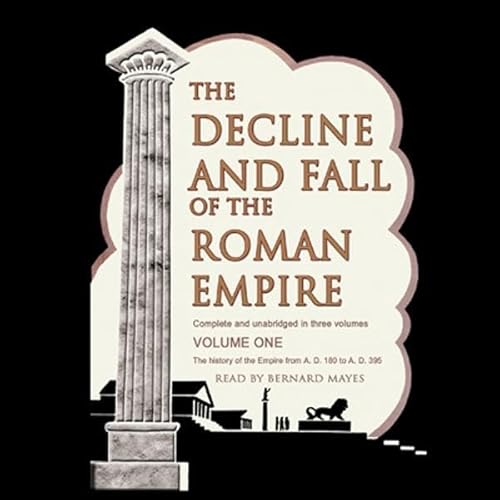
The History of the Decline and Fall of the Roman Empire (Volume 1)

Author: Edward Gibbon

Narrated By:  Bernard Mayes

Edward Gibbon (Author, 1737-1794, Englishman who received degrees from the Universities of Cambridge and Oxford.)

Gibbon has an interesting background that seemed suited to admittance to the clergy when he became a symbol of militant agnosticism, even though he was more sophist than militant. This first volume of “The…Decline and Fall of the Roman Empire” made him famous.

Volume 1 of Gibbon’s history of the Roman Empire is interesting for its relevance to modern day nation-state leadership.

One is inclined to compare the tumultuous leadership of the Roman Empire to the history of one’s own country. There are parallels between good and bad leaders of the Roman Empire and the potential for collapse of today’s nation-states. Thinking of America, even a non-historian knows of leaders like Washington, Lincoln, and the Roosevelts who are considered by most historians and political scientists as great leaders. They managed American crises and had greater overall impact on America’s future than most other Presidents. Of course, America has also had its duds which can only be considered long after their tenure by historians who mitigate subjectivity.

America’s President Washington might be favorably compared to Rome’s first emperor, Augustus. Both exemplified leadership that could bring together disparate interests with a vision of what their nations could achieve in the world in which they lived. Of course, Augustus ruled for over 40 years while Washington led America for only 8. Augustus established an empire while Washington established a singular nation-state. However, both created a period of peace and stability during their terms of leadership.

Augustus transitioned Rome from a Republic to an Empire while Washington helped establish the U.S. government by presiding over debates on a constitution that defined the presidency and a system of government’ checks and balances.

Augustus stabilized Rome during years of civil war while Washington led the U.S. through the post-Revolutionary War with Great Britain. Both Augustus and Washington commanded militaries that assured peace within their countries. Washington took command of the Continental Army throughout the war with Great Britain. He organized and trained the troops who had little formal military training. He retreated when necessary and took calculated risks while forging foreign alliances to win American independence from the British. Both Augustus and Washington influenced the economics of taxation to support the administration of government. Though their tenures were quite different, each warranted a system for leadership succession.

Like the great achievements of Augustus in forging an empire, many of Washington’s methods for establishing an independent government have been modified by future leaders. American leadership changes every four to eight years. Surprisingly, despite some long reigning emperors of Rome like Augustus, the average reign is only 5 to 7 years. America’s new Presidents, like Rome’s often acted in ways that would not have been acceptable to their predecessors. Gibbon explains how different emperors shaped the Roman empire through inheritance, military coups, and political maneuvering. Some emperors were assassinated within months of their ascension. American Presidents have been assassinated but inheritance of leadership came from elections, not the power of the military or a leader’s wealth.

The power of a Roman emperor could ignore the Roman Senate and its citizens with the military might at their beckon call.

Successive Roman emperors and American presidents changed the way their governments functioned. The power of a Roman emperor could ignore the Roman Senate and its citizens with the power of the military. In contrast an American President’s government policy changes require a level of cooperation from congress, the judiciary, and the will of the people to make fundamental changes in governance. Gibbon’s history shows Roman emperors handled crises with the power of their position but the same may be argued for America if one considers Lincoln’s actions to preserve the Union with a Civil War. Both emperors and presidents used propaganda, public display, and association with religion to preserve their public image and legitimacy.

The Roman Empire and the destruction of Carthage.

Gibbon’s history of the Roman Empire in Volume 1 contrasts the good and bad that occur during the growth and survival of the Empire. There are numerous examples of horrific times for the Empire’s citizens. However, the Roman Empire lasted for 1,500 years despite what he called the loss of civic virtue, the rise of religion, military decay, economic strain, and barbarian invasion. Many of Gibbon’s noted reasons for the Roman Empire’s decline are mitigated by the brilliance of the founders of the American Constitution and the “balance of power” principle that created three branches of government. With a balance of power, neither a President, a Congress, or a Court is likely to endorse dictatorship.

A part of Gibbon’s first volume addresses the conflict between the Roman legions and what are loosely described as the barbarians. Barbarians were the non-Romans of that time.

They were the Germanic tribes of Goths, Vandals, Franks, and Alemanni. There were the Celts of Gaul and Britain, the Huns of Central Asia, the Parthians and Sassanids of the Persian empires, and the Slaves and Bulgars that arrived at the end of the Roman Empire. The distinction between a Roman soldier and a Barbarian is somewhat obscure. Though the Romans were more highly trained and operated within a structured military hierarchy, they exhibited some of the unruliness of the Barbarians who fought in loose tribal warbands. Roman’ equipment and armor were more standardized than the weapons of the Barbarians. Though some might argue the Romans had citizenship and status, they succumbed to mercenary actions just as the Barbarians often did in their tribal communities. A significant difference between the Roman soldier and Barbarians was discipline in battle. Roman soldiers fought in tight formations while the Barbarians fought with hit-and-run tactics. The interesting thought one has about that difference is the mistakes of America in Vietnam and what many consider a defeat by Ho Chi Minh’s hit-and-run tactics.

Map of the United States of America with state names.

America declared independence in 1776 which means it has lasted for 249 years. There seems little reason to believe America cannot survive more years, i.e. presuming global warming, nuclear war, virus creation, or some other unimagined catastrophic event destroys human life.

BEGINNINGS

This introduction to the first volume of Gibbon’s work sets the table for the remarkable growth and longevity of the Roman Empire. Hopefully, the next few reviews of this very long listen will be of interest to those who follow this blog.

Books of Interest
 Website: chetyarbrough.blog

The History of the Decline and Fall of the Roman Empire (Volume 1)

Author: Edward Gibbon

Narrated By:  Bernard Mayes

The following story of Rome is largely absent of Julius Caesar which is a surprise to many who are dilatants of history. Caesar’s reign was as a dictator from 49 BCE to 44 BCE. Augustus was Caesar’s great-nephew and was adopted by Caesar as his son and heir.

Mark Antony became the leader of Rome after Caesar’s murder. Anthony ruled until 30 BCE when Augustus dethroned him and became the first emperor of what became known as the Roman Empire in 24 BCE. Though Caesar played a role in ending the Republic, it was Augustus who established the Roman Empire which explains why Gibbon begins his history of Rome with Augustus’s rule. Gibbon notes Augustus was the real architect of imperial Rome. Augustus consolidated the power of disparate interest groups to create the Roman Empire. Augustus reformed the government, secured military loyalty, and restored order after defeating Anthony.

What is unclear is why there was a conflict between Augustus and Anthony when Anthony supported Caesar. A little research suggests Anthony’s relationship with Cleopatra interfered with Augustus’s view of singular Roman leadership of Roman territory, i.e. exclusive of Egypt’s influence or interests. A propaganda war was created by Augustus that gained the Senate and Roman people’s support in what became a war against Anthony’s rule. This led to the Battle of Actium where Anthony and Cleopatra’s forces were defeated by Augustus. Anthony and Cleopatra returned to Egypt and committed suicide, leaving Augustus to rule Rome.

Augustus (27 BCE – 14 CE) – The first emperor, established the principate.

Tiberius (14–37 CE) – A capable but unpopular ruler.

Caligula (37–41 CE) – Infamous for his erratic behavior.

Claudius (41–54 CE) – Expanded the empire, including the conquest of Britain.

Nero (54–68 CE) – Known for his extravagance and persecution of Christians.

Vespasian (69–79 CE) – Stabilized the empire after the chaos of 69 CE.

Domitian (81–96 CE) – A harsh ruler, assassinated by his own court.

Trajan (98–117 CE) – Expanded the empire to its greatest territorial extent.

Hadrian (117–138 CE) – Consolidated the empire, built Hadrian’s Wall.

Marcus Aurelius (161–180 CE) – The philosopher-emperor, faced invasions.

Commodus (177–192 CE) – His misrule led to instability.

Septimius Severus (193–211 CE) – Strengthened the military.

Caracalla (198–217 CE) – Granted Roman citizenship to all free men.

Diocletian (284–305 CE) – Reformed the empire, introduced the tetrarchy.

Constantine the Great (306–337 CE) – Legalized Christianity, founded Constantinople.

Theodosius I (379–395 CE) – Made Christianity the state religion.

Romulus Augustulus (475–476 CE) – The last emperor of the Western Roman Empire.

This introduction to the first volume of Gibbon’s work sets the table for the remarkable growth and longevity of the Roman Empire. Hopefully, the next few reviews of this very long listen will be of interest to those who follow this blog.

SUPREME COURT

To Leah Litman, Trump’s election seems a setback but not a reversal of the ideal of balancing equal rights with private interests. As Alexander Pope wrote in his poem, in the 18th century “Hope springs eternal in the human breast”.

Books of Interest
 Website: chetyarbrough.blog

Lawless (How the Supreme Court Runs Conservative Grievance, Fringe Theories, and Bad Vibes)

Author: Leah Litman

Narrated By:  Leah Litman

Leah Litman (Author, BA in Chemistry & Chemical Biology, constitutional law scholar with Doctorate from University of Michigan Law School.)

One doubts Leah Litman would suggest there are no biological differences between men and women considering her education as a science major and legal scholar. As a science major, she knows there are chromosomal, hormonal, physical, and reproductive system differences between the sexes. However, Litman is spot on in arguing women do not have equal rights with men just as all races and ethnicities do not in the ideals of American Democracy. Litman argues that legally, equality is not being enforced in America today and is being diminished by today’s Supreme Court of the United States.

American Supreme Court

Litman persuasively argues today’s Supreme Court has eroded women’s rights by supporting legal theories that are ideologically promoted by political conservatives but not by precedents set by an earlier Supreme Court. Today’s majority at the Supreme Court has succumbed to the influence of conservative theories about the sexes rather than precedents set by an earlier Supreme Court.

It is not that the sexes are not different but that they deserve equal treatment under the law.

The point made by Litman is that the Supreme Court has found that in “all forms of discrimination”, equality of opportunity is mandated by the 14th amendment which provides equal protection under the law to all citizens with assurance that no person should be deprived of life, liberty, or property without due process. Further, the Civil Rights Act of 1964 prohibits discrimination based on race, color, religion, sex, or national origin in employment, education, and public accommodation. Previously settled law by the Supreme Court is being ignored in reversing Roe v. Wade, criminalizing same sex intimacy and marriage, and denying equal rights to the LGBTQ community.

What Litman is pointing to is the politicalization of the Supreme Court.

One might argue the Court has always been a political body. America’s history of discrimination has been reinforced and attacked in different eras of the Court. As the Turkish saying, “A fish rots from the head down”, today’s Justices of the Supreme Court are reversing precedents set in former rulings. America elects a President every four years. Even though Supreme Court justices are appointed for a lifetime, they decide to retire at some point in their careers and are replaced by recommendations of a current President with acceptance or rejection by Congress. If a conservative is in the office of the Presidency, then the recommendation will be based on candidates who reinforce a President’s political leaning. The same, of course, is true for a more liberal President.

Litman infers a politicalization of the Supreme Court lies at the feet of those who choose to vote, promote, and support candidates of their choice.

America is at a conservative revisionist point in the history of the Court with Donald Trump’s election. America has only itself to blame or praise for that revisionism. The obvious leaning of Litman is liberal in that she strongly believes in equal rights for all Americans. Her plea is for Americans to wake up to the importance of voting, promoting, and supporting candidates for public office.

American Democracy remains the best form of government despite wavering on balancing equal rights and private interests.

A perfect society will balance equal rights with private interests. America is not there, but it has a greater possibility of getting there than any other form of governance. To Leah Litman, Trump’s election seems a setback but not a reversal of the ideal of balancing equal rights with private interests. As Alexander Pope wrote in his poem, in the 18th century “Hope springs eternal in the human breast”.

UNDERCOVER

Scott Payne’s story makes one proud to be an American because of his bravery and willingness to risk his life for what is good about being in the land of the free.

Books of Interest
 Website: chetyarbrough.blog

 Code Name: Pale Horse (How I Went Undercover to Expose America’s Nazis)

Author: Scott Payne, Michelle Shephard

Narrated By:  Scott Payne

Scott Payne is a former undercover FBI agent who retired from the agency after 23 years of service. Michelle Shephard is an independent investigative reporter, author, and Canadian filmmaker.

Scott Payne’s history as an undercover FBI agent offers a dark picture of a part of America that one hopes and presumes most Americans revile.

With the help of Michelle Shepard, Payne reveals how a part of American society believes in white supremacy and an inherent right to victimize the public. Some people seek the reward of money and power, along with the prestige of being members of a miscreant minority, to murder, rob, and sell illicitly gained drugs and merchandise to enrich themselves. This minority demeans the ideals of American democracy.

America is founded on a government with power that comes from the consent of the people.

America is managed with belief in the rule of law, individual rights, a separation of powers to prevent tyranny, the equality of all people, and the right to vote for its leadership. Payne’s service in the FBI as an undercover agent shows how a minority of Americans violate these founding principles. Payne’s story reminds one of what many Americans think they are and should be. He, like most Americans, comes from the middle-class, finishes high school and grows into adulthood. He chooses to go to college, has found God to be important in his life, gets married, has children, and gets on with life. He comes across as an “everyman” American; although at 6′ 4″, he is taller and more athletic than most. He chooses to become a policeman and is later hired by the FBI.

Texas Motorcycle Club’ Patches.

Payne chooses to become an undercover agent for the FBI and becomes acquainted with a motorcycle group in Texas that is being investigated. Payne spends many months to ingratiate himself to the group and eventually becomes a member of the Outlaws, one of the “Big Four” clubs in America. This particular chapter deals in stolen goods and drugs. Payne’s entry as an undercover agent was in the stolen vehicles business with the intent of becoming undercover in their drug business. What is made clear in Payne’s story is how dangerous the drug business is and how he is nearly killed when a body search is conducted in a dark basement.

The personal stress of an undercover agent is made clear in Payne’s story.

Payne’s belief in God, FBI support, and his wife’s commitment to their marriage save him from a mental breakdown. After arrests of the biker gang members that were breaking the law in Texas, Payne moves on to an undercover assignment in Tennessee to infiltrate a white supremacist group. Like Germany’s Nazi movement, white supremacy in America is a sore that never heals and can grow to threaten a country’s life. The disgusting delusion that “all people are not equal” penetrates society like a contagious disease. Payne shows how white supremacists recruit and train followers that infect society. Humans have a desire to become a part of something greater than themselves. Sadly, that desire works for and against the American ideal of freedom.

Payne’s story makes one proud to be an American because of his bravery and willingness to risk his life for what is good about being in the land of the free.