FAME

As a son of a strong mother, one is impressed by Tina Knowles’ character in her enlightening memoir. She shows how women are the backbone of society despite their treatment in a patriarchal world.

Books of Interest
 Website: chetyarbrough.blog

Matriarch (A Memoir)

Author: Tina Knowles

Narrated By: Tina Knowles & 4 more

Celestine Ann Knowles aka Tina Knowles. (Author, American businesswoman, fashion designer, and mother of the famous performer, Beyoncé.)

This is an intelligent well-written memoir of the mother of two famous performers, Beyoncé and Solange Knowles. Celestine Ann Knowles is born in Galveston, Texas on January 4, 1954. Her two famous daughters are the singer Beyoncé and the composer, Solange Knowles.

The mother of these two famous women tells a story of what it is to live in the 1950s as a young, poor Black American. Tina (a diminutive of Celestine) Knowles becomes a successful businesswoman, fashion designer, philanthropist and mother of two highly successful women in the 21st century.

Galveston’s in the 1950s.

Living in Galveston, Texas in the 1950s as a person of color is starkly and clearly explained in Tina Knowles’ memoir. Tina’s father works as a longshoreman. His work is sporadic because of a mining accident that ruined one eye and made him hard of hearing which limited the work he could do as a longshoreman. With the aid of his wife, Tina’s mother as a seamstress, their meager income is enough for them to get bye. Tina’s mother is the foundation of the family. Tina grows up as a force of nature before reaching adulthood. She grows up in a family ruled by a “Matriarch” as the power in her family and neighborhood. Even in her pre-school years, as the youngest of seven children, Tina understands her mother is the person who holds the family together and eventually makes Tina the matriarch of her future family.

White American’ opposition to equality in the 50s.

Tina adventured where many young Black children timorously dealt with life in an unfair world. Despite its unfairness, Tina ventured forth.

Tina tells the story of her childhood companions who would not go into an ice cream store in Galveston when white children were being served. Tina ignores their timorousness, goes into the store and is told to get out by the store manager. She finds what her friends were saying is true, but she had to experience it herself. Tina goes to a Catholic school where she is treated harshly by the teachers but continues on to graduate despite their strict rules. Nearing graduation, she becomes ill and is treated by a white physician who presumes she is lying about never having premarital sex. The white physician and an aide strap her down and conduct a physical exam that leaves blood on the table because of her hymen being broken by the exam. Her mother calls the physicians to complain about the treatment of her daughter and takes her to another hospital to find her illness is unrelated to the doctor’s presumptive and unnecessary pelvic exam.

Tina is raised in the time when Black discrimination is finally beginning to change. Brown v. Board of Education is decided in 1954.

Tina graduates from high school, presumably in the early 1970s, and goes on to college. While in high school, she joins a local singing group that is inspired by The Supremes. They call themselves the Veltones. That experience leads her to work in fashion and entertainment. She becomes a designer, and entrepreneur, and eventually the “Matriarch” of her own family. In 1980, Tina marries Mathew Knowles. They were married for over 30 years but divorced in 2011.

In the Knowles’ marriage (1980-2011) they have two daughters, i.e., Beyoncé and Solange Knowles.

Tina Knowles explains how the birth of Beyoncé ignited her ascendence as the “Matriarch” of her generation. From taking care of Beyoncé to remodeling her house to creating her first business, Tina created her own world. Tina built the foundation for her life and raised one of the most famous singers in the world.

“Headliners”–Tina Knowles first business.

At 32 years of age, Tina decides to start a business. With financing from what is to become her former husband, she decides to open a salon. Tina is pregnant with her second child, Solange. Matthew involves himself in Tina’s business in financial ways that challenge its success. Tina starts “Headliners” in the early 1990s to offer make-up and beauty services in Houston, Texas. Beyoncé is now around nine years old while Solange is nearing four or five years of age.

Matthew and Tina Knowles file for bankruptcy.

Her husband, Matthew decides to quit his six-figure job to join Tina in her business. For unclear reasons, the family files for bankruptcy, sells their home, and rebuilds their lives while Tina focuses on her salon business. Tina explains she decides to divorce her husband because of his infidelity and mishandling of their dwindling wealth. She holds her life together by focusing on the burgeoning career of her girls and her salon business. Tina shows herself as the guiding force of her talented daughters. She has become the “Matriarch” that her mother had developed her to be.

Beyoncé’s 2025 concert in London.

Though most interest in Tina’s story may be because of her daughter, Beyoncé, her memoir suggests the “Matriarch” of the next generation of Knowles will be her daughter, Solange. She does not diminish the great success of Beyoncé as an incredible talent who runs her musical productions, but it seems Solange is the worker bee that is driven to become her generation’s “Matriarch”.

Agnéz Deréon (Tina Knowles’ mother, the “Matriarch” of the Knowles’ descendants.)

At the end of Tina’s book, she has reached the age of 70. She maintains a clear picture of the story of her life. Married and divorced twice, she is in charge of her life and appears to influence all who surround her. As a survivor of breast cancer and a firm grasp on life, she uses her strong belief in God and the love of her family to believe the best is yet to come. As a son of a strong mother, one is impressed by Tina Knowles’ character in her enlightening memoir. She shows how women are the backbone of society despite their treatment in a patriarchal world.

DAMNED & FORGOTTEN

Allen Esken’s story is too tedious and drawn out to be a great work of fiction. However, it reminds one of the injustices of life for those who get away with murder.

Books of Interest
 Website: chetyarbrough.blog

The Quiet Librarian (A Novel)

Author: Allen Eskens

Narrated By: Livana Muratovic

Allen Eskens (Author, former defense attorney who lives in Minnesota.)

Allen Eskens has written a story of revenge and war without giving it context which diminishes its value. Having visited the former Yugoslavia which is split into 6 ethnic territories, the war that occurred between Bosnian and Serbian people can still be seen in pock marked buildings that were evidence of the war. Our guide for the trip reflects on America and NATO’s failure to aid a peaceful resolution while the conflict killed many people that may have been saved by international intervention. Eskens makes a passing comment about that feeling in his book, but the truth of that conflict is as real today as the people who lived through it.

Josip Broz Tito (Yugoslavian ruler 1953-1980, died in May of 1980.)

When Tito died in 1980, Slobodan Milošević, a nationalist Serbian leader promoted the idea of a “Greater Serbia” without accommodation to ethnic differences of the former Yugoslavian people. Milošević capitalized on the historic conflict between Serb’ and Bosnian’ ethnic and religious beliefs to acquire and hold power. Serbian Christian beliefs were used as a tool to incite support of Milošević’s rule of Bosnians who are generally Muslim believers. Many Bosnians and Serbians die as a result of Milošević. Slobodan Milošević retained power for 13 years but is removed in October of 2000 when Vojislav Koštunica won the presidency. Though Milošević supporters try to protest the election results, they fail.

Slobodan Milošević (President of Serbia 1989-1997, died in 2006 of a heart attack.)

Milošević is arrested in 2001, extradited to The Hague, and tried for war crimes, genocide, and crimes against humanity. He is the first former head of state to be tried by the Hague court. The trial lasted for four years. Milošević is found dead in his prison cell. He was 64. Autopsy shows it to be a heart attack. No verdict is reached, leaving no closure to the victims of his perfidy.

The division of Yugoslavia after Tito’s death.

This history does not change Eskens’ story, but it offers context that helps one understand why a Bosnian emigree to America pursued a former Serbian nationalist who brutally raped her mother and murdered her family in front of her during the Bosnian/Serbian war. It is credible fiction of the consequence of war whether in Bosnia or anywhere in the world where the guilty go unpunished. The question becomes, is intent to murder a criminal by one who has firsthand knowledge of another’s heinous act equally guilty of murder? The question is not asked or answered by Esken’s story; probably because it is unanswerable.

The heroine of Eskens story is Hana Babić who emigrates to Minnesota to earn a living as a librarian.

She has adopted the grandson of a close friend who is murdered in the Bosnian/Serbian war. That adoption and her personal experience drives her to find and murder the man who destroyed her life in Bosnia. She has to choose between committing murder in America or letting a murderer go free when she finds her nemesis. However, protecting her adopted boy by letting a guilty person escape vigilante justice is what drives the author’s story. If one sticks with the story, they find her answer.

One wonders about lives of Ukrainians if a tentative settlement proposed by Putin in August 2025 is accepted by Ukraine. Territories under siege in Ukraine would be given to Russia in return for ending the war.

How many Ukrainians will leave their homeland to seek a new life? How many will stay, and secretly fight on? How many will reluctantly accept their homeland’s loss? These were decisions made by Bosnians in former Yugoslavia.

Allen Esken’s story is too tedious and drawn out to be a great work of fiction. However, it reminds one of the injustices of life for those who get away with murder.

EMIGREE

“The Sun is Also a Star” is a nicely written book that will keep reader/listeners interested in knowing what happens to two young lovers. One is left in suspense until its last chapters.

Books of Interest
 Website: chetyarbrough.blog

The Sun is Also a Star 

Author: Nicola Yoon

Narrated By: Bahni Turpin & 2 more

Nicola Yoon (Author, Jamaican American, NYT’s bestselling author, National Book Award finalist, electrical engineering undergraduate at Cornell, graduated from Emerson College with a Master of Creative Writing.)

Nicolo Yoon, the author, worked as a programmer in investment management for 20 years before publishing her first book, “Everything Everything”. It became a best seller. “The Sun is Also a Star” is her second published book which also became a best seller. Interestingly, the Jamaican born writer’s husband is a Korean American graphic designer. One presumes her book partly reveals her life experience in America. The credibility of her love story lies in the truth of the saying that “birds of a feather flock together”, an apocryphal Biblical saying that reaches back to the “Book of Ecclesiasticus” in the first century. Her hero and heroine are highly intelligent teenagers of immigrant parents who are influenced by their parent’s native cultures. Being children of immigrants, highly intelligent, high performers in academics, and living in America are why one thinks of the “birds of a feather…” analogy.

JAMAICA, SOUTH OF CUBA, OFF OF THE FLORIDA COAST.

“The Sun is Also a Star” is about a Jamaican girl, a South Korean boy, and the girl’s parents who are being deported because of their illegal immigration status. The heroine’s father comes to America illegally to pursue a career. His wife and daughter follow later in presumably the same illegal way. The girl’s father struggles as an unsuccessful aspiring actor. He and the girl’s mother work at menial jobs for the families’ survival. They are within a day of being deported by the American government. Their daughter loves her mother and is ambivalent about her father. She is a bright high school student nearing graduation. The daughter is seeking help from an immigration attorney to delay and hopefully stop their deportation. On her way to an immigration lawyer’s office, she meets a handsome South Korean boy near her age who is interviewing with an Ivy League school in the same building in which the lawyer practices his profession. They serendipitously meet and their lives become intertwined.

Over 200,000 immigrant arrests in America have been made as of August of 2025.

This is a fairy tale story that offers a truth about the iniquity of arbitrary enforcement and forced ejection of purported illegal immigrants in America. The second term of the Trump’ presidency shows how wrong it is to deport alleged illegal immigrants without judicial review. Obviously, if a legal review shows an immigrant is a criminal there is justification for immediate deportation. If the legal review shows an immigrant has always been a productive and law-abiding citizen of America, some may reasonably argue they should be directed to a program that allows them to eventually become legal residents of the United States.

Without legal review, a valuable source of American productivity is unnecessarily lost. To argue that loss is justified by jobs that will be filled by citizens of the United States is weak because many of the jobs taken are not taken by American citizens because the wages are too low, the physical demands too high, and the hospitality needs of much of America are unmet. It is true that many in America are unemployed because they have chosen to not get a good education and choose to remain unemployed by being unwilling to work for low wages. Their unemployment is not because of illegal immigrants but because of the choices they have made in their lives. Construction, agriculture, hospitality, retail, healthcare, and small businesses have been negatively impacted by the deportation of immigrant labor. In some industries, up to 40% of the workforce has been impacted by deportation.

Yoon’s story is a fairy tale of young love between an illegal and legal immigrant living in America.

Nicolo Yoon explains how love between two people occurs when they have similar life experiences and relate to those experiences with shared intelligence. The young girl and boy have similar life experiences in America. Both choose to educate themselves. The two young teenagers have parents that love them who have their own prejudices and life experiences in ways that influence their children to be ambivalent about the love they have for each parent.

Most parent’s, regardless of their culture, want a better life for their children.

Yoon illustrates the motivations and consequences of people who decide to emigrate. Whether emigrating legally or illegally, emigrees are faced with the difficulty of adjusting to a different culture that conflicts in good and bad ways with the culture they have left. Emigree’ parents wish well for their children but many fail to grasp the freedom offered by American culture to choose their own path in life. Even though life choices are influenced by one’s intellect, emotions, and (in America) a white majorities’ discrimination, most young people are able to choose their own path in life.

“The Sun is Also a Star” is a nicely written book that will keep reader/listeners interested in knowing what happens to two young lovers. One is left in suspense until its last chapters.

DICTATORSHIP

The importance of freedom in book publication and for those who read them is the message Charlie English gives the public in “The CIA Book Club”. It is too bad America’s current President chooses not to read because this book reminds one of how important books are in the world.

Books of Interest
 Website: chetyarbrough.blog

The CIA Book Club (The Secret Mission to Win the Cold War with Forbidden Literature)

Author: Charlie English

Narrated By: Michael David Axtell

Charlie English (Author, British non-fiction author, former head of international news at the Guardian.)

“The CIA Book Club” is a reminder of the former USSR and today’s Russian invasion of Ukraine and what is at stake for Ukraine’s citizens that may, once again, come under the repressive return of a dictatorial leader. Putin has adopted many of the same characteristics of Joseph Stalin, a leader who believed in dictatorial control over the media, and isolating or murdering anyone who challenges his leadership. The scale of Putin’s use of gulags, and mass executions is much smaller than Stalin’s but his cultivation of a cadre of followers, rewarded by the power of association and lure of wealth, create a similar dictatorship.

Poland-Europe’s crossroad.

What Charlie English reminds listener/readers of is how Poland suffered under Stalin and what it will mean to Ukrainians when much of their land is taken to settle the Ukrainian war.

Without solid opposition of all Western powers, concession of Ukrainian land seems inevitable. Trump’s waffling opposition to Putin and the fear of nuclear confrontation reduce the likelihood of Russia’s peaceful withdrawal from Ukraine.

Like the repressive actions of the USSR in the Baltics, English explains how brutal Hitler, Stalin, and Stalin’s successors were to Poland even after Stalin’s death.

Strick control over publishing continued after Stalin’s death. Orwell, Koestler, and Solzhenitsyn were banned, and western books were blocked at the border. Polish citizens like Miroslaw Chojecki risked imprisonment for smuggling and/or re-printing forbidden works. The KGB monitored dissidents, writers, and students. English notes that phones were tapped and homes raided. However, a CIA program continued to provide copies of banned books to Polish dissidents. Polish citizens became partners in covert activities to smuggle and re-print books for their countrymen and women. A Solidarity movement against censorship and discrimination is formed by Polish patriots. This reminds one of the resistances one hears when visiting today’s Baltic countries and stories of citizens whose families were jailed, tortured, and sometimes killed during Stalin’s occupation.

Poland, a spectacularly beautiful country.

Poland is an important trade and agricultural producer at the crossroad of Europe. It has no natural land barriers between itself and the great powers on their borders. Its strategic value to European aggressors has made it a victim of a history of foreign occupation. In the 13th, 17th, 18th, and 20th centuries Poland was occupied by Mongols, Prussians, Germans, and Russians. Poland’s diverse population seems to have been unable to create a strong centralized authority that could successfully resist their powerful neighbors who confiscated their riches and occupied their land. Charlie English’s book reminds reader/listeners of what makes Poland a great nation. It is its diversity and its pursuit of intellectual development. Sadly, its geographic location has threatened its existence for millenniums. America is blessed by its geographic location and shows how it could survive as a free democratic nation. Through clandestine operations and support by the CIA, Polish patriots were able to reproduce banned books during the cold war that aided the intellectual growth of Poland despite Stalin’s repression.

America’s current President impedes the influence of freedom in Europe by dismantling surveillance oversight, undermining the EU-U.S. Data privacy framework, and by shutting down the GEC (Global Engagement Center) which is designed to counter foreign disinformation.

Trump’s intent is to save money. The author notes the same thing nearly happened with the CIA book publishing support of Poland when some of America’s leaders tried to cut its funding. The CIA prevailed and the financial support continued.

The importance of freedom in book publication and for those who read them is the message Charlie English gives the public in “The CIA Book Club”. It is too bad America’s current President chooses not to read because this book reminds one of how important books are in the world.

NO WINNERS

Black America is not liberated by the Civil War. Neither will the Russians or Ukrainians be liberated by whichever side wins. There are no winners. There is only death and destruction as evidenced by the tragedy unfolding in Gaza.

Books of Interest
 Website: chetyarbrough.blog

How to Dodge a Cannon Ball (A Novel)

Author: Denard Dayle

Narrated By: William DeMeritt

Denard Dayle (Author, Jamaican-American writer, graduate of Princeton with an MFA from Columbia University.)

The central character in Denard Dayle’s novel is Anders. Anders is a light skinned Black soldier in the American Civil War. He begins as a Confederate and escapes to become a Union soldier as a Flag carrier. The author’s story is tedious and a mess, but it reflects the many conflicts among Americans fighting in the Civil War. The bizarre happenings in Dayle’s story are meant to be satirical with a bite but with so many twists in ideas about race, nationalism, gender, and the history of the war that one is inclined to put the book down. One may soldier on with a hope to understand Dayle’s point.

America’s Civil War.

After listening to “How to Dodge a Cannonball” for several hours, one gathers Dayle’s point is to show the complexity of America’s Civil War and what it means to be an American. The absurdity of all wars is revealed in America’s Civil War contradictions and hypocrisies. There are many, some of which are uniquely about civil wars, but also about every war.

In fighting a civil war for freedom in America, governments deny freedom to both sides of the conflict.

In fighting a war of conquest like that in Ukraine, both the aggressor and defender nations equally deny freedom to their citizens. Dayle shows race, gender, and nationality make little difference in who loses their freedom when war is declared. Black America is not liberated by the Civil War. Neither will the Russians or Ukrainians be liberated by whichever side wins. There are no winners. There is only death and destruction as evidenced by the tragedy unfolding in Gaza.

Dayle makes his point, but the story becomes too repetitive and tiresome for this listener/reader who quits the book before its ending.

MUSICAL CLASSICS

Pleasure in a classical performance can appeal to one who is familiar with the technical aspects of a production and to another for its emotional impact. Both Greenberg and Plotkin offer valuable insights to the relevance and reason for attending classical music performances in this ever-changing world.

Books of Interest
 Website: chetyarbrough.blog

Classical Music 101 (A Complete Guide to Learning and Loving Classical Music.)

Author: Fred Plotkin

Narrated By: Fred Plotkin

Fred Plotkin (Author, speaker, consultant on food, opera, and Italian culture.)

This is an informative overview of classical music but would have been better if some of the music referred to had been included in an audio version of Plotkin’s book. It is an interesting contrast to Professor Greenberg’s “Great Courses” lectures about classical music. Both writers offer insight to a non-musician’s interest in classical music. Both address Western classical music. They offer sketches of major figures like Bach, Mozart, Beethoven, and others. Greenberg introduces more information about musical grammar to offer a vocabulary of understanding while Plotkin focuses on how to listen and how modern renditions of the classics can be different from their original performances. The added dimension offered by Plotkin is the emotive qualities of particular musical instruments in a musical production.

Plotkin’s book is a more intuitive introduction to classical music productions than Greenberg’s lectures.

Plotkin’s music review is about the sensual message that classical music offers listeners. Greenberg, though equally insightful, offers a technical explanation of a classical’ composers or performers production. It would have been helpful to hear the difference between an original classical production and a modern interpretation, but Plotkin chooses not to use that audio tool. Plotkin’s high praise for Beethoven’s ninth symphony would have been a welcome audio addition to his insightful book.

Greenberg’s lectures are historical and chronological while Plotkin’s story is more about musical interpretation by different instruments in classical music productions.

Music, Opera, and History

Plotkin delves into the change in performances based on newly invented music instruments and different interpretations by performers of classic pieces. A piano began as a harpsichord in the 1700s which plucked strings like those on a tightly drawn bow. This evolves into an escapement that has hammers striking taught strings evolving into today’s pianos. The range of sounds grows with the addition of foot pedals and framed strings evolve from wooden infrastructure to cast iron frames that allow tighter strings and richer sound. (See the review of “Chopin’s Piano“) The number of keys is standardized at 88 by the late 19th century. From these earlier changes, digital pianos are created in the late 1900s and soon hybrid pianos are made with both acoustic and digital features. Musical instrument evolution explains why Plotkin suggests listeners compare an original classical piece of music in a modern format. It may become emotively different from older recordings because of instrument focus in the music or change in the instrument of presentation. Plotkin notes there are experiential and interpretive differences in modern performances of the classics. Here is where an audio example would have been helpful.

Plotkin notes that difference in musical performances go beyond changes in musical instruments. He notes interpretations of the classics change. He explains artists like Emanuel Ax and Marilyn Horne use tempo, and phrasings dynamics that offer different experiences to a listener. (Another example of why it would have been easier to understand if there was an audio example.) Plotkin endorses listening to recordings of musical productions because they offer clarity and access to a wider audience. However, Plotkin notes that a live performance offers more spontaneity and emotional immediacy than a recording.

It is feelings of a modern audience that excites Plotkin’s imagination

Plotkin makes the point that an historical original may or may not be the best that a composers’ creation offers to a modern audience. However, it is feelings of a modern audience that excites Plotkin’s imagination. In Plotkin’s opinion, a classics’ meaning is not to be cast in stone because times change, and yesterday’s history may not resonate with today’s events. What Plotkin is driving for is the cultivation of expert listeners who can appreciate yesterday’s classics because they resonate with today’s events, though composed in a different era, they offer new perspective to modern events.

One who has listened to both Greenberg’s lectures and Plotkin’s book recognize both want to reach an audience of non-specialists to nurture their interest in classical music.

Both believe classical music is an interpretive exercise based on an orchestra’s performance. They are peas in a pod when it comes to wanting to see emotional transformation in a person listening to a classic’s performance. Both Greenberg and Plotkin believe the classics are meant to be a sensual experience. Greenberg educates his audience on the structure and historical complexity of classical music. Plotkin focuses on classical musical instruments and performances that remain classics because of their emotive relevance to the present as well as the past.

Different points of view about classical music.

One presumes Greenberg’s and Plotkin’s two views of classical music may come into conflict in the changes from the original intent of great composers who have created what Greenberg may argue is a timeless masterpiece. Greenberg’s technical understanding of composition may seem more important than a transitory emotional response from a less knowledgeable audience. Here is where a detailed presentation of Beethoven’s ninth could have clarified the values of the classics noted in Plotkin’s excellent book. One wonders how a modern performance of Beethoven’s ninth might be different from an earlier version.

Value of musical classics.

Both Greenberg and Plotkin offer equal enlightenment on the value of musical classics. Audiences will always have different understandings of classical performances. The goal of a great classical performance is to please its audience. Pleasure in a classical performance can appeal to one who is familiar with the technical aspects of a production and to another for its emotional impact. Both Greenberg and Plotkin offer valuable insights to the relevance and reason for attending classical music performances in this ever-changing world.

MARK TWAIN

Chernow’s biography is a mirror of Twain’s time and life. Chernow implies Twain could see imperfections of society without seeing his own. Twain’s genius to entertain America and readers around the world is not diminished by Chernow’s well written book.

Books of Interest
 Website: chetyarbrough.blog

Mark Twain 

Author: Ron Chernow

Narrated By: Jason Culp

Ron Chernow (Author, journalist, biographer, winner of the 2011 Pulitzer Prize for Biography and the American History Prize for his 2010 book “Washington: A Life”.

No stranger to historical biographies, Ron Chernow has written an interesting biography of the peripatetic humorist Samuel Clemens, aka Mark Twain. Samuel Clemens was born in Florida, Missouri, two weeks after Hailley’s Comet passed Earth in 1835, he died in 1910 when Hailey’s Comet made its closest approach to Earth in 1910. Chernow’s biography explains how Clemens became a steamboat pilot, frontier journalist, author, and American gadfly in his journey through 74 plus years of life.

Chernow’s biography of Mark Twain reminds one of Donald Trump without the power of the Presidency.

Clemens is noted as a stretcher of truth who told stories of his time that illustrated the contradictions of race, slavery, and morality that live through today. Twain is shown to express himself in humorist ways that challenged racial norms and societal conflicts which made some laugh, and others cringe with disgust or anger. Chernow argues Twain’s use of language shaped American literature. He gave American literature a unique voice that blended humor with criticism. Twain humanized the Black community and the iniquity of slavery, but Twain’s upbringing suggests he did not escape the false belief of innate Black’ inequality. Chernow painted a picture of Twain that showed how society was filled with the promise and pitfalls of Americans’ character.

Chernow shows how Clemens reinvents himself, not from formal education but from life experience.

At 21, Clemens begins training himself as a steamboat pilot on the Mississippi river, a highly praised, prized, and well-compensated position. Chernow suggests Clemens found his nom deplume, Mark Twain, based on the language of riverboat pilots. (“Mark Twain” is the 12 feet of depth needed for safe navigation of a riverboat.) As material transport changed after the steamboat era, Twain had to find a new career. He traveled to Nevada with the hope to become rich as a silver baron during the gold and silver rushes of the late 1850s. However, he never struck it rich, lost other people’s money, and turned to earlier work experience in newspapers when he lived in Missouri. He had learned the typesetting business and had written a few articles for the paper in his hometown. He settled in Carson City, Nevada, eventually becoming a journalist. On the one hand his stretching of the truth got him in trouble as a journalist but, on the other, it opened him to another career. His wit and way with words led to a role as lecturer and performer.

Chernow shows Twain changes jobs based on his innate abilities and external events.

The development of mass media, America’s Civil War, the industrialization of America, and the growth of a celebrity’ culture influence Twain’s life and made him a cultural symbol of America in the same way Dickens, Dostoevsky, and Chinua Achebe became symbols of their countries. Twain exemplified American life, its contradictions, its greed, and its biases that were blended into the personal tragedies and experiences of his own life. He turned his life experience into an art that reflected America’s growth as a nation. He became a writer and lecturer.

Chernow explains how Twain did not just read his lectures, i.e., he performs and acts their meaning to an audience.

Twain blends storytelling with satire and theater to entertain his audience. His reputation as a public speaker is made in California, but he becomes a global star. He performs in London, Berlin, and Bombay with what became cultural events about American humor and American foibles. His lectures are folksy with tinges of intellectualism that make him revered, respected, and laughed about by his audiences. Chernow believes he created an image of one who speaks truth to power about imperialism, religion, and human folly.

Chernow does not sugar coat truth about Twain.

Like all human beings, Twain had his blind spots. He was silent about lynching and its immorality, and he was trapped in his vision of racism by treating it as a troubling fact of American life despite his championing of civil rights. At best, he appears to be an agnostic when it comes to religion. There is criticism of Twain’s close relationship with teenage girls that he dismisses as a public concern by saying “It isn’t the public’s affair”. Twain is reckless with other people’s and his own money and investment. He exhibits behavior that suggests a gambler’s view about getting rich quickly. Twain could be vindictive, and melancholic because of his gloomy view of humanity. His family life suffers from his impulsivity and emotional distancing toward his wife and daughters. In one sense, Chernow makes Twain more human by noting he is like most of us except for his insightful sense of humor and talent for extemporaneous public speaking.

The archive of Twain’s letters is in the thousands which spans his entire adult life.

Chernow gathers much of his understanding of Twain from his personal letters rather than his books. He does note a number of Twain’s family members and friends are models for characters in his novels. However, Chernow’s focus is on Twain the man who appears morally inconsistent, a poor manager of other people’s money, and prone to anger when aggravated by other’s opinions. Whether this is fair or not, it describes many people today.

Chernow’s biography is a mirror of Twain’s time and life. Chernow implies Twain could see imperfections of society without seeing his own. Twain’s genius to entertain America and readers around the world is not diminished by Chernow’s well written book.

WEALTH

What is wrong about Housel’s investment recommendations is that his life experience sets a table that is not the same table as those who have much less to eat.

Books of Interest
 Website: chetyarbrough.blog

The Psychology of Money (Timeless Lessons on Wealth, Greed, and Happiness)

Author: Morgan Housel

Narrated By: Chris Hill

Morgan Housel (Author, two-time winner of the Best in Business Award from the Society of American Business Editors and Writers.)

“The Psychology of Money” is a plain-spoken examination of the value of wealth, how it is attained, retained or lost, and why its’ real value is independence. A superior perception of reality would certainly be ideal, but Housel implies no such thing exists, and that the presumption is too theoretical to be useful. Every human being becomes a product of their life experience. Unquestionably, all human beings have genetic inheritance, but Housel suggests personal life experience molds that genetic inheritance. All true, but it helps if your parents are upper middleclass and have a mindset for saving rather than spending their income.

Housel argues high intelligence is no guarantee of success in achieving wealth.

To achieve wealth, Housel argues one needs to be a consistent saver, a long-term thinker, an index fund investor in the stock market, and one who resists impulsive decisions to sell investments or use savings during financial instability. These guidelines are based on a wealth-seeker’s “margin of error” calculation of financial need during market weakness. One’s objective is to maintain one’s independence and freedom to live as they wish without risking that freedom by buying luxuries from short-term gains to only appear wealthier than others.

Cutting through the lessons that are listed by Housel’s suggestions is the ancient Greek recognition of the importance of “knowing thyself”.

Are you a crazy risk taker, do you think about the value of wealth, are you more interested in what others think of you than who you are to yourself, are you goal oriented or a “go along to get along” kind of person? These are clues to who you are and whether you should change to assure a life of freedom to live as you wish.

Janitor Ronald Read Leaves Behind $8,000,000 Fortune at his death

Housel gives the example of the janitor millionaire from Vermont who had no formal financial education. Ronald Read worked as a janitor and gas station attendant during his working life. He lived frugally while investing in blue-chip stocks that he held until his death. He amasses a fortune because of small savings and investments while never having high income but investing unneeded cash based on the way he chose to live. By being patient and disciplined over the course of his life, Read died in 2014 at the age of 92, donating $4.8 million to Brattleboro Memorial Hospital, $1.2 million to Brooks Memorial Library, and $2 million to his stepchildren, caregivers, and friends. Like Ben Franklin, Read lived a long life, accumulated great wealth while living the life he wanted. Just like Franklin, Read lived his life as he wanted and contributed his savings to eleemosynary institutions and people who were important to him during his lifetime.

Warren Buffett (The Oracle of Omaha.)

Warren Buffett is another example offered by Housel to explain that time and compounded returns on investment are key to one’s independence and success for living as one chooses. Buffet’s genius is not in just choosing the right stocks, but in staying with investments over the long term. Housel notes 96% of Buffett’s immense wealth came after his 65th birthday.

The discipline outlined by Housel is difficult for a young person to accept because of the tendency of human nature to impress others with their success.

When young, image is important for reasons ranging from attracting desirable partners to impressing others with one’s success by driving expensive cars, wearing elegant clothes, and living in luxurious homes. Many people believe image is as important as substance and fail to realize its folly when they are too old to do much about it. Freedom to live as we choose is a mixed blessing. Being disciplined about money and investment when one is young is an important lesson but hard to follow, particularly in a free society.

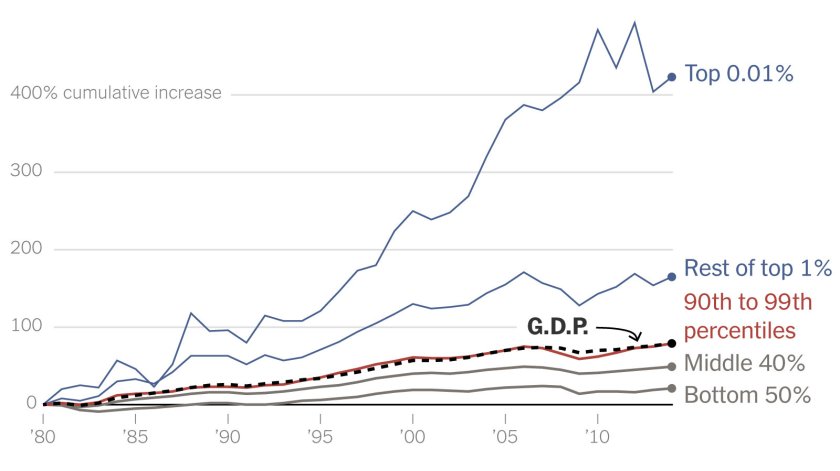
Piketty argues that the income gap widens after World War II.  He estimates 60% of 2010’s wealth is held by less than 1% of the population.

Housel comes from a family of savers who appear to have followed the path he recommends in his book. Though what he recommends makes sense, his starting point seems better than most middleclass or poor families in America. He chooses a very conservative investment strategy because of his life experience. He only invests in index funds and lives in a house without a mortgage. His story is not a typical American middleclass family story. What works for him is based on his personal life experience. What is wrong about Housel’s investment recommendations is that his life experience sets a table that is not the same table as those who have much less to eat. This is not to say Housel’s advice is wrong in recommending living within one’s means, investing for the long term, and letting wealth accumulate over time. It is good advice but where one starts in life makes a difference because your life experiences mold a large part of who you become and how you choose to save or spend your money.

UNINTENDED CONSEQUENCE

Technology is a key to social need which has not been well served in the past or present and could become worse without pragmatic accommodation.

Books of Interest
 Website: chetyarbrough.blog

Daughters of the Baboo Grove (From Chian to America, a True Story of Abduction, Adoption, and Separated Twins)

Author: Barbara Demick

Narrated By: Joy Osmanski

Barbara Demick (Author, American journalist, former Beijing bureau chief for the Los Angeles Times.)

This is a brief and fascinating historical glimpse of a government policy gone awry. Like America’s mistaken policies on immigration, Barbara Demick’s story of China’s one-child policy traces the effects of government overreach. Demick tells the story of a rural Chinese family who births twin sisters during the time of China’s unjust enforcement of their one-child policy. One sister is abducted by Chinese government officials, and is adopted by a family in Texas. The ethics of an inhumane Chinese government policy and the perfidy of free enterprise are exposed in Demick’s true story of two children’s lives.

The territorial size of China in respect to continental America.

China’s one-child policy leads to a Chinese criminal enterprise to capitalize on kidnapping and selling children born to families that could not afford the fines for having more children than the law allows. Undoubtedly, most children born were cherished by their parents, but the hardship of life and human greed leads to unconscionable human trafficking. Kidnapping became a part of a legal and criminal enterprise in China. Government policy allowed bureaucrats and scofflaws to confiscate children from their parents and effectively deliver or sell children to orphanages or people wanting to adopt a child. Demick recounts stories of grieving parents and grandparents that cannot get their children back once they have been taken.

Child trafficking, broken families, loss of personal identity, human shame, and the immoral implication of other countries interest in adopting children are unintended consequences of a poorly thought out and implemented government policy.

Demick becomes interested in this story because of a message she receives from a stepbrother of an adopted Chinese sister that has a twin that lives in China. Because of Demick’s long experience in visiting and reporting on China, she had a network of people she could call. Using adoption records, Demick is able to find the Texas stepsister who had been kidnapped when she was 22 months old. She was trafficked to an orphanage in the Hunan Province of China. Years later, through messaging apps, the twins communicated with each other and shared their photographs. They eventually meet in China in 2019.

One is hesitant to argue a government policy is a unique act of China when every government makes policy decisions that have unintended consequences.

America’s policy decisions on immigration are a present-day fiasco that is as wrong as the one-child policy in China’s history. The one-child policy is eventually rejected by the Chinese’ government but Demick’s book shows how bad government policy has consequences that live on even when they are changed by future governments. America’s policy on immigration will be eventually reversed but its damage will live on.

Getting back to the story, Demick is instrumental in having the mother of Esther (aka E) and the twins meet in China.

One is hesitant to argue a government policy is a unique act of China when every government makes policy decisions that have unintended consequences. The twins are initially reticent but warm to each other in a way that bridges the cultural and language divide between the sisters. The two mothers see their respective roles in their daughter’s lives. E and her identical twin, Shuangjie, are reserved when they meet because of the cultural distance that was created by E’s adoption.

E. appears more confident than Shuangjie who is more reserved and less assured.

However, Demick suggests they seem to mirror each other in subsequent meetings. One feels a mix of emotions listening to this audiobook version of “Daughter’s of the Bamboo Grove”. They have grown up in different environments but seem to have been raised in similar economic circumstances, though the two economies are vastly different in income per household, the two appear to be raised in similar economic classes.

Every person who reads/listens to “Daughter’s of the Bamboo Grove” can view the story from different perspectives.

There is the perspective of identical twins raised in different families, cultures, and histories. How are identical twins different when they are raised by different parents and in different cultures? Another perspective is that Xi and Trump have had dramatic effects on the societies their policies have created. The Twin’s meeting in 2019 is one year after my wife and I had visited China. Xi had become President after his predecessor began opening China’s economic opportunities. Two incidents on the trip when Xi had become President come to mind. The first is the feeling one has of being monitored everywhere and the internet restrictions when used to ask questions. The second was an incident in a crowded Chinese market when I was approached by a beefy citizen who raised his arms and seemed to be angrily talking to me in Chinese which I sadly did not understand. The distinct impression is that I was not welcome. This was a singular incident that did not repeat in our 21-day tour, but it seemed like an expression of hostility toward America.

This listener/reader thinks of the unintended consequences of Trump’s treatment of alleged illegal immigrants.

Trump’s immigration policy is similar to China’s earlier mistake with the one-child policy. America’s, China’s, and Japan’s economies are highly dependent on youth which is diminished in two fundamental ways. One is by public policy that restricts birth, and the other is immigration. Freedom of choice is a foundational belief in democracy while considered a threat in autocracy. In America today, it seems there is little difference between America, Japan, or China in regard to government policy that threatens the future. All have an aging population that can only be aided by younger generations. Even though manufacturing may become less labor intensive, public need in the service industry will grow. Technology is a key to social need which has not been well served in the past or present and could become worse without pragmatic accommodation.

POWER DISTRIBUTION

Unequal opportunity and inequality of race, ethnicity, and the sexes are societies’ problem. This foolish story is a waste of reader/listener’s time because it fails to address the reality of social inequality with a solution that can make a difference.

Books of Interest
 Website: chetyarbrough.blog

The Power (A Novel)

Author: Naomi Alderman

Narrated By: Adjoa Andoh

Naomi Alderman (Author, British writer, novelist, producer for TV and movies.)

This is a marginally interesting novel about gender inequality. Naomi Alderman begins her story with two male thugs who murder the heroine’s mother and leave a daughter for dead. The young daughter defends her mother with a deadly electrical power that has laid dormant in her life but becomes energized by a force of will. The daughter attacks the overpowering thugs but is unable to save her mother. Alderman’s idea is to reverse the traditional roles of men and women by giving women a power greater than the physical strength advantages of men. This latent power is alleged to have been repressed and is miraculously discovered and cultivated in this young girl by her mother.

The reason I find Alderman’s story tiresome is because she creates the same problem for women that exists in this largely patriarchal world. Great men like great women that wield inordinate power over others are almost always bad because as Lord Acton noted “power tends to corrupt, and absolute power corrupts absolutely”.

The influence of raw power is diminished by social change, not by leaders’ gender, or the risk of superior weapons of mass destruction.

Raw power is not a gender problem. WMD as a raw power in the hands of a male or female leader are a societal problem. Unequal opportunity and inequality of race, ethnicity, and the sexes are societies’ problems. This foolish story is a waste of reader/listener’s time because it fails to address the reality of social inequality with a solution that can make a difference.