MOST INTERESTING ESSAYS 2/5/26: THEORY & TRUTH, MEMORY & INTELLIGENCE, PSYCHIATRY, WRITING, EGYPT IN 2019, LIVE OR DIE, GARDEN OF EDEN, SOCIAL DYSFUNCTION, DEATH ROW, RIGHT & WRONG, FRANTZ FANON, TRUTHINESS, CONSPIRACY, LIBERALITY, LIFE IS LIQUID, BECOMING god-LIKE, TIPPING POINT, VANISHING WORLD, JESUS SAYS
“The Mission” is a depressing view of American ineptitude that reminds one of the Bay of Pigs, Vietnam, Iraq, Afghanistan, and 9/11.
Books of Interest Website: chetyarbrough.blog
The Mission (The CIA in the 21st Century)
Author: Tim Weiner
NarratedBy: Stefan Rudnicki
Tim Weiner (Author, American reporter, awarded Pulitzer Prize and National Book Award for books on espionage, national security and foreign policy.)
This is a tough book to read/listen to because of its damning assessment of the American CIA. Weiner is not the only American writer to reveal failed operations of the CIA but his access to their files seems like America’s attempt to understand and improve CIA operations’ management. That is the best face one can put on Weiner’s highly critical assessment of CIA operations. The CIA’s official response is that Weiner is biased, and his research of CIA files misrepresents the complexity of intelligence work. Some historians suggest Weiner cites CIA’ failures without enough context to balance the need for a covert intelligence agency.
The more troubling concern inferred by Weiner is the Trump Presidency and his authoritarian character and tolerance for leaders like Putin who think “might makes right”. What use will Trump make of the CIA’s covert power?
As the Turkish proverb says, “fish stinks first at the head”. Weiner notes, along with the huge escalation of drone assassinations by a liberal Democrat like Obama, one wonders what Trump may do in his second term.
Weiner explains the second Bush administration uses the CIA to push for evidence of WMD in their desire for justification to invade Iraq. The facts did not matter because the President wanted action. Under the Bush administration, the CIA adopts “enhanced interrogation techniques” (brutal torture) of political prisoners kept at Bagram Air Base. Weiner argues the CIA mission of covert intelligence is distorted in a drift toward paramilitary operations causing civilian casualties. One gets a sense that the second Bush administration is reacting to the horrendous 9/11 attack because of his administration’s failure to acknowledge CIA’s evidence that Bin Laden planned an attack on the U.S. The evidence of an attack’s imminence is clearly reported to the President by CIA leadership. This is a tough pill to swallow because the intelligence purpose of the CIA seems subordinated by both Democrats and Republicans to political interest rather than nation-state security.
Weiner vilifies CIA leaders like George Tenet, Porter Goss, and Leon Panetta. Tenet assures President Bush of Iraq’s possession of WMD. Goss, a Republican appointed by Bush, and Panetta, appointed by Obama, transformed the CIA into a paramilitary force after 9/11. Obama authorized use of drones in covert killings of over 500 foreign agents based on CIA’ espionage and analysis of their activities. Weiner notes Michael Hayden authorized torture programs by the CIA. Wiener argues torture programs and authorized assassinations damaged CIA’s credibility and effectiveness. To Wiener, the CIA’s leadership decline reaches back to Allen Dulles’s Cold War and William Casey’s Iran-Contra entanglement during the Reagan years. Covert action became more important than intelligence gathering.
“The Mission” is a depressing view of American ineptitude that reminds one of the Bay of Pigs, Vietnam, Iraq, Afghanistan, and 9/11. Wiener offers a dim view of both Democratic and Republican leadership in America. One hopes America can be better than what Wiener reveals in “The Mission”. The jury may still be out, but Trump’s administration seems likely to continue America’s international decline.
Historically, collectivization of land has failed even when those who are part of the collective are better off than they were when they had no land.
Books of Interest Website: chetyarbrough.blog
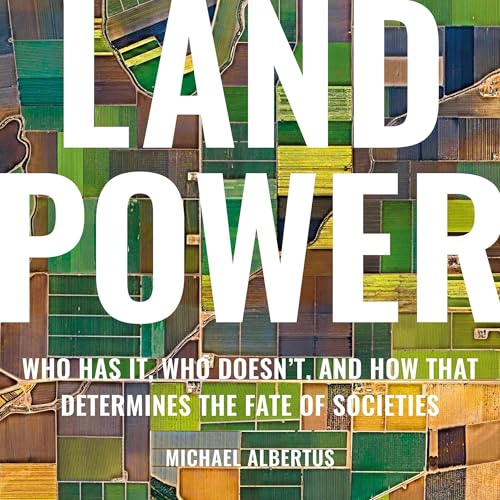
Land Power (Who Has It, Who Doesn’t, and How that Determines the Fate of Societies)
Author: Michael Albertus
NarratedBy: Braden Wright
Michael Albertus (Author, professor at the University of Chicago in the Department of Political Science.)

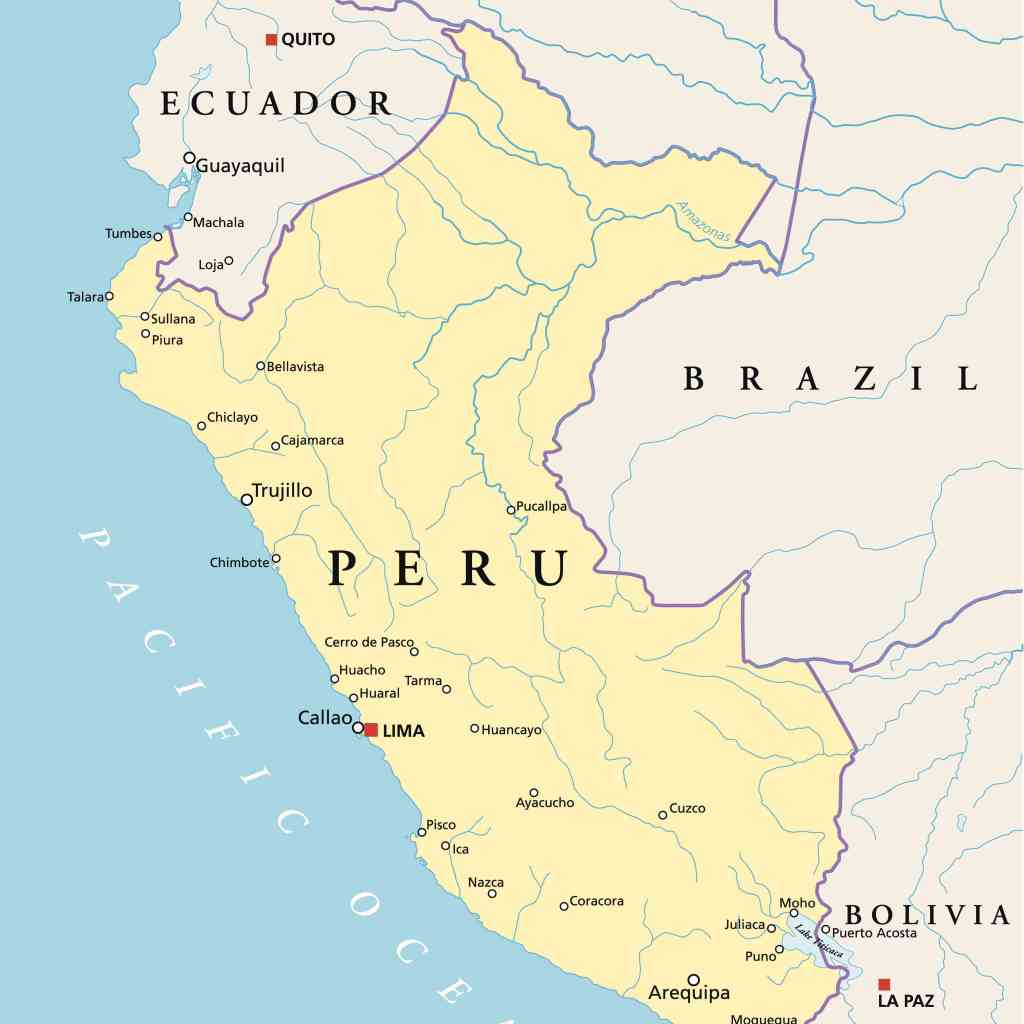
Michael Albertus develops a powerful argument for “Land Power”. Much of history and current events in relatively undeveloped countries are identified as proof of Albertus’s belief that “Land Power” is key not only to economic growth but to social improvement. He reflects on the history of Great Britain, France, and the United States while noting current affairs in developing countries like Peru, Columbia, and Bolivia support his argument.
The unfortunate truth of history is that indigenous populations, particularly in America and Great Britain, were displaced in order for “Land Power” to be the engine for economic prosperity and social change. In the case of America of course, it is the displacement of North American natives by English settlers who became Americans. In contrast Great Britain’s “Land Power” comes from a landed aristocracy and their subjugation of foreign cultures with autocratic control and rule of Asian and European countries. In France, Kings and an aristocratic government’s rejection by commoners in 1789 seem the motive force behind “Land Power” ascension.
For Peru, Columbia, and Bolivia Albertus infers examples of Britain, America, and France set a table for “Land Power” change by their governments. In my opinion, the age of technology has diminished “Land Power” importance in America, Great Britain, and France.
“Land Power” still carries weight in America, Great Britain, and France but in the tech age it seems the power of accumulated wealth has become more powerful than land. However, Albertus’s “Land Power” argument in regard to South American countries like Peru, Colombia, and Bolivia are compelling in regard to their economic and social improvement. Albertus notes private land ownership and recognition of women’s rights to own property, show that “Land Power” is a source of economic and social improvement in South America. He suggests countries like Mexico are being challenged by their failure to reform land ownership policies but today’s leaders in Peru, Columbia, and Bolivia have made significant land reform changes.
Albertus explains the major reform movement between 1969-1980 made by General Alvarado in Peru.
General Alvarado ordered nearly half of all private agricultural land be redistributed among Peruvian citizens. He dismantled large estates to empower peasant cooperatives. It has not been a perfect solution because it created an insurgent group called the Shining Path that pressed for a Maoist collective land reform for the redistributed Peruvian estates. Just as collective farms failed in China, they failed in Peru because common gains in collectives did not fairly reward performance. Collective farms distort the needs and results when a collective rather than a singular leader is responsible for performance of the collective. Nevertheless, the steps taken to dismantle half of private agricultural land, is considered by Albertus a step in the right direction because it incentivized many Peruvians who were living in poverty.
In Colombia, in 1966 through 1970 President Restrepo redistributed agricultural land to former agricultural laborers.
FARC (Revolutionary Armed Forces of Colombia) is organized in 1964 to offer peasant self-defense for actions soon to be taken by President Restrepo to reduce land ownership inequality. Between 2010 and 2018, President Santos negotiated with FARC to settle disputes between former landowners, and new farmers that benefited from land redistribution. There is still conflict because of FARC’s false belief in collective farming which has been proven a failure in other countries, but President Santos and his successors have created a path, though no solution, for reform through the hope for understanding and compromise. Albertus infers land reform is a work in progress, not a perfect solution.
Land reform in Bolivia spans 1953 and the early 2000s.
Presidents Estenssoro (1952-1956) and Evo Morales (2006-2019) worked on land reform along the same lines as Peru and Colombia. Large estates were broken up in 1953 and redistributed to peasants. Morales clarifies indigenous land rights but formalized communal ownership of redistributed land. This is another example of a work in progress because collectivization may be a step in redistributed land, but it has not proven to be a long-range benefit to a country’s citizens. It becomes too divisive and unrewarding for optimum performance and fair rewards for those who excel.
One who read/listens to Albertus’s insight to land reform believes his story has merit but his history is too optimistic when a little additional research shows land reform is a losing proposition when not fully supported by institutions that had implemented change.
History shows land collectivization when large landowners lose their land is a fool’s errand because it fails to reward those who excel as part owners of redistributed land. Human nature gets in the way. Those who work harder than others expect to have proportionate reward. Collective farming disincentivizes personal high performance. Historically, collectivization of land has failed even when those who are part of the collective are better off than they were when they had no land.
“Republic of Lies” is a deeply troubling book that explains much about why lies of a President of the United States are ignored.
Books of Interest Website: chetyarbrough.blog
Republic of Lies (American Conspiracy Theorists and Their Surprising Rise to Power)
Author: Anna Merlan
NarratedBy: Suehyla El-Attar & 1 more
Anna Merlan (Author, journalist, BA degree in Modern Literary Studies from University of California, Santa Cruz, master’s degree in journalism from Columbia University.)

Anna Merlan’s “Republic of Lies” explains conspiracy theories are created by people who have real concerns, fears, and grievances about the world in which they live. Some people capitalize on people’s concerns only to satisfy their desire for money, power, or prestige without care or thought about others. Conspiracy theorists seem to believe everything that happens in society is about plots by others to control or create havoc in their lives.
The digital age.
The advent of the digital age has increased the threat of interest groups that see others as alien to their learned beliefs. The fault is not always in the conspiring groups but in listeners who fail to recognize theories are only theories based on different life experiences and beliefs of like-minded people. The root of the problem with conspiracy is that life experience, and differences in one’s appearance provide a basis for prejudicial bias, identification and belief that is as easily wrong as right. Discrimination based on the color of one’s skin or ethnicity become “de rigueur”, i.e. something required by etiquette or current fashion, rather than the substance of who you are as a person.
Investigative journalism is an important part of the American way of life and its search for truth.
Merlan is an intelligent and brave investigative journalist who interviews extremists to find what they believe and why they believe it. Merlan explains how conspiracy theories are by definition beliefs based on perceptions of events in the world. There is a disconnect between what is real and unreal when what human beings see is based on personal life experience and perception. That is why conspiracy is always a theory which can either be right or wrong and still have great impact on and consequence for society.
Alex Jones (Conspiracy radio host, convicted of civil liability for defamation and required to pay over $1 billion in damages to families of Sandy Hook victims.)
Merlan reveals conspiracy theories in the 20th and 21st centuries that have caused an erosion in trust, strained interpersonal relationships, and promoted extremism. Those who share conspiracy theories often deny the proofs of science and what is evident from repeated human atrocities. People become stuck in misbegotten beliefs that polarize groups of humanity who believe you are either one of us or one of them. In that separation, only those who have the same beliefs are worthy of acceptance. Others are disposable and not worthy of life or liberty.
CIA mind-control program.
Merlan reminds listeners of the CIA mind-control program using LSD in the 195os-1970s, and the Tuskegee Syphilis Study of 1932-1972 as acts of American government that erode public trust. Programs like these have created fertile ground for conspiracy theories to argue there is a deep state government that controls the creation and administration of public policy. The formation of QAnon in 2017 is an internet-born conspiracy factory that trades on the mistrust of government. The internet is no longer mere propaganda tool but a decentralized grassroots generator of government-distrusting American citizens’ groups.
“Republic of Lies” is a deeply troubling book that explains much about why lies of a President of the United States are ignored.
The fear of government is legitimized by American government’s mistakes of the past. Turning to an authoritarian President is American citizens answer to distrust of government. The concern one has is in the character of the authoritarian that has been chosen.
The conclusion one may draw from “Eleanor Oliphant is Completely Fine” is that government liberality is better than authoritarianism
Books of Interest Website: chetyarbrough.blog
Eleanor Oliphant is Completely Fine
Author: Gail Honeyman
NarratedBy: Cathleen McCarron
Gail Honeyman (Author, Scottish writer and novelist, won the 2017 Costa First Novel Award for “Eleanor Oliphant”.)
“Eleanor Oliphant Is Completely Fine” is a commentary on life’s loneliness which seems a self-imposed choice. There is a comic and mysterious quality to Honeyman’s story. Genetics and life experience inherent in every life is what the story of Oliphant is about. As an observer of life, one may believe experiences of life only reinforce genetic predisposition. If one accepts that belief, little of who we become is under our control. Honeyman’s story infers that is only partly true.
Waxing hair removal.
Life is a struggle for Eleanor. It is not that Eleanor does not make choices about life but that her choices appear other directed rather than inner directed. Life may be just a matter of chances and circumstances rather than inner directed motivation. Her story begins with a visit to a salon for an intimate waxing of her labia majora. (Hot or cold wax is applied to her intimate parts that pulls the roots of pubic hair off.) Eleanor is shocked by the experience. One presumes she is shocked because of the pain but surprisingly Eleanor explains it is because of the appearance it leaves of her naked woo-hoo. She thinks she now looks like an infant rather than a fully mature woman. This is a somewhat comic beginning to the author’s story. On the other hand, it shows Eleanor’s life seems more determined by society than inner direction.
Eleanor is a bookkeeper in a small business.
There is a mystery in this story that is slowly revealed by the details of Eleanor’s life. She lives alone in what is a subsidized apartment paid by social services. She is visited by a case worker and there appears some mysterious reason for her receiving help from the State. The mysterious reason is implied by the interview of Eleanor by a social case worker who pauses as she looks at the last part of a file as she interviews Eleanor. The case worker’s pause is about something written about Eleanor’s past. That past is made more mysterious as one finds Eleanor’s mother is institutionalized for some reason not disclosed.
Cultural differences.
The striking point made by this case worker’s visit to an American reader is the difference between Great Britain’s philosophical and cultural differences in regard to social policy. America rejects socialism while Great Britain endorses it. Great Britain practices democratic welfare capitalism while American democratic welfare is more limited. Healthcare is publicly funded in Great Britain while it is mostly private in America. These differences do not change the truth of Eleanor’s life story but it contextualizes Honeyman’s view of a life in a democratic socialist system rather than a democratic capitalist country.
The waxing incident is a comic beginning to Honeyman’s story, but it reflects on urban life as emotionally isolating despite being surrounded by other people.
Eleanor drinks half or more of a bottle of vodka alone in her apartment at the end of a work day. Her life is depressingly humdrum with hints of a trauma earlier in life. Whatever that trauma may have been urges one to keep listening or reading the author’s story. One’s interest is heightened by a young man that seems interested in Eleanor as a future companion. The young man is Raymond, a co-worker. Raymond is a loved son which is quite different from the family in which Eleanor appears to have been raised
Nearly half way through the book, one finds Eleanor has a scar on her face.
Like stepping into a darkened room, Honeyman shines a light on humanity. We become who we are from genetics and life experience. Honeyman gives many hints in her story that suggest there is a connection between Eleanor’s appearance, her reclusive and withdrawn behavior, her alcohol consumption, her mother’s confinement, and the aid she receives from Great Britain’s welfare system.
The perspective one gains from this story ranges from the horror of human selfishness to the value of caring for others.
One may compare American Capitalism with British Socialism thinking of their strengths and weaknesses or view the story of Oliphant as something that can occur in any social system of government.
Oliphant is rescued from a horrible family environment by Great Britain’s social welfare system to become an independent and productive British/Scottish citizen.One wonders if the same could happen in America with a less liberal system of welfare that relies on self-interest to change people’s lives. Of course, that is an unanswerable question because Oliphant could have been rescued in either country. On the other hand, would more citizens be saved by a more socialist system of democratic capitalism?
The details of Oliphant’s life are horrific. The cruelty of family life is real in every culture, whether authoritarian or democratic. The conclusion one may draw from “Eleanor Oliphant is Completely Fine” is that government liberality is better than authoritarianism.
It is interesting to be reminded of the danger of a strong executive branch and the consequence of rule by an authoritarian President. Trump shows loyalty to his beliefs, rather than competence, as the primary qualification for appointment to America’s federal government bureaucracy.
Books of Interest Website: chetyarbrough.blog
Alexander Hamilton
Author: Ron Chernow
NarratedBy: Scott Brick
Ron Chernow (Author, biographer of Alexander Hamilton, George Washington, Ulysses Grant, and Mark Twain.)
Though this critic did not care for Chernow’s biography of Washington, his examination of Alexander Hamilton is of some value. Chernow’s attention to detail is impressive. Considering the detail of Chernow’s biographies, it is quite an achievement for Chernow to have had the time to fully research and write histories of one, let alone four, important American’ leaders and influencers.
Traditionally, Alexander Hamilton’s father has been identified as James A. Hamilton, a largely unsuccessful Scottish trader in the British West Indies (approximately 1,000 miles from the American’ continent–made up of the islands of Cuba, Jamaica, and the Lesser Antilles.)
However, Chernow suggests James Hamilton may not have been the father of Alexander because his mother, Rachel Faucette, may have had sexual relations with other men. Ms. Faucette had become James’ lover while being married to Johann Lavien. Faucette had become unhappy and left Lavien in 1750 to take up with James Hamilton. Lavien had Faucette imprisoned for adultery. Lavien eventually divorces Faucette in 1759.
Chernow suggests Faucette, at some point, may have had an affair with Thomas Stevens, a successful merchant and landlord, while living with James Hamilton.
Chernow’s evidence is primarily from reports of Alexander’s close physical appearance to a son of Thomas Stevens. These two young men, Alexander and Thomas Steven’s son, Edward, were about a year apart in age with Edward being the older. Alexander and Edward became close friends, and Thomas Stevens played an important role in Alexander’s life when his mother died. Stevens took Hamilton into his household on St. Croix. Alexander became part of the Stevens’ family.
In Hamilton’s time with the Stevens family, he became educated by reading books and being employed in the mercantile trades of the West Indies.
By any measure, whether Alexander is the son of Stevens or Hamilton makes little difference. By definition, Alexander’s paternity is illegitimate. One asks oneself–so what? Alexander’s genetic inheritance from Faucette and either father leads him to become one of the most important historical influences in the creation of the American Constitution.
Hamilton arrives in New York City in 1772. Hamilton is only 17. The American Constitution is adopted, signed and ratified on September 17, 1787, and implemented on March 4, 1789.
Hamilton’s influence as a representative of New York is to create a centralized government with taxation authority.
This national government is to have the right to enforce national laws that apply to all citizens according to enumerated powers of a federal government under the direction of a President and Congress elected by American citizens. Chernow notes that George Clinton, the governor of New York, is opposed to the strengthening of the federal government because of his interest in maintaining his power as Governor of New York. Hamilton is one of the three representatives of New York at the convention, two of which were opposed to strengthening the federal government.
Chernow explains how the convention succeeded in strengthening the federal government.
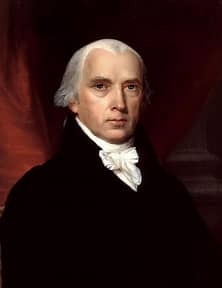
Alexander Hamilton (1755-1804)James Madison (1751-1836)
The two framers that are shown to have the greatest impact on the draft of the Constitution are Alexander Hamilton and James Madison. Chernow explains Hamilton pushed for a strong centralized government with broad powers to tax, regulate commerce, and enforce laws. Madison supports a strong federal government but argues for states’ rights and strict limits on federal authority. Hamilton wishes for broad flexibility for the federal government in the interpretation of implied powers while Madison insists on an explicit statement of the powers of the federal government to limit its implied powers. Hamilton looks to America as an industrializing nation that should be supported by a national bank with federal support for infrastructure improvements while Madison sees America as the agrarian breadbasket for the world with limited banking and industrial’ support by the federal government. Hamilton believes in rule by an educated elite while Madison is concerned about concentration of power in an elitist aristocracy. In the end, Madison takes on the role as the principal author of the Constitution which is intended to limit Hamilton’s expansive interpretation of federal government control of State governance.
It is interesting to be reminded of the danger of a strong executive branch and the consequence of rule by an authoritarian President.
Trump shows loyalty to his beliefs, rather than competence, as the primary qualification for appointment to America’s federal government bureaucracy. Chernow successfully reminds listener/readers of the history of early American government creation, but “Hamilton” is not a page turner like his biography of Mark Twain.
“The Sun is Also a Star” is a nicely written book that will keep reader/listeners interested in knowing what happens to two young lovers. One is left in suspense until its last chapters.
Books of Interest Website: chetyarbrough.blog
The Sun is Also a Star
Author: Nicola Yoon
NarratedBy: Bahni Turpin & 2 more
Nicola Yoon (Author, Jamaican American, NYT’s bestselling author, National Book Award finalist, electrical engineering undergraduate at Cornell, graduated from Emerson College with a Master of Creative Writing.)
Nicolo Yoon, the author, worked as a programmer in investment management for 20 years before publishing her first book, “Everything Everything”. It became a best seller. “The Sun is Also a Star” is her second published book which also became a best seller. Interestingly, the Jamaican born writer’s husband is a Korean American graphic designer. One presumes her book partly reveals her life experience in America. The credibility of her love story lies in the truth of the saying that “birds of a feather flock together”, an apocryphal Biblical saying that reaches back to the “Book of Ecclesiasticus” in the first century. Her hero and heroine are highly intelligent teenagers of immigrant parents who are influenced by their parent’s native cultures. Being children of immigrants, highly intelligent, high performers in academics, and living in America are why one thinks of the “birds of a feather…” analogy.
JAMAICA, SOUTH OF CUBA, OFF OF THE FLORIDA COAST.
“The Sun is Also a Star” is about a Jamaican girl, a South Korean boy, and the girl’s parents who are being deported because of their illegal immigration status. The heroine’s father comes to America illegally to pursue a career. His wife and daughter follow later in presumably the same illegal way. The girl’s father struggles as an unsuccessful aspiring actor. He and the girl’s mother work at menial jobs for the families’ survival. They are within a day of being deported by the American government. Their daughter loves her mother and is ambivalent about her father. She is a bright high school student nearing graduation. The daughter is seeking help from an immigration attorney to delay and hopefully stop their deportation. On her way to an immigration lawyer’s office, she meets a handsome South Korean boy near her age who is interviewing with an Ivy League school in the same building in which the lawyer practices his profession. They serendipitously meet and their lives become intertwined.
Over 200,000 immigrant arrests in America have been made as of August of 2025.
This is a fairy tale story that offers a truth about the iniquity of arbitrary enforcement and forced ejection of purported illegal immigrants in America. The second term of the Trump’ presidency shows how wrong it is to deport alleged illegal immigrants without judicial review. Obviously, if a legal review shows an immigrant is a criminal there is justification for immediate deportation. If the legal review shows an immigrant has always been a productive and law-abiding citizen of America, some may reasonably argue they should be directed to a program that allows them to eventually become legal residents of the United States.
Without legal review, a valuable source of American productivity is unnecessarily lost. To argue that loss is justified by jobs that will be filled by citizens of the United States is weak because many of the jobs taken are not taken by American citizens because the wages are too low, the physical demands too high, and the hospitality needs of much of America are unmet. It is true that many in America are unemployed because they have chosen to not get a good education and choose to remain unemployed by being unwilling to work for low wages. Their unemployment is not because of illegal immigrants but because of the choices they have made in their lives. Construction, agriculture, hospitality, retail, healthcare, and small businesses have been negatively impacted by the deportation of immigrant labor. In some industries, up to 40% of the workforce has been impacted by deportation.
Yoon’s story is a fairy tale of young love between an illegal and legal immigrant living in America.
Nicolo Yoon explains how love between two people occurs when they have similar life experiences and relate to those experiences with shared intelligence. The young girl and boy have similar life experiences in America. Both choose to educate themselves. The two young teenagers have parents that love them who have their own prejudices and life experiences in ways that influence their children to be ambivalent about the love they have for each parent.
Most parent’s, regardless of their culture, want a better life for their children.
Yoon illustrates the motivations and consequences of people who decide to emigrate. Whether emigrating legally or illegally, emigrees are faced with the difficulty of adjusting to a different culture that conflicts in good and bad ways with the culture they have left. Emigree’ parents wish well for their children but many fail to grasp the freedom offered by American culture to choose their own path in life. Even though life choices are influenced by one’s intellect, emotions, and (in America) a white majorities’ discrimination, most young people are able to choose their own path in life.
“The Sun is Also a Star” is a nicely written book that will keep reader/listeners interested in knowing what happens to two young lovers. One is left in suspense until its last chapters.
Technology is a key to social need which has not been well served in the past or present and could become worse without pragmatic accommodation.
Books of Interest Website: chetyarbrough.blog
Daughters of the Baboo Grove (From Chian to America, a True Story of Abduction, Adoption, and Separated Twins)
Author: Barbara Demick
NarratedBy: Joy Osmanski
Barbara Demick (Author, American journalist, former Beijing bureau chief for the Los Angeles Times.)
This is a brief and fascinating historical glimpse of a government policy gone awry. Like America’s mistaken policies on immigration, Barbara Demick’s story of China’s one-child policy traces the effects of government overreach. Demick tells the story of a rural Chinese family who births twin sisters during the time of China’s unjust enforcement of their one-child policy. One sister is abducted by Chinese government officials, and is adopted by a family in Texas. The ethics of an inhumane Chinese government policy and the perfidy of free enterprise are exposed in Demick’s true story of two children’s lives.
The territorial size of China in respect to continental America.
China’s one-child policy leads to a Chinese criminal enterprise to capitalize on kidnapping and selling children born to families that could not afford the fines for having more children than the law allows. Undoubtedly, most children born were cherished by their parents, but the hardship of life and human greed leads to unconscionable human trafficking. Kidnapping became a part of a legal and criminal enterprise in China. Government policy allowed bureaucrats and scofflaws to confiscate children from their parents and effectively deliver or sell children to orphanages or people wanting to adopt a child. Demick recounts stories of grieving parents and grandparents that cannot get their children back once they have been taken.
Child trafficking, broken families, loss of personal identity, human shame, and the immoral implication of other countries interest in adopting children are unintended consequences of a poorly thought out and implemented government policy.
Demick becomes interested in this story because of a message she receives from a stepbrother of an adopted Chinese sister that has a twin that lives in China. Because of Demick’s long experience in visiting and reporting on China, she had a network of people she could call. Using adoption records, Demick is able to find the Texas stepsister who had been kidnapped when she was 22 months old. She was trafficked to an orphanage in the Hunan Province of China. Years later, through messaging apps, the twins communicated with each other and shared their photographs. They eventually meet in China in 2019.
One is hesitant to argue a government policy is a unique act of China when every government makes policy decisions that have unintended consequences.
America’s policy decisions on immigration are a present-day fiasco that is as wrong as the one-child policy in China’s history. The one-child policy is eventually rejected by the Chinese’ government but Demick’s book shows how bad government policy has consequences that live on even when they are changed by future governments. America’s policy on immigration will be eventually reversed but its damage will live on.
Getting back to the story, Demick is instrumental in having the mother of Esther (aka E) and the twins meet in China.
One is hesitant to argue a government policy is a unique act of China when every government makes policy decisions that have unintended consequences. The twins are initially reticent but warm to each other in a way that bridges the cultural and language divide between the sisters. The two mothers see their respective roles in their daughter’s lives. E and her identical twin, Shuangjie, are reserved when they meet because of the cultural distance that was created by E’s adoption.
E. appears more confident than Shuangjie who is more reserved and less assured.
However, Demick suggests they seem to mirror each other in subsequent meetings. One feels a mix of emotions listening to this audiobook version of “Daughter’s of the Bamboo Grove”. They have grown up in different environments but seem to have been raised in similar economic circumstances, though the two economies are vastly different in income per household, the two appear to be raised in similar economic classes.
Every person who reads/listens to “Daughter’s of the Bamboo Grove” can view the story from different perspectives.
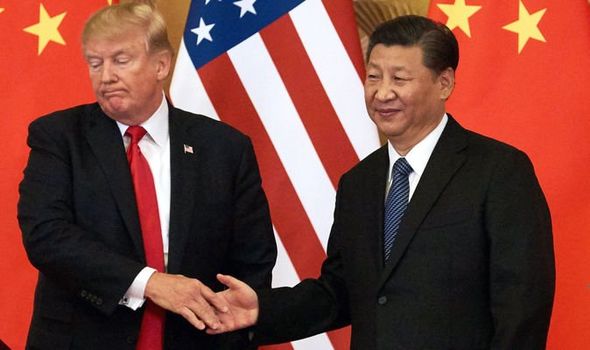
There is the perspective of identical twins raised in different families, cultures, and histories. How are identical twins different when they are raised by different parents and in different cultures? Another perspective is that Xi and Trump have had dramatic effects on the societies their policies have created. The Twin’s meeting in 2019 is one year after my wife and I had visited China. Xi had become President after his predecessor began opening China’s economic opportunities. Two incidents on the trip when Xi had become President come to mind. The first is the feeling one has of being monitored everywhere and the internet restrictions when used to ask questions. The second was an incident in a crowded Chinese market when I was approached by a beefy citizen who raised his arms and seemed to be angrily talking to me in Chinese which I sadly did not understand. The distinct impression is that I was not welcome. This was a singular incident that did not repeat in our 21-day tour, but it seemed like an expression of hostility toward America.
This listener/reader thinks of the unintended consequences of Trump’s treatment of alleged illegal immigrants.
Trump’s immigration policy is similar to China’s earlier mistake with the one-child policy. America’s, China’s, and Japan’s economies are highly dependent on youth which is diminished in two fundamental ways. One is by public policy that restricts birth, and the other is immigration. Freedom of choice is a foundational belief in democracy while considered a threat in autocracy. In America today, it seems there is little difference between America, Japan, or China in regard to government policy that threatens the future. All have an aging population that can only be aided by younger generations. Even though manufacturing may become less labor intensive, public need in the service industry will grow. Technology is a key to social need which has not been well served in the past or present and could become worse without pragmatic accommodation.
Benjamin Franklin was no saint. He was a pragmatic, diplomatic, and intelligent politician who believed in improving himself, being honest in his relations with others, and determinately set on leaving a legacy of diplomatic accomplishments that (unlike our current government leaders) was intent on truly making America great.
Books of Interest Website: chetyarbrough.blog
The Completed Biography of Benjamin Franklin
Author: Mark Skousen
NarratedBy: Richard Ferrone
Mark Amdrew Skousen (Author, economic analyst for the CIA from 1972-1977, is considered a political conservative, a distant descendant of Benjamin Franklin.)
Though the history of Benjamin Franklin is “well plowed” ground, Mark Skousen assembles Franklin’s original papers on his intended biography to give a fascinating portrait of perhaps the greatest American patriot in our history. Franklin’s role in America’s independence from Great Britain is perfectly explained in Skousen’s review of Franklin’s intended autobiography. The many offices that Franklin assumed in pre- and post-revolutionary times are evidence of his patriotism and importance.
Benjamin Franklin (1706-1790, died at the age of 84.)
Franklin served as a member of the Continental Congress from 1775 to 1776. He was the President of Pennsylvania from 1785 to 1788. His diplomatic roles were as Commissioner to France from 1776-1778, Minister Plenipotentiary to France from 1779 to 1785, and Peace Commissioner who negotiated the Treaty of Paris ending the Revolutionary War and establishing American independence. These formal posts fail to mention his great role in representing America to the British throne while sailing to England before the revolution.
Thomas Penn (1702-1775)
It is ironic that Franklin became the President of Pennsylvania in 1785 when he had challenged the Penn family’s proprietary control over Pennsylvania territory given to the Penn family by the King of England.
The Penns refused to allow taxation of their estates in the colonies. Franklin met with Thomas Penn and wrote a paper saying the Penns prevented governors from using discretion in the management of the Pennsylvania colony, refused colonists right to raise funds, and would not accept taxation on their properties. Though Franklin did not legally represent the colonies, he galvanized opposition and created groundwork for colonial autonomy. He became known as the “defender of colonial rights”.
Franklin’s biography explains how he became widely known in England, France, and the colonies.
In 1773, two Massachusetts’s colonial government letters were published at the direction of Franklin that exposed British officials’ promotion of restrictions on the colonies’ liberties. Franklin had been appointed Postmaster General in America, authorized by England, but was discharged for having published those inflammatory letters. Franklin wrote several satires mocking British colonial policies. He opposed the Stamp Act while becoming a representative of Pennsylvania, Massachusetts, Georgia, and New Jersey in London.
Benjamin Franklin’s experiment.
Despite Franklin’s opposition to England’s infringement on colonial rights, he was celebrated in England’s scientific community. He received the Copley Medal for his experiments with electricity and a fellowship in the Royal Society. William Strahan, one of England’s printers who was an MP, and the famous William Pitt sympathized with Franklin’s explanation of the colony’s grievances. On the other hand, growing anger from England’s parliamentarians required Franklin to escape arrest in England in 1775.
Benjamin and William Franklin
To show how torn colonist’ families are about the colony’s declaration of independence, Franklin’s son, “Billy”, actually William Franklin, is noted in his father’s diary and writings to have chosen to take the British side of the conflict. William had served as the Royalist’s Governor of New Jersey. He was appointed with the help of his father’s influence in London. William refused to join the Patriot cause and was imprisoned from 1776 to 1778, and later, exiled to Britain where he lived until the end of his life. It appears Benjamin and William never reconciled and never saw each other again. Benjamin Franklin dies at the age of 84 in 1790 while his son Willaim passes at the age of 83 in 1813.
Symbol of the Colonys’ fight for independence.
Some interesting notes are in Franklin’s diary about symbols of the war of independence. In 1754, Franklin published the cartoon of a snake emblazoned with 13 skin segments with a message “Join or Die” It was originally designed for the French and Indian War but became a symbol of the colonies fight for independence from Britain. In contrast, Franklin opposed the eagle as a national emblem and preferred the turkey. To Franklin, the eagle was a bird of bad moral character while the turkey, in his opinion, represented “a more respectable bird”. This is a surprise to many who revere the eagle as America’s symbol of independence, strength, and elegance today.
Franklin is considered wealthy at the time of his death.
In today’s dollars, Franklin’s wealth may be estimated at 10 to 90 million dollars. He had created a printing empire with “The Pennsylvania Gazette” and “Poor Richard’s Almanack” and used his presses to print books, pamphlets, and even currency. He licensed lighting rods to minimize building destruction from lightning strikes and provided heat to colonist’s homes with the Franklin stoves. He had rental properties in Philadelphia and speculated on western land purchases. He received compensation for his diplomatic and government service as Postmaster General. Franklin showed himself to be frugal putting money aside to receive compounding interest on its principle. He preached and practiced the adage, “A penny saved is a penny earned”.
Deborah (Read) Franklin, Benjamin Franklin’s wife.
Benjamin Franklin notes his wife’s name is Deborah Read. She dies in 1774 at the age of 66 from a series of strokes. Her health declined as Franklin’s diplomatic service in England and France took him away from home. When she suffered from a series of strokes, his voyages to Europe kept him from returning immediately. He returned in 1775, and Franklin was buried beside her in 1790.
Franklin’s self-written biography shows him to be charming and flirtatious with an appreciation of women.
Franklin’s flirtations with Brillon and Helvétius connected Franklin to influential French society, helping him secure support for the American cause. Ms. Brillon is in her 30s while Franklin is in his 70s. Another French lady is Madam Helvétius is in her mid-60s. Franklin proposes marriage to which she declines. It seems there is more smoke than fire in regard to Franklin’s illicit liaisons in France. However, he does admit to some youthful indiscretions with women of challenged reputations when he is younger.
Benjamin Franklin was no saint. He was a pragmatic, diplomatic, and intelligent politician who believed in improving himself, being honest in his relations with others, and determinately set on leaving a legacy of diplomatic accomplishments that (unlike our current government leaders) was intent on truly making America great.
Millman’s Socratic story is about human patience and knowledge. He addresses knowledge as something of the greatest value that can keep one from resorting to violence. This is a message that resonates with those who are appalled by today’s international and domestic conflicts.
Books of Interest Website: chetyarbrough.blog
The Journeys of Socrates
Author: Dan Millman
NarratedBy: Sam Tsoutsouvas
Dan Millman (Author, world champion athlete, martial arts instructor, and college professor.)
Dan Millman’s reasons for the title of his book “The Journeys of Socrates” is difficult to understand. The known facts of Socrates life do not seem remotely related to the life of a Jewish immigrant who lived in 19th century Russia. The story is almost too horrific to believe because of the tragic life of its hero Sergei Ivanov, a Jew in Tsarist Russia being raised in a camp of Cossack warriors. The only parallels one may make is that Socrates is characterized in ancient writings as a man who sought virtue and wisdom in his journey through life.
Socrates was known as a warrior in the Peloponnesian War between Athens and Sparta (431-404 BCE). He is better known as a teacher and student of the philosophy of life.
Socrates had gained a reputation for bravery, endurance, and moral fortitude in war, while a mentor of young men like Alcibiades who wanders through life with little self-understanding. (It is the ancient writings of Plato, Xenophon, and Aristophanes that reveal some of what is told of Socrates life.) This seems a slender thread of association with the title of Millman’s book. The story of Sergei Ivanov is of a man who introspectively examines the meaning of life after experiencing horrific violence. This is a Socratic interrogation of a Jew’s life in pre-1917, revolutionary Russia and Ukraine.
Hiding one’s identity as a Jew has been told many times by many authors. Ethnicity and religious belief, like the color of one’s skin, marks one as different.
Ethnicity is a marker of human beings as the “other”, i.e., someone different than themselves. Unlike the color of one’s skin, ethnicity is easier to hide. Sergei Ivanov becomes known as a Jew in a Cossack training camp. He decides to escape that life but is followed by a fellow trainee who catches him. They fight and Sergi’s antagonist is knocked unconscious and appears dead. Sergi escapes and plans to find what he believes is a treasure buried by his grandfather that will give him enough money to get passage to America from his grandfather’s Ukranian homeland.
Buried treasure.
Sergi finds the treasure that had been buried by his grandfather, but it was only a clock and five gold pieces, not enough for passage to America. However, there is an address on the clock that leads him to his grandfather’s house. What he finds is an aunt that he thought was dead. She has a daughter for whom he falls in love and asks for her hand in marriage. They are married and Sergi’s plan is to take his now pregnant wife to America when he has earned enough money for passage. However, fate intervenes.
The man Sergi thought he had killed when he escaped the training camp was alive and had become a leader of a Cossack gang that terrorized the country with a special hatred for Jews.
The gang comes across Sergi and his pregnant wife when they are out for a walk before their planned trip to America. His former enemy and his followers murder Sergi’s wife, rip the baby out of her womb and leave her husband unconscious on the ground after trying to defend his pregnant wife. The gang leader chooses to leave Sergi alive to remember the grief he would have for his wife and baby’s loss of life because he could not save them. Sergi recovers and prepares himself for revenge on his former training camp antagonist.
Deaths inevitability.
At this point, one presumes this is to remind listeners of Socrates reported bravery, endurance, and moral belief despite hardship in life and one’s inevitable death. However, this is only a small part of the author’s intent. What one draws from the story is how ethnic or racial discrimination exists in every nation in the world. Human nature is often brutish and violent despite a rational person’s search for truth and peaceful coexistence. One asks oneself why humans wage war, why we murder innocents, and why does revenge only begat more death.
Sergi recovers from his injuries and is counseled and educated by a believer of a different faith.
As one finishes Millman’s story, listener/readers realize Sergi’s teacher is educating him about human patience, ethnic understanding, and knowledge that can break the repeating cycle of discrimination and violence caused by racial, gender, and ethnic difference. It requires patience, preparation, and knowledge. Sergi spends many years with his teacher and gains great strength to prepare him for what is to happen next in his life. Knowledge of what happened when he was struck down after his wife was murdered is not clear to him. As the story develops, one finds his wife had two children in her womb and only one died in the confrontation. What happens when Sergi meets his wife’s murderer is the denouement and fundamental meaning of Millman’s story.
Millman’s Socratic story is about human patience and knowledge. He addresses knowledge as something of the greatest value that can keep one from resorting to violence. This is a message that resonates with those who are appalled by today’s international and domestic conflicts.
Murata’s satire infers obsession with sex for pleasure, child rearing collectivization, gender dysphoria, and pregnancy equalization are pathways to societal destruction.
Books of Interest Website: chetyarbrough.blog
Vanishing World (A Novel)
Author: Sayaka Murata
NarratedBy: Nancy Wu
Sayaka Murata (Author, Japanese novelist.)
Sayaka Murata’s subject is clearly revealed in its title, “Vanishing World”. “Vanishing World” is a provocative assessment of how sexual relationship and sex education has changed. Murata satirically reveals how human reproduction, objectification of life, motherhood, and technology may dehumanize society.
Murata’s fictional story is highly informative in regard to sexual difference and similarity between men and women.
In one sense, Murata’s fictional story is highly informative in regard to sexual difference and similarity between men and women. As a reader/listener, Murata offers a detailed description of the physical difference between the sexes. Many who think they know something about sexual difference will find the author’s candor enlightening. However, her depiction of social relationship is off-putting with a satirical exaggeration of socio/sexual objectification.
Murata writes about a single parent family with a young daughter who lives with her mother and is nearing the age of puberty.
(Though not mentioned in Murata’s story, single family homes in America have grown by nearly 30% in the 21st century.) The main character’s name is Amane and Murata’s story is about Amane’s sexual awakening and how she views social relationship. Amane is infatuated with an animated male character on television. She imagines being married to this character before puberty but holds this character in her mind throughout childhood and later life.
Murata suggests reproduction may evolve into a preferential desire for artificial insemination rather than sexual intercourse between a man and woman.
This idea feeds into a listener/reader’s mind as a diminishment of the need for emotional attachment to the opposite sex for procreation. Sex becomes detached from procreation, evolving into only “hooking up” for sexual stimulation and/or personal gratification. Murata infers desire is no longer needed for procreation but only to experience intercourse as an emotional and physical pleasure. Consequently, it seems perfectly natural to transfer sexual desire to a fictional character because it becomes unnecessary to have emotional attachment to humans when a figment of one’s imagination is available.
Murata creates a bizarre world.
The bizarro world that Murata creates is an extension of a belief that society is becoming less attached to their humanity. Marriage, human relationship, and motherhood are replaced by mindful personal’ inwardness and endless pursuit of physical stimulation without emotional entanglement. By extension, Murata suggests science will create wombs for men so that the difference in sexes equalizes childbirth and care of children. Caregiving becomes bureaucratic and collective because caregiving is no longer personalized.
Murata suggests that a new system of childcare will evolve into collective training camps for working parents who are too self-absorbed to raise their own children.
Collective childcare disconnects parents from the management and development of their children. The sterility of conception by artificial insemination, collective childcare, and social acceptance of multiple sex partners diminishes both familial relations and child development. Birthing and raising children becomes a clinical process, i.e., less personal with both men and women capable of experiencing pregnancy and delivery; all without responsibility or obligation for childcare.
In some sense, this satire illustrates the negative potential of socio/sexual equality.
Murata’s story ends with the birth of their first child from a man who is Amane’s husband. She is torn over not being able to take the baby home because the child is already being “cared for” in a ward meant to raise and nurture all newly born children. A final point is made in the story by a visit from Alane’s mother after the birth. She asks Amane where the child is, and Alane explains the child will not be raised by her and her husband. Alane’s mother is aghast. Her mother falls to the floor and dies without any apparent familial concern for her sudden collapse and presumably, death. The next thing to happen is a visit from one of the children born in this new world. Alane chooses to have sex with him and the story ends.
“Vanishing World” implies 21st century science, organizational bureaucracy, and social change threatens survival of humanity. Murata’s satire infers obsession with sex for pleasure, child rearing collectivization, gender dysphoria, and pregnancy equalization are pathways to society’s collapse.