Fredrick Backman’s story shows how the best and worst adults come from the admixture of life. “My Friends” is a funny and barely believable story, written by a highly entertaining and accomplished writer.
Books of Interest Website: chetyarbrough.blog
My Friends (A Novel)
Author: Fredrik Backman
NarratedBy: Marin Ireland
Fredrik Backman (Author, Swedish blogger and columnist, also wrote “A Man Called Ove”.
Fredrik Backman’s “My Friends” is an immensely entertaining story that fulfills the meaning of the word “wry”. A definition of wry is “ironically or grimly humorous”. What “My Friends” shows is that the life of a child is as much luck as innate ability and choice.
The main character of “My Friends” is Louisa, a 17-year-old foster child living on the street. She has a preternatural ability to draw and appreciate a work of art.
Backman’s story infers human beings are born with a genetic inheritance reinforced or discouraged by life experiences. Louisa never knows her father and is raised by a mother who drinks herself to death. Louisa is shunted to a neighbor’s care who abandons her to child services. She escapes into the streets of a city where reader/listeners find her meeting a disheveled and apparently ill person outside an art auction house. Louisa is drawing small red fish on a building wall when she is joined by this stranger who begins drawing skulls on the same wall. This chance meeting changes the course of Louisa’s life.
As luck and circumstance would have it, the artist (Kimkim aka C. Jat) is a painter whose work Louisa has admired over her short years of life. She has carried a post card (which she cherishes) that shows the artist’s famous work that is being auctioned. She does not realize the person she is talking to is the artist.
Monet’s “Water Lillies” as an example of a famous work that has been auctioned several times with the last auction amounting to $65.5 million.
Some days later the artist dies in a hospital with his lifelong friend, Ted, at his side. Ted has purchased the world-renowned painting done by the artist. Ted had bid the highest amount for the work because Kimkim wished to give the work to the young girl he had met painting red fish on the wall on which he was painting skulls. Because of his fame, the painting takes all Kimkim had saved over the years of his life.
A skull painter named Jean-Michel Basquiat is referred to as an artist emulated by Kimkim.
The author has set the table for his story. Kimkim dies and asks his life partner, Ted, to give the painting to the homeless girl. There is a fairy tale quality to the story, but it opens one’s mind to the serendipitous nature of life. Children live lives in a world of other’s making. Formative years of every child range from horrendous to beatific. Louisa is just one example of the happenstance of life for a young girl. It makes one think of the horrendous circumstances of children who are raised in war torn countries or on the streets of the homeless in America or other countries that fail to care for the indigent. Louisa’s story is “every child’s” story that is far from ideal but as real as life in the anywhere world.
There is a fairy tale quality to the story, but it opens one’s mind to the serendipitous nature of life.
The twists and turns of Backman’s story have Ted reluctantly taking Louisa under his wing while she maneuvers to escape and leave the valuable painting to Ted. She returns to the street as an 18-year-old young woman on her own. Louisa leaves Ted asleep on a train car with the boxed painting by his side because she does not believe the valuable painting should be hers. A reader/listener is only half-way through this imaginative story. It is not a book one will put down before learning how it ends.
Backman’s story shows how the best and worst adults come from the admixture of life. “My Friends” is a funny and barely believable story, written by a highly entertaining and accomplished writer.
Gaige’s writing is crisp, insightful, entertaining, and highly relatable. It gets to the heart of life’s struggles without being judgmental or accusatory.
Books of Interest Website: chetyarbrough.blog
Heartwood
Author: Amity Gaige
NarratedBy: Justine Lupe & 5 more
Amity Gaige (Author, lecturer in English at Yale University, 2017 Guggenheim Fellow in Fiction.)
“Heartwood” is a well written, creative, and insightful novel about human fragility. It begins with a lost hiker on the Appalachian Trail. One may recall newspaper articles about this trail where many famous and infamous people have been known to travel. What is less well known is the trail is 2,197-miles long and crosses 14 states. Amity Gaige writes a story of one lost hiker, but it is much more. Of course, it is about search and rescue that reveals how complicated it is to find someone who is lost in a wilderness. In a public hiking trail, at least in the pre-Trump era, national government employees were available to conduct search and rescue services in national parks. There are many local volunteers who aide in these searches, but it is managed by experienced park rangers. Gaige reveals the inner fears and reality of one who is lost in life as well as in a wilderness. The creativity of the author is in her reveal of human nature. All people struggle to live lives that mean something but exhibit physical and mental flaws that get in the way.
The lost hikers name is Valerie Gillis. The primary searcher is Bev Miller, a lieutenant in charge of search and rescue teams when someone is lost on the Appalachian Trail. Those who are rescued, and those who rescue, live lives of equal unpredictability. (Bev Miller’s mother is in a health care facility for the elderly who are troubled by dementia.) The hiker is seeking solace from her personal life by taking a hike on the Trail with a friend who is a substitute for her recently divorced husband. Her and her friend become separated, and she wanders off the Trail. She becomes disoriented and cannot find her way back to the well-traveled path but, as a trained nurse, she copes with her isolation better than most who might make the same mistake. She keeps her wits about her, but an unexpected event changes the course of her life.
Military training.
The area in which Gillis becomes lost is near a security encampment used to train soldiers for wilderness’ survival. The training is harsh and some of the inductees choose to go AWOL, absent without leave. An AWOL’ escapee who is having a nervous breakdown comes across Gillis. His psychological imbalance influences him to imprison Gillis making her unable to find her way back to the Trail. Eventually, her antagonist leaves but Gillis’s physical deterioration advances to the point of near starvation.
The author is exploring the idiosyncrasies of life. Many incidents that lead to the rescue of Gillis show how every human being deals with events in life that are beyond their control. One elderly woman who exhibits symptoms of dementia becomes a clue to the location of Gillis. This elderly woman’s life shows one of many circumstances in life that are beyond one’s control. This dementia burdened woman recovers some of her lost faculties to report having talked to a young man who is being treated for psychological imbalance. He tells of meeting a lost hiker in the wilderness. Until that clue is revealed. no one knew the correct area in which to search for Gillis.
There are many human relationship strengths and weaknesses revealed in Amity Gaige’s “Heartwood”. Gaige’s writing is crisp, insightful, entertaining, and highly relatable. It gets to the heart of life’s struggles without being judgmental or accusatory.
Pedophilia is a terrible crime. Unprofessional exposure of its consequence compounds a victim’s trauma. There are no heroes or heroines in Lisa Jewell’s imaginative story.
Books of Interest Website: chetyarbrough.blog
None of This Is True (A Novel)
Author: Lisa Jewell
NarratedBy: Kristin Atherton & 9 more
Lisa Jewell (Author, British writer, born in London, has written several novels.)
“None of This Is True” is a disturbing novel. From a happenstance birthday party at a restaurant, two young women find they were born on the same day in the same hospital. One of the women is a podcaster and the other is a housewife. This chance meeting leads to the podcaster agreeing to create a podcast about the life of the woman who had been born on the same day in the same hospital forty-five years earlier. Both are married with children and husbands but one has a story to tell that only comes clear as the podcast unfolds. The circumstances of her life peak the podcaster’s interest because the woman asking to tell her story had married her husband when he was 43 and she was only 16. The thought of such an age difference makes one instantly dislike her husband which only deepens as the story proceeds.
Definition.
This marriage becomes increasingly shocking as the podcaster’s recordings begin. The story tells of this odd marriage to a husband who often stays out all night either drinking or something worse considering his predilection for young girls. The mother is interviewed by the podcaster who characterizes her as a narcissist who regrets ever having gotten pregnant. She seems to care nothing about the impropriety of her daughter marrying a 43-year-old when she is 16.
Victims.
The story becomes more complicated as the victim of pedophilia appears to steal items from the podcaster’s home. At a half-way point in the novel, the reader/listener realizes the podcaster is out of her depth in thinking her podcast is an appropriate way of dealing with the psychological trauma of a victim of her lived life. One begins to lose their baring on who is guilty for having lived a life of misery and dysfunction. Only the specter of pedophilia seems clearly wrong, but the victim of the pedophilia is raised by an uncaring mother that let it happen. Now there is a podcaster caught in the middle of something way beyond her professional ability who is caught in a growing domestic abuse and psychological nightmare.
The inhumanity of humanity.
This is a terrifying book about humanity. One is drawn into its sordid tale to reveal how inadvertently we can be drawn into the drama of another’s life without qualification for dealing with its complexity. As a reader/listener there are lessons to be learned about one’s limitations and how we can become a part of the problem, rather than a solution. Pedophilia is a terrible crime. Unprofessional exposure of its consequence compounds a victim’s trauma. There are no heroes or heroines in Lisa Jewell’s imaginative story.
Human nature is universal, but it is also particular. In that particularity, “Ikigai” may or may not work for you or me. That is not to say the philosophy of “Ikigai” cannot lead one to a better life but only you can decide.
Books of Interest Website: chetyarbrough.blog
Ikigai (Japan’s Secrets to a Long and Happy Life)
Author: Hector Garcia, Fransec Miralles
NarratedBy: Oscar López Avila
Hector Garcia (Spanish born author and philosopher, lives in Tokyo.)Fransec Miralles (Spanish Editor, world traveler.)
In planning a trip to Japan in September 2025, “Ikigai” is a recommended book by our Japanese guide. Surprisingly, the authors are born in Spain.
“Ikigai” is a Japanese philosophy about life and its value.
As understood by Garcia and Miralles, “Ikigai” is a guide to a meaningful and fulfilling life. As a philosophy, “Ikigai” is not about life’s destination. “Ikigai” is a compass to give one direction for a meaningful and fulfilling life. The principles of “Ikigai” revolve around a healthy diet, high quality health care, community ties that limit one’s isolation, physical routines, mindfulness, and stress reduction. Those who practice the philosophy of “Ikigai” in Garcia’s and Miralles’s opinion will live happier, healthier, and more fulfilling lives.
Life’s value.
Garcia and Miralles suggest the demographics of Japan are proof of the value of “Ikigai”. The highest number of citizens over 100 years of age live in Japan. The average life span of men and women in Japan is 85; for Americans, the average is 79.61. The authors suggest longer lives of Japanese is because of their practice of following the principles of “Ikigai”. Of course, the length of one’s life is not the point, but the quality of one’s life is everything.
Diet, healthcare, sociability, and daily routines reduce stress. These are guidelines for an “Ikigai” way of life.
There are no surprises in these guidelines. Diet is to consume fruits, vegetables, fish, limited red meat, with few sweets containing processed sugars like white, brown, powdered, or high-fructose corn syrups. Healthcare should be provided through universal coverage. Sociability is encouraged to avoid isolation. Daily walking, stretching, moving around, and being mindful of one’s activity should be a part of a person’s lifestyle. Find what reduces your stress and practice those activities. These are familiar guidelines but not often practiced because of the stresses of the culture in which people live. Many try to escape the stress of their cultures with bad eating habits, poor physical routines, and social isolation. Some fail to follow these guidelines because they are too poor to care.
Human frailties like hearing loss, vision loss, or physical deterioration.
There are a number of difficulties with the guidelines noted by Garcia and Miralles. Finding a way of life that fulfills the ideals of “Ikigai” discounts the nature of human beings. It is impossible to ignore the personal instincts, drives, physical maladies, and cognitive abilities of different human beings. One size does not fit all because of these differences. Human nature may be universal, but it is not the same because human history, physical limitation, culture, and individual experiences are different. If the cultures in which you live do not offer universal health care, one is on their own. A capitalist culture operates in a different way than a socialist culture. Poverty, levels of education, and government influence exist in every culture and by nature distort what use can be made of “Ikigai” guidelines.
Human nature is universal, but it is also particular. In that particularity, “Ikigai” may or may not work for you or me. That is not to say the philosophy of “Ikigai” cannot lead one to a better life but only you can decide.
The relentless harshness of Demon’s life wares on a listener/reader. One has to be invested in Demon’s life adventure to fully appreciate the creative talent of the author.
Books of Interest Website: chetyarbrough.blog
Demon Copperhead (A Novel)
Author: Barbara Kingsolver
NarratedBy: Charlie Thurston
Barbara Kingsolver (Author, American Pulitzer Prize-winning novelist, born in 1955.)
Several years ago, I began Barbara Kingsolver’s “The Poisonwood Bible” for which she won a Pulitzer Prize. This revisit to her writing is to see what her view is of a young boy in a broken American family. “The Poisonwood Bible” like “Demon Copperhead” are well written novels but “…Poisonwood…” is about missionary work whereas “…Copperhead…” is about life in America for children who are challenged by poor family circumstances. Both novels are too long though …Poisonwood… is highly acclaimed and rewarded by a Pulitzer Prize. Demon Copperhead is the story of a young boy caught in a welfare system meant to aid mothers who are incapable of caring for themselves, let alone their children.
Kingsolver’s point of view can be understood from different perspectives.
The hardship of raising a child is compounded by circumstances of an unmarried woman with a substance abuse problem. The story of Demon Copperhead explains how incredibly harsh it can be to live in America. Despite America’s reputation in the western world as a land of opportunity, it is viewed by many as a land of excess and inequality. Sweden, Canada, and Germany consider America more critically than other western nations. Kingsolver explores some examples of why America is viewed so differently.
Demon’s parent is a recovering drug addict with poor job prospects whose husband has died and decides to marry a man with anger management problems.
Demon’s mother obviously has personal problems. With a school-age child to raise, and a second marriage created out of her self-inflicted problems, her life is a mess. Addiction returns, and her new husband physically abuses her son. She overdoses, and her son calls 911 to have her rescued. She does not recover, and Demon becomes a ward of the State. Demon is farmed out to a rehabilitation ranch called a foster home when in fact it is more like a slave retreat serving the needs of a hard scrabble farm. Demon’s mother dies from her earlier overdose. Demon is 11 years old with nowhere to go than a neighbor’s family to be watched over while he fulfills his obligations to the rehabilitation ranch. He is essentially a slave to the care of cattle and the harvesting of tobacco when he is not in school.
Harshness of life is generally an uncommon circumstance of life in America, but it shows how harsh life can be whether one lives in America or anywhere in the world.
Demon is characterized as a tough-minded boy who adapts to his circumstances with little choice because of his age and family circumstance. One dim opportunity is the grace of his dead mother’s neighbors that reluctantly allow him to temporarily stay with them after his mother’s death. Demon chooses to search for his birth father’s grave and finds his grandmother in Nashville, Tennessee. It comes as a surprise that Demon’s father comes from a matriarchal family that is a haven for lost human beings.
The relentless harshness of Demon’s life wares on a listener/reader. One has to be invested in Demon’s life adventure to fully appreciate the creative talent of the author. Some will choose to finish Kingsolver’s story to find out how Demon’s life is either resurrected or lost. Others will move on to another book, not out of disappointment with Kingsolver’s creativity but out of fatigue from a story that is too long.
Science is unquestionably dependent on precise measurement while art or literature may have little to do with it.
Books of Interest Website: chetyarbrough.blog
The Perfectionists
Author: Simon Winchester (How Precision Engineers Created the Modern World)
NarratedBy: Simon Winchester
Simon Winchester (British-American author and journalist)
The beginning of “The Perfectionist” has an interesting vignette about Simon Winchester’s father that sets the table for his book. Simon’s father is characterized as an engineer that was asked to investigate why ammunition being used during WWII was misfiring. Bernard Winchester went to the production’ plant and precisely measured the ammunition that was being manufactured. Its quality was found to be well within specifications required to fire properly when used. Simon’s father followed a shipload of the ammunition to its destination to re-measure the specifications after delivery. The on-board jostling of cargo boxes caused miniscule damage to ammunition resulting in misfires in the field. Simon’s father’s discovery led to better packaging of the ammunition. Simon notes his father is highly praised by the military for his diligent investigation which made corrections in the way ammunition was packaged for transport to the front.
Simon’s father followed a shipload of ammunition to its destination to re-measure the specifications after delivery.
Simon Winchester’s story of his father is the subject of “The Perfectionist”. There are many ways of categorizing the advance of civilization. Manufacturing precision is Simon Winchester’s category of choice. Simon explains how improvements in precision, reaching as far back as the 18th century, led to technological advancement in the modern world. To Winchester, much of that advancement came from the needs of the military.
Winchester notes that John Wilkinson standardized and precisely measured cannon barrel rifling in the 1770s to improve accuracy.
The inaccuracy of weapons like cannons, mass production of reliable weaponry, and strategic advantage for military commands were founded on improvements in precision. Winchester notes that John Wilkinson standardized and precisely measured cannon borings in the 1770s to improve accuracy and reliability in battle. In the 1800s, the French began standardizing gun parts to allow interchangeability when field weapons were damaged or just quit working. In visiting France, Thomas Jefferson recognized the value of that interchangeability during America’s civil war when weapons often broke down and could only be repaired by craftsman who understood how a uniquely designed gun could be repaired.
Eli Whitney chose to hoodwink the American government during the War of Independence when he falsely claims to have a manufacturing plant that could produce standard gun parts.
Around 1801, Whitney contracts with the government and is paid but never produces any standardized parts. Whitney puts on a false show of interchangeability with parts that were manufactured by craftsman rather than a standardized process of production. (Whitney is neither penalized or required to repay the government.) The consequence of mass production of precise gun parts and ammunition is to kill more people in war which started an arms race that continues through to today. Progress in weapon design and manufacture is a harbinger of good and ill. Moving away from weapon production to the rise of industrialization, precise measurement remains a critical component of societies’ modernization.
Though there are precursors to the steam engine that reach back before the 18th century, James Watt (pictured here) revolutionizes its design with the help of Matthew Boulton.
Winchester explains how refinement of the steam engine enables the Industrial Revolution. Watt is obsessed with refining the containment of steam from an operating engine. Watt knows leakage of steam is correlated with loss of steam engine power and potential. The key to achieving better efficiency comes from John Wilkinson who develops a machine that could bore a precise hole through solid iron. With that level of precision, Watt recognized he could produce an engine with perfectly cylindrical, leak-proof chambers that could more efficiently power pistons to produce energy. Watt, Boulton, and Wilkinson open the world to the industrial revolution. Winchester suggests precision is the pursuit of perfection, i.e., a preeminent turning point in history. One may take issue with that conclusion because invention and innovation seem more important than precision, which is a tool rather than a cause for modernity.
The remarkable story of the jet engine is told by Winchester.
It is surprising that the jet engine became a reality as early as the beginning of WWII. Like nuclear bomb invention, Germany’s Hitler initially fails to grasp the importance of jet engine propulsion. However, Germany becoming the first to create a jet plane, the Heinkel He 178, to fly with jet propulsion. Hitler is more focused on refinement of the V-2 rocket as a revenge weapon against England than on jet propulsion for airplanes.
Frank Whittle (1907-1996, English aviation engineer and pilot who invented the jet engine.)
The original idea for the jet engine came from Frank Whittle, a British engineer in the early 1930s. Whittle realized Newton’s laws of energy could propel an airplane without propellers. Newton’s third law says for every action in one direction there is an equal but opposite energy reaction. Whittle acquired a patent on the idea of a jet engine but because of the five-pound cost of patent renewal and lack of any financial support for his brilliant idea, his patent expired. As a result, no single entity holds a patent on jet propulsion. It is not until May of 1941, that Frank Whittle’s turbojet engine first flies a plane.
1945 Gloster Meteor British jet.
There are many issues to be resolved for the idea of a jet engine to propel an airplane. There is the extreme pressure and heat generated by fuel being ignited within a turbine that must be designed with precise measurements, i.e., measurements within millionths of an inch. Winchester notes that the slightest deviation in blade shape, alignment, or material composition could cause vibration, inefficiency, or worse–engine failure and pilot death. The jet engine components had to endure extreme temperature changes and withstand metal fatigue while operating with high-speed rotating parts. Thousands of parts had to be precisely designed and integrated to provide the propulsion necessary for flight.
Whittle’s ultimate success leads him to be Knighted in 1948.
Whittle is recruited in 1937 by British Thomson-Houston, an engineering firm, to build a prototype of a jet engine. With money to create a prototype, Whittle turned his design idea into reality. With the help of two retired RAF officers, Whittle formed a company called Power Jets Ltd. In 1944, Britan nationalized Power Jets Ltd and Whittle was compelled to resign from the board in 1946. However, Whittle was ultimately recognized and knighted in 1948 for his contribution to Jet engine development.
The next big area of change addressed by Winchester is computer chip manufacture.
Transistors like these in the early years of computers are used in computer chip manufacture.
Winchester’s primary subject is Moore’s law postulated in 1965 by Gordon Moore, the co-founder of Intel. Moore predicts microchip computing power and efficiency would double every year and then every two years with continued miniaturization of chip transistors. His prediction, as of today, holds true. The size of computer chip transistors is measured in millimeters in the early 1960s. Today, measurement is at an atomic level, trending toward the use of quantum theory to continue Moore’s law prediction.
The last chapter of “The Perfectionist” is about measurement as a tool. Ironically, understanding measurement evolves through history. It may be a standard of change, but it is also a subject of change. The idea of distance measurement has evolved from an organic explanation that only imperfectly describes the visual world. That imperfectness leads to an obsession with exactness that boggles the mind.
As a caution, Winchester suggests the pursuit of precision may blind us to other values. The aesthetic beauty of a musical composition, architecture, a great novel, or mere thoughts of human beings may have little to do with precise measurement but can change the world. What one sees or feels is what we discount or respond to with emotion and/or appreciation, regardless of measurement analytics. Science is unquestionably dependent on precise measurement while art or literature may have little to do with it.
The conclusion one may draw from “Eleanor Oliphant is Completely Fine” is that government liberality is better than authoritarianism
Books of Interest Website: chetyarbrough.blog
Eleanor Oliphant is Completely Fine
Author: Gail Honeyman
NarratedBy: Cathleen McCarron
Gail Honeyman (Author, Scottish writer and novelist, won the 2017 Costa First Novel Award for “Eleanor Oliphant”.)
“Eleanor Oliphant Is Completely Fine” is a commentary on life’s loneliness which seems a self-imposed choice. There is a comic and mysterious quality to Honeyman’s story. Genetics and life experience inherent in every life is what the story of Oliphant is about. As an observer of life, one may believe experiences of life only reinforce genetic predisposition. If one accepts that belief, little of who we become is under our control. Honeyman’s story infers that is only partly true.
Waxing hair removal.
Life is a struggle for Eleanor. It is not that Eleanor does not make choices about life but that her choices appear other directed rather than inner directed. Life may be just a matter of chances and circumstances rather than inner directed motivation. Her story begins with a visit to a salon for an intimate waxing of her labia majora. (Hot or cold wax is applied to her intimate parts that pulls the roots of pubic hair off.) Eleanor is shocked by the experience. One presumes she is shocked because of the pain but surprisingly Eleanor explains it is because of the appearance it leaves of her naked woo-hoo. She thinks she now looks like an infant rather than a fully mature woman. This is a somewhat comic beginning to the author’s story. On the other hand, it shows Eleanor’s life seems more determined by society than inner direction.
Eleanor is a bookkeeper in a small business.
There is a mystery in this story that is slowly revealed by the details of Eleanor’s life. She lives alone in what is a subsidized apartment paid by social services. She is visited by a case worker and there appears some mysterious reason for her receiving help from the State. The mysterious reason is implied by the interview of Eleanor by a social case worker who pauses as she looks at the last part of a file as she interviews Eleanor. The case worker’s pause is about something written about Eleanor’s past. That past is made more mysterious as one finds Eleanor’s mother is institutionalized for some reason not disclosed.
Cultural differences.
The striking point made by this case worker’s visit to an American reader is the difference between Great Britain’s philosophical and cultural differences in regard to social policy. America rejects socialism while Great Britain endorses it. Great Britain practices democratic welfare capitalism while American democratic welfare is more limited. Healthcare is publicly funded in Great Britain while it is mostly private in America. These differences do not change the truth of Eleanor’s life story but it contextualizes Honeyman’s view of a life in a democratic socialist system rather than a democratic capitalist country.
The waxing incident is a comic beginning to Honeyman’s story, but it reflects on urban life as emotionally isolating despite being surrounded by other people.
Eleanor drinks half or more of a bottle of vodka alone in her apartment at the end of a work day. Her life is depressingly humdrum with hints of a trauma earlier in life. Whatever that trauma may have been urges one to keep listening or reading the author’s story. One’s interest is heightened by a young man that seems interested in Eleanor as a future companion. The young man is Raymond, a co-worker. Raymond is a loved son which is quite different from the family in which Eleanor appears to have been raised
Nearly half way through the book, one finds Eleanor has a scar on her face.
Like stepping into a darkened room, Honeyman shines a light on humanity. We become who we are from genetics and life experience. Honeyman gives many hints in her story that suggest there is a connection between Eleanor’s appearance, her reclusive and withdrawn behavior, her alcohol consumption, her mother’s confinement, and the aid she receives from Great Britain’s welfare system.
The perspective one gains from this story ranges from the horror of human selfishness to the value of caring for others.
One may compare American Capitalism with British Socialism thinking of their strengths and weaknesses or view the story of Oliphant as something that can occur in any social system of government.
Oliphant is rescued from a horrible family environment by Great Britain’s social welfare system to become an independent and productive British/Scottish citizen.One wonders if the same could happen in America with a less liberal system of welfare that relies on self-interest to change people’s lives. Of course, that is an unanswerable question because Oliphant could have been rescued in either country. On the other hand, would more citizens be saved by a more socialist system of democratic capitalism?
The details of Oliphant’s life are horrific. The cruelty of family life is real in every culture, whether authoritarian or democratic. The conclusion one may draw from “Eleanor Oliphant is Completely Fine” is that government liberality is better than authoritarianism.
As a son of a strong mother, one is impressed by Tina Knowles’ character in her enlightening memoir. She shows how women are the backbone of society despite their treatment in a patriarchal world.
Books of Interest Website: chetyarbrough.blog
Matriarch (A Memoir)
Author: Tina Knowles
NarratedBy: Tina Knowles & 4 more
Celestine Ann Knowles aka Tina Knowles. (Author, American businesswoman, fashion designer, and mother of the famous performer, Beyoncé.)
This is an intelligent well-written memoir of the mother of two famous performers, Beyoncé and Solange Knowles. Celestine Ann Knowles is born in Galveston, Texas on January 4, 1954. Her two famous daughters are the singer Beyoncé and the composer, Solange Knowles.
BeyoncéMandatory Credit: Photo by Andrew H. Walker/Shutterstock (10569848bu) Solange Knowles Black composer & performance artist.
The mother of these two famous women tells a story of what it is to live in the 1950s as a young, poor Black American. Tina (a diminutive of Celestine) Knowles becomes a successful businesswoman, fashion designer, philanthropist and mother of two highly successful women in the 21st century.
Galveston’s in the 1950s.
Living in Galveston, Texas in the 1950s as a person of color is starkly and clearly explained in Tina Knowles’ memoir. Tina’s father works as a longshoreman. His work is sporadic because of a mining accident that ruined one eye and made him hard of hearing which limited the work he could do as a longshoreman. With the aid of his wife, Tina’s mother as a seamstress, their meager income is enough for them to get bye. Tina’s mother is the foundation of the family. Tina grows up as a force of nature before reaching adulthood. She grows up in a family ruled by a “Matriarch” as the power in her family and neighborhood. Even in her pre-school years, as the youngest of seven children, Tina understands her mother is the person who holds the family together and eventually makes Tina the matriarch of her future family.
White American’ opposition to equality in the 50s.
Tina adventured where many young Black children timorously dealt with life in an unfair world. Despite its unfairness, Tina ventured forth.
Tina tells the story of her childhood companions who would not go into an ice cream store in Galveston when white children were being served. Tina ignores their timorousness, goes into the store and is told to get out by the store manager. She finds what her friends were saying is true, but she had to experience it herself. Tina goes to a Catholic school where she is treated harshly by the teachers but continues on to graduate despite their strict rules. Nearing graduation, she becomes ill and is treated by a white physician who presumes she is lying about never having premarital sex. The white physician and an aide strap her down and conduct a physical exam that leaves blood on the table because of her hymen being broken by the exam. Her mother calls the physicians to complain about the treatment of her daughter and takes her to another hospital to find her illness is unrelated to the doctor’s presumptive and unnecessary pelvic exam.
Tina is raised in the time when Black discrimination is finally beginning to change. Brown v. Board of Education is decided in 1954.
Tina graduates from high school, presumably in the early 1970s, and goes on to college. While in high school, she joins a local singing group that is inspired by The Supremes. They call themselves the Veltones. That experience leads her to work in fashion and entertainment. She becomes a designer, and entrepreneur, and eventually the “Matriarch” of her own family. In 1980, Tina marries Mathew Knowles. They were married for over 30 years but divorced in 2011.
In the Knowles’ marriage (1980-2011) they have two daughters, i.e., Beyoncé and Solange Knowles.
Tina Knowles explains how the birth of Beyoncé ignited her ascendence as the “Matriarch” of her generation. From taking care of Beyoncé to remodeling her house to creating her first business, Tina created her own world. Tina built the foundation for her life and raised one of the most famous singers in the world.
“Headliners”–Tina Knowles first business.
At 32 years of age, Tina decides to start a business. With financing from what is to become her former husband, she decides to open a salon. Tina is pregnant with her second child, Solange. Matthew involves himself in Tina’s business in financial ways that challenge its success. Tina starts “Headliners” in the early 1990s to offer make-up and beauty services in Houston, Texas. Beyoncé is now around nine years old while Solange is nearing four or five years of age.
Matthew and Tina Knowles file for bankruptcy.
Her husband, Matthew decides to quit his six-figure job to join Tina in her business. For unclear reasons, the family files for bankruptcy, sells their home, and rebuilds their lives while Tina focuses on her salon business. Tina explains she decides to divorce her husband because of his infidelity and mishandling of their dwindling wealth. She holds her life together by focusing on the burgeoning career of her girls and her salon business. Tina shows herself as the guiding force of her talented daughters. She has become the “Matriarch” that her mother had developed her to be.
Beyoncé’s 2025 concert in London.
Though most interest in Tina’s story may be because of her daughter, Beyoncé, her memoir suggests the “Matriarch” of the next generation of Knowles will be her daughter, Solange. She does not diminish the great success of Beyoncé as an incredible talent who runs her musical productions, but it seems Solange is the worker bee that is driven to become her generation’s “Matriarch”.
Agnéz Deréon (Tina Knowles’ mother, the “Matriarch” of the Knowles’ descendants.)
At the end of Tina’s book, she has reached the age of 70. She maintains a clear picture of the story of her life. Married and divorced twice, she is in charge of her life and appears to influence all who surround her. As a survivor of breast cancer and a firm grasp on life, she uses her strong belief in God and the love of her family to believe the best is yet to come. As a son of a strong mother, one is impressed by Tina Knowles’ character in her enlightening memoir. She shows how women are the backbone of society despite their treatment in a patriarchal world.
Chernow’s biography is a mirror of Twain’s time and life. Chernow implies Twain could see imperfections of society without seeing his own. Twain’s genius to entertain America and readers around the world is not diminished by Chernow’s well written book.
Books of Interest Website: chetyarbrough.blog
Mark Twain
Author: Ron Chernow
NarratedBy: Jason Culp
Ron Chernow (Author, journalist, biographer, winner of the 2011 Pulitzer Prize for Biography and the American History Prize for his 2010 book “Washington: A Life”.
No stranger to historical biographies, Ron Chernow has written an interesting biography of the peripatetic humorist Samuel Clemens, aka Mark Twain. Samuel Clemens was born in Florida, Missouri, two weeks after Hailley’s Comet passed Earth in 1835, he died in 1910 when Hailey’s Comet made its closest approach to Earth in 1910. Chernow’s biography explains how Clemens became a steamboat pilot, frontier journalist, author, and American gadfly in his journey through 74 plus years of life.
Chernow’s biography of Mark Twain reminds one of Donald Trump without the power of the Presidency.
Clemens is noted as a stretcher of truth who told stories of his time that illustrated the contradictions of race, slavery, and morality that live through today. Twain is shown to express himself in humorist ways that challenged racial norms and societal conflicts which made some laugh, and others cringe with disgust or anger. Chernow argues Twain’s use of language shaped American literature. He gave American literature a unique voice that blended humor with criticism. Twain humanized the Black community and the iniquity of slavery, but Twain’s upbringing suggests he did not escape the false belief of innate Black’ inequality. Chernow painted a picture of Twain that showed how society was filled with the promise and pitfalls of Americans’ character.
Chernow shows how Clemens reinvents himself, not from formal education but from life experience.
At 21, Clemens begins training himself as a steamboat pilot on the Mississippi river, a highly praised, prized, and well-compensated position. Chernow suggests Clemens found his nom deplume, Mark Twain, based on the language of riverboat pilots. (“Mark Twain” is the 12 feet of depth needed for safe navigation of a riverboat.) As material transport changed after the steamboat era, Twain had to find a new career. He traveled to Nevada with the hope to become rich as a silver baron during the gold and silver rushes of the late 1850s. However, he never struck it rich, lost other people’s money, and turned to earlier work experience in newspapers when he lived in Missouri. He had learned the typesetting business and had written a few articles for the paper in his hometown. He settled in Carson City, Nevada, eventually becoming a journalist. On the one hand his stretching of the truth got him in trouble as a journalist but, on the other, it opened him to another career. His wit and way with words led to a role as lecturer and performer.
Chernow shows Twain changes jobs based on his innate abilities and external events.
The development of mass media, America’s Civil War, the industrialization of America, and the growth of a celebrity’ culture influence Twain’s life and made him a cultural symbol of America in the same way Dickens, Dostoevsky, and Chinua Achebe became symbols of their countries. Twain exemplified American life, its contradictions, its greed, and its biases that were blended into the personal tragedies and experiences of his own life. He turned his life experience into an art that reflected America’s growth as a nation. He became a writer and lecturer.
Chernow explains how Twain did not just read his lectures, i.e., he performs and acts their meaning to an audience.
Twain blends storytelling with satire and theater to entertain his audience. His reputation as a public speaker is made in California, but he becomes a global star. He performs in London, Berlin, and Bombay with what became cultural events about American humor and American foibles. His lectures are folksy with tinges of intellectualism that make him revered, respected, and laughed about by his audiences. Chernow believes he created an image of one who speaks truth to power about imperialism, religion, and human folly.
Chernow does not sugar coat truth about Twain.
Like all human beings, Twain had his blind spots. He was silent about lynching and its immorality, and he was trapped in his vision of racism by treating it as a troubling fact of American life despite his championing of civil rights. At best, he appears to be an agnostic when it comes to religion. There is criticism of Twain’s close relationship with teenage girls that he dismisses as a public concern by saying “It isn’t the public’s affair”. Twain is reckless with other people’s and his own money and investment. He exhibits behavior that suggests a gambler’s view about getting rich quickly. Twain could be vindictive, and melancholic because of his gloomy view of humanity. His family life suffers from his impulsivity and emotional distancing toward his wife and daughters. In one sense, Chernow makes Twain more human by noting he is like most of us except for his insightful sense of humor and talent for extemporaneous public speaking.
The archive of Twain’s letters is in the thousands which spans his entire adult life.
Chernow gathers much of his understanding of Twain from his personal letters rather than his books. He does note a number of Twain’s family members and friends are models for characters in his novels. However, Chernow’s focus is on Twain the man who appears morally inconsistent, a poor manager of other people’s money, and prone to anger when aggravated by other’s opinions. Whether this is fair or not, it describes many people today.
Chernow’s biography is a mirror of Twain’s time and life. Chernow implies Twain could see imperfections of society without seeing his own. Twain’s genius to entertain America and readers around the world is not diminished by Chernow’s well written book.
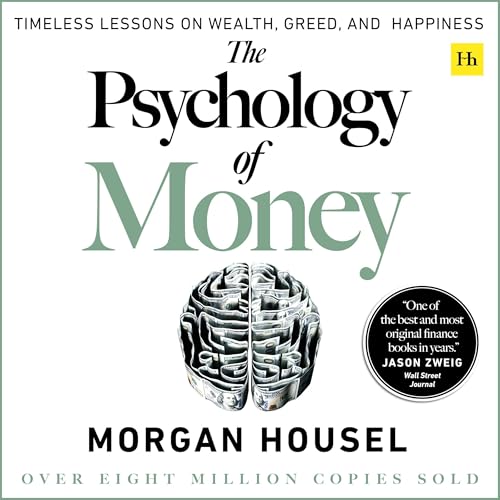
What is wrong about Housel’s investment recommendations is that his life experience sets a table that is not the same table as those who have much less to eat.
Books of Interest Website: chetyarbrough.blog
The Psychology of Money (Timeless Lessons on Wealth, Greed, and Happiness)
Author: Morgan Housel
NarratedBy: Chris Hill
Morgan Housel (Author, two-time winner of the Best in Business Award from the Society of American Business Editors and Writers.)
“The Psychology of Money” is a plain-spoken examination of the value of wealth, how it is attained, retained or lost, and why its’ real value is independence. A superior perception of reality would certainly be ideal, but Housel implies no such thing exists, and that the presumption is too theoretical to be useful. Every human being becomes a product of their life experience. Unquestionably, all human beings have genetic inheritance, but Housel suggests personal life experience molds that genetic inheritance. All true, but it helps if your parents are upper middleclass and have a mindset for saving rather than spending their income.
Housel argues high intelligence is no guarantee of success in achieving wealth.
To achieve wealth, Housel argues one needs to be a consistent saver, a long-term thinker, an index fund investor in the stock market, and one who resists impulsive decisions to sell investments or use savings during financial instability. These guidelines are based on a wealth-seeker’s “margin of error” calculation of financial need during market weakness. One’s objective is to maintain one’s independence and freedom to live as they wish without risking that freedom by buying luxuries from short-term gains to only appear wealthier than others.
Cutting through the lessons that are listed by Housel’s suggestions is the ancient Greek recognition of the importance of “knowing thyself”.
Are you a crazy risk taker, do you think about the value of wealth, are you more interested in what others think of you than who you are to yourself, are you goal oriented or a “go along to get along” kind of person? These are clues to who you are and whether you should change to assure a life of freedom to live as you wish.
Janitor Ronald Read Leaves Behind $8,000,000 Fortune at his death
Housel gives the example of the janitor millionaire from Vermont who had no formal financial education. Ronald Read worked as a janitor and gas station attendant during his working life. He lived frugally while investing in blue-chip stocks that he held until his death. He amasses a fortune because of small savings and investments while never having high income but investing unneeded cash based on the way he chose to live. By being patient and disciplined over the course of his life, Read died in 2014 at the age of 92, donating $4.8 million to Brattleboro Memorial Hospital, $1.2 million to Brooks Memorial Library, and $2 million to his stepchildren, caregivers, and friends. Like Ben Franklin, Read lived a long life, accumulated great wealth while living the life he wanted. Just like Franklin, Read lived his life as he wanted and contributed his savings to eleemosynary institutions and people who were important to him during his lifetime.
Warren Buffett (The Oracle of Omaha.)
Warren Buffett is another example offered by Housel to explain that time and compounded returns on investment are key to one’s independence and success for living as one chooses. Buffet’s genius is not in just choosing the right stocks, but in staying with investments over the long term. Housel notes 96% of Buffett’s immense wealth came after his 65th birthday.
The discipline outlined by Housel is difficult for a young person to accept because of the tendency of human nature to impress others with their success.
When young, image is important for reasons ranging from attracting desirable partners to impressing others with one’s success by driving expensive cars, wearing elegant clothes, and living in luxurious homes. Many people believe image is as important as substance and fail to realize its folly when they are too old to do much about it. Freedom to live as we choose is a mixed blessing. Being disciplined about money and investment when one is young is an important lesson but hard to follow, particularly in a free society.
Piketty argues that the income gap widens after World War II. He estimates 60% of 2010’s wealth is held by less than 1% of the population.
Housel comes from a family of savers who appear to have followed the path he recommends in his book. Though what he recommends makes sense, his starting point seems better than most middleclass or poor families in America. He chooses a very conservative investment strategy because of his life experience. He only invests in index funds and lives in a house without a mortgage. His story is not a typical American middleclass family story. What works for him is based on his personal life experience. What is wrong about Housel’s investment recommendations is that his life experience sets a table that is not the same table as those who have much less to eat. This is not to say Housel’s advice is wrong in recommending living within one’s means, investing for the long term, and letting wealth accumulate over time. It is good advice but where one starts in life makes a difference because your life experiences mold a large part of who you become and how you choose to save or spend your money.





















































 REVIEWS AND VIEWS OF LIFE