THE WEST

Though Mahbubani’s book is quite provocative, it is short and interesting. “How the West Lost It” is certainly worth reading/listening to, but few Presidents of the United States have reversed the admittedly slow improvement of “equality of opportunity” in America.

Books of Interest
 Website: chetyarbrough.blog

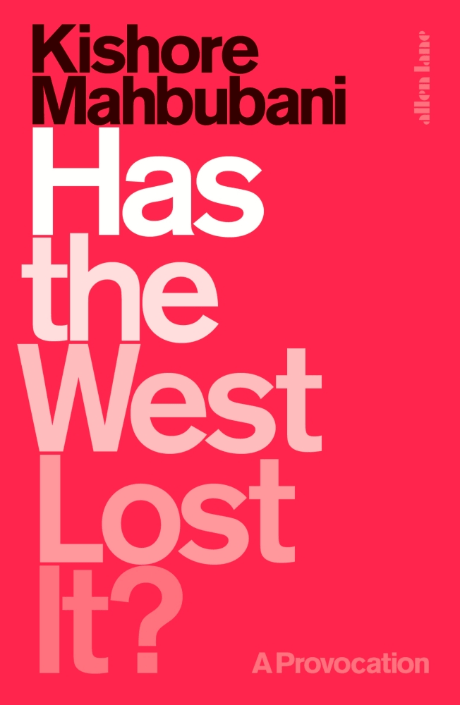
How the West Lost It (A Provocation)

AuthorKishore Mahbubani

Narrated By: Jonathan Keeble

Kishore Mahbubani (Author, Singaporean diplomat and geopolitical consultant, former Fellow at Harvard University’s Center for International Relations, formally served as the United Nations Security Council President.)

Mr. Mahbubani’s short book suggests the highly provocative belief that the West’s dominance of the world is giving way to Asia, particularly China and India. To mitigate the West’s decline, Mahbubani argues–the West needs to develop a more “coherent and competitive global strategy”. Paul Kennedy of Yale University praises Mahbubani’s assessment. The public commentator Fareed Zakaria endorses Mahbubani’s belief, and Hilton Root of “The Independent Review” acknowledges Mahbubani’s inference that “the West’s overperformance was a historical aberration and the East’s rise reflects a rebalancing of history”. Despite Root’s measured support of Mahbubani’s book, his analysis is nuanced. Root argues the decline of the West is oversimplified and that Mahbubani underestimates the resilience of Western economies.

Mahbubani argues Great Britain’s Brexit and Trump’s re-election are reactions to the West’s economic decline.

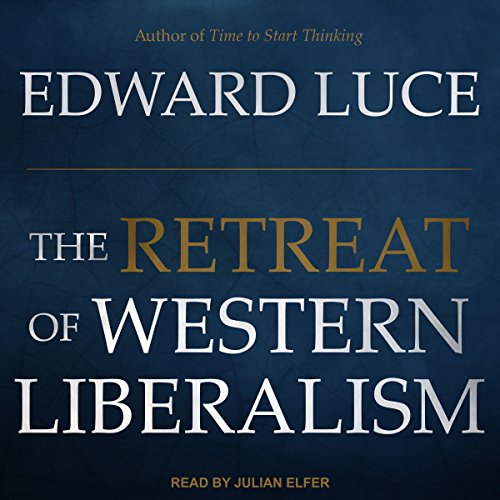
Edwad Luce argues Western liberalism needs to be reinvented by investment in a technological revolution for all Americans, not just those who have benefited from the industrial revolution. However, China seems to have read the future better than the West by building up their reserves of rare metals needed for advanced computer chips. In contrast, President Trump chooses to antagonize allies as well as competitors with a foolish trade war.

Root believes the innovative capacity and adaptability of the West will make adjustments to remain competitive, if not the dominant economic power of the world. Trump’s trade war suggests otherwise. Trump’s attitude is to ignore the years of built-up trust with Western allies and attack the world with destructive economic tariffs meant to right wrongs that are figments of real-politic’ imagination. However, some believe Mahbubani discounts political freedom and the drive of both the West and East to improve citizens’ living standards. That seems somewhat plausible, but Trump is attacking Americas most highly regarded universities with specious concerns with what he considers overactive recruitment of immigrants and minorities. The truth is American education for immigrants aids the strength and influence of Democracy in the world.

Yale University (American education for immigrants aids the strength and influence of Democracy in the world.)

The long cultural, educational, and technological influence of the West may be diminished by some of today’s political leaders but the trend over the last 200 years is unlikely to be reversed by Trump’s misguided authoritarianism. Trump’s significant risks are partially mitigated by publicly ingrained western democratic values. Though democracy is messy, it has demonstrated long-term stability and innovation that equals or exceeds the worst of what Trump’s authoritarianism is doing to the American economy and its institutions. Three more years of Trump’s presidency will not erase America’s legacy or destroy its future.

Though Mahbubani’s book is quite provocative, it is short, impactful, and interesting. “How the West Lost It” is certainly worth reading/listening to, but few Presidents of the United States have reversed the admittedly slow improvement of “equality of opportunity” in America. Mahbubani argues for a more diplomatic American policy with rising nations in the East because he believes China will ultimately replace America as the leading economy in the world.

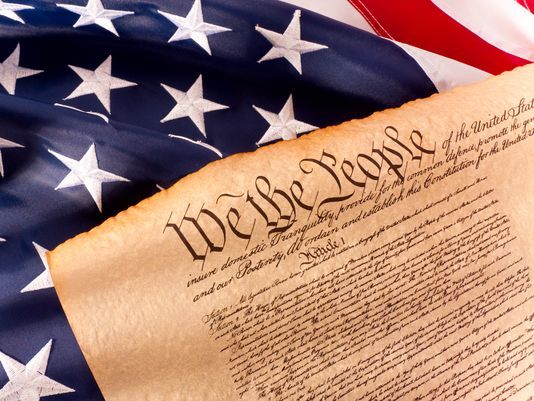
The interpretation of the Constitution has changed over the last 200 years, but it stands for continuity for America’s present and future.

The direction of American society remains true to the fundamental beliefs of liberty, equality, sovereignty, rule of law, separation of powers, federalism, checks and balances, and individual rights. Trump is challenging some of those rights, but balance of power and term limits will ultimately rescue America from his misbegotten domestic and international blunders. These rights have been challenged at different times in America’s history but never permanently reversed.

CAPITALIST DEMOCRACY

America’s current government may not be the criminal enterprise of Drew Hayes’ “Forging Hephaestus”, but it reflects on the worst characteristics of capitalist democracies.

Books of Interest
 Website: chetyarbrough.blog

Forging Hephaestus: Villains’ Code Series, Book 1 

Author: Drew Hayes

Narrated By: Amy Landon

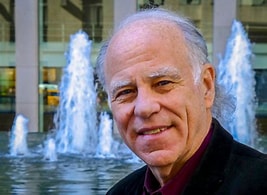
Drew Hayes (Author, humorist writer who earned a BA in English from Texas Tech University.)

“Forging Hephaestus” is the beginning of a series of books that this critic is unlikely to complete. The first book, “Forging Hephaestus” sets the table for some interesting points about systems of power, identity, and morality that reminds one of government control and influence. However, Hayes is creating a secret guild of criminals’ intent on ruling the world of crime.

Drew’s story begins with the creation of a young woman that embodies the force of fire.

She is like the mythological god of fire though not appearing as someone who is male or has, as the Greek myth goes, any physical imperfection. One presumes the author is challenging the patriarchal truth of history that shows power, aggression, and ambition are not only masculine. Additionally, the choice of Hephestus as a woman makes one think about a person who exemplifies both creation and destruction, i.e., the birth and death of humanity.

If one thinks of Hayes’ story as a cynical allegory of government, rather than a criminal enterprise, it becomes more interesting to this reviewer.

What Drew describes as a Villains’ Guild is like a government elected by people who believe they are voting for someone who represents their interests. In reality, voters are voting for self-interested people who may or may not govern in voter’s best interest. At best, governments try to serve the public but are not gods of infallible understanding that can legislate what is always in the best interest of its citizens. Generally, governments control through compliance, not morality. Order is prized over justice and equity. That desire for order changes elected officials’ loyalty to those who are elected as much as to people who voted for them.

The guild that Hayes creates audits and enforces their criminal objectives with state surveillance and internal security.

State surveillance and internal security are the same tools used by government which are even more effective today than in the past because of technology. (A past trip to China after Xi had taken power shows how internet searches are restricted when one is in a Bejing’ hotel.) The paradox of surveillance and internal security is that no one is truly free whether they are a part of those who govern or are the governed. Human nature exploits the weak, the ethnic, and ill-informed. Government representatives are no more virtuous or venal than the citizens who elected them. That is why citizens become skeptical about the legitimacy of their government’s concern about common good.

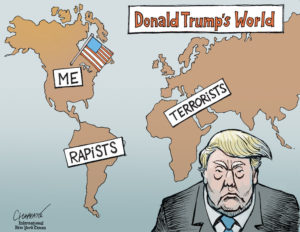
Trump’s world view.

Listening/reading “Forging Hephaestus” is an apocryphal story to some who feel President Trump is the quintessential example of one who is more interested in himself and his family’s wealth than the people who voted for him. America’s current government may not be the criminal enterprise of Drew Hayes’ “Forging Hephaestus”, but it reflects on the worst characteristics of capitalist democracies.

DANGER WILL ROBINSON

Trump’s push to hugely increase government debt at the expense of the poor and middle class, along with a tariff war, look to some like paths toward an economic Armageddon.

Books of Interest
 Website: chetyarbrough.blog

On Tyranny (Twenty Lessons from the Twentieth Century)

Author: Timothy Snyder

Narrated By: Timothy Snyder

Timothy Snyder (Author, graduated from Brown University with a degree in history and political science, received a Doctor of Philosophy in modern history from the University of Oxford.)

“On Tyranny” makes one research Timothy Snyder’s education because of his allusion to the rise of Hitler and America’s rising authoritarianism in the 21st century. His short book “On Tyranny” is disconcerting. He infers Trump’s presidency is an early sign of American democracy’s deterioration. He recounts the rise of German complacency when Hitler came to power and Nazi’ support for victimization of Jews and invasion of Poland are the beginning of a plan to reorganize spheres of influence in Europe.

Snyder’s observation is undoubtedly to create a sense of moral urgency on the part of American listener/readers to do more than just observe what is happening in America. Not that it is about Jewish discrimination but about American government rounding up and deporting alleged illegal immigrants without due process and sending them to prisons in other countries. Snyder is a scholar who specialized in Eastern European totalitarianism which suggests he knows something about the precursors of authoritarianism.

It seems the comparison of Trump to Hitler is hyperbolic when one considers the dire financial condition of Germany in the late 1920s. However, Trump’s push to hugely increase government debt at the expense of the poor and middle class, along with a tariff war, look to some like paths toward an economic Armageddon. If the economy falters, would America fall into Germany’s past? One doubts that will happen, but with a President who believes his own lies and Americans who accept them gives listener/readers of “On Tyranny” a chill. The power of Snyder’s argument gains some credibility.

It seems with the history of the United States, federal government checks and balances, and the limited tenure of elected Presidents, a Nazification of America seems unlikely. However, the danger is there because Trump has strong support from his party and many Americans who voted for him who choose to ignore his lies.

EQUALITY

Discrimination is certainly based on the color of one’s skin but also on gender, ethnicity, and income inequality. Those nations that embrace equality of opportunity for all will be the leaders of the future in the age of technology

Books of Interest
 Website: chetyarbrough.blog

Caste (The Origins of Our Discontent)

Author: Isabel Wilkerson

Narrated By:  Robin Miles

Isabel Wilkerson (Author, American journalist, winner of the Pulitzer Prize in journalism in 1994 while serving as the Chicago Bureau Chief for the NYTimes.)

Isabel Wilkerson has written a provocative book about what she characterizes as a rigid social hierarchy in America that undermines the ideals of democracy. Wilkerson weaves her personal life and the history of black experience with the sociological failings in America’s treatment of race. She notes the past and present truth of white America’s unequal treatment of its citizens based on race. However, her characterization of America’s discrimination as a caste system and its comparison to India’s and Nazi Germany’s governments is hyperbolic. Nevertheless, it creates a sense of urgency for those who believe in the ideal of human equality. It is difficult, if not impossible, to compare other nation’s inequality with America’s effort and present-day failure to fulfill the ideals of democracy.

The timeliness of Wilkerson’s book seems appropriate in relation to the backward steps being taken by Donald Trump.

Some Americans feel threatened by demographic change that will make white citizens less than 50% of America’s population by 2045. In theory, no one should care if all people are treated equally. What history shows is that the ideals of equality have never been achieved in America or in any other country with a dominant race and/or ethnicity.

Trump’s effort to return America to its past is interpreted by some as a return to industrial production.

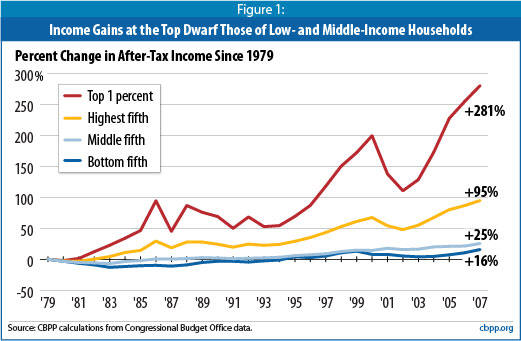
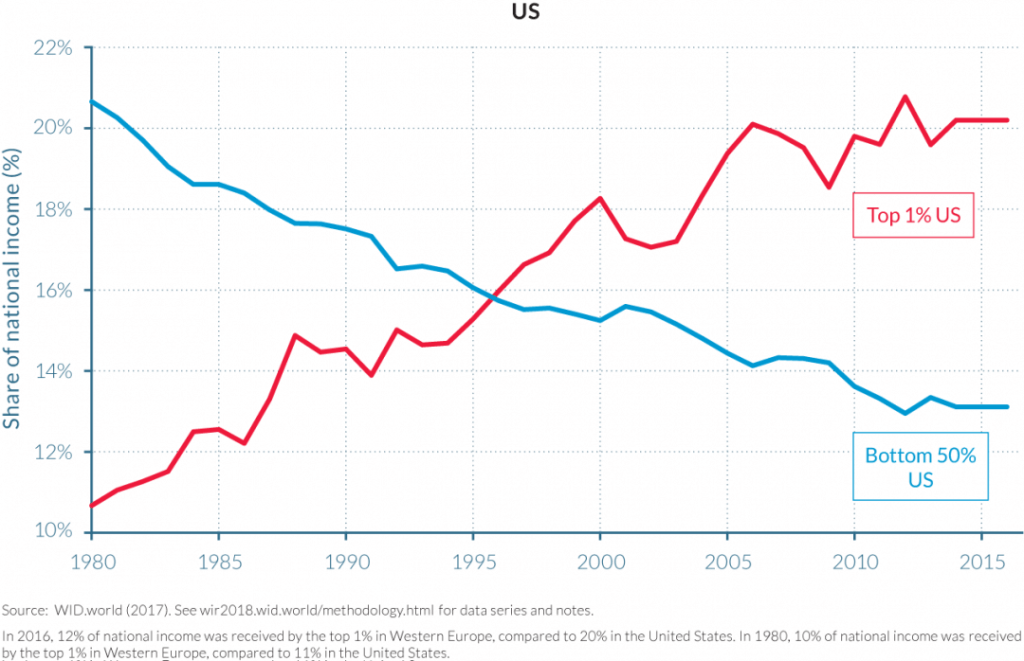
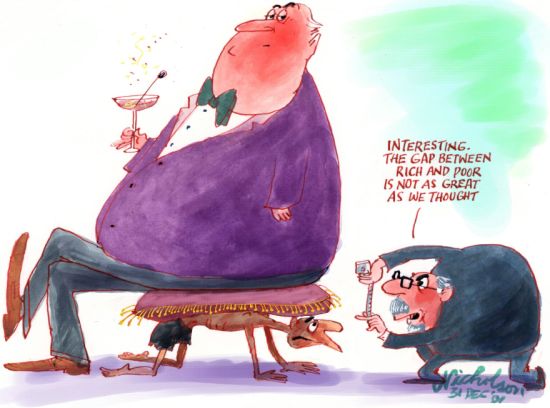
America’s return to industrialization is a false flag that will not make America Great. Reindustrialization and keeping America white is a fool’s errand based on demography and the age of technology. Trump’s desire for power, adulation, and loyalty have little to do with prejudice but everything to do with appealing to the worst fears of middle-class America. Trump is willing to use whatever dog whistle is required to satisfy his desire for power and prestige. He understands the fears of the middle class and where American power lays. Power and money are the driving forces of capitalism. Middle class American’s buying power has stagnated or fallen since the 1970s despite the increasing wealth of the top 10% of American citizens. The middle class of America is something Trump appealed to in his re-election for a second term because of their disproportionate loss of income and the rising wealth of America’s business leaders. The irony is that Trump is one of the beneficiaries of that income gap between the very rich and the working-class.

Income growth in America.

Income disparity trend in the U.S. through 2015.

Wilkerson is right in the sense that America’s real objective should be to ensure equality of all. She is arguing we should have a greater sense of urgency in achieving equality. Equal treatment for all is a formula that can maintain America’s position as an economic, military, and political hegemon. American industrial hegemony is yesterday’s goal. Technological advancement is today’s goal. To achieve today’s goals, equal treatment of all becomes essential in technology because intelligence, innovation, and persistence does not lie in any one race, sex, or creed.

America is class conscious but not in the same way as either India’s or Nazi Germany’s histories.

Wilkerson notes a caste system can be built around ethnicity, religion, language, or gender but race discrimination is what she has personally experienced and underlays much of her comparisons of American history with India and Nazi Germany. Equality of opportunity is key to continued growth of human beings and national economies in the age of technology. In the short term, one may see an autocratic country like China become an economic and military hegemon, but maintenance of that success is dependent on equality of opportunity for all, not just those in power.

One can sympathize with the author’s view of discrimination but her comparison of America to India and Nazi Germany misses too much of what unequal treatment in America is based upon.

Discrimination is certainly based on the color of one’s skin but also on gender, ethnicity, and income inequality. Those nations that embrace equality of opportunity for all will be the leaders of the future in the age of technology.

GOVERNMENT LIFE CYCLE

Robert Kaplan’s inference is that all nation-state governments are being challenged by an increasingly polarized society. The question is whether Trump is a symptom or cure for the decline of America.

Books of Interest
 Website: chetyarbrough.blog

Waste Land (A World of Permanent Crises)

By: Robert Kaplan

Narrated By: Robert Petkoff

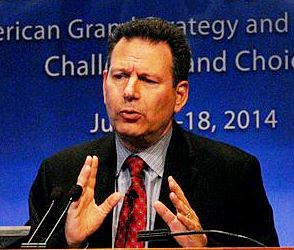
Robert D. Kaplan (Author, writer for The Atlantic, Washinton Post, New York Times, The New Republic, Foreign Affairs, and the Wall Street Journal)

Robert Kaplan’s book makes one pessimistic about the future of democratic government. The wars in Gaza and Ukraine, along with the re-election of Donald Trump, and the economic retrenchment of Xi in China reinforce some of the themes of Kaplan’s “Waste Land”. One who reads or hears national news understands why Kaplan argues there is a growing decline in Russia’s, China’s and America’s governments. He argues the cause of that decline is increased world interconnectedness, and rising government instability. His biggest concern is what he believes is a nascent parallel to the rise of Naziism.

The advent of the internet has been a mixed blessing because it is used to spread false information as well as the truth.

The consequence has been to make societies more polarized. An example is a widespread opinion by Trump appointees that the rise in the number of government employees is wasting taxpayer dollars for public education, science research, foreign aid, veterans’ affairs, the national park service and the IRS. (For example, an estimated 76,000 employees–16% of the work force has been discharged from Veterans Affairs. The VA provides healthcare services for eligible veterans, handles disability compensation, pensions, education assistance, like the GI bill, and home loans to citizens who have honorably served America.) These reductions in workforce are not based on any analysis of work performance but solely to reduce the cost of government. Trump, like Xi and Putin, believe Thucydides’ observation that “The strong do what they can and the weak suffer what they must”.

Trump’s firings are being done by an appointed agent of the President who decimated the work force of Twitter in the same way he is arbitrarily discharging American government employees.

Kaplan argues today’s political atmosphere in America, Russia, and China are similar to the societal condition of Germany before the rise of Hitler. He points to the fragility of authoritarians and the rise of societal polarization in today’s world. He compares economic instability, social discontent, and political extremism of the Weimar Republic to what he implies is a growing condition in both Western democracies and Eastern autocracies. The last chapters of Kaplan’s book focus on urbanization of the world and its consequent polarization of society that is deconstructed governance in a way that reminds him of the Weimar Republic’s deterioration. He infers Trump’s re-election, the dismantling of the American government, and America’s social disruption is similar to what happened in Germany in the early 1930s.

An example of the disruption of which Kaplan writes is the Venezuela immigrants who were flown to El Salvador and frog-walked to an El Salvador prison without adjudication by America’s judicial system.

Kaplan’s argument is that President Trump is destabilizing the American government by violating the Constitution of the United States.

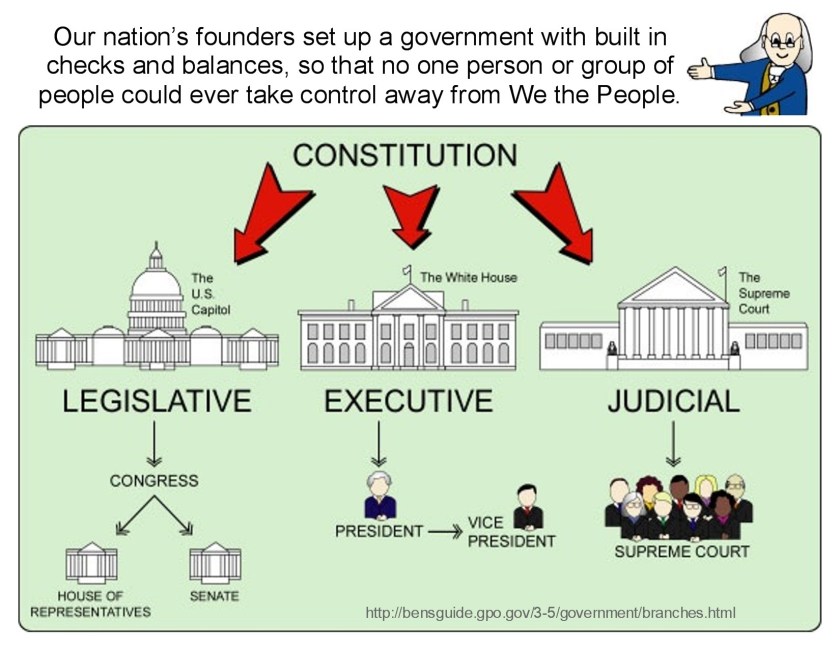
A federal judge ordered a plane full of alleged immigrants (identified as gang members) to be returned to the United States. The plane was in the air when the President in apparent defiance of a direct court order chose to not have the plane turned around. The deported were filmed as they were frog-walked into a foreign jail while being denied any hearing or adjudication of their alleged criminality. The President of the United States appears to have ignored a Federal Court, the Third Branch of American government, designed to balance arbitrary actions of either a President or Congress for denying due process of law.

America re-elected Trump despite his conviction on 34 counts of falsifying business records for paying “hush money” to Stormy Daniels when first elected in 2016.

Though Trump’s conviction does not rise to the level of Hitler’s high treason in the failed Beer Hall Putsch, willingness to lie under oath is a troubling characteristic for a President, let alone, any citizen of the United States. According to news reports, Trump says he did not know he had been asked to turn the plane around by a Federal Judge. One might ask why should America believe what he says?

Trump is challenging the authority of Congress and the Judiciary by taking actions without consideration of the Constitution of the United States.

This reminds one of human rights violations in the early days of Hitler’s rise in Germany. Hitler gathered sympathizers from disillusioned veterans, business leaders, the middle class, the German youth, and Far-Right Nationalists. Trump appears to have had similar support in his re-election. Trump decides to pardon all January 6, 2021, U.S. Capitol attackers. Those pardons are a diminishment of American democracy akin to Hitler’s support of Nazi sympathizers.

Attack on the Capitol on January 6, 2021–Trump pardons all attackers on 1/20/25, after being re-elected as President of the United States.

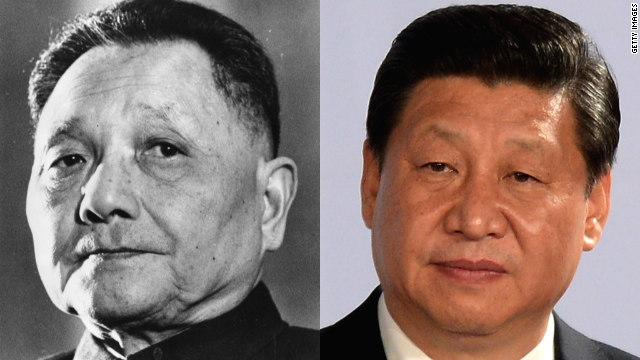
Deng led a transformative change in China’s economy after Mao’s death. With a pragmatic judgement that “It doesn’t matter whether a cat is black or white as long as it catches mice”

In the last third of Kaplan’s book, the incredible success of China under Deng Xiaoping is addressed. Kaplan explains Deng became the leader of China between 1978 and 1989. Though Deng was a contemporary leader during the Mao administration, Deng led a transformative change in China’s economy after Mao’s death. With a pragmatic judgement that “It doesn’t matter whether a cat is black or white as long as it catches mice” he opened China to the pursuit of personal, and individual citizen’ prosperity. The result of Deng’s pragmatism was the unprecedented economic growth and wealth of China. Much of what Deng started has been reversed by the Xi administration. In Kaplan’s opinion, the resurgence of the communist party has led to a reversal of economic growth in China. Kaplan infers a return to collectivism is a reflection of societal interconnectedness with a government-controlled internet that denies freedom of thought and action by China’s citizens.

Kaplan refers to Jane Jacobs (1916-2006) and the urbanization of America. He notes Oswald Spengler (1929-1936) recognized the implication of urbanization is government deterioration as a part of the natural lifecycle of every civilization. The point Kaplan makes is that nation-states have become like the early cities Jacobs refers to but with an interconnectedness that accelerates and shortens government lifecycles. Robert Kaplan’s inference is that all nation-state governments are being challenged by an increasingly polarized society caused by internet connectedness. The question is whether Trump is a symptom or cure for the decline of America.

DEMOCRACY’S IMPERFECTION

There are many reasons why America continues to prosper despite elections of inept political leaders.

Books of Interest
 Website: chetyarbrough.blog

America’s Deadliest Election (The Cautionary Tale of the Most Violent Election in American History)

By: Dana Bash, David Fisher

Narrated By: Dana Bash

Dana Bash is an American journalist and news anchor for CNN. David Fisher is an accomplished author who has written twenty New York Times bestsellers.

“America’s Deadliest Election” reaches back to 1868 in Louisiana to tell the story of Henry C. Warmoth who was elected governor and later, a Congressional representative of Louisiana. Warmoth’s election in Louisiana reminds one of Donald Trump’s election in 2017. Warmoth manages to become the 23rd Governor of Louisiana in 1868. His election at the young age of 26 made him one of the youngest governors in U.S. history. Of course, age is not the reason one might compare Trump’s election to Warmoth’s, but it is Warmoth’s unrestrained rhetoric and purposeful lies that got him elected.

Henry C. Warmoth (1842-1931, died at age 89. He was the Reconstruction governor of Louisiana and later Louisian State Representative.)

In Louisiana a large unrepresented minority were black Americans. Warmoth’s term ended with allegations of corruption and dishonesty but his rhetoric for disenfranchised blacks gave him the governorship and later a position as Louisian State Representative in congress. His political career extended through 10 years of Civil War Reconstruction and corruption.

Depiction of a US Army Officer Meeting with African Americans in Louisiana after the Emancipation Proclamation.

As a wealthy American, Trump and many rich business leaders and industrialists believe lower taxes and less government regulation improves opportunity and raises the living standards of the poor. Many wealthy Americans believe John F. Kennedy’s 1963 line that “a rising tide lifts all boats”. History shows a different picture, i.e. with lower taxes, the rich got richer, the middle class remained middle class, and the poor increased. America is nearing the point where it will have its first trillionaires while this richest country in the world has an increasing number of poor and a burgeoning homeless crisis.

In modern times, Trump’s rhetoric disingenuously appeals to blue-collar workers but with an underlying appeal to the rich who believe in “trickle down” economics.

Freedom allows American citizens to lie as well as tell the truth. The problem with truth is “truth is in the eye of the beholder” or what Timothy Leary called a human’s “reality tunnel”. Warmoth and Trump had their own “reality tunnels” with the objective of getting them elected. Their objective is to gain power, money, or prestige. Both Warmoth and Trump are willing to lie to themselves and others to gain their objective.

In American democracy, freedom is the holy grail of its success.

As pointed out in “The Economist” earlier this week, Democracy is messy. Democracies like France, Great Britain, and the European Union are struggling to find their way in the 21st century. Representative government is difficult because voters cannot know if candidates for office are telling a follower only what they want to hear or if what is said is what the candidate believes. Additionally, voters cannot be sure an elected person is capable or willing to walk the talk after their election.

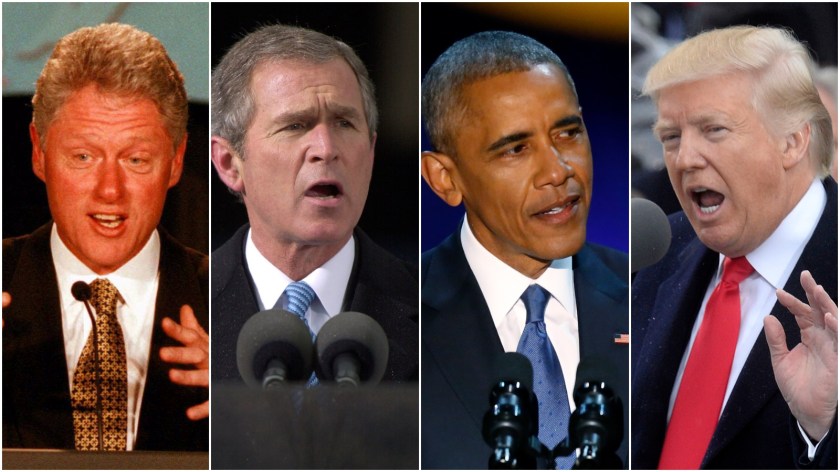
Recent Presidential elections in America before Biden replaces Trump.

Many Blacks had never been able to vote but Warmoth (a former Union Civil War’ veteran) became instrumental in supporting the 15th amendment that prohibited states from denying the vote based on race, color, or previous condition of servitude. For the first time in America, Blacks could vote. Naturally, Blacks voted for Warmoth despite his reputation for corruption. However, Warmoth’s support and actions create a split between his Republican followers and slavery proponent Democrats that remind listeners of today’s political party intransigence.

An irony of the story of Governor Warmoth is that he is clearly a scofflaw, but his lawlessness helped bring black Americans into the electoral process.

Warmoth was a criminal. He speculated in state bond and treasury notes which were a conflict of interest for a governor. He profited from a partnership given by a newspaper that had a contract for state printing. Warmoth created what was called the “State Returning Board” that had the authority to discard legitimate votes to keep Louisiana Republicans in power. One might suggest President Trump had similar conflicts of interest.

The authors explain what made Warmoth a crook. It was for the reward of money and power.

Inept and unethical practices are mitigated by the foresight of the framers of the Constitution. The acts of legislators since the beginning of America’s creation have bent the arc of history toward freedom and equality. Balance of power between branches of government, election of honest and ethical leaders, media that exposes political rhetoric for its understanding of truth and lies have helped Americans to live free and prosper. America is blessed with natural resources that have made America become a great Democratic success.

There are many reasons why American Democracy continues to prosper despite elections of inept and unethical political leaders.

The last chapters of Bash’s and Fisher’s book show what can happen when there is a sharp split between Democrats and Republicans that roils the American democratic process. What this history shows is that we have been at this crossroad before, and America pulled itself together. Warmoth was not the ideal representative of American Democracy, but he played a part in history that began the movement for Black freedom in the South and their right to vote.

Trump reminds one of Warmoth’s history. One hopes the split between political parties will be mended by the election of a President that can heal the vituperative factionalism of the Democratic and Republican parties in 2025.

DEMOCRACY OR ELSE

“…saving America” will not come from “…ten easy steps” but from one vote at a time.

Books of Interest
 Website: chetyarbrough.blog

Democracy or Else” How to Save America in 10 Easy Steps

By: Jon Favreau, Jon Lovett, Tommy Vietor

Narrated By: Jon Favreau, Jon Lovett, Tommy Vietor

(Left to Right) Jon Favreau, Jon Lovett, Tommy Vietor

The suggestion that “Democracy or Else” comes from “…10 Easy Steps” on “How to Save America…” is an oversimplification of life and politics. Saving America takes hardened objective opinion, personal commitment, appreciation of the difficulty of being a political leader, and most importantly, the wisdom of Jesus Christ. Few, if any humans fit the bill. Voting is the only thing that everyone who believes in American Democratic leadership will agree upon in the author’s “…10 Easy Steps”. The steps are not easy. The authors appear to have committed some time and effort to fulfill some part of the 10 steps.

Many (not most) Americans may be willing to vote but working on a campaign for a candidate who wishes to be elected to public office will always be low on their list of commitments.

Human beings, let alone Americans, are an unruly lot. Making a living, waiting for a hand-out, hating or loving others, and experience of life come first in the minds of most, if not all, human beings. The nuts and bolts of what it takes to become an elected representative in Democracy are way down on the list of humans’ self-interest. American Democracy, like all known forms of government, have winners and losers. Democracy has the best odds for serving the self-interest of its citizens but remains far from the idealistic goals of the U.S. Constitution.

American Presidents have been good and bad throughout history. Only a few have earned the history of “good or great” for America. The checks and balances of American government, the ideals of the Constitution, capitalism, and expanded voting rights have saved American Democracy from tyranny. Anyone who has read this blog, knows there is an opinion about the next President’s election but “…saving America” will not come from “…ten easy steps” but from one vote at a time.

AMERICA’S DECISION

It is up to Americans to vote or not vote. The choice today is between two old men. American Democracy will not fail because of either man’s election.

America’s Presidential debate on June 27th, 2024, was a painful reminder of advancing age. Whether to choose Donald Trump or Joseph Biden to be the next President of the United States is a “Hobson’s Choice”. Americans are compelled to vote for one of these two men or stay home and do nothing. Doing nothing means other Americans will decide who will represent Democracy to the world for the next four years.

Getting old is a mixed blessing. On the one hand, living long may offer wisdom, experience, and relationship connections. On the other, living long engenders health issues, physical frailty, and diminished mental acuity. Underlying these mixed blessings are the way a person has lived their life, the decisions they have made, the way they have treated others, and the inner moral compass they have followed.

It is up to Americans to vote or not vote for a President of the United States. The choice today is between two old men. Either will have the help of the three branches of the American government to do their job. American Democracy will not fail because of either man’s election to the office of President of the United States.

DEMAGOGUERY

In 2025, the American election process may allow an adjudicated felon become President.

Books of Interest
 Website: chetyarbrough.blog

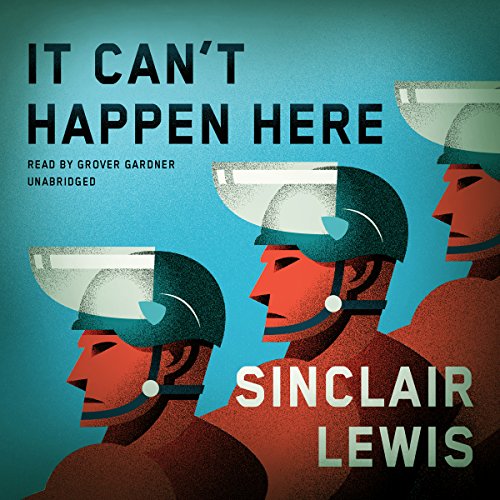
“It Can’t Happen Here” 

By: Sinclair Lewis

Narrated By: Grover Gardener

Sinclair Lewis (1885-1951, American novelist and playwright, first American to receive the Nobel Prize in Literature.)

“It Can’t Happen Here” was published in 1935. It is a novel about the election of a fascist to the American Presidency. Lewis was a recovering alcoholic who died at the age of 65 from advanced alcoholism. Though divorced in 1942, he was a father of a son who died in WWII in 1944. There is a sad irony in his son’s death when “It Can’t Happen Here” was written before America’s entry into war against the fascist nations of Germany and Italy.

Lewis describes a view of the 1930s in America when Roosevelt was dealing with the Great Depression and Hitler was martialing a nascent Nazi party in Germany.

Some Americans viewed Roosevelt as a fascist because of his centralization of power in the government. Famous people of that time, like V.P. John Nance Garner, Journalist Walter Lippmann, and Ambassador Joseph Kennedy turned against Roosevelt’s early administration. On the one hand, “It Can’t Happen Here” may be interpreted as a critique of the Roosevelt Administration.

Benito Mussolini (1883-1945, WWII Italian dictator who founded the National Fascist Party.)

However, historians suggest Lewis wrote “It Can’t Happen Here” as a warning to Americans that a reaction to Roosevelt’s interventionist economic policies could lead to a fascist American President’s election.

A fascist President’s policies would promote rich white Americans at the expense of the poor, particularly women and racial minorities. Lewis had reservations about extending Roosevelt’s New Deal policies but recognized it had alleviated much of the Depression’s suffering.

That control and influence hugely increased in the Roosevelt administration and roosted in the 1950s with Eisenhower’s mandated Interstate Highway System, and signature Civil Rights Legislation. Some would argue it blossomed with John Kennedy’s election, expanded in Johnson’s administration, and changed direction with Reagan’s election. Between 1789 and today, American political parties have increased federal government control on, and influence of, American society. Those controls changed human’ and economic’ rights of Americans.

Humans are naturally motivated by self-interest. In a capitalist economy, money and power are synchronized influences on freedom. Those influences are concentrated in an election process largely dependent on Americans who have money and power. Without money, one is unlikely to be elected to a political office. The consequence is a distortion of equality of opportunity. Corporations legally recognized as individuals carry greater influence on electability than “one person, one vote”.

“It Can’t Happen Here” and the American Presidential election process clearly shows “It Can Happen Here”, and it has happened here.

In 2025, the American election process may allow an adjudicated felon become President.

THE MARSHALL PLAN

NATO is not an American Marshall Plan but a bulwark for nation-state self-determination.

Books of Interest
 Website: chetyarbrough.blog

“The Marshall Plan” (Dawn of the Cold War)

By: Benn Steil

Narrated by: Arthur Morey

Benn Steil (Author, American economist, senior fellow and director of international economics at the Council on Foreign Relations.)

Along with an excellent history of America’s “…Marshall Plan”, there is an underlying message about two fundamental forms of government, i.e., one is democratic, and the other is authoritarian. By democratic, the point is not to suggest an idyllic understanding of American Democracy or Russian Authoritarianism. America and Russia have experienced government leadership that has been both authoritarian and democratic in the last 248 years.

One can justifiably argue America’s authoritarianism was experienced during the four years of the Trump administration (2017-2021).

In contrast Russia’s democratic experience was with Mikhail Gorbachev between 1985 and 1991. Before and after Gorbachev, democratic experience in Russia has been limited and largely authoritarian. What history of “The Marshall Plan” shows is the superior value of American democracy’s checks and balances that limit the power of authoritarian leadership by preserving deliberations of the many as opposed to the one. Trump is not the first U.S. President that was an authoritarian.

George Catlett Marshall Jr. (1880-1959, American army officer and statesman, became Secretary of State and Secretary of Defense during the Truman administration.)

History of “The Marshall Plan” shows the resilience of democratic versus authoritarian governance. Steil shows “The Marshall Plan” is created in a boiling cauldron of disagreement among branches of the American government. The conflicts between American political parties and departments of government hammered out a plan that improved the economies of both America and Europe after the war. America became the economic hegemon of the world as Russia’s economy collapsed in the early 60s.

One might argue the success of China came as a result of the more inclusive economic decision-making policies of Deng Xiaoping after Mao Zedong’s death. With Deng’s opening the economy to market-oriented reforms in 1978, worker efficiency and productivity created an economic boom in China. China’s danger today is the autocratic rule of Xi Jinping. His one-man rule nearly collapsed the economy during Covid 19. America certainly suffered from Covid, but Trump’s authoritarian character was mitigated by political resistance to unilateral Presidential decision-making.

Steil explains how Molotov delayed negotiations on “The Marshall Plan” with a clear understanding that only one person, Joseph Stalin, made decisions in Russia.

Steil notes “The Marshall Plan” is singularly disparaged and reviled by the Russian government. That disparagement is directed by one person, Joseph Stalin. There is no one to oppose the autocratic rule of Stalin’s leadership. Stalin’s opposition was either sent to the Gulag or murdered. A more balanced power structure in Russia could have taken advantage of “The Marshall Plan” but by singular fiat of one person (Stalin) implementation was impeded after WWII. The errors inherent in communism and authoritarian rule are being recreated by Putin in the 21st century.

What Steil shows is that many elected officials in America fought the principles of “The Marshall Plan”. However, the constant back and forth of government policy arguments in Congress aided European recovery after the war in a way that stabilized Europe and monumentally improved the economic growth of America.

Autocracies can certainly improve their economic growth at a pace that is superior to governments ruled by democratic ideals. However, autocracies have a much greater risk of following the wrong path because of their singular focus on one person’s decisions.

With an autocrat’s decision-making process, economic growth is either stultified or accelerated by one person’s decision. The give and take of democracies offer the benefit of different policy maker’s perspectives that may slow policy decisions but ultimately improve the odds of forward economic growth.

However, it is more than the availability of natural resources that made America economically successful. It is the give and take of a democratic process that protects America from the giant missteps that can come from autocratic rule. America has had some good to great rulers, but it has also had some ignorant, bigoted autocrats that offered minimal support for the ideals of freedom and equality. Checks and balances are the strength of American democracy. Presidents can make a difference, but they cannot destroy America’s future.

Ben Steil’s history of “The Marshall Plan” is not limited to an explanation of how important and difficult it is for America to pass important and consequential legislation.

The last chapters of Steil’s history of the Marshall Plan explains why Russia, China, and North Korea resent American encroachment on their spheres of influence. From the era of Stalin, Mao, and Kim Jong II, there has been a growing concern over the expansion of America’s sphere of influence. Steil explains how the Marshall Plan has morphed into a deepening concern about NATO expansion in Europe. As noted in an earlier, the Marshall Plan is created to aid recovery of countries that were impacted by WWII’s destruction. In reality it aided America to become the hegemon of the world. Because of the economic stimulus that revived the countries damaged by WWII, America created new markets for their industrial growth and international trade.

NATO is viewed as another vehicle for America’s economic growth and ideological threat to Putin, Xi, and Kim Jong Un’s control of their countries.

NATO is viewed as another invidious way for America to expand their influence and power. That seems an unfair evaluation of NATO. NATO is a military defense plan saying one country within NATO that is attacked by another country is an attack on all NATO countries. Every nation that has managed to become an independent country should be able to pursue there own interests.

The iron curtain is rusting but its characteristic strength remains a barrier to international cooperation.

The rusting of the iron curtain comes from the tears of societies ruled by authoritarians. The authoritarians are leaders who believe their way of life is threatened. NATO is viewed as a trojan horse at the front gates of non-aligned countries.

One decries Putin’s slaughter of Ukrainians in an unjust war. Life of innocents have no value to today’s Russian leadership that believes their power and way of life is threatened.

The real-politic of authoritarian’s desire for stability and power outweigh the value of human life. The same is seen in the plight of Palestinians who are not part of the October 7th’ terrorists’ killings and kidnappings but are in the way of Israel’s retaliation against Hamas.

In my amateur opinion, China, Russia, North Korean, or other authoritarian governments have a right to rule their countries as they wish. Their citizens are the key to every leader’s longevity. NATO is an effort to offer freedom of choice to established independent countries but if the citizens of a country support their leaders, there is little NATO, or any alliance can do, except to support the sovereignty of all nations.

NATO is not an American Marshall Plan but a bulwark for nation-state self-determination.

Steil argues George Kennan is right in suggesting NATO expansion would be “the most fateful error of American policy in the entire post-Cold War era”. Kennan believed it would inflame nationalist beliefs and reinvigorate the Cold War. And so, it has–as evidenced by Russia’s invasion of Ukraine, China’s expressed intention and action toward Taiwan, and North Korea’s armaments support of Russia.