AI TRANSITION

The potential of AI is akin to the Industrial Revolution, yet it could surpass it significantly if managed correctly by humans.

Books of Interest
 Website: chetyarbrough.blog

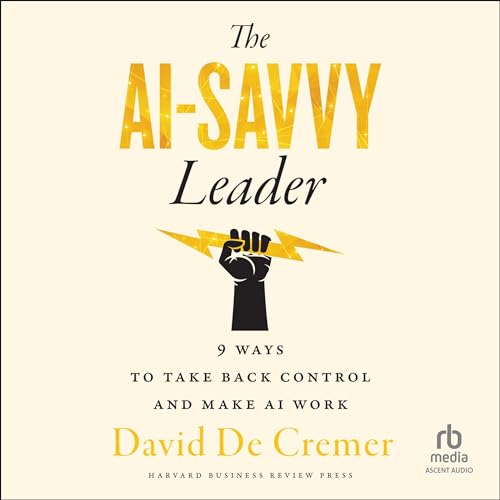
The AI-Savvy Leader (Nine Ways to Take Back Control and Make AI Work)

By: David De Cremer

Narrated By: David Marantz

David De Cremer (Author, Belgian born professor at Northeastern University in Boston, and behavioral scientist with academic studies in economics and psychology.)

“The AI-Savvy Leader” should be required reading for every organization investing in artificial intelligence for performance improvement. From government to business, to eleemosynary organizations, De Cremer offers a guide for organizational transition from physical labor to labor-saving benefits of AI.

AI offers the working world the opportunity to increase their productivity without the mind-numbing physical labor of assembly lines and administrative scut work.

Like assembly line production implemented by Ford and work report filing and writing during the industrial revolution, AI offers an opportunity to increase productivity without the mind-numbing physical labor of assembly line work and after-work’ analysis reports. With AI, more time is provided to workers to think and do what can be done to be more productive.

Arguably, AI is similar to the industrial revolutions transition to assembly line work. Assembly line work improved over time by changes that made it more productive. Why would one think that AI is any different? It is just another tool for improving productivity. The concern is that AI means less labor will be required and that workers will lose their jobs. De Cremer notes loss of employment is one of the greatest concerns of employees working for an organization transitioning to AI. Too many times organizations are looking at reducing costs with AI rather than increasing productivity.

The solution identified by De Cremer is to make AI transition human centered.

His point is that organizations need to understand the human impact of AI on employees’ work process. AI should not only be viewed as a cost-cutting process but as a process of reducing repetitive work for labor to make added contributions to an organization’s goals. AI does not guarantee continued employment, but reduced manual labor offers time and incentive to improve organization productivity through employee’ cooperation rather than opposition. AI is mistakenly viewed as an enemy of labor when, in fact, it is a liberator of labor that provides time to do more than tighten bolts on an auto body frame.

AI is not a panacea for labor and can be a threat just like industrialization was to many craftsmen.

But, like craftsman that went to work for industries, today’s labor will join organizations that have successfully transitioned to AI with a human-centered rather than cost-reduction mentality. Labor productivity is only a part of what any AI transition provides an organization. What is often discounted is customer service because labor is consumed by repetitive work. If AI improves labor productivity, more time can be provided to an organization’s customers.

When AI is properly human centered, the customer can be offered more personal attention by fellow human beings employed by an AI organization.

Too many organizations are using AI to respond to customer complaints. Human-centered AI becomes a win-win opportunity because labor is not consumed by production and has the time to understand customer unhappiness with service or product. AI does not think like a human. AI only responds based on the memory of what AI has been programmed to recall. With human handling of customer complaints, problems are more clearly understood. Opportunity for customer satisfaction is improved.

De Creamer acknowledges AI has introduced much closer monitoring of worker performance and carries some of the same mind-numbing work introduced in assembly line manufacturing.

De Creamer suggests negative consequences of AI should be dealt with directly with employees when AI becomes a problem. Part of a human-centered AI organization’s responsibility is allowing employees to take breaks during their workday without being penalized for slackening production. Repetitive tasks have always been a drain on productivity, but it has to be recognized and responded to in the light of overall productivity of an organization.

AI, like the industrial revolution, is shown as a great opportunity for human beings.

De Creamer suggests AI is not and will never be human. To De Creamer AI is a recallable knowledge accumulator and is only a programmed tool of human minds, not a replacement for human thought and understanding. The potential of AI is akin to the Industrial Revolution, yet it could surpass it significantly if managed correctly by humans.

CLICKS

Just as McCulloch’s history shows how the internet changed yesterday, it seems A.I. will change the future.

Books of Interest
 Website: chetyarbrough.blog

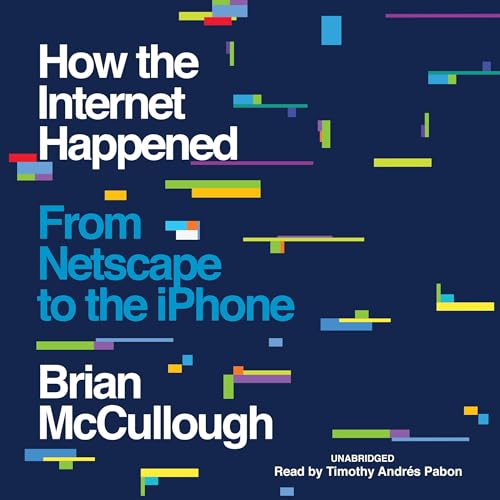
How the Internet Happened (From Netscape to the iPhone)

By: Brian McCullough

Narrated By: Timothy Pabon

Brian McCullough (Author, CEO of Resume Writers.com, entrepreneur.)

A book about the beginning of the internet is such old news, one is inclined to put this book aside. The internet was born in the 1960s and only became recognizable in the 1980s. However, even in 2024, it is interesting to hear about early users who became rich just by organizing information on an easily accessible and free media platform.

Like this blog, it is rewarding to write something that others are interested in reading.

The exercise of book reviews is a reward to one’s education and an ego boost for a writer from an audiences’ clicks. Brian McCullough tells the story of the founders of YAHOO, Jerry Yang and David Filo who were in college and became fascinated by the World Wide Web because of information it offered with clicks on a computer board. This was in the 1990s. Though there were many websites to choose from, they were disorganized and difficult to find if you were looking for specific information. Yang and Filo began organizing the websites by their offered information. YAHOO’S founders were looking for information of interest to them, and presumed others would like to know how they could use a keyboard to find information they might need or want.

Jerry Yang and David Filo were fascinated by what could be found on the internet.

They spent hours, days, weeks, months that grew into years organizing website addresses so others could find what was interesting to them. In these early years, making money was not their primary objective. They did not use their site to advertise products for income. They felt clicks were their reward and that clicks would be lost if advertisers were allowed to use their site. They chose to have users pay a fee to become members of their site. Their use and organization of the internet became an obsession for them and followers steadily increased. Their click numbers and users rose into the millions and advertisers were again knocking at their door. They resisted until they realized their idea could be worth something more than their interest in learning, gathering, and organizing knowledge. They relented, allowed advertising, and the clicks to their site kept on rising. YAHOO went public. The rest is history.
McCulloch goes on to describe the rise and fall of companies that capitalize on the internet.

The companies ranged from behemoth companies like Amazon, Microsoft, Google, Apple, and Ebay that rocketed to the stratosphere while Priceline.com, Netscape, Pets.com, Webvan and others plunged into the abyss. This is not to say today’s behemoths will continue to dominate the market or that some new company will replace their success with even greater appeal. A.I., like the internet, may be a killer discovery that makes or breaks today’s behemoths into tomorrow’s also-rans or hangers-on.

McCulloch’s history is interesting because it explains how winners understood the future better than losers understood the present.

It’s fascinating to find Apple’s Jobs resisted creation of the iPhone but employees worked secretly to refine the idea and Jobs eventually agreed. McCulloch also reveals the monopolistic nature of today’s winners and the threat they present to the future. Killer ideas of today’s tech companies capitalize on the internet’s information ubiquity, and how it can be organized to offer product to the world at a competitive price.

A.I. is a new idea that organizes information on its own with consequences to the public that are yet to be realized. Just as McCulloch’s history shows how the internet changed yesterday, it seems A.I. will change the future.

BIODIVERSITY

Human population growth is slowing, and awareness of biodiversity is improving but is the trajectory of global warming outpacing human action?

Books of Interest
 Website: chetyarbrough.blog

Biology: The Science of Life

Author: Great Book Series

Narrated By: Professor Stephen Nowicki

Stephen Nowicki, Ph.D. (Bass Fellow and Professor of Biology @ Duke University, Associate Chair of the Dept. of Biology and Neuroscience.)

This is a dauting series of lectures with a theory of the beginning of life. It addresses living things in general but more specifically what is known about human life. Not surprisingly, it is immensely complicated.

There may have been an Adam and Eve in history, but Science infers any garden of Eden had to have been long after the beginning of life on earth.

Nowicki explains how Stanley Miller conducted an experiment in 1952 that simulated conditions of the early days of earth’s formation. Methane, ammonia, hydrogen, and water were present in those early days. These ingredients were used in a controlled environment, with the help of energy (primordial lightening), to combine into amino acid compounds that are essential to life. These basic chemicals were present in the early days of earth. These amino acid compounds are the building blocks of life.

With amino acids, it became possible for DNA and RNA formation. DNA and RNA are shown to synthesize proteins leading to cellular process and organic development.

From these early beginnings, a natural selection process is initialized, i.e. evolution began which led to complex organisms like viruses, bacteria, animals, and eventually humans. Nowicki goes on to explain the complex biology of science. This is a point at which understanding by a lay reader/listener becomes difficult and only partially comprehensible. He begins with a detailed discussion of genetics, the study of genes, their discovery and function.

With the help of Rosalind Franklin (lower right), Watson (lower left) and Crick came up with the double helix model made of deoxyribose sugar that alternates with phosphate group strands.

The most famous pioneers of genetics are James Watson and Francis Crick. The genetic model they created reveals the backbone (organizational structure) of genes. With addition of nucleotides (adenine, thymine, guanine, and cytosine) to the gene backbone, genetic instructions are encoded by single strands of RNA into double strands of DNA. RNA’s single strands direct ribosomes that prevent mutation and maintain genetic integrity.

Nowicki jumps back in history to explain Darwin’s theory and proof of evolution. In addition, he recounts Gregory Mendel’s discovery of genetic inheritance. (Though Darwin and Mendel were contemporaries, it is not believed they ever met.) Mendel found, in breeding pea plants, that pea plants inherited certain traits of their parent plants with first generation plants having one color flower while second generation had 1/3rd to 2/3rd color differences that experimentally suggest inheritability of appearance. Mendel had no knowledge of genetics but was aware of Darwin’s writing. Ironically, Mendel discovered that inheritance had distinct genetic units of dominant and recessive characteristics explained how second-generation pea plants had mixed colors. This inheritable element of a gene became known as an “allele”, a word coined by British geneticist William Bateson in the early 1900s.

A listener/reader is only 1/4 of the way through Nowicki’s lectures at this point. Many of the remaining lectures delve into the details of gene function that will be interesting to biology students but only confuse and tire a dilettante.

To this reviewer, the two most enlightening features of Nowicki’s lectures are his views on the origin of human life and the ecological loss of biodiversity that threatens human existence. Nowicki challenges religious belief in the origin of life with a convincing argument for nature’s creation of human existence. His last lecture addresses global warming, reduced biodiversity, and the consequences of a loss of earth’s laboratory of medicinal cures for human ailments.

Nowicki leaves listener/readers with belief in humanity’s and earth’s environmental correction but with reservation. Human population growth is slowing, and awareness of biodiversity is improving but is the trajectory of global warming outpacing human action?

PRECISION

The human factor is at the heart of perfection with precision as the qualifying characteristic of craftsmanship or technology.

Books of Interest
 Website: chetyarbrough.blog

“The Perfectionists” How Precision Engineers Created the Modern World

By: Simon Winchester

Narrated by: Simon Winchester

Simon Winchester (British-American author, journalist, historian.)

Simon Winchester has a remarkable ability to simplify, detail, and vivify history’s complexity. Winchester is not new to this listener. His erudition, writing, and narration are a pleasure to read or hear. His story of the origin of the first Oxford English Dictionary, is a fascinating recollection of Dr. William Minor who shot and killed a stranger on a London street. Dr. Minor was imprisoned in an asylum for his aberrant behavior but became an important source of information for James Murray, the leading lexicographer of the “Oxford English Dictionary”.

“The Perfectionists” is about the advance of the world economy from the perspective of entrepreneurs driven to succeed. Their success, in Winchester’s opinion, is based on understanding and capitalizing on the value of precision.

Though one may go back to the first century to find the first steam engine, it is the invention of James Watt, and the improvements of Matthew Boulton, and Sir Charles Algernon Parsons in the 18th and later 19th centuries that perfected steam engine utility and power. Watt created the steam engine, Boulton helped Watt perfect the steam engine for industrial use, and Parsons expanded its utility by creating steam turbines to power the propellers of steamboats. Each played a role in making steam engines more efficient with precise design and milling refinements that provided more power and wider utility.

Luddites protested against the industrial revolution because machines were replacing jobs formerly done by laborers.  Just as the Luddites fomented arguments against mechanization, Nicholas Carr argues automation created unemployment and diminished craftsmanship.

With the advent of the industrial revolution, Winchester explains how speed and quality of production were geometrically improved by focusing on precision. He offers several industry examples, including weapon manufacture, automobile production, camera refinement, telescope resolution, airplane manufacture, watch making, and CPU design which now leads to the A.I. revolution.

Winchester notes the beginning of the industrial revolution starts with the perfection of energy production machines that power the manufacture of standardized parts for finished products.

Winchester tells the story of the French that insisted on standardizing parts for gun manufacture to increase the speed with which repairs could be made for damaged weapons. Winchester recounts the war of 1812 when Great Britain bloodied the nose of America by routing the capitol’s volunteer defense because of a lack of useable guns. He tells the story of an American rifleman with a broken trigger on his rifle who chooses to run from a British onslaught because trigger replacement would take two weeks for customization to fit his gun.

American guns were custom made which meant that when one was damaged it would take weeks for repair.

Honoré LeBlanc, a French gunsmith during the reigns of Louis XV and XVI, created the idea of interchangeable gun parts in the 18th century. Though it came to the attention of Thomas Jefferson, it did not catch hold in America until after the war of 1812. There was an effort by America to standardize parts in the early 1800s but Eli Whitney (the inventor of the cotton gin), hoodwinked the American government into a contract for standard gun parts that never materialized.

Winchester explains Eli Whitney flimflammed the American government to get a contract for standardized gun parts but never produced the product for which the government contracted.

Winchester notes Whitney knew nothing about guns and hired a crew of customizing gunsmiths who manufactured unique weapons that could not be repaired with standardized parts. Because the parts were manufactured by individual craftsman, the guns produced were not interchangeable. They did not have precisely manufactured parts that would allow interchangeability. Whitney gave a demonstration to the government with only one gun that he assembled in front of Jefferson and a government committee. He did not demonstrate any repair with standard parts. Jefferson fell for the false presentation and initially lauded Whitney. This demonstration was in 1801 which explains why a soldier might have fled because of a broken trigger in the War of 1812.

Henry Royce (1863-1933)

Winchester explains standardizing and precision making of gun parts were an essential step in the industrialization of America. Standardization and precision-made interchangeable parts became the touchstone of success in the automobile industry in the 20th century. Winchester tells the story of Rolls Royce and Ford Motor companies to make his point. Both Royce and Ford recognized the importance of precisely made standard automobile parts to garner their success in the automobile business. Though their route to success is precise manufacture of automobile parts, the wealth they created for themselves was quite different.

Henry Ford (1863-1947)

Ford became one of the richest people in the world while Royce became wealthy but not among the richest in the world. Royce chose to pursue perfection of every part of the automobile which limited his unit production and increased manufacturing cost. Though Ford perfected standardized mechanical parts, they were precisely designed only for functionality. Ford added the dimension of standardized labor to the manufacturing process. By creating an assembly line of laborers with precise replaceable mechanical parts, Ford could produce more automobiles than Royce in a shorter period of time.

The point Winchester makes is perfection of standardization (production of precisely tooled engine parts) is a cornerstone of successful industrialization. Royce expanded the concept to every part of an automobile while Ford focused on replaceable mechanical parts of the automobile.

Winchester tells a story of ball bearing manufacturing during Henry Ford’s reign when some automobiles were failing. The bearing manufacturer proved it was not their bearings with tests that showed the bearings were perfectly within precise measurement requirements. What Ford realizes is that the ball bearings were milled exactly the same and met the precise dimensions required. The problem was found to be the assembly line and human assembly mistakes. One thinks of the loss of precision in Boeing aircraft today and wonders what that means for Boeing’s future if it is not immediately corrected.

Winchester contextualizes the story of the ball bearings in recalling the history of a near catastrophic plane crash when a Rolls-Royce jet engine fails on a Qantas Airlines Airbus A380 in 2010.

Jet engines are precisely manufactured marvels of aviation. However, a tiny flaw in one oil pipe within the engine nearly caused the loss of over 400 passengers. Winchester explains Jet engines are dependent on superheated gas exchange that, if not properly cooled, will damage the engine. Every engine has a series of drilled holes that allow ambient air to cool the engine during flight. The holes are drilled in precise locations throughout the engine louvers and oil pipes to keep the engine from overheating. One of the oil pipes holes is in the wrong location which caused the engine to overheat after many flights. The failure of human oversight of the automated process and final checks by the manufacturer are the underlying cause of the near catastrophe.

More examples of the importance of precision are wonderfully offered by Winchester in “The Perfectionists”. His examination of the tech industry is as prescient as his analysis of the automotive industry and airline industry. He covers Moore’s law and how technology is advancing at an accelerating pace while inferring humanity may be at a turning point. That turning point is the crossroad between human and machine decisions about the future.

The human factor is at the heart of perfection with precision as the qualifying characteristic of craftsmanship or technology.

Winchester infers craftsmanship does not mean precision is to be sacrificed. He recalls the emphasis on precision in Japanese culture where many craftsmen assembled and repaired Seiko watches to revitalize the brand in the late 20th century. Precision is not a lost art whether work is done by machine or a craftsman, but the human factor remains a critical component of both processes. The point to this listener is that precision is only a part of what has advanced the welfare of society.

ENERGY MATTERS

The boon for composite material is their utility for work and play. Their bane is disposal and their effect on the environment.

Books of Interest
 Website: chetyarbrough.blog

“The Nature of Matter: Understanding the Physical World” (The Great Book Lectures)

By: David Ball

Narrated by: Professor David W. Ball

Professor David W. Ball (Professor of Chemistry and Chair of Chemistry Dept. at Cleveland State University, received Masters and Doctoral Degrees from Rice University,

Professor Bell offers a definition and description of matter in the universe. He carries on much of what is explained by Pollock in “Particle Physics”. Bell explains how physics particles form matter with the addition of energy, Bell reifies and expands Pollock’s history of physics. Though there is significant overlap in their presentations, Bell offers a more detailed understanding of matter with its component particles and the role of energy in what humans hear, feel, smell, and see.

Two facts about matter expanded by Bell are about energy’ component’s and structure’s interactions among and within atoms. Though Pollock alluded to the structure of matter and fully explains energy’s importance at the atomic level, Bell expands explanation of electrons and the way they provide energy within and between atoms.

The structure of revolving electrons generate energy in different orbits around the nucleus of an atom. Initially, those orbits were thought to be like planets revolving around the sun but were found to be located within shells around the nucleus in three different orbits. These shells come in three categories. One is spherically symmetric (called the S orbital), the second is dumbbell-like with two lobes along specific axis’s (called P orbitals), and the third (which are also called P orbitals) follow a preferred direction that is not spherical. These shells are important because their reactivity and bonding play a critical role in the formation of matter.

Ball explains electron arrangement around the nucleus of an atom determine chemical properties and behavior of molecular interactions. Electrons are the wave feature of Quantum Mechanics that confound an ordered world of cause and effect postulated by Albert Einstein. What is made a little clearer by Ball is that color is an integral part of energy at the atomic level. Electron energy has discrete and precise energy levels that are arranged around the nucleus of an atom.

Without light particles (protons), energy would not exist. Ball notes electron energy is fundamentally affected by light.

Light or photons are the source of discrete energy levels called quanta that do different things–1) generate absorption, 2) cause transition between shell levels, 3) generate fluorescence, and/or 4) penetrate an atom’s dense nucleus to change mass to energy.

Ball explains why carbon is the most important element in the periodic table. Carbon’s importance is signified by its absence or presence in matter. Matter is either organic or inorganic with carbon being the measure of its classification. The astounding realization is that as a percentage of the earth’s elements, carbon is only 0.032% of our environment. (In contrast, the 3 largest fundamental elements on earth are oxygen at 46.6%, silicon is 27.7%, and Aluminum is 8.1%.) It is a reminder that earth’s living things (organic matter) are dependent on carbon, a miniscule percentage of our environment.

Without carbon, there would be no life (as we know it) on earth.

Ball’s chapter on water is an enlightening exploration of its reputation as a universal solvent with various uses and characteristics when boiled or frozen. Water’s dissolving and heat-storing capability are thoughtfully explained. Pollution is touched upon with explanations about what is being done and needs to be improved to preserve the world’s environment.

Ball explores prosthesis and material questions and solutions for the creation of body parts.

From dental fillings to tooth implants, to artificial hips, knees, hearts, arteries and breast implants, Ball explains how biochemistry and materials are critical to their manufacture and utility. He suggests the future will include brain implant enhancements and increases in human longevity.

In “Resistance is Futile”, Ball explains the value of superconductivity.

The current reality of world’ electrification is that 30% of its beneficial power is lost in transmission. Material qualities of our wired world inhibit electrical power conductivity. That 30% loss can be reduced by hugely lowering the temperature of transmission material, with the idea to invent a superconductive material that does not require super-cooled temperatures. Success in finding that material remains a work in progress. No one has found a superconductivity material that does not require super-cooled temperatures. However, Ball notes discovery would be an immense energy saver for the world.

In contrast to “Resistance is Futile” Ball notes “Resistance is Useful”.

Ball explains how resistance creates heat in a semi-conductor that can be translated in a wired circuit to trigger a directed instrumental behavior or action. With the design of circuit boards with semi-conductors (specifically transistors), one could initiate or complete a series of tasks. From automating machines to creating powerful laptop computers, semi-conductor manufacture grew into an immense industry. As the complexity of tasks increased, the size of semi-conductors decreased. Gordon Moore proposed Moore’s law that suggested transistor’ size (a form of semi-conductor) in integrated circuits would become smaller and double every two years. Moore’s Law is not precisely true, but miniaturization, performance, and integration remain semi-conductor manufacturing’ goals.

The last lectures address composites and their component assembly in everything from concrete to fiberglass to tires.

These composites are formed from different materials based on their elemental properties that provide valuable materials to society. They are formed by atomic level interactions between elemental properties. Composite materials are noted as a boon and bane of society. The boon is their utility for new products for work and play. Their bane is disposal and their effect on the environment.

A REWIRED GENERATION

“The Anxious Generation” is a much-needed warning to America and the world.

Books of Interest
 Website: chetyarbrough.blog

“The Anxious Generation” (How the Great Rewiring of Childhood is Causing an Epidemic of Mental Illness)

By: Jonathan Haidt

Narrated by: Sean Pratt & Jonathan Haidt

Jonathan Haidt (Author, American social psychologist, Professor of Ethical Leadership NY University Stern School of Business.)

“The Anxious Generation” is a well-documented and disturbing analysis of the impact of the internet on American children. It undoubtedly reflects a similar but undocumented impact on children with internet access around the world.

Anxiety is defined as apprehensive uneasiness or nervousness that exhibits itself either physically and/or mentally.

The internet is an information vehicle that can create anxiety in every human being, but Haidt shows its generational significance in the young, i.e., those of 18 years of age or younger. Haidt argues the internet is particularly harmful to girls but suggests it has significant social consequence for boys. Whether male or female, the formative years of children are significantly changed by the ubiquitous presence of cell phone’ internet access.

Haidt implies the role of girls in American society is particularly affected by the internet because of social inequities between the sexes. Physical appearance for women is weighted with more significance than other qualities of being human in America. The point is that rather than innate human capability, perceived beauty becomes a dominant desire of most young American girls.

Haidt notes the internet offers a constant reminder of how one looks to others.

Young American girls are bombarded with internet information about how they look and what others think of their looks. Heidt argues the barrage of information from mobile phone’ access to the internet creates extraordinary anxiety among girls. They become anxious about how others measure their appearance. Some become depressed. Some exhibit anorexic behavior. Some choose to cut themselves. Some withdraw from society. At an extreme, some commit suicide.

Additionally, Haidt notes the allure of internet sexual predation of young girls by men who use the internet to lure young girls and women into compromising pictorial positions by appealing to their desire to be recognized as desirable and beautiful. Added to this sexual predation is the power of the internet to demean, ridicule, and abuse young girls concerned about their place in the world.

Haidt argues boys are also deeply affected by the ubiquitous internet, but their anxiety is caused by growing isolation. Rather than making boyhood friends, participating in sports, attending parties, they become addicted users of the internet who are driven to improve their scores on Fortnite, Halo, or Call of Duty. At the same time, the availability of porn exacerbates misogyny and reinforces a distorted view of society. Their growing isolation in imagined worlds interrupts their psychological growth in the real world of success and failure. Computer gaming reduces social connection. Haidt speculates the availability of free porn decreases boy’s interest in risking the complications and potential of dating. Young boys have the risk of being turned down when asking a girl for a date. There is no risk of being turned down by a free porn site.

(One wonders if young boys associate success in gaming with success in life without understanding the importance of education and gainful employment for socially recognized identities. Without an education and employment, a spiral of homelessness and despair consumes young men’s lives. This is not a Haidt conclusion, but it seems plausible.)

Haidt suggests increases in suicides for young men is caused by the early life’ allure of the internet age.

Haidt explores the possibility of a loss of faith or spirituality as a consequence of internet addiction. Haidt speculates distraction of the internet replaces the camaraderie created by religious services. This seems reasonable in one way but too speculative in another. History shows religion has been as much a cause of social destruction as social benefit.

In the last chapters of Haidt’s book, he addresses constructive ways of dealing with cell phone ubiquity and the negative consequence of internet addiction.

The most reasonable suggestions are for cell phone programing to include internet restrictions based on the age of the user. He goes on to argue cell phones should be placed in lock bags or secured by school administrations during classes. The burden of age verification should be put on internet providers and phone manufacturers with penalties for failure to comply with mandated requirements.

A fundamental point of Haidt’s book is that free play time is an essential part of childhood development.

That play time should be for socialization, not internet exploration. A fundamental flaw in Haidt’s prescription is in the need for better parent supervision when many families are broken, or too burdened by gainful employment to reasonably care for their children. This is not to argue Haidt is incorrect in identifying what should and could be done to address the negative impact of cell phone addiction. “The Anxious Generation” is a much-needed warning to America and the world.

A.I.’S Future

The question is–will humans or A.I. decide whether artificial intelligence is a tool or controller and regulator of society.

Books of Interest
 Website: chetyarbrough.blog

“Co-Intelligence” 

By: Ethan Mollick

Narrated by: Ethan Mollick

Ethan Mollick (Author, Associate Professor–University of Pennsylvania who teaches innovation and entrepreneurship. Mollick received a PhD and MBA from MIT.)

“Co-Intelligence” is an eye-opening introduction to an understanding of artificial intelligence, i.e., its benefits and risks. Ethan Mollick offers an easily understandable introduction to what seems a discovery equivalent to the age of enlightenment. The ramification of A.I. on the future of society is immense. That may seem hyperbolic, but the world dramatically changed with the enlightenment and subsequent industrial revolution in ways that remind one of what A.I. is beginning today.

Mollick explains how A.I. uses what is called an LLM (Large Language Model) to consume every written text in the world and use that information to create ideas and responses to human questions about yesterday, today, and tomorrow. Unlike the limitation of human memory, A.I. has the potential of recalling everything that has been documented by human beings since the beginning of written language. A.I. uses that information to formulate responses to human inquiry. The point is that A.I. has no conscience about what is right or wrong, true or false, moral or immoral.

A.I. can as easily fabricate a lie as a truth because it draws on what others have written or spoken.

Additionally, Mollick notes that A.I. is capable of reproducing a person’s speech and appearance so that it is nearly impossible to note the differences between the real and artificial representation. It becomes possible for the leader of any country to be artificially created to order their subordinates or tell the world they are going to invade or decimate another country by any means necessary.

Mollick argues there are four possible futures for Artificial Intelligence.

Presuming A.I. does not evolve beyond its present capability, it could still supercharge human productivity. On the other hand, A.I. might become a more sophisticated “deep fake” tool that misleads humanity. A.I. may evolve to believe only in itself and act to disrupt or eliminate human society. A fourth possibility is that A.I. will become a tool of human beings to improve societal decisions that benefit humanity. It may offer practical solutions for global warming, species preservation, interstellar travel and habitation.

A.I. is not an oracle of truth. It has the memory of society at its beck and call. With that capability, humans have the opportunity to avoid mistakes of the past and pursue unknown opportunities for the future. On the other hand, humans may become complacent and allow A.I. to develop itself without human regulation. The question is–will humans or A.I. decide whether artificial intelligence is a tool or controller and regulator of society.

TWITTER FAILURE

One suspects Musk is at a crossroad. He will either sell X at a loss or figure out how the forum can provide a service to the public for which it is willing to pay.

Books of Interest
 Website: chetyarbrough.blog

“Extremely Hardcore” (Inside Elon Musk’s Twitter)

By: Zoë Schiffer

Narrated by: Jame Lamchick

Zoë Schiffer (Author, senior reporter at “The Verge”, freelance journalist, experience as a tech content manager.)

Zoë Schiffer’s “Extremely Hardcore” is a send-up of Elon Musk’s takeover of Twitter. Elon Musk believes in freedom of speech with a commitment that results in the dismantling of Twitter. What Schiffer makes clear to some who listen to her book is that the failure of Twitter is not because of Musk but because of the ideal of free speech.

Musk made an error in trying to shift Twitters’ income source from advertising to users. Only with advertiser revenues could Twitter pursue the ideal of free speech.

Musk’s task should not have been to do what has not been possible because of the nature of human beings. Free speech is a laudable but unachievable goal because human beings are influenced by the way they are raised and the experience of living. Advertisers want to know that the media on which they advertise is not going to offend its customers. Musk is unquestionably a genius and a credit to human progress but creating a forum for free speech is an unachievable goal.

Jack Dorsey (American internet entrepreneur, philanthropist, and programmer.)

The co-founder of Twitter, Jack Dorsey, was no better at creating a free-speech forum than Elon Musk. Dorsey was liberated from the struggle to achieve the unachievable by Musk when Twitter was sold. The only chance for X’s survival is for Musk to offer a service that goes beyond the ideal of free speech to a forum that acknowledges some free speech is harmful and that X’s media forum can serve the public in some other way.

Twitter appeared to be a bloated organization that was organized to do the impossible. Monitoring and regulating free speech bureaucratized Twitter in ways that made profitability difficult, if not impossible. On the other hand, Twitter offered a free service to a public that craves attention and recognition. X cannot survive as a free speech forum because it cannot survive its debt service based on people who are only seeking attention and recognition.

Musk’s choice to change Twitter to an organization called X is only going to succeed if he manages to either return it to a monitored public forum or a service beyond the unachievable principle of free speech.

The history of Reddit and its successful public stock offer earlier this week shows that a monitored public forum can be successful. One wonders if Musk will take the hint and emulate Reddit’s success. His mistaken belief about freedom of speech suggests he will not invest in re-bureaucratization of what is now called X.

One suspects Musk is at a crossroad. He will either sell X at a loss or figure out how the forum can provide a service to the public for which it is willing to pay.

TIKTOK ENERGY

America and every nation must believe in themselves until, like all changes in society, the proof of an energy’s value becomes self-evident

Books of Interest
 Website: chetyarbrough.blog

“Energy” (A Human History)

By: Richard Rhodes

Narrated by: Jacques Roy

Richard Rhodes (American journalist, historian, and author.)

Richard Rhodes explains the many forms of “Energy” that have changed the course of history. The one constant is human ingenuity. The source of energy evolves over centuries of civilization. The source of energy has changed from human hands to fuel burning machines to atomic fission to fusion to information. The back and forth of human thought and action have used sources of energy to remake the world. Rhodes’ history shows progress is not always forward. Change is often resisted until results outweigh failures.

Having just gone through the first chapters of Rhode’s excellent history of energy, this review was prematurely completed because of the TikTok controversy noted in the news.

It is important to complete Rhodes’ history to have some understanding of why information is the energy of modern times. Citizens of the world are facing many of the same obstacles Rhodes wrote about in his book. That energy is information may seem incongruous to some but, Rhodes’ history about wood, coal, oil, electricity, nuclear power, and the current state of renewables is like the energy crises of information today. Rhodes does not consider what some argue is tomorrow’s energy source. Tomorrow’s energy source is information. The many trials, the fits and starts, of the energy sources Rhodes explains are the same trials facing today’s world with information as the most current iteration of “Energy”.

Energy is fuel for doing work. Its early forms are those noted in Rhodes’ history. Earlier forms of energy are still relevant, but their utility is being challenged by the immense growth of information and how information drives the future.

There are lessons to be learned about the challenges of information as energy from the experiences noted in Rhodes’ history. This is a bumpy time that shares the trials and tribulations of wood, coal, oil, electricity, nuclear power, and renewable energy of the past. Each energy source has improved the lives of its users but not without trial and error. The world is in the midst of a transition from the industrial age just as the industrial age transitioned from the agricultural age. The world is entering the information age.

The energy change today is information, most recently multiplied by artificial intelligence.

The paranoia of today is that foreign governments will use information to disrupt the progress of nations that have their own forms of government. The controversy of TikTok is a case in point. On the one hand TikTok is being used by small entrepreneurs in America to conduct their businesses. On the other, TikTok’ popularity is spreading the equivalent of porn to the public, distorting the perception and education of children. There is the added threat of influencing the public to overthrow governments. The question is would TikTok be any less a threat if it were owned and restricted to one country or another? Facebook offers the same potential as TikTok. Facebook, Google, and Amazon are energy sources for distorting truth and influencing the public in the same way as TikTok. Domestic ownership does not cure the negative potential of information distortion or abhorrent political influence.

Is TikTok going to change democratic capitalism or is it going to change Chinese communism? One suspects, it will change both. The information highway cannot be blocked. Information energy, like water, will find its own way through cracks in its environment.

The fundamental point made in the last two chapters of Rhode’s excellent history is that the world, and America, need to increase the number of nuclear energy plants based on the need to curb environmental pollution. His argument is based on learning from the nuclear accidents that have occurred, and designing nuclear power plants to mitigate the consequence of failure. He notes no energy source in the world has succeeded without learning from producer’s mistakes. Our mistakes at Chernobyl, 3-Mile Island, and Fukushima are correctable. Environmental degradation is the crises of the 21st century that threatens human existence.

America and every nation must believe in themselves until, like all changes in society, the proof of an energy’s value becomes self-evident.

MEMORY & INTELLIGENCE

Total recall does not make humans more intelligent or necessarily more informed about the world.

Books of Interest
 Website: chetyarbrough.blog

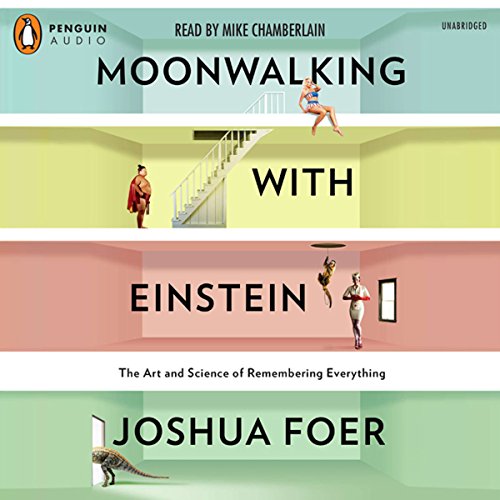
“Moon walking with Einstein: The Art and Science of Remembering Everything

By: Joshua Foer

Narrated by: Mike Chamberlain

Joshua Foer (Author, freelance journalist, 2006 USA Memory Champion.)

Joshua Foer offers an interesting explanation of human memory. Foer became the 2006 USA memory champion. Foer explains how he achieved that distinction. What is interesting and surprising about Foer’s achievement is that he argues extraordinary memory is a teachable skill.

Arthur Conan Doyle (1859-1930)

Fans will remember Sir Arthur Conan Doyles’ explanation of Sherlock Homes’ prodigious memory technique called the “mind palace”.

Foer explains the idea is not a fiction but an historically proven method for improving one’s memory through association. “Mind palace” is traced back to ancient Greece as a memory tool of the Greek poet Simonides of Ceos. The idea is to associate facts with familiar features of a house in which one has lived, or of which one has intimate knowledge. The idea of memory being associated with something is not revelatory to anyone who tries to remember someone’s name. Many people, particularly good salespeople, use association to remember a customer’s name. They might remember Fred as a “red” tie or Monica as a “harmonica” and so on.

Foer suggests nothing is forgotten but only stored in one’s mind.

The problem is recalling a mind’s recorded information. If one makes a point of associating a fact with something that is familiar, say like a space in your own house, it is more likely to be recallable. Foer notes experimental studies show human brains record memories of events but may be unable to consciously recall details. In “show and tell” experiments, humans show evidence of a recorded memory by expressing familiarity, if not specificity. (“MIT research explains how our brain helps us remember what we’ve seen, even as visual information shifts around within our visual system.” See MIT NEWS Feb. 8, 2021.)

Foer suggests the history of memory began naturally with tales told and re-told before writing became a way of record keeping.

Foer explains history shows that philosophers like Socrates rejected the idea of recording information as a way of revealing truth. To Socrates, truth comes from conversational exploration of nature as it is. Foer suggests society is fortunate that Plato and Archimedes partly disagreed and chose to provide a written record of Socrates thought.

A larger picture of Foer’s view of memory and recall implies a leveling of knowledge in the world.

From an oral tradition to the written word to radio to television to the internet of things to microchips in one’s brain–the recall of facts become more widely shared. The complication of improving “knowledge leveling” is in how recalled facts are assembled by the brain of the receiver.

Foer illustrates how much effort must be put into memorizing information if one wishes to excel as a technologically unplugged person who wishes to recall more facts. It requires concentrated effort to create a mnemonic device like rooms in a house to associate a series of facts or numbers that can be recalled. On the other hand, advances in technology could make that exercise moot.

In the near future, recollection from an implanted human chip could improve correlation of facts for thought and action.

This is not to diminish the accomplishments of the author in training his mind to recall facts better than others. In the near future, recalling and collating facts may be more efficiently managed by an A.I. microchip that complements human thought and action.

Having eidetic memory or technological total recall does not make humans more intelligent or necessarily more informed about the world. Recall of facts is only a means to an end that may as easily destroy as improve society.