MOST INTERESTING ESSAYS 12/4/25: THEORY & TRUTH, MEMORY & INTELLIGENCE, PSYCHIATRY, WRITING, EGYPT IN 2019, LIVE OR DIE, GARDEN OF EDEN, SOCIAL DYSFUNCTION, DEATH ROW, RIGHT & WRONG, FRANTZ FANON, TRUTHINESS, CONSPIRACY, LIBERALITY, LIFE IS LIQUID, BECOMING god-LIKE, TIPPING POINT, VANISHING WORLD
With rule by the one there are no checks and balances which threatens war and discounts peace.
Books of Interest Website: chetyarbrough.blog
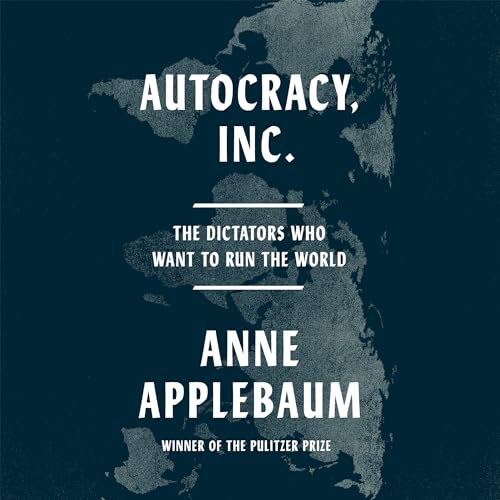
Autocracy, Inc. (The Dictators Who Want to Run the World)
By: Anne Applebaum
Narrated By: Anne Applebaum
Anne Applebaum (Author, journalist, historian, wrote Pulitzer Prize for Non-Fiction with “Gulag: A History” Also wrote “Red Famine”, both of which have been reviewed in this blog.)
“Autocracy, Inc.” infers there are two forms of government in the world, one is autocratic, the other democratic. Applebaum shows autocracies are often venal and kleptocratic. One might agree, but immorality and greed are a part of human nature in every form of government. This is not something Applebaum denies, but all forms of government have experienced excesses of wealth and power that have led to autocracy. What Applebaum argues is that autocracy is more threatening today than at any time in history.
The prestige of national leaders is by definition power.
As the British Lord Acton noted in 1887–“Power tends to corrupt, and absolute power corrupts absolutely”. Both democratic and autocratic leaders are subject to Acton’s aphorism. This is not to say Applebaum’s argument is not important, but no form of government, including democracy, has been found to fairly regulate the faults of human nature.
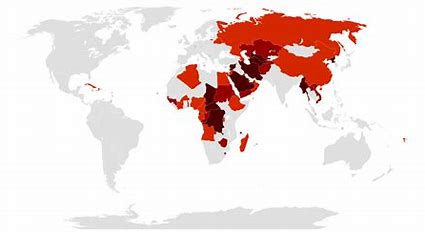
What Applebaum makes clear is that autocracy magnifies the faults of human nature because in countries like China, North Korea, Myanmar, Russia, parts of Africa, and similar autocracies, there are no checks and balances.
Imprisonment, torture, and murder for challenges to leadership are condoned, and commonplace. Applebaum’s added dimension is that many autocratic nations have begun aligning themselves to split the world between the lands of the relatively free and the chained.
Alexi NalvanyLiyu XiuaoboJang Song-thaekAung San Suu Kyi
Applebaum offers many examples of imprisonment, torture, and murder in autocratic countries. Some of the most famous are Navalny in Russia, the Nobel Prize laureate Liu Xiaobo in China, Jang Song-thaek, the second most powerful leader in North Korea, and of course, Aung San Suu Kyi in Myanmar. However, what makes Applebaum’s history terrifying is the calculated and cooperative effort by aligned autocracies to subvert freedoms offered in America and other democratic countries.
The author argues many autocratic leaders have become so powerful that no fellow countryman, regardless of their location, is safe from incarceration or assassination.
Assassination of Kim Jon Un’s brother.
Vladimir Putin is believed to have ordered the assassination of a number of Russian citizens around the world. Autocracies use the tools of State to directly or indirectly threaten or assassinate dissidents anywhere in the world.
Facial recognition in China.
The advance of Artificial Intelligence has magnified the strength of autocratic rule with tools of surveillance, assassination, and indoctrination that reach around the world. Applebaum argues the line between democracies and autocracies is hardening to the point of irreconcilable difference, leading to wars between states and territories like Syria, Ukraine, Sudan, and Gaza.
Democracy has its problems which includes dalliance with autocracy, but rule by the one where there are no checks and balances threatens war and discounts peace.
The concern one may have about the interconnected world is that it homogenizes society. Anand’s interconnected world implies free-will is a fiction.
Books of Interest Website: chetyarbrough.blog
“The Content Trap” A Strategist’s Guide to Digital Change
By: Bharat Anand
Narrated By: Jason Culp
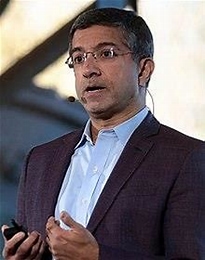
Bharat Anand (Author, American economist, Professor of Business administration at Harvard Business School.)
Bharat Anand offers a compelling explanation of how connection has become as important as “…Content…” in the digital age. His point is not to say content is irrelevant but without understanding digital interconnectedness, Anand infers profits, personal achievement, and commercial success are diminished or lost.
In the digital age, Anand argues if success is measured by profit, longevity, or fame, the key to success is adapting to interconnectedness.
Anand argues business managers and companies will fail if they do not adjust to changes in the way the public sees, understands, and uses the digital world. To give examples of his point, Anand notes the adjustments made by Apple, Microsoft, Google, Amazon, and the Fox TV network that have changed their business models to adjust to a digital world. Anand explains the digital world is a ubiquitous force (interconnected by computers, smartphones, and the internet) used by insightful individuals and businesses to achieve their goals.
Apple initially focused on product design and utility and earned a reputation for excellent product.
However, as the product evolved, Anand notes Apple’s specialization in quality meant less to their success than the connectivity to sources of information, entertainment, and people. The iPhone became ubiquitous and highly profitable when they improved Apple connectivity among iPhone’ users. They expanded that connectivity with their iTunes creation, audio book features, and various internet media offerings.
Microsoft specializes in software development tools that can be used by individuals and businesses to improve their communication skills and connectedness inside and outside their business.
Microsoft’s software enhances interconnectedness and communication while providing useful information to banks, affiliates, and users to understand the value of their business and how they may or may not complement each other’s performance. Microsoft expands their interconnectedness with an annual subscription system that appeals to repeat users of Microsoft’s updated software.
Google substantially improves their reach into the digital age by choosing to pay Apple $20,000,000 a year to use their search engine.
Though that is challenged by the government as a monopolization of trade, it illustrates the truth of Anand’s observation about the value of interconnectedness among companies in today’s digital world as a way of improving profits, growing, and assuring longevity.
Amazon ranks as one of the leading retailers and suppliers of consumer goods in America.
Bezos introduces many marketing innovations based on interconnections with customers that include many consumer enhancements. Amazon created its own storage and delivery service to directly compete with same day availability of product that showed customers could get product as fast as they could by going to a box retailer. Amazon capitalized on book selling by creating a portable library with Kindle that lowered NY Times’ best-selling books at half or less than the recommended retail price.
Fox television rose to compete with the big three television networks by buying the rights to NFL football at a price far beyond what the networks at that time were willing to pay. Digital age football fan connectivity gave Fox the power and influence to become the 4th major tv network in America.
Anand’s point is that adaptation, rather than opposition to evolving human connectivity, is the key to success. Identifying what is happening in the world and adapting to societal inevitabilities offers opportunities to keep pace with change and prosper. Anand is not saying content does not matter but that content is improved by adapting, rather than resisting or fighting evolving societal norms.
Anand addresses a favorite publication of many, “The Economist”, an international newspaper that has weathered the storm of newspaper disappearance in the 20th and 21st century.
Anand notes “The Economist” has prospered since the 19th century, despite the collapse of the newspaper industry in the late 20th and early 21st centuries. He argues it survives and prospers because of editorial development of international’ news through consensus of its experienced and educated writers. One might accept his observation but with reservation because of a recent survey request from the “Economist” for reader response.
The “Economist” survey form is daunting because it infers a pricing scheme based on digitalization of its articles. Having received the survey, some (like me) choose to throw it away.
The appeal of “The Economist” is in its editorial opinion of the world. Those who have traveled around the world are fascinated by the editorial opinions of a group of educated generalist opinion writers. Their survey may have been to solicit better reader connectivity, but it read like a prescription for higher prices for publication.
The threat of digitization of the “Economist” may ruin its appeal to many readers. It seems the “Economist” would change if it follows what seems the intent of their survey. The “Economist” survey seems like a digitization of their work to make it more connected to an untraveled public. They risk falling into the trap of “breaking news” rather than an insightful editorial opinion about non-western cultural policies and beliefs. They would be following the lead of many newspapers that couldn’t adjust to the interconnected digital world and had to close their doors.
Anand’s book is interesting and seems largely correct about the road to economic success, i.e., people and companies adjusting to the reality and understanding of an increasingly interconnected world.
The concern one may have about the interconnected world is that it homogenizes society. Anand’s interconnected world implies free-will is a fiction.
The near assassination of Trump is a harbinger of a world unduly influenced by today’s technology and media influence.
Books of Interest Website: chetyarbrough.blog
“Playing with Reality”
By: Kelly Clancy
Narrated By: Patty Nieman
Kelly Clancy (Author, graduate of MIT in physics with a Ph.D. in biophysics from U.C. Berkley.)
Kelly Clancy has a distinct point of view as a scientist. Her understanding of game theory and the mathematics of probability may steer reader/listeners away from her interesting book. “Playing with Reality” is less like playing and more like hard work, at least in the first chapters. Clancy begins by defining game theory and its permutations. Then she explains how it is a flawed tool for understanding human behavior. As one gets through the first chapters of her book, a reader/listener realizes Clancy is offering more than gaming theory history.
Clancy offers a detailed history of the growth of computer technology through the use of gaming programs designed to educate, entertain, and enrich private companies, public conglomerates, and individuals.
Clancy reveals the growth of chess playing gaming programs like Deep Thought, Big Blue, and Deep Blue to expose the battle line between human and artificial intelligence. Clancy is a skeptic of gaming technology–with a warning.
Clancy’s skepticism lies in mistaking game-theory’ studies as proof of predictive human behavior.
Clancy notes human behavior is not predictable for many reasons; one of which is human irrationality, and another is a human’s sense or understanding that he/she is being manipulated for prescribed responses. For example, in the first instance, a person may be irrationally afraid of all snakes even though there are no poisonous snakes in their State. In the second instance, a person who knows the theory of something like the “Prisoner’s Dilemma” can choose to modify their behavior and respond based on knowledge of previous experimental studies.
John von Neumann (1903-1957, Hungarian American mathematician, physicist, computer scientist, engineer and polymath.)
The troubling part (the warning) revealed by Clancy is that brilliant people like John von Neumann, an intellectual giant of the twentieth century, can have bad ideas. Clancy notes von Neuman considered preemptively nuking the Soviet Union because he reasoned it would (and it did) successfully create a nuclear bomb soon after America’s bombing of Nagasaki and Hiroshima. Neuman presumably considered this a rational option based on game-theory thinking.
Today, one wonders what Russia’s leader is capable of with nuclear weapons if he considers them just another tool of war.
Clancy notes Putin, like the President of the United States, is legislatively authorized to unilaterally choose to use nuclear weapons to protect what they believe is a threat to their countries. The gaming industry and the growth of A.I. are not the problem. Human nature is the problem. There are not enough checks and balances to keep well intentioned Presidents or bad actors from making bad decisions.
Clancy shows how the computer gaming industry has obscured the tragic consequence of violence by returning murdered life in a game back to life so they can play the game again. The game is not real, but the lesson is that gun violence is ok because it is just a game that can be replayed. Computer gaming has become a gateway to violence in the world. Easy access to guns is a problem in America but guns are instruments of violence, not the cause of violence. Among the causes are, poor education, poverty, mental dysfunction, and gaming that distorts reality.
Political position and power are dangerous in the face of human irrationality, a not uncommon characteristic of intelligent, ill-informed, or uncaring political leaders. In this age of computer drones and face recognition, three American citizens, one Iranian citizen, and an Egyptian’ Al Quada leader were killed by drone strikes at the order of American Presidents.
These murders may or may not have been justified but they exemplify the danger of gaming, face recognition, and the future of artificial intelligence. Clancy tempers her assessment of gaming in the last chapters of her book, but some will come away from her positive comments with a sick feeling in their stomach.
The near assassination of former President Trump is a harbinger of a world unduly influenced by today’s technology and media influence.
“…saving America” will not come from “…ten easy steps” but from one vote at a time.
Books of Interest Website: chetyarbrough.blog
“Democracy or Else” How to Save America in 10 Easy Steps
By: Jon Favreau, Jon Lovett, Tommy Vietor
Narrated By: Jon Favreau, Jon Lovett, Tommy Vietor
(Left to Right) Jon Favreau, Jon Lovett, Tommy Vietor
The suggestion that “Democracy or Else” comes from “…10 Easy Steps” on “How to Save America…” is an oversimplification of life and politics. Saving America takes hardened objective opinion, personal commitment, appreciation of the difficulty of being a political leader, and most importantly, the wisdom of Jesus Christ. Few, if any humans fit the bill. Voting is the only thing that everyone who believes in American Democratic leadership will agree upon in the author’s “…10 Easy Steps”. The steps are not easy. The authors appear to have committed some time and effort to fulfill some part of the 10 steps.
Many (not most) Americans may be willing to vote but working on a campaign for a candidate who wishes to be elected to public office will always be low on their list of commitments.
Human beings, let alone Americans, are an unruly lot. Making a living, waiting for a hand-out, hating or loving others, and experience of life come first in the minds of most, if not all, human beings. The nuts and bolts of what it takes to become an elected representative in Democracy are way down on the list of humans’ self-interest. American Democracy, like all known forms of government, have winners and losers. Democracy has the best odds for serving the self-interest of its citizens but remains far from the idealistic goals of the U.S. Constitution.
American Presidents have been good and bad throughout history. Only a few have earned the history of “good or great” for America. The checks and balances of American government, the ideals of the Constitution, capitalism, and expanded voting rights have saved American Democracy from tyranny. Anyone who has read this blog, knows there is an opinion about the next President’s election but “…saving America” will not come from “…ten easy steps” but from one vote at a time.
The sharpened point of Slade’s story is that, like the sinking of the Edmund Fitzgerald and El Faro, it takes great tragedy before change takes place.
Books of Interest Website: chetyarbrough.blog
“Into the Raging Sea”Thirty-Three Mariners, One Megastorm, and the Sinking of the El Faro
By: Rachel Slade
Narrated By: Erin Bennett
Rachel Slade (Author, winner of the Maine Literary Award for non-fiction.)
Rachel Slade begins her book with the last words of a mariner calling for help from a sinking ship in the grip of a Hurricane. The ship is the El Faro. The author writes her story based on the El Faro’s written log during a severe storm somewhere between Florida and Puerto Rico. The storm was Hurricane Joaquin, a category 4 Hurricane that had recorded wave heights of 10 meters (over 32 feet). Winds ranged from 130 to 156 mph with rough seas, roiled by rogue waves. Rogue waves are twice the size of surrounding waves and appear unexpectedly.
Slade methodically sets a table for the El Faro on a “…Raging Sea”.
Slade writes about a mariner’s desperate call for help. In its beginning, the story lags but the author offers cultural insight to the life of merchant marines, the equipment they operate, and the business of international trade. Her story explains how important and dangerous the life of a merchant marine can be, why it is important, and how mariners are dependent on equipment they use, their shipmates’ qualifications, and business owners’ drive for success.
Every person makes decisions about what they are going to do to make their way in life.
Becoming a merchant marine, like every decision in life, is based on personal circumstances, ambitions, and choices. Slade describes the El Faro mariners as adventurous and interested in seeing the world and being paid for what they do. Some are educated, others not, but all learn what they need to do to be part of a mariners’ crew.
There are schools for mariners at all levels of education but like any job, one can start at the bottom as a laborer that learns by doing. What the story of the El Faro shows is that like in any chosen job in life, some become expert at what they do, others try and fail, try again or move on. What Slade infers is that the El Faro sinks because of its crew but also because of others, both on and off the sea. As John Donne wrote in 1624, “no man (or woman) is an island”–emphasizing the interconnectedness of society.
The crew of the El Faro wanted to be paid but to some it was adventure and/or escape from a humdrum of life. Undoubtedly, mariners were motivated for different reasons. Some wished to see the world, be recognized for good work, wished to crew on bigger and better vessels, or be promoted to higher position. Motivation and ambition are different for everyone. What is lost to history are details. Slade tries to reveal some of the details about the El Faro’ crew, its owners, the ship, and the business of international trade. Why did the El Faro sink? Who and what was lost? What is it like to be in a hurricane at sea? Is somewhat at fault?
Slade’s story gains momentum as sinking of the El Faro seems imminent.
The aftermath is a careful and detailed explanation of rescues at sea, why the El Faro sank, what rescue efforts were made, how families of the lost were affected, and what changes were demanded in the industry. The loss of 33 mariners, the entire crew of the El Faro, is a horrible tragedy for the families who lost their loved ones. The causes of the tragedy range from crew mistakes to ship design to corporate malfeasance. The common thread is human nature.
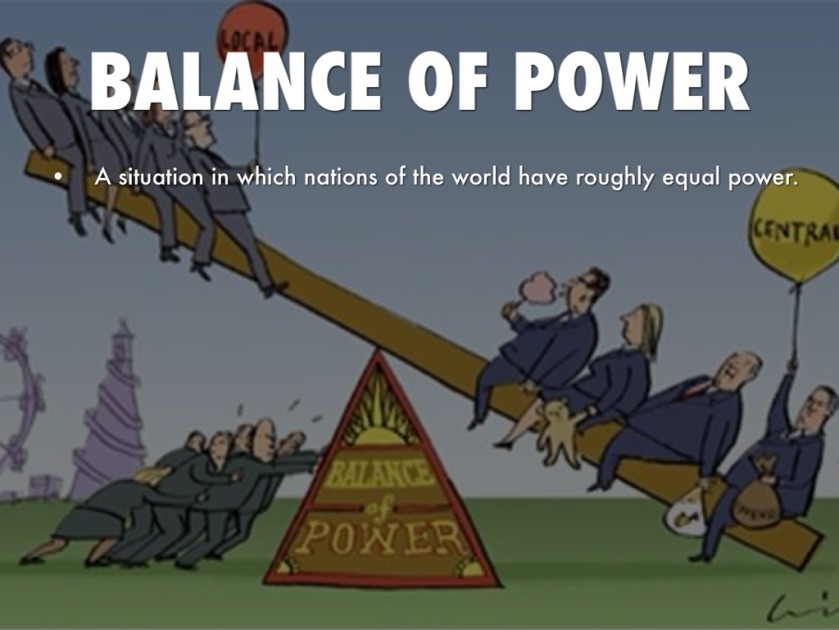
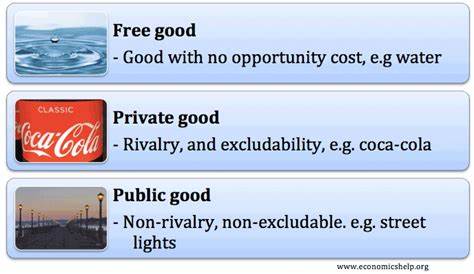
What this review suggests is that the fundamental issue in every form of government and society is balance between public and private good.
One will draw their own conclusions from Slade’s history of the loss of the El Faro. In a capitalist society, balance is dependent on prudent regulation. Prudence is meant to mean the use of human reason to balance the needs of the public with private interests. That balance is complicated by human nature that drives private interests to focus on money, power, and prestige rather than public need.
Slade shows regulation of international trade often conflicts with private interests that object to regulation and improvements in ship design.
Conflict between public good and private interest is not a new discovery. Neither is the sinking of the El Faro. The sinking of the Edmund Fitzgerald in 1975 led to changes in international shipping. Business owners were required to provide survival suits for mariners in their employ, depth finders, positioning systems, improved ship design, and inspections by the Coast Guard became mandatory. These were regulations that increased costs of shipping that rippled through the economy and initially penalized private interests. The public benefits because mariners are safer, and families are less threatened by loss. The public also suffers because transported goods become more expensive. Balance eventually occurs as private interests are compelled to pay more for labor which is part of the public.
Capitalism works because it is a process that balances public need with private interests. Capitalism’s weakness is that the process takes time to balance public needs with private interests.
The sharpened point of Slade’s story is that, like the sinking of the Edmund Fitzgerald and El Faro, it takes great tragedy before change takes place.
Every nation in the world can learn from nation-state’ mistakes in history but none can right the wrongs of the past.
Books of Interest Website: chetyarbrough.blog
“Empireworld” (How British Imperialism Shaped the Globe)
By: Sathnam Sanghera
Narrated by: Homer Todiwala
Sathnam Sanghera (Author, British journalist, born to Punjabi parents, graduate of Christ’s College, Cambridge with a degree in English Language and Literature.)
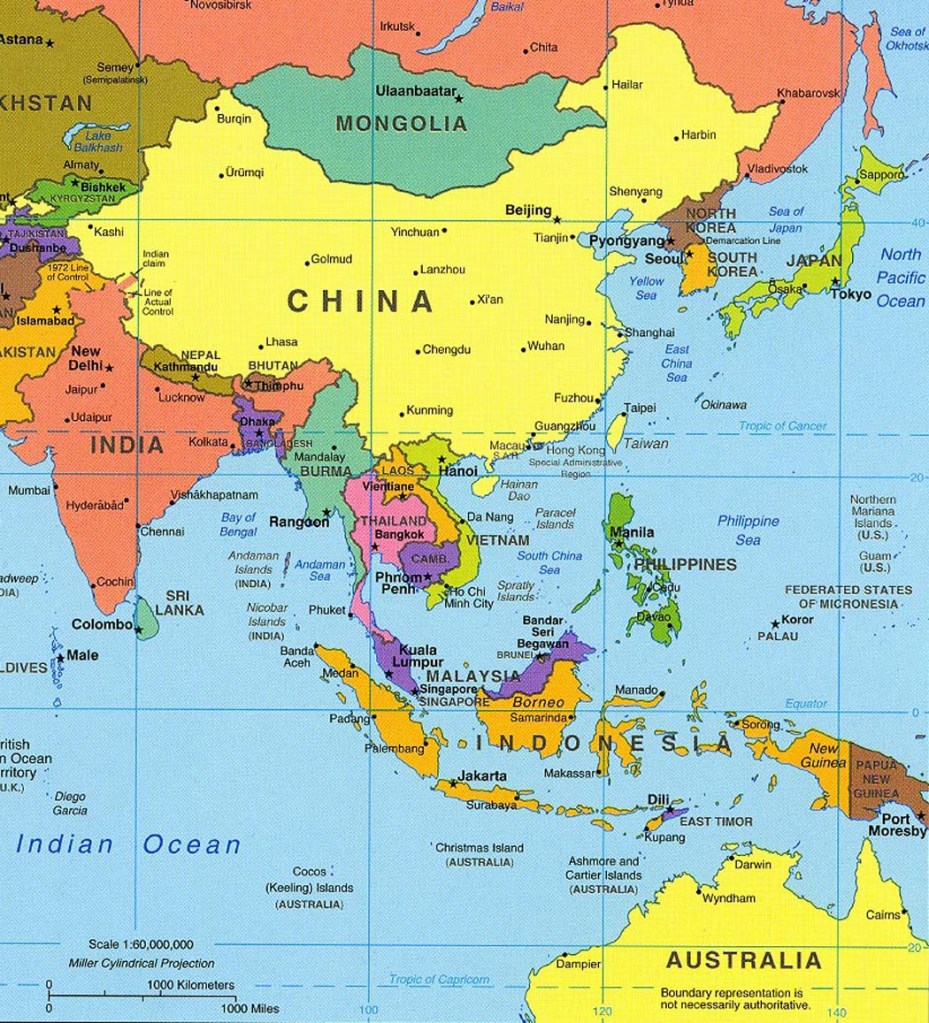
“Empireworld” offers a credible explanation of how the white race, which is a mere 16% of the world’s population, has dominated the world since the 17th century. That domination changed in the 21st century. It changed with the power and economic growth of the United States which is being challenged today by the Asian continent.
In earlier centuries, China, the Ottoman (modern day Turkey), and Mughal Empires (modern day India, Pakistan, and Bangladesh) were Asian rulers of the world
Prior to the 17th century, an empire’s influence is arguably more local because of transportation and communication limitations. What Sanghera infers is Great Britain’s growing power and influence surpassed others because of its domination of the sea and growing industrialization. The point is all of these 17th century nations were principally white with similar ambitions but only Great Britain influenced all foreign cultures of that period, with remnants extending into modern times.
France, Spain, the Dutch Republic, and Portugal were major 17th century players, but Sanghera argues the imperialist drive of Great Britain surpassed its rivals.
Sanghera focuses on GB, not only because it was white but because it represented a national power’s intent to shape the world in its own image. The image Sanghera creates is not egalitarian, democratic, or sanguine. GB is characterized as dominating, autocratic, and driven by self-interest. He suggests eleemosynary efforts by GB to aid other countries was principally to guild their own lily, not to offer other countries self-determination or freedom. Indigenous populations are inferred to be expendable in Sanghera’s “Empireworld”.
“Empireworld” is a harsh judgement of Great Britain’s history of enslavement, indigenous displacement, colonization, and confiscation of other countries’ natural resources. Sanghera systematically builds a case for GB’s attempt to English-size the world. Parenthetically, this is the same view held by some nations about America.
Sanghera recalls the history of the slave trade, Great Britain’s colonization of India, Nigeria, Australia, New Zealand, North America, and other countries of the world. He reminds listener/readers of the despoiling of the animal kingdom, confiscation of nation-state natural resources, enslavement of Africans, sexual discrimination, suppression of colonial sovereignty, displacement of indigenous peoples, and re-education or extermination of native countrymen who will not accept an English view of superiority and custom.
Sanghera tempers his harsh view of Great Britain in the conclusion of “Empireworld”. He does not deny G.B.’s history but acknowledges his countries’ measured efforts to right the wrongs of the past; which is of course not possible.
Sanghera cites G.B.’s belated effort to preserve animal and plant species, its acceptance of former colonies’ nation-state sovereignty, growing discussion about reparation for profiting from the slavery trade, endorsement of indigenous people’s rights, legislative action for sexual freedom, and support for improved health, education, and welfare of former colonial citizens. All are works in process, far from completion, but progressing. Sanghera’s history of Great Britain is the story of America. Though America avoided the colonial history of England, it has similar challenges.
Every nation in the world can learn from nation-state’ mistakes in history but none can right the wrongs of the past.
One suspects Musk is at a crossroad. He will either sell X at a loss or figure out how the forum can provide a service to the public for which it is willing to pay.
Books of Interest Website: chetyarbrough.blog
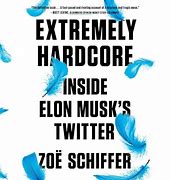
“Extremely Hardcore” (Inside Elon Musk’s Twitter)
By: Zoë Schiffer
Narrated by: Jame Lamchick
Zoë Schiffer (Author, senior reporter at “The Verge”, freelance journalist, experience as a tech content manager.)
Zoë Schiffer’s “Extremely Hardcore” is a send-up of Elon Musk’s takeover of Twitter. Elon Musk believes in freedom of speech with a commitment that results in the dismantling of Twitter. What Schiffer makes clear to some who listen to her book is that the failure of Twitter is not because of Musk but because of the ideal of free speech.
Musk made an error in trying to shift Twitters’ income source from advertising to users. Only with advertiser revenues could Twitter pursue the ideal of free speech.
Musk’s task should not have been to do what has not been possible because of the nature of human beings. Free speech is a laudable but unachievable goal because human beings are influenced by the way they are raised and the experience of living. Advertisers want to know that the media on which they advertise is not going to offend its customers. Musk is unquestionably a genius and a credit to human progress but creating a forum for free speech is an unachievable goal.
Jack Dorsey (American internet entrepreneur, philanthropist, and programmer.)
The co-founder of Twitter, Jack Dorsey, was no better at creating a free-speech forum than Elon Musk. Dorsey was liberated from the struggle to achieve the unachievable by Musk when Twitter was sold. The only chance for X’s survival is for Musk to offer a service that goes beyond the ideal of free speech to a forum that acknowledges some free speech is harmful and that X’s media forum can serve the public in some other way.
Twitter appeared to be a bloated organization that was organized to do the impossible. Monitoring and regulating free speech bureaucratized Twitter in ways that made profitability difficult, if not impossible. On the other hand, Twitter offered a free service to a public that craves attention and recognition. X cannot survive as a free speech forum because it cannot survive its debt service based on people who are only seeking attention and recognition.
Musk’s choice to change Twitter to an organization called X is only going to succeed if he manages to either return it to a monitored public forum or a service beyond the unachievable principle of free speech.
The history of Reddit and its successful public stock offer earlier this week shows that a monitored public forum can be successful. One wonders if Musk will take the hint and emulate Reddit’s success. His mistaken belief about freedom of speech suggests he will not invest in re-bureaucratization of what is now called X.
One suspects Musk is at a crossroad. He will either sell X at a loss or figure out how the forum can provide a service to the public for which it is willing to pay.
“Drucker” is an interesting book about an important 20th century professor and storied business consultant.
Books of Interest Website: chetyarbrough.blog
“Drucker” (The Man who Invented the Corporate Society)
By: John J. Tarrant
Published in 1980–No picture available of the author, John J. Tarrant.
Peter Drucker was a world-renowned business and government management consultant in the mid-twentieth century. John J. Tarrant’s personal memoir is about Peter Drucker’s business and government management beliefs. A lack of approval or acknowledgement of Tarrant’s book by Drucker reinforces one’s belief in Tarrant’s objectivity.
With my personal experience as a neophyte business manager in the 1970s, Peter Drucker was a business consultant we studied in management development classes.
There were several group meetings with other managers in the company for which I worked. In those meetings we discussed Drucker’s views on business management and practice. Drucker had a profound effect on me and how I managed my part of the business.
A fundamental point made by Drucker is that a business’ manager must focus on strengths, not weaknesses of people reporting to him or her.
The principle of that focus is that every manager is charged with setting goals while recognizing he/she needs to build around personal weaknesses with direct report’ employee’s strengths. The point is that a manager and/or employee in an organization is unlikely to know all there is to know to achieve a company’s goals. Drucker argues the purpose of business is to sustain itself by achieving determined objectives. It is not about profit but about sustaining a business’s future. That principle applies to government departments as long as they continue to serve the needs of the public. When businesses or government departments fail to preserve their future or purpose, they deserve dissolution.
What Tarrant notes in his memoir is that Drucker believes government departments do not have the same incentives as businesses and tend to become self-perpetuating when their original purpose is achieved. Businesses disappear or go bankrupt because they do not generate enough revenue to sustain their future. Drucker suggests government departments rarely disappear. They become self-perpetuating. They are protected by public taxes, not the principle of free market revenue. Tarrant infers Drucker believes government departments should be dissolved when their goals are achieved.
Tarrant categorizes Drucker as a conservative but not in a 21st century Republican sense but in a belief that government tends to waste public taxes because their goals tend to evolve from service to the public to employment-preservation. Government departments should not exist as an employment haven without public purpose.
Tarrant notes Drucker voted as a Democrat. As an Austrian born American, Tarrant notes, he only voted for a Republican President twice in his lifetime. Drucker is alleged to regret having voted Republican the two times he did. One was for Nixon and the second I can’t remember. This is not to suggest Drucker was partisan because his focus was on management, not politics. “Drucker” is an interesting book about an important 20th century professor and storied business consultant.
Nolan clearly illustrates how important political power is in balancing corporate owner/managers’ disproportionate incomes and privileges with labor.
Books of Interest Website: chetyarbrough.blog
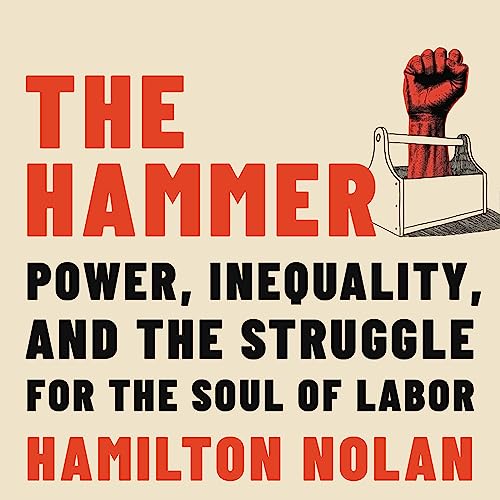
“The Hammer” (Power, Inequality, and the Struggle for the Soul of Labor)
By: Hamilton Nolan
Narrated by: Franklin Pierson
Hamilton Nolan (Author and free-lance Journalist)
“The Hammer” is a paean to unionization. Unions lost much of their political power in the early 1970s. Political power of labor was diminished by State governments, poor labor union management, and a diminishing number of labor union members. Nolan’s argument is workers have to reestablish political power to change their unfair and inequitable relationship with business.
The widening gap between rich and poor is traced to the era of President Reagan when the first deep cuts in corporate taxes occur.
Reagan fought unionization by firing air traffic controllers that sought better wages. Reagan’s supporters believed government social programs were out of control and their cost diminished the power of free enterprise. Much of the American public either agreed or were apathetic. However, as the gap between rich and poor accelerated, Americans began to complain about inequality. With extraordinary income increases for business owners and CEOs, and repressed wages for workers, the need for unionized political power became self-evident. Nolan introduces his book about unionization with a brief biography of Sara Nelson.
Sara Nelson (AFA president of the Association of Flight Attendants.)
Nolan writes about Sara Nelson who became a union member when she worked for United Airlines as a stewardess. Nelson was born and lived in Corvallis, Oregon. She applies for a job with United Airlines in St. Louis. She gets the job but her first paycheck is late. She couldn’t pay her rent. A check is given to her by a union employee to tide her over until her first check is delivered. From that day forward, according to Nolan, Nelson became a supporter of unions. Eventually Nelson becomes the president of the Association of Flight Attendants (AFA).
Liz Shuler (President of the AFL-CIO since 8/5/21.)
Ironically, the first woman President of the AFL-CIO is also from Oregon. Liz Shuler received a bachelor’s degree in journalism from U of O in Eugene, Oregon. She became a union activist after college and worked to organize clerical workers at Portland General Electric. She is elected as the President of the AFL-CIO in 2021 after serving as the first woman Secretary-Treasurer of the organization.
Nolan’s book addresses State conflicts with unionizers and family-income for low-income workers. The first states he addresses are South Carolina and California. Nolan notes South Carolina has become a haven for businesses wishing to avoid unions. South Carolina’ State laws discourage unionization which appeals to businesses wishing to relocate. Nolan notes South Carolina attracts businesses looking to improve profits by reducing labor costs. The consequence of business’s lower labor cost is to reduce South Carolina workers’ standard of living. South Carolina’s workers are among the lowest (19th out of 50 States) paid workers in the U.S. Nolan implies South Carolina’s income inequality is a consequence of the State’s policy of discouraging unionization.
California has the fourth largest income inequality in the U.S.
Nolan notes the cascading negative of unfair compensation for domestic labor. Though California now allows childcare servers to be unionized, their unionization efforts are discouraged by government regulation, as well as the fragmentation of its poorly compensated workers. The consequence of State government regulation keeps wages low and discourages entrepreneurs from starting childcare’ businesses. A compounding negative is created when users of childcare’ service, women in particular, are unable to work in regular work-day jobs. Workers are compelled to stay home to take care of their children, reducing family income and further impoverishing low-income childcare’ workers. It becomes a vicious cycle, hurting entrepreneurs trying to start a childcare service, employees wishing to increase family income, and employers needing more workers.
Nolan expands his argument by noting how service industries in Las Vegas, the State of Florida, New Orleans, and Mississippi are benefited by unionization.
Vacation and gambling meccas like Las Vegas, Florida, New Orleans and Mississippi need service industry employees. These vacation and gambling meccas depend on service quality for visiting tourists. Lack of representation for service employees diminishes employee’ standards of living which indirectly damages the reputation of the entertainment and vacation industry.
In Las Vegas, where Nolan lived for twenty years, the service industry is protected by the Culinary Union.
Nolan notes how strong the Culinary Union has become in Las Vegas and disparages casino owners like the Fertitta’s who have fought unionization. Numerous examples are given to show how union actions have improved the lives of Casino workers, many of which are immigrants from other countries.
Nolan’s argument for the value of unionization is compelling but his encomium for the union movement ignores America’s immigration crises.
The vast need for immigration reform is not being forcefully addressed by unions. Compensation inequity is a noble fight carried out by unionization, but it needs to broaden its role in immigration. Unions need to use their power and influence to change immigration policies to equitably treat a labor force that is sorely needed in America. Unions need to help educate and house legal immigrants, so they do not become a part of America’s growing homelessness. Additionally, unions could use their recruiting expertise to get Americans off the street by providing job training services and gainful employment.
Public perception of unions could be monumentally improved with a program to recruit and indoctrinate the homeless with training for jobs in the 21st century.
There is so much that unions could do to far exceed the minimalist goal noted in Liz Shuler’s plan to add a million union members over the next 10 years. Nolan pitches for Sara Nelson as a more dynamic leader for the union movement. Maybe Nelson would be better than Shuler, but growth, value, and public perception of union members could be monumentally improved with a program to recruit and indoctrinate the homeless with training and jobs for the 21st century.
Whomever the leaders of unionization may be in the future, Nolan clearly illustrates how important political power is in balancing corporate owner/managers’ disproportionate incomes and privileges with labor.
Appelbaum infers no American President has found the magic formula for balancing the needs of its citizens with the concept of Adam Smith’s free enterprise.
Books of Interest Website: chetyarbrough.blog
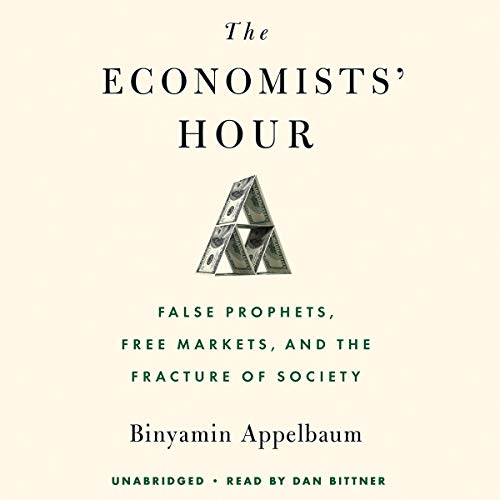
“The Economists’ Hour: False Prophets, Free Markets, and the Fracture of Society“
By: Binyamin Appelbaum
Narrated by: Dan Bittner
Binyamin Appelbaum (Author, winner of a George Polk Award and a finalist for the 2008 Pulitzer Prize, lead writer on economics and business for The New York Times Editorial Board)
Binyamin Appelbaum has written an interesting summary of a difficult but immensely important subject. Economic policy and theory are boring, but they touch every aspect of life. Appelbaum shows economic policy magnifies or diminishes the welfare of every American, let alone every economy in the world.
Adam Smith’s foundational theory of economics.
Though only briefly mentioned by Appelbaum, American economic policy begins with Adam Smith (1723-1790), the Scottish philosopher who wrote “The Wealth of Nations”. Smith advocated free trade and argued against parochial maximization of exports and imports that is manipulated by strict governmental regulation meant only to accumulate gold and silver.
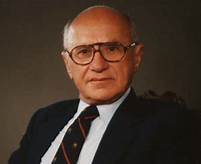
JOHN MAYNARD KEYNES (1883-1946, CONSIDERED FOR NOBEL 3 TIMES FOR DIPLOMACY BUT NEVER AWARDED.)MILTON FRIEDMAN (1912-2006, 1976 NOBEL PRIZE FOR ECOOMIC SCIENCES.)
Appelbaum illustrates how American policy violated the entrepreneurial freedom that Adam Smith advocated. In contrast to Smith, John Maynard Keynes (1883-1946) advocates government intervention whenever there is an economic downturn. Equally interventionist is Milton Freidman’s (1912-2006) belief that government should increase or decrease the money supply for national economic stability. The point seems to be that every economist thinks they have a magic bullet that will cure the ills of a faltering economy.
To be fair, Friedman did believe in free enterprise in regard to nation-state currencies. He argued for a floating currency rate that ultimately led to President Nixon’s abandonment of the gold standard. However, the nature of human beings led to speculation and manipulation of nation-state’ currencies that exacerbated trade tariffs and defeated the policy’s free-enterprise objective.
FRANKLIN ROOSEVELT (32ND PRESIDENT OF THE UNITED STATES, INTHE DEPRESSION, BANKS FAILED, UNEMPLOYMENT AND POVERTY SKYROCKEDTED.GEORGE W. BUSH (43RD PRESIDENT OF THE U.S. 3 MILLION JOBS LOST IN THE 2001 RECESSION)
One concludes from “The Economists’ Hour…”, there is no magic solution for an economy in crises. Neither Franklin Roosevelt, George W. Bush, Barack Obama, or any American President cured what ails an American economy that succumbs to economic crises. Adam Smith would argue an economic crisis is caused by a governments’ interference with free enterprise.
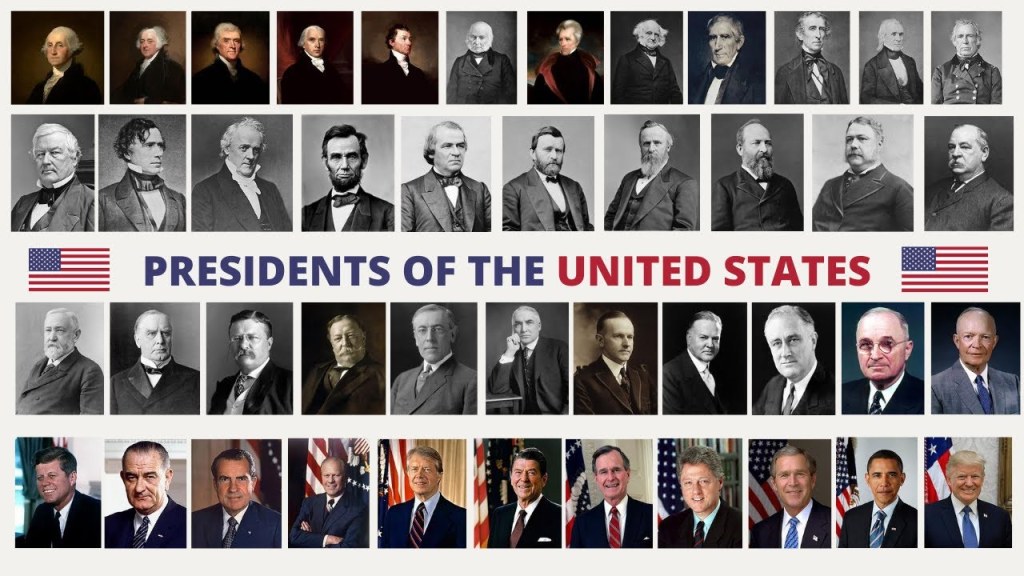
Applebaum explains how every 20th and 21st century President of the United States placed their faith in economists’ economic assessments of their day. All Presidents have found intervention by the government has unintended consequences.
President Nixon adopted Freidman’s monetary policy by imposing a freeze on prices and wages that squeezed the life out of the business economy and beggared the wage-earning public with job loss.
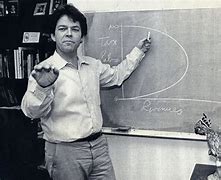
A decade of stagflation (high inflation and slow growth) followed Nixon’s administration. Stagflation is attacked by the Reagan administration with mixed results. A myth from economists like Arthur Laffer grew in 1974. Laffer believes taxation is either too high or too low for any benefit to society. Laffer argued zero tax and maximum taxation are equally harmful and produce economic stagnation and/or collapse.
ARTHUR LAFFER (American economist and author, served on President Reagan’s Economic Policy Advisory Board 1981-1989, Here illustrating the “Laffer Curve”.)
Laffer argued every government that reduces tax revenue decreases the stimulative effect of government spending. On the other hand, he suggested every tax cut increases income for taxpayers that will stimulate business and increase employment while encouraging higher production. He laughably created the “Laffer curve” to imply there is an optimum balance of tax reduction that would stimulate economic growth with proportionate increases in government revenue to provide for better government services. That balance has never been found. President Ronald Reagan experimented with Laffer’s idea, but it fails from unintended consequences. The principal consequence is to increase the gap between rich and poor.
BENEFIT OF TAX REDUCTION
Reagan accelerated a movement for government tax reduction that ultimately reduced income taxes from 70% to 28%. The result of government tax reduction during the Reagan years increased the U.S. budget deficit from $78.9 billion to $1.412 trillion. The benefit of that tax reduction went to the wealthy while school lunches were cut, subsidized housing declined by 8%, and poor families lost $64 a month in welfare payments. In 2023, the budget deficit stood at $1.70 trillion, an imbalance that shows why the “Laffer curve” is sardonically laughable.
President Reagan’s administration (1981-1989) was influenced by Laffer’s curve.
The joke is “There is no perfect balance on the curve because of the nature of human beings.”
Roosevelt, George W. Bush, and Obama choose to follow Keynesian policy. Roosevelt bloated government employment. All three increased the government deficit.
Some suggest the idea of “Cost benefit analysis” (CBA) is recommended to the federal government by two law professors, Michael Livermore and Richard Revesz during the George H. Bush administration but Reagan initiated it with an Executive Order in 1981.
Appelbaum notes that “cost benefit analysis” for government is first used during the administration of Ronald Reagan. However, Bill Clinton reifies its use with an Executive Order in 1993 that required covered agencies to do a CBA on “economically significant” government regulations. Ironically, Clinton was the first President in the post 19th century to balance the budget. Andrew Jackson manages to do it in his term between 1829 and 1837.
An irony of using “cost benefit analysis” is that it required a determination of of a human life’s value. Presidents Nixon, Ford, Carter, and future Presidents use value per statistical life during their administrations. High-income earners were worth $10 million to $15 million, middle-income earners $1 million to $2 million, and low-income earners $100,00 to $200,000. Of course, these values were always litigable. The point is that CBA became a tool for government to regulate the costs of government policies, ranging from military expense to the health, safety, and welfare of American citizens.
The remainder of Appelbaum’s book reflects on the experience of America, Chile, and Taiwan in the 20th century. The implication of his review of economic policy is that those countries that align with the free enterprise beliefs of Adam Smith have made mistakes. However, America’s, Chile’s, and Taiwan’s economic policies seem to have had more economic success when following Smith’s beliefs.
No American President has found the magic formula for balancing the needs of its citizens with the concept of Adam Smith’s free enterprise.
Along with CBA, Appelbaum notes the ongoing controversy is about regulation by government when it tries to balance American health, education, and welfare with Adam Smith’s concept of free enterprise. Appelbaum infers no American President has found the magic formula for balancing the needs of its citizens with the concept of Adam Smith’s free enterprise.
























































 REVIEWS AND VIEWS OF LIFE