BEGINNINGS

This introduction to the first volume of Gibbon’s work sets the table for the remarkable growth and longevity of the Roman Empire. Hopefully, the next few reviews of this very long listen will be of interest to those who follow this blog.

Books of Interest
 Website: chetyarbrough.blog

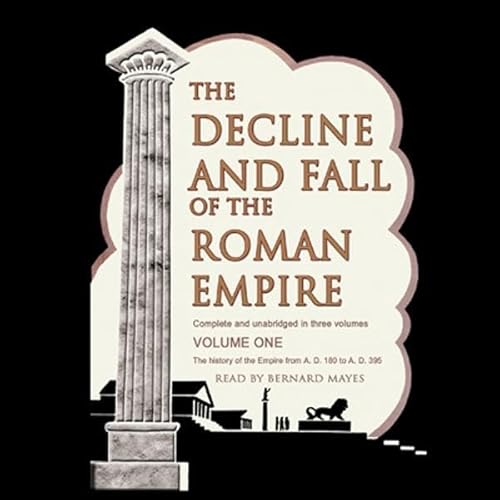
The History of the Decline and Fall of the Roman Empire (Volume 1)

Author: Edward Gibbon

Narrated By:  Bernard Mayes

The following story of Rome is largely absent of Julius Caesar which is a surprise to many who are dilatants of history. Caesar’s reign was as a dictator from 49 BCE to 44 BCE. Augustus was Caesar’s great-nephew and was adopted by Caesar as his son and heir.

Mark Antony became the leader of Rome after Caesar’s murder. Anthony ruled until 30 BCE when Augustus dethroned him and became the first emperor of what became known as the Roman Empire in 24 BCE. Though Caesar played a role in ending the Republic, it was Augustus who established the Roman Empire which explains why Gibbon begins his history of Rome with Augustus’s rule. Gibbon notes Augustus was the real architect of imperial Rome. Augustus consolidated the power of disparate interest groups to create the Roman Empire. Augustus reformed the government, secured military loyalty, and restored order after defeating Anthony.

What is unclear is why there was a conflict between Augustus and Anthony when Anthony supported Caesar. A little research suggests Anthony’s relationship with Cleopatra interfered with Augustus’s view of singular Roman leadership of Roman territory, i.e. exclusive of Egypt’s influence or interests. A propaganda war was created by Augustus that gained the Senate and Roman people’s support in what became a war against Anthony’s rule. This led to the Battle of Actium where Anthony and Cleopatra’s forces were defeated by Augustus. Anthony and Cleopatra returned to Egypt and committed suicide, leaving Augustus to rule Rome.

Augustus (27 BCE – 14 CE) – The first emperor, established the principate.

Tiberius (14–37 CE) – A capable but unpopular ruler.

Caligula (37–41 CE) – Infamous for his erratic behavior.

Claudius (41–54 CE) – Expanded the empire, including the conquest of Britain.

Nero (54–68 CE) – Known for his extravagance and persecution of Christians.

Vespasian (69–79 CE) – Stabilized the empire after the chaos of 69 CE.

Domitian (81–96 CE) – A harsh ruler, assassinated by his own court.

Trajan (98–117 CE) – Expanded the empire to its greatest territorial extent.

Hadrian (117–138 CE) – Consolidated the empire, built Hadrian’s Wall.

Marcus Aurelius (161–180 CE) – The philosopher-emperor, faced invasions.

Commodus (177–192 CE) – His misrule led to instability.

Septimius Severus (193–211 CE) – Strengthened the military.

Caracalla (198–217 CE) – Granted Roman citizenship to all free men.

Diocletian (284–305 CE) – Reformed the empire, introduced the tetrarchy.

Constantine the Great (306–337 CE) – Legalized Christianity, founded Constantinople.

Theodosius I (379–395 CE) – Made Christianity the state religion.

Romulus Augustulus (475–476 CE) – The last emperor of the Western Roman Empire.

This introduction to the first volume of Gibbon’s work sets the table for the remarkable growth and longevity of the Roman Empire. Hopefully, the next few reviews of this very long listen will be of interest to those who follow this blog.

SUPREME COURT

To Leah Litman, Trump’s election seems a setback but not a reversal of the ideal of balancing equal rights with private interests. As Alexander Pope wrote in his poem, in the 18th century “Hope springs eternal in the human breast”.

Books of Interest
 Website: chetyarbrough.blog

Lawless (How the Supreme Court Runs Conservative Grievance, Fringe Theories, and Bad Vibes)

Author: Leah Litman

Narrated By:  Leah Litman

Leah Litman (Author, BA in Chemistry & Chemical Biology, constitutional law scholar with Doctorate from University of Michigan Law School.)

One doubts Leah Litman would suggest there are no biological differences between men and women considering her education as a science major and legal scholar. As a science major, she knows there are chromosomal, hormonal, physical, and reproductive system differences between the sexes. However, Litman is spot on in arguing women do not have equal rights with men just as all races and ethnicities do not in the ideals of American Democracy. Litman argues that legally, equality is not being enforced in America today and is being diminished by today’s Supreme Court of the United States.

American Supreme Court

Litman persuasively argues today’s Supreme Court has eroded women’s rights by supporting legal theories that are ideologically promoted by political conservatives but not by precedents set by an earlier Supreme Court. Today’s majority at the Supreme Court has succumbed to the influence of conservative theories about the sexes rather than precedents set by an earlier Supreme Court.

It is not that the sexes are not different but that they deserve equal treatment under the law.

The point made by Litman is that the Supreme Court has found that in “all forms of discrimination”, equality of opportunity is mandated by the 14th amendment which provides equal protection under the law to all citizens with assurance that no person should be deprived of life, liberty, or property without due process. Further, the Civil Rights Act of 1964 prohibits discrimination based on race, color, religion, sex, or national origin in employment, education, and public accommodation. Previously settled law by the Supreme Court is being ignored in reversing Roe v. Wade, criminalizing same sex intimacy and marriage, and denying equal rights to the LGBTQ community.

What Litman is pointing to is the politicalization of the Supreme Court.

One might argue the Court has always been a political body. America’s history of discrimination has been reinforced and attacked in different eras of the Court. As the Turkish saying, “A fish rots from the head down”, today’s Justices of the Supreme Court are reversing precedents set in former rulings. America elects a President every four years. Even though Supreme Court justices are appointed for a lifetime, they decide to retire at some point in their careers and are replaced by recommendations of a current President with acceptance or rejection by Congress. If a conservative is in the office of the Presidency, then the recommendation will be based on candidates who reinforce a President’s political leaning. The same, of course, is true for a more liberal President.

Litman infers a politicalization of the Supreme Court lies at the feet of those who choose to vote, promote, and support candidates of their choice.

America is at a conservative revisionist point in the history of the Court with Donald Trump’s election. America has only itself to blame or praise for that revisionism. The obvious leaning of Litman is liberal in that she strongly believes in equal rights for all Americans. Her plea is for Americans to wake up to the importance of voting, promoting, and supporting candidates for public office.

American Democracy remains the best form of government despite wavering on balancing equal rights and private interests.

A perfect society will balance equal rights with private interests. America is not there, but it has a greater possibility of getting there than any other form of governance. To Leah Litman, Trump’s election seems a setback but not a reversal of the ideal of balancing equal rights with private interests. As Alexander Pope wrote in his poem, in the 18th century “Hope springs eternal in the human breast”.

UNDERCOVER

Scott Payne’s story makes one proud to be an American because of his bravery and willingness to risk his life for what is good about being in the land of the free.

Books of Interest
 Website: chetyarbrough.blog

 Code Name: Pale Horse (How I Went Undercover to Expose America’s Nazis)

Author: Scott Payne, Michelle Shephard

Narrated By:  Scott Payne

Scott Payne is a former undercover FBI agent who retired from the agency after 23 years of service. Michelle Shephard is an independent investigative reporter, author, and Canadian filmmaker.

Scott Payne’s history as an undercover FBI agent offers a dark picture of a part of America that one hopes and presumes most Americans revile.

With the help of Michelle Shepard, Payne reveals how a part of American society believes in white supremacy and an inherent right to victimize the public. Some people seek the reward of money and power, along with the prestige of being members of a miscreant minority, to murder, rob, and sell illicitly gained drugs and merchandise to enrich themselves. This minority demeans the ideals of American democracy.

America is founded on a government with power that comes from the consent of the people.

America is managed with belief in the rule of law, individual rights, a separation of powers to prevent tyranny, the equality of all people, and the right to vote for its leadership. Payne’s service in the FBI as an undercover agent shows how a minority of Americans violate these founding principles. Payne’s story reminds one of what many Americans think they are and should be. He, like most Americans, comes from the middle-class, finishes high school and grows into adulthood. He chooses to go to college, has found God to be important in his life, gets married, has children, and gets on with life. He comes across as an “everyman” American; although at 6′ 4″, he is taller and more athletic than most. He chooses to become a policeman and is later hired by the FBI.

Texas Motorcycle Club’ Patches.

Payne chooses to become an undercover agent for the FBI and becomes acquainted with a motorcycle group in Texas that is being investigated. Payne spends many months to ingratiate himself to the group and eventually becomes a member of the Outlaws, one of the “Big Four” clubs in America. This particular chapter deals in stolen goods and drugs. Payne’s entry as an undercover agent was in the stolen vehicles business with the intent of becoming undercover in their drug business. What is made clear in Payne’s story is how dangerous the drug business is and how he is nearly killed when a body search is conducted in a dark basement.

The personal stress of an undercover agent is made clear in Payne’s story.

Payne’s belief in God, FBI support, and his wife’s commitment to their marriage save him from a mental breakdown. After arrests of the biker gang members that were breaking the law in Texas, Payne moves on to an undercover assignment in Tennessee to infiltrate a white supremacist group. Like Germany’s Nazi movement, white supremacy in America is a sore that never heals and can grow to threaten a country’s life. The disgusting delusion that “all people are not equal” penetrates society like a contagious disease. Payne shows how white supremacists recruit and train followers that infect society. Humans have a desire to become a part of something greater than themselves. Sadly, that desire works for and against the American ideal of freedom.

Payne’s story makes one proud to be an American because of his bravery and willingness to risk his life for what is good about being in the land of the free.

BRUTALITY

What is so troubling about Grandin’s history is what appears to be the nature of human beings whether royalist, capitalist, socialist, or communist.

Books of Interest
 Website: chetyarbrough.blog

America, América (A New History of the New World)

Author: Greg Grandin

Narrated By:  Holter Graham

Greg Grandin (Author, American historian, professor of history at Yale University.)

Before Professor Grandin, most Americans presumed the United States came from the traditions of the British empire. After reading/listening to America, América, one recognizes the powerful influence of the Spanish empire on the settlement of North America, the attitude of colonists toward minorities, the growth of slavery, and the deep entanglement of Spain in the broader Americas. America, América is a book that widens one’s understanding of the history of the United States.

When being reminded of the many atrocities of colonization and the decimated indigenous natives of the Americas, one is appalled by man’s inhumanity to man. Grandin begins his history of colonization with the Spanish empires’ expansion into the Americas long before the Mayflower expedition to America. Conquistadors set the table for the way what became Americans way to colonize the New England territory. Hernán Cortés and Francisco Pizarro led expeditions that decimated the Aztecs in Mexico and the Incas in Peru. Looking for wealth Spanish conquistadors murdered, raped, and pillaged Latin American native populations. The conquistadors exemplified what became the modus vivendi of British colonists in America. Indigenous peoples were forced to work for Spanish landlords, later supplemented by imported African slaves. The atrocities of Spain in the 16th century are repeated by English settlers in the 17th and later centuries. An estimated 80% of the indigenous people of the Americas perished from disease, forced labor, and ethnic cleansing by Spanish settlers–a grim reminder of American settlers did to indigenous natives in America.

What is so troubling about Grandin’s history is what appears to be the nature of human beings whether royalist, capitalist, socialist, or communist. America, América shows the founding of the United States is a repeat of Spain’s early colonization of the southern part of North America. The human race appears driven by the desire for money, power, and prestige in a system that begins with attack on indigenous peoples and repeats as a perceived advance of civilization. There is some truth in that perception but one realizes indigenous peoples are equally driven and commit human atrocities among themselves in pursuit of value, power, and, or prestige.

This book is returned before completion because of its length. Its history is enlightening but its length is too much for this dilettante.

CRISIS

There is no religious, nationalist, or political justification for killing of innocents but the history of the world shows we are all killers.

Books of Interest
 Website: chetyarbrough.blog

Conquering Crises (Ten Lessons to Learn Before You Need Them)

By: Admiral William H. McRaven

Narrated By:  Willaim H. McRaven

William H. McRaven (Author, retired four-star admiral in the U.S. Navy, ninth commander of the U.S. Special Operations Command from 2011 to 2014, commanded special operations in Iraq and Afghanistan.)

Wisdom does not always come with experience or age. Though born in 1955, William McRaven spent 40 years as a special operations officer in the U.S. Navy. He retired from military service and became chancellor of the University of Texas System from 2015-2018. Now, as a writer, McRaven offers some insightful advice to those who manage others in response to crises. He offers his personal, corporate, and institutional experience as a crises’ manager.

Though McRaven’s experience comes from a military system of command, he offers a listen, learn, and plan approach to getting things done through others.

When faced with a reported crisis, he notes the first information one receives is usually inaccurate and misleading. He offers numerous examples like Pearl Harbor in 1941, Hurricane Katrina in 2005, and Covid-19 in the 21st century. The first reports of those crises were misleading and were found to be much more consequential and damaging than originally reported. The first step when faced with a crisis is to be sure of the facts. McRaven generally discounts first reports. He suggests one should confirm details from personal observation (if possible or practicable). If one cannot investigate facts of a crises personally, one must confirm details from other sources that are at, subject to, or near the crisis. The point is not to act on first reports but to seek more information.

McRaven receives a phone call in the middle of the night about a mistaken Taliban sympathizer carrying a weapon who is shot and killed by an American soldier during America’s intervention in Afghanistan.

It was found he was not a sympathizer but a cousin of the President of Afghanistan. McRaven calls General Petraeus in the middle of the night to report the incident. Petraeus thanks McRaven for contacting him immediately rather than waiting until the morning. Both recognize the urgency of the crises. They discuss details of what happened and plan a response. McRaven is ordered to contact the President of Afghanistan immediately to explain what happened and offer American support for the family of the murdered cousin. McRaven’s point is know the facts of a crises, create a plan to address what is known, react as quickly as the correct facts are known, plan a response agreed upon by those in authority, and act (as soon as possible) according to plan.

Taliban resurgence in Afghanistan.

A more complicated crisis noted by McRaven is also in Afghanistan. America’s ambassador to Afghanistan meets with McRaven to tell him the special forces reporting to him in Afghanistan are alienating local Afghan citizens with their military actions against the Taliban. The ambassador tells McRaven his operations are alienating Afghani citizens to the point of losing America’s war against the Taliban. The meeting becomes heated because McRaven believes his command is doing a great job of pacifying Taliban attacks on local citizens. Rather than acting like an ostrich with its head in the sand, McRaven calls for a meeting of colonels in the Afghanistan theater to investigate the Ambassador’s accusation. The team McRaven assembles finds the Ambassador’s concerns are justified. Though peaceful coexistence appeared to be improved with McRaven’s special forces’ actions, the alienation of Afghani’s was growing. As has been written by other authors, America’s special forces often acted based on one Afghani family’s personal anger at another family rather than for any concern about Taliban activity.

The group of colonels assembled by McRaven developed a plan to more judiciously act on alleged Taliban activity from Afghan informants.

Of course, America’s ignominious departure from Afghanistan, implies McRaven’s response was too little and too late. This is not to argue that McRaven’s response was wrong but only that the plan did not stop Taliban resurgence. The valid point McRaven is making is that one should systematically address a crisis, create a plan once the facts are known, and execute the plan. Obviously, not all crises are successfully resolved. In the case of America’s intervention in Afghanistan, McRaven’s plan may not have been right for the facts that were gathered, or the crises was just too culturally complex for a successfully executed response.

McRaven comes across as a highly competent leader and manager in a crises.

Where one may have reservations about any leader’s role in a crisis is whether they agree on the facts. McRaven believes it is right to assassinate a proven terrorist who has killed innocent people. That kind of decision goes beyond the principles of McRaven’s book about response to crises. “Judge not, lest ye be judged” is alleged to have been said by Jesus in his Sermon on the Mount.

McRaven believes assassination is justified.

In Ukraine and Gaza, innocents are being killed every day. There is no religious, nationalist, or political justification for killing of innocents but the history of the world shows we are all killers. In a crisis, you would want someone like McRaven to be the “beauty on duty”, but one must ask oneself if assassination is ever justified.

AGI

Humans will learn to use and adapt to Artificial General Intelligence in the same way it has adapted to belief in a Supreme Being, the Age of Reason, the industrial revolution, and other cultural upheavals.

Books of Interest
 Website: chetyarbrough.blog

How to Think About AI (A Guide for the Perplexed)

By: Richard Susskind

Narrated By:  Richard Susskind

Richard Susskind (Author, British IT adviser to law firms and governments, earned an LL.B degree in Law from the University of Glasgow in 1983, and has a PhD. in philosophy from Columbia University.)

Richard Susskind is another historian of Artificial Intelligence. He extends the history of AI to what is called AGI. He has an opinion about the next generation of AI called Artificial General Intelligence. AGI (Artificial General Intelligence) is a future discipline suggesting AI will continue to evolve to perform any intellectual task that a human can.

These men were the foundation of what became Artificial Intelligence. AI was officially founded in 1956 at a Dartmouth Conference attended by John McCarthy, Marvin Minsky, Nathaniel Rochester, and Claude Shannon. Conceptually, AI came from Alan Turing’s work before and during WWII when he created the Turing machine that cracked the German secret code.

McCarthy and Minsky were computer and cognitive scientists, Rochester was an engineer and became an architect for IBM’s first computer, Shannon (an engineer) and Turing were both mathematicians with an interest in cryptography and its application to code breaking.

Though not mentioned by Susskind, two women, Ada Lovelace and Grace Hopper played roles in early computer creation (Lovelace as an algorithm creator for Charles Babbage in the 19th century, and Hopper as a computer scientist that translated human-readable code into machine language for the Navy).

Susskind’s history takes listener/readers to the next generation of AI with Artificial General Intelligence (AGI).

Susskind recounts the history of AI’s ups and downs. As noted in earlier book reviews, AI’s potential became known during WWII but went into hibernation after the war. Early computers lacked processing capability to support complex AI models. The American federal government cut back on computer research for a time because of unrealistic expectations that seemed unachievable because of processing limitations. AI research failed to deliver practical applications.

The invention of transistors in the late 1940’s and 50s and microprocessors in the 1970s reinvigorated AI.

Transistor and microprocessor inventions addressed the processing limitations of earlier computers. John Bardeen, Walter Brattain, and William Shockley working for Bell Laboratories were instrumental in the invention of transistors and microprocessors. Their inventions replaced bulky vacuum tubes and miniaturized more efficient electronic devices. In the 1970s Marcian “Ted” Hoff, Federico Faggin, and Stanley Mazor, who worked for Intel, integrated computing functions onto single chips that revolutionized computing. The world rediscovered the potential of AI with these improvements in power. McCarthy and Minsky refine AI concepts and methodologies.

With the help of others like Geoffrey Hinton and Yann LeCun, the foundation for modern AI is reinvigorated with deep learning, image recognition, and processing that improves probabilistic reasoning. Human decision-making is accelerated in AI. Susskind suggests a blurred line is created between human and machine control of the future with the creation of Artificial General Intelligence (AGI).

With AGI, there is the potential for loss of human control of the future.

Societal goals may be unduly influenced by machine learning that creates unsafe objectives for humanity. The pace of change in society would accelerate with AGI which may not allow time for human regulation or adaptation. AGI may accumulate biases drawn from observations of life and history that conflict with fundamental human values. If AGI grows to become a conscious entity, whatever “conscious” is, it presumably could become primarily interested in its own existence which may conflict with human survival.

Like history’s growth of agricultural development, religion, humanist enlightenment, the industrial revolution, and technology, AGI has become an unstoppable cultural force.

Susskind argues for regulation of AGI. Is Artificial General Intelligence any different than other world changing cultural forces? Yes and no. It is different because AGI has wider implications. AGI reshapes or may replace human intelligence. One possible solution noted by Ray Kurzweil is the melding of AI and human intelligence to make survival a common goal. Kurzweil suggests humans should go with the flow of AGI, just like it did with agriculture, religion, humanism, and industrialization.

Susskind suggests restricting AGI’s ability to act autonomously with shut-off mechanisms or accessibility restrictions on human cultural customs. He also suggests programming AGI to have ethical constraints that align with human values and a rule of “do no harm”, like the Hippocratic oath of doctors for their patients.

In the last chapters of Susskind’s book, several theories of human existence are identified. Maybe the world and the human experience of it are only creations of the mind, not nature’s reality. What we see, feel, touch, and do are in a “Matrix” of ones and zeros and that AGI is just what humans think they see, not what it is. Susskind speculates on the growth of virtual reality developed by technology companies becoming human’s only reality.

AI and AGI are threats to humanity, but the threat is in the hands of human beings. As the difference between virtual reality and what is real becomes more unclear, it will be used by human beings who could accidentally, or with prejudice or craziness, destroy humanity. The same might be said of nuclear war which is also in the hands of human beings. A.I. and A.G.I. are not the threat. Conscious human beings are the threat.

Humans will learn to use and adapt to Artificial General Intelligence in the same way it has adapted to belief in a Supreme Being, the Age of Reason, the industrial revolution, and other cultural upheavals. However, if science gives consciousness (whatever that is) to A.I., all bets are off. The end of humanity may be in that beginning.

ARROGANCE

A President who only sees government as a cost and the wealthy as the nation’s only benefactors, compounds America’s inability to solve the problems of poverty with eviction being a preeminent symptom.

Books of Interest
 Website: chetyarbrough.blog

Evicted (Poverty and Profit in the American City)

By: Matthew Desmond

Narrated By:  Dion Graham

Matthew Desmond (Author, sociologist and a Pulitzer Prize winner, Professor of Sociology at Princeton.)

Matthew Desmond has written about American poverty in “Evicted”. There are two types of poverty. One is a worker who is not making enough money to be anything more than poor. The second kind of poor is grinding poverty where one must choose between having food to eat or a roof over one’s head. One who is poor can live in America, may get an education, find a job, and get along in life. However, those with too little money to eat and have shelter–live lives of desperation. Desmond’s book is about the latter to show how American society is failing desperate citizens. Desmond interviews several poor Americans that offer a clear understanding of the difference between being poor in America and being desperately poor in America.

“Land of opportunity” believers argue there are jobs in America and those who choose to beg for food rather than work deserve their fate. The truth is that many jobs in America do not pay enough for those who have jobs to pay rent and feed their families. Housing is expensive and affordable housing is not being produced in large enough quantities to reduce the costs of housing. Affordable housing is hard to build because many homeowners resist having it built in their neighborhoods. When land is found, it is often too expensive for the builder to make a profit with low rents. The cost of construction is often higher than it needs to be because of high land prices, building code requirements, or rezoning needed to allow multifamily housing.

Education in America is not meeting the needs of its citizens.

School availability is not well enough managed to ensure education for all who live in America. Sex education and contraception are being discouraged in school, which is a foolish, self-destructive societal mistake. Healthcare is too expensive for many Americans with low incomes which compounds the health problems of the poor who cannot afford either medical service or treatment. Grinding poverty causes some to seek relief through drugs which increases medical problems and further aggravates inequality being fed by an illicit industry that is growing in America. Drug abuse kills Americans in many ways; not the least of which is addiction and poverty.

The history of American income inequality is burdened by forms of racism and sexual discrimination that do not treat people equally.

Jobs are changing with automation and outsourcing of goods produced by an international economy. American government has failed to create policies that help those who need more help. As one of the wealthiest nations in the world, America has been incapable of solving the spread of poverty among its citizens.

In reading/listening to Desmond’s research, it seems like there is an American conspiracy making one of the wealthiest countries in the world incapable of solving the housing, education, and employment problems of its citizens.

A President who only sees government as a cost and the wealthy as the nation’s only benefactors, compounds America’s inability to solve the problems of poverty with eviction being a preeminent symptom.

MEDICINE

A government designed to use public funds to pick winners and losers in the drug industry threatens human health. Only with the truth of science discoveries and honest reporting of drug efficacy can a physician offer hope for human recovery from curable diseases.

Books of Interest
 Website: chetyarbrough.blog

Rethinking Medications (Truth, Power, and the Drugs You Take)

By: Jerry Avorn

Narrated By: Jerry Avorn MD

Jerry Avorn (Author, professor of medicine at Harvard Medical School where he received his MD, Chief Emeritus of the Division of Pharmacoepidemiology and Pharmacoeconomics)

Doctor Avorn enlightens listener/readers about drug industry’ costs, profits, and regulation. Avorn explains how money corrupts the industry and the FDA while encouraging discovery of effective drug treatments. The cost, profits, and benefits of the industry revolve around research, discovery, medical efficacy, human health, ethics, and regulation.

Drug manufacture is big business.

Treatments for human maladies began in the dark ages when little was known about the causes of disease and mental dysfunction. Cures ranged from spirit dances to herbal concoctions that allegedly expelled evil, cured or killed its followers and users. The FDA (Food and Drug Administration) did not come into existence until 1930, but its beginnings harken back to the 1906 Pure Food and Drug Act signed into law by Theodore Roosevelt. The FDA took on the role of reviewing scientific drug studies for drug treatments that could aid health recovery for the public. The importance of review was proven critical by incidents like that in 1937, when 107 people died from a Sulfanilamide drug which was found to be poisonous. From that 1937 event forward, the FDA required drug manufacturers to prove safety of a drug before selling it to the public. The FDA began inspecting drug factories while demanding drug ingredient labeling. However, Avorn illustrates how the FDA was seduced by Big Pharma’ to offer drug approvals based on flawed or undisclosed research reports.

Dr. Martin Makary (Dr. Makary was confirmed as the new head of the FDA on March 25, 2025. He is the 27th head of the Department. He is a British-American surgeon and professor.)

What Dr. Avorn reveals is how the FDA has either failed the public or been seduced by drug manufacturers to approve drugs that have not cured patients but have, in some cases, harmed or killed patients. It will be interesting to see what Dr. Marin Makary can do to improve FDA’s regulation of drugs. Avorn touches on court cases that have resulted in huge financial settlements by drug manufacturing companies and their stockholders. However, he notes the actual compensation received by individually harmed patients or families is miniscule in respect to the size of the fines; not to mention many billions of dollars the drug companies received before unethical practices were exposed. Avorn notes many FDA’ research and regulation incompetencies allowed drug companies to hoodwink the public about drug companies’ discovered but unrevealed drug side-effects.

A few examples can be easily found in an internet search:

1) Vioxx (Rofecoxib), a pain killer, had to be withdrawn from use in 2004 because it was linked to increased risk of heart attacks and strokes. It was removed from the market in 2004.

2) Fen-Phen (Fenfluramine/Phentermine), a weight-loss drug had to be taken off the market in 1997 because of severe heart and lung complications.

3) Accutane was used to cure acne but was found to be linked to birth defects and had to be withdrawn in 2009.

4) Thalidomide was found to cause birth defects to become repurposed for treatment of certain cancers.

5) A more recent failure of the FDA is their failure to regulate opioids like OxyContin that resulted in huge fines to manufacturers and distributors of the drug.

Lobbyists are hired by drug companies to influence politicians to gain support of drug companies. In aggregate, this chart shows the highest-spending lobbyists in the 3rd Qtr. of 2020 were in the medical industry.

Dr. Avorn argues Big Pharma’s lobbying power has unduly influenced FDA to approve drugs that are not effective in treating patients for their diagnosed conditions. Avorn infers Big Pharma is more focused on increasing revenue than effectively reviewing drug manufacturer’ supplied studies. Avorn argues the FDA has become too dependent on industry fees that are paid by drug manufacturers asking for expedited drug approvals. Avorn infers the FDA fails to demand more documentation from drug manufacturers on their drug’ research. The author suggests many approved opioids, cancer treatment drugs, and psychedelics have questionable effectiveness or have safety concerns. Misleading or incomplete information is provided by drug companies that makes applications an approval process, not a fully relevant or studied action on the efficacy of new drugs.

Avorn is disappointed in the Trump administrations’ selection of Robert Kennedy as the U.S. Secretary of Health and Human Services because of his lack of qualification.

The unscientific bias of Kennedy and Trump in regard to vaccine effectiveness reinforces the likelihood of increased drug manufacturers’ fees that are just a revenue source for the FDA. Trump will likely reward Kennedy for decreasing the Departments’ overhead by firing research scientists and increasing the revenues they collect from drug manufacturers seeking drug approvals.

Trump sees and uses money as the only measure of value in the world.

It is interesting to note that Avorn is a Harvard professor, a member of one of the most prestigious universities in the world. Harvard is being denied government grants by the Trump administration, allegedly because of Harvard’s DEI policy. One is inclined to believe diversity, equity, and inclusion are ignored by Trump because he is part of the white ruling class in America. Trump chooses to stop American aid to the world to reduce the cost of government. American government’s decisions to starve the world and discriminate against non-whites is a return to the past that will have future consequences for America.

Next, Avorn writes about the high cost of drugs, particularly in the United States. Discoveries are patented in the United States to incentivize innovation, but drug companies are gaming that Constitutional right by slightly modifying drug manufacture when their patent rights are nearing expiration. They renew their patent and control the price of the slightly modified drug that has the same curative qualities. As publicly held corporations, they are obligated to keep prices as high as the market allows. The consequence leaves many families at the mercy of their treatable diseases because they cannot afford the drugs that can help them.

Martin Shkreli, American investor who rose to fame and infamy for using hedge funds to buy drug patents and artificially raise their prices to only increase revenues.

The free market system in America allows an investor to buy a drug patent and arbitrarily raise its price. Avorn suggests this is a correctable problem with fair regulation and a balance between government sponsored funding for drug research in return for public funding. Of course, there are some scientists like Jonas Salk in 1953 who refused to privately patent the polio vaccine because it had such great benefit to the health of the world.

Avorn notes the 1990’s drug costs in the U.S. are out of control.

Only the rich are able to pay for newer drugs that cost hundreds of thousands of dollars per year. Americans spend over $13,000 per year per person while Europe is around $5,000 and low-income countries under $500 per year. These expenditures are to extend life which one would think make Americans live longest. Interestingly, America is not even in the top 10. Hong Kong’s average life expectancy is 85.77 years, Japan 85. South Korea 84.53. The U.S. average life expectancy is 79.4. To a cynic like me, one might say what’s 5 or 6 more years of life really worth? On the other hand, billionaires and millionaires like Peter Thiel and Bryan Johnson have invested millions into anti-aging research.

Avorn reinforces the substance of Michael Pollan’s book “How to Change Your Mind” which reenvisions the value of hallucinogens in this century.

Avorn notes hallucinogens efficacy is reborn in the 21st century to a level of medical and social acceptance. Avorn is a trained physician as opposed to Pollan who is a graduate with an M.A. in English, not with degrees in science or medicine.

In reviewing Avorn’s informative history, it is apparent that patients should be asking their doctors more questions about the drugs they are taking.

Drugs have side effects that can conflict with other drugs being taken. In this age of modern medicine, there are many drugs that can be effective, but they can also be deadly. Drug manufacturers looking at drug creation as only revenue producers is a bad choice for society.

Avorn’s history of the drug industry shows failure in American medicines is more than the mistake of placing an incompetent in charge of the U.S.

Taking money away from research facilities diminishes American innovation in medicine and other important sciences. However, research is only as good as the accuracy of its proof of efficacy for the treatment of disease and the Hippocratic Oath of “First, do no harm”. A government designed to use public funds to pick winners and losers in the drug industry threatens human health. Only with the truth of science discoveries and honest reporting of drug efficacy can a physician offer hope for human recovery from curable diseases.

RISK/REWARD

AI is only a tool of human beings and will be misused by some leaders in the same way Atom bombs, starvation, disease, climate, and other maladies have harmed the sentient world. AI is more of an opportunity than threat to society.

Books of Interest
 Website: chetyarbrough.blog

A Brief History of Artificial Intelligence (What It Is, Where We Are, and Where We Are Going)

By: Michael Wooldridge

Narrated By: Glen McCready

Michael Wooldridge (Author, British professor of Computer Science, Senior Research Fellow at Hertford College University of Oxford.)

Wooldridge served as the President of the International Joint Conference in Artificial Intelligence from 2015-17, and President of the European Association for AI from 2014-16. He received a number of A.I. related service awards in his career.

Alan Turing (1912-1954, Mathematician, computer scientist, cryptanalyst, philosopher, and theoretical biologist.)

Wooldridge’s history of A.I. begins with Alan Turing who has the honorific title of “father of theoretical computer science and artificial intelligence”. Turing is best known for breaking the German Enigma code in WWII with the development of an automatic computing engine. He went on to develop the Turing test that evaluated a machine’s ability to provide answers to questions that exhibited human-like behavior. Sadly, he is equally well known for being a publicly persecuted homosexual who committed suicide in 1954. He was 41 years old at the time of his death.

Wooldridge explains A.I. has had a roller-coaster history of highs and lows with new highs in this century.

Breaking the Enigma code is widely acknowledged as a game changer in WWII. Enigma’s code breaking shortened the war and provided strategic advantage to the Allied powers. However, Wooldridge notes computer utility declined in the 70s and 80s because applications relied on laborious programming rules that introduced biases, ethical concerns, and prediction errors. Expectations of A.I.’s predictability seemed exaggerated.

The idea of a neuronal connection system was thought of in 1943 by Warren McCulloch and Walter L Pitts.

In 1958, Frank Rosenblatt developed “Perception”, a program based on McCulloch and Pitt’s idea that made computers capable of learning. However, this was a cumbersome programming process that failed to give consistent results. After the 80s, machine learning became more usefully predictive with Geoffrey Hinton’s devel0pment of backpropagation, i.e., the use of an algorithm to check on programming errors with corrections that improved A.I. predictions. Hinton went on to develop a neural network in 1986 that worked like the synapse structure of the brain but with much fewer connections. A limited neural network for computers led to a capability for reading text and collating information.

Geoffrey Hinton (the “Godfather of AI” won the 2018 Turing Award.)

Then, in 2006 Hinton developed a Deep Belief Network that led to deep learning with a type of a generative neural network. Neural networks offered more connections that improved computer memory with image recognition, speech processing, and natural language understanding. In the 2000s, Google acquired a deep learning company that could crawl and index the internet. Fact-based decision-making, and the accumulation of data, paved the way for better A.I. utility and predictive capability.

Face recognition capability.

What seems lost in this history is the fact that all of these innovations were created by human cognition and creation.

Many highly educated and inventive people like Elon Musk, Stephen Hawking, Bill Gates, Geoffrey Hinton, and Yuval Harari believe the risks of AI are a threat to humanity. Musk calls AI a big existential threat and compares it to summoning a demon. Hawking felt Ai could evolve beyond human control. Gates expressed concern about job displacement that would have long-term negative consequences with ethical implications that would harm society. Hinton believed AI would outthink humans and pose unforeseen risks. Harari believed AI would manipulate human behavior and reshape global power structures and undermine governments.

All fears about AI have some basis for concern.

However, how good a job has society done throughout history without AI? AI is only a tool of human beings and will be misused by some leaders in the same way atom bombs, starvation, disease, climate, and other maladies have harmed the sentient world. AI is more of an opportunity than threat to society.

FUTURE A.I.

Human nature will not change but A.I. will not destroy humanity but insure its survival and improvement.

Books of Interest
 Website: chetyarbrough.blog

Human Compatible (Artificial Intelligence and the Problem of Control)

By: Stuart Russell

Narrated By: Raphael Corkhill

Stuart Johnathan Russell (British computer scientist, studied physics at Wadham College, Oxford, received first-class honors with a BA in 1982, moved to U.S. and received a PhD in computer science from Stanford.)

Stuart Russell has written an insightful book about A.I. as it currently exists with speculation about its future. Russell in one sense agrees with Marcus’s and Davis’s assessment of today’s A.I. He explains A.I. is presently not intelligent but argues it could be in the future. The only difference between the assessments in Marcus’s and Davis’s “Rebooting AI” and “Human Compatible” is that Russell believes there is a reasonable avenue for A.I. to have real and beneficial intelligence. Marcus and Davis are considerably more skeptical than Russell about A.I. ever having the equivalent of human intelligence.

Russell infers A.I. is at a point where gathered information changes human culture.

Russell argues A.I. information gathering is still too inefficient to give the world safe driverless cars but believes it will happen. There will be a point where fewer deaths on the highway will come from driverless cars than those that are under the control of their drivers. The point is that A.I. will reach a point of information accumulation that will reduce traffic deaths.

A.I. will reach a point of information accumulation that will reduce traffic deaths.

After listening to Russell’s observation, one conceives of something like a pair of glasses on the face of a person being used to gather information. That information could be automatically transferred by improvements in Wi-Fi to a computing device that would collate what a person sees to become a database for individual human thought and action. The glasses will become a window of recallable knowledge to its wearer. A.I. becomes a tool of the human mind which uses real world data to choose what a human brain comprehends from his/her experience in the world. This is not exactly what Russell envisions but the idea is born from a combination of what he argues is the potential of A.I. information accumulation. The human mind remains the seat of thought and action with the help of A.I., not the direction or control by A.I.

Russell’s ideas about A.I. address the concerns that Marcus and Davis have about intelligence remaining in the hands of human’s, not a machine that becomes sentient.

Russell agrees with Marcus, and Davis–that growth of A.I. does have risk. However, Russell goes beyond Marcus and Davis by suggesting the risk is manageable. Risk management is based on understanding human action is based on knowledge organized to achieve objectives. If one’s knowledge is more comprehensive, thought and action is better informed. Objectives can be more precisely and clearly formed. Of course, there remains the danger of bad actors with the advance of A.I., but that has always been the risk of one who has knowledge and power. The minds of a Mao, Hitler, Beria, Stalin, and other dictators and murderers of humankind will still be among us.

The competition and atrocities of humanity will not disappear with A.I. Sadly, A.I. will sharpen the dangers to humanity but with an equal resistance by others that are equally well informed. Humanity has managed to survive with less recallable knowledge so why would humanity be lost with more recallable knowledge? As has been noted many times in former book reviews, A.I. is, and always will be, a tool of human beings, not a controller.

The world will have driverless cars, robotically produced merchandise, and cultures based on A.I.’ service to others in the future.

Knowledge will increase the power and influence of world leaders to do both good and bad in the world. Human nature will not change but A.I. will not destroy humanity. Artificial Intelligence will insure human survival and improvement. History shows humanity has survived famine, pestilence, and war with most cultures better off than when human societies came into existence.