Every human being has their own story. Are we free if we choose to be free or are we all just programmed?
Books of Interest Website: chetyarbrough.blog
Washinton Black (A Novel)
By: Esi Edugyan
Narrated By: Dion Graham
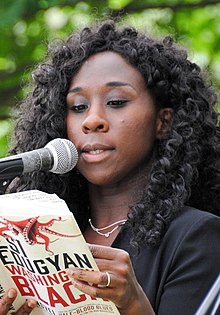
Esi Edugyan (Canadian novelist, two-time winner of the Giller Prize for “Half-Blood Blues” and “Washington Black”, the Giller Prize is a Canadian literary award of $100,000 for the winner.)
“Washington Black” is about a young slave growing to adulthood in the 19th century. It begins on a Barbados sugar plantation and ends in England and Morrocco after a journey that stretches one’s imagination to its limits.
“Washington Black” is an imaginative journey but it steps a bit too far when the author writes of a steerable airship carrying its two passengers into an Atlantic Ocean storm that luckily lands on a slave trader’s vessel instead of plunging into the ocean.
Despite Edugyan’s implausible rescue of Washington Black and his white English protector, there is enough interest in the main characters to keep listeners listening and readers reading. At five years of age, Washington Black who is called Wash, is rescued by a tall black slave named “Big Kit”. None of the slaves on the Barbados sugar plantation mess with Big Kit. Only the “big boss”, the manager of the plantation is powerful enough to bloody her nose without being intimidated. Big Kit becomes Wash’s protector. Wash has no idea who His real mother is, but Big Kit becomes his early guide through life.
When Wash reaches the age of 10 or 11, the plantation is visited by Christopher “Titch” Wilde who is the brother of Erasmus Wilde, both of which are the sons of John Wilde, a famous explorer-scientist who travels the world. “Titch is somewhat of a scientist himself. He meets with Wash and decides it would be good to have Wash as his aide while he pursues his scientific research.
Erasmus Wilde has responsibility for running the plantation which he dislikes but is ordered to because it supports the Wilde wealth for their father’s research. Erasmus and Titch have an older brother named Phillip that comes to the plantation to see his brothers. Phillip kills himself in front of Wash, presumably so Wash can show the brothers where his body can be found. Wash is devastated by the suicide and brings “Titch” to the site where it occurred. “Titch” realizes Wash will be accused of murdering the brother. “Titch” has found Wash to be a natural artist and can produce documentation for some of his science research. He does not want Erasmus to take Wash away and makes plans to escape. The escape is in the dirigible mentioned earlier.
The adventures of Wash accelerate from here.
As “Titch” had expected, Erasmus accuses Wash of murdering their older brother.
Both Wash and “Titch” become fugitives. The suicide of Phillip is a “red flag” that suggests the Wilde family is, at the very least, psychologically troubled. Those troubles revisit the Wilde family with events of the father, mother, Erasmus and “Titch”.
Titch’s father is declared dead because of a mistaken belief that a storm in Alaska killed him. He was not dead but chose to stay in Alaska despite the public reports of his death.
The father makes no effort to correct the mistake of his reported death. “Titch” finds that out and travels with Wash to find his father. His father is glad to see his son but is not inclined to return to civilization because of a comfort he feels in his new environment. “Titch” is pushed over the edge by his father’s lack of concern about others, including “Titch”, his mother, and remaining brother. “Titch” abandons Wash just like his father abandoned everyone in the family. “Titch” disappears in a storm and presumably dies. The father actually dies while Wash is there. Wash chooses to return to civilization and becomes a free man or at least a man who is free of slavery.
More surprises come toward the end of Edugyan’s story as Wash grows to manhood, but the author stretches one’s imagination a little too far for those who will be entertained by her creativity but disappointed by its implausibility.
Edugyan makes one wonder if anyone is truly free. Are we only programed by genetics and our experiences in life?
Every human being has their own story. Are we free if we choose to be free or are we simply programmed?
In the end, “…History of the Book…”is brought together by Smyth’s review of book circulation. From early written manuscripts, small accumulations by the few grew into massive libraries for the general public.
Books of Interest Website: chetyarbrough.blog
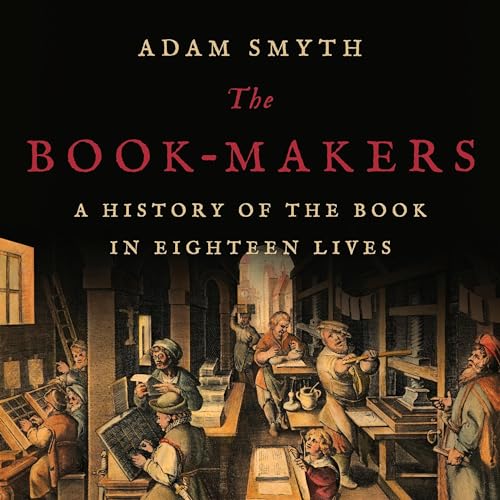
The Book-Makers (A History of the Book in Eighteen Lives)
By: Adam Smith
Narrated By: Adam Smith
Adam Smyth (Author, Professor of English Literature and the History of the Book at Oxford University.)
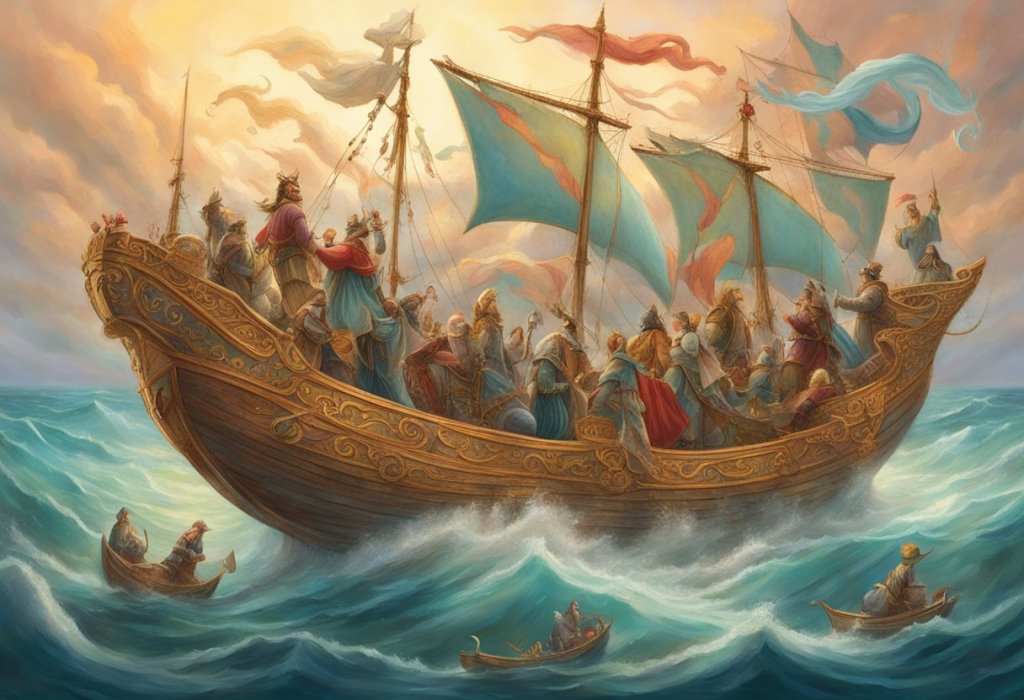
The Gutenberg press is invented in the mid-15th century in Germany. Not surprisingly, the most widely printed book is the Christian Bible that began with the Guttenberg Bible, a 42-line Bible also called the Mazarin Bible, printed in 1455. Adam Smyth notes the first non-religious, widely popular book is printed in 1494, titled “Das Narrenschiff” or “Ship of Fools”.
“The Ship of Fools” is written by Sebastian Brant in 1494. It is a collection of satirical poems and illustrations depicting the foolish behavior of humans and the corruption of the church.
Printed originally in German in Basel, Switzerland, “The Ship of Fools” was lavishly illustrated and became a best seller in Europe. Its popularity came from its satirical content, wide translation, and visual appeal. Smyth explains the book critiques human folly and vice with 112 chapters, each of which is accompanied by a woodcut illustration.
Smyth explains how bookbinding and printing grew as an art.
Contributions to the art were made by both men and women. Elizabeth Collett and Sarah Benlowes were instrumental in improving the quality and continuity of noted books in the 17th century. They pioneered a “cut and paste” technique that made famous books more consistent, unique, and artistic without changing their author’s meaning.
John Baskerville (1706-1775) created and, with the management of his wife, distributed the Baskerville typeface. Not surprisingly, no picture is available on the internet of his wife Sarah Eaves.
John Baskerville and his future wife, Sarah Eaves, made significant contributions to the quality of the printed page. Baskerville created Baskerville typeface in 1757. The new typeface set a new standard for typography with sharp serifs, high contrast thick and thin strokes, and overall clarity. His future wife managed their print business and helped implement Baskerville’s innovations. Together, they improved ink color and sharpness to provide higher quality printing for books.
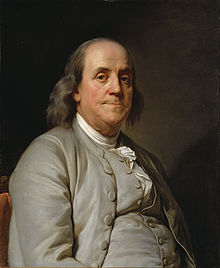
No story of the “History of the Book…” could be complete without addressing Benjamin Franklin (1706-1790).
Smyth reveals the contributions Franklin makes while using Caslon typeface created by Baskerville for the publication of newspapers, advertising, and the most successful non-religious book of the 18th century, “Poor Richard’s Almanac”. Franklin is the quintessential American by exemplifying the strengths and weakness of capitalism.
Money is important to Franklin in different ways.
Franklin used his newspaper to support and print paper money for the U.S. government. Franklin’s industriousness is well documented by historians, but Smyth notes a glaring flaw in Franklin’s character. Of course, this flaw is taken out of historical context and Franklin eventually changes his view, but he supported and brokered the slave trade between the 1750s and 60s. He is seduced by amorality, presumably because of the human desire for money, power, and/or prestige. Of course, this is being human; like all citizens of any economy or government.
Franklin’s views on slavery changed in the 1780s when he became a vocal abolitionist, but he certainly enriched himself in slavery’s earlier years.
Smyth flashes back to the invention of paper. The early beginning of paper is traced back to China in the 2nd century CE. Ts’al Lun (Cai Lun), a court official, is credited for developing papermaking techniques. Paper production spreads to the Islamic world in the 7th century with the printing of the Koran. It extends to Europe in the 12th century. The truly big jump in paper production came in the early 19th century with Louis-Nicolas Robert in France. The Fourdrinier machine could produce huge rolls of paper, but Louis-Nicolas Robert is unable to capitalize on the process because patenting was not available in France. Paper production process improves with John Gamble and Bryan Donkin in England. Paper production became faster, more efficient, and cost-effective.
The truly big jump in paper production came in the early 19th century with Louis-Nicolas Robert in France.
In the end, “…History of the Book…”is brought together by Smyth’s review of book circulation. From early written manuscripts, small accumulations by the few grew into massive libraries for the general public. Access to great and inane writings of genius and pulp producers reached wider and wider audiences. The final chapters address some of the great writers of modern times, particularly poets of which this reviewer is minimally interested and sadly ignorant.
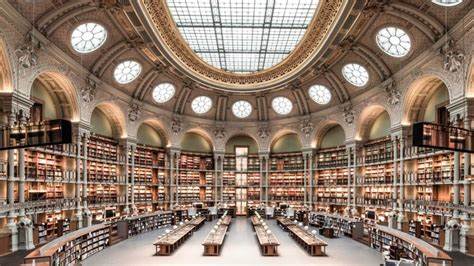
One of the largest libraries in the world is in France, The Bibliothèque Nationale de France.
The well-made point of Orlean’s history of the Los Angeles Central Library is that a listener/reader can learn a great deal about the world and other people’s life experience from books. The loss of a book is not like human death, disease, or disability. A book is a liberation and broadening of life’s narrowness.
Books of Interest Website: chetyarbrough.blog
The Library Book
By: Susan Orlean
Narrated By: Susan Orlean
Susan Orlean (Author, American journalist, tv writer, staff writer for The New Yorker.)
“The Library Book” is not a thriller, but it is an appreciation of a public service available in nearly every community of the United States. Libraries can be found in communities of less than 8,000 people or megalopolises of millions. Susan Orlean focuses her book on the great fire in 1986 at the Los Angeles Central Library where over 400,000 books were destroyed, and an estimated 700,000 were damaged. Though this was not the largest library in America, it was the largest library fire in U.S.’ history. Orlean’s research suggests the arsonist was a Wanna-Be actor named Harry Peak. However, there is no concrete evidence to confirm his guilt. No one is convicted for the library’s alleged arson. The cause remains undetermined.
It is interesting to note that Orlean admits there were electrical problems in the old building that had been recorded by building inspectors, but fire inspectors concluded it was arson.
It seems somewhat disingenuous for the City or Orlean to accuse Peak as an arsonist but that is not the primary message of her book. Her message is that many, including this reviewer, love the knowledge and experience of others who write books. Arguably, public libraries are one of the greatest public services in America, and at a cost much less than most public services in America.
The last chapters of her book address the history of the creation and renovation of the Los Angles Central Library. It reaches back to the 19th century. She recalls the liberal leaning of librarians and their early adoption of women in the workplace. Two women became Library’ managers in the 1800s. Orlean notes in a joking conversation with a manager of the library about the unlikely promotion of a political conservative as a head librarian.
An interesting note from the author is that the Los Angeles library has historically been a haven for the homeless, a problem that has dramatically risen in the 21st century. Some librarians have expanded their services to help the homeless. It seems noteworthy that the libraries in Las Vegas and those visited in other cities do not lock their bathroom doors the way private businesses like Starbucks choose to do.
The Los Angeles Library took six years to rebuild while workers carried on during the course of reconstruction. She notes that a new book generally requires a week before it hits the shelf because of time needed for proper cataloging. A somewhat distracting habit Orlean uses is recitation of a book’s Dewey Decimal’ number that begins most of the chapters. An interesting note from the author is that the library has historically been a haven for the homeless, a problem that has dramatically risen in the 21st century. Some librarians have expanded their services to help the homeless. It seems noteworthy that the Los Angeles Central library and libraries in Las Vegas do not lock their doors the way private businesses like Starbucks have chosen to do.
The Los Angeles Library is rebuilt to be better than it was before the fire.
Orlean explains library managers in LA are pushing to expand services their libraries provide. Having personal experience of traveling the world, countries like Finland show they have modernized libraries with a concept highly recommended in Orlean’s history of the Los Angeles’ library. Helsinki, Finland’s state-of-the-art library is a dramatic example of the services a library can provide. Everything from music instrument rentals, to recording studios, to sewing machine tables, and cooking kitchens are added to the library’s book inventory. All of these features have been created in Helsinki’s modernly designed library. It is a multi-purpose building that serves both children and adults.
The well-made point of Orlean’s history of the Los Angeles Central Library is that a listener/reader can learn a great deal about the world and other people’s life experience from books.
The loss of a book is not like human death, disease, or disability. A book is a liberation and broadening of life’s narrowness.
Many of the Los Angeles Library books were recovered but the process of recovery required the help of many of LA’s businesses. The books that got wet needed to be frozen to keep them from molding. City businesses made room for soaked books in their commercial freezers. The Los Angeles Central Library is rebuilt to be better than it was before the fire. Many of the books survived with the feint smell of smoke. The library continues to expand and enlighten Angeleno’s lives.
The human factor is at the heart of perfection with precision as the qualifying characteristic of craftsmanship or technology.
Books of Interest Website: chetyarbrough.blog
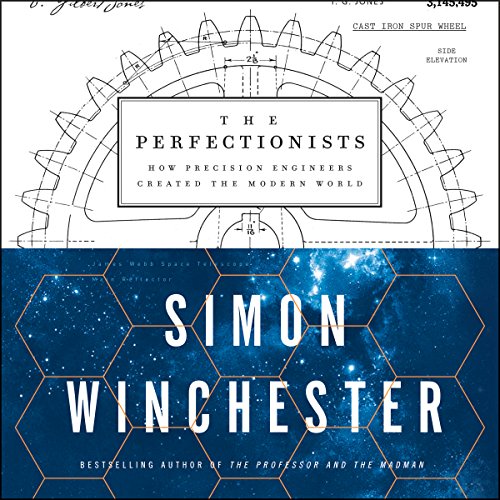
“The Perfectionists” How Precision Engineers Created the Modern World
By: Simon Winchester
Narrated by: Simon Winchester
Simon Winchester (British-American author, journalist, historian.)
Simon Winchester has a remarkable ability to simplify, detail, and vivify history’s complexity. Winchester is not new to this listener. His erudition, writing, and narration are a pleasure to read or hear. His story of the origin of the first Oxford English Dictionary, is a fascinating recollection of Dr. William Minor who shot and killed a stranger on a London street. Dr. Minor was imprisoned in an asylum for his aberrant behavior but became an important source of information for James Murray, the leading lexicographer of the “Oxford English Dictionary”.
“The Perfectionists” is about the advance of the world economy from the perspective of entrepreneurs driven to succeed. Their success, in Winchester’s opinion, is based on understanding and capitalizing on the value of precision.
James Watt (1736-1773) perfected Thomas Newcomen’s 1712 steam engineMatthew Bolton (1758-1809) partnered with Watt to perfect steam engine power generation.Charles Algernon Parsons (1854-1931) perfected the steam engine to propel steamboats.)
Though one may go back to the first century to find the first steam engine, it is the invention of James Watt, and the improvements of Matthew Boulton, and Sir Charles Algernon Parsons in the 18th and later 19th centuries that perfected steam engine utility and power. Watt created the steam engine, Boulton helped Watt perfect the steam engine for industrial use, and Parsons expanded its utility by creating steam turbines to power the propellers of steamboats. Each played a role in making steam engines more efficient with precise design and milling refinements that provided more power and wider utility.
With the advent of the industrial revolution, Winchester explains how speed and quality of production were geometrically improved by focusing on precision. He offers several industry examples, including weapon manufacture, automobile production, camera refinement, telescope resolution, airplane manufacture, watch making, and CPU design which now leads to the A.I. revolution.
Winchester notes the beginning of the industrial revolution starts with the perfection of energy production machines that power the manufacture of standardized parts for finished products.
Winchester tells the story of the French that insisted on standardizing parts for gun manufacture to increase the speed with which repairs could be made for damaged weapons. Winchester recounts the war of 1812 when Great Britain bloodied the nose of America by routing the capitol’s volunteer defense because of a lack of useable guns. He tells the story of an American rifleman with a broken trigger on his rifle who chooses to run from a British onslaught because trigger replacement would take two weeks for customization to fit his gun.
American guns were custom made which meant that when one was damaged it would take weeks for repair.
Honoré LeBlanc, a French gunsmith during the reigns of Louis XV and XVI, created the idea of interchangeable gun parts in the 18th century. Though it came to the attention of Thomas Jefferson, it did not catch hold in America until after the war of 1812. There was an effort by America to standardize parts in the early 1800s but Eli Whitney (the inventor of the cotton gin), hoodwinked the American government into a contract for standard gun parts that never materialized.
Winchester explains Eli Whitney flimflammed the American government to get a contract for standardized gun parts but never produced the product for which the government contracted.
Winchester notes Whitney knew nothing about guns and hired a crew of customizing gunsmiths who manufactured unique weapons that could not be repaired with standardized parts. Because the parts were manufactured by individual craftsman, the guns produced were not interchangeable. They did not have precisely manufactured parts that would allow interchangeability. Whitney gave a demonstration to the government with only one gun that he assembled in front of Jefferson and a government committee. He did not demonstrate any repair with standard parts. Jefferson fell for the false presentation and initially lauded Whitney. This demonstration was in 1801 which explains why a soldier might have fled because of a broken trigger in the War of 1812.
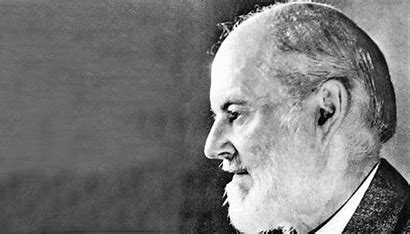
Henry Royce (1863-1933)
Winchester explains standardizing and precision making of gun parts were an essential step in the industrialization of America. Standardization and precision-made interchangeable parts became the touchstone of success in the automobile industry in the 20th century. Winchester tells the story of Rolls Royce and Ford Motor companies to make his point. Both Royce and Ford recognized the importance of precisely made standard automobile parts to garner their success in the automobile business. Though their route to success is precise manufacture of automobile parts, the wealth they created for themselves was quite different.
Henry Ford (1863-1947)
Ford became one of the richest people in the world while Royce became wealthy but not among the richest in the world. Royce chose to pursue perfection of every part of the automobile which limited his unit production and increased manufacturing cost. Though Ford perfected standardized mechanical parts, they were precisely designed only for functionality. Ford added the dimension of standardized labor to the manufacturing process. By creating an assembly line of laborers with precise replaceable mechanical parts, Ford could produce more automobiles than Royce in a shorter period of time.
The point Winchester makes is perfection of standardization (production of precisely tooled engine parts) is a cornerstone of successful industrialization. Royce expanded the concept to every part of an automobile while Ford focused on replaceable mechanical parts of the automobile.
Winchester tells a story of ball bearing manufacturing during Henry Ford’s reign when some automobiles were failing. The bearing manufacturer proved it was not their bearings with tests that showed the bearings were perfectly within precise measurement requirements. What Ford realizes is that the ball bearings were milled exactly the same and met the precise dimensions required. The problem was found to be the assembly line and human assembly mistakes. One thinks of the loss of precision in Boeing aircraft today and wonders what that means for Boeing’s future if it is not immediately corrected.
Winchester contextualizes the story of the ball bearings in recalling the history of a near catastrophic plane crash when a Rolls-Royce jet engine fails on a Qantas Airlines Airbus A380 in 2010.
Jet engines are precisely manufactured marvels of aviation. However, a tiny flaw in one oil pipe within the engine nearly caused the loss of over 400 passengers. Winchester explains Jet engines are dependent on superheated gas exchange that, if not properly cooled, will damage the engine. Every engine has a series of drilled holes that allow ambient air to cool the engine during flight. The holes are drilled in precise locations throughout the engine louvers and oil pipes to keep the engine from overheating. One of the oil pipes holes is in the wrong location which caused the engine to overheat after many flights. The failure of human oversight of the automated process and final checks by the manufacturer are the underlying cause of the near catastrophe.
More examples of the importance of precision are wonderfully offered by Winchester in “The Perfectionists”. His examination of the tech industry is as prescient as his analysis of the automotive industry and airline industry. He covers Moore’s law and how technology is advancing at an accelerating pace while inferring humanity may be at a turning point. That turning point is the crossroad between human and machine decisions about the future.
The human factor is at the heart of perfection with precision as the qualifying characteristic of craftsmanship or technology.
Winchester infers craftsmanship does not mean precision is to be sacrificed. He recalls the emphasis on precision in Japanese culture where many craftsmen assembled and repaired Seiko watches to revitalize the brand in the late 20th century. Precision is not a lost art whether work is done by machine or a craftsman, but the human factor remains a critical component of both processes. The point to this listener is that precision is only a part of what has advanced the welfare of society.
Dead authors may give understanding of life that offers a “…Tranquil Mind” but change in belief by renowned living authors explain why some feel they live in an age of anxiety.
Breaking Bread with the Dead (A Reader’s Guide to a Tranquil Mind.)
By: Alan Jacobs
Narrated by: P.J. Ochlan
Alan Jacobs (Author, distinguished professor of the humanities at Baylor University, considered a Christian conservative by the media.)
Alan Jacobs offers an example of why book’ reader/listeners are “Breaking Bread with the Dead”. A personal reason for reading/listening to books is to acquire understanding of an author’s opinion. Of course, perceptions may be incorrect, but a book writer’s intended meaning, at the very least, makes a reader/listener think. Jacobs gives many examples of what past authors made him think. He explains how and why dead writers are a “…Guide to a Tranquil Mind”.
In a short book, Jacobs notes knowledge of the past gives context and perspective to the present.
Dead authors add the dimension of a past that is either very like the present or very different. When a dead author’s beliefs are more like the present, it makes one think there may be something universal about their belief. At the least, a dead author’s beliefs help one understand the difference between the past and the present. Both circumstances offer what Jacobs suggests are a “…Guide to a Tranquil Mind”. Belief either remains the same or modern life makes past beliefs unique to their time.
Renowned dead authors, or for that matter, insightful living authors make one realize how much they do not know.
Dead authors may give understanding of life that offers a “…Tranquil Mind” but change in belief by renowned living authors explain why some feel they live in an age of anxiety. In either case, it pays to seek understanding from both dead and living writers.
The Louvre (The Many Lives of the World’s Most Famous Museum)
By: James Gardner
Narrated by: Graham Halstead
James Gardner (Author, art and literary critic.)
James Gardner is an art and literary critic based in New York and Buenos Aires. His writing has appeared in publications including the “New York Times”, the “Wall Street Journal”, and the “New Republic”.
View from the top of Louvre Museum in a beautiful sunrise over Paris
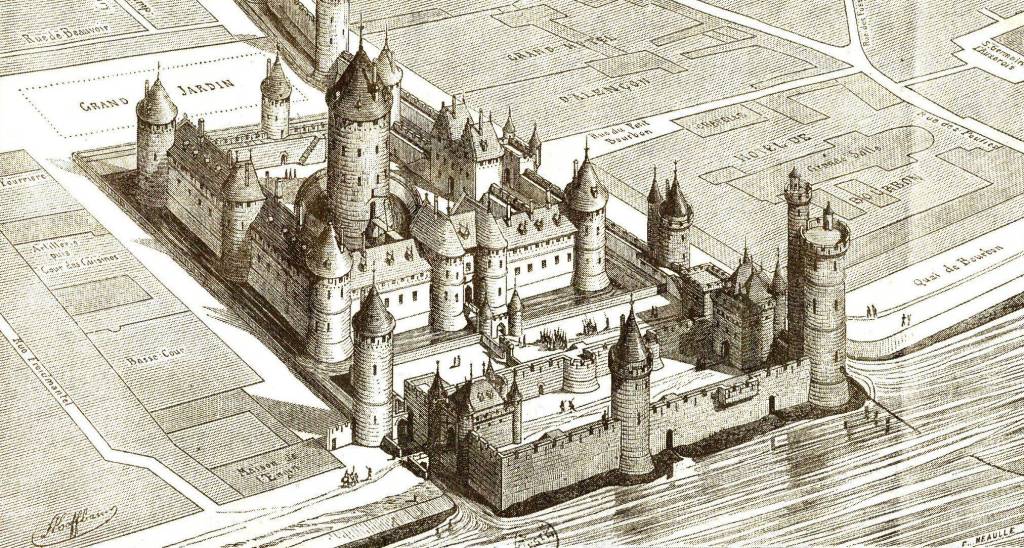
Having visited the Louvre a few years ago, it seems worth listening to James Gardner’s book about one of the world’s greatest museums. It is a surprise to find the Louvre dates to the 12th century. It began as a walled fort to protect Paris but was expanded when King Philippe Auguste decided to build a castle at the wall next to the Seine River.
The Louvre was originally planned as a fortress to protect Paris.
The origin of the name Louvre is a mystery. Gardner notes some thought it came from an association with a wolf hunting den; others thought it came from a Saxon word for watchtower (lauer) but no one knows for sure. The Louvre was neglected for several years after Louis XIV moved to Versailles. Some work was done, but King Louis’s architect spent most of his time on the new Versailles residence.
Gardner explains the remains of King Auguste’s castle foundation can still be seen today.
The Louvre became the home of King Francois I in 1528.
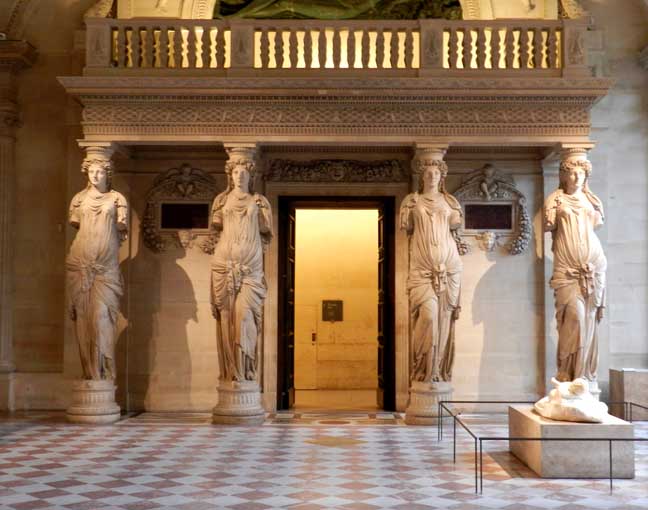
In 1550, the sculptor Jean Goujon created the caryatids (sculpted female figures as column supports) inside Francois I’s Louvre Palace.
The Louvre remained a royal residence until 1682 when Louis XIV moved to Versailles.
Gardner notes, it is after the French Revolution that the Louvre becomes classified as a museum.
The National Assembly of the nascent government republic opened the eight-acre site as a museum in 1793 with a collection of 537 paintings. Most of these paintings were from royal residences or church-property’ confiscations. Famous paintings like the Mona Lisa were not exhibited until 1797, just as Napoleon rises to power.
It is not until Napoleon Bonaparte’s 1799 coup d’état that a serious renovation of the Louvre is undertaken.
Bonaparte makes the Louvre his royal residence in Paris. Vivant Denon became the first director of the Louvre. He was a diplomat under the bourbon kings, Louis XV and Louis XVI, and then appointed director of the Louvre by Napoleon after his Egyptian campaign (1798-1801). Denon had been with Napoleon in Egypt. Denon was displaced during the Bourbon Restoration because of his association with Napoleon. Not much was done on the Louvre during the Bourbon Restoration.
Vivant Denon (1747-1825. artist, writer, diplomat, author, and archaeologist.)
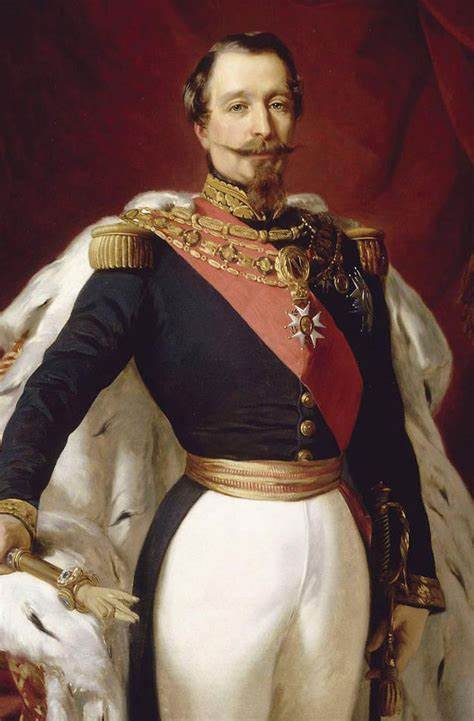
Napoleon III (1852-1870 reign, first president of France, became last emperor of France–deposed in exile. Nephew of Napoleon Bonaparte.)
Napoleon III undertakes a grand renovation of the Louvre with the building of its two major wings. The “Pavilion Denon” is dedicated at the Louvre by Napoleon III in the 1850s. Napoleon III employs Louis Visconti to design the Louvre renovation but he dies in 1853. The Visconti plan is executed by Hector Lefuel. It connects the old Louvre Palace around the Cour Carree with the Tuileries Palace to the west. The two major wings and their galleries and pavilions are completed during Napoleon III’s reign.
Francois Mitterrand (President of France 1981-1995)
WWII may have been the death nell of the Louve if it had not been for the cleverness of the French and the tacit cooperation of a German officer. The final chapters address today’s view of the Louvre and the renovations made by French President, Francois Mitterrand. Mitterrand carries the torch of French freedom and appreciation of art in the most elaborate Louvre addition since Napoleon III’s grand renovation. Mitterrand hires I.M. Pei to design the Louvre addition.
I.M. Pei (1917-2019, world renown American architect.)
It is known as the Grand Louvre Modernization project which is most noticeable because of the glass pyramid that becomes the primary Louvre entry. The pyramid seems incongruous to this tourist but is reminiscent of the Napoleonic history of France. Napoleon is more than a conqueror of countries. His political ambition entails more than power, though power is certainly a large part of his hegemonic ambition.
Gardner notes Napoleon’s inspired interest in other nation’s traditions, history, and art. His ambition in Egypt entails a consuming passion for understanding its historic rise to power and hegemonic power’s correlation with prominence in the world.
I.M. Pei’s decision is to create a symbol of the power and permanence of Egypt with a pyramid. The Louvre’s entrance is representative of Egyptian and French ambition in the world. As history shows, Egypt and France were hegemons of the world at different times.
Gardner’s book, “The Louvre”, should be on every tourist’s list before visiting the center of Paris. Gardner shows how much there is to see and how little one will understand without spending more than a day, let alone a few hours, at the Louvre.
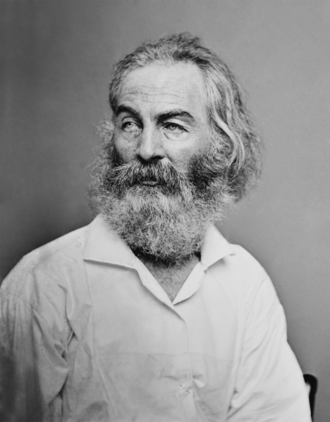
“Leaves of Grass” is perfectly rendered by Edoardo Ballerini. Walt Whitman’s masterpiece shines in Ballerini’s narration. Whitman lived in one of America’s most tumultuous times. He lived through the build-up of the civil war, worker displacement from American industrialization, and the assassination of Abraham Lincoln. Despite the horrors of his time, Whitman celebrated life.
Today is a good time to listen to Whitman’s masterwork. Living in the time of Covid19, Russia’s attack on Ukraine, January 6 violence in the nation’s capital, probable arrest of a former President, natural disasters, climate change, threat of Armageddon, American poverty, immigration, and homelessness—all can overwhelm one’s senses. Whitman understood the difficulties of his time but rises above them by celebrating what being American means.
Being American means having a written Constitution.
Being American means balance of power based on independent judicial, legislative, and executive branches of government.
Being American means being free within the context of rule-of-law. Being American means freedom to vote for representative government. Being American means freedom of speech and the press within the bounds of slander toward others.
Just as was true in the time of Walt Whitman, there is no guarantee of peace and tranquility, but his blank verse reflects on the many positive values of living life as an American. Whitman implies Americans should celebrate what they have, not what they want.
Mad Enchantment: Claude Monet and the Painting of the Water Lilies
By:Ross King
Narrated by: Joel Richards
Ross King (Canadian Author of books on Italian, French and Canadian Art and History.)
Ross King refreshes one’s interest in the history of WWI while revealing much of the mystery and appeal of Claude Monet and his art. Monet’s diminutive size contrasts with his giant impact on impressionism. As a founding father of impressionism, Monet’s passion is to show the effect of light on life and nature.
Monet lived in Giverny, France in a modest house with a well-maintained lily pond and garden that served as a subject of his art.
Having read biographies of Leonardo da Vinci and Caravaggio, Monet is certainly not the first to have had a passion for the effect of light on a subject. Monet produces light that moves an admirer from objective observation to subjective pleasure.
In 1874, Monet exhibited “Impression Sunrise” that received hostile reviews. That painting exemplified the beginning of Impressionism. King shows Monet insists on his vision and the era of modern art is born.
YOUNG MONET AND MATURED MONET AS PAINTED AND LATER PHOTOED.
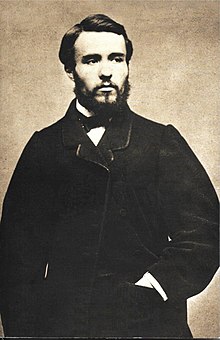
Portrait of Claude Monet 1867 (oil on canvas) Carolus-Duran, Charles Emile Auguste (1837-1917) MUSEE MARMOTTAN MONET, PARISOscar Claude Monet (Artist, founder of impressionist painting revealing how he perceived nature. 1840-1926)
King recounts Monet’s relationship with Clemenceau, known in France as the tiger before WWI, and the Father of Victory at its end. King explains Clemenceau is a duelist in his early years who becomes a physician, newspaper writer/publisher, and then politician.
Clemenceau at Age 24 in 1865.
Clemenceau is recognized as a great orator and leader of men by no less than Winston Churchill.
Clemenceau becomes prime minister of France during WWI.
Clemenceau cheers French resistance to the German assault of France. At defeat of Germany, Clemenceau presses for German reparations, including return of the Alsace-Lorraine region of France. He insists on full compensation for German destruction from WWI.
King offers a Eurocentric view of WWI. France is not a great fan of America’s reluctance to join the war when France is pummeled by Germany. Though Clemenceau appreciates the ideal of Wilson’s 14-point plan, he objects to the League of Nations and insists on German reparations that set the table for WWII.
Monet is also not a great admirer of America. He considers American buyers of his art as profligate and ignorant of fine art and their value. King notes both Clemenceau and Monet admire Japanese artists and collect many of their works. Many of Monet’s paintings are sold to Japanese buyers.
Clemenceau and Monet are close friends until death. Monet is the first to go but Clemenceau is ill and soon to die. Both were of a similar age. Both were hard working Frenchmen in their respective professions. Monet’s art is sold or bartered during his life to private and public museums. Many of Monet’s works are donated to the French government at his death. A government financed museum is created for an exclusive exhibit of Monet’s paintings.
Mussee Marmottan in Paris
King notes Monet loses much of his eyesight in later years, but he perseveres with the help of eye surgery that returns some vision to one eye. Clemenceau plays a large part in convincing Monet to donate his art to France. As both are approaching death, Monet’s penchant for procrastination nearly fractures their close relationship. Part of the fracturing is related to the government’s problems with creating a museum that would meet Monet’s requirements. Some of his canvases were huge and Monet wished to have them displayed in an oval shaped museum. Additionally, King notes Monet is often dissatisfied with a painting and would destroy it and start over. Monet is also noted to dawdle when nearing a paintings completion by leaving a detail that is planned but never executed. King explains Monet’s work ethic is phenomenal. He wakes at dawn and works through the night until his energy is spent.
Clemenceau is a significant character in King’s biography of Monet. In some respects, the two men are alike. They are both relentlessly energetic in their respective professions. Though Clemenceau is a doctor, his passion is in publishing and politics. He travels the world. Monet restricts his travel to France, mostly between Paris and Giverny but with a passion for work equal to Clemenceau’s. Monet’s passion is for impressionist renderings of the natural world.
As Monet’s vision deteriorates, later work reimagines impressionism based on failing vision–but more poignantly, it seems Monet’s later paintings reflect on the trials of a long life.
Water Lillies 1919 at The Met Fifth Avenue in New York.
King suggests looking at one of Monet’s water lilies paintings long enough gives one’s imagination free reign to see something more than a pond. Some see figures of women, others–spirits of the dead. A lily pond seems as much a tribute to life as to decay.
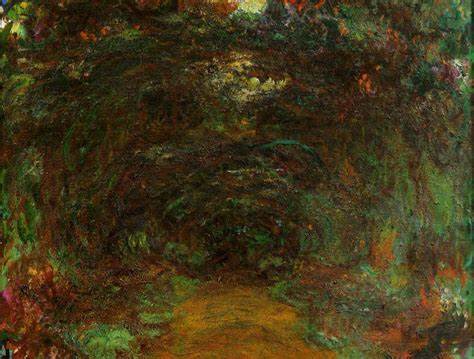
Rose Trellises in Giverny 1922
In King’s epilogue, Monet is glorified in a review and contrast of early and late impressionist paintings. King reminds listeners of Monet’s initial vilification by the art world, his resurrection, demise, and reification in modern times. What Monet could see with younger eyes, before cataracts obscured his vision, King recognizes as a new era of art. King offers tribute to two great men, Clemenceau’s political renown which revels in his time and Monet’s art celebrated for all time.
“A History of Wine in Ten Glasses” is a journey around the world of wine.
Paul Wagner is a wine instructor at (where else?) Napa Valley College.
There are several revelations about wine for us amateur wine drinkers. Thomas Jefferson tried and failed to create a good wine in his home state of Virginia.
Jefferson’s failure is related to a grapevine disease in Virginia’ soils that attacked the roots of plants he brought with him from his diplomatic mission in France. The root disease is discovered after Jefferson’s death. Once the disease is diagnosed and treated, Wagner notes Virginia began producing some fine wines.
Wagner dates the production of wine back to 6000 BC in what is now known as Georgia. Some would dispute that and suggest China had a rice and grape mixed fermented wine in 7000 BC. Others suggest Iran may have been the origin of the first wines on the the Persian Gulf. In any case, wine has been with us for centuries.
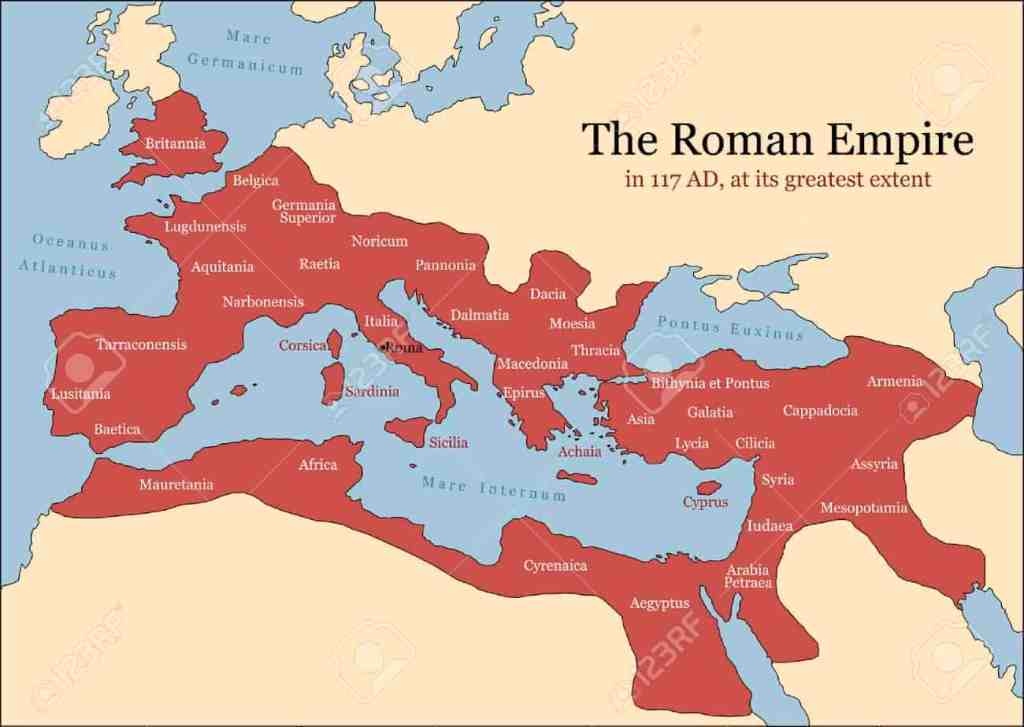
Wagner argues the Roman Empire is the primary disseminator of the art of wine making.
Rome’s conquest of countries surrounding the Mediterranean spread wine making throughout the known world, sometime between 27 BC and 476 AD. Even today, the greatest wine volume comes from Italy with France and Spain, the second and third biggest producers
More than ten glasses are identified by Wagner, but the primary libations are from Italy, France, Spain, U.S., Australia, Greece, South Africa, Chile, Argentina, and Germany. However, Wagner takes side trips to smaller countries like Portugal and New Zealand.
Having traveled to some of these countries, his assessment of their wines seems spot on. Interestingly, his assessment of Chile’s inexpensive Malbec is a favorite of mine. In Italy, the selection of wine at dinner seems the simplest of all decisions. Rarely is red wine in Italy served that is too bitter or too sweet. Retsina in Greece is a horrible drink but adding water makes all the difference. Retsina remains an acquired taste but with water it becomes palatable. Traveling to Argentina and New Zealand confirms Wagner’s assessment of the quality of their wines.
The idea of adding water to wine is a surprise but Wagner notes added water was often the habit of early wine drinkers. (Of course, watered wine is common in religious ceremony.)
Wagner also notes that a pinch of salt can smooth the acidic taste of an inexpensive wine. Potassium chloride, not salt, is what is recommended by some wine connoisseurs.
German wine Labeling system.
A surprising note by Wagner is that German and New Zealand wines are tightly controlled by a labeling system to assure the quality of their wine.
Wagner reports on Germany’s and New Zealand’s precise label certification. One suspects precise wine labeling is a characteristic of the precisionist culture of Germany. However, New Zealand’s labeling is a result of some Marlborough wines that were contaminated by runoff from lumber harvesting activities in 2005. Both countries labeling assures the quality of their wines. Undoubtedly, there is a concomitant cost for the right label.
Wagner lives in Napa Valley and, not surprisingly, suggests many of the best wines in the world come from Napa Valley’ vineyards. Blind wine testing in Paris confirms his opinion. What he says is true about many Napa Valley wines, but prices of those great tasting wines are often higher than many can afford.
“A History of Wine in Ten Glasses” is a nice introduction to the vagaries and mysteries of wine selection. For we amateurs wine selection remains hit and miss because it is only our personal taste and affordability that matters.
Paul Kildea (Author, Austrailian conductor, Artistic Director of Musica Vivia Australia.)
Paul Kildea is a multifaceted talent who has written an interesting biography of Frederic Chopin and a lesser-known Polish musician, Wanda Landowska, who revivified Chopin’s music.
Frederic Francois Chopin (1810-1849, Composer and virtuoso pianist.)
Whether one knows anything of music or history, Kildea expertly entertains listener/readers with “Chopin’s Piano”.
Chopin is noted as a Romanticist composer considered among the most creative of all time. For that reason, the sound of Chopin’s work has changed with the times.
There are several ironies in Kildea’s history of Chopin. Chopin is shown to have been pleased by being considered French though he was Polish. Chopin is characterized as anti-Semitic though at times financially supported by Jews and resurrected by a world-renowned harpsichordist, Wanda Landowska, a proud and nationalist Pole who escaped Nazi persecution and extermination. Landowska, a woman of the Jewish faith, flees Paris when Germany invades France.
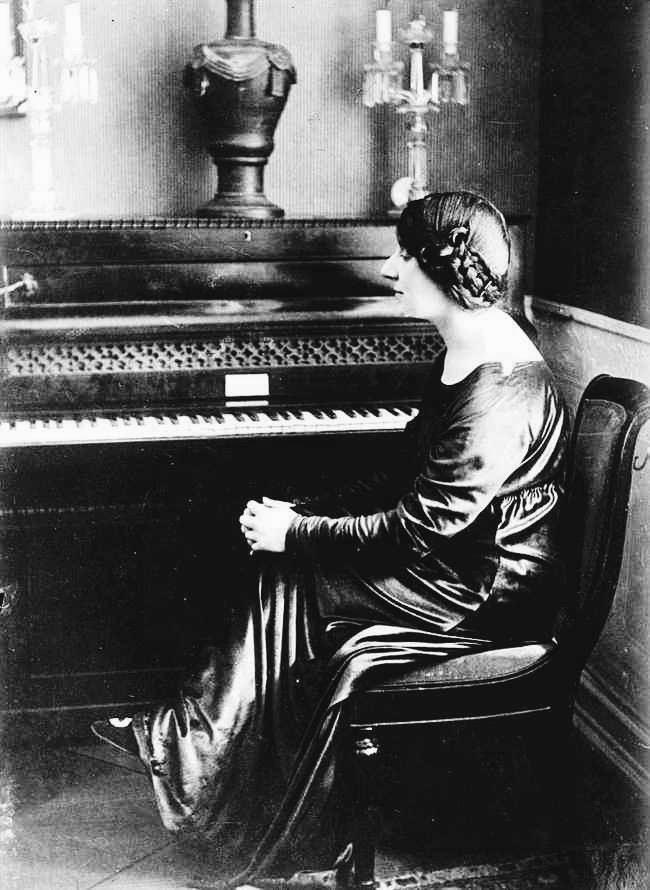
Wanda Landowska in front of the Bauza piano owned by Chopin.
One of her treasured pianos is the Bauza piano used by Chopin to create his greatest masterpieces, the Preludes.
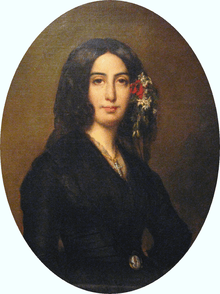
George Sand (1804-1876, French novelist and 10 year companion of Chopin)
Kildea reflects on Chopin’s diminutive physique and self-effacing nature. Chopin never marries but has a ten-year relationship with George Sand, a divorced woman with a broadly libertine reputation.
One wonders what Sand’s influence is on Chopin’s creativity. What Kildea explains is that Sand admires Chopin’s dedication to music and supports Chopin through his frail health during the most productive period of his life. However, at the end of their ten year relationship, Sand leaves because the burden of their relationship is either too much or she just chooses to return to a life of independence.
The thread of Kildea’s history is the Bauza piano’s location in the 21st century. It’s whereabouts remains unknown.
This piano was used by Chopin between 1838-39 when living with George Sand in Majorca. A striking point in Kildea’s story is that the Bauza piano is a crudely formed instrument carved from local softwood. Its innards are made of felt, pig iron, and copper but its cultural importance is extraordinary and its provenance unquestioned. It disappeared when confiscated by Nazi Germany when they ransacked Landowska’s home in Paris.
Wanda Landowska in 1953.
The last half of Kildea’s story is about the trials and achievements of Wanda Landowska. In reflecting on Landowska’s rise to fame, the Bauza piano is a symbol of Chopin’s creative genius.
This flawed instrument is used to create compositions that are endlessly translated by pianoforte (soft and loud sound) from the use of harpsicords to modern Steinways. Landowska, and many pianists of the 19th through the 21st century are listed by Kildea, showing the brilliance and variety of Chopin’s compositions. Only a musical conductor turned author like Kildea could explain this to the public. “Chopin’s Piano” is a small opening to a big world.































































 REVIEWS AND VIEWS OF LIFE