FAME

As a son of a strong mother, one is impressed by Tina Knowles’ character in her enlightening memoir. She shows how women are the backbone of society despite their treatment in a patriarchal world.

Books of Interest
 Website: chetyarbrough.blog

Matriarch (A Memoir)

Author: Tina Knowles

Narrated By: Tina Knowles & 4 more

Celestine Ann Knowles aka Tina Knowles. (Author, American businesswoman, fashion designer, and mother of the famous performer, Beyoncé.)

This is an intelligent well-written memoir of the mother of two famous performers, Beyoncé and Solange Knowles. Celestine Ann Knowles is born in Galveston, Texas on January 4, 1954. Her two famous daughters are the singer Beyoncé and the composer, Solange Knowles.

The mother of these two famous women tells a story of what it is to live in the 1950s as a young, poor Black American. Tina (a diminutive of Celestine) Knowles becomes a successful businesswoman, fashion designer, philanthropist and mother of two highly successful women in the 21st century.

Galveston’s in the 1950s.

Living in Galveston, Texas in the 1950s as a person of color is starkly and clearly explained in Tina Knowles’ memoir. Tina’s father works as a longshoreman. His work is sporadic because of a mining accident that ruined one eye and made him hard of hearing which limited the work he could do as a longshoreman. With the aid of his wife, Tina’s mother as a seamstress, their meager income is enough for them to get bye. Tina’s mother is the foundation of the family. Tina grows up as a force of nature before reaching adulthood. She grows up in a family ruled by a “Matriarch” as the power in her family and neighborhood. Even in her pre-school years, as the youngest of seven children, Tina understands her mother is the person who holds the family together and eventually makes Tina the matriarch of her future family.

White American’ opposition to equality in the 50s.

Tina adventured where many young Black children timorously dealt with life in an unfair world. Despite its unfairness, Tina ventured forth.

Tina tells the story of her childhood companions who would not go into an ice cream store in Galveston when white children were being served. Tina ignores their timorousness, goes into the store and is told to get out by the store manager. She finds what her friends were saying is true, but she had to experience it herself. Tina goes to a Catholic school where she is treated harshly by the teachers but continues on to graduate despite their strict rules. Nearing graduation, she becomes ill and is treated by a white physician who presumes she is lying about never having premarital sex. The white physician and an aide strap her down and conduct a physical exam that leaves blood on the table because of her hymen being broken by the exam. Her mother calls the physicians to complain about the treatment of her daughter and takes her to another hospital to find her illness is unrelated to the doctor’s presumptive and unnecessary pelvic exam.

Tina is raised in the time when Black discrimination is finally beginning to change. Brown v. Board of Education is decided in 1954.

Tina graduates from high school, presumably in the early 1970s, and goes on to college. While in high school, she joins a local singing group that is inspired by The Supremes. They call themselves the Veltones. That experience leads her to work in fashion and entertainment. She becomes a designer, and entrepreneur, and eventually the “Matriarch” of her own family. In 1980, Tina marries Mathew Knowles. They were married for over 30 years but divorced in 2011.

In the Knowles’ marriage (1980-2011) they have two daughters, i.e., Beyoncé and Solange Knowles.

Tina Knowles explains how the birth of Beyoncé ignited her ascendence as the “Matriarch” of her generation. From taking care of Beyoncé to remodeling her house to creating her first business, Tina created her own world. Tina built the foundation for her life and raised one of the most famous singers in the world.

“Headliners”–Tina Knowles first business.

At 32 years of age, Tina decides to start a business. With financing from what is to become her former husband, she decides to open a salon. Tina is pregnant with her second child, Solange. Matthew involves himself in Tina’s business in financial ways that challenge its success. Tina starts “Headliners” in the early 1990s to offer make-up and beauty services in Houston, Texas. Beyoncé is now around nine years old while Solange is nearing four or five years of age.

Matthew and Tina Knowles file for bankruptcy.

Her husband, Matthew decides to quit his six-figure job to join Tina in her business. For unclear reasons, the family files for bankruptcy, sells their home, and rebuilds their lives while Tina focuses on her salon business. Tina explains she decides to divorce her husband because of his infidelity and mishandling of their dwindling wealth. She holds her life together by focusing on the burgeoning career of her girls and her salon business. Tina shows herself as the guiding force of her talented daughters. She has become the “Matriarch” that her mother had developed her to be.

Beyoncé’s 2025 concert in London.

Though most interest in Tina’s story may be because of her daughter, Beyoncé, her memoir suggests the “Matriarch” of the next generation of Knowles will be her daughter, Solange. She does not diminish the great success of Beyoncé as an incredible talent who runs her musical productions, but it seems Solange is the worker bee that is driven to become her generation’s “Matriarch”.

Agnéz Deréon (Tina Knowles’ mother, the “Matriarch” of the Knowles’ descendants.)

At the end of Tina’s book, she has reached the age of 70. She maintains a clear picture of the story of her life. Married and divorced twice, she is in charge of her life and appears to influence all who surround her. As a survivor of breast cancer and a firm grasp on life, she uses her strong belief in God and the love of her family to believe the best is yet to come. As a son of a strong mother, one is impressed by Tina Knowles’ character in her enlightening memoir. She shows how women are the backbone of society despite their treatment in a patriarchal world.

MARK TWAIN

Chernow’s biography is a mirror of Twain’s time and life. Chernow implies Twain could see imperfections of society without seeing his own. Twain’s genius to entertain America and readers around the world is not diminished by Chernow’s well written book.

Books of Interest
 Website: chetyarbrough.blog

Mark Twain 

Author: Ron Chernow

Narrated By: Jason Culp

Ron Chernow (Author, journalist, biographer, winner of the 2011 Pulitzer Prize for Biography and the American History Prize for his 2010 book “Washington: A Life”.

No stranger to historical biographies, Ron Chernow has written an interesting biography of the peripatetic humorist Samuel Clemens, aka Mark Twain. Samuel Clemens was born in Florida, Missouri, two weeks after Hailley’s Comet passed Earth in 1835, he died in 1910 when Hailey’s Comet made its closest approach to Earth in 1910. Chernow’s biography explains how Clemens became a steamboat pilot, frontier journalist, author, and American gadfly in his journey through 74 plus years of life.

Chernow’s biography of Mark Twain reminds one of Donald Trump without the power of the Presidency.

Clemens is noted as a stretcher of truth who told stories of his time that illustrated the contradictions of race, slavery, and morality that live through today. Twain is shown to express himself in humorist ways that challenged racial norms and societal conflicts which made some laugh, and others cringe with disgust or anger. Chernow argues Twain’s use of language shaped American literature. He gave American literature a unique voice that blended humor with criticism. Twain humanized the Black community and the iniquity of slavery, but Twain’s upbringing suggests he did not escape the false belief of innate Black’ inequality. Chernow painted a picture of Twain that showed how society was filled with the promise and pitfalls of Americans’ character.

Chernow shows how Clemens reinvents himself, not from formal education but from life experience.

At 21, Clemens begins training himself as a steamboat pilot on the Mississippi river, a highly praised, prized, and well-compensated position. Chernow suggests Clemens found his nom deplume, Mark Twain, based on the language of riverboat pilots. (“Mark Twain” is the 12 feet of depth needed for safe navigation of a riverboat.) As material transport changed after the steamboat era, Twain had to find a new career. He traveled to Nevada with the hope to become rich as a silver baron during the gold and silver rushes of the late 1850s. However, he never struck it rich, lost other people’s money, and turned to earlier work experience in newspapers when he lived in Missouri. He had learned the typesetting business and had written a few articles for the paper in his hometown. He settled in Carson City, Nevada, eventually becoming a journalist. On the one hand his stretching of the truth got him in trouble as a journalist but, on the other, it opened him to another career. His wit and way with words led to a role as lecturer and performer.

Chernow shows Twain changes jobs based on his innate abilities and external events.

The development of mass media, America’s Civil War, the industrialization of America, and the growth of a celebrity’ culture influence Twain’s life and made him a cultural symbol of America in the same way Dickens, Dostoevsky, and Chinua Achebe became symbols of their countries. Twain exemplified American life, its contradictions, its greed, and its biases that were blended into the personal tragedies and experiences of his own life. He turned his life experience into an art that reflected America’s growth as a nation. He became a writer and lecturer.

Chernow explains how Twain did not just read his lectures, i.e., he performs and acts their meaning to an audience.

Twain blends storytelling with satire and theater to entertain his audience. His reputation as a public speaker is made in California, but he becomes a global star. He performs in London, Berlin, and Bombay with what became cultural events about American humor and American foibles. His lectures are folksy with tinges of intellectualism that make him revered, respected, and laughed about by his audiences. Chernow believes he created an image of one who speaks truth to power about imperialism, religion, and human folly.

Chernow does not sugar coat truth about Twain.

Like all human beings, Twain had his blind spots. He was silent about lynching and its immorality, and he was trapped in his vision of racism by treating it as a troubling fact of American life despite his championing of civil rights. At best, he appears to be an agnostic when it comes to religion. There is criticism of Twain’s close relationship with teenage girls that he dismisses as a public concern by saying “It isn’t the public’s affair”. Twain is reckless with other people’s and his own money and investment. He exhibits behavior that suggests a gambler’s view about getting rich quickly. Twain could be vindictive, and melancholic because of his gloomy view of humanity. His family life suffers from his impulsivity and emotional distancing toward his wife and daughters. In one sense, Chernow makes Twain more human by noting he is like most of us except for his insightful sense of humor and talent for extemporaneous public speaking.

The archive of Twain’s letters is in the thousands which spans his entire adult life.

Chernow gathers much of his understanding of Twain from his personal letters rather than his books. He does note a number of Twain’s family members and friends are models for characters in his novels. However, Chernow’s focus is on Twain the man who appears morally inconsistent, a poor manager of other people’s money, and prone to anger when aggravated by other’s opinions. Whether this is fair or not, it describes many people today.

Chernow’s biography is a mirror of Twain’s time and life. Chernow implies Twain could see imperfections of society without seeing his own. Twain’s genius to entertain America and readers around the world is not diminished by Chernow’s well written book.

FICTION’S VALUE

How many thoughts run through one’s mind as they listen or read Hurwitz’s imaginative story? Maybe a movie will be made that simplifies and dumbs down its plot. The point is that fiction begins, regardless of the media in which it is represented, from a writer’s mind who creates a story.

Books of Interest
 Website: chetyarbrough.blog

Out of the Dark (An Orphan X Novel–Book 4)

Author: Gregg Hurwitz

Narrated By: Scott Brick

Gregg Hurwitz (Author, American crime novelist, comic book writer.)

In the media lately, there has been the observation that novels are losing their grip on the reading public. A number of recent studies, like that done by the National Endowments for the Arts, show a drop in adult readers of fiction in 2012 from 45.2% of adults to 37.6% in 2022. Possibly more troubling is the 13-year-olds drop from 27% to 14% in a similar time frame. Some suggest it is because of cognitive fatigue and a cultural shift to visual or audio entertainment. There is undoubtedly some truth in that belief.

Empathy, thought, and human insight generated by audiobooks, films, and serialized television generate the same thrill and human understanding as written fictional stories.

However, even though the format has changed, an author’s creation is the source of an idea whether it is converted to a film or audiobook. One can draw as much, if not more, knowledge of the world and human experience from visual and audio input as from reading a book. Books of fiction can be equally impactful from a screen that is viewed or an audiobook that is heard through EarPods.

Fiction begins on the written page whether it becomes a movie or a bestselling audiobook.

Of course, audio/visual actors can elicit different interpretations to an audience of what has been written by its originator but that is true of any person’s perception of what a writer meant in the creation of his/her story. So what? If the visual or auditory results are insightful then the media representation of a book of fiction has value. The point is the impetus of media presentation came from a written document by a writer. Of course, in today’s world, that writer may have his idea enhanced by A.I. but the idea still came from human thought.

Hurwitz’s novel is complicated with many story lines and characters.

Hurwitz’s novel resonates with a view of today’s world. America has a President that was nearly assassinated in his first term of office. This President uses lies in ways that make one wonder about his views and the direction of America. It makes one think about the assassin Hurwitz creates and whether a foolish young man on a roof could become an agent of the government to murder perceived enemies of the state by someone who is out of control. Of course, a majority of voters chose today’s President so maybe lying should not be a criterion for judgement of one’s value as a leader of a democracy.

“Out of the Dark” is a fictional novel that captures a listener’s imagination in a well narrated audiobook.

The story is of an incredibly intelligent, tech savvy, American assassin that chooses to turn his skill to murdering an American President. The President is characterized as a brilliant politician serving his last term of office. A woman secret service officer is interviewed by the President to be the person in charge to protect him from the rogue assassin that has been used by the President to assassinate alleged foreign enemies. Assassination is a crime against humanity. There seems no justification for one nation state to have assassination as a tool of governance. Would assassination of Hitler have erased antisemitism or WWII?

How many thoughts run through one’s mind as they listen or read Hurwitz’s imaginative story? Maybe a movie will be made that simplifies and dumbs down its plot. The point is that fiction begins, regardless of the media in which it is represented, from a writer’s mind who creates a story.

VANISHING WORLD

Murata’s satire infers obsession with sex for pleasure, child rearing collectivization, gender dysphoria, and pregnancy equalization are pathways to societal destruction.

Books of Interest
 Website: chetyarbrough.blog

Vanishing World (A Novel) 

Author: Sayaka Murata

Narrated By: Nancy Wu

Sayaka Murata (Author, Japanese novelist.)

Sayaka Murata’s subject is clearly revealed in its title, “Vanishing World”. “Vanishing World” is a provocative assessment of how sexual relationship and sex education has changed. Murata satirically reveals how human reproduction, objectification of life, motherhood, and technology may dehumanize society.

Murata’s fictional story is highly informative in regard to sexual difference and similarity between men and women.

In one sense, Murata’s fictional story is highly informative in regard to sexual difference and similarity between men and women. As a reader/listener, Murata offers a detailed description of the physical difference between the sexes. Many who think they know something about sexual difference will find the author’s candor enlightening. However, her depiction of social relationship is off-putting with a satirical exaggeration of socio/sexual objectification.

Murata writes about a single parent family with a young daughter who lives with her mother and is nearing the age of puberty.

(Though not mentioned in Murata’s story, single family homes in America have grown by nearly 30% in the 21st century.) The main character’s name is Amane and Murata’s story is about Amane’s sexual awakening and how she views social relationship. Amane is infatuated with an animated male character on television. She imagines being married to this character before puberty but holds this character in her mind throughout childhood and later life.

Murata suggests reproduction may evolve into a preferential desire for artificial insemination rather than sexual intercourse between a man and woman.

This idea feeds into a listener/reader’s mind as a diminishment of the need for emotional attachment to the opposite sex for procreation. Sex becomes detached from procreation, evolving into only “hooking up” for sexual stimulation and/or personal gratification. Murata infers desire is no longer needed for procreation but only to experience intercourse as an emotional and physical pleasure. Consequently, it seems perfectly natural to transfer sexual desire to a fictional character because it becomes unnecessary to have emotional attachment to humans when a figment of one’s imagination is available.

Murata creates a bizarre world.

The bizarro world that Murata creates is an extension of a belief that society is becoming less attached to their humanity. Marriage, human relationship, and motherhood are replaced by mindful personal’ inwardness and endless pursuit of physical stimulation without emotional entanglement. By extension, Murata suggests science will create wombs for men so that the difference in sexes equalizes childbirth and care of children. Caregiving becomes bureaucratic and collective because caregiving is no longer personalized.

Murata suggests that a new system of childcare will evolve into collective training camps for working parents who are too self-absorbed to raise their own children.

Collective childcare disconnects parents from the management and development of their children. The sterility of conception by artificial insemination, collective childcare, and social acceptance of multiple sex partners diminishes both familial relations and child development. Birthing and raising children becomes a clinical process, i.e., less personal with both men and women capable of experiencing pregnancy and delivery; all without responsibility or obligation for childcare.

In some sense, this satire illustrates the negative potential of socio/sexual equality.

Murata’s story ends with the birth of their first child from a man who is Amane’s husband. She is torn over not being able to take the baby home because the child is already being “cared for” in a ward meant to raise and nurture all newly born children. A final point is made in the story by a visit from Alane’s mother after the birth. She asks Amane where the child is, and Alane explains the child will not be raised by her and her husband. Alane’s mother is aghast. Her mother falls to the floor and dies without any apparent familial concern for her sudden collapse and presumably, death. The next thing to happen is a visit from one of the children born in this new world. Alane chooses to have sex with him and the story ends.

“Vanishing World” implies 21st century science, organizational bureaucracy, and social change threatens survival of humanity. Murata’s satire infers obsession with sex for pleasure, child rearing collectivization, gender dysphoria, and pregnancy equalization are pathways to society’s collapse.

PERSONAL IDENTITY

Susan Faludi concludes one’s personal identity is not fixed but changes based on our parents’ influence and life experience.

Books of Interest
 Website: chetyarbrough.blog

In the Darkroom 

Author: Susan Faludi

Narrated By: Laurel Lefkow

Susan Charlotte Faludi (Author, American feminist, and journalist. Received the Kirkus Prise for “In the Darkroom” in 2016.)

“In the Darkroom” is an interesting exploration of Susan Faludi’s remembrance of her father. Every parent who has a child thinks about what their influence is or will be in their children’s life and memory. Faludi’s memoir shows parents have an immense influence on who our children become.

Steven Faludi, Susan’s father, passed away on May 14th, 2015.

Faludi shows her father as a chameleon who refuses to be identified as one thing or another.

Susan Faludi’s father was Steven Faludi, a Holocaust survivor who made his living as a professional photographer. “In the Darkroom” Susan Faludi explains her father chose to become a woman at the age of 76 by undergoing sex reassignment surgery in Thailand. Her father became Stefánie Faludi living in Hungary. As an author, Susan recalls her childhood and the volatile relationship her father had with her mother. Steven Faludi was a domineering husband and father who is eventually divorced by Susan’s mother. She recalls a violent incident after the divorce where Steven crashes through their front door to stab her mother’s presumed boyfriend. He is arrested but manages to turn the attack into a rescue of his ex-wife from an intruder to avoid criminal charges.

Despite Steven Faludi’s survival from the Holocaust, he aligned himself with right-wing nationalist politics when he returned to Hungary.

Hungary had a reputation for anti-Semitism and anti-LGBTQ beliefs. Surprisingly, he became xenophobic and anti-Semitic despite being Jewish. Faludi suggests her father may have rejected his Jewish identity as a way of distancing himself from what he had been through. Like his decision to become a woman, he recreated himself. His irrational fears may have made him dislike people from other countries, cultures, or ethnicities. Susan Faludi believes it is his way to defend his self-identity from the Holocaust’ trauma, shame, and loss of people he knew, loved, or cared about. It is impossible to comprehend what it must have been like to survive the Holocaust. Anyone who has visited Auschwitz or a concentration camp site understands how unbelievably horrible that experience must have been. On the other hand, Ms. Faludi interviews grade school friends of her father before the war and notes Steven Faludi was a difficult student with which to be friends.

Susan Faludi is considered among the top 20 influential modern feminist theorists.

Not surprisingly, Susan Faludi becomes a feminist with gender identity being an important experience in her family’s life. She uses her journalistic talent to look at her father’s past and her personal experience. Her memoir looks into the nature of personal identity, how our identity is made, and what we do with it. Not surprisingly, much of who we become is from genetic inheritance and interaction with our parents. Faludi is an investigative journalist which drives her to dig into the details of her family’s past to better understand herself. Faludi’s father is shown to be abusive, controlling, and emotionally distant husband and father, a characteristic not uncommon in this patriarchal world.

“In the Darkroom” is an ironic title to Faludi’s book because much of one’s family life takes place in the “…Darkroom” of one’s mind.

Does one’s identity come from what you choose or is it a consequence of your experience as a child born into a family that is either nurturing or neglectful? Her memoir offers no formulaic answer. She suggests close examination of our family childhood reveals we are witnesses to the strengths and weaknesses of our parents. However, as witnesses we live in a “…Darkroom” of the mind that obscures any truth that explains how children are influenced by parental relationship.

We are not puppets of our parents, but neither are we free.

We choose to become ourselves through acceptance or rejection of up and down experience with parents but that is not the only experience that influences our lives. As we grow, we meet others who impact and change our views of life. Faludi explains she initially rejected her father because of his violence, abuse, and distant behavior but as she learned of his gender confusion and transition, she recognized her father’s pain and reassessed her relationship with him. Our parents experience and growth to adulthood have the same ups and downs of life that every human being experiences. They had their influences and choices just as their children will have in their lives.

Unlike the development of an image in a dark room, one’s life is never fixed by the solution in which it is placed.

Susan Faludi concludes one’s personal identity is not fixed but changes based on our parents’ influence and life experience. Of course, this is a subjective process, and “truth” is hard to pin down. Ignorance or the influence of others often distorts “truth”. Faludi suggests life is shaped by memory, trauma, the stories we tell, and the life we live. The story of her father’s life is the example of one who reconstructed his/her life. Change does not erase the past, but her father’s reinvention of his identity changed Faludi’s feelings about him. Faludi’s memoir shows how life is contradictory and complex.

GOTHIC TALE

The climax of “Modern Gothic” is where myth enters Moreno-Carcia’s story. The fundamental truths of colonization are revealed in her creative story while its denouement is an entertaining explosion of imagination.

Books of Interest
 Website: chetyarbrough.blog

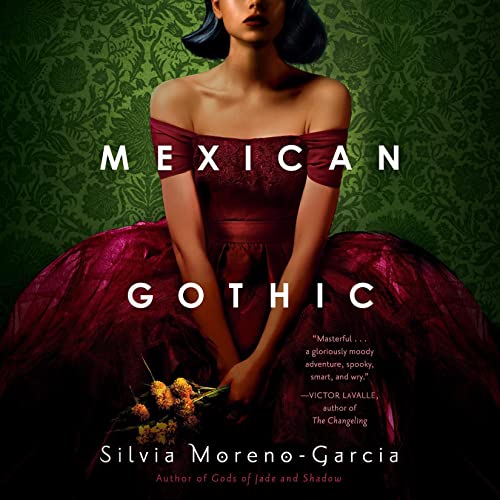
Mexican Gothic

Author: Silvia Moreno-Garcia

Narrated By: Frankie Corzo

Silvia Moreno-Garcia (Author, Mexican/Canadian novelist, editor and publisher.)

Moreno-Garcia’s “Mexican Gothic” is a chilling story of colonization, eugenics, ecological contamination, mystical beliefs, and control of society by men. The author chooses the name of Doyle as an English family that exploits the Mexico’ silver mining industry in earlier centuries. A dynasty is created by generations of Doyle’s. They created a colonial manor called “High Place” from which to rule a crumbling empire. As colonizers they capitalize on Mexico’s silver deposits by exploiting native Mexicans’ land and labor to grow their mining operation. The wealth of local citizens is lost to the English foreigners who keep wages low to increase the wealth of the Doyle family.

Over generations, the Doyle men married local women that were related to each other. A common practice of royalty before the twentieth century.

They wished to maintain the genetic purity of the Doyle bloodline by having future Doyles marry genetic descendants of Mexican women that had been their wives. This is not greatly different than the experience of royal marriages in European cultures. The consequence of that marriage tradition is that recessive genetic mutations become more prominent in offspring. Children were more susceptible to diseases like cystic fibrosis and had higher incidents of developmental and cognitive disorders. This is one of many threads of meaning in “Mexican Gothic” because one of these descendants becomes a murderer of Doyle family members and the current Doyle generation seems socially dysfunctional. Added to that dysfunction is the Doyle family’s diminishing wealth.

An arranged marriage is a lynch pin to the story.

The heroine, Noemi, is the daughter of a wealthy Mexican family. She is sent to investigate a letter that was received by her father from a young woman that marries a Doyle. She is a cousin of Noemi’s. The marriage is arranged in part because of her father, and he feels something is wrong and wants Noemi to visit the Doyle family to find what the mysterious letter means. Soon after Noemi arrives, she begins to have hallucinatory dreams. Listener/readers find the hallucinations are because of spores that are in the bedroom of the deteriorating Doyle house. A clever thread of meaning in Moreno-Garcia’s story is ecological contamination that comes from colonization. As one nation colonizes another, it inevitably brings different plants and animals that are not indigenous to the country they are colonizing. The author notes a fungus is growing in the Doyle household that may have come from the original colonizers.

The penultimate theme in “Modern Gothic” is the creation of myths that compound the horrific events that occur in the Doyle house.

From the history of murders in the Doyle household, to hallucinatory dreams, to incestuous relationships, to the gloom and doom of the story, to a myth about the age of the Doyle patriarch, Moreno-Garcia offers a climax to her story that vivifies reader/listener’s imagination. The climax of “Modern Gothic” is where myth enters Moreno-Carcia’s story. The fundamental truths of colonization are revealed in her creative story while its denouement is an entertaining explosion of imagination.

OLD SCHOOL INDIAN

“Old School Indian” is returned without being completed. It would have been interesting to know more about what it is like to be raised in America as a descendant of a Mohawk Indian Tribe but experimenting with gender identity are steps too far for this reader/listener.

Books of Interest
 Website: chetyarbrough.blog

Old School Indian (Novel)

Author: Aaron John Curtis

Narrated By:  Jason Grasi

Aaron John Curtis (Author, essayist, member of the Akwesasne Kanienkehaka, a Mohawk tribe.)

Curtis begins a rye, mordant, and witty novel that gives one an idea of how an Indian descendant might view themselves as a part of American society. Curtis’s main character is Abe Jacobs; raised in an Indian family deeply rooted in their Mohawk culture. He grows to attend college at Syracuse University in New York with an ambition to become a writer. He becomes concerned about skin sores that develop on his skin that itch, suppurate, appear, and disappear.

Abe is a handsome young man in Curtis’s story. He is troubled by skin sores and anxious to find out what causes them and how they can be treated and cured. He meets his future wife while going to college. She is a free spirited, attractive woman who is drawn to Abe because of his good looks which become more attractive when she finds he is a descendant of a Mohawk tribe. They become lovers on the day they meet. As their relationship grows, life goes on. They have times when they are apart, living life on their own terms but staying in touch by phone and recurrent rendezvouses.

The seriousness of Abe’s disease is finally diagnosed. The symptoms can cause artery inflammation leading to organ failure and dementia at an early age. This fictional disease (though there is a true similar disease) prepares readers for a story about what it is like to be in the prime of one’s life to face a disease that can disfigure your appearance and shorten your life. Aside from the point of having a potentially deadly disease, a listener/reader wonders what it is like to be a descendent of an Indian tribe in America.

As the book progresses, the story of Abe and his girlfriend are shown to have been raised in families struggling with poverty. Abe and his soon to be wife begin revealing the hardship of their lives. Poverty diminishes life in so many ways that the author’s clever beginning is not enough for this critic to complete his story. His hero tries to commit suicide at 12 years of age. Abe’s poverty is something many generations have experienced but being drawn to suicide and willingness to experiment with gender identity are steps too far for this critic.

“Old School Indian” is returned without being completed. It would have been interesting to know more about what it is like to be raised in America as a descendant of a Mohawk Indian Tribe but experimenting with gender identity are steps too far for this reader/listener.

RIGHT & WRONG

The story of “…Belle Lettres…” inelegantly reminds one of the effects of Trump on America’s reputation.

Books of Interest
 Website: chetyarbrough.blog

The Belles Lettres Papers (A Novel)

By: Charles Simmons

Narrated By:  Alex Hyde-White

Charles Paul Simmons (1924-2017, Author and former American editor for The New York Times Book Review, graduate of Columbia University in 1948.)

“The Belles Lettres Papers” is a fictional account about the destruction of an American book review company. Written by a person who worked as the editor for the NY Times Book Review gives credibility to its author. One wonders how the nationally famous paper felt about his book. Simmons writes a story of a magazine company that exclusively reviews new books that become literary successes, sometimes bestsellers, or dead or dying dust gatherers.

To this book critic, Simmons certainly seems to know what he is writing about but “The Belles Lettres Papers” falls into a dust gatherer category of books.

Book reading or listening is an educational, sometimes entertaining, experience. There are so many books written that it is impossible to know what to read or listen to without someone’s review of what has been newly or recently published. Of course, there are genres that a reader/listener will choose that influences their book choices. Even when one limits themselves to a genre, there are too many choices that require a way of limiting one’s choice.

Experience reveals “best seller” is not a consistently reliable way of choosing a book, but it is one of the most commonly used methods of selection.

What “…Belles Lettres…” reveals is the potential corruption that can inflate a books placement on a best seller list. Book review publications, like all business enterprises, have owners and employees that have various levels of honesty, capability, and ethical standards. What Simmons shows is how every business owner and employee is subject to the influence of money and power.

The potential weaknesses of humanity play out in every organization that provides service or material to the public.

Simmons shows how a fictional book review company has employees who are corrupted by the power of their positions and the money they make. The fictional company has a male business manager who thinks his female secretary wishes to have sex with him because of natural attraction. Ethically, no employee reporting to a manager they work for should have sexual relations with a direct report. This is particularly egregious in Simmon’s story because of sexual inequality that permeates society. As Lord Acton’s observation about power (power corrupts, absolute power corrupts absolutely), a person who has power over another is always at risk of self-delusion.

Simmons goes on to explain how undercompensating employees can corrupt an organization by incentivizing theft and other ways of undermining a company’s integrity.

Simmons addresses the incentive of owners or those in power of an organization to cut personnel employment to save money at the cost of product quality or service. America is experiencing that today with the actions of the Trump Administration in arbitrarily firing federal employees, regardless of what they do for American citizens.

In a last chapter, Simmons addresses the revisions that can occur in a company that decides on a wholesale turnover in employees.

The integrity of a company’s mission can be sorely challenged. In the case of “…Belle Lettres…” a decision for publication of salacious books replaces the company’s former studied reviews of good writers. The organization loses its reputation as a reviewer of high-quality publications.

Trump’s assessment of immigration.

The story of “…Belle Lettres…” inelegantly reminds one of the effects of Trump on America’s reputation as a supporter of western society by reducing foreign aid, undermining university independence, denying global warming, arbitrarily firing government employees, and expelling American immigrants.

SURVEILLANCE SOCIETY

The author makes a point in “The Dream Hotel”, but her book is a tedious repetition of the risk of human digitization that is a growing concern in this 21st century world.

Books of Interest
 Website: chetyarbrough.blog

The Dream Hotel (A Novel)

By: Laila Lalami

Narrated By:  Frankie Corzo, Barton Caplan

Laila Lalami (Moroccan-American novelist, essayist, and professor, earned a PhD in linguistics, finalist for the Pulitzer Prize for “The Moor’s Account”.)

Laila Lalami imagines a “Brave New World” in which algorithms predict probabilities of lethal criminal behavior. She creates a nation-state with a human behavior monitoring and detention system for every human that might commit a lethal crime. The growing collection of data about human thought and action suggests a level of truth and possibility.

Lalami creates a state that monitors, collates, and creates probability algorithms for human behavior.

To a degree, that state already exists. The difference is that the algorithms are to get people to buy things in capitalist countries and jail or murder people in authoritarian countries. One might argue America and most western countries are in the first category while Russia, and North Korea are in the second.

Lalami’s description of the detention system, like many bureaucratic organizations, is inefficient and bound by rules that defeat their ideal purpose.

A young mother named Hussein is coming back from a business trip. She is detained because of data collected on her about where she has been, what she did on her business trip, her foreign sounding name, and the kind of relationship she has with her husband and twin children. An algorithm has been created based on a profile of her life. It flags the young woman so that she has a number slightly over a probability threshold of someone who might kill their husband. Of course, this is ridiculous on its face. Whether she murders her husband or not is based on innate errors of behavioral prediction and bureaucratic confusion.

Every organization or bureaucracy staffed by human beings has a level of confusion and inefficiency that is compounded by information inaccuracy.

That does not make the organization bad or good, but it does mean, like today’s American government’s bad decisions on foreign aid or FDA bureaucracy throws the baby out with the bath water. Lalami’s point is that detention because of one’s name, family relationship, and presumed prediction for murder, based on a digitized life, is absurd. Algorithms cannot predict or explain human behavior. At best, an algorithm has a level of predictability, but life is too complex to be measured by a fictive number created by an algorithm.

The author makes a point in “The Dream Hotel”, but her book is a tedious repetition of the risk of human digitization that is a growing concern in this 21st century world.

PSYCHOSIS

The imagination of Han Kang gives reader/listener’s an explanation of how a human being can become psychotic. Kang’s characters show how psychosis comes from many sources, a major one of which is family relationship.

Books of Interest
 Website: chetyarbrough.blog

The Vegetarian 

By: Han Kang

Narrated by: Deborah Smith, Janet Song, Stephen Park

Han Kang (Author, South Korean writer, awarded the International Booker Prize for fiction in 2016 and the Nobel Prize in Literature in 2024.)

A listener/reader may be tempted to put this book aside with the thought that it is a titillating pornographic tale that is not worthy of one’s time. However, after an hour or two, one realizes this is a journey for something difficult to describe.

In Kang’s fictional story, two sisters are raised by the same parents. One is the older of the two and becomes a successful small business owner with a video artist husband; the other is a housewife who lives with a husband that seems to neither love nor respect her. Both marriages fail but for different but interlocking reasons.

The younger sister becomes a vegetarian later in her married life. She explains her vegetarianism is based on a dream she has about something that is not clearly defined. One gathers the dream has something to do with the source of meat that involves the killing of animals while vegetarian food comes from nature’s abundance. The husband reluctantly goes along with the change but becomes more and more unhappy in his life with the younger sister. The unhappiness grows to something greater when his wife begins to complain about how her meat-eating husband’ smells. The breaking point comes when the husband asks his wife’s mother, father, and sister-in-law to convince his wife to abandon vegetarianism and begin adding meat to her diet. At dinner in their house, the father forcefully demands his daughter to eat meat. She refuses and the conflict becomes violent. Her father pries her mouth open and shoves meat into her mouth. The daughter rebels and cuts her wrist with a knife in an act of defiance. Her brother-in-law grasps the younger daughter who is profusely bleeding and rushes her to the hospital.


The brother-in-law that rushed to save the vegetarian is a video artist.

The main characters of the story and the substance of their conflict is now made clear to the listener/reader. The next portentous development is the older sister’s husband (a video artist) begins to fantasize about the younger sister whom he had rushed to the hospital. His fantasy grows to the point of asking the younger daughter to pose nude for an art video he wishes to create. She agrees. A listener/reader begins to understand the younger sister is slipping into a psychosis. Her brother-in-law paints her nude body with flowers that make her feel that she is becoming part of nature, i.e., something growing like the vegetarian diet upon which she relies. The brother-in-law’s sexual desire becomes more aroused by the video and his relationship with the younger sister.

The deepening psychosis of the younger daughter grows when the brother-in-law hires a nude male model to be a part of a new video.

The male model resists but agrees to pose with her but refuses to go beyond allowing flowers being painted on his nude body and a video of the two without clothes but with painted bodies. The brother-in-law’s sexual fantasy grows from this experience but is disappointed in the male actor who refuses to have sex with the sister-in-law while the video is being filmed. The male actor did not want to be viewed as a porn star.

The brother-in-law’s fantasy leads to the sister-in-law’s agreement to have sex with him on film as long as he allows her to paint flowers on his body that are similar to what he had painted on her body. They become sexually entwined at the sister-in-law’s house. The older sister discovers them in their sexual rendezvous where the video is being produced.

The younger sister has crossed a barrier between sanity and insanity. It is not a matter of remorse for the sexual relationship but from a reinforcement of her obsessive need for being a vegetarian as an integral part of nature. She refuses her humanity. She has crossed the Rubicon between sanity and insanity. She refuses to eat anything and only wishes to drink water to feed her growth as a plant. Both her husband and the husband of the older sister-in-law essentially drop out of Kang’s story. The older sister’s husband does not forgive her husband for his sexual transgression and the younger sister’s husband never loved the vegetarian in the first place.

This amazing book, “The Vegetarian”, offers a vivid portrayal of a human beings’ descent into psychosis.

The imagination of Han Kang gives reader/listener’s an explanation of how a human being can become psychotic. Kang’s characters show how psychosis comes from many sources, a major one of which is family relationship.