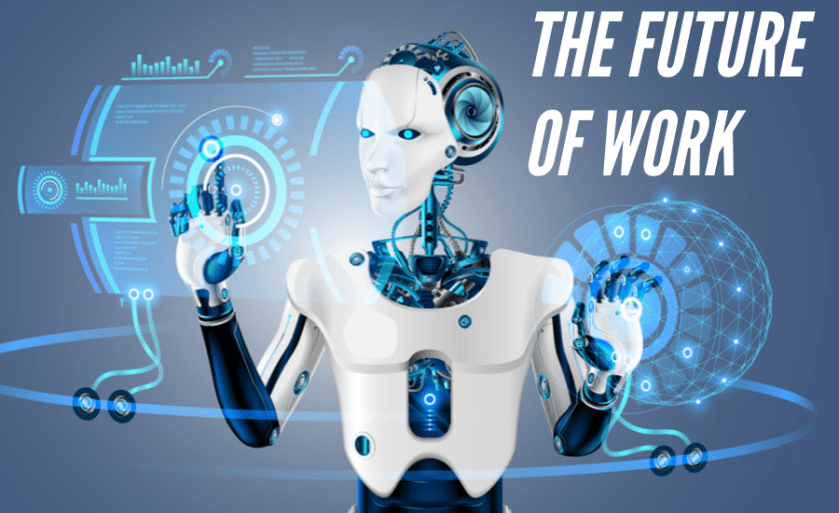
FUTURE A.I.

Human nature will not change but A.I. will not destroy humanity but insure its survival and improvement.

Books of Interest
 Website: chetyarbrough.blog

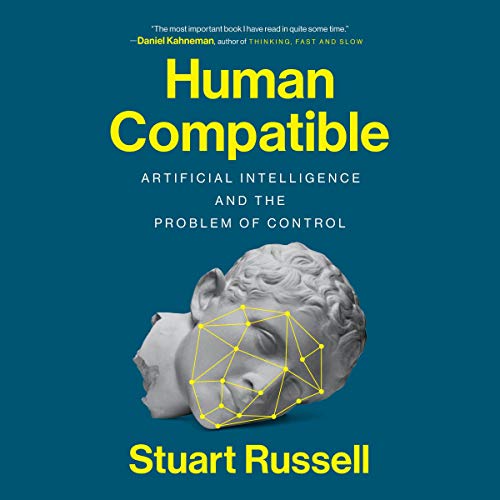
Human Compatible (Artificial Intelligence and the Problem of Control)

By: Stuart Russell

Narrated By: Raphael Corkhill

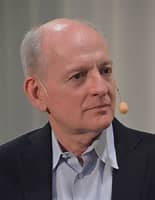
Stuart Johnathan Russell (British computer scientist, studied physics at Wadham College, Oxford, received first-class honors with a BA in 1982, moved to U.S. and received a PhD in computer science from Stanford.)

Stuart Russell has written an insightful book about A.I. as it currently exists with speculation about its future. Russell in one sense agrees with Marcus’s and Davis’s assessment of today’s A.I. He explains A.I. is presently not intelligent but argues it could be in the future. The only difference between the assessments in Marcus’s and Davis’s “Rebooting AI” and “Human Compatible” is that Russell believes there is a reasonable avenue for A.I. to have real and beneficial intelligence. Marcus and Davis are considerably more skeptical than Russell about A.I. ever having the equivalent of human intelligence.

Russell infers A.I. is at a point where gathered information changes human culture.

Russell argues A.I. information gathering is still too inefficient to give the world safe driverless cars but believes it will happen. There will be a point where fewer deaths on the highway will come from driverless cars than those that are under the control of their drivers. The point is that A.I. will reach a point of information accumulation that will reduce traffic deaths.

A.I. will reach a point of information accumulation that will reduce traffic deaths.

After listening to Russell’s observation, one conceives of something like a pair of glasses on the face of a person being used to gather information. That information could be automatically transferred by improvements in Wi-Fi to a computing device that would collate what a person sees to become a database for individual human thought and action. The glasses will become a window of recallable knowledge to its wearer. A.I. becomes a tool of the human mind which uses real world data to choose what a human brain comprehends from his/her experience in the world. This is not exactly what Russell envisions but the idea is born from a combination of what he argues is the potential of A.I. information accumulation. The human mind remains the seat of thought and action with the help of A.I., not the direction or control by A.I.

Russell’s ideas about A.I. address the concerns that Marcus and Davis have about intelligence remaining in the hands of human’s, not a machine that becomes sentient.

Russell agrees with Marcus, and Davis–that growth of A.I. does have risk. However, Russell goes beyond Marcus and Davis by suggesting the risk is manageable. Risk management is based on understanding human action is based on knowledge organized to achieve objectives. If one’s knowledge is more comprehensive, thought and action is better informed. Objectives can be more precisely and clearly formed. Of course, there remains the danger of bad actors with the advance of A.I., but that has always been the risk of one who has knowledge and power. The minds of a Mao, Hitler, Beria, Stalin, and other dictators and murderers of humankind will still be among us.

The competition and atrocities of humanity will not disappear with A.I. Sadly, A.I. will sharpen the dangers to humanity but with an equal resistance by others that are equally well informed. Humanity has managed to survive with less recallable knowledge so why would humanity be lost with more recallable knowledge? As has been noted many times in former book reviews, A.I. is, and always will be, a tool of human beings, not a controller.

The world will have driverless cars, robotically produced merchandise, and cultures based on A.I.’ service to others in the future.

Knowledge will increase the power and influence of world leaders to do both good and bad in the world. Human nature will not change but A.I. will not destroy humanity. Artificial Intelligence will insure human survival and improvement. History shows humanity has survived famine, pestilence, and war with most cultures better off than when human societies came into existence.

THINKING

A.I. will continue to grow as an immense gatherer of information. Will it ever think? Can, should, or will future prediction and political policy be based only on knowledge of the past?

Books of Interest
 Website: chetyarbrough.blog

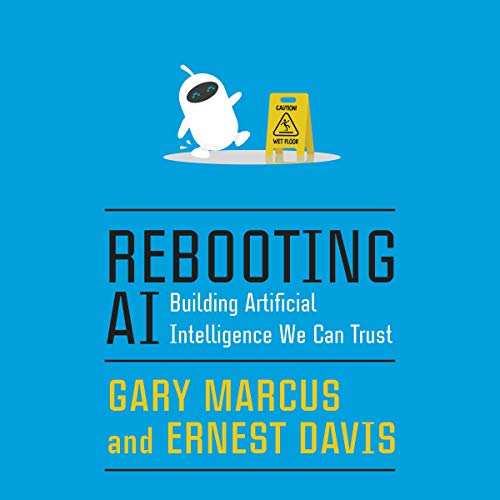
Rebooting AI (Building Artificial Intelligence We Can Trust)

By: Gary Marcus and Ernest Davis

Narrated By: Kaleo Griffith

These two academics explain much of the public’s misunderstanding of the current benefit and threat of Artificial Intelligence.

Marcus and Davis note that A.I. cannot read and does not think but only repeats what it is programmed to report.

They are not suggesting A.I. is useless but that its present capabilities are much more limited than what the public believes. In terms of product search and economic benefit to retailers, A.I. is a gold mine. But A.I.’s ability to safely move human beings in self-driving cars, free humanity from manual labor, or predict cures for the diseases of humanity are far into the future. A.I. is only a just-born baby.

Self-driving cars, robot servants, and cures for medical maladies remain works in process for Artificial Intelligence.

Marcus and Davis note A.I. usefulness remains fully dependent on human reasoning. It is a tool for recall of documented information and repetitive work. A.I. is not sentient or capable of reasoning based on the information in its memory. Because of a lack of reasoning capability, answers to questions are based on whatever information has been fed to an A.I. entity. It does not use reason to answer inquiry but only recites responses to questions from programmed information in its memory. If sources of programmed information are in conflict, the answers one receives from A.I. may be right, wrong, conflicted, or unresponsive. You can as easily get an answer from A.I. that is wrong as one that is right because it is only repeating what it has gathered from the past.
What Marcus and Davis show is how important it is that questions asked of Microsoft’s Copilot, ChatGPT, Watson, or some other A.I. platform be phrased carefully.

The value of A.I. is that it can help one recall pertinent information only if questions are precisely worded. This is a valuable supplement to human memory, but it is not a reasoned or infallible resource.

Marcus and Davis explain “Deep Learning” is not a substitute for human reasoning, but it is a supplement for more precise recorded information.

Even with multilayered neural networks, like deep learning which attempt to mimic human reasoning by patterning of raw data, can be wrong or confused. One is reminded of the Socratic belief of “I know something that I know nothing.” Truth is always hidden within a search for meaning, i.e., a gathering of information

The true potential of A.I. is in its continued consumption of all sources of information to respond to queries based on a comprehensive base of information. The idea of an A.I. that can read, hear, and collate all the information in the world is at once frightening and thrilling.

The risk is the loss of human freedom. The reward is the power of understanding. However, the authors explain there are many complications for A.I. to usefully capitalize on all the information in the world. Information has to be understood in the context of its contradictions, its ethical consequence, information bias, and the inherent unpredictability of human behavior. Even with knowledge of all information in the world, decisions based on A.I. do not ensure the future of humanity? Should humanity trust A.I. to recommend what is in the best interest of humanity based on past knowledge?

Markus and Davis argue A.I. is not, does not, and will not think.

A.I. will continue to grow as an immense gatherer of information. Will it ever think? Can, should, or will future prediction and political policy be based only on knowledge of the past?

HEALTH

“This is Your Brain on Parasites” is a bad book title but McAuliffe has written an interesting book about physical and mental health, and the treatments being researched in the 21st century.

Books of Interest
 Website: chetyarbrough.blog

This is Your Brain on Parasites (How Tiny Creatures Manipulate Our Behavior) and Shape Society

By: Kathleen McAuliffe

Narrated By: Nicol Zanzarella

Kathleen McAuliffe (Author, science journalist who has published in The New York Times, The Atlantic, and Smithsonian. Received an M.A. in natural science from Trinty College Dublin.)

Kathleen McAuliffe apprises the public of the importance of personal health along with a somewhat bizarrely titled book “This is Your Brain on Parasites”. McAuliffe’s book is about the science of health and its maintenance. The idea of a parasite in one’s brain seems unworthy of a book because of the creepy implication of possession. However, McAuliffe refers to a physician and several research scientists that have found evidence of brain parasites that effect animal and human behavior.

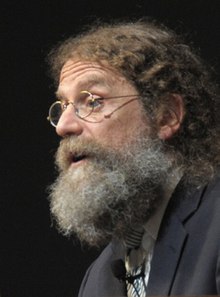
Dr. Robert Sapolsky, a neuroscientist and professor at Stanford studied what is called a Toxoplasma gondii parasite. It forms cysts in brain tissue that are shown to affect human behavior. People who have developed the cysts have shown symptoms of risk-taking behavior, and mental dysfunction like schizophrenia.

Dr. Jaroslav Flegr is a parasitologist, evolutionary biologist and professor of biology at the Faculty of Science, and professor at Charles University in Prague.

McAuliffe meets with a Czech scientist, Dr. Jaroslav Flegr, who conducted research showing the Toxoplasma gondii parasite in cat feces can infect the brain of a human being. The author meets other American research scientists that show how parasites infect animal brains whose behavior is affected in ways that are not natural to their species. A parasite being the source of a diseased brain has implications for treating mentally dysfunctional patients that may have a parasitic infection.
What McAuliffe’s book implies is the importance of washing one’s hands when handling pets, or their fecal material.

“This is Your Brain…” reminds one of the importance of hygiene when replenishing a bird feeder or filling an animal feeding trough to avoid possible parasites.

As most know, Kennedy is not a believer in vaccination despite a growing measles epidemic and the proof that vaccination works. McAuliffe does believe there are circumstances where a child crawling across the floor of a clean house gathers some immunity naturally but that un-common pathogens require uncommon vaccination.

Two other subjects mentioned by McAuliffe is natural and science made vaccinations and the benefits they provide humanity. This is a particularly timely suggestion considering Trump’s appointment of Robert F. Kennedy Jr. (a confessed anti-vaxxer) as the Secretary of Health and Human Services.

McAuliffe notes how research is showing how certain microbes can remove calories from food and how certain drugs can reduce hunger among overweight patients. She reflects on the intersection of microbiology and human health.

Another interesting examination by McAuliffe is the science research being done on gut microbiomes, a community of microorganisms in human digestive systems.

The research on microbiomes has resulted in effective weight loss drugs that have become popular medications for people struggling with weight gain.

“This is Your Brain on Parasites” is a bad book title but McAuliffe has written an interesting book about physical and mental health, and the treatments being researched in the 21st century.

MODERATION

Unless homelessness is addressed with affordable housing, America’s future looks bleak. A land of have and have-nots will grow to crush American prosperity.

Books of Interest
 Website: chetyarbrough.blog

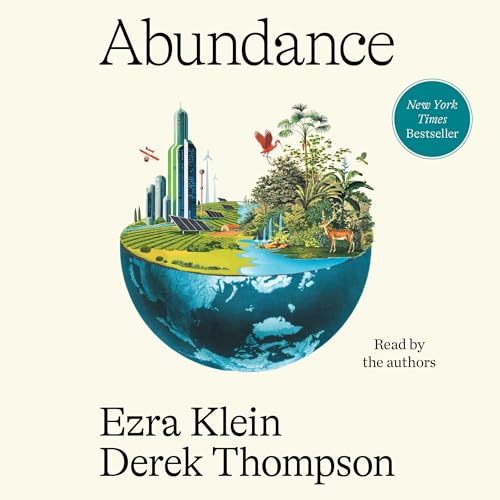
Abundance 

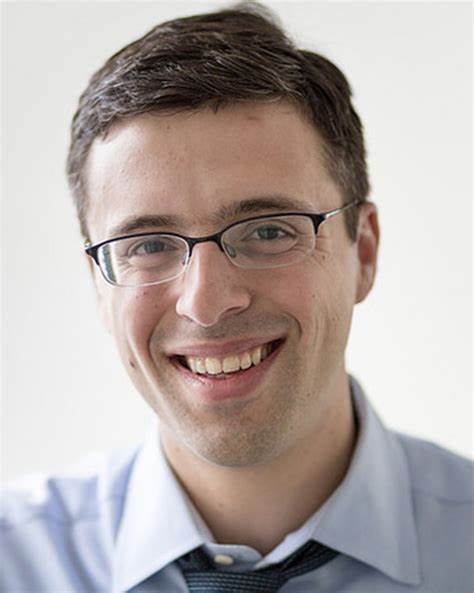
By: Ezra Klein, Derek Thompson

Narrated by: The Authors

These two young Americans offer an insightful view of politics and American government in the 21st century.

Klein or Thompson could have voted for either Trump or Harris in America’s last election. Their book argues American government is both a boon and bane for citizen “Abundance” in the 21st century. They note America has contradictory economic policies that have created great abundance among Americans while exacerbating inequality. Evidence for their opinion is growing homelessness, an immigration crisis, loss of manufacturing jobs, and government’s failure to creatively adjust public policies to provide solutions.

Those who have shared in the abundance of America have voted for candidates to preserve their privileges.

The authors note homelessness is a function of affordable housing that is denied by government policies that regulate zoning and construction requirements. Government policies make affordable housing too costly to build and impossible to locate because of zoning restrictions. The number of people living on the street is a self-inflicted American tragedy. Some of the homeless are young, some are old, some have mental or physical problems, and others are victims of drugs or their own weaknesses. What they have in common is unaffordable housing.

Historically, immigration has been a great boon to American economic growth.

Klien and Thompson note restrictive immigration policies have created obstacles for workers needed for manufacturing in key industries like agriculture, auto industry assembly, housing construction, and clean energy infrastructure. Rather than wasting money on building walls and deporting workers, the authors advocate immigration reform that meets the needs of American business. One can imply the authors meaning is that to “Make America Great Again” requires immigrants willing to work in agricultural and manufacturing jobs. The end of the baby boom requires help from immigrants to meet the needs of increased manufacturing and construction in the United States.

Some believe what Trump is doing is good for the American economy in the long run.

The criticism is that in the short run, the economy may collapse. Tariffs being used as a ham-fisted way of negotiating fair international trade is a fool’s errand. America needs labor and material in the short run to achieve equal and greater prosperity than it had in the 1970s. Added manufacturing will aid American prosperity, but it will be surpassed in the long run by automation. It is the automation race America needs to win or compete with to remain a world leader. Competing in that race depends on education, and scientific research. The irony is that Trump is firing government employees who have responsibility for public education, research, and funding that have been the engines of America’s prosperity.

The government employees discharged by the Trump administration to solely reduce costs is short sighted.

In the 1980s, 60% of basic research in the U.S. was funded by the government. In 2022 that funding dropped to 40%. Advances in semiconductors, global positions systems, biotechnology, and aeronautics were government-funded discoveries in the 1980s. American government-funded scientific research gave America the internet, GPS technology, mass production of penicillin, Space exploration, human genome project discoveries, and renewable energy innovations. The Department of Health and Human Services has lost 20,000 employees, the Department of Education 1,300, the National Oceanic and Atmospheric Administration 800, and the National Institutes of Health 1,200. One wonders how many of these employees may have been on the edge of scientific discoveries that could change the world.

The truth of “Abundance” is that America has caused many negative ecological impacts and aggravated the gap between rich and poor.

Klein and Thompson have written a provocative book. However, the truth of “Abundance” in America has caused many negative ecological impacts and aggravated the gap between rich and poor. Looking only to abundance does not address either social inequality or the environment. The NIMBY (not in my back yard) resistance to affordable housing aggravates inequality and increases homelessness. Unquestionably, higher density housing impacts the environment.

Klein and Thompson fail to address the increased power of corporations in America.

The 2010 Citizens United v. Federal Election Commission gave corporations the power to spend unlimited amounts of money on political campaigns. The influence of corporations on elections has disproportionate power in the election of government policy makers. That decision by the Court is a distortion of one person, one voter’s influence on public policy.

Aristotle emphasized the importance of “All things in moderation”. NIMBY communities must open their minds and hearts to homelessness and moderate their resistance to neighborhood accommodation. Government agencies must supervise and service higher density housing impacts wherever they are built and after they are completed.

Unless homelessness is addressed with affordable housing, America’s future looks bleak. A land of have and have-nots will grow to crush American prosperity.

MEDIA SELF-INTEREST

One may question William’s characterization of Facebook’s “Careless People” as more like calculating self-interested managers than careless employees.

Books of Interest
 Website: chetyarbrough.blog

Careless People (A Cautionary of Power, Greed, and Lost Idealism)

By: Sarah Wynn-Williams

Narrated By: Sarah Wynn-Williams

Sarah Wynn-Williams (Author, Ex-Meta executive, presently barred from criticism of Meta, formally known as Facebook.)

As noted in the sub-title of “Careless People”, Meta (formerly known as Facebook) is criticized as an international influencer of society that has lost its sense of ethics, i.e. the ability to see the difference between right and wrong. Facebook originally intended to be a forum for the connection of people interested in sharing ideas, communicating with others, and building positive social connection. Instead, the author’s experience as a Facebook’ executive found that expansion, profit, and political influence became an unethical pursuit by the major shareholders (particularly Mark Zukerberg) and managers of the corporation. She argues leadership of Facebook recklessly pursued income, expansion, and political influence around the world with little ethical oversight.

New Zealand (The birthplace of Sarah Wynn-Williams)

Ms. Williams was born in New Zealand but went to work for Facebook and became a U.S. citizen. Her work at Facebook led to a promotion that made her the Director of Global Public Policy which provided opportunity to travel the world soliciting business for Facebook in other countries. Her experience informs listeners of what Meta’s corporate goal: “give people the power to build community and bring the world closer together” became something less as a result of careless management oversight.

Williams begins with a story of a harrowing trip to Myanmar, presumably after their revolution in 2021.

The military coup that ousted the democratically elected government appears to have just begun when Williams had an audience to pitch the Facebook platform to its military government. Just getting to the building where the meeting was to be held was a trial but her position as a representative of Facebook ended with her arrival at a headquarters building of the new regime. It is an interesting story because it shows the power of Facebook association in a country that just had a coup d’état that ended civilian rule. Millions of Myanmar citizens were displaced by widespread human rights abuses with civilian arrests and violence. One wonders what “giving people the power to build community” means in what became a military totalitarian state. (When visiting the Baltics last year, our guide expressed a love for Myanmar’s citizens and the country but was told by Myanmar friends it is unsafe to visit since the coup.)

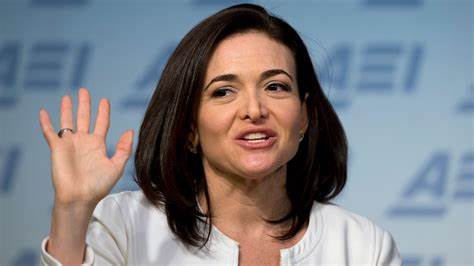
Williams worked directly with Sheryl Sandberg, the COO of Facebook.

Later, Williams explains a meeting with a Japanese official where Sandberg and Williams go to promote interest in Facebook which had not been a part of the Japanese media environment. The involvement of Williams was primarily to support Sandberg’s pitch. Williams indicates Sandberg was quite complementary of Williams’ assistance after the meeting which gives context to their relationship. A subsequent description of Sandberg’s strong, sometimes harsh, personality and influence on Facebook employees is given by Williams. The Japan’ meeting was successful because Facebook entered the market in 2010. Its popularity is said to have declined with Instagram and LINE being the dominant platforms, but Facebook maintains a presence in the country.

Societies interconnectedness is a boon and bane for 21st century society.

The pandering of Zukerberg, Bezos, Musk, Cook, and Pichai to world governments is made suspect by William’s experience as an employee of Facebook. Media companies have become too big to fail and too ungovernable to manage. Even though the internet more intimately connects the world, the platforms of today’s giants of information create a forum for control and conflict rather than a place to encourage social comity.

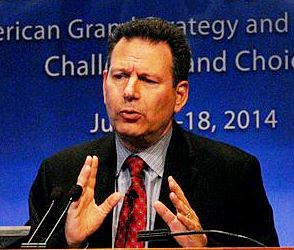
Robert Kaplan (Author of “Waste Land”.)

As noted by Robert Kaplan in “Waste Land”, the growing decline of Russia’s, China’s and America’s governments has been increased with world interconnectedness. It appears from William’s experience at Facebook, there is some truth in Kaplan’s observation. Kaplan’s solution is to dismantle these giants and encourage competition to defray their principal stockholder’s influence.

As the Turkish saying goes, “a fish rots from the head down”. Williams frequent contact with Mark Zuckerberg gives weight to her view of Facebook culture. Mr. Zuckerberg seems to carelessly lead Meta into the arena of politics by promoting Facebook’s media clout to political parties because it raises revenues with political advertising and influences government policy on media’ regulation. Frighteningly, Williams notes Zuckerberg considers running for President with the power of Meta to support his candidacy. One may question William’s characterization of Facebook’s “Careless People” as more like calculating self-interested managers than careless employees.

AMERICAN HOPE

From Fukuyama’s intellectual musing to our eyes and ears, one hopes he is correct about America’s future in the technological age.

Books of Interest
 Website: chetyarbrough.blog

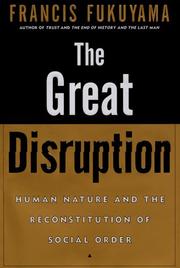
The Great Disruption (Human Nature and the Reconstitution of Social Order)

By: Francis Fukuyama

Francis Fukuyama (Author, political scientist, political economist, international relations scholar.)

Francis Fukuyama argues America is at the threshold of a social reconstitution. Fukuyama believes we are at Gladwell’s “Tipping Point” that is changing social norms and rebuilding America’s social order. He argues the innovation of technology, like the industrial revolution, is deconstructing social relationships and economics while reconstructing capitalist democracy.

The immense power of big technology companies like Amazon, Google, and Facebook have outsized influence on American society. They change the tone of social interaction through their ability to disseminate both accurate and misleading information. They erode privacy and create algorithms tailored to disparate interest groups that polarize society. The media giant’s objective is to increase clicks on their platforms to attract more advertisers who pay for public exposure of their service, merchandise, and brand.

To reduce outsize influence of big tech companies, Fukuyama suggests more technology has an answer.

There should be more antitrust measures instituted by the government to break monopolistic practices and encourage competition with large technology companies. Algorithms created by oversight government organizations can ensure transparency and reduce harmful content to reduce big tech companies influence on society. (One doubts expansion of government agencies is a likely scenario in today’s government.)

On the one hand, technology has improved convenience, communication, and a wider distribution of information.

On the other, technology has flooded society with misinformation, invaded privacy, and polarized society. Technology has created new jobs while increasing loss of traditional industry jobs with automation. Trying to return to past labor-intensive manufacturing companies is a fool’s errand in the age of technology.

Luddites during the Industrial Revolution.

Like the industrial revolution, the tech revolution’s social impact is mixed with a potential for greater social isolation, and job displacement with the addition of wide distribution of misinformation. The positives of new technology are improvements in healthcare product and services, renewable energy, and climate understanding with potential for improved control.

Face-to-face interactions become less and less necessary. Children’s access to technology impacts parental supervision and relationship. Fukuyama suggests setting boundaries for technology use needs to be a priority in American families. Technology can open the door to better education, but it also becomes a source of misinformation that can come from the internet of things. Employers have the opportunity to help with work-life balance by encouraging flexible hours and remote work. (Oddly, that suggestion is being undermined by the current government administration and many American companies.)

Economic growth, access to information, and global connectivity have been positively impacted by technology. However, the concentration of power, misinformation, and surveillance of social media has diminished privacy and eroded individual freedom. There are concerns about technology and how it is good and bad for democratic capitalism.

The good lies in increased efficiency, innovation and creation of new markets, through globalization. However, today’s American government shows how tariffs are a destroyer of globalization. Fukuyama implies A.I. and automation is displacing workers and aggravating economic inequality because it is being misunderstood for its true potential and also being misused. Personal data is used to manipulate consumers in ways that challenge the balance between corporations and consumers.

Fukuyama argues private parties will grow in America to create software that will filter and customize online services.

With that effort control of the influence of big tech companies will be diminished. With decentralization of big tech power and influence, society will theoretically become less polarized and more consensus oriented. The capitalist opportunity for tech savvy startups that diminish influence of big tech companies will re-create diversification like that which the matured industrial revolution gave to new manufacturers. Like Standard Oil and other conglomerates of the industrial revolution, businesses like Amazon, Google, and Facebook will have competition that diminishes their power and influence.

American Government will grow to regulate the internet of things just as it has grown to regulate banks, industries, and social services.

Service to citizens will become a bigger part of the economy as a replacement for manufacturing. Family life will re-invent itself as a force of society because of the time saved from manufacturing product to improve human relationships.

From Fukuyama’s intellectual musing to our eyes and ears, one hopes he is correct about America’s future in the technological age.

TOO LATE

Ideally, public good and ethics will be taught in advance of the melding of technology and government, i.e., not after mistakes are made. However, history suggests humans will blunder down the road of experience with A.I., making mistakes, and trying to correct them after they occur.

Books of Interest
 Website: chetyarbrough.

The Technological Republic (Hard Power, Soft Belief, and the Future of the West)

By: Alexander C. Karp and Nicholas W. Zamiska

Narrated By: Nicholas W. Zamiska

The authors are the founder and operations manager of the American software company, Palantir Technolgies. Palantir has been hired by the U. S. Department of Defense, the Intelligence Community, agencies of NATO countries, and Western corporations to provide analytic platforms for defense analysis, healthcare, finance, and manufacturing.

They believe artificial intelligence research and development has lost its way.

They argue Silicon Valley has lost focus on what is important for survival of society and Western values. They suggest A.I. should be focusing on serving humanity in ways that responsibly regulate nuclear weapons and protect society from existential risks like climate change, pandemics, asteroid collisions, etc., that threaten human extinction. The authors provide a powerful criticism of technology and its national purpose.

Karp and Zamiska argue that technology is focusing on consumerism rather nuclear annihilation or existential risk.

By focusing on convenience and entertainment for financial success, fundamental problems like the threat of nuclear war, homelessness, inequality, and climate change are ignored or relegated to the trash heap of history. (“Trash heap of history” is the belief that what happens, happens and society can do nothing about it.) The west has become complacent with short-term focus on profit and consumer demand. The authors argue that the greater good is no longer thought of as an important societal goal. The primary goal is making money that enriches creators and company owners by making purchases more convenient to and for consumers.

Aldous Huxley (English writer and philosopher, 1894-1963, author of “Brave New World”.)

Their argument is there should be more collaboration between tech and government. Historically, government is only as good as the information it has to make societal decisions. A computer program can be programmed with false information like the error of weapons of mass destruction that led to an invasion of Iraq that was a bad decision. The domino theory input that led to the Vietnam war; so, on and so on. There is also the threat of an elected President that uses the power of technology to do the wrong thing because of his/her incompetence. There is the risk of government gathering personal information and using it to cross the line into a “Brave New World” where innovation, free thought, and independent action are discouraged or legislated against so people can be sent to jail for breaking the law?

Possibly, melding technology with government is an answer, but it is a chicken and egg concern. Education about public good and ethical practices should begin as soon as the egg cracks, not after hatchlings are already old enough to work. Phrases that come to mind are “What’s done is done” or “The die is cast”.

The authors argue the West needs to up-its-game if it wishes to create a peaceful and prosperous future for a society that is founded on the ideal of human freedom.

Without future generations creating policies based on ethical purpose for the public good, one infers western culture will spiral into individual isolation and self-interest that diminishes western culture and ideals.

Ideally, public good and ethics will be taught in advance of the melding of technology and government, i.e., not after mistakes are made. However, history suggests humans will blunder down the road of experience with A.I., making mistakes, and trying to correct them after they occur.

TROJAN HORSE

Stanislas Dehaene’s research on the subconscious mind seems to reveal more about human weakness than strength. His research indirectly points to the danger of scientific discovery introducing subconscious human processing to machine learning.

Books of Interest
 Website: chetyarbrough.

Consciousness and the Brain  (Deciphering how the brain codes our thoughts)

By: Stanislas Dehaene

Narrated By: David Drummond

Stanislas Dehaene (French author and cognitive neuroscientist.)

This is the second review of Dehaene’s book. It was reviewed in 2017 with an essay titled “Consciousness”. A second look is informative because it is a complicated subject implying brain function might one day be replicated by machine learning. He suggested machine learning is a long way into the future but with quantum technology that future seems less distant.

To recall information and report meaning is a definition of what Dehaene calls consciousness.

The complicating part of that definition is the subconscious and its role in conscious awareness. Dehaene argues the subconscious is outside of our conscious awareness but is an integral part of decisions and human behavior. He implies if the brain can be precisely mapped, it can be translated to machine learning that will make the subconscious an explicitly known influence on thought and action.

The ramifications of what is subconsciously understood being a part of conscious decision making and action is both positive and negative.

Theoretically decisions and actions will be more accurate and routine tasks and habits can be more efficiently executed. Unconscious bias could be eliminated. On the other hand, the mental shortcuts of the unconscious in a machine-mind may cause stereotyping or overconfidence that elicits inappropriate or harmful thoughts and actions.

Replicating the conscious and unconscious mind by mapping the brain and transferring those human functions to machine learning seems like a Trojan horse that offers a pyric victory. Dehaene’s research on the subconscious mind seems to reveal more about human weakness than strength. His research indirectly points to the danger of scientific discovery introducing subconscious human processing to machine learning.

MARS & BEYOND

Mahaffey is a supporter of nuclear energy and its potential for earth’s energy needs. He argues fission can be made a useful source of energy while fusion research holds the best opportunity for humanity’s future.

Books of Interest
 Website: chetyarbrough.blog

Atomic Adventures (Secret Islands, Forgotten N-Rays, and Isotopic Murder-A Journey into the Wild World of Nuclear Science.)

By: James Mahaffey

Narrated By: Keith Sellon-Wright

James Mahaffey (Author, Research scientist at Georgia Tech Research Institute)

“Atomic Adventures” is a reminder of the race for the atomic bomb, its wide pursuit by nations of the world, and research for the holy grail of atomic fusion. Mahaffey’s science explanations are tedious for non-scientists, but his history of the secrets and use of atomic energy are interesting and surprising.

The United States, with the help of the UK, may have been first to acquire the atom bomb in 1945, but eight more nations acquired it by 2006.

United States: Acquired in 1945.

Russia (formerly the Soviet Union): Acquired in 1949.

United Kingdom: Acquired in 1952.

France: Acquired in 1960.

China: Acquired in 1964.

India: Acquired in 1974.

Israel: Believed to have acquired in the late 1960s, though it maintains a policy of deliberate ambiguity.

Pakistan: Acquired in 1998.

North Korea: Acquired in 2006

It is somewhat ironic that Pakistan did not acquire the atom bomb until 1998 when Pakistan’s “father of the bomb”, Abdul Qadeer Khan, became a rich man by selling technological know-how of the bomb to nations like North Korea, Libya, and Iran.

Abdul Qadeer Khan

Abdul Qadeer Khan (1936-2021, father of Pakistan’s atomic weapons program, died at age 85.)

As a singular discovery, Einstein’s E = mc² offered a dual opportunity for the world, i.e., destruction and/or survival of the human race. The bomb suggests destruction while nuclear fusion offers an inexhaustible energy source that could reverse global warming and rocket human beings to other worlds.

ALBERT EINSTEIN (1879-1955, died at age 76.)

Mahaffey explains the immense potential of nuclear power as a principal source of energy. History shows nation-state and political conflicts may spin nuclear power out of control to kill millions and devastate the environment. On the other hand, nuclear research and power offer avenues for humanity’s survival and longevity.

Mahaffey notes there were Japanese, as well as better known German scientists, who were working on the creation of a nuclear bomb that could destroy Allied armaments and combatants. The rush to weaponize radiation during WWII surprisingly includes research being done by Japan as well as Germany during WWII. America won the research race because of superior human and financial resources that could be marshalled to complete the scientific research and experimentation needed to perfect a nuclear weapon.

Mahaffey explores the creation and destructive history of the atom bomb.

Surprising to some listeners, Mahaffey explains Argentina’s significant effort to increase its research and development of nuclear power after WWII. Argentina created the National Atomic Energy Commision in 1950. The chief researcher, hired by President Juan Perón, was Ronald Richter (1909-1991), an Austrian-born scientist who headed their plan to create a fusion power facility. Richter fails but nuclear energy remains an important part of Argentina’s history. In the 1960s they built their own research reactors and by 1974 built their first fission nuclear power reactor, Atucha I. By 1984, they had two heavy-water reactors with Atucha I and Atucha II.

Ronald Richter (1909-1991, Austrian-born German who became an Argentine citizen who headed up the Argentine Huemul Project to create a nuclear fusion power plant. He failed, despite the millions of dollars spent to build and rebuild fusion power plants.

Image result for ronald richter

Yoshio Nishina (the father of modern physics research), Bunsaku Arakatsu, and Masatoshi Okochi created the so-called Ni-Go and F-Go projects to develop an atom bomb. They did not get beyond the laboratory stage because of a lack of resources, the exigency of war, and the complexity of nuclear technology. The energy of nuclear power, as shown by history, is two edged.

Yoshio Nishina (1890-1945, the father of modern physics research during WWII.)

Image result for medical use of nuclear energy

On the other nuclear radiation can heal the sick

and potentially provide a clean renewable energy source.

Mahaffey explains how research in fusion can go awry. In a news article, two chemists reported in 1989 that fusion was created in their experiment by involving heavy water (deuterium oxide) and palladium electrodes. They reported excess heat production that they believed was nuclear fusion. As with all scientific experiment, their results had to be confirmed by other scientists testing of their results in the same experiment. Mahaffey, in his role at the Georgia Research Institute, was asked to replicate the experiment. Using the same tabletop experiment, Mahaffey initially confirmed Fleishmann’s and Pons’ findings. However, no other table-top experiments found the same results. What Mahaffey finally found was that the neutron counting device that was recording increased heat was the actual source of the heat increase, not the chemical interaction between heavy water and palladium electrodes. Further research is being conducted but the U.S. Department of Energy concluded in 2004 there is no convincing evidence to support cold fusion. Tests are still being done but Mahaffey infers that research is a scientific dead end. Mahaffey and a colleague tried again in a basement of his colleague’s house to try a similar experiment and failed.

NASA's Mars rover Perseverance landing: Everything you need to know | Space

Nuclear power has the potential to revolutionize interplanetary travel. The higher efficiency and power, particularly with the perfection of fusion, will shorten travel times and make trips to Mars and beyond more feasible.

Mahaffey explains how communication will be a challenge when interplanetary travel becomes common. The distance to other planets or galaxies will impede communication because of the limits of the “speed of light”. However, the solution may lie in quantum entanglement’s experimental proof found by Clauser, Aspect, and Zellinger. The complexity of entanglement makes the theory unprovable at the time of Mahaffey’s book.

In theory, quantum entanglement suggests information (communication) may be instantaneously transmitted across galaxies without the limitations of the speed of light.

Mahaffey goes on to explain the risk of radiation in a chapter about a “dirty bomb”. Security measures used to protect the public from radiation leaks make thieves believe something valuable is being secured by government laboratories. Thieves will steal these secure containers only to find they are risking death by opening their booty. Additionally, Mahaffey notes radioactive material is often disposed of illegally and irradiates innocent people who own dump sites that received inadequately contained radioactive material.

Mahaffey is a supporter of nuclear energy and its potential for earth’s energy needs. He argues fission can be made a useful source of energy while fusion research holds the best opportunity for humanity’s future.

FINANCIAL LITERACY

What Professor Fullenkamp makes clear is information is key to understanding financial markets, but human judgement is the difference between investor’ success or failure.

Books of Interest
 Website: chetyarbrough.blog

Financial Literacy (Finding Your Way in the Financial Markets)

By: The Great Courses

Lectures By: Professor Connel Fullenkamp

Professor Connel Fullenkamp (Lecturer at Duke University, economist and director of undergraduate studies in economics.)

“Financial Literacy” may put some listeners to sleep but there is a lot to be learned from Connel Fullenkamp’s lectures. He gives a lengthy description of financial markets extending from Stocks to Bonds, Forex, Commodity, and Derivative Markets. He offers information about how money is used and made in financial markets. Fullenkamp addresses banks, stocks, selling and buying securities, expected returns on investments, how they are priced, controlled, and how information about them is important for personal financial decisions.

It is no surprise to find that banks play a critical role in financial markets.

They provide personal banking services by accepting deposits and providing loans to individuals and businesses. They smooth the flow of money in the economy. Banks can help companies raise capital by offering advice and services for the issuance of stocks and bonds to finance businesses. They offer advisory services for mergers, acquisitions, and other financial strategies. Banks can act as market makers by buying and selling securities for their clients. They can provide asset management services, research and analysis, and ensure legal regulation and compliance with government and international laws. Banks are the backbone of financial markets when they provide efficient allocation of resources and ensure the smooth functioning of the financial system. All of this is true in concept.

However, banks, savings and loan companies, and mortgage lenders are run by human beings who are subject to all the risks of human nature that can lead to catastrophic financial collapse as it almost did in the 2007-2010 mortgage derivative crises.

To be fair to the professor’s presentation, the 2007-2010 crises is not only because of the bad mortgages generated by financial institutions like Countrywide, New Century and Ameriquest. Goldman Sachs, Lehman Brothers, Bear Stearns, and Merrill Lynch investment banks are equally guilty. They packaged bad mortgages with high-risk mortgages to be sold to the public as safe collateralized securities that were far from safe and ultimately unsound. The result was a near worldwide financial collapse.

The government compounded the failure of 2007-2010 by guaranteeing poorly justified mortgages that were included in the packaged securities.

Rating agencies like Moody’s Standard & Poor’s, and Fitch ratings misled investors about the risks of the packaged mortgage securities. Government oversight organizations like the Federal Reserve and Department of the Treasury did not adequately do their job. Ironically, banks like Wells Fargo resisted the mortgage derivatives while banks like JPMorgan Chase bought and sold them but was too big to fail. Ironically, both banks became vehicles for recovery by taking over some of the lenders that had to0 many mortgage derivatives in their portfolios. (As noted in earlier book reviews, many families lost their homes because of foreclosures caused by lenders who originated the mortgages in these securities.) Fullenkamp explains financial markets are based on information. However, as noted by information computer geeks, “garbage in, garbage out” sunk lenders and victimized many investors, lenders, and homebuyers.

In explaining the stock market, Fullenkamp notes an investor becomes a partial owner of a company which gives them a stake in a company’s future profits, either from dividends or market performance.

Stocks have a dual identity. The difficulty for the investor is in understanding the information provided by the company to predict company performance and reap the benefits of stock appreciation. Fullenkamp gives some insight on assessment of that information, but most listeners seem most likely to pay less attention to professors of finance than to their own judgement.

Fullenkamp goes on to discuss Forex (Foreign Exchange). This is a global marketplace for trading national currencies.

Unlike stock and bond markets, a Forex market operates 24 hours a day because currency is an international trading market with centers in different cities like New York, Tokyo, and London. In the case of Europe and the U.S., the trade would be in Euros and US Dollars or in Japan and the U.S., the trade would be in Dollars and Yen. Exchange Rates fluctuated based on nation-state events. Strategic buying and selling based on those events can create profits and losses for exchange traders. Unlike a singular centralized stock market, Forex is decentralized and conducted electronically over the counter (OTC) by a network of banks, brokers, and dealers.

Fullenkamp also defines commodities markets. There are hard and soft commodities. Hard are like gold, oil, and other naturally produced materials. Soft are agricultural products like wheat, coffee, or cotton.

Most commonly, trading in these products is done with futures contracts. Futures are agreements to buy or sell a commodity at a predetermined price on a future date. The investor is gambling on the commodity to be either worth more or less than what the product is expected to cost at the actual time of purchase or sale. There are several exchanges around the world. The participants are speculators that either take the commodities at the agreed upon price or simply gain or lose money based on the actual price of the commodity when it is deliverable.

There is a great deal to absorb from Fullenkamp’s lectures. The last lecture is on “The Future of Finance”.

He suggests the technology of mobile phones has expanded the lending industry to individuals from institutions. It has already begun in less successful economic societies. Mobile money platforms and digital financial services are being used in Africa. Users of these platforms store, send and receive money by mobile phone owners because traditional banking services are not available. Fintech companies are formed to assess creditworthiness of individuals and small businesses. The vast amount of personal information becoming available with the internet becomes a source of customer approval or rejection of small companies and individuals seeking loans.

What Professor Fullenkamp makes clear is information is key to understanding financial markets, but human judgement is the difference between investor’ success or failure.