HEALTH

“This is Your Brain on Parasites” is a bad book title but McAuliffe has written an interesting book about physical and mental health, and the treatments being researched in the 21st century.

Books of Interest
 Website: chetyarbrough.blog

This is Your Brain on Parasites (How Tiny Creatures Manipulate Our Behavior) and Shape Society

By: Kathleen McAuliffe

Narrated By: Nicol Zanzarella

Kathleen McAuliffe (Author, science journalist who has published in The New York Times, The Atlantic, and Smithsonian. Received an M.A. in natural science from Trinty College Dublin.)

Kathleen McAuliffe apprises the public of the importance of personal health along with a somewhat bizarrely titled book “This is Your Brain on Parasites”. McAuliffe’s book is about the science of health and its maintenance. The idea of a parasite in one’s brain seems unworthy of a book because of the creepy implication of possession. However, McAuliffe refers to a physician and several research scientists that have found evidence of brain parasites that effect animal and human behavior.

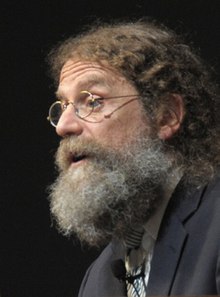
Dr. Robert Sapolsky, a neuroscientist and professor at Stanford studied what is called a Toxoplasma gondii parasite. It forms cysts in brain tissue that are shown to affect human behavior. People who have developed the cysts have shown symptoms of risk-taking behavior, and mental dysfunction like schizophrenia.

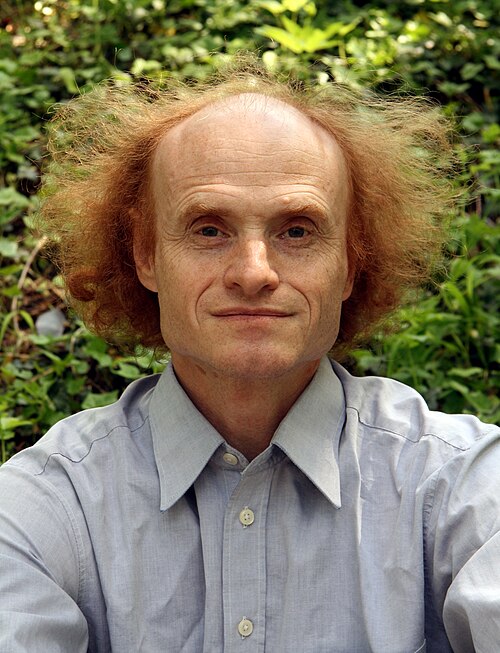
Dr. Jaroslav Flegr is a parasitologist, evolutionary biologist and professor of biology at the Faculty of Science, and professor at Charles University in Prague.

McAuliffe meets with a Czech scientist, Dr. Jaroslav Flegr, who conducted research showing the Toxoplasma gondii parasite in cat feces can infect the brain of a human being. The author meets other American research scientists that show how parasites infect animal brains whose behavior is affected in ways that are not natural to their species. A parasite being the source of a diseased brain has implications for treating mentally dysfunctional patients that may have a parasitic infection.

What McAuliffe’s book implies is the importance of washing one’s hands when handling pets, or their fecal material.

“This is Your Brain…” reminds one of the importance of hygiene when replenishing a bird feeder or filling an animal feeding trough to avoid possible parasites.

As most know, Kennedy is not a believer in vaccination despite a growing measles epidemic and the proof that vaccination works. McAuliffe does believe there are circumstances where a child crawling across the floor of a clean house gathers some immunity naturally but that un-common pathogens require uncommon vaccination.

Two other subjects mentioned by McAuliffe is natural and science made vaccinations and the benefits they provide humanity. This is a particularly timely suggestion considering Trump’s appointment of Robert F. Kennedy Jr. (a confessed anti-vaxxer) as the Secretary of Health and Human Services.

McAuliffe notes how research is showing how certain microbes can remove calories from food and how certain drugs can reduce hunger among overweight patients. She reflects on the intersection of microbiology and human health.

Another interesting examination by McAuliffe is the science research being done on gut microbiomes, a community of microorganisms in human digestive systems.

The research on microbiomes has resulted in effective weight loss drugs that have become popular medications for people struggling with weight gain.

“This is Your Brain on Parasites” is a bad book title but McAuliffe has written an interesting book about physical and mental health, and the treatments being researched in the 21st century.

HUMAN

What is the value of high IQ? If everyone was smarter, would they be happier? It seems the only real value of genetics is in the prevention of known diseases, not in improvement of IQs or creation of a perfect human being (whatever that is).

Books of Interest
 Website: chetyarbrough.blog

The Social Genome: The New Science of Nature and Nurture

By: Dalton Conley

Narrated By: Christopher Douyard

Dalton Clark Conley (Author, Princeton University professor, American sociologist.)

Dalton Conley offers a complex explanation of why one child intellectually and financially excels while others are left behind. The “Social Genome” is an attempt to explain the complexity and inadequacy of genetic research. Not too surprisingly, there seems a correlation between wealth and intellectual development, but its relationship includes familial and environmental nurturing in ways that are too complex for today’s science to measure.

FAMOUS WOMEN IN HISTORY (Many women are as intellectually strong and mentally tough as men, e.g.  Cleopatra, Sojourner Truth, Indira Gandhi, Golda Meir, Benazir Bhutto, Malala Yousafzai, and others.)

Dalton argues both genetics and environment shape human intellect and economic success. However, science’s current knowledge of genetic and environmental impact is not clearly understood in a way to aid human development. The current limitations of science make it impossible to determine the precise genetic and environmental factors that shape human development. Dalton offers many examples of how genetics and environment are relevant to human development, but neither are precisely measurable nor manageable.

The idea of clearly understanding the genetic and environmental causes of who humans become is a bit frightening.

Even if it were possible to achieve precise measurement of genetic and environmental influences, should that knowledge be used to create designer human beings?

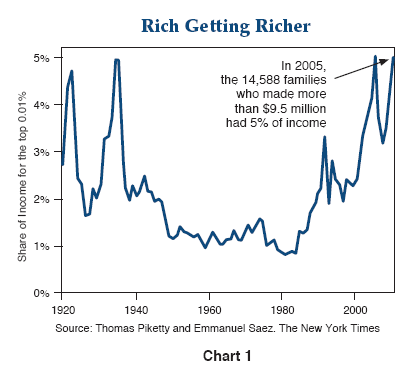
Piketty argues that the income gap widens after World War II.  He estimates 60% of 2010’s wealth is held by less than 1% of the population. 

Dalton does believe there is a correlation between economic well-being and IQ, but the correlation is affected by genetic inheritance. Dalton concludes economic well-being is a positive factor in IQ improvement. That raises questions about how one can improve the economic well-being of a society to improve IQ. Dalton infers there is no one size fits all solution for IQ improvement. Nurture and nature are too intimately intertwined to know how IQ of a society can be improved. A conclusion one may draw is that environmental and societal factors like human nutrition, general education and improved equal opportunity can mitigate IQ diminishment. Whether one should modify human genomes is a step too far.

In many ways, this is a frustrating book to listen to or read.

If all people looked more alike than different would there be less conflict in the world? No, but being of one race or another makes a difference in one’s opportunities in the world. What is the value of high IQ? If everyone was smarter, would they be happier? It seems the only real value of genetics is in the prevention of known diseases, not in improvement of IQs or creation of a perfect human being (whatever that is).

UNDERSTANDING SCIENCE

The immense downside of an unpredictive future is the many setbacks that will occur because of inept political leadership. Science is not an answer. It is only a tool for understanding.

Books of Interest
 Website: chetyarbrough.blog

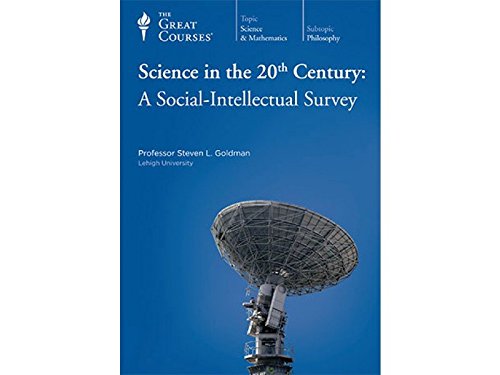
Science in the 20th Century (A Social-Intellectual Survey)

By: The Great Courses

Narrated By: Steven L. Goldman

Professor Steven L. Goldman.

Goldman’s review of 2oth century science identifies the fundamental change that has occurred in today’s perception of reality. One wonders if Albert Einstein was wrong about the predictability of science. Even at the end of Einstein’s life, he believed quantum mechanics was just a step in scientific research and not a basis for the truth of reality. Einstein insisted there was an undiscovered law about the nature of reality that would return life to predictability. The details of Goldman’s “Science in the 20th Century” infers otherwise.

Unpredictability of life’s existence is reinforced by Professor Goldman’s summary of scientific discoveries.

What is true of physics in the world, seems true for all the sciences. Whether reviewing the physical, biological, algorithmic, social, or applied sciences, unpredictability exists. Every science seems as unpredictable for the same reason as noted in the science of the quantum world. One cannot identity both position and momentum of an atomic particle at the same time. By the same measure, popularly elected representatives or authoritarian dictatorships cannot be measured by their position and direction of action. One can see a leader’s position but not measure their direction until the direction is past. Who would have thought Hitler would be the instigator of WWII? World leaders today are just as unpredictable. Citizens cannot measure leader’s positions and direction in advance. Citizens can only see one or the other at a specific point in time–never both position and direction at the same time.

What Goldman’s history of science implies is that if we live in a world of quantum mechanics, all life is, always has been, and always will be, unpredictable.

The solace in this possible truth is that, though there is still immense societal conflict and inequality in the world, science has improved society.

  • Technology has improved communication, transportation and daily life.
  • Vaccines, antibiotics, and surgical operations have drastically improved helath and life expectancy.
  • The world population has become more literate and has greater access to education than ever before.
  • Equality and justice show some progress in human rights, gender equality and social inclusion.
  • Enviornmental awareness has improved to combat climate change which has led to renewal energy innovations and conservation initiatives.
  • The world has increased connectivity to improve cultural exchange, economic collaboration and shared global interests.

Science is not an answer. It is only a tool for understanding.

The immense downside of an unpredictive future is the many setbacks that will occur because of inept political leadership. From the perspective of quantum mechanics, one hopes leadership means do not justify humanity’s end.

SCIENCE

Scientific discovery revealed the theory of evolution, the germ theory of disease, the laws of motion and universal gravitation, the theory of relativity, the discovery of DNA, drugs to cure disease, and quantum mechanics that imply future unpredictability. This is the daunting message of Goldman’s lectures.

Books of Interest
 Website: chetyarbrough.blog

Science in the 20th Century (A Social-Intellectual Survey)

By: The Great Courses

Narrated By: Steven L. Goldman

Professor Goldman received a B.S. Degree in Physics from Polytechnic University of New York and received a Master of Arts and PhD in Philosophy from Boston University.

Professor Goldman offers lectures on transformative scientific discoveries of the 20th century. He begins with great discoveries in physics by Newton, Einstein, Curie, Bohr, Planck, Heisenberg, Dirac and others who broaden a listener’s understanding of the universe, Earth, life, and humanity. He melds science into philosophy which gives a generalist an appreciation of genius and its limitations. From the limitations of microscopes, thermometers, spectroscopes, barometers, and galvanometers, Goldman draws lines between science’s experimentally reproducible facts and philosophy’s speculation.

Newton and Einstein had different understandings of the universe. Newton understood gravity as a force between two masses, subject to earth’s gravitation. Einstein redefined Newton’s gravity as a power exerted throughout the universe and between planets rather than one planet we call earth. Einstein proves the power of gravity is based on forces beyond earth though Newton’s interpretation is predictive of most physics’ phenomena on earth, it fails to predict the effects of time, space, and energy in the universe. Einstein’s discoveries lead to a theory of General Relativity where mass and energy are equal to each other and interchangeable. Newton viewed space and time as absolute while Einstein viewed them as relative. Newton’s physics were simpler to understand while Einstein’s required advanced mathematics that took into consideration the warping of space and time. To Newton, the speed of gravity was a constant while to Einstein, the only constant was the speed of light. To Newton two occurrences could occur simultaneously but Einstein recognized simultaneity is impossible. Any distance between the two occurrences will always be observed at the speed of light which means they cannot have happened at the same time because they cannot be in the same place. The speed of light controls the observation of action. Two occurrences cannot occupy the same space therefor they cannot happen simultaneously.

Professor Goldman explains the many utilitarian uses of great scientific discoveries from so many scientists that names become too numerous to be recalled.

However, without their discoveries, humanity would not have entered the age of Artificial Intelligence and the reality of information as an energy source in the world; not to mention the many scientific discoveries that have improved the lives of 8.2 billion people. (Another side of that story is the number of people killed by WMD, undiscovered cures for disease, and earth’s pollution by humanities use of known and yet to be known discoveries.)

Without fossil fuels, renewable energy, and nuclear power, humanity would still be living in caves, subject to nature’s choice. The importance of information is why we read books, listen to lectures, rely on remembrance of things past, and choose the course of our lives. As Shakespeare noted in The Tempest, “What’s past is prologue”.

Scientific discovery revealed the theory of evolution, the germ theory of disease, the laws of motion and universal gravitation, the theory of relativity, the discovery of DNA, drugs to cure disease, and quantum mechanics that imply future unpredictability. This is the daunting message of Goldman’s lectures.

MODERATION

Unless homelessness is addressed with affordable housing, America’s future looks bleak. A land of have and have-nots will grow to crush American prosperity.

Books of Interest
 Website: chetyarbrough.blog

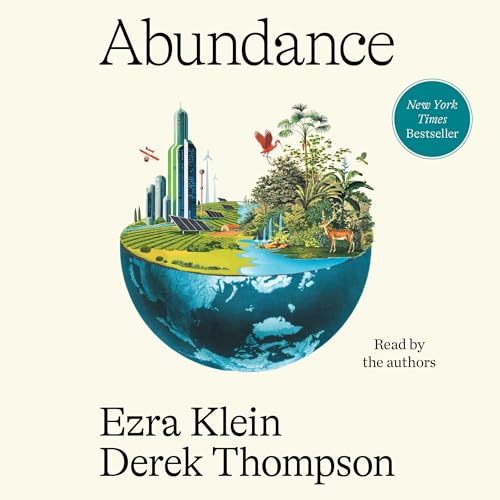
Abundance 

By: Ezra Klein, Derek Thompson

Narrated by: The Authors

These two young Americans offer an insightful view of politics and American government in the 21st century.

Klein or Thompson could have voted for either Trump or Harris in America’s last election. Their book argues American government is both a boon and bane for citizen “Abundance” in the 21st century. They note America has contradictory economic policies that have created great abundance among Americans while exacerbating inequality. Evidence for their opinion is growing homelessness, an immigration crisis, loss of manufacturing jobs, and government’s failure to creatively adjust public policies to provide solutions.

Those who have shared in the abundance of America have voted for candidates to preserve their privileges.

The authors note homelessness is a function of affordable housing that is denied by government policies that regulate zoning and construction requirements. Government policies make affordable housing too costly to build and impossible to locate because of zoning restrictions. The number of people living on the street is a self-inflicted American tragedy. Some of the homeless are young, some are old, some have mental or physical problems, and others are victims of drugs or their own weaknesses. What they have in common is unaffordable housing.

Historically, immigration has been a great boon to American economic growth.

Klien and Thompson note restrictive immigration policies have created obstacles for workers needed for manufacturing in key industries like agriculture, auto industry assembly, housing construction, and clean energy infrastructure. Rather than wasting money on building walls and deporting workers, the authors advocate immigration reform that meets the needs of American business. One can imply the authors meaning is that to “Make America Great Again” requires immigrants willing to work in agricultural and manufacturing jobs. The end of the baby boom requires help from immigrants to meet the needs of increased manufacturing and construction in the United States.

Some believe what Trump is doing is good for the American economy in the long run.

The criticism is that in the short run, the economy may collapse. Tariffs being used as a ham-fisted way of negotiating fair international trade is a fool’s errand. America needs labor and material in the short run to achieve equal and greater prosperity than it had in the 1970s. Added manufacturing will aid American prosperity, but it will be surpassed in the long run by automation. It is the automation race America needs to win or compete with to remain a world leader. Competing in that race depends on education, and scientific research. The irony is that Trump is firing government employees who have responsibility for public education, research, and funding that have been the engines of America’s prosperity.

The government employees discharged by the Trump administration to solely reduce costs is short sighted.

In the 1980s, 60% of basic research in the U.S. was funded by the government. In 2022 that funding dropped to 40%. Advances in semiconductors, global positions systems, biotechnology, and aeronautics were government-funded discoveries in the 1980s. American government-funded scientific research gave America the internet, GPS technology, mass production of penicillin, Space exploration, human genome project discoveries, and renewable energy innovations. The Department of Health and Human Services has lost 20,000 employees, the Department of Education 1,300, the National Oceanic and Atmospheric Administration 800, and the National Institutes of Health 1,200. One wonders how many of these employees may have been on the edge of scientific discoveries that could change the world.

The truth of “Abundance” is that America has caused many negative ecological impacts and aggravated the gap between rich and poor.

Klein and Thompson have written a provocative book. However, the truth of “Abundance” in America has caused many negative ecological impacts and aggravated the gap between rich and poor. Looking only to abundance does not address either social inequality or the environment. The NIMBY (not in my back yard) resistance to affordable housing aggravates inequality and increases homelessness. Unquestionably, higher density housing impacts the environment.

Klein and Thompson fail to address the increased power of corporations in America.

The 2010 Citizens United v. Federal Election Commission gave corporations the power to spend unlimited amounts of money on political campaigns. The influence of corporations on elections has disproportionate power in the election of government policy makers. That decision by the Court is a distortion of one person, one voter’s influence on public policy.

Aristotle emphasized the importance of “All things in moderation”. NIMBY communities must open their minds and hearts to homelessness and moderate their resistance to neighborhood accommodation. Government agencies must supervise and service higher density housing impacts wherever they are built and after they are completed.

Unless homelessness is addressed with affordable housing, America’s future looks bleak. A land of have and have-nots will grow to crush American prosperity.

SERVICE & PROFIT

Government is not a business for profit and should not be solely measured by its cost. America will survive the catastrophic mistakes being made by President Trump but American citizens, and the welfare of the world will suffer for years to come.

Books of Interest
 Website: chetyarbrough.blog

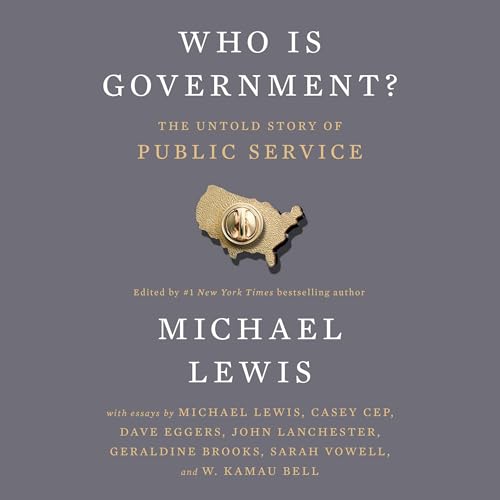
Who is Government (The Untold Story of Public Service)

By: Michael Lewis, Casey Cep, Dave Eggers, John Lanchester, Geraldine Brooks, Sarah Vowell, and Kamau Bell

Edited By: Michael Lewis

The stories of these writers are a tribute to those who have chosen careers in American government. Having personally earned a master’s degree in public administration, worked as a local government manager, then as a manager of a private business division, and finally, as a personal business owner, I have an opinion about President Trump. My experience is based on three different types of employment. All were rewarding experiences but in fundamentally different ways.

The writers of “Who is Government” show how ignorant business creators and managers like Donald Trump and Elon Musk are in discounting the contribution of employees of government organizations. Private corporations do not survive without profit to its owners. Public organizations do not survive without service to the public.

Profit is simple to measure. Public service is measurable but more abstract and difficult to quantify.

One can choose, like Musk did with Twitter, to reduce costs by firing employees. That may improve profitability but at a cost that may hurt or destroy the future of a business. In the case of Twitter, the company lost much of their advertising revenue because an unsupervised public forum could spread false and defamatory information that embarrasses advertisers who were protected by Twitter’ employees that were fired. No analysis was done by Musk about Twitter information’ controls provided by employees. The new entity, “X”, seems to have assuaged some advertisers’ concerns because they have started to use Musk’s new company. The point is that if Musk had taken more time to evaluate what fired employees were doing, he may have retained many of the advertisers who left the forum.

Trump’s employment of Musk to decimate the government employee workforce is following the same foolish path that was taken with Twitter.

No analysis of employee contributions is made. The goal is only to reduce government’ cost regardless of employee’ contribution to public need or service. The consequences have likely reduced health and welfare of American citizens; not to mention harm done to incomes of thousands of government employees’ families.

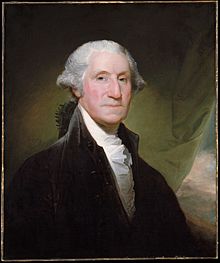
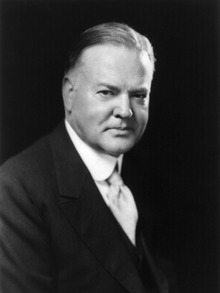
With exceptions of George Washington, Harry Truman, Carter, and the two Bush presidents, the worst former businessman that became President was Herbert Hoover who served as President before the greatest depression in America’s history. With Trump as President, one has to wonder whether he is leading America and the world toward its second great depression.

HERBERT HOOVER (31ST PRESIDENT OF THE U.S.)

“Who is Government” illustrates how government employees have contributed to the health and welfare of America. They are unknown and viewed by people like Trump and Musk as just a cost, without benefit to the public. How many science, medical, veteran, and welfare services are being decimated by their narrow vision of government management?

Government is not a business for profit and should not be solely measured by its cost. America will survive the catastrophic mistakes being made by President Trump but American citizens, and the welfare of the world will suffer for years to come.

TROJAN HORSE

Stanislas Dehaene’s research on the subconscious mind seems to reveal more about human weakness than strength. His research indirectly points to the danger of scientific discovery introducing subconscious human processing to machine learning.

Books of Interest
 Website: chetyarbrough.

Consciousness and the Brain  (Deciphering how the brain codes our thoughts)

By: Stanislas Dehaene

Narrated By: David Drummond

Stanislas Dehaene (French author and cognitive neuroscientist.)

This is the second review of Dehaene’s book. It was reviewed in 2017 with an essay titled “Consciousness”. A second look is informative because it is a complicated subject implying brain function might one day be replicated by machine learning. He suggested machine learning is a long way into the future but with quantum technology that future seems less distant.

To recall information and report meaning is a definition of what Dehaene calls consciousness.

The complicating part of that definition is the subconscious and its role in conscious awareness. Dehaene argues the subconscious is outside of our conscious awareness but is an integral part of decisions and human behavior. He implies if the brain can be precisely mapped, it can be translated to machine learning that will make the subconscious an explicitly known influence on thought and action.

The ramifications of what is subconsciously understood being a part of conscious decision making and action is both positive and negative.

Theoretically decisions and actions will be more accurate and routine tasks and habits can be more efficiently executed. Unconscious bias could be eliminated. On the other hand, the mental shortcuts of the unconscious in a machine-mind may cause stereotyping or overconfidence that elicits inappropriate or harmful thoughts and actions.

Replicating the conscious and unconscious mind by mapping the brain and transferring those human functions to machine learning seems like a Trojan horse that offers a pyric victory. Dehaene’s research on the subconscious mind seems to reveal more about human weakness than strength. His research indirectly points to the danger of scientific discovery introducing subconscious human processing to machine learning.

THE DISMAL SCIENCE

It appears to this listener/reader, the rise of authoritarianism in the world today lays at the feet of Marx and, to a lesser extent, von Mises’ economic theories.

Books of Interest
 Website: chetyarbrough.blog

Human Action: A Treatise on Economics

By: Ludwig von Mises 

Narrated By: Jeff Riggenbach

Ludwig von Mises (Austrian-American economist, logician, sociologist, and philosopher. 1881-1973, died at age 92.)

Economics is defined as a social science that studies how individuals, businesses, governments, and societies allocate resources to satisfy the needs and desires of a community of people. Historically, one of the greatest explainers of this social science is Ludwig von Mises. Maturing at a time of the communist revolution, the advance of capitalism and both world wars, von-Mises offers one of the greatest books about economics since Adam Smith. The only economist of greater significance is Adam Smith (1723-1790) because of his origination of the principles of economics. Close behind are Karl Marx (1818-1883), and John Maynard Keynes (1883-1946).

Of course, all economists are beholding to Adam Smith with his original conception of the dismal science. Smith conceived of the “invisible hand” of economics that postulated self-interest as the primary contributor to the overall good of society. Von Mises seems to guardedly agree but suggests self-interest’ market pricing can artificially distort distribution of economic resources. Von Mises infers the “invisible hand” is inefficient at the least and may artificially distort prices in the hands of authoritarian governments and business monopolies. Karl Marx suggests the invisible hand would evolve into a production system that would be owned by the public to ensure equality of distribution in an evolutionary economy that passes from capitalism to socialism, and finally communism. Marx argues self-interest will evolve into a common interest for all. Marx’s idea of change in the nature of human beings beggars the imagination.

Smith supported limited government intervention to maintain justice, defense, and public works.

Both Smith and Marx believed in a “labor theory of value” which argues the value of a commodity is determined by the labor required to produce it. Where Smith and Marx depart is in government enforcement of a balance between labor and the cost of goods. Von Mises opposed most forms of governmental intervention in the economy. However, Keynes argues government intervention is necessary during economic downturns. After WWII, Keynes theory became an important part of the American government’s support of European reconstruction.

Von Mises believed in human individualism which carries the risk of authoritarian domination.

Von Mises believed in human individualism while Smith and Keynes support limited government intervention. Marx argues human nature could be shaped by a melding of government dictatorship with societal pressures to support communal goals.

At extremes, von Mises endorses individualism and Marx endorses dictatorship. The middle ground seems held by Adam Smith and John Maynard Keynes that endorse limited government intervention. It appears to this listener/reader, the rise of authoritarianism in the world today lays at the feet of Marx and, to a lesser extent, von Mises’ economic theories.

The length and value of von Mises’ book overwhelms a non-economist listener with his esoteric statistical and lengthy explanations of economic theory. However, comparison with a dilatant’s understanding of other renown economists is enlightening.

MARS & BEYOND

Mahaffey is a supporter of nuclear energy and its potential for earth’s energy needs. He argues fission can be made a useful source of energy while fusion research holds the best opportunity for humanity’s future.

Books of Interest
 Website: chetyarbrough.blog

Atomic Adventures (Secret Islands, Forgotten N-Rays, and Isotopic Murder-A Journey into the Wild World of Nuclear Science.)

By: James Mahaffey

Narrated By: Keith Sellon-Wright

James Mahaffey (Author, Research scientist at Georgia Tech Research Institute)

“Atomic Adventures” is a reminder of the race for the atomic bomb, its wide pursuit by nations of the world, and research for the holy grail of atomic fusion. Mahaffey’s science explanations are tedious for non-scientists, but his history of the secrets and use of atomic energy are interesting and surprising.

The United States, with the help of the UK, may have been first to acquire the atom bomb in 1945, but eight more nations acquired it by 2006.

United States: Acquired in 1945.

Russia (formerly the Soviet Union): Acquired in 1949.

United Kingdom: Acquired in 1952.

France: Acquired in 1960.

China: Acquired in 1964.

India: Acquired in 1974.

Israel: Believed to have acquired in the late 1960s, though it maintains a policy of deliberate ambiguity.

Pakistan: Acquired in 1998.

North Korea: Acquired in 2006

It is somewhat ironic that Pakistan did not acquire the atom bomb until 1998 when Pakistan’s “father of the bomb”, Abdul Qadeer Khan, became a rich man by selling technological know-how of the bomb to nations like North Korea, Libya, and Iran.

Abdul Qadeer Khan

Abdul Qadeer Khan (1936-2021, father of Pakistan’s atomic weapons program, died at age 85.)

As a singular discovery, Einstein’s E = mc² offered a dual opportunity for the world, i.e., destruction and/or survival of the human race. The bomb suggests destruction while nuclear fusion offers an inexhaustible energy source that could reverse global warming and rocket human beings to other worlds.

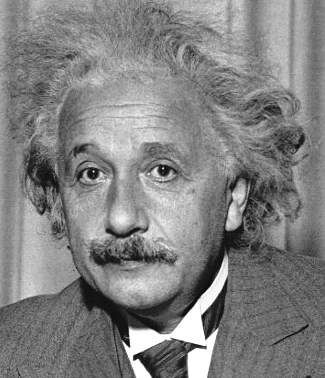
ALBERT EINSTEIN (1879-1955, died at age 76.)

Mahaffey explains the immense potential of nuclear power as a principal source of energy. History shows nation-state and political conflicts may spin nuclear power out of control to kill millions and devastate the environment. On the other hand, nuclear research and power offer avenues for humanity’s survival and longevity.

Mahaffey notes there were Japanese, as well as better known German scientists, who were working on the creation of a nuclear bomb that could destroy Allied armaments and combatants. The rush to weaponize radiation during WWII surprisingly includes research being done by Japan as well as Germany during WWII. America won the research race because of superior human and financial resources that could be marshalled to complete the scientific research and experimentation needed to perfect a nuclear weapon.

Mahaffey explores the creation and destructive history of the atom bomb.

Surprising to some listeners, Mahaffey explains Argentina’s significant effort to increase its research and development of nuclear power after WWII. Argentina created the National Atomic Energy Commision in 1950. The chief researcher, hired by President Juan Perón, was Ronald Richter (1909-1991), an Austrian-born scientist who headed their plan to create a fusion power facility. Richter fails but nuclear energy remains an important part of Argentina’s history. In the 1960s they built their own research reactors and by 1974 built their first fission nuclear power reactor, Atucha I. By 1984, they had two heavy-water reactors with Atucha I and Atucha II.

Ronald Richter (1909-1991, Austrian-born German who became an Argentine citizen who headed up the Argentine Huemul Project to create a nuclear fusion power plant. He failed, despite the millions of dollars spent to build and rebuild fusion power plants.

Image result for ronald richter

Yoshio Nishina (the father of modern physics research), Bunsaku Arakatsu, and Masatoshi Okochi created the so-called Ni-Go and F-Go projects to develop an atom bomb. They did not get beyond the laboratory stage because of a lack of resources, the exigency of war, and the complexity of nuclear technology. The energy of nuclear power, as shown by history, is two edged.

Yoshio Nishina (1890-1945, the father of modern physics research during WWII.)

Image result for medical use of nuclear energy

On the other nuclear radiation can heal the sick

and potentially provide a clean renewable energy source.

Mahaffey explains how research in fusion can go awry. In a news article, two chemists reported in 1989 that fusion was created in their experiment by involving heavy water (deuterium oxide) and palladium electrodes. They reported excess heat production that they believed was nuclear fusion. As with all scientific experiment, their results had to be confirmed by other scientists testing of their results in the same experiment. Mahaffey, in his role at the Georgia Research Institute, was asked to replicate the experiment. Using the same tabletop experiment, Mahaffey initially confirmed Fleishmann’s and Pons’ findings. However, no other table-top experiments found the same results. What Mahaffey finally found was that the neutron counting device that was recording increased heat was the actual source of the heat increase, not the chemical interaction between heavy water and palladium electrodes. Further research is being conducted but the U.S. Department of Energy concluded in 2004 there is no convincing evidence to support cold fusion. Tests are still being done but Mahaffey infers that research is a scientific dead end. Mahaffey and a colleague tried again in a basement of his colleague’s house to try a similar experiment and failed.

NASA's Mars rover Perseverance landing: Everything you need to know | Space

Nuclear power has the potential to revolutionize interplanetary travel. The higher efficiency and power, particularly with the perfection of fusion, will shorten travel times and make trips to Mars and beyond more feasible.

Mahaffey explains how communication will be a challenge when interplanetary travel becomes common. The distance to other planets or galaxies will impede communication because of the limits of the “speed of light”. However, the solution may lie in quantum entanglement’s experimental proof found by Clauser, Aspect, and Zellinger. The complexity of entanglement makes the theory unprovable at the time of Mahaffey’s book.

In theory, quantum entanglement suggests information (communication) may be instantaneously transmitted across galaxies without the limitations of the speed of light.

Mahaffey goes on to explain the risk of radiation in a chapter about a “dirty bomb”. Security measures used to protect the public from radiation leaks make thieves believe something valuable is being secured by government laboratories. Thieves will steal these secure containers only to find they are risking death by opening their booty. Additionally, Mahaffey notes radioactive material is often disposed of illegally and irradiates innocent people who own dump sites that received inadequately contained radioactive material.

Mahaffey is a supporter of nuclear energy and its potential for earth’s energy needs. He argues fission can be made a useful source of energy while fusion research holds the best opportunity for humanity’s future.

BELIEF

Extending Harari’s idea of biophysics research and algo-rhythmic programming suggests a potential for immense changes in society. A singularity that melds A.I. with human brain function and algo-rhythmic programming may be tomorrow’s world revolution. Of course, that capability cuts both ways, i.e., for the good and bad of society.
Books of Interest
 Website: chetyarbrough.blog

Homo Deus (A Brief History of Tomorrow)

By: Uval Noah Harari

Narrated By: Derek Perkins

Yuval Noah Harari (Author, Israeli medievalist, military historian, science writer.)

By any measure, Yuval Noah Harari is a well-educated and insightful person who will offend some and enlighten others with his opinion about religion, spirituality, the nature of human beings, and the future. He implies the Bible is a book of fiction that is historically proven to have been written by different authors with contradictions that only interpreters can reconcile as God’s work.

“Homo Deus” is a spiritual book suggesting humanity is on its own and has a chance to survive the future but only through the ability of human understanding and effort.

To Harari, the greatest threats to society are national leaders who believe in God, heaven and eternal life who discount human existence and use of science to improve human life on earth. The irony of Harari’s belief is that humanist leaders are the only hope for human life’ survival.

Harari argues science, free enterprise, and the growth of knowledge offer the best hope for the future of human life.

Neither capitalism nor communism are a guarantee of survival because of the increasing potential for error as human beings become more God-like. Advances in engineering, artificial intelligence, and biotechnology may replace the happenstance of human birth. The value of free enterprise is evident in the agricultural, industrial, and technological revolutions of history. However, as science improves the understanding of the mind and body of human beings, the technology of biogenetics offers hope for the future while running the risk of biological error with unforeseen consequences.

Harari’s book is the brave new world written about by Shakespeare in the 17th century and reimagined by Aldous Huxley in his 1932 dystopian novel “Brave New World”.

On the one hand, Shakespeare offers a positive spin as his character, Miranda, sees people from outside her experience and says “How beauteous mankind is! O Brave! That has such people in’t”. While Huxley notes a future society that becomes conformist and lacks individuality and human emotion. Which way society will turn is unknown.

The conformist demands of collective ownership of property and means of production by communism impede creativity. Capitalism is more creative and dynamic. However, capitalist incentive raises the specter of human nature that only sees financial gain without any concern for environmental or human cost. On balance, capitalism appears more likely to accelerate technology because communism more often follows than changes scientific direction.

The growth of knowledge comes from science and exploration of the unknown, but its use can be destructive as well as constructive.

Some think A.I. will lead the world to greater knowledge and prosperity while others believe it will destroy human life. A sceptic might suggest both views are wrong because A.I. is only a tool for recalling knowledge of the past to help humans make better decisions for the future. The real risk, as it has always been, is human leadership.

Harari believes, like Nietzsche, that God is dead because belief in God is losing its power and significance in the modern world.

Though many still believe in God, it seems more people are viewing God as a myth. The Pew Research Center reports a median of 45% of people across 34 countries still believe in God. However, the variation is wide with Brazil saying 70% believe while in Japan the percentage is only 20%. Harari implies belief in God is in decline.

Harari explains biophysics illustrates that human thought is algorithmic. He argues our thoughts, decisions, and behaviors can be understood to be a result of patterns created in human brains that are pre-determined. There is no “free-will” in Harari’s opinion. This is not to suggest aberrant behavior does not exist, but that human thought and action is determined by our experientially defined brain in the same way a computer is programmed. Experience from birth to adulthood is just part of a mind’s programming.

Harari implies understanding of brain function will change the world as massively as the Agricultural, Industrial, and technological revolutions.

Harari goes on to suggest humans have never been singular beings, but a multitude of beings split into two brains that mix and match their biogenetic and biochemical programming to think and act in pre-determined ways. Experiments have shown that the way the left half of a human brain sees and compels action is different than how the right brain sees and compels action. Each half thinks and acts independently while negotiating a concerted action when both halves are functioning normally. That negotiation between the two brain halves results in an algorithm for action based on the biochemical nature of the brain. The way two halves of the brain interact multiply the person we are or will become.

Extending Harari’s idea of biophysics research and algo-rhythmic programming suggests a potential for immense changes in society. A singularity that melds A.I. with human brain function and algo-rhythmic programming may be tomorrow’s world revolution. Of course, that capability cuts both ways, i.e., for the good and bad of society. Interestingly, Harari paints a grim picture of the future based on an A.I. revolution.