“Confront and Conceal” is a depressing examination of the American Presidency.
Books of Interest Website: chetyarbrough.blog
“Confront and Conceal“
By: David Sanger
David Sanger (Author, American journalist for the New York Times, Harvard graduate. Co-winner of 3 Pulitzer Prizes.)
David Sanger offers a journalist eye view of the first four years of the Obama Administration in “Confront and Conceal”. The most impactful impression a reader gets of a U.S. presidential office is that it is a difficult and complex job. Sanger’s observations imply the best a voter can hope for in electing a President is that he/she is a good student of the politics of life and government. Sanger shows Obama has the skill of both while the President who follows only understands the first and cares nothing about the second. This is not to suggest Sanger shows Obama as a perfect President but that his skill in governing far exceeds his successor.
Obama eschewed American intervention in foreign governments but inherited American presence in Iraq and Afghanistan.
At the same time, the American economy was in free fall. A mortgage crisis was born from the greed of human nature. The cure for the mortgage crisis is initiated by the Bush administration. However, like many Presidents before, American foreign government intervention plagues Obama throughout his tenure.
The horrible consequence and resolution of the mortgage crises fell largely on the poor in America.
The rich generally escaped its devastating impact because they had the resources to cash out debts carrying rising interest rates. An estimated 861,664 families lost their homes to foreclosure. The lending institution’ managers who approved loans to the poor on false pretenses were largely forgiven for their greed. Obama’s administration succeeded in stabilizing the American economy, but the fairness of the process is grossly inequitable.
With the exception of the first Bush’s invasion of Iraq, American military intervention in foreign governments has been a failure in every circumstance since WWII.
One might argue this is less true in the case of Korea but the continued belligerence of North Korea and foreign relations conflicts with China and Russia are a direct result of past American military interventions. Obama attempts to improve relations with China but is unsuccessful. Sanger shows that lack of success is because of suspicion of America’s past history and because of a belief that Obama is simply trying to isolate China’s influence in the world. Russia’s invasion of Ukraine speaks for itself. It will ultimately fail but at the consequence of many lost Russian and Ukrainian lives.
“Confront and Conceal” is no pean to the Obama administration. It is a revealing examination of a well-educated and prudent President who wishes to do what is best for America but is trapped by history and human nature.
Obama, like all 21st century Presidents, has the power to kill individual human beings by remote control and direct covert actions that can and do have unintended consequences. Obama is the first President to wheel the power of drone death to eliminate enemy combatants. Even though Obama martials western powers to participate in the overthrow of the Libyan government, Quaddaffi is not given a trial but murdered by rebel Libyan forces. Libya remains a failed government in search of stability. The idea of an incompetent and revengeful elected President of the United States with the power of drone murder is frightening.
“Confront and Conceal” is a depressing examination of the American Presidency because it shows a decent and intelligent President is only slightly better than an incompetent, dishonest, and poorly educated human being like Donald Trump. President Obama’s biggest contribution to America is in providing better health care for the poor but even that is being challenged by his successors.
Appelbaum infers no American President has found the magic formula for balancing the needs of its citizens with the concept of Adam Smith’s free enterprise.
Books of Interest Website: chetyarbrough.blog
“The Economists’ Hour: False Prophets, Free Markets, and the Fracture of Society“
By: Binyamin Appelbaum
Narrated by: Dan Bittner
Binyamin Appelbaum (Author, winner of a George Polk Award and a finalist for the 2008 Pulitzer Prize, lead writer on economics and business for The New York Times Editorial Board)
Binyamin Appelbaum has written an interesting summary of a difficult but immensely important subject. Economic policy and theory are boring, but they touch every aspect of life. Appelbaum shows economic policy magnifies or diminishes the welfare of every American, let alone every economy in the world.
Adam Smith’s foundational theory of economics.
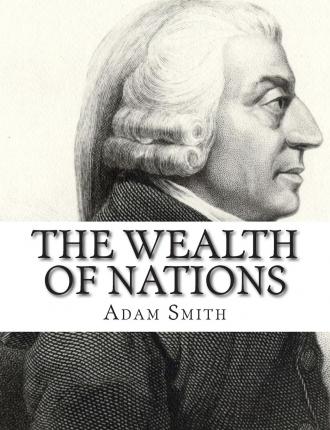
Though only briefly mentioned by Appelbaum, American economic policy begins with Adam Smith (1723-1790), the Scottish philosopher who wrote “The Wealth of Nations”. Smith advocated free trade and argued against parochial maximization of exports and imports that is manipulated by strict governmental regulation meant only to accumulate gold and silver.
JOHN MAYNARD KEYNES (1883-1946, CONSIDERED FOR NOBEL 3 TIMES FOR DIPLOMACY BUT NEVER AWARDED.)MILTON FRIEDMAN (1912-2006, 1976 NOBEL PRIZE FOR ECOOMIC SCIENCES.)
Appelbaum illustrates how American policy violated the entrepreneurial freedom that Adam Smith advocated. In contrast to Smith, John Maynard Keynes (1883-1946) advocates government intervention whenever there is an economic downturn. Equally interventionist is Milton Freidman’s (1912-2006) belief that government should increase or decrease the money supply for national economic stability. The point seems to be that every economist thinks they have a magic bullet that will cure the ills of a faltering economy.
To be fair, Friedman did believe in free enterprise in regard to nation-state currencies. He argued for a floating currency rate that ultimately led to President Nixon’s abandonment of the gold standard. However, the nature of human beings led to speculation and manipulation of nation-state’ currencies that exacerbated trade tariffs and defeated the policy’s free-enterprise objective.
FRANKLIN ROOSEVELT (32ND PRESIDENT OF THE UNITED STATES, INTHE DEPRESSION, BANKS FAILED, UNEMPLOYMENT AND POVERTY SKYROCKEDTED.GEORGE W. BUSH (43RD PRESIDENT OF THE U.S. 3 MILLION JOBS LOST IN THE 2001 RECESSION)
One concludes from “The Economists’ Hour…”, there is no magic solution for an economy in crises. Neither Franklin Roosevelt, George W. Bush, Barack Obama, or any American President cured what ails an American economy that succumbs to economic crises. Adam Smith would argue an economic crisis is caused by a governments’ interference with free enterprise.
Applebaum explains how every 20th and 21st century President of the United States placed their faith in economists’ economic assessments of their day. All Presidents have found intervention by the government has unintended consequences.
President Nixon adopted Freidman’s monetary policy by imposing a freeze on prices and wages that squeezed the life out of the business economy and beggared the wage-earning public with job loss.
A decade of stagflation (high inflation and slow growth) followed Nixon’s administration. Stagflation is attacked by the Reagan administration with mixed results. A myth from economists like Arthur Laffer grew in 1974. Laffer believes taxation is either too high or too low for any benefit to society. Laffer argued zero tax and maximum taxation are equally harmful and produce economic stagnation and/or collapse.
ARTHUR LAFFER (American economist and author, served on President Reagan’s Economic Policy Advisory Board 1981-1989, Here illustrating the “Laffer Curve”.)
Laffer argued every government that reduces tax revenue decreases the stimulative effect of government spending. On the other hand, he suggested every tax cut increases income for taxpayers that will stimulate business and increase employment while encouraging higher production. He laughably created the “Laffer curve” to imply there is an optimum balance of tax reduction that would stimulate economic growth with proportionate increases in government revenue to provide for better government services. That balance has never been found. President Ronald Reagan experimented with Laffer’s idea, but it fails from unintended consequences. The principal consequence is to increase the gap between rich and poor.
BENEFIT OF TAX REDUCTION
Reagan accelerated a movement for government tax reduction that ultimately reduced income taxes from 70% to 28%. The result of government tax reduction during the Reagan years increased the U.S. budget deficit from $78.9 billion to $1.412 trillion. The benefit of that tax reduction went to the wealthy while school lunches were cut, subsidized housing declined by 8%, and poor families lost $64 a month in welfare payments. In 2023, the budget deficit stood at $1.70 trillion, an imbalance that shows why the “Laffer curve” is sardonically laughable.
President Reagan’s administration (1981-1989) was influenced by Laffer’s curve.
The joke is “There is no perfect balance on the curve because of the nature of human beings.”
Roosevelt, George W. Bush, and Obama choose to follow Keynesian policy. Roosevelt bloated government employment. All three increased the government deficit.
Some suggest the idea of “Cost benefit analysis” (CBA) is recommended to the federal government by two law professors, Michael Livermore and Richard Revesz during the George H. Bush administration but Reagan initiated it with an Executive Order in 1981.
Appelbaum notes that “cost benefit analysis” for government is first used during the administration of Ronald Reagan. However, Bill Clinton reifies its use with an Executive Order in 1993 that required covered agencies to do a CBA on “economically significant” government regulations. Ironically, Clinton was the first President in the post 19th century to balance the budget. Andrew Jackson manages to do it in his term between 1829 and 1837.
An irony of using “cost benefit analysis” is that it required a determination of of a human life’s value. Presidents Nixon, Ford, Carter, and future Presidents use value per statistical life during their administrations. High-income earners were worth $10 million to $15 million, middle-income earners $1 million to $2 million, and low-income earners $100,00 to $200,000. Of course, these values were always litigable. The point is that CBA became a tool for government to regulate the costs of government policies, ranging from military expense to the health, safety, and welfare of American citizens.
The remainder of Appelbaum’s book reflects on the experience of America, Chile, and Taiwan in the 20th century. The implication of his review of economic policy is that those countries that align with the free enterprise beliefs of Adam Smith have made mistakes. However, America’s, Chile’s, and Taiwan’s economic policies seem to have had more economic success when following Smith’s beliefs.
No American President has found the magic formula for balancing the needs of its citizens with the concept of Adam Smith’s free enterprise.
Along with CBA, Appelbaum notes the ongoing controversy is about regulation by government when it tries to balance American health, education, and welfare with Adam Smith’s concept of free enterprise. Appelbaum infers no American President has found the magic formula for balancing the needs of its citizens with the concept of Adam Smith’s free enterprise.
Contrary to Leonhardt’s optimism, whether the American power structure continues to shift toward a more equitable treatment of the poor remains to be seen.
Blog: awalkingdelight
Books of Interest Website: chetyarbrough.blog
“Ours Was the Shining Future”
By:David Leonhardt
Narrated by: Dan John Miller
David Leonhardt (Author, journalist and columnist, writes “The Morning” newsletter for the “New York Times”, received a BS from Yale in applied mathematics in 1994.)
David Leonhardt writes an encomium to Democratic Capitalism in “Ours Was the Shining Future”. Some of what Leonhardt writes will make conservative Americans gag while liberals will tend to praise his view of American history. The hot button issues of 21st century America are immigration and the rising gap between rich and poor.
“Dallas, Texas, United States – May 1, 2010 a large group of demonstrators carry banners and wave flags during a pro-immigration march on May Day.”
Leonhardt’s selected historical facts argue that immigration has a cost to America that is mitigated by its contribution to the economy by second and later generation immigrants. He resurrects John F. Kennedy’s oft quoted phase about America as “A Nation of Immigrants”. Leonhardt argues the rising gap between rich and poor accelerated with the election of Ronald Reagan and subsequent tax and spend decisions made by later government administrations.
The difficulty one may have with Leonhardt’s reporting is that historical facts do not speak for themselves.
It is the power of Leonhardt’s persuasion rather than the facts of history (and one’s own prejudices) that make a credible argument for
(1) the benefit of unionization in America,
(2) the benefit of intervention by the Franklin Roosevelt administration during the depression,
(3) the aggressive tax reduction for high income earners with government overspending (beginning with Ronald Reagan) that negatively affected the American economy and disproportionately increased the gap between the rich and poor, and
(4) the monumental economic benefits from second generation immigrants like Sundar Pichai (CEO of Google), Indra Nooyi (former CEO of PepsiCo), Elaine Chao (the U.S. Secretary of Transportation under Trump), and Lin-Manuel Miranda (the creator of the Broadway musicals “Hamilton” and “In the Heights”), and others.
Leonhardt recounts the history of the union movement in America that evolved into a political power that improved the income and lives of the working poor.
He touches on the corruption of the union movement but on balance suggests more good than bad came from its representation of labor. Leonhardt argues the decline of unionization and tax policy changes in the late 20th century increased the gap between rich and poor.
Leonhardt argues immigration needs reform and infers it should begin with acceptance of an estimated 340,000 children (dreamers) born in the U.S. to unauthorized immigrants.
He suggests new immigration should be limited to immediate relatives of legal immigrants that presently live in the U.S. He reiterates the value of second-generation immigrants while acknowledging the burden borne by the economy with first generation immigrants. New immigrants generally have a language deficiency, greater education needs, and a willingness to work at jobs for lower pay than non-immigrant workers who also need jobs.
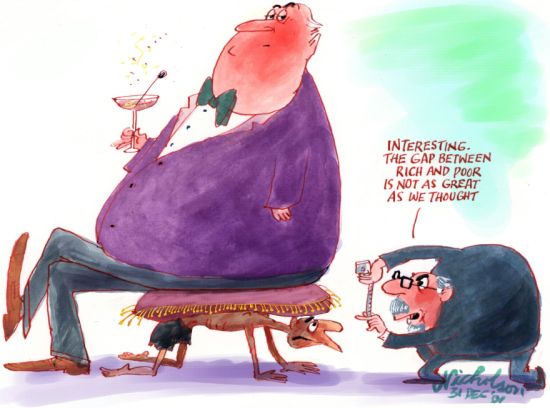
Leonhardt suggests the gap between rich and poor is a function of an unequal distribution of political power.
Leonhard believes improvement is coming from a resurgent union movement and an evolving recognition by both conservatives and liberals of the consequence of inequitable tax treatment that favors the rich.
There is some evidence to support Leonhardt’s belief in a power shift with the recent union actions in automobile, teacher. and nursing services strikes that increased their income. Minimum wages have risen in 22 states that have affected an estimated 10 million workers. The highest are in California ($16), Massachusetts ($15.75), and Washington ($15.50).
However, one is inclined to be skeptical about income gap reduction with Trump’s Presidency that further reduced taxes on the rich and Biden’s reluctance to act on tax inequality.
Leonhardt receives a Pulitzer Prize for Commentary, the Gerald Loeb Award for excellence in reporting on business, finance, and the economy, a New York Time Book Review Editors’ Choice award, and The Atlantic’s Ten Best Books of the Year for the most notable and influential book of the year. These are nice academic rewards but whether Leonhardt’s arguments are anything more than a finger in a dike, near a breaking point, is yet to be revealed.
Contrary to Leonhardt’s optimism, whether the American power structure continues to shift toward a more equitable treatment of the poor remains to be seen. The continued popularity of Trump among conservatives is disheartening and suggests otherwise.
In the 21st century, actions and policies of one nation are not local. Like a ripple in water, the world can be changed by one stone thrower.
Blog: awalkingdelight Website: chetyarbrough.blog
Crashed: How a Decade of Financial Crises Changed the World
By: Adam Tooze
Narrated by: Simon Vance, Adam Tooze
Adam Tooze (British Author, Historian, professor at Columbia University, Director of the European Institute.)
“Crashed” is a book about the 2008 financial crash. Though it is old news, Adam Tooze offers historical perspective and a cautionary tale about America, the E.U., China, India, Russia, Spain, and other nations of the world. Interconnectedness is greater now than any time in history. The surprising realization in Tooze’s analysis of the financial crash is that America caught a fiscal infection like Covid19, and it spread across the world.
These securities were purchased and re-sold among big banks, wealthy investors, and investment houses. The lax oversight of the quality of the combined mortgages led to a cascade of bank and investment house failures that nearly collapsed the world financial system.
Though the western world was more directly affected by purchases of these mortgage packages, countries like China, Russia, South Korea, Ireland, Spain, and Greece were severely, if not equally, impacted.
Nations’ financial crises were not solely because of purchases of these mortgage packages but because of world economic interconnectedness. Nations of the world, as users of energy and product purchases, quit buying. At the same time, Tooze notes the American dollar was hoarded by some countries for protection from devaluation of local currencies. With America’s financial crises, the dollar became a source of devaluation rather than protection.
China chose to invest in domestic infrastructure projects like dams, high speed rail, and bridges. China chose to increase product production (at lower labor costs) for the worldwide market. In contrast, Russia reinforced kleptocracy, before, during, and after the 2008 crisis, by rewarding Russian oligarchs who became a wealthy and powerful cadre of supporters of the government. With favored treatment of the oligarchs, Vladimir Putin recognized he had the power to act as he wished whether it was in the best interest of Russian citizens or not. (This is similar to the repressive reign of Kim Jon-un who spreads the wealth of his nation on a relatively small cadre of North Korean protectors while many citizens live in poverty.)
Ben Bernanke (American economist, 14th chairman of the Federal Reserve.)
In America, Tooze deconstructed the complicated negotiation process between banking industry independence and federal government oversite by the Obama administration. The range of disagreement is from nationalization of the banking industry to a direct bailout of overextended banks. Though the government bluntly accused banking executives of overpaying themselves for the mistakes they made, Obama and Geitner recognized the importance of industry independence in making complicated decisions to get America out of its financial ditch. The decision is made to bailout the banks. The American government loaned enough money to banks and select companies to maintain American lenders’ and industries’ liquidity.
Timothy Geithner (Former central banker, 75th U.S Secretary of the Treasury under President Obama.)
In order to stabilize the economy, 320 billion euros were lent to Greece by the European Union and the IMF. As of 2019, only 41.6 billion had been paid back to reduce that debt. The E.U. and IMF imposed austerity measures that principally hurt the poor by reducing retirement pensions and employment opportunities. Greece fell into a recession that lasted until 2017. The poor became poorer because of pension reductions and loss of jobs. (Full repayment of the 320-billion-dollar loan is not expected until 2060.)
Tooze tells a similar story about Spain. The 2008 crises caused a 3.6% reduction in GDP in 2009. Spain’s response was similar to Greece’s in that the poor were more likely to have been hurt than the rich because of implemented austerity measures that reduced public spending, and job creation that impoverished a wide swarth of society.
The final chapters of Tooze’s history severely criticizes the rise of Trump and his extremist rhetoric about helping the working poor when in fact he is only interested in himself, his power, and his wealth. Tooze implies Trump uses American belief in free speech, and the power of public office to distort the truth of immigration, poverty, and equality to mislead the public. Historically, this is not a new American phenomenon but in this technological age, the damage political leaders can inflict on the public is multiplied.
In explaining the impact of the 2008 financial crises, Tooze shows how one nation’s actions and policies can roil the world. In the 21st century, actions and policies of one nation are not local. Like a ripple in water, the world can be changed by one stone thrower.
Mandela’s biography and today’s conflict between Hamas and Israel makes one ask oneself–Is a tenuous and ephemeral peace worth the death of innocents?
Audio-book Review By Chet Yarbrough
Blog: awalkingdelight Website: chetyarbrough.blog
Long Walk to Freedom
By:Nelson Mandela
Narrated by: Michael Boatman
Nelson Mandela, (1918-2013, Died at age 95, South African anti-apartheid activist and politician, President of South Africa 1994-1999)
Nelson Mandela’s autobiography details the life of a remarkable and important leader of South Africa’s revolt against apartheid. Mandela began as a pacifist resister of white repression. However, his autobiography shows a change in belief from passive resistance to violence. (Mandela’s evolution from pacifist to belief in violence for social change is a reminder of the evolution of Malcolm X , the rise of the Black Panthers in America, and the Hamas and Israeli conflict in Palestine and Israel.)
Factions of the world today, like Mandela’s thought and action in the mid-20th century, believe in the utility of violence and terror for social change. The state of Israel, the territory of Gaza, and many countries of the world, like India, Lebanon, Iran, Hong Kong, Sudan, Libya, America, and others have political factions that believe they can change their societies with violence and terror. The conundrum of violence and terror is whether they proffer social gain or loss. The truth of gain or loss from violence and terror is being tested by the Hamas faction of Palestine and the conservative followers of Netanyahu in Israel.
The likelihood of a young African boy raised in a small village becoming President of South Africa beggars the imagination.
Mandela’s autobiography explains how it happened. There are 11 officially recognized tribes in South Africa. Mandela was born into the Thembu royal family, a subgroup of the Xhosa people. He explains his father, though not literate or formally educated, is a leader in his village. Mandela notes that his father had four wives and travelled between villages to spend time with each wife. When his father was away, his birth mother took care of him, but his father, as well as his mother, seem to have had great influence on his life. Mandela tells of walks with his father and the conversations his father has with other village members that mold Mandela’s beliefs and ambition in life.
Mandela notes his mother guides him to an important change in his life. When his father dies, his mother moves to a bigger village where he comes under the care of a regent of the Thembu tribe.
Mandela is effectively adopted into the royal Thembu family and moves into their palace. His ambition seems stimulated by that association and inspires him to become a formally educated South African.
Mandela receives a BA degree from Fort Hare in Alice, South Africa in 1943. He studied law at the University of Witwatersrand in Johannesburg. At that time, Mandela did not receive a law degree but was able to practice law because of a two-year diploma in law as an add-on to his BA. (When imprisoned, he studies, passes his University of South Africa’ law classes, and receives an LLB in 1989.) Mandela chooses to use his two-year diploma in law to become an advocate for Black liberation in South Africa. After graduation and his beginning practice of law, he is counseled by some to abandon politics to avoid arrest and intimidation by the government. However, Mandela chooses to join the African National Congress (ANC) in 1943. He becomes the co-founder of the youth league of ANC in 1944.
FORT HARE COLLEGEUNIVERSITY OF WITWATERSRAND
In his early ANC years, Mandela emphasized passive resistance like that practiced by Mahatma Gandhi in India. ANC had been formed in 1912 as a South African native congress but grew to become a multi-racial organization including all races and ethnic groups in South Africa. Mandela notes that the communist party was interested in being part of ANC’s role in liberating South Africans from apartheid. Mandela expresses reservation about the CPSA (the Communist Party of South Africa) but acknowledges its help in raising funds for an ANC army that was to be organized by Mandela as a militant resistance force to overcome apartheid. CPSA influence and ANC association became a part of the movement.
As a politician, Mandela had no experience in armed resistance. It is interesting that he is chosen to form the first ANC terrorist cell.
Mandela grows to believe political recognition requires violent resistance but also a personal ability to persuade others to join the ANC’ movement either financially or physically. Mandela is trained in Ethiopia by Col Fekadu Wakene on how to plant explosives and manage a volunteer army.
Col Fekadu Wakene taught South African political activist Nelson Mandela the tricks of guerrilla warfare – including how to plant explosives before slipping quietly away into the night. (BBC Africa by Penny Dale)
Ironically, Mandela is arrested in 1961 after only one action by his gathered volunteer army in December 1961. Whether the action is at the order of Mandela is not revealed but the resistance blows up an electricity sub-station. Mandela is arrested and serves 27+ years in prison for organizing the volunteer army which became known as Umkhonto we Sizwe (Spear of the Nation). Three years of trial led to a guilty verdict.
Mandela was arrested and charged with high treason along with his collaborators. The Rivonia Trial turned Mandela into a symbol of the struggle against apartheid.
The last chapters of Mandela’s autobiography is about his incarceration on Robben Island and Pollsmoor Prison and the conditions of his imprisonment. While in prison, Mandela continues his education to become a licensed attorney.
In the first two years at Robben Island, Mandela and his co-conspirators are restricted to their cells. Methodist religious services were eventually allowed but sermonizing about reconciliation offended Mandela and his fellow prisoners. Though much of what some ministers preached were offensive to the imprisoned, Mandela approves of one minister who looks at his religion through the lens of science as well as faith.
ROBBEN ISLANDPOLLSMOOR PRISON
Mandela and his co-conspirators remain at Robben Island for 18 years before being transferred to Pollsmoor Prison in Cape Town. This is a significant improvement in their incarceration because of cell accommodations and food quality. However, his co-conspirators are separated from Mandela. Mandela is released in 1990, over 29 years after arrest.
Mandela explains a door is opened to the government of South Africa by Kobie Coetsee (1931-2000, died at age 69), the South African minister of justice and prisons.
In 1985, Botha was President of South Africa. Botha offered release to Mandela if he would unconditionally renounce violence against the government. Mandela refused and Botha denied Mandela’s release.
When F. W. de-Klerk became President of South Africa, after being Minister of National Education, a possibility for Mandela’s release was reopened.
Later, Mandela negotiated with de-Klerk to have his co-conspirators released from Robben Island and Pollsmoor. Further, Mandela negotiated with de-Klerk to have South Africa’s apartheid policies eliminated. President de-Klerk agreed, and Mandela was released in 1990. Both de-Klerk and Mandela receive the Nobel Peace prize for their negotiated peace agreement.
The last three-hour section of Mandela’s autobiography is about freedom and Mandela’s election as President of South Africa. The price of peace is high because violence seems a requirement for good-faith negotiation between opposing parties. Mandela’s biography and today’s conflict between Hamas and Israel makes one ask oneself–Is a tenuous and ephemeral peace worth the death of innocents?
(There is a brief interview with the author who aided Mandela in completion of his autobiography. It took two years of interviews and research to complete Mandela’s story.)
The flaws of society are only magnified by the surreptitious use of private information. McCarten shows human self-interest is unlikely to change in a surveillance driven society. As long as human self-interest revolves around money, power, and prestige, private information should be protected.
Audio-book Review By Chet Yarbrough
Blog: awalkingdelight Website: chetyarbrough.blog
Going Zero: A Novel
By:Anthony McCarten
Narrated by:Marin Ireland
Anthony McCarten (Author, New Zealand writer and filmmaker.)
Anthony McCarten creates a fictional story that fits today’s truth about a brave new world revealed by Aldous Huxley in 1932 and reinforced by George Orwell in 1949. https://chetyarbrough.blog/2019/09/08/2-2-makes-5/ The striking revelation and threat in “Going Zero” is that our human desire for recognition drives society to accept the intrusion of government and big business into our lives. The popularity of the former company Twitter, today’s Reddit, internet users, and ubiquitous mobile phone’ users show how addictive recognition has become to the young and old. That need for recognition conflicts with the right to privacy. McCarten shows how important and harmful right to privacy’s loss can become.
McCarten offers a clever story that reveals the danger of unrestricted access to citizen’ information. A highly profitable private tech company offers $3,000,000 to any one of ten pre-selected contestants that can be undetected by a software company’s private surveillance program. A private tech company gains the cooperation of the federal government to use their data base and surveillance technology to help find these ten contestants within a 30-day period. The tech company’s software can mine government’ data and use government’ surveillance equipment to track private citizens. The program is called “Going Zero”. The purported reason for cooperation of the government is to protect citizens from society’s bad actors. The tech company’s interest is in getting a muti-billion-dollar contract for their proprietary software.
Added to McCarten’s fine story is the mystery of a disappeared but unacknowledged agent of the C.I.A. The one person that successfully beats the “Going Zero” contest is the agent’s wife. She only enters the contest to expose the government’s information about her husband.
Both government and business believe they use personal information to serve the public. Government and big business subtlety influence society to believe private information is public information. Government argues knowledge of private information protects society. Big business argues collection and use of private information offers material, social, and/or psychological rewards to the public.
Capitalism is not the problem in America. It is the failure of the S.E.C., the FBI, C.I.A., the President, and congressional legislators to do their job.
A contrary argument is that government and big business would be able to program society by using private information to reward citizens like Palov’s dogs. The questions one may ask oneself: Can bad actors really be identified before they rob, steal, rape, and murder? What are the ramifications of a business that uses private information to tap into subliminal desires of the public? “Going Zero” offers an example of how private information collected by government and big business are a threat to society.
Anthony McCarten’s story shows how important it is to protect personal privacy.
The flaws of society are only magnified by the surreptitious use of private information. McCarten shows human self-interest is unlikely to change in a surveillance driven society. As long as human self-interest revolves around money, power, and prestige, private information should be protected. If there is a counter argument, I would like to hear it.
Detroit manages to restructure their debt with the help of its citizens. Greece is caught in the grips of E.U.’ and IMF’ bureaucracy that only increases its debt.
Audio-book Review By Chet Yarbrough
Blog: awalkingdelight Website: chetyarbrough.blog
Adults in the Room (My Battle with the European and American Deep Establishment)
By:Yanis Varoufakis
Narrated by:Leighton Pugh
Yanis Varoufakis (Author, Greek economist and politician, Minister of Finance of Greece for 7 months in 2015, launched Diem25, the “Democracy in Europe Movement 2025” in February 2016.)
Yanis Varoufakis gives listeners a glimpse of decisions made when a national government is compelled to declare a national debt crisis. To fairly understand “Adults in the Room”, one will struggle with Varoufakis long story. His story is about restructuring rather than refinancing the debt owed the E.U. and IMF for a national debt crisis. Restructuring debt changes terms of repayment based on an original debt, while refinancing increases the debtor’s burden.
It is helpful to have listened to a book about Detroit’s bankruptcy. Detroit’s harrowing experience gives some idea of how difficult it is for a government entity to repay creditors for profligate government economic management. Detroit manages to restructure their debt with the help of its citizens. Greece is caught in the grips of E.U.’ and IMF’ bureaucracy that only increases its debt.
Varoufakis’ argument for understanding the plight of society’s poor is highly relevant in this era of democracies’ homelessness and economic inequality.
Varoufakis acknowledges socialist beliefs while inferring a negative opinion about capitalism. Varoufakis professes strong belief in democracy with a pronounced lean toward socialism, i.e., a belief similar to America’s Bernie Sanders who is mentioned in “Adults in the Room”.
Varoufakis notes that Greek, like American society, is unequal with rich and poor being disproportionately benefited by intended and unintended government and economic policy.
Greek government’s effort to compensate for inequality seems couched in an economic system meant to equalize citizen inequity with a pension system designed to compensate the poor for economic inequality. A poorly managed national economy and a weakly enforced tax collection system compounds Greek government failure to live within its means.
When Greece declares a sovereign debt crisis, the European Union and the IMF (International Monetary Fund) provide a credit lifeline of $9.5 billion to avoid a default on a previous bailout.
This so-called lifeline is contrary to what is requested by Varoufakis who becomes the Minister of Finance for Greece. The benefit of restructuring the debt provides liquidity to the Greek banking system without theoretically damaging credit worthiness of either the E.U. or IMF. On its face, it seems a win-win solution for Greece’s debtors and Greece’s citizens. However, the E.U. sees it as a dangerous alternative that fails to address the root causes of Greece’s profligate behavior. The E.U. demands control of all economic expenditures of the Greek government in return for a bail-out of past debt with a larger tranche of new debt. Financial control of Greece’s use of the new funds is to be exercised by a triumvirate representing the debt holders.
Varoufakis asks that Greece’s original bailout debt be restructured as a long-term bond with reduced payments over a long period of time, with payment size largely determined by Greece’s liquidity in a recovering economy.
In contrast, the demands of the E.U. and IMF are that salaries and pensions be cut, government employees’ pensions frozen, and retirement age raised. Those measures disproportionately hit the poor, destroy jobs, do nothing to improve tax receipts, and make it more difficult for Greece to pay its debt; not to mention the strict control of all expenditures by an external triumvirate of debt holders.
With these draconian rules, Varoufakis notes unemployment improves. However, the economy is estimated to be 25% smaller; not to mention the impact of the external triumvirates’ control reduces living standards, pensions, and salaries of the working poor.
The point of Varoufakis’ story is that the E.U. and I.M.F.’s mandated terms victimizes the most vulnerable Greek citizens trying to make a living.
Varoufakis resigns after 7 months in office after unsuccessfully fighting the onerous and inequitable demands of the E.U. and IMF. In some listener’s opinion, some may suggest Varoufakis abandons the poor, but his story suggests the decision of the controlling triumvirate of the E.U. and IMF rendered his continued role as Minister of Finance a virtual joke. Varoufakis is unable to change the E.U. and IMF board’s inflexible rules. Greece’s Minister of Finance cannot achieve a delay in their demand for restructuring the Greek’s debt to correct a poorly managed tax system and weak economy that victimizes the most vulnerable citizens of Greece.
For listeners of “Adults in the Room”, one wonders where wealthy Greek citizens were when Varoufakis tries to pull Greece out of its financial ditch.
Unlike the book about Detroit’s bankruptcy, there seems no appeal to rich citizens of Greece and a method for using Greece’s historical art and artifacts to collateralize a more equitable bail out for its people. Where were the Greeks who could afford to pay their taxes? Where were the art and antiquity foundations that could have aided in the negotiations with the E.U. and the I.M.F.? The historic art and monuments of Greece are an international treasure, particularly for western culture.
In retrospect, Varoufakis’s idea of restructuring the debt seems brilliant but there seems no time is allowed for Varoufakis to organize a response that could change the mindset of the members of the E.U. and IMF decision makers. As a “Monday morning quarterback”, Varoufakis’s idea would have carried more weight if he had gathered support from wealthy Greek merchants and art foundation entities that could have created a repayment sweetener to seal his loan restructuring idea. However, it appears there was not enough time for Varoufakis to gather enough support to make a case for debt restructuring. The triumvirate controlling the purse strings of the bailout would not wait.
Listeners owe a debt to writers like Varoufakis who are willing to tell their stories, whether right or wrong. In fairness to Varoufakis, it is easy to retrospectively review his actions to save the Greek economy.
At best, one concludes, restructuring Greece’s debt was a great idea that could have achieved a decent compromise for its lenders. On the other hand, one wonders what the leaders of Greece were doing when the repayment crises first began to show itself.
There were undoubtedly some powerful and rich Greek leaders who could have come to the aid of their country in this 21st century “time of need”. One is reminded of the heroic defense of Greek citizens in Crete when Nazis invaded their strategically located island. Where were the descendants of the many great Greek heroes of antiquity?
Gorbachev freed the Russian economy and Putin capitalized on that freedom. However, both reached beyond their grasp and damaged Russia’s standing in the world.
A History of Russia: From Peter the Great to Gorbachev
By: Mark Steinberg, The Great Courses
Narrated by:Mark Steinberg
Mark David Steinberg (History Professor at University of Illinois specializing in the cultural, intellectual, and social history of Russia.)
Professor Mark Steinberg’s history of Russia is an informative tour of Russian history that gives some context to the perplexing, contradictory, and murderous behavior of Vladimir Vladimirovich Putin. Though Steinberg’s history focuses on Tsarist Russia, a little research reveals why Putin argues Ukraine is historically a part of Russia.
Russia is an ancient nation that reaches back to the year 862.
The northern and southern lands were combined in 882 by Prince Oleg of Novgorod upon the seizure of Kiev in what is today the capital of Ukraine. Kiev becomes the capital of the combined lands. Eastern Christian religion is adopted from the Byzantine Empire by Russia in 988. Upon the Mongol invasion in 1237-1240, Russia’s size diminishes, and Russia’s capital moves to Moscow.
The first leader to be titled Tsar of Russia is Ivan the Terrible in 1547.
Ivan IV (Called Ivan the Terrible’s visage is forensically reconstructed by Mikhail Gerasimov)
Ukraine emerges as a nation in the mid-18th century, but large portions of the country remain under the control of Russia.
It is not until 1991, that Ukraine’s independence is recognized by America, Poland, and Canada.
Steinberg’s history addresses the time of Peter the Great through Mikhail Sergeyevich Gorbachev. What one hears from the lectures is the vacillation of Russian leadership from Europeanization to de-Europeanization. The primary interest of non-aristocratic Russians is in the political principle of socialism.
Autocracy is a common thread in Steinberg’s history of Russia. However, beginning with Peter the Great, that thread is frayed by changes that modernize Russian government management of its citizens. It remains autocratic but recognizes the country is behind Europe in its economic and cultural improvement.
Tsar Peter the Great (As Tsar from 1682 to 1721, Pyotr I Alekseyevich leads Russia as a harsh autocrat with the goal of defeating Ottoman and Swedish control of the Sea of Azov and the Baltic.
Steinberg explains Peter the Great’s objective is to create a new Russia by replacing its traditionalist and medieval social and political systems with enlightened public policies. He plans to modernize Russia by promoting education and industrialization. His objective is to emulate and compete with European modernization. The Russian Academy of Science and Saint Petersburg State University are founded in 1724. Peter the Great creates a governing Senate in 1711 and other institutions to improve the administration of the Russian autocracy.
Peter the Great dies unexpectedly and fails to designate an heir to the throne. Succession founders for several years with little progress toward modernization until Catherine II becomes Catherine the Great, empress of Russia from 1762 to 1796.
Catherine the Great II (Born 1729, dies in 1796 at age 67.)
Catherine the Great marries the grandson of Peter the Great who died months after becoming Emperor of Russia. Catherine the Great is of the same mind as Peter the Great in modernizing Russia. New Russian cities, universities, and theatres are created by Catherine the Great. With the help of fellow nobles, Grigory Orlov and Grigory Potemkin, and Russia’s generals of that time, Russia expands their territory and continues its Europeanization. Western philosophers like Voltaire become friends of Catherine the Great.
After Catherine the Great, her son Tsar Paul I takes control of the Russian government. Steinberg characterizes Paul I as a despotic ineffectual leader who projects an authoritarian and patriarchal image and reverses many of the liberal policies initiated by Catherine the Great. He is assassinated by the elite guards of the Russian military and his son, Alexander I, becomes Tsar.
With the rise of education, Steinberg explains the creation of what is called the “intelligensia”, a class of younger Russians interested in social change. Some were largely self-educated like Vissarion Belinsky, the son of a rural physician and Nikolai Gogol, born into the Ukranian family gentry (a class below aristocracy). Others were from the aristocratic class like Alekasndr Pushkin.
From left to right, Belinsky, Gogol, Pushkin–associated with the Russian Intelligesia in the early and mid-19th century.
Alexander I (reigned 1801-1825) is described by Steinberg as a leader of two minds that on the one hand reestablishes many of the reforms of his grandmother, Catherine the Great.
On the other hand, Steinberg suggests Alexander I resists revolutionary movements that were roiling Europe during his reign. Alexander, I joins Britain in 1805 to defeat Napoleon Bonapart. Alexander switches sides and forms an alliance with Napoleon in the Treaty of Tilsit in 1807. However, in 1810, Alexander abandons Napoleon over disagreement on Polish territory. Napoleon’s invasion of Russia in 1812 is a disaster for the French and Russia gains territory in Finland and Poland.
Nicholas I (Reign 1825-1855, Grandson of Catherine the Great.)
Serfdom is a troubling social problem in Russia that is acknowledged by Catherine the Great but not resolved until after an 1861 decree for abolition by Alexander II. Though Catherine and Allexander II are not related, it is Alexander II who initiates what Catherine the Great recognized as the iniquity of Russian inequality. Though it is many years before the reality of abolition of Serfdom is truly addressed, Alexander II is the first to begin its reversal. His predecessor, Nicholas I did nothing to eliminate serfdom and in fact tried to re-establish aristocratic privilege.
Mid-day meal for peasants in 1860s Russia
Inequality in Russia, just as is true in America, remains a work in progress. Steinberg offers more detail of Russia’s drive toward modernity, but the next great change is of course the revolution of 1917. Steinberg explains Russia’s growing interest in socialism and its conflict with patriarchal rule. He notes the two major factions that wished to change the course of Russian history. One is the Bolshevik movement. The other is the Menshevik movement. But, before we get to 1917, it seems the 1904-1905 Russo-Japanese war is important because of its relevance to Putin’s decision to invade Ukraine.
The last Tsar of Russia is Tsar Nicholas II. Nicholas II’s reign is from 1894 to 1917, after which his entire family is murdered by Bolshevik revolutionaries.
A precursor to the 1917 revolution is the 1905 uprising of Russian citizens who are unhappy with Tsar Nicholas II’s leadership. Growing inflation, poverty and hunger, a defeat in the Russo-Japanese War, and widespread discontent lead to a revolt. A workers demonstration leads to “Bloody Sunday”. An estimated 1,000 to 4,000 Russian citizens are murdered by Russian soldiers.
Of particular interest is the loss of the Russo-Japanese war. Both Russia and Japan want warm-water ports in the Pacific Ocean. A port that served that purpose is on the Korean peninsula, either off Manchuria or Korea. Tsar Nicholas’s inept management and the superior military actions of the Japanese defeat Russia.
The relevance of that defeat is the position Putin has put the Russian government in with the invasion of Ukraine. The question is whether Ukraine will be as successful as Japan in defeating Russia. The west must ask itself whether they have a dog in this fight or let Ukraine bear the brunt of an unjust war.
The exclusiveness of being a member of Lenin’s red party undoubtedly aided the ultimate success of the revolution because it required committed enforcers to rally the Russian people.
Steinberg explains Lenin clearly understood that authoritarian force would be required for communist’ socialism to succeed. The future of the revolution became dependent on a leader like Stalin who exemplified a party member that understood the importance of authoritarian command. The test of that truth comes in 1924 when Lenin dies from a brain hemorrhage.
Joseph Stalin (1878-1953, died at age 74, ruled Russia from 1929 to 1953.)
Authoritarian leadership, with its history of competent and incompetent Russian Tsars, is not new to the Russian people. With an improved education system in the 18th century, Steinberg explains even the intelligentsia accepted authoritarian rule. Adding to Russian’ acceptance of authoritarian rule is the belief that something had to change because life in Russia during Tsar Nicholas II’s rule is abysmal for the majority of Russian people.
Mikhail Gorbachev (1931-2022, died at age 91. Ruled the U.S.S.R. from 1985-1991 and served as President of Russia 1990-1991.)
Nearing the end of Steinberg’s lectures, the rise of glasnost with Mikhail Gorbachev is addressed. Between the death of Stalin and the rule of Gorbachev, 5 men ruled the U.S.S.R. Gorbachev wishes to keep the U.S.S.R. together but fails. His failure, in part, seems related to Steinberg’s history. Rather than glasnost, the U.S.S.R. seems to have needed a more authoritarian leader. Not in the sense of repression but in a demand to keep the U.S.S.R. together until the government’s effort at reform has time to be enacted. America had a civil war to prove it is one nation. That may have been a possibility with a more authoritarian Russian leader but that appears not to have been in the nature of Mikhail Gorbachev.
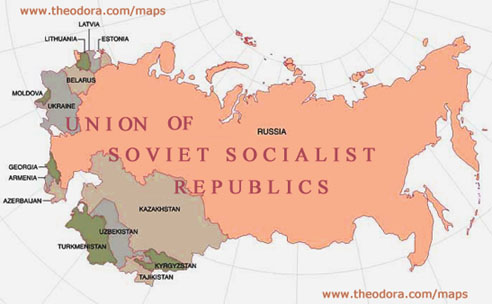
The U.S.S.R. dissolves in 1991. Since that dissolution, Russia has occupied some of the eastern territory of Ukraine and Crimea.
Though Steinberg does not fully address Vladimir Putin in his history of Russia, he sets the table for understanding why a reader/listener might think there is no way out for Vladimir Putin. The history Steinberg suggests Putin in one sense is the perfect transitional leader of the territorially reduced Russia. The firm hand of a secret police officer, with 16 years’ experience as a former KGB agent, and a position as Deputy Mayor of St. Petersburg’s seems an apt formula for success for a future President of Russia. Putin did well in his first years as President of Russia but seems to have made a career, if not life ending, error in his invasion of Ukraine.
Steinberg illustrates how Russia’s leaders range from enlightened to repressive managers of government. At different times in history, that management style served Russia’s economy and citizens, sometimes well and sometimes poorly. It is up to Russian citizens to decide which government actions and leaders best serves their needs.
From a western perspective, both Gorbachev and Putin served Russia well.
Nathan Bomey (Author, reporter at Axios, former writer for USA Today and the Detroit Free Press.)
Why is Detroit’s bankruptcy relevant to any American who does not live or plan to live in Detroit? The answer is–Nathan Bomey’s history of Detroit’s “…Bankruptcy…” defines American Democracy.
The story of Detroit’s bankruptcy exemplifies American Democracy’s strengths and weaknesses.
American Democracy’s strength is shown by Detroit’s recovery from bankruptcy in less than a year and a half. On the one hand, Democracy’s weakness is shown by the arrest of its corrupt Detroit Mayor, Kwame Kilpatrick, who is convicted for racketeering and theft that results in a 28-year prison sentence. (Compounding that weakness is the oft indicted and vilified American President, Donald Trump, who commutes Kilpatrick’s sentence after 7 years of his 28-year sentence.)
Kwame Kilpatrick (Mayor of Detroit 2002-2008.)
Detroit’s debt reaches back to Coleman Young’s tenure as Mayor of Detroit; not because of theft or malfeasance but because of the desire of the mayor to make Detroit better. Coleman is characterized as a polarizing figure whose combativeness endeared him to blacks but riled some white Detroit residents. Some suggest Young is unfairly judged by his detractors.
Coleman Young (Mayor of Detroit 1974-1993, Born in 1918, Died in 1997 at the age of 79.)
Young was the first African American to lead a major American city (the fifth largest city in America at that time). He completed a number of public works like the Renaissance Center, the Detroit People Mover, and the Joe Louis Arena.
The Americans pictured below come from many different walks of life, with Republicans, Democrats, Independents, racial, religious, and ethnic differences. They are charged with a responsibility to heal broken promises between American citizens and their local government. The following pictures are only a partial list of “movers and shakers” showing the diversity of Americans who martialed settlement of an $18 billion dollar debt to achieve the goal of getting Detroit out of bankruptcy.
U.S. BANKRUPTCY JUDGE STEVEN RHODESMARIAM NOLAND, PRES. OF THE COMMUNITY FOUNDATION U.S. DIST.JUDGE GERALD ROSENGOVERNOR OF MICHIGAN RICK SNYDERKEVYN ORR, BANKRUPTCY ATTORNEY APPT. BY GOVERNOR SNYDERRIP RAPSON, PRES. OF THE KRSGE FOUNDATIONANDY DILLON,MICHIGAN TREASURERGRAHAM BEAL,DIRECTOR OF THE DETROIT INSTITUTE OF ARTSALBERTO IBARGüEN, PRESIDENT OF THE KNIGHT FOUNDATIONSHIRLEY LIGHTSEY, PRES. OF THE DETORIT RETIRED CITY EMPLOYEESHEATHER LENNOX LEAD JONES DAY BANKRUPCY LAWYERDARREN WALKER 10TH PRES.OF THE FORD FOUNDATION
The city of Detroit filed for Chapter 9 bankruptcy on July 18, 2013, with a city approved plan on November 7, 2014. That plan paves the way for its exit from bankruptcy. Chapter 9 is a form of bankruptcy that only applies to American local governments because of their continuing responsibility for public service while declaring bankruptcy. It is similar to a Chapter 11 bankruptcy, but a local government’s reorganization requires a state-appointed oversight board to review actions by the reorganized government body. The difference between Chapter 11 and Chapter 9 is that Chapter 11 eliminates an enterprise while Chapter 9 leaves a government jurisdiction in place because of its continuing public responsibilities (the provision for the health, safety, and welfare of its citizens).
Bomey’s history infers no one could have done more than the middle-aged attorney, Kevin Orr, in his management of the Detroit bankruptcy. Orr is a successful bankruptcy attorney in the Jones Day legal firm who agrees to leave the firm to manage Detroit’s fiscal crises through what promises to be a complicated and difficult bankruptcy. Orr’s ability to gain support of the governor of Michigan, Rick Snyder is the beginning of a partnership to save the motor city. These two men set the table for a “…Resurrected” Detroit.
DETROIT
Chapter 9 is a complicated process because it involves so many assets and liabilities that have to be reconciled while continuing care for local government’s citizens. This is the job taken by Kevin Orr. In addition to a city’s physical assets and their maintenance, Orr is the responsible managing agent for Detroit’s underfunded and poorly staffed services. Both working and retired employees of Detroit expect to be paid for present and past work for the city. The money needed to carry out that responsibility requires everyone to take a financial “haircut”. The magnitude of responsibilities in a city of 639,000 residents and thousands of pension-dependent former employees seems impossible. All of Detroit’s citizens and pensioners are at the mercy of a judicial system and Orr’s administration, over which they have no control and limited influence. Bomey explains how Orr’s impossible task is systematically accomplished with the help of Americans coming from nearly every ethnic, religious, and racial category in America.
Settlement of Detroit’s bankruptcy is approved by U.S. Bankruptcy judge Steve W. Rhodes on November 12, 2014.
The city would receive $194.8 million from the state of Michigan over a period of 10 years to help fund the city’s pension system. (a bail out approved by the Governor, Rick Snyder)
The city would issue $1.28 billion in bonds to pay off its creditors. (Pennies on the dollar.)
The city would transfer control of its water and sewer department to a regional authority .
The city would create a nine-member financial review commission to oversee its finances for at least 13 years.
The Detroit Art Collection would remain intact without jeopardizing an estimated value of over a billion dollars.
The settlement is no bed of roses for past and present Detroit employees or for investors and banks that financed Detroit’s former mishandling of government business. Pensions were cut by 4.5% with eliminated future cost-of-living adjustments and steep reductions in medical coverage for citizens who are the least likely to be able to afford an income reduction. Both UBS and Bank of America had to right off much of their loans to Detroit. Bond holders had to settle for pennies on the dollar.
Bomey’s history of the Detroit bankruptcy shows human freedom, within the framework of rule-of-law, releases the great strength of human diversity and creativity. Without freedom, diversity, and creativity Bomey shows how and why governments fail, i.e., either sooner or later. That is the lesson of Bomey’s history of “Detroit Resurrected”.
Walter Russell Mead (American Author, Professor of Foreign Affairs and Humanities at Bard College, taught American foreign policy at Yale.)
Walter Russell Mead hardens the consequence of race and creed in the history of the modern world. Mead offers a biblically influenced history of human progress in “The Arc of a Covenant”. One cannot diminish the value of human diversity, but Mead implies millions who were murdered, maimed, or imprisoned in history have paid a price for human progress. Mead suggests the greatest price paid is by Jews who were largely abandoned by Franklin Roosevelt’s America and imprisoned, gassed, and murdered in WWII.
Despite America’s decisive role in WWII, largely orchestrated by Franklin Roosevelt, Mead suggests President Truman’s actions to end the war and gain the peace shine as brightly as the social programs created by his predecessor.
As is widely known, the Ark of the Covenant carried two stone tablets that were given to Moses by God that contain the Ten Commandments.
Mead implies these commandments were adhered to by Truman more than any President before or after his presidency. He notes that despite Truman’s lack of a college degree and inexperience as a politician, he utilized the universal values of the ten commandments to guide America out of war into a peace meant to reinforce the “…Covenant” given to Moses by God. It is clear from Mead’s history, that Truman did not do it alone, but he led the effort with the support of his predecessors, direct reports, and successors.
As the 33rd President, Truman re-engaged the U.S. in internationalist foreign policy, adopted Kennan’s recommendation of containment of U.S.S.R. during the Cold War, passed the Truman Doctrine that helped eliminate the communist threat in Greece and Turkey, responded to the Berlin Wall crises with the Berlin Airlift, and passed the $13 billion dollar Marshall Plan to aid Western European recovery after WWII. Truman also ended racial segregation in the Armed Services, and established the NSC, the CIA, and the NSA.
In America, Henry Cabot Lodge and evangelist, William Blackstone, were two predecessors to Truman that martialed American opinion to support the Balfour proposition of Englishman Arthur Balfour who recommended support for a Jewish homeland in Palestine. To an evangelist, one presumes the motivation is biblical belief in the prophecy of Armageddon that is to occur in the Middle east with the return of Jesus Christ to save believers in the faith. Lodge supports Zionism (a 19th century plan for a Jewish homeland in Palestine) as the Chairman of the Senate Republican Conference from 1918 to 1924.
In 1946, Palestinians refuse to agree to a separate Jewish homeland in their country. They would only agree based on a one state solution where Jews would be a minority in a Palestinian controlled state. The consequence of that refusal is to diminish the territorial control of the Palestinian people.
Mead notes the British walked a fine line between their need for oil from the Middle East and their effort to fulfill the promise of the Balfour agreement.
The conflict between Jews and Palestinians is initially controlled by the British military when the Jewish settlements first came to Israel. In the end, the British need for oil is greater than their continuing act as arbitrator for the Palestinian/Jewish conflicts.
The British decide to turn the conflict over to the United Nations which was formed in 1945 as a replacement for the League of Nations.
Though this body is meant to resolve international conflicts, it has five permanent members that have veto powers over its policies. They are China, France, Russia, the UK, and the US. Russia for a short time supports an independent Jewish State but becomes a notorious abuser and murderer of Russian Jews during the Stalinist years.
By a slim margin, with Stalin’s real-politic support, a UN resolution is passed to create a Jewish state in Palestine.
Stalin’s goal is to drive a wedge between Western powers like the UK and the US by supporting the resolution. The UK needs Arab oil even at the expense of the Balfour plan and the UN resolution. In enforcing the partition, Mead notes Truman is caught between the jaws of Cerberus guarding what is the hell between Arab states and a boundary line for Israel.
Mead explains Eleanor Roosevelt is a major force in politics of the U.S., particularly after the death of President Roosevelt.
She supports the UN resolution and expects the American government to enforce its implementation. In 1948, Mead notes Truman plans to enforce the UN resolution with the American military, if necessary, which is not popular with some American leaders and U.S. voters.
Mead illustrates how America aided Israel in its early formation, but notes Israel grew strong on its own. After the end of the Cold War, the world enters a Cold Peace. Mead drops a cultural bomb on his readers by noting America’s role as western world savior morphs into western world goat. Mead infers that transmogrification is the base upon which Donald Trump is elected. He suggests the fall of the U.S.S.R. seemingly created a bed of roses but turned into a crown of thorns.
Mead suggests America in in a post-cold-war era. America’s left-wing support of Israel is now Right-wing support.
Deregulated growth of the economy is a causal factor in the widening gap between rich and poor. 9/11 destroyed America’s self-confidence by suggesting America cannot protect itself, let alone spread democratic values in the world. American power emulates authoritarian government with slogans like “Make America Great” with an underlying disregard for foreign relations and world peace. Mead suggests there is a growing loss of faith in American government.
It is sad to think how vilified and unfair history has been to such a small ethnic minority.
What seems glaringly obvious in Mead’s “too long” story is the immense contribution Jews have made to the United States. As a small minority, their contribution to the world outstrips any ethnic group in this dilatant’s flawed memory. Mead gives some perspective to that realization.