HUMANITY’S TRIAL

Audio-book Review
 By Chet Yarbrough

Blog: awalkingdelight)
 Website: chetyarbrough.blog

The Earth Transformed: An Untold History

By: Peter Frankopan

Narrated by: Peter Frankopan

Peter Frankopan, (Author, Professor of Global History at Oxford University, Director of the Oxford Centre for Byzantine Research.)

Peter Frankopan journeys from pre-history to the present to offer perspective on the earth’s global warming crisis. He reviews what is either speculated or known of disastrous world events. Frankopan recalls histories of major volcanic eruptions, earthquakes, tsunamis, droughts, famines, pandemics, and epidemics that have changed the course of history.

In the beginning, one thinks Frankopan is setting up a rationalization to argue global warming is just another world changing crisis that will be managed by humanity.

However, Frankopan is explaining the history of world crises and how humanity dealt with its eternal recurrence. In broad outline, he suggests world crises are dealt with in two ways, i.e., one, with religion or mysticism, and/or two, with adaptation. In every historical crisis, leadership is the presumed key to survival.

Frankopan explains the common denominator for crises that change the world is death.

Just as America and the world recovers from Covid-19, millions have died. We who remain carry on.

Whether a catastrophic event is geological, climatological, or pathogenic, life is a victim. Before history is written, Frankopan offers explanations of what happened to life based on fossilized remains. Causes for death are either geological (like earthquakes), climatological (like volcanic dust that blocks the sun), pathogenic (like the plague or a virus), or manmade (like the nuclear bomb). When written history begins, Frankopan’s evidence of world crises is more precisely explained. (From an objective perspective of any historian’s story, any history of the past is trapped in His/Her’s interpretation of other’s reported facts.)

Frankopan argues life on earth has come and gone through centuries of crises.

The evolution of human beings shows they have managed to ameliorate past crises by meeting them head-on. Humans have overcome crises by adapting to change, whether manmade or environmental. If the past is prologue to life’s survival, global warming’s threat will be met and ameliorated by human response. Just as all crises in world history have ended lives, the same is true of global warming. That does not necessarily mean all human life ends. Frankopan’s history infers life will be changed by global warming but leaves unanswered whether human life will end.

Jumping ahead in Frankopan’s scholarly review of history, the age of Sputnik emphasized the growing importance of science in the ecology of the world.

The Russian Launch of Sputnik in 1957.

Ironically, Russia’s giant step ahead of America in the space race awakened the world to the importance of science. Frankopan notes the hubris of humanity taking center stage with Khrushchev’s comments about humankind’s need and ability to control nature. To Frankopan, control of nature is a turning point in the hubris of humankind. He notes the U.S.S.R. experiments with weather control as a way to improve agricultural productivity. Frankopan suggests the real objective is to realize the potential of weather control as a weapon of war and goes on to explain how America capitalizes on that idea in the Vietnam war.

The irony and hubris of humanity in believing it can control the weather is evident in the despoiling of earth by human ignorance and action.

The profligate use of carbon-based energy for industrial growth far outstrips any science driven effort by humanity to control the weather. World ecology has proven too complex for constructive control by human beings. It is as though the world is being turned back to religion and myth to explain the phenomenon of world existence.

The last two chapters address overwhelming evidence for causes and consequences of late 20th and early 21st century world’ environmental damage.

From deforestation in the Amazon, to automobile increase in China, to waterway dams and aquifer depletion, a listener/reader’s fear and depression are kindled.

Harvard educated politicians like Ted Cruz and poorly educated Presidents like Donald Trump insist global warming is a hoax. As political power representatives of the wealthiest country in the world, one cannot but be appalled by climate change deniers.

The world’s future is based on an unknown solution to global warming.

Some suggest A.I. is key to solving global warming. Frankopan’s history suggests it is human beings that gave humanity the ability to overcome past crises. A.I. is one of humanities tools. It seems fair to suggest today’s crises will be another difficult chapter in the history of humanity. Judging by Frankopan’s history of human adaptation, global warming may not be humanities last chapter. However, Frankopan warns listerner/readers against the hubristic belief that nature can be controlled by humankind.

Stephen Hawking suggested humanity will not survive another 1,000 years on Earth and that human survival depends on colonization elsewhere in the Solar System. Frankopan seems to infer, humanity does not have that much time.

Frankopan wryly observes global warming is a crisis, but that human life is more likely to end from some other cataclysmic natural event like that which killed the dinosaurs (a meteor strike), a massive underwater volcanic eruption, or nuclear war before global warming kills us all.

One hopes histories past lessons inform a future that includes a place for the youth of this, the next, and future generations. World change brought on by crises have been overcome in the past through human adaptation. It seems reasonable to presume, despite the ignorance of some national leaders, that humanity will survive today’s global warming crisis.

GOVERNMENT IDEALISM

Audio-book Review 
By Chet Yarbrough 

Blog: awalkingdelight) 
Website: chetyarbrough.blog 

Cuba (An American History) 

By: Ada Ferrer 

Narrated by: Alma Cuervo, Ada Ferrer- prologue. 

Ada Ferrer (Author, historian, winner of the Pulitzer Prize for her American History of Cuba.)

Ada Ferrer’s “Cuba” offers an insightful history of Cuba. She reveals how this island nation became a Spanish and American obsession and explains its complicated relationship with the world and America. In Cuba, Columbus finds three Indigenous inhabitants, the Tainos, the Ciboneys, and the Guanajatabeyes. Though Columbus may have tasted the sweetness of sugarcane, he was looking for gold and failed to appreciate sugar’s commercial value.  

The Italian explorer, Christopher Columbus, lands in Cuba on his historic and misguided exploration of the Western world in 1492.

Ferrer notes Spanish conquistador, Diego Cuellar, arrives in 1511 to establish a Spanish settlement in Baracoa, Cuba.

Spain becomes the de facto ruler of this island, less than four hundred miles off Florida’s coast. With Cuba’s declaration of independence in 1868, Spain’s control is challenged by years of Cuban rebellion until American intervention in 1898. Spain had colonized and controlled Cuba for over three hundred years. In 1898, America declares war on Spain and ejects Spain’s suzerainty in the Spanish-American War. However, Cuba fails to become truly independent until 1902 when the U.S. ends its military occupation. Ferrer notes in the years between 1898 and 1902, American leaders like John Quincy Adams covet American assimilation of Cuba. However, Cubans had other ideas.  

Ferrer infers Cubans felt the same about America’s control of Cuba as they did of Spain’s. With liberation of Cuba in 1898, America chose to appoint the same Spanish bureaucrats to manage the country as when Spain controlled Cuba.

America influences election of a President of Cuba’s new Republic by supporting Thomas Palma. Palma lasts for 4 years. In general, Ferrer implies Cubans were glad to see America withdraw in 1909. However, American withdrawal is tempered by the Platt Amendment that would allow American military intervention if American leadership believed Cuban independence was at risk. 

Cuba neglected to form a government that could or would govern the inherent self-interest of human beings.

Failure to understand human self-interest exacerbates the economic challenge of the Great Depression. The first act of one of Cuba’s kleptocrats in the early 1930s is to pilfer the treasury, escape to America, and build what became known as “Little Havana” in Florida; leaving Cuba without funds to govern their newly formed government. 

Cuba’s kleptocratic government copes through the years of the depression to become fertile ground for the American mob, led by Lucky Luciano and Myer Lansky. Lansky meets with Batista and hands over suitcases of money to cement a relationship between the mob and the Cuban government. Lansky establishes a Cuban gambling industry and makes Cuba a transportation hub for illegal drug distribution. 

Ferrer notes at times in history, the conflict between Black and white citizens becomes as violent in Cuba as in America.  

In subsequent years, Cuba writes a new constitution that theoretically guarantees social equality but fails to enforce its idealistic intentions. Considering Ferrer’s studied and detailed history of Cuba’s government struggles, a reader/listener recognizes the wisdom of America’s founding fathers in creating a government of checks and balances. One realizes Cuba runs through several Presidents that fail to achieve the ideals of their Constitution. The ideal of equality among men and women of all races and creeds, though preached in both Cuba and America, is not achieved in either country.

Ferrer recounts the story of Lucky Luciano carrying suitcases filled with money to corrupt Batista’s government to transform Havana into a mecca for gambling and prostitution. 

Fulgencio Batista (1901-1973) U.S. backed dictator of Cuba.

After a series of difficulties in the economy, Fulgencio Batista becomes President in 1940 and again in 1955 after a seven-year interregnum with two other Cuban Presidents.

Ferrer notes Cuba in later days of Batista and during the depression is a kleptocratic state. The failure to establish a government that serves its people rather than its corrupt leaders, and Batista’s cruel administration set the table for citizen’s discontent and rebellion. That discontent led to Fidel Castro’s rise to power in 1976. 

Fidel Castro (1926-2016) Photograph in 1959. Castro served as President and then Secretary of the Central Committee of the Communist Party of Cuba but always considered himself a Socialist.

Ferrer clearly explains Castro was a committed revolutionary socialist, not a communist. Castro makes the same mistake China and Russia are making in understanding the economics of Karl Marx. This is not to say Marx is right about the evolution of government but that the ideal of a socialist’s or communist’s success is dependent upon economic growth. Without wealth, there is no equity to equally distribute.  

Ferrer shows Castro to be an idealist, a person committed to the equality of humanity but unable to create the economic viability needed for socialism to work.

Fidel Castro is both revered and reviled by Cubans, let alone many Americans. The inherent self-interest of humanity makes socialism and communism an ideal, not a reality. Neither China, Russia, nor Cuba, seem to understand, as Marx infers–to become either a socialist or communist state, a state must begin with capitalism.  

Self-interest will always interfere with the idealism of socialism and communism. The missing requirement of all forms of government is the perfection of checks and balances that can fairly mitigate inherent human self-interest. 

“Cuba” is an excellent historical account that illustrates the strength and weakness of autocratic leaders and government idealism.  Ferrer’s work deserved the Pulitzer Prize.

OUR WORLD

Audio-book Review
 By Chet Yarbrough

Blog: awalkingdelight)
 Website: chetyarbrough.blog

Pacific: Silicon Chips and Surfboards, Coral Reefs and Atom Bombs, Brutal Dictators, Fading Empires, and the Coming Collision of the World’s Superpowers

By: Simon Winchester

Narrated by: Simon Winchester

Simon Winchester (English American author, National Book Award Winner for Non-Fiction).

“Pacific” is an entertaining and tragic reminder of earth’s despoliation and man’s inhumanity to man. Simon Winchester begins his story by explaining the Pacific Ocean is the largest ocean on Earth, bounded in the south by Antarctica, in the west by Asia and Europe (sparsely dotted by Oceania), and in the east by the Americas.

Winchester begins with Bikini Island’s 23 nuclear bomb tests between 1946-1958.

The tests were codified by four titles: Operations Crossroads, Castle, Redwing, and Hardtack. The objective was to find an explosive device that would end WWII. Two fundamental flaws in the plan are the iniquitous displacement of indigenous people on Bikini Island and the consequence of nuclear fission on humanity. One rationalizes both by believing actions taken saved the future. The saving came at the expense of a small island’s contamination, its inhabitant’s displacement, and the mitigated losses of Allied soldiers in a protracted Japan invasion. And, of course, the estimated 80,000 people killed in Japan within one year of the two atomic bombs, and the 90,000 to 166,000 that it grew to in years to come.

The rationalization is capsulized by Oppenheimer’s quote after detonation of the first atomic bomb. That seems the truth, without any rationalization. The reality of science trumps rationalization. The numbers of dead and injured is science. Bomb blasts are the science of numbers vs. the less-definable rationalization of survivors. Belief in the value of killing people is rationalization. What is not believed to be true from science or faith is only proven after its consequences are experienced.

From the Bhagavad Gita, Oppenheimer notes “I have become Time, the destroyer of worlds”.

Much of the history of the 20th century is artfully recounted by Winchester’s “Pacific”. From the growth of computers to the serendipitous creation of surfboards, Winchester reminds listeners of our changing world. Much of what science has found has hugely benefited humanity but we never know it’s true impact in advance. The atomic bombs invention is a blessing and curse. It may lead to the discovery of a new source of pollution-free power or the end of civilization.

Though Winchester’s book is written before Russia’s invasion of Ukraine, it reveals the likelihood of coming collisions between nation-states.

Winchester reminds us of the USS Pueblo incident in 1968 and its boarding and threats by North Korean soldiers. Though it was a spying mission it was conducted in neutral waters off of Korea. The inept Captain of the vessel allows the illegal boarding by North Korean forces. North Korea commandeered the vessel and unjustly incarcerated 83 seaman. Winchester notes no one is killed but the North Koreans held the seaman in poorly maintained facilities for 338 days.

Pueblo Vessel remains in the hands of the North Koreans. (Picture Taken in 2012.)

Even though education levels and science will rise among nations, each has cultural and political beliefs that are different. Those differences give rise to inevitable conflict. Winchester infers the need for recognition of human equality. He argues individuated cultural and political beliefs will continue to collide in a post-nuclear world where human life’s survival is threatened.

Winchester adds the well-worn story of environmental degradation caused by humanity.

The world’s continued use of fossil fuels is slowly changing the ecology of the Pacific Ocean. The coral that is dying provides nutrients for fish and wildlife that sustain one of humanity’s primary food sources.

“Pacific” is another story that warns of humanities folly. Winchester’s story reinforces growing understanding that we all live on one planet. Life will not end from human despoliation, but human beings will disappear if we continue to ignore nature’s balance. What will remain is life that survives in a different world.

HINDSIGHT (G.W.’S LEGACY)

Audio-book Review
 By Chet Yarbrough

Blog: awalkingdelight)
 Website: chetyarbrough.blog

Landfall (A Novel)

By: Thomas Mallon

Narrated by: Robert Petkoff

Thomas Mallon (Author, novelist, essayist, and critic.)

Thomas Mallon’s book is a fictionalized account of George W. Bush’s administration. Mallon cleverly includes a fictional love story that adds some drama to his story. What one should be wary of is Mallon’s political bias and how it might color the story.

In listening to a book of fiction that uses the names of the known, it is difficult to separate fact from fiction.

Fictionalizing history-making characters is particularly difficult when it is written about events of the near past. What helps is the knowledge that all history books are partly fictionalized by choice of an author’s facts. Revisionist history is why past Presidents have both risen and fallen in the eyes of historians and the public.

George W. Bush makes some bad decisions as a young man, but more importantly and significantly, as a two-term President.

The son of former President H. W. Bush comes across as a decent and flawed human being. America’s consequence from Iraq and Afghanistan invasions and George W.s response to Katrina show American government hubris and failure. Mallon’s story shows American’s fallibility as a democratic government. Both Republican and Democratic parties in America have made good and bad domestic and international decisions; some of which have been reversed, others not.

Mallon writes of the difficulty of working through America’s deadly mistakes in Iraq.

Mallon chooses to write a fictional account of the bad decisions made by President George W. Bush. Some of us have short memories but Mallon reminds listeners of the last four years of George W.’s Presidency. Some in Bush’s administration reluctantly suggest America must withdraw from the mess America created by removing Iraq’s autocratic and brutal dictator, Saddam Hussein. Some of George W.’s leaders were misled (or lied to themselves) about Iraq’s threat of weapons of mass destruction (WMD). No one in George W.’s administration manages to persuade policy makers that American nation-building in foreign cultures is a fool’s errand.  

Autocratic governments know little about what it means to be free, or at least free within the rule of law.

Mallon creates a story that implies there is a great deal of descension in the second term of George W.’s administration. This is particularly evident in the intellectual conflict between the Secretary of Defense, Donald Rumsfeld, and Secretary of State, Condoleezza Rice. There is a growing recognition by leaders in the administration, that America could not re-build Iraq’s government. Rumsfeld may have suggested immediate withdrawal of American troops from Iraq with political spin that infers America’s job is done.  The President and Secretary of State Rice realize the Presidency and American resolve is tarnished by withdrawal, whether it is militarily or diplomatically accomplished. Mallon’s novel concludes G.W.’s legacy is the Iraq debacle and the mishandling of the Katrina disaster in Louisiana.

Katrina disaster in Louisiana

As time passes and history is rewritten, Mallon’s conclusions are likely to be repeated. Neither George W. Bush, Secretary of Defense Rumsfeld, nor Secretary Rice will be remembered as great leaders. It is not judgement about their patriotism or their desire to make America safer or better, but a consequence of political mistakes.

George W’s administration fails to understand nation-building is folly, and natural disasters are not about the dead but about quick and organized aid to survivors. Mallon’s book is a reminder of how difficult it is for any organization’s leader to become great in the eyes of history.

WAR

Audio-book Review
 By Chet Yarbrough

Blog: awalkingdelight)
 Website: chetyarbrough.blog

48 Laws of Power

By: Robert Greene

Narrated by: Richard Poe

Robert Greene (Author, B.A. in classical studies.)

Robert Greene’s “48 Laws of Power” is an interesting journey through the history of leadership, and war. It is an interesting contrast to what some authors have written about Machiavelli’s “Prince”.

Greene’s history is timely in respect to Russia’s invasion of Ukraine and America’s Vietnam, Iraq, and Afghanistan failures. Though these events were for ideologically different reasons, Greene’s 48 laws are relevant.

Greene offers so many anecdotes, this review focuses on Wu Zetian, Mao Zedong, Charles-Maurice de Talleyrand-Perigord (aka Talleyrand), and Henry Kissinger. These are four among many accomplished leaders Greene reviews from the 7th to the 21st century. Each exercise some variation of Greene’s “48 Laws of Power”. The story of Wu Zetian is the most amazing of the four.

Wu Zetian (624 CE to 705 CE, died at age 81, Empress from 649-683, Emperor 690-704 CE)

One presumes this a mature rendering of Wu, not the young concubine who attracted Emperor Taizong.

Wu Zetian is the only female emperor in 2000 years of China’s imperial rule. She is alleged to have indirectly and directly ruled the Tang Dynasty from 649 to 704CE. She became the concubine of emperor Taizong but was exiled to a nunnery by the wife of Taizong’s son. Wu returned to marry Taizong’s son. According to Greene, Wu strangled her daughter and accused Gaozong’s wife. Upon conviction, Gaozong’s wife is executed. This paved Wu’s way to become first wife of Gaozong. Gaozong became the putative emperor from 649-683 CE.

Greene explains Wu was the power behind Gaozong’s rule. When Gaozong died in 683, Wu formally proclaimed herself emperor in 690 CE and died in 705 CE at the age of 81. Whether precisely true or not, Greene gives this as evidence of steely determination and willingness “to do whatever it takes” to gain power. Ruthless leadership is one of the “48 Laws of Power”.

When Mao gathered a force to overthrow China’s government, he and his recruits were defeated in battle and scattered to the country by Chiang Kai-shek. (Mao in 1943 when Chiang Kai-shek was exiled to Taiwan.)

Chiang Kai-shek failed to eliminate Mao when he had the chance. (Official portrait of China’s leader in 1943.)

Mao gathers more followers and returns to force Chiang Kai-shek into exile in Taiwan. An opposing army’s leader must be eliminated to ensure security of an existing government. Greene explains this is another of the “48 Laws of Power” required to maintain leadership.
Tallyrand served France from 1789 to 1834 under Napoleon Bonaparte, Louis XVIII, and Louis Philippe I. Tallyrand’s skill in keeping his plans to himself allows him to remain a power behind the thrown throughout his adult life.

Charles-Maurice de Talleyrand-Perigord (1754-1838).

Greene notes Tallyrand’s reputation was to never talk about himself while talking to others. This is at the heart of his rise to power. Tallyrand’s purpose for talking to others is to gather information to know how to use information to accomplish his personal objectives. Greene suggests Tallyrand lured Napoleon out of his banishment in Elba because he knew Napoleon would be defeated and no longer a threat to France’s leadership. Greene notes keeping one’s own council secret is one of the “48 Laws of Power”.

In modern times, Greene implies Henry Kissinger is a master of the “48 Laws of Power”. Greene notes Kissinger acted as a power behind the throne of Presidents of the United States.

Greene is not arguing Nixon was not the leader of America during his time as President but that much of what is accomplished in his administration is traced to the power of Henry Kissinger. Kissinger, like Tallyrand, kept his own thoughts and ambitions to himself. When necessary, he publicly praised his superiors to assure his place of power and influence. His intellectual curiosity involved him so many government’ policies beyond his role as Secretary of State that he became an indispensable source of information and counsel.

Greene notes Kissinger insured his ascendence in American government by courting both candidates for the Presidency when the war in Vietnam is raging. Kissinger would work for either a Democratic or Republican President as long as he could achieve his personal and undisclosed objectives. As noted in the biography of Kissinger by Niall Ferguson, Kissinger is closer to Nelson Rockefeller than to Nixon as he pursues his personal ambition.

As one listens to “48 Laws of Power” and Greene’s anecdotes, one realizes the Russian/Ukrainian war is unlikely to end soon. The leaders of both countries exercise their respective “…Laws of Power” at the expense of their citizen’s lives. The same seems applicable to America’s mistakes in Vietnam, Iraq, and Afghanistan.

THE LOUVRE

Audio-book Review
 By Chet Yarbrough

Blog: awalkingdelight)
 Website: chetyarbrough.blog

The Louvre (The Many Lives of the World’s Most Famous Museum)

By: James Gardner

Narrated by: Graham Halstead

James Gardner (Author, art and literary critic.)

James Gardner is an art and literary critic based in New York and Buenos Aires. His writing has appeared in publications including the “New York Times”, the “Wall Street Journal”, and the “New Republic”.  

View from the top of Louvre Museum in a beautiful sunrise over Paris

Having visited the Louvre a few years ago, it seems worth listening to James Gardner’s book about one of the world’s greatest museums. It is a surprise to find the Louvre dates to the 12th century. It began as a walled fort to protect Paris but was expanded when King Philippe Auguste decided to build a castle at the wall next to the Seine River.

The Louvre was originally planned as a fortress to protect Paris.

The origin of the name Louvre is a mystery. Gardner notes some thought it came from an association with a wolf hunting den; others thought it came from a Saxon word for watchtower (lauer) but no one knows for sure. The Louvre was neglected for several years after Louis XIV moved to Versailles. Some work was done, but King Louis’s architect spent most of his time on the new Versailles residence.  

Gardner explains the remains of King Auguste’s castle foundation can still be seen today.

The Louvre became the home of King Francois I in 1528.

In 1550, the sculptor Jean Goujon created the caryatids (sculpted female figures as column supports) inside Francois I’s Louvre Palace.

The Louvre remained a royal residence until 1682 when Louis XIV moved to Versailles.

Gardner notes, it is after the French Revolution that the Louvre becomes classified as a museum.

The National Assembly of the nascent government republic opened the eight-acre site as a museum in 1793 with a collection of 537 paintings. Most of these paintings were from royal residences or church-property’ confiscations. Famous paintings like the Mona Lisa were not exhibited until 1797, just as Napoleon rises to power.

It is not until Napoleon Bonaparte’s 1799 coup d’état that a serious renovation of the Louvre is undertaken.

Bonaparte makes the Louvre his royal residence in Paris. Vivant Denon became the first director of the Louvre. He was a diplomat under the bourbon kings, Louis XV and Louis XVI, and then appointed director of the Louvre by Napoleon after his Egyptian campaign (1798-1801). Denon had been with Napoleon in Egypt. Denon was displaced during the Bourbon Restoration because of his association with Napoleon. Not much was done on the Louvre during the Bourbon Restoration.

Vivant Denon (1747-1825. artist, writer, diplomat, author, and archaeologist.)

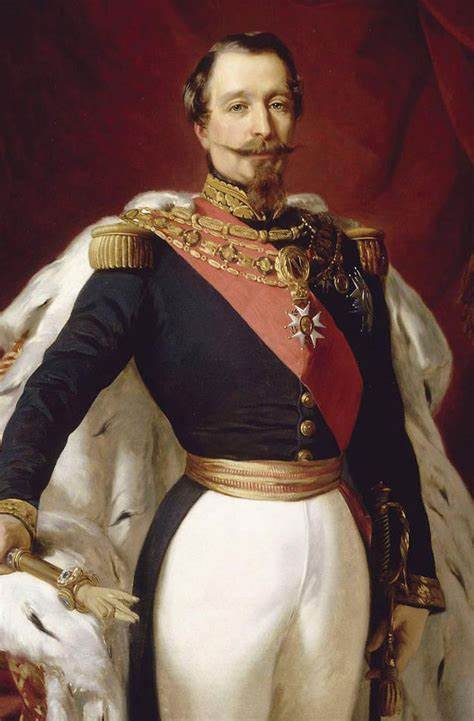
Napoleon III (1852-1870 reign, first president of France, became last emperor of France–deposed in exile. Nephew of Napoleon Bonaparte.)

Napoleon III undertakes a grand renovation of the Louvre with the building of its two major wings. The “Pavilion Denon” is dedicated at the Louvre by Napoleon III in the 1850s. Napoleon III employs Louis Visconti to design the Louvre renovation but he dies in 1853. The Visconti plan is executed by Hector Lefuel. It connects the old Louvre Palace around the Cour Carree with the Tuileries Palace to the west. The two major wings and their galleries and pavilions are completed during Napoleon III’s reign.

Francois Mitterrand (President of France 1981-1995)

WWII may have been the death nell of the Louve if it had not been for the cleverness of the French and the tacit cooperation of a German officer. The final chapters address today’s view of the Louvre and the renovations made by French President, Francois Mitterrand. Mitterrand carries the torch of French freedom and appreciation of art in the most elaborate Louvre addition since Napoleon III’s grand renovation. Mitterrand hires I.M. Pei to design the Louvre addition.

I.M. Pei (1917-2019, world renown American architect.)

It is known as the Grand Louvre Modernization project which is most noticeable because of the glass pyramid that becomes the primary Louvre entry. The pyramid seems incongruous to this tourist but is reminiscent of the Napoleonic history of France. Napoleon is more than a conqueror of countries. His political ambition entails more than power, though power is certainly a large part of his hegemonic ambition.

Gardner notes Napoleon’s inspired interest in other nation’s traditions, history, and art. His ambition in Egypt entails a consuming passion for understanding its historic rise to power and hegemonic power’s correlation with prominence in the world.

I.M. Pei’s decision is to create a symbol of the power and permanence of Egypt with a pyramid. The Louvre’s entrance is representative of Egyptian and French ambition in the world. As history shows, Egypt and France were hegemons of the world at different times.

Gardner’s book, “The Louvre”, should be on every tourist’s list before visiting the center of Paris. Gardner shows how much there is to see and how little one will understand without spending more than a day, let alone a few hours, at the Louvre.

V.A.T.

Audio-book Review
By Chet Yarbrough

(Blog: awalkingdelight)
 Website: chetyarbrough.blog

Rebellion, Rascals, and Revenue: Tax Follies and Wisdom Through the Ages

By: Michael Keen, Joel Slemrod

Narrated by: Walter Dixon

“Rebellion, Rascals, and Revenue” is a painful and laborious book to listen to, in part, because of its length but mostly because of its subject. Few citizens appreciate having their hard-earned wealth and income reduced by government taxation. However, the co-authors are well qualified and informative in explaining how important taxes are to every form of government to insure citizen’s peace, welfare, and protection. More importantly, they show how countries of the world have both aided and diminished prosperity of nation-state’ economies with good and bad tax policies.

Kevin McCarthy (Speaker of the House.)

As noted by McCarthy, the deficit exceeds the annual gross national product of the United States.

Keen’s and Slemrod’s book is timely. The wide gap between America’s two major political parties is partly because of America’s deficit, which has not been higher since WWII. The solution lies in the political will to increase taxes and reduce government expenditure. The difficulty is finding an equitable balance between tax revenues and the health, education, and welfare of America’s citizens.

However, America’s homelessness is evidence of a gap between rich and poor that belies America’s great wealth.

Keen’s and Slemrod’s book illustrate the folly of many nations that have inexpertly balanced tax policy with the health, education, and welfare of their citizens. From before the French revolution to modern times, the authors recount errors made by governments that bumble their way from forcing tax collection to passing confiscatory laws that support bureaucracies that beggar rather than serve the public. Along the way, the authors show how tax collection is conducted, how some improvements were made, and how citizens were both benefited and harmed by tax policies.

After wading through the author’s history of nation-state’ tax hijinks, Keen and Slemrod conclude America’s tax system should be overhauled. Their solution is a value added tax. This is an interesting conclusion that is reinforced by T. R. Reid’s book, “A Fine Mess” which suggests the same thing. However, Reid is a reporter for the “Washington Post”, not an economist with experience like Keen’s and Slemrod’s.

A value-added tax (VAT) is a consumption tax on goods and services that is levied at each stage of the supply chain where value is added, from initial production to the point of sale. The amount of VAT the user pays is based on the cost of the product minus any costs of materials in the product that have already been taxed at a previous stage1.

Keen and Slemrod do not clearly explain why they think a VAT is the solution to a better tax system than America’s current policy. Reid explains a VAT is a broad-based low-rate tax that will reduce the need for a tax collection bureaucracy because it eliminates corporate loopholes, broadens, and reduces tax rates, and equalizes citizens’ tax burden. Reid believes more revenue would be produced to reduce America’s debt. It would also reduce the expense of America’s tax collection bureaucracy. In theory both government expense and the deficit would be aided by a VAT tax policy.

MINDS MATTER

Audio-book Review
By Chet Yarbrough

(Blog: awalkingdelight)
 Website: chetyarbrough.blog

Unthinkable: An Extraordinary Journey Through the World’s Strangest Brains

By: Helen Thompson

Narrated by: Helen Thompson

Helen Thompson (British Author, journalist with a bachelor’s degree in Neuroscience.)

“Unthinkable” is a series of interviews of people who have a reputation for seeing the world and their place in it, differently. The author is a journalist.

As an investigative reporter, Helen Thompson elicits human perceptions of the world that are different from what most people perceive.

Thompson argues perception of the world comes from the mind. As synaptic activity of the mind is better understood, she infers what is real or false may become more universally understood.

Though Thomson’s interviews are anecdotal, they suggest the mystery of consciousness holds a key to mental health.

An interesting highlight of Thompson’s investigation is the existence of synesthesia in some people. Synesthesia is a neurological condition where information meant to stimulate one of your senses, actually stimulates more than one of your senses. Thompson notes people who have synesthesia may be able to hear colors, feel sound, or taste shapes. Two people with the same diagnosis may not perceive the world in the exact same way but their brains are stimulated to see more than what most people see, hear, or feel.

Synesthesia may be a mixed blessing in that it can overwhelm one’s senses, but it implies a more multifaceted view of reality.

One of Thompson’s last interviews is of a doctor who has a form of synesthesia that magnifies his empathy for patients. He actually feels some of what a patient is experiencing. Presuming the doctor’s senses are not overloaded by empathy, the patient seems more likely to be better served. If the mind’s neurological pathways for synesthesia can be identified, could empathy become instilled in every thinking being? Possibly, but the question remains whether that would enhance or burden humanity by making people who serve society emotionally drained, tired, and demotivated.

An earlier chapter addresses people who can develop “mind palaces” like the fictional character Sherlock Holmes.

They can recall the minutest details of an incident and compare it with information and experience they have acquired over the breadth of their life. If neurological pathways of a mind palace can be replicated in every human mind, could humans use those pathways to recall what they have learned from past experience and education to solve human problems?

One wonders if that is not the direction of A.I. in the future. This leads to concern of life becoming more machine-like than human with the added dimension of life as machine.

A third story is of the man who believes he is dead. His conception of himself is reinforced by brain scans that show very little neuronal activity though he continues to wake up every morning and function like a human during the day. He has little emotion or hunger and feels comfortable spending the day in a cemetery among those whom he feels are fellow travelers. Through medication, his neuronal activity is re-established, and he becomes more aware of his existence among the living.

A third story is of the man who believes he is dead. This anecdotal story reinforces belief that life is all in the mind.

There are more bizarre stories, but the underlying theme is life is defined by consciousness. Examples are given to show how parts of the brain are interconnected by neurons that pass information to the body about human existence in the world. The inference is that as humanity gains knowledge of how this interconnection works and which parts of the brain control neuronal activity, it will be possible to change human life. The impossible question to answer is whether that change will have good or ill effects on society. Of course, that may be moot if humanity cannot come to grips with the harm that is being done to the world’s environment.

This is a book one may set aside as an anecdotal journey into bizarre human anomalies.  On the other hand, it affirms the importance of understanding everyone is part of humanity. It seems search for understanding of consciousness is essential for the continuation of human beings, whether mentally disabled, psychotic, neurotic, or diagnostically normal.

REVOLUTION

Audio-book Review
            By Chet Yarbrough

(Blog: awalkingdelight)
 Website: chetyarbrough.blog

A Tale of Two Cities

By: Charles Dickens

Narrated by: Simon Callow

(1812-1870, English Author and social critic.)

As most know, “A Tale of Two Cities” was first published as a series in the U.K. in the 19th century. Its formal publication date was 1859. In comparison to some novels, “A Tale of Two Cities” is difficult to follow because of the many characters who play important roles in Dicken’s story.

The setting is in two cities, London and Paris before, during, and after the French revolution of 1789.

The famous beginning of Dicken’s story of the French revolution is “It was the best of times, it was the worst of times….” Most of the tale is about “…the worst of times…” in France.

The picture of the London and Paris cities is dismal because of its citizens who were either very rich or very poor. The seat of power in Paris is teetering on the edge of a coming revolution. The focus of the story turns to its main theme with Alexandre Manette, a French physician, heard to be alive after being unjustly imprisoned for 18 years in Paris. The story of Manette’s imprisonment is revealed to Jarvis Lorry, a London bank manager. Lorry arranges a meeting with the jailed Manette in Paris with his daughter who lives in London.

Manette’s daughter is Lucie. She goes to Paris with her governess, Miss Pross. Lucie meets with her father whom she thought was dead. Lucie brings her father back to London, but he suffers periodic mental lapses that return him to a shoemaking trade he learned while in prison. We get a glimpse of London on Manette’s return but it is of a trial that reminds one of the gaps between haves and have-nots in London. There is a trial for a spy named Charles Darnay, the nephew of a French aristocrat.

London in the 18th Century.

Lucie is a witness to Darnay’s alleged spying. She knows nothing about Darnay’s activity, but he had helped her in some minor way when he was accused of being a spy. Because of her testimony, Darnay’s character seems less spy-like and more gentlemanly. Darnay is acquitted because his defense attorney notes one of his colleagues, Sydney Carton, looks much like Darnay and could have as easily been the person accused. Darnay is released. The person, Sydney Carton, looks like Darnay but is loosely characterized as an undisciplined young bon vivant.

London court 18th century.

The main characters of the story are Dr. Manette, and Darnay but each character noted in these first chapters play important roles in the story. Dr. Manette had been unjustly imprisoned in the Bastille because of the death of a son and his mother caused by two French aristocrats. The remaining story largely takes place in Paris.

Dickens brings Darnay and Lucie together as husband and wife in London before the revolution in France. They have a son and daughter. The son dies, which reflects upon child mortality which is rather common in that time of the world’s history.

The reasons for the French Revolution, inferred by Dickens, are from harsh, unfair, and unequal treatment of the poor by the aristocracy. The examples given range from an aristocrat’s comment to the poor and hungry to “eat grass”, to the murder of a young boy and his mother by two “bon vivants” who hide their crime, to a murdered boy killed by an errant carriage accident caused by Darnay’s French Uncle.

Dickens creates the story of Darnay’s uncle flipping a coin to the father of a boy killed by his carriage’s collision. Darnay’s uncle is later murdered at his home by the father of the boy.

The table is set for the French Revolution of 1789. Dickens introduces the Defarge’s, Madame and Monsieur Defarge. They are republicans planning to kill as many of the French aristocracy as they can. Interestingly, the strongest and most violent of the revolutionaries is Madame Defarge.

As they storm the bastille, Monsieur Defarge demands a visit to Dr. Manette’s former cell. He knows of a secreted letter that explains why Manette is jailed and wishes to recover it. That letter incriminates Darnay’s Uncle and, by association, blames anyone that is part of that family.

Two years after the 1789 revolution in Paris, Darnay receives a letter from a servant of his murdered uncle asking for his help to be released from the Bastille. Darnay journeys to Paris and is imprisoned in the Bastille because of his association with French aristocracy. The remainder of the story is about the effort to get Darnay released. As true of other Dicken’s novels, there is a bitter-sweet happy ending.

Dickens is a masterful writer but to this reviewer, “A Tale of Two Cities” is not his best work. It is easy to lose the thread of the story because of its many characters. On the other hand, the characterization of Madam Defarge is one of the most terrifying written descriptions of revenge for social inequality. The terror of the French revolution and its causes are frighteningly vivified by Dickens’ creation of the Defarge’s.

BE CURIOUS

Audio-book Review
 By Chet Yarbrough

(Blog: awalkingdelight)
 Website: chetyarbrough.blog

The Data Detective

By: Tim Harford

Narrated by: Tim Harford

Tim Harford (British Author, Master’s degree in economics, journalist.)

Tim Harford gives listeners a practical application of “Thinking Fast and Thinking Slow” in the art of statistical analysis. Sounds boring, just as the title “The Data Detective” but in this day of media overload Harford castes a warning. Be skeptical of conclusions drawn by statistical data, whether accumulated by business interests, science nerds, or algorithms. Think slow because thinking fast obscures understanding of statistical analysis. Above all, be curious when reading a statistical analysis that either adds or subtracts from your understanding. With that admonition, Harford offers ten ways to question the veracity and truthfulness of statistical analysis.

Tim Harford gives listeners a practical application of “Thinking Fast and Thinking Slow” in the art of statistical analysis.

Harford argues it is important to investigate a writer’s qualifications as an analyst, and the “how, why, and when” data is collected. As the famous economist Milton Friedman said, “Statistics do not speak for themselves.” Or, as Mark Twain made famous, “There are three kinds of lies: lies, damned lies, and statistics.” It appears Harford agrees with Friedman, but not Twain, because he believes understanding a statistical study can reveal possible or at least probable truth.

Dr. Cuyler Hammond and Dr. Daniel Horn were smokers up until they finished their statistical report that correlated smoking with cancer.

Harford gives an example of statistical reports that correctly correlated smoking with lung cancer. Cuyler Hammond’s and Daniel Horn’s 1952 statistical study led to the 1964 Surgeon General report that confirmed cancer’s correlation with smoking. The disheartening story Harford tells is the tobacco industry’s purposeful effort to deny correlation. The tobacco industry’s methods were to suggest other causes, like auto exhaust or other carcinogens, as likely causes of lung cancer. They created doubt, whether true or false, which poisons belief in statistical studies.

Like the cowboy Marlboro smoker demonstrating a healthy image of a smoker, advertising obscures facts. The smoking industry successfully created doubt.

Harford explains personal investigation based on curiosity and detective work is necessary if one is looking for a probability of truth.

American free enterprise is created to produce product, service and jobs while making enough profit to stay in business. Sometimes those goals interfere with truth.

As human nature would have it, some businesses care less about truth than profit. This is not meant as a criticism but as an affirmation of human nature.

Harford explains there are many statistical studies purporting rises in crime, inequality, poverty, and medical health that need to be closely examined for validity. He argues every conclusion drawn from statistical surveys that contradict interest-group’ or individual’ belief should be closely examined. The methodology of a good statistical study must be understood within its era, its compiler’s biases, its stipulated human cohort, its conclusion, and its tested repeatability by others.

Harford challenges the supposition that violence has increased in America. This is undoubtedly music to the ears of elected officials who resist national gun control measures. Harford and the famed psychologist, Steven Pinker, suggest statistical analysis shows violence of earlier history is greater than in the 21st century. Harford acknowledges this is no comfort to the heart-rending reality of a child lost to suicide by gun or the horrendous school shootings of the last 3 years. As Horford explains statistics do not register human grief. Statistics are an impersonal unfeeling view of human life.

Harford does not read statistical surveys as truth but as a roadmap for discovery. He looks at a statistical survey like a detective searching for details. Who are the gatherers of the statistics? How were they collected? Why are they relevant? What period do statistics represent and do they relate the present to the past? Without answers, Harford argues statistical surveys are no better than propaganda.

Harford offers a graphic example of the context needed to clearly illustrate the value of statistical studies. The history of America’s invasion of Iraq and its human cost is dramatically and comprehensively revealed in one statistical picture.

Harford’s story shows how graphics can capsulize a statistical truth that shocks one’s senses. Simon Scarr summarizes a statistical report on deaths from the Iraq war with one graph.

Harford advances his view of the metaverse and its growing role in the world. He gives examples of Target’ and Costco’ algorithms that tells a father his daughter is pregnant, and infers a wife’s husband is cheating. A Target algorithm sends a note to a father about the pending birth of a baby based on his daughter’s purchases at the store. Costco sends a rebuy message for condoms to a wife when she calls and explains they never use condoms. Both stores apologize for sending their notes and say their stores made auto-response mistakes. Harford notes email apologies are a common response of stores that use similar algorithms.

Harford notes the irony of a metaverse that invades privacy with algorithms that can easily mislead or affirm societal trends or personal transgressions.

The last chapters of Harford’s book reinforce the importance of statistical studies by recounting the history of Florence Nightingale’s heroic hospital service in Turkey during the Crimean war (1853-1856). Harford explains Nightingale’s interest in mathematics and association with luminaries like Charles Babbage (an English polymath that originated the concept of a digital programmable computer). Nightingale’s hospital service and interest in mathematics lead her to correlate patient’ diseases with causes. The hospital to which she was assigned by the U. K. was without proper food and water. The hospital was dirty, and disease ridden. She had two objectives. First to have food and water supplied, and second to clean the hospital. Her statistical analysis made her realize cleaning was as important as food and clean water in reducing contagion among her patients. Like the statistical analysis of smoking and cancer changed smokers, Nightingale changed nursing.

Florenvce Nightingale (1820-1910, English social reformer born in Italy, Founder of modern nursing.)

“The Data Detective” is a disturbing book that shows the power of media and how it can mislead as well as inform the public.

This is a disturbing book that shows the power of media and how it can mislead as well as inform the public. With poorly or intentionally misleading statistical studies, opposing interest groups harden their political beliefs.

Harford concludes with an appeal to discordant interest groups to be curious about why they disagree with each other.  Reputable statistical analysis can improve one’s belief in probable truth and decrease echo chamber‘ adherence of disparate interest groups.