Scott Payne’s story makes one proud to be an American because of his bravery and willingness to risk his life for what is good about being in the land of the free.
Books of Interest Website: chetyarbrough.blog
Code Name: Pale Horse (How I Went Undercover to Expose America’s Nazis)
Author: Scott Payne, Michelle Shephard
Narrated By: Scott Payne
Scott Payne is a former undercover FBI agent who retired from the agency after 23 years of service. Michelle Shephard is an independent investigative reporter, author, and Canadian filmmaker.
Scott Payne’s history as an undercover FBI agent offers a dark picture of a part of America that one hopes and presumes most Americans revile.
With the help of Michelle Shepard, Payne reveals how a part of American society believes in white supremacy and an inherent right to victimize the public. Some people seek the reward of money and power, along with the prestige of being members of a miscreant minority, to murder, rob, and sell illicitly gained drugs and merchandise to enrich themselves. This minority demeans the ideals of American democracy.
America is founded on a government with power that comes from the consent of the people.
America is managed with belief in the rule of law, individual rights, a separation of powers to prevent tyranny, the equality of all people, and the right to vote for its leadership. Payne’s service in the FBI as an undercover agent shows how a minority of Americans violate these founding principles. Payne’s story reminds one of what many Americans think they are and should be. He, like most Americans, comes from the middle-class, finishes high school and grows into adulthood. He chooses to go to college, has found God to be important in his life, gets married, has children, and gets on with life. He comes across as an “everyman” American; although at 6′ 4″, he is taller and more athletic than most. He chooses to become a policeman and is later hired by the FBI.
Texas Motorcycle Club’ Patches.
Payne chooses to become an undercover agent for the FBI and becomes acquainted with a motorcycle group in Texas that is being investigated. Payne spends many months to ingratiate himself to the group and eventually becomes a member of the Outlaws, one of the “Big Four” clubs in America. This particular chapter deals in stolen goods and drugs. Payne’s entry as an undercover agent was in the stolen vehicles business with the intent of becoming undercover in their drug business. What is made clear in Payne’s story is how dangerous the drug business is and how he is nearly killed when a body search is conducted in a dark basement.
The personal stress of an undercover agent is made clear in Payne’s story.
Payne’s belief in God, FBI support, and his wife’s commitment to their marriage save him from a mental breakdown. After arrests of the biker gang members that were breaking the law in Texas, Payne moves on to an undercover assignment in Tennessee to infiltrate a white supremacist group. Like Germany’s Nazi movement, white supremacy in America is a sore that never heals and can grow to threaten a country’s life. The disgusting delusion that “all people are not equal” penetrates society like a contagious disease. Payne shows how white supremacists recruit and train followers that infect society. Humans have a desire to become a part of something greater than themselves. Sadly, that desire works for and against the American ideal of freedom.
Payne’s story makes one proud to be an American because of his bravery and willingness to risk his life for what is good about being in the land of the free.
Some academics considered Timothy Leary a visionary thinker who pioneered consciousness expansion, psychedelic therapy, and transhumanism. Others argue he lacked scientific rigor.
Books of Interest Website: chetyarbrough.blog
The Acid Queen (The Psychedelic Life and Counterculture Rebellion of Rosemary Woodruff Leary)
Author: Susannah Cahalan
Narrated By: Susannah Cahalan
Susannah Cahalan (Author, journalist for the New York Post)
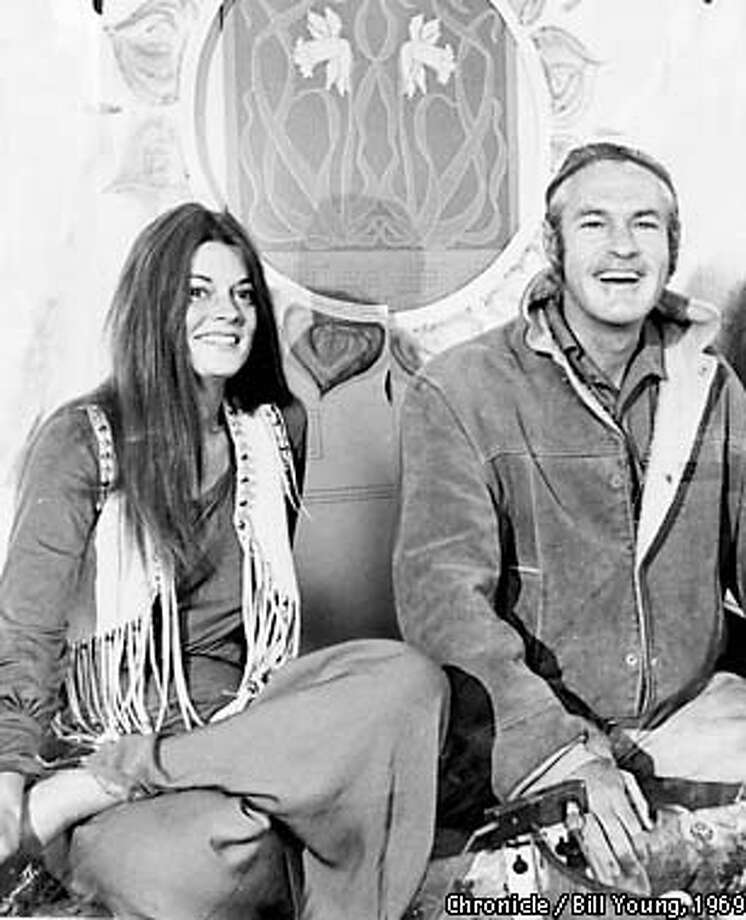
Susannah Cahalan has written a titillating story of the 60s and 70s and Americans burgeoning experimentation with illicit drugs. It focuses on Rosemary Woodruff Leary, the fourth wife of the LSD guru, Timothy Leary. Leary’s first wife committed suicide, his second seemed a rebound companion, his third is to Nena von Schlebrugge, and then Rosemary who eventually becomes his lover, fourth wife, and supporter during their 9 years of marriage. His last marriage was to Barbara Chase in 1978 which lasted for 14 years until 1992. Leary died in 1996 at the age of 75.
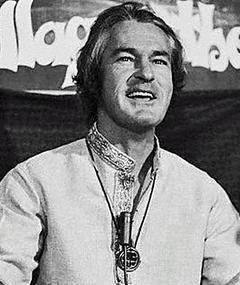
Timothy Leary’s time with Rosemary is filled with mutual infidelity but with freely given support by Rosemary of a diminishing intellectual who promoted hallucinogens and their mind-altering effects. The handsome Leary became a significant influence on the use of hallucinogens like LSD and psilocybin as tools for expanding human consciousness. He believed psychedelics could unlock deeper levels of self-awareness, creativity, and spiritual enlightenment. An interesting point about LSD and other hallucinogens is how they have become useful drugs for modern treatment of psychological dysfunctions like schizophrenia and PTSD. On the other hand, Cahalan shows indiscriminate use of LSD can diminish social propriety and become an escape from or harmful distortion of consciousness.
Putting aside the value of hallucinogens, “The Acid Queen” is about the life of Rosemary Woodruff Leary.
Rosemary was born in 1935. Growing into a beautiful woman, she was drawn into the counterculture movement of the 60s and 70s in her travels to San Francisco, Southern California, and New York. Her beauty opened doors of opportunity for Rosemary. She became an airline stewardess until retirement in her early 30s that were required by age limits of airlines in those years. Cahalan infers Rosemary’s attractiveness and free-spirited beliefs led her to use sex as a useful way of getting what she wanted through relationships with men. She joined the beatnik generation because it fit her style of living. This is a generation that rejected mainstream American culture with an interest in artistic self-expression, non-conformity, and spirituality. This was in the 1950s and early 60s.
Rosemary meets Timothy Leary in 1965.
Leary’s use of LSD as a transformative experience fit into Rosemary’s lifestyle. She became one of Leary’s devoted followers. They married in 1967. Art Linkletter’s daughter died in 1969 by suicide and blamed it on LSD. Not surprisingly, the conservative President, Richard Nixon, called Leary “the most dangerous man in America”. In 1968 Timothy Leary was arrested in Laguna Beach, California and charged with marijuana possession. He was tried in 1970 and sentenced to 1o years in prison. He escaped prison with the help of the Weather Underground but was recaptured in 1973. His sentence, in conjunction with his former conviction, was extended to 20 years. He was released in 1976, after 3 years, when he cooperated with authorities by offering information on the counterculture movement.
Cahalan shows how Rosemary followed and supporter Leary in his escape from prison and how their relationship fell apart.
It is somewhat unclear from Cahalan’s story about why Rosemary gave up on Leary. One may have been because of his and her self-absorption or their penchant for attachment to others for the support they believe they deserved. Cahalan’s story of Rosemary is interesting because of her association with Leary. Though Rosemary is self-educated, she appears to have limited formal education with her claim to fame largely based on the men with whom she became intimately involved.
In contrast, Timothy Leary earned a B.A. in psychology from the University of Alabama in 1943, a master’s degree in psychology from Washington State University in 1946, and a Ph.D. in psychology from the University of California, Berkeley in 1950.
Leary had many intimate women friends and five wives. He had two children, a girl born in 1947 and a boy born in 1949, with his first wife, Marianne Bush. Leary’s daughter died at age 42. She hung herself with her shoelaces tied to a jail bar while waiting to be charged for shooting her boyfriend. His son Jack, at 25 years of age, is noted in a NYT’s article in 1974. The article clearly implies Jack had become estranged from his father.
“The Acid Queen” is a sad story of two self-absorbed people who had exciting and tragic lives.
Timothy Leary had fame and fortune. Rosemary Woodruff Leary had beauty and tenacity. Neither seem paragons of virtue and both seem much less than they could have been. The underlying message of “The Acid Queen” is we need to be more connected to the world, less self-absorbed, and more other-directed. (Easy to say or write, but unlikely to be.)
Some academics considered Leary a visionary thinker who pioneered consciousness expansion, psychedelic therapy, and transhumanism.
Timothy Leary showed himself to be a charismatic and persuasive speaker. However, critics argue he lacked scientific rigor and had little foresight or objectivity about the effects of drugs on consciousness. Rosemary may have been “The Acid Queen” but never achieved the sobriquet of “Queen of Hearts”.
There is enough abundance in the world to create opportunity for all, but Ernaux’s history implies people must change their ways.
Books of Interest Website: chetyarbrough.blog
The Years
By: Annie Ernaux
Narrated by: Anna Bentinck
Annie Ernaux (Author, French writer, 2022 Nobel Prize winner, born in 1940.)
Annie Ernaux offers a perspective on history from the experience of her life as a French woman in the mid 20th to 21st century. Though born before the beginning of World War II, Ernaux matures as a young woman in the 1950s. A striking difference between the history of this time is the difference between Algeria’s drive for independence and American’s mistakes in Vietnam. French Algeria is less understood in American memories than its troubled history in Vietnam. Aside from misunderstanding France’s Algerian experience, the social changes Ernaux’s notes are similar to many Americans’ experiences in Vietnam.
Eisenhower’s, Kennedy’s, and Johnson’s leadership in the Vietnam war seem, in some respects, similar to Ernaux’s memory of Charles de Gaulle’s leadership in Algeria.
Eisenhower and Kennedy were veterans of war who became leaders of their countries. Though Eisenhower and Kennedy believed Vietnam was a threat as a communist Domino, de Gaulle believed Algeria was a threat to France’s right to colonize. These famous nationalist leaders were wrong. Southeast Asian countries had a right to choose their own form of government, and Algeria had a right to choose self-government.
Though Annie Ernaux was born just before 1946, she matured during great changes in the world.
Her experience of post-war reconstruction, the rise of consumerism, women’s rights, sexual liberation, social class differentiation, and societal norms changed in America, France, and most nations of the world.
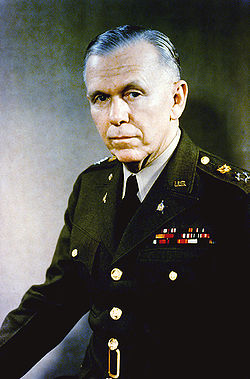
George Marshall was Secretary of State from 1947 to 49 and headed the Marshall Plan to reconstruct Europe after the war.
America played a great part in the financial reconstruction of Europe, Japan, and Germany after the end of WWII. America’s goal was to prevent future conflicts, promote economic recovery, and counter the influence of communism, but in that process, America influenced social norms throughout the world. Some of the influences created clear lines of opposition between communism, socialism, and capitalism. However, all economic systems influenced societal change. Whether communist, socialist, or capitalist there were changes in normative social values. Societies increased consumerism, instituted policies for equal rights to some degree, and made class distinctions based on money, or its equivalent, i.e., power. In capitalist and socialist societies, social position became more about money and the power of its influence. In communist societies, it was more about power and the influence of money. Political differences remained sharply divided in ways that influenced social norms, but the general direction was similar. Communism, socialism, capitalism, and all its derivations focused on consumerism, women’s rights, and class differences that changed the world during Annie Ernaux’s “…Years” of life.
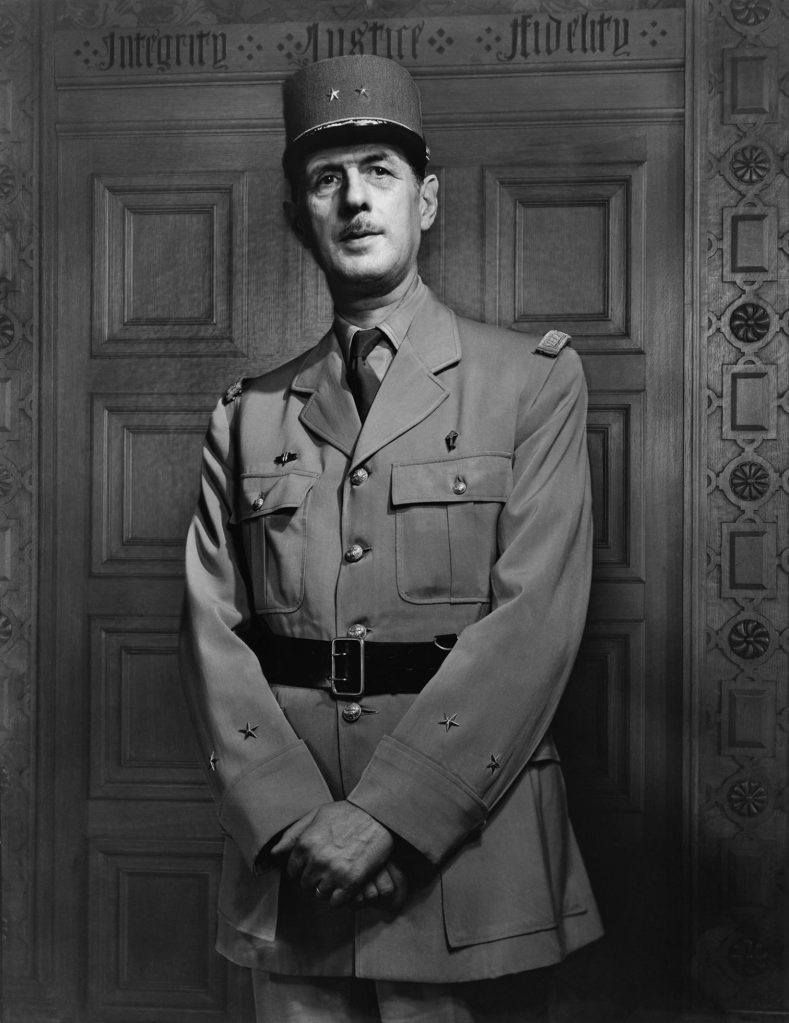
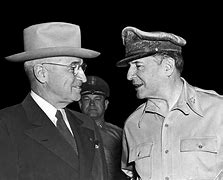
American President Harry Truman led the U.S. from 1945 to 1953.Emperor Hirohito next to MacArthur was emperor of Japan from 1926-1989. Mao was China’s leader from 1924 to 1953. Stalin led Russia from 1943 to 1976.Charles de Gaulle effectively led France from 1944 to 1959 with the last ten years as France’s President.
Feckless leaders, deluded authoritarians, and a few truly service-oriented leaders rose in every system of government, including American, English, Japanese, Chinese, French, Russian, and other nations. The main differences lay in leader’s longevity, and their economic policies. Leaders of China and Russia having fewer leadership changes between 1946 and 2006 than most nations were largely authoritarian. There were 6 leadership changes in China and 9 in the Soviet Union. Only 1 of 6 in China and only 1 of 9 in the Soviet Union leaned toward capitalism.
From 1946 to 2006, there were 11 presidents in America, 13 prime ministers in England, 32 prime ministers in Japan, and 6 presidents in France. All of these democratic nations exclusively leaned toward capitalism.
However, Ernaux’s history infers every nation shows social norms changing in similar ways. Even China and Russia show changes in consumerism, women’s rights, sexual liberation, and class differentiation. Unquestionably, the societal changes did not change to the same degree, but they were similar. Maladies of society are common in all forms of government, only the degree of change in societal norms is different. All nations have more or less consumer opportunities, more or less human equality, all have class distinctions, but normative change is a work in progress, not an end but a beginning process.
Annie Ernaux in earlier years of her life.
Ernaux’s trip down memory lane is interesting but not particularly revelatory. Her remembrance of the past is helpful because she shows how social change evolved in both good and bad ways in her own life. Consumerism seems on the edge of being out of control with money and wealth being the “sine qua non” of the good life. Without money, life seemed not worth living to some. Ernaux suggests America has become an arrogant example of wealth and privilege that diminishes civility. Ernaux is not suggesting she is above the fray of wealth as privilege and reveals her own character flaws by noting affairs with younger men in what seems a wasted attempt to reclaim youth. She implies a prejudice against Arabs and Africans who she believes wrongly consider themselves as French. She infers they are not French because they are not white Christians, even if they are born in France.
One comes away from “The Years” with a feeling that societies of the world are at a crossroad.
Wealth should not be the measure of one’s social value and privilege. Inequality is a sin against humanity. Prejudice is the cause of much of the world’s conflict. Immigration is a misunderstood value of societal comity. Tolerance of all religious beliefs has been an unresolvable puzzle but a desirable societal goal. There is enough abundance in the world to create opportunity for all, but Ernaux’s history implies people must change their ways.
This review does not do justice to Swafford’s excellent history of Mozart. One of the most revelatory and entertaining parts of Swafford’s history is the bawdy, funny, and clever poetry that Wolfgang’s letters reveal about his personality. Genius takes many forms.
Books of Interest Website: chetyarbrough.blog
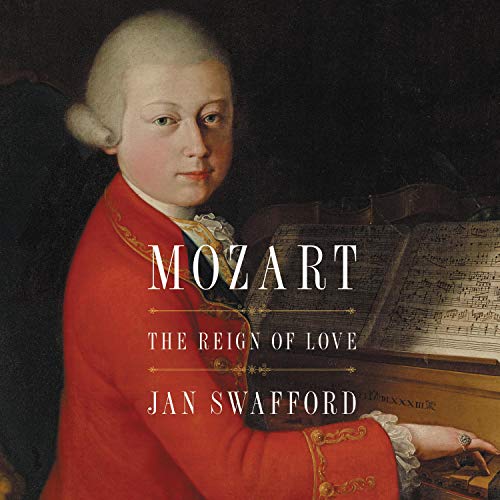
Mozart (The Reign of Love)
By: Jan Swafford
Edited By: Tim Cambell
Jan Swafford (Author, American composer, lecturer and writer.)
Jan Swafford has written a magnificent biography that diminishes and reinforces the comedic/tragic/brilliant characterization of Mozart in the film Amadeus. By any measure, Mozart is shown by Swafford to be a funny and brilliant musician while widely considered by musicologists as one of the greatest composers of all time.
Tom Hulse as Mozart in the movie “Amadeus”.
Vaguely remembering the film, the comedy enacted by Tom Hulce was hilarious, but Swafford shows how truly remarkable Mozart was as a violin and piano musician who began at the age of seven to tour Europe with his eleven-year-old sister, and their father, in 1762. The film is entertaining but misses the immense talent of this family’ trio in his book “Mozart”.
Maria Anna Mozart (1751-1829) Sister of Wolfgang Mozart was a highly talented musician who played piano and toured with Wolfgang when he was 7 and she was 11.
Though Maria Anna Mozart may not have been a genius like her brother, Swafford explains she was a piano prodigy as a result of her father’s guidance as a music teacher. Leopold Mozart may have been a helicopter father who dominated his children’s lives but his contribution to their success is made clear by Swafford.
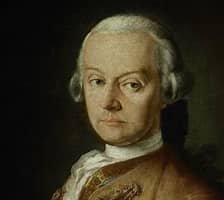
Leopold Mozart (1719-1787, father of Wolfgang and Maria Anna Mozart.)
Though Leopold Mozart is criticized by some as an over controller of his son’s life, it seems unlikely that Wolfgang Mozart would have become such a great musician and composer without his father. Wolfgang came to revile his father’s control of the family’s income that is largely a result of his daughter’s and son’s talents. Swafford shows how instrumental Leopold was in creating Mozart’s legendary abilities. Leopold was a great teacher who adjusted his teaching methods to the innate interests of his son and daughter. His daughter’s precocity did not reach the level of her brother’s success, but one wonders how much of her fame and ability is related to societal misogyny?
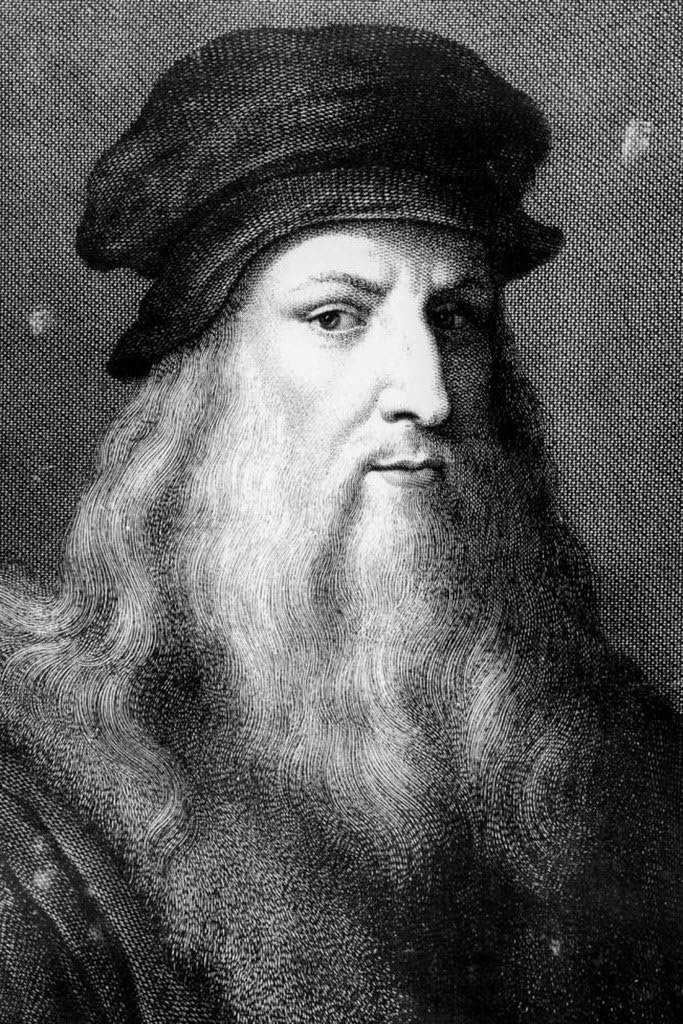
Leonardo da VinciSIR ISAAC NEWTON (1642-1727)ALBERT EINSTEIN (1879-1955)Emily Dickenson
This remarkable history of the Mozart family makes one wonder what makes the difference between geniuses like da Vinci, Newton, Einstein, Dickinson and others and those of us who are ordinary. One presumes it is a combination of genetic disposition, education, and luck. All of these circumstances are presumed and revealed by Swafford in Wolfgang Amadeus Mozart’s life.
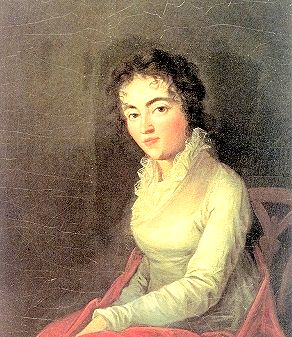
Swafford notes two women in Wolfgang’s life that were important. They were sisters. In 1777, Wolfgang sent a letter to his father about Aloysia Weber (on the left) and the possibility of her traveling with him to Paris. Aloysia is alleged to have rejected his advances, but Wolfgang’s father wrote a letter that vociferously objected to his son’s dalliance with the Weber’ daughters. Leopold implies Aloysia was a gold-digger and would ruin Wolfgang’s career. One may interpret the letter as more of a concern with Leopold’s son’s ability to raise money for the family, i.e. not the scandal of her travelling with Wolfgang. In any case, Wolfgang marries Constanze Weber (on the right), the younger sister, in 1782. It has been characterized as a marriage filled with love and mutual support.
Swafford explains why Wolfgang leaves Salzburg for Vienna, Austria in 1781.
Mozart felt his music was undervalued and constrained by the archbishop he worked for in Salzburg. To the disappointment of his father, Wolfgang moves to Vienna to pursue his career. His father’s disappointment was both financial and social. Because Leopold had been a guiding force in Wolfang’s life and career, not to mention the wealth he brought the Mozart family, his move to Vienna became a break from his father’s influence. They continued to correspond, but the familial and financial bond were broken with growing hostility felt by Leopold toward his son.
Wolfgang Amadeus Mozart (1756-1791 died at the age of 35.)
Wolfgang lives until 1791. His exact cause of death is unknown, but he had endured many illnesses in his 35 years of life. There is speculation that it was a recurrence of rheumatic fever or complications of strep throat. Some suggest it may even have been poisoning. The reality of that time is that the average life expectancy in the 18th century was 25 to 40 years of age. Some certainly lived to 50 or 60 but they lived most of their lives within a wealthy or privileged group. Wolfgang had some wealth in his last years of life, but not without a great deal of hard work as a master musician, composer and son of a near-do-well father.
One of the most revelatory and entertaining parts of Swafford’s history is the bawdy, funny, and clever rhymes that Wolfgang’s letters reveal about his personality. Two examples: “Oh my dear little cousin, I send you a thousand kisses, And if you don’t like them, Send them back with your wishes.” or “To every good friend I send my greet feet; addio nitwit. Love true true true until the grave, if I live that long and do behave.”
As noted in an earlier audio book review of Professor Robert Greenberg’s lectures on classical music the innovations of great composers were greatly enhanced by audio supplements.
This review does not do justice to Swafford’s excellent history of Mozart. Swafford’s audio book would be hugely improved for lay listeners with audio examples of Mozart’s noted contributions to classical music.
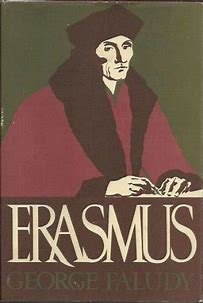
George Faludy suggests the most popular books written by Erasmus were “The Praise of Folly” and “Colloquies” which are similar in that they offer humorous and insightful stories of the human condition. One leaves Faludy’s biography of “Erasmus” with the thought that these two should be read, particularly because of the time in which we live today.
Books of Interest Website: chetyarbrough.blog
ERASMUS
By: George Faludy
György Bernát József Leimdörfer aka George Faludy (1910-2006) Author, Hungarian poet and translator.
George Faludy’s biography of Erasmus was published in 1970. A few years ago, I purchased a paperback edition of Faludy’s book because of an interest in a 16th century “man of the cloth” (an ordained Catholic priest) who became a devotee of Francesco Petraca (better known as Petrarch who is considered the father of humanism). Erasmus was born in 1466 and died in 1536. He believed in the value, dignity, and potential of human beings. Petrarch had been dead for a hundred years when Erasmus became a proponent of humanism at a time when Catholic’ Indulgences were challenged by Martin Luther. Luther’s Ninety-Five Theses led to a schism in the church leading to the establishment of Protestantism.
Martin Luther (1483-1546)
Luther’s Ninety-Five Theses led to a schism in the church leading to the establishment of Protestantism.
It is hard to imagine how Erasmus managed to become a leader in reforming the Catholic Church with his humanist beliefs. Erasmus walks a fine line between the schism fomented by Martin Luther and his belief in reform. Erasmus wrote the famous work “The Praise of Folly” that was a satirical critique of societal and ecclesiastical practices of the Catholic church without joining the movement started by Luther. On the one hand, Erasmus agreed with Luther on the importance of faith and the perfidy of “indulgences” sold by the Church. Indulgences were to raise money with alleged religious guaranties for a Catholic’s admittance to heaven. On the other, Erasmus insisted on faith in God and reform, not abandonment of the Catholic church. Erasmus’s academic and scholarly review and interpretation of religious texts convinced him that the Church only needed reform, not schism.
Faludy carefully explains the tumultuous relationship between Erasmus and Luther that at times seemed to break but survived their fundamental disagreement on reform versus schism.
Erasmus acknowledged many misrepresentations of religious text with an unwavering belief in the divinity of their origin. As one who is skeptical about the divinity of religious texts, it is encouraging to read of this highly respected scholar’s belief in their truth. Faludy’s biography of Erasmus may not change an agnostic’s mind about God, but it will give one pause because of Erasmus’s reported research of original religious works in Greek, Latin, and other languages, i.e., a skill beyond most peoples’ capabilities.
Faludy does not write of Erasmus as a saintly person but as a well-educated and diligent scholar.
A surprising note by Faludy is that Erasmus suffered from syphilis which suggests something less than perfection in Erasmus’s character. However, Faludy’s note is not corroborated by any other information known to this reviewer.
Faludy suggested the most popular books written by Erasmus were “The Praise of Folly” and “Colloquies” which are similar in that they offer humorous and insightful stories of the human condition. One leaves Faludy’s biography of “Erasmus” with the thought that these two should be read, particularly because of the time in which we live today.
Alan Bullock reflects on Hitler and Stalin’s differences which in some ways are greater than their similarities.
Books of Interest Website: chetyarbrough.blog
Hitler and Stalin
By: Alan Bullock
Alan Bullock (1914-2004, Author, British historian, died at age 89.)
Alan Bullock was one of Britain’s leading historians. His most renowned work was “Hitler: A Study in Tyranny”, published in 1952. At a book sale, Bullock’s “Hitler and Stalin” is purchased because of a recently reviewed history of Stalin and an interest in Bullock’s comparison of Stalin to Hitler.
Bullock reflects on the two dictators’ differences which in some ways are greater than their similarities. Bullock’s history is an informative history of WWII and the failed alliance of two of the most reviled leaders of the 20th century. Stalin and the Russian military are justifiably praised by Roosevelt and the Allied powers for his contribution to Nazi Germany’s defeat. Later in the twentieth century, the West’s view of Stalin changes.
At first glance, Hitler and Stalin are more different than alike in Bullock’s characterization.
Hitler is a master orator that enlivens Germany with a preternatural ability to influence and motivate his audience. Stalin is a communist influencer but holds his opinions to himself in addressing an audience or convincing the Communist Polit bureau of his legitimacy and intent. Stalin rules the Communist Party with an iron fist by exiling or executing anyone who becomes an influencer of the Party. Stalin creates fear among Party members while creating an image of strong leadership and infallibility among the Russian people.
Both Roosevelt and Harry Truman are initially impressed by Stalin’s personality, if not his leadership. Stalin is not a dynamic speaker who motivates an audience of followers. However, as Russia becomes an ally of the West, he develops a personable relationship with both WWII’ American Presidents. Churchill has reservations about Stalin’s political objectives but becomes reconciled to Stalin’s influence on Roosevelt to smooth the relationship among the three national leaders.
Truman eventually comes to understand Stalin’s true nature as Churchill’s “iron curtain” speech is given in 1946.
When Roosevelt dies, just before the end of the war, Stalin endears himself to Truman. Truman responded to Stalin’s insistence on splitting Germany by authorizing the Berlin Airlift in 1948. With the help of the UK and France 2.3 million tons of supplies are delivered to West Berlin between 1948 and 49. Germany is split between two spheres of interest, the U.S.S.R. and Europe, in 1949 that lasts until 1990.
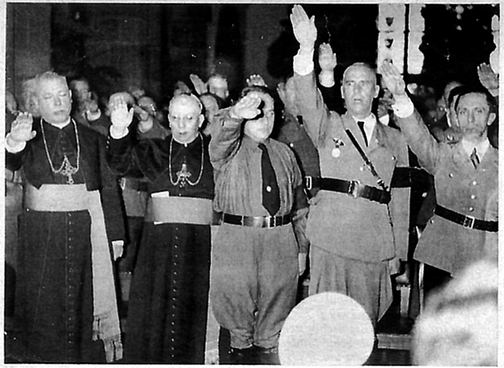
Hitler has Nazi Party members as his enforcers.Commuist Party–Stalin’s enforcers, “For Motherland, for Stalin” is on the flag on the right. (AP Photo/Mikhail Metzel)
Bullock explains how both Hitler and Stalin depend on a cadre of enforcers that align with their leadership. Hitler has Nazi Party members while Stalin has Communist party members. Both have military leaders in their respective parties. In contrast to Stalin, Hitler gains the support of industrialist and business leaders while Stalin relies on the intelligentsia and workers. Both used propagandas to support their positions but Stalin backs up propaganda with constant disruption of party leadership with often false accusations that end with exile or assassination. Hitler uses the SS for his enforcement but limits leader disruption while creating a cult of personality by presenting himself as the savior of Germany. Stalin is highly paranoid about usurpers of power while Hitler becomes more paranoid as the war begins to turn against him. Neither leader plans for leadership succession.
Hitler’s industrial and business leaders willingly choose to support rearmament of the military.
Because of Germany’s weakened condition after WWI’s punishing demands for war reparations, Hitler’s industrial and business leaders willingly choose to support rearmament of the military. In contrast, Stalin’s close association and identification with Leninist Communism garners support of non-professional Russian citizens who commit themselves to industrialization of Russia.
A cult of personality helps both Hitler and Stalin but the basis upon which the cult is formed is different. Hitler’s cult is internalized by industrial and business leaders who, along with Hitler, believe Germany has been unfairly treated by reparations and poorly ruled after WWI. In contrast, Stalin’s cult is based on Russian peasant beliefs in the ideals of communism by a leader who is perceived as a Leninist successor. Stalin systematically exiles or murders any Party leaders who are intent on rising in the Party.
Both Hitler and Stalin exercise centralized control.
Both Hitler and Stalin exercise centralized control, but the internal motivation of their citizens is different. Germany’s citizens identify with the unfairness of reparations and the rearmament of the country. Russian citizens identify with modernization and improved productivity based on the ideals of communism. Most citizens of both countries seem to internalize motivation to industrialize and modernize their countries but for different reasons.
Bullock shows both Hitler and Stalin are antisemitic.
The nature of failure is to have someone to blame. The only difference in these leaders’ antisemitism is that Hitler more systematically than Stalin incarcerated and murdered Jews. Hitler codifies his antisemitism in “Mein Kamph” and chooses to use his power and influence to create the holocaust. As the war ends, Stalin looks for excuses for the hardship of Russian citizens and uses antisemitism as an excuse for communism’s failures. The atrocious treatment of Jews is an unforgivable guilt for humanity which explains why the Balfour recommendation is made by the UK. The ramification of that decision lives in the world today.
Germany’s invasion of Russia is a surprise to Stalin because of their non-aggression pact.
Bullock does not spend much time with a report of Stalin’s reaction. However, some historians suggest Stalin retired to his Dacha when the invasion became known and only returned to lead Russia when a delegation of Party members came to ask him to return.
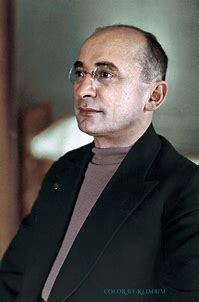
The author suggests Lavrentiy Beria, a brutal enforcer of Stalin’s dictatorship, is at his side when he dies and expresses disgust with Stalin’s leadership while leaving the room with intent to seize power. Beria was executed by the Soviet Union on December 23, 1953.
As is well known, Hitler committed suicide in his underground bunker on April 30, 1945. Bullock suggests Hitler’s remains were found by the Russian Army and taken back to Russia. Since Bullock’s book, forensic evidence confirms Hitler’s remains were taken to Moscow. The last days of Stalin were in 1953. Bullock notes Stalin had a stroke but had for months, if not years, lost much of his memory and forceful personality.
Truman’s presidential accomplishments were not done alone but he managed highly educated and experienced people who got things done. He had the respect of people who reported to him, and he was tough, pragmatic, and willing to make hard decisions when circumstances required leadership.
Books of Interest Website: chetyarbrough.blog
Truman
By: David McCullough
David McCullough (1933-2022, Author, historian, winner of a Pulitzer Prize, the National Book Award, and later given the Presidential Medal of Freedom in 2006.)
One of the great historians of the modern age, David McCullough received the National Book Award for “Truman” in 1982. As a biography of an American President, it is among the best ever written about a President whom few regard as being in the category of Washington, Lincoln, or FDR. Every chapter is a pleasure to read because it reminds one of why many consider America the best country in the world in which to live. This portrait of the 33rd President of the United States shows a man of modest means, without a college degree, who grows to become a great manager of others and leader of a post WWII world.
President Harry S. Truman (1884-1972, President from 1945-1953.)
Thrown into the Presidency after 82 days as Vice President of the United States, Truman became President. FDR died April 12, 1945. Germany was near defeat by the Allies. Within a month, on May 8th, the Allies celebrated what is known as V-E Day, Victory in Europe Day. Truman is faced with a decision on how best to end WWII by defeating Japan. Though when he rose to the Presidency, he had not been informed about the Manhattan Project. He was fully briefed on April 25, 1945, by Henry Stimson and General Leslie Groves, leaders of the Manhattan Project. In mid-July of 1945 the first atomic bomb was successfully tested and Truman described it as “the most terrible bomb in the history of the world”.
Captain Harry Truman November 1918.
As a former veteran and captain in WWI, Truman knew what continuing the war meant to the lives of American soldiers.
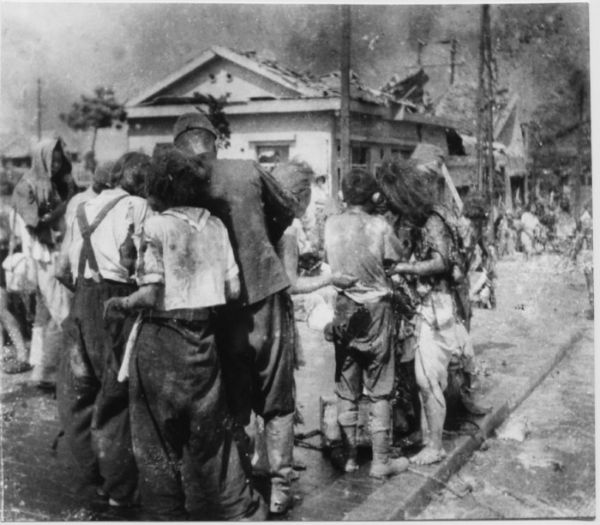
As a former veteran and captain in WWI, Truman knew what continuing the war meant to the lives of American soldiers if Japan were conventionally attacked by Allied forces. He ordered the use of two atom bombs, one on August 6, 1945, on Hiroshima and a second on Nagasaki on August 9, 1945. There was no official warning. Leaflets were dropped over some Japanese cities on August 6, but one suspects that was just a precedent to instill fear about further destruction if Japan refused to surrender.
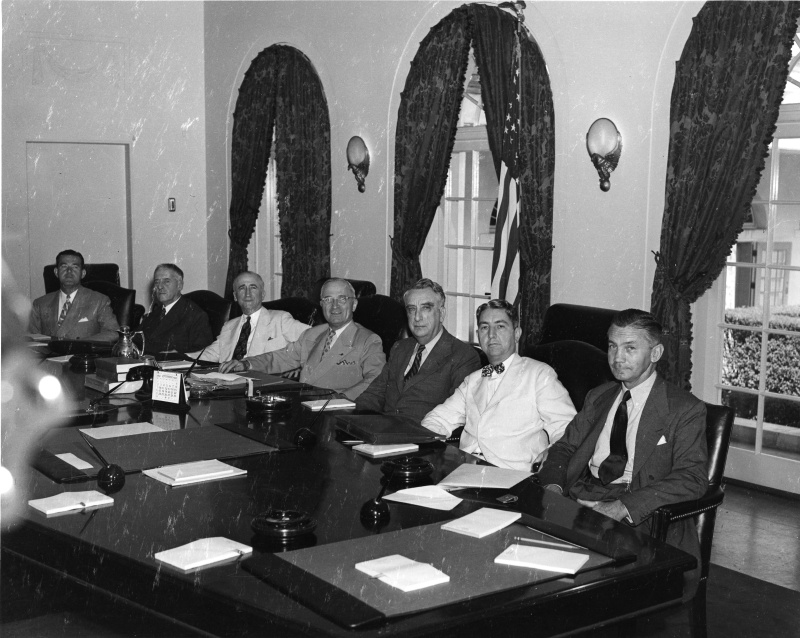
TRUMAN’ CABINET IN 1945
President Harry S. Truman meets with Cabinet members in the White House. From left to right: Postmaster General Robert Hannegan; Secretary of War Henry Stimson; Secretary of State James Byrnes; the President; Secretary of the Treasury Fred Vinson; Attorney General Tom Clark; and Secretary of the Navy James Forrestal.
Truman took complete responsibility for the decision to drop the bombs.
As shown in the movie about Truman’s meeting with Oppenheimer after Hiroshima and Nagasaki, Truman was put-off by Oppenheimer’s concern over postwar use of nuclear weapons. Presumably, Truman’s feelings were that many lives were saved despite the loss of Japanese citizens from the use of atomic weapons. McCullough’s depiction of Truman is that he was tough, pragmatic, and willing to make hard decisions. He took personal responsibility for the use of atomic bombs to end the war.
Truman’s whistle-stop campaign in 1948.
McCullough goes on to explain Truman’s second term election effort that began when Dewey, his Republican opponent, looked like a sure winner. Truman campaigned across the country by train. Truman’s victory and what seemed an interminable train ride was a testament to the grit and determination of this 5-foot, 9-inch dynamo.
Truman’s character description is reinforced with McCullough’s history of Truman’s relationship with General McArthur. In the early days of the Korean war, McArthur took charge of American forces and made decisions that seemed to bode well for the end of the conflict. McArthur reversed the course of the war by insisting on a risky reinforcement of American forces. It was the right move and Truman admired McArthur’s grit in insisting on the reinforcement. However, McArthur overstepped his position when he insisted on bombing Chinese cities when China escalated the Korea war. McArthur publicly criticized Truman’s administrative opposition to escalation.
Truman relieved McArthur of his command in Korea and pursued a negotiated peace at the 38th parallel. This was another tough, pragmatic, and unpopular decision by Truman. In retrospect, one recognizes it was the right decision, but Truman was markedly criticized by the press and public for his decision.
In the early days of the Korean war, McArthur took charge of American forces and made decisions that seemed to bode well for the end of the conflict. McArthur reversed the course of the war by insisting on a risky reinforcement of American forces.
One can argue McCullough’s history places Truman in the pantheon of the greatest Presidents of the United States since Washington, Lincoln, and FDR. Truman ended WWII, agreed with and supported the Marshall plan that rebuilt Europe, created the Truman Doctrine to contain Soviet Expansion, desegregated the military, established the CIA, NSA, and NSC by signing the National Security Act of 1947, approved the Berlin airlift when the Soviets isolated West Berlin, and banned discrimination in the federal workforce. Truman managed some of the greatest minds of his 20th century administration to make America the preeminent leader of the western world.
Truman’s presidential accomplishments were not done alone but he managed highly educated and experienced people who got things done. He had the respect of people who reported to him, and he was tough, pragmatic, and willing to make hard decisions when circumstances required leadership in the face of public opposition.
Homelessness, illegal immigration, and America’s budget deficit will not be cured by reducing taxes on the rich or by tariffs that artificially increase the cost of living, or by cutting the labor force of farmers through mass deportations, or by making it easier to do business in the U.S.
Books of Interest Website: chetyarbrough.blog
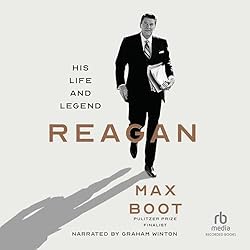
Reagan (His Life and Legend)
By: Max Boot
Narrated By: Graham Winton
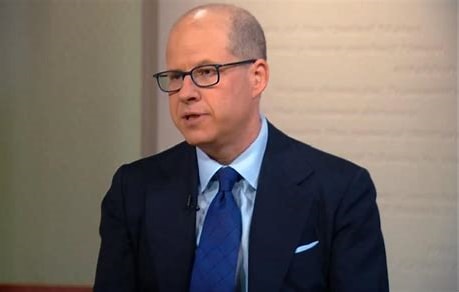
Max Boot (Russian-born naturalized American author, editorialist, lecturer, and military historian, writer and editor for The Christian Science Monitor.)
Not being a fan of Ronald Reagan’s presidency, there is some reluctance in reviewing Max Boot’s biography of the man. However, Boot’s writing and research offer an understanding that makes one separate Reagan’s political life from his experienced life. Boot explains Reagan’s life during the years before and after the depression.
Reagan’s father was an alcoholic which reminds one of how one’s childhood is rarely idyllic. Boot’s biography of Reagan shows one becomes who they are–despite the human faults of their parents. The way a child matures is only partly defined by parents’ influence. Reagan’s father’s alcoholism did not carry through to his son.
Boot’s biography shows Reagan to be an affable, well-adjusted, teenager and young adult who has a strong sense of what he believes is right and wrong.
Reagan is a football athlete in high school that grows to become a 6′ 1″ handsome young man from a relatively poor middle-class family. He aspires to college and works to have enough money to attend Eureka College in Illinois. He graduates in 1932 with a BA in Economics and Sociology. Reagan is remembered by classmates and teachers as a smart student and determined football player that gave him the grit and experience to become a movie star in the 1940s.
The first chapters of Boot’s biography of Reagan are about his break into the entertainment industry as a sports caster.
Reagan had a nearly photographic memory. He used that skill to recall a football game he played in college to impress a radio station manager with broadcast details of a game. He recalls a game he played in college and purposefully embellishes his role in the game. Reagan’s skill as a radio announcer led to a screen test with Warner Brothers in 1937 that launched his film career.
As WWII approaches, Reagan enlists as a lieutenant in the U.S. Army Air Force. (The Air Force in these early days were not a separate branch of the service.)
Reagan’s experience in the entertainment industry led to producing training and propaganda films for the Army Air Force. Boot explains Reagan had significant vision problems with nearsightedness in his youth and presbyopia (difficulty of focusing on close objects) as he got older. Reagan never served in a combat role. He eventually adopted contact lenses to correct his vision; partly to please film producers who disliked the “coke bottle” lenses he needed to see properly.
Four issues that are interesting and informative in the first chapters of Boot’s biography of Reagan are 1) how affable, and well liked Reagan was to people who met him, 2) that he was well-read, 3) very handsome with a respect for women that carried through to several relationships, and 4) that though he had a sense of right and wrong, his moral center seemed to waiver between concern and indifference.
During the depression, Reagan was a strong supporter of Franklin Roosevelt’s efforts to resurrect the American economy.
Reagan seemed more like a liberal Democrat than the conservative Republican he came to be as Governor of California and President of the United States. The remainder of the book shows how that change came about. Boot notes several factors that influenced Reagan to change from a Roosevelt to Goldwater supporter. The movie industry and the growing anti-communist era of the fifties influenced many former liberals. Reagan’s experience in Hollywood reinforced conservativism.
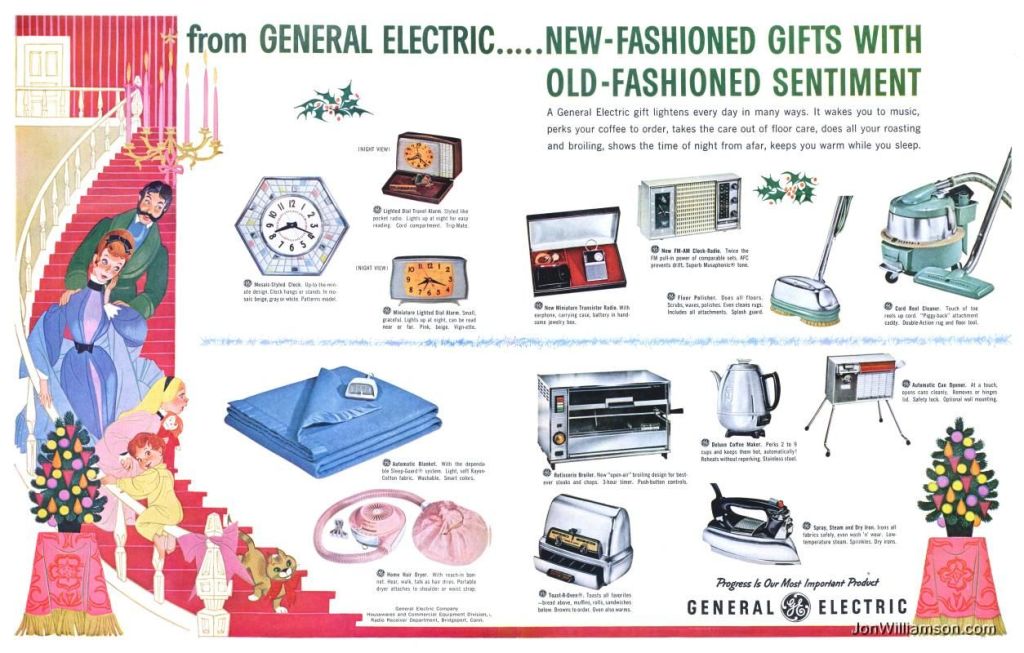
Reagan became rich from his relationship with Gerneral Electric. The corporate culture of GE in the 1950s and 60s was decidedly conservative. When Reagan became the host of “General Electric Theater” that culture seeped into his consciousness.
In 1962, Reagan switched from the Democratic party to the Republican party. He supported the election of Goldwater who ran against President Lyndon Johnson who was mired in the Vietnam war while promoting big government social welfare programs. The influence of Goldwater and the liberalism of the Johnson polices drove Reagan to believe big government was ruining the wealth and opportunity of Americans. He adopted conservative beliefs for economic deregulation, tax cuts that largely benefited the rich, and promoted anti-communist foreign policies. Reagan’s support for conservative policies is exemplified by his “A Time for Choosing” speech supporting Barry Goldwater’s campaign for President in 1964.
In the political climate of the 1960s, Reagan, with the support of GE, runs for Govenor of California. His position as president of the Screen Actors Guild, support of Goldwater, and the public’s perception of inefficiency of state government provided a platform for Reagan to run. The civil rights movement, Vietnam protests, the free speech movement, the Watts riots in LA, and the hippie movement in San Francisco created an environment ripe for conservative reaction. Reagan is elected Governor of California twice, to serve from 1967 to 1975.
Reagan as the Governor of California.
Reagan described his time with GE as a “postgraduate course in political science”.
Reagan’s experience as Governor of California, his Hollywood image, the support of big companies like GE, and the economic issues confronting Carter, give him a platform to run for President of the United States. Todays’ Republicans hold Reagan in high regard. Some view Reagan as one of the best recent presidents of the United States. Those who hold him in high regard cite his economic policies, strong national defense and leadership during the cold war. He believed in small government, lower taxes, and conservative values. Some suggest Trump is Reaganomics second coming.
Reagan runs for President of the United States in 1976. He wins and is re-elected in 1980.
What is not fully understood by some Americans, is the accomplishments of Reagan held some very negative consequences. Some argue he was the prime mover in nuclear weapons reduction. The biography of Gorbachev suggests the prime mover was Gorbachev and his support of glasnost with an opening of Russia to western ideals.
Some, like me, would argue Reagan accelerated economic inequality by giving tax cuts to the wealthy and deregulating the economy.
The federal deficit increased from $70 billion dollars to 152.6 billion dollars during the Reagan presidential years. In comparison to Carter’s administration, the deficit was less than half of Reagan’s at $74 billion dollars. Today’s deficit has grown to 1.83 trillion dollars. Four out of seven presidents (including Trump’s second term) since Reagan have been Republican. The deficit lays at the feet of both parties.
With the election of Trump, who emulates Reagan’s policies, one wonders–how much greater the deficit will be with reduced taxes for the rich and a renewal of economic deregulation.
Homelessness, illegal immigration, and America’s budget deficit will not be cured by reducing taxes on the rich or by tariffs that artificially increase the cost of living, or by cutting the labor force of farmers through mass deportations, or by making it easier to do business in the U.S.
Purnell’s biography implies the drive to succeed for women is based on intimacy rather than inherent human equality. Though that is not the intent of Purnell, intimacy has historically been the avenue women have had to take in society to open opportunity’s door.
Books of Interest Website: chetyarbrough.blog
Kingmaker (Pamela Harriman’s Astonishing Life of Power, Seduction, and Intrigue)
By: Sonia Purnell
Narrated By: Louise Brealey
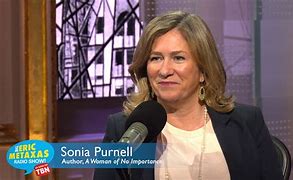
Sonia Purnell (Author, British journalist, worked at the news magazine “The Economist”)
Every writer is influenced by the country in which they were born. Sonia Purnell writes an interesting biography of Pamela (Digby-Churchill) Harriman in “Kingmaker” but from the perspective of a British journalist. This is not to argue Purnell’s interesting perspective is wrong but that there is a spin that is nationalist, more than objective, about Pamela Harriman’s life.
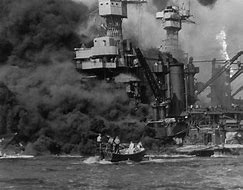
During the beginning years of WWII, America avoided the war until Pearl Harbor when it became clear that a policy of isolationism would not work.
The reluctance of many American businessmen and industrialists like Joseph Kennedy and Henry Ford would not see Hitler for what he was, a fascist racist planning to dominate as much of Europe as Germany’s war machine would allow. Some in the American government, like Franklin Roosevelt, understood Hitler was a threat to all of Europe if not America. Roosevelt maneuvered the government to support England with a Lend/Lease program to defend themselves against German aggression, despite a political majority’s desire for isolationism.
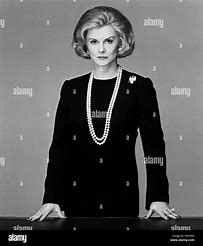
Getting back to Purnell’s history of Pamela Harriman, Purnell explains the important role Pamela played, before Pearl Harbor, that mobilized America’s entry into the war. Pamela Harriman is unquestionably an English patriot. Her close relationship with Winston made her an ideal conduit and influencer in smoothing the relationship between America and the British government. The intimate relationship she developed with Harriman is a tribute to her contribution to the formation of an allied force to defeat Germany.
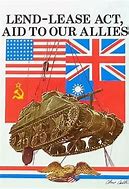
The massive Lend-Lease program is created in the late 1930s because of the Neutrality Acts that kept America out of direct engagement in the early days of WWII.
The program began in 1939 as a cash and carry program that evolved into a Lend-Lease program in 1941. American could lend or lease military equipment and supplies to any country that allies themselves with the U.S. if it were to enter into the war. The United Kingdom, Russia, and China were considered crucial to any alliance that might be created to defeat Germany. The complexity and logistics of Lend-Lease required astute management by American managers. Harry Hopkins was its first administrator, but Averill Harriman was needed to become a diplomatic political expediter for the process.
Purnell argues the political process in the American/United Kingdom relationship was smoothed and improved by Pamela Digby Harriman who was married to the son of Winston Churchill, Randolph Churchill.
Randolph has at best, a mixed reputation. He was a heavy drinker, reckless, and rude. He was married and divorced twice and had gambling problems that were a constant debt problem that disrupted Pamela’s life. She became closer to Winston Churchill than to her husband and became much more politically involved and astute than her husband in government affairs. That experience made her a perfect match for building a closer relationship with Avrill Harriman that became an affair between two married adults. Harriman was twenty-eight years older than Pamela but had a reputation as a suave ladies’ man.
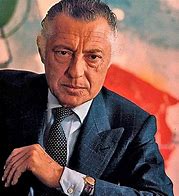
Purnell reflects on the many affairs of Pamela Churchill Harriman beginning with Averell Harriman, then Edward R. Murrow, and proceeding to John Hay Whitney, Prince Aly Khan, Gianni Agnelli, Alfonso de Portago, Baron Elie de Rothschild, Frederick L. Anderson, Sir Charles Portal, and William S. Paley. The story becomes stale.
There is a cloying sense of unfairness in “Kingmaker ” because Pamela’s skill seems trivialized by her sexuality.
Pamela simply wanted an equal opportunity to succeed in the pursuit of money, power, and prestige, i.e. all the secular objectives men take for granted. Purnell’s biography implies the drive to succeed for women is based on intimacy rather than inherent human equality. Though that is not the intent of Purnell, intimacy has historically been the avenue women have had to take in society to open opportunity’s door.
Much may be learned in Adam Zamoyski’s biography of Napoleon Bonaparte but too much detail makes it a slog for non-historians.
Books of Interest Website: chetyarbrough.blog
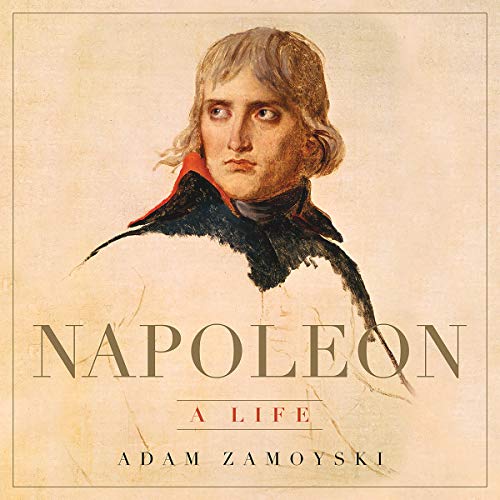
Napoleon (A Life)
By: Adam Zamoyski
Narrated By: Leighton Pugh
Adam Zamoyski (Author, British historian, descendant of Polish nobility.)
Adam Zamoyski overwhelms reader/listeners with Napoleon’s military campaign details which tempt amateur history buffs to put his book aside. Yes, there was the French revolution but understanding the role of Napoleon’s many military campaigns is too complex for an amateur’s understanding of France’s history. Napoleon’s relationship with famous movers and shakers of his time are important, but Zamoyski’s military campaign details are too much. Napoleon’s break with Paoli and Corsica’s ambivalent relationship with France is interesting but Paoli is a largely unknown person to the general public. International relations between France, Great Britain, Poland, Germany, Prussia, and Russia are left to history buff’s inadequate knowledge of history.
In a number of ways, Zamoyski’s biography of Napoleon is disappointing. It is a definitive biography of a legend, but Zamoyski’s history of Napoleon’s life is too complex for a lay audience.
To a historian, Zamoyski’s book is undoubtedly important but to an amateur it is too detailed. For a dilatant of history, the best one gets from the author is that Napoleon was a tactical genius, a great leader who oddly eschews domestic or war-related violence, while becoming among the greatest conquerors of nations in history. After his many campaigns, he turns his genius into a micro-manager of household concerns, international relations, and France’s disorganized governance. Without a military campaign, his tactical brilliance is wasted on vendettas, extra-marital liaisons, and personal expenditures. On the other hand, Napoleon creates a French financial system that supports a massive miliary force with over 60% of its national budget while reorganizing its government’ inefficiencies.
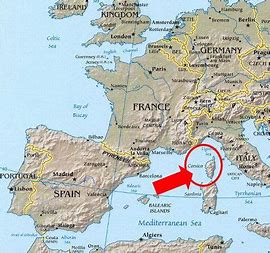
Napoleon descends from a royal family that endeavors to confirm its paternal and landed interests in Corsica. Not clearly coming from royalty is an obsession that follows Napoleon throughout his life. Since, 1769, Corsica is recognized as a region of France, but it is geographically closer to Italy with a rich history of Italian influence.
There is much in Zamoyski’s biography that one learns about Napoleon Bonapart. The young Napoleon is noted as well-educated self-confident, shy-with-women’ person who has interest and understanding of mathematics and a genius for military tactical plans and maneuvers. Napoleon eventually overcomes his shyness with women but only after becoming a leader of men. His extramarital affairs are noted throughout Zamoyski’s book.
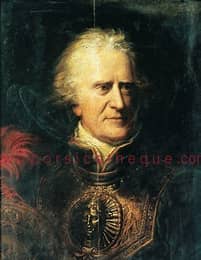
At the age of 9, Zamoyski notes Napoleon is sent to a military academy at Brienne-le-Chateau, and later to the Ecole Milita ire in Paris. In his younger years, Napoleon is characterized as a Corsican patriot who admired Paoli, a leader of Corsican independence from France. However, he chooses to follow France and eventually breaks with Paoli and the history of Corsica. Paoli never gives much attention or respect to Napoleon despite his effort to endear himself.
Pasquale Paoli (1725-1807, Corsican patriot, statesman, and military leader who flees to London after failing to rid Corsica of French rule.)
Bonaparte first develops a relationship with the Robespierre brothers (Maximilien and Augustin) in 1793. Great Britain and Spain were allied with French rebels in southern France and Bonaparte met the brothers in opposition to Royalist rebels. Bonaparte’s tactical brilliance routs southern France rebels and forces the Anglo-Spanish fleet to depart. This became the beginning of Napoleon’s rise to prominence in the French military. He is 24 years of age.
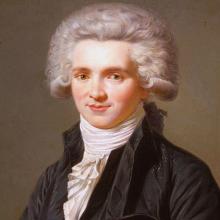
Maximilien Robespierre, a friend of Napoleon. (1758-1794, leader of the Jacobin republican movement in France, is condemned and beheaded on July 28, 1794,)
The Robespierre’ brothers, of which Maximilien is the best known, are associated with the Jacobins, an extreme egalitarian group that fomented a French revolution in 1793-94. Maximillian Robespierre instituted the Reign of Terror with mass executions for which he is eventually guillotined in 1794. With the seeds of rebellion planted by the Jacobins, the French Revolution occurs in 1789 through 1799. Napoleon distances himself from the brothers and the Jacobin movement in 1794. He became a “blue-blooded” Frenchman and abandoned his Corsican roots.
Charles Maurice Camille de Talleyrand-Périgord (1754-1938, French clergyman, statesman, and leading diplomat. Died at age 84.)
Another interesting relationship noted by the author is between Napoleon and Charle Maurice de Talleyrand-Perigord, more commonly known as Talleyrand. Talleyrand and Napoleon had a close relationship between 1799 and 1807. Talleyrand acts as France’s Foreign Minister negotiating many treaties that increased Napoleon’s power in both France and Europe. However, Talleyrand becomes critical of Napoleon’s aggressive expansionist policies. He is eventually removed from his ministerial position in 1807.
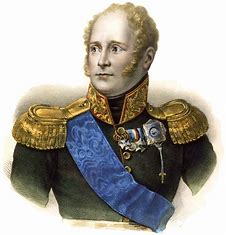
Czar Alexander I (1777-1825)
In 1805, Czar Alexander joins Russia with Austria in the battles of Austerlitz against Napoleon. However, he switches sides to join Napoleon after Napoleon’s success in Austerlitz. He switches sides again to defeat Napoleon with the British at Waterloo in 1815.
The author notes Talleyrand speaks to Czar Alexander about his concern over Napoleon’s ambition and is alleged to have said he would collude with the Czar to defeat Napoleon. Talleyrand by any measure is a traitor to Napoleon, if not his country. Not surprisingly, Talleyrand (though he remains in Napoleon’s government) had a role in the Bourbon restoration in France after Napoleon’s abdication in 1814.
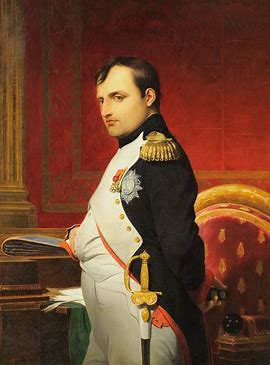
The diminutive Napoleon next to Czar Alexander I.
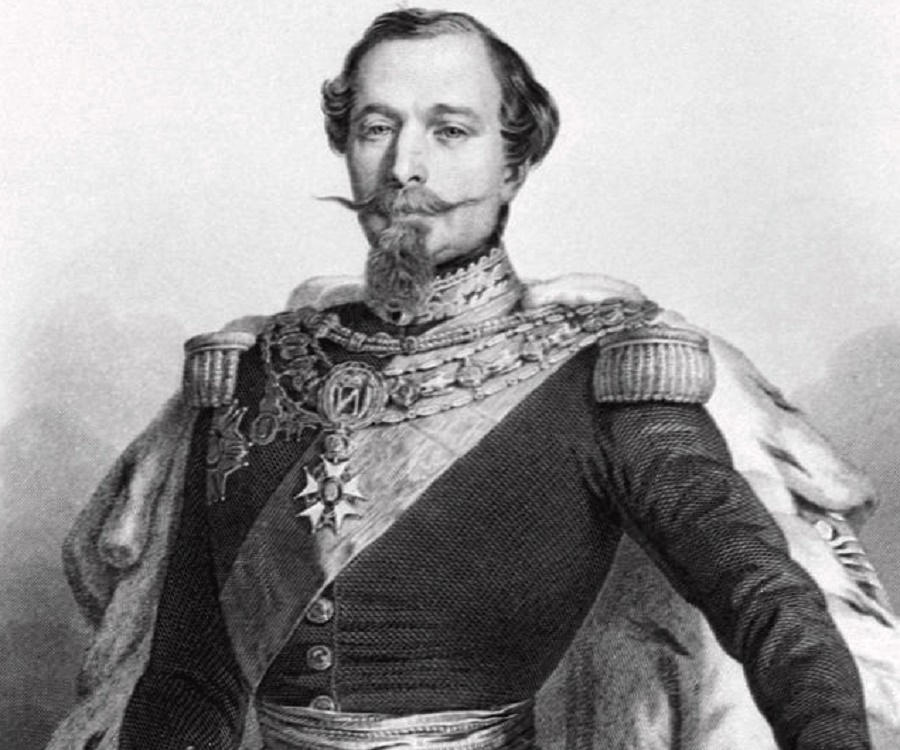
One might argue Napoleon did not restore a traditional monarchy but created the First French Empire in 1804. However, this Empire led to the return of the Bourbon monarchy in 1814. Louis-Napoleon Bonaparte, Napoleon’s nephew, became Emperor Napoleon III in 1852, and remained so, until his defeat in the Prussian War of 1870. France did not truly become a Republic until 1870.
Considering the origin of the Bonaparte family, it comes as little surprise that Napoleon decides to return France to monarchy by another name by becoming an emperor.
Louis-Napoleon Bonaparte (1808-1873, initially became the first president of France in 1848 but became its second Emperor in 1852. He was deposed in 1870.)
Despite Napoleon’s predilection for royalty, Zamoyski notes numerous improvements made by Napoleon’s new role in the governance of France. He established the Napoleonic Code that provided a government framework designed to ensure equal treatment by law, protection of property rights, and individual freedom. He centralized government functions within departments to streamline governance. He instituted educational reforms by establishing secondary schools to train future government employees and military officers. He established a banking system to stabilize the economy. Though Napoleon detained the Pope for interfering with French governance, he liberalized control of church appointments by allowing the state some control.
One comes away from Zamoyski’s Napoleon biography with a deep appreciation of a legend in his time and for all time. As a tactical genius, Napoleon sometimes failed to look beyond an immediate problem, but when it came to understanding what is needed to manage a huge organization, Zamoyski shows Napoleon to be a visionary.
As is well known, Napoleon is defeated at the Battle of Waterloo in 1815. Zamoyski notes Napoleon is exiled to Elba where he escapes and is then interned on Saint Helena where he dies in exile from what is believed to be stomach cancer. He died at the age of 51. Napoleon’s confinement at Saint Helena is a sad end to an incredibly brilliant life.
Much knowledge is provided by Adam Zamoyski’s biography of Napoleon Bonaparte, but too much detail about specific battles makes the book much too long for non-historians.
























































 REVIEWS AND VIEWS OF LIFE