VENGEFUL IDEALIST

The election results are in, and Trump is our President once again. This is a sad commentary on the will of the American people and the threat America is to world economic comity.

Books of Interest
 Website: chetyarbrough.blog

People, Power, and Profits (Progressive Capitalism for an Age of Discontent)

By: Joseph E. Stiglitz

Narrated By: Sean Runnette

Joseph Stiglitz (Author, American economist, public policy analyst, received a Nobel Memorial Prize in Economic Sciences in 2001.)

With reservation, Joseph Stiglitz’s book “People, Power, and Profits” is reviewed here. The reservation is because of the risk of succumbing to echo-chamber’ belief. That belief is that corporations and wealthy individuals should not be able to pour as much money as they want into the American election process, that bankers unjustly escaped punishment for the 2008 financial crises, and that Donald Trump should never again be elected President of the United States.

Stiglitz is considered a “New Keynesian” economist which puts him at odds with famous economists like Milton Friedman and Friedrich Hayek. Friedman believes the most effective fiscal policies comes from monetary policy control by the government. Hayek believed in a market economy with as little government intervention as possible. Stiglitz flatly disagrees with Hayek and only agrees with Friedman in that government has a responsibility to intervene in government economic policy. Stiglitz identity as a “New” Keynesian is because, unlike Keynes’ economic theory, there is no waiting for an economic crisis for government to intervene but to intervene now to make future economic crises less likely.

John Maynard Keynes (English, Eton and King’s College graduate, mathematician, economist, 1883-1946, died at age 62.)

Why I am concerned about listening to Stiglitz’s book about the economy is that I am listening to some things I already believe. I believe the gap between rich, and poor is the greatest threat to, not only American democracy, but all forms of government. Stiglitz may be my echo chamber.
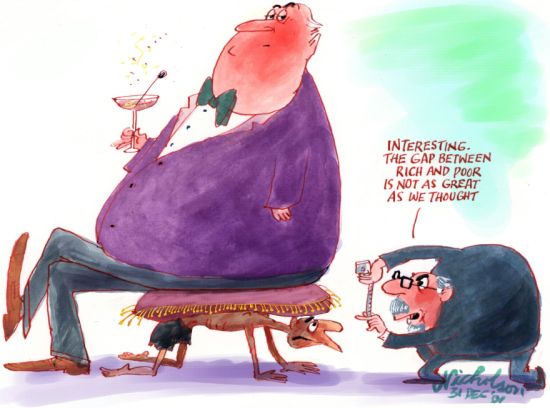
Stiglitz believes in democratic government intervention to ameliorate the wide gap between rich and poor.

Stiglitz has an idealist platform to cure what he views as the solution to narrowing the gap between rich and poor in America. Stiglitz makes five policy recommendations to reduce the gap between rich and poor in America.

  1. Increase taxes on income from capital gains and inheritance.
  2. Use tax revenues to improve public education in ways that equalize costs between the rich and poor.
  3. Refine anti-trust laws to prevent monopolies and promote competition.
  4. Intervene in corporate governance to ensure fairer compensation between management and labor.
  5. Regulate banks to prevent exploitation of the public.

These are defensible polices but they have to survive the give and take political process of American democratic government.
However, that process is unfairly biased by allowing corporations and the wealthy to pour disproportionate amounts of money into the American election process. Contribution by corporations and the wealthy should be limited because candidates are beholding to big financial donors with little concern for the poor.

Small donors driving 2020 presidential race

In the 2020 and 2024 election cycle, big donors contributed from 75 to 78 percent of campaign donations.

The problem with Stiglitz’s book is not in his recommendations but in his vengeful angel’ rhetoric. America is founded on freedom, not revenge. It is the give and take of differences of opinion and “checks and balances” of the Constitution that have made America great. Many mistakes have been made and are still being made by our government but even a horrible President like Trump cannot change the fundamental direction of our democracy.
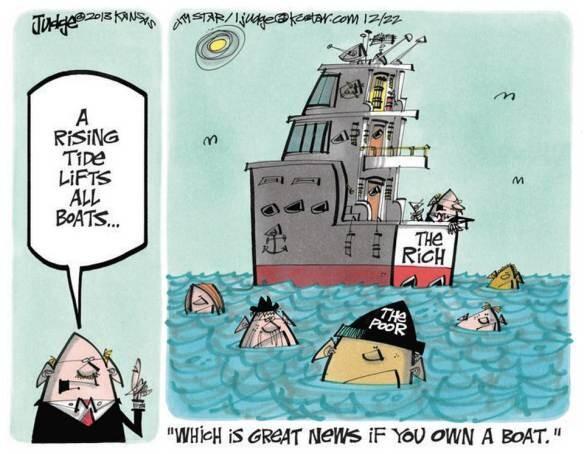
John F. Kennedy’s belief that a rising tide lifts all boats has not provided life vests to the poor in America.

The gap between rich and poor in America must be resolved. Neither Harris nor Stiglitz may be the answer, but Trump is only going to try to resurrect a past that has led our government in the wrong direction. The unconscionable cost of medical services and drugs, extraordinary compensation for executives, regressive taxes, election financing bias, and financial industry greed must be addressed through the American political process.

American democracy’s failures will not be cured, but they must be addressed and ameliorated to remain a beacon for freedom in the world. The election results are in, and Trump is our President once again. This is a sad commentary on the will of the American people and the threat America is to world economic comity.


POLITICAL CHAOS

Tariffs to restrict foreign production is shooting citizens in the foot by artificially increasing the cost of living.

Books of Interest
 Website: chetyarbrough.blog

Edge of Chaos: Why Democracy Is Failing to Deliver Economic Growth – and How to Fix It

By: Dambisa Moyo

Narrated By: Pamala Tyson

Dambisa Moyo (Zambian-born economist and author with a BS and MBA from Harvard, former World Bank consultant to Europe, Central Asia and Africa.)

“Edge of Chaos” is a revelatory and intelligent analysis of economic rewards and risks of democracies and dictatorships. Fundamentally, Moyo argues failures of government economies are related to societal instability and short-term government economic policies that are disproportionately influenced by monied interests and kleptocratic political leaders. Rich corporations and kleptocratic leaders distort economic opportunity, create chaos while producing and exacerbating economic inequality. She argues America is at the edge of chaos because of a flawed democratic election system that is biased toward short-term rather than long term economic policy.
Moyo identifies the Gini index of income inequality to show that there is little difference between the rich and poor in China and the United States despite their government leaders’ differences.

China is a dictatorship while America is a form of democracy. They are nearly the same on the Gini index scale of citizen inequality while South Africa, Zambia and Brazil are at the bottom. Slovenia, the Czech Republic, Slovakia, Belarus and most of the Scandinavian countries show the lowest differences in citizen’ economic inequality. Mayo argues the difference has little to do with their forms of government except in relation to their government policies. In her opinion, China and the United States could improve their citizen’s Gini index position if their government policies would focus on income equality.

Both China and America have relative stability but with different forms of government.

Unquestionably, freedom is the sine non quo (indispensable ingredient) of America, but it is income inequality that causes the chaos Moyo alludes to in her book. That chaos is not overtly apparent in China because of dictatorship but one who has traveled to China feels there is a similar level of discontent, if not chaos, among its citizens over economic inequality.

Moyo’s solution for reducing America’s growing chaos seems difficult but not impossible to implement.

Dambisa Moyo’s solution revolves around the following 8 recommendations.

  1. Make voting compulsory to increase voter participation more representative of the people.
  2. Make election to the House of Representatives a six-year term like the Senate to encourage longer term economic goals but limit the number of terms one can be in office. (Eliminate career politicians.)
  3. Increase the pay of politicians to what successful private sector leaders receive.
  4. Establish policy making agencies that can focus on long-term policies without being threatened by near term election cycles.
  5. Invest in the education of future leaders of the political system.
  6. Encourage public officials to focus on economic diversification with an educated understanding of technological change in the world.
  7. The wealth of the nation should be focused on reduction of economic inequality.
  8. Strategies to manage natural resources should be developed to focus on sustainability.

Fair trade is where America is on the wrong side of history according to the author.

Adam Smith believed in fair trade.

Adam Smith argued for removing trade barriers like tariffs and quotas because of limited natural resources. He explains resources are more efficiently allocated, product production is increased, and economic growth is improved with free trade. As inferred by Moyo, American chaos is partly a result of ignoring Adam Smith’s prescient understanding of economics.

America democracy has journeyed a long way since 1776.

America’s fundamental success came from its emphasis on freedom within rules-of-law organized around the “checks and balances” of three distinct branches of government, i.e., the executive, congressional, and judicial branches. This is the strength of American Democracy that has offered stability. The inference made in “Edge of Chaos” is that America’s stability is at risk if it does not adapt to technological change wrought by A.I. and global interconnectivity.

Technology is changing the nature of American productivity from material products to service. With the help of A.I., America can begin to address many of the service needs of its citizens. From aid to the homeless, to education for service to others, to drug treatment of the addicted, to improved health care for all, the prosperity and income of Americans can be more equitably shared.

Global interconnectivity requires greater acceptance of fair trade as originally described by Adam Smith.

Today’s alleged protection of worker employment by using tariffs to restrict foreign production is shooting citizens in the foot by artificially increasing the cost of living. Re-education for service to the public by using A.I. to make citizens more human-centered offers an alternative to 21st century American chaos.

These are intelligent observations by a very young and well-educated author.

DEMOCRACY’S IMPERFECTION

There are many reasons why America continues to prosper despite elections of inept political leaders.

Books of Interest
 Website: chetyarbrough.blog

America’s Deadliest Election (The Cautionary Tale of the Most Violent Election in American History)

By: Dana Bash, David Fisher

Narrated By: Dana Bash

Dana Bash is an American journalist and news anchor for CNN. David Fisher is an accomplished author who has written twenty New York Times bestsellers.

“America’s Deadliest Election” reaches back to 1868 in Louisiana to tell the story of Henry C. Warmoth who was elected governor and later, a Congressional representative of Louisiana. Warmoth’s election in Louisiana reminds one of Donald Trump’s election in 2017. Warmoth manages to become the 23rd Governor of Louisiana in 1868. His election at the young age of 26 made him one of the youngest governors in U.S. history. Of course, age is not the reason one might compare Trump’s election to Warmoth’s, but it is Warmoth’s unrestrained rhetoric and purposeful lies that got him elected.

Henry C. Warmoth (1842-1931, died at age 89. He was the Reconstruction governor of Louisiana and later Louisian State Representative.)

In Louisiana a large unrepresented minority were black Americans. Warmoth’s term ended with allegations of corruption and dishonesty but his rhetoric for disenfranchised blacks gave him the governorship and later a position as Louisian State Representative in congress. His political career extended through 10 years of Civil War Reconstruction and corruption.

Depiction of a US Army Officer Meeting with African Americans in Louisiana after the Emancipation Proclamation.

As a wealthy American, Trump and many rich business leaders and industrialists believe lower taxes and less government regulation improves opportunity and raises the living standards of the poor. Many wealthy Americans believe John F. Kennedy’s 1963 line that “a rising tide lifts all boats”. History shows a different picture, i.e. with lower taxes, the rich got richer, the middle class remained middle class, and the poor increased. America is nearing the point where it will have its first trillionaires while this richest country in the world has an increasing number of poor and a burgeoning homeless crisis.

In modern times, Trump’s rhetoric disingenuously appeals to blue-collar workers but with an underlying appeal to the rich who believe in “trickle down” economics.

Freedom allows American citizens to lie as well as tell the truth. The problem with truth is “truth is in the eye of the beholder” or what Timothy Leary called a human’s “reality tunnel”. Warmoth and Trump had their own “reality tunnels” with the objective of getting them elected. Their objective is to gain power, money, or prestige. Both Warmoth and Trump are willing to lie to themselves and others to gain their objective.

In American democracy, freedom is the holy grail of its success.

As pointed out in “The Economist” earlier this week, Democracy is messy. Democracies like France, Great Britain, and the European Union are struggling to find their way in the 21st century. Representative government is difficult because voters cannot know if candidates for office are telling a follower only what they want to hear or if what is said is what the candidate believes. Additionally, voters cannot be sure an elected person is capable or willing to walk the talk after their election.

Recent Presidential elections in America before Biden replaces Trump.

Many Blacks had never been able to vote but Warmoth (a former Union Civil War’ veteran) became instrumental in supporting the 15th amendment that prohibited states from denying the vote based on race, color, or previous condition of servitude. For the first time in America, Blacks could vote. Naturally, Blacks voted for Warmoth despite his reputation for corruption. However, Warmoth’s support and actions create a split between his Republican followers and slavery proponent Democrats that remind listeners of today’s political party intransigence.

An irony of the story of Governor Warmoth is that he is clearly a scofflaw, but his lawlessness helped bring black Americans into the electoral process.

Warmoth was a criminal. He speculated in state bond and treasury notes which were a conflict of interest for a governor. He profited from a partnership given by a newspaper that had a contract for state printing. Warmoth created what was called the “State Returning Board” that had the authority to discard legitimate votes to keep Louisiana Republicans in power. One might suggest President Trump had similar conflicts of interest.

The authors explain what made Warmoth a crook. It was for the reward of money and power.

Inept and unethical practices are mitigated by the foresight of the framers of the Constitution. The acts of legislators since the beginning of America’s creation have bent the arc of history toward freedom and equality. Balance of power between branches of government, election of honest and ethical leaders, media that exposes political rhetoric for its understanding of truth and lies have helped Americans to live free and prosper. America is blessed with natural resources that have made America become a great Democratic success.

There are many reasons why American Democracy continues to prosper despite elections of inept and unethical political leaders.

The last chapters of Bash’s and Fisher’s book show what can happen when there is a sharp split between Democrats and Republicans that roils the American democratic process. What this history shows is that we have been at this crossroad before, and America pulled itself together. Warmoth was not the ideal representative of American Democracy, but he played a part in history that began the movement for Black freedom in the South and their right to vote.

Trump reminds one of Warmoth’s history. One hopes the split between political parties will be mended by the election of a President that can heal the vituperative factionalism of the Democratic and Republican parties in 2025.

SPINNERS

“All the Worst Humans” is a macabre but revealing look into the darkest corners of public relations.

Books of Interest
 Website: chetyarbrough.blog

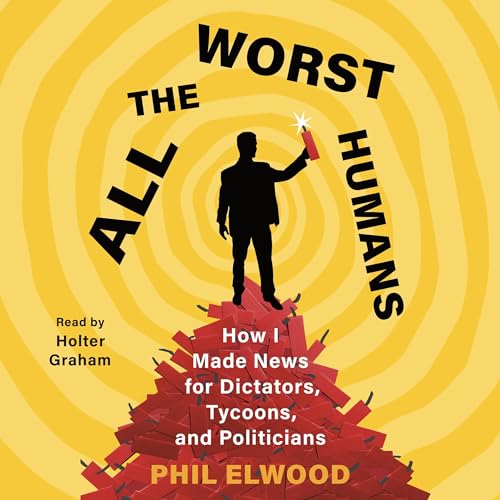
All the Worst Humans (How I Made News for Dictators, Tycoons, and Politicians)

By: Phil Elwood

Narrated By: Holter Graham

Phil Elwood (Author, public relations operative, graduate of Georgetown University with graduate studies at the London School of Economics.)

“All the Worst Humans” is a macabre but revealing look into the darkest corners of public relations. It is an anecdotal story, with a ring of self-effacing truth by Phil Elwood who specializes in spinning news about morally corrupt people and bad events. A listener is skeptical of Elwood’s integrity because of the nature of what he does for a living. Elwood manipulates societies understanding by spinning the facts of current events to hide what truth there is in history.

The truth of history is purposeful or a choice and spin of facts to recreate a past that always has more facts than can be or are reported.

Reputable historians certainly try to accurately report the facts of history, but truth is malleable based on the facts that are chosen. Though Elwood profiles himself harshly as a troubled human being, he is like a disreputable historian who spins facts that have little to do with truth. Elwood’s job is to make facts tell a kind of “truth” that makes bad people and/or events look good or at least better than bad.

Elwood’s self-effacing story admits his weakness for alcohol and addictive drugs.

Elwood manages to become an intern for Congressional representatives like Senator Daniel Moynihan after failing to graduate from college. He corrects his college failure with the help of his congressional contacts to enter Georgetown University where he earns a college degree.

Elwood leaves his Congressional internships and the contacts they entailed to become a success as a public relations operative.

He becomes an operative who spins facts to change the public’s perception of people and events. Elwood is an “operative” because he contacts legitimate media writers/broadcasters and political influencers to change their minds about people and events that are or will become news of the day.

Elwood’s story begins with an FBI phone call that asks for the correct number of his and his wife’s apartment address.

He arranges for a meeting with the FBI in an hour after the call, purportedly to allow his wife time to leave with some of the files in their apartment. This is a puzzling beginning to a wild explanation of Elwood’s life. One is unsure of how much of what is written is spinning the truth of who Elwood is and what he believes. One wonders if Elwood’s story is just an entertaining vignette of a complex and intelligent writer, a public relations expert, or writer of fiction. (A brief review of the internet shows Elwood is not only a graduate of Georgetown University, but did graduate work at the London School of Economics.)

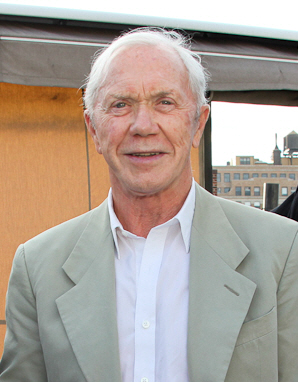
Peter Brown (American-based English businessman who became part of the Beatles’ management team.)

After Elwood’s stint as a congressional intern, he is hired by a public relations firm headed by a former Liverpool Beatles’ assistant, a man named Peter Brown. Brown became an officer of Apple Corps, the Beatles management company. Brown was instrumental in arranging the wedding of John Lennon to Yoko Ono in Gibraltar which is made famous in Lennon’s song “The Ballad of John and Yoko”.

Elwood offers examples of work that he does as an operative for Brown’s company. Brown, or someone from his office, calls Elwood to “baby sit” Libyan executives who work for Muammar Gaddafi in a trip to Las Vegas.

Elwood explains they carried millions of dollars in suitcases they kept in their hotel room. They lost thousands of dollars at the gaming tables and used Elwood to arrange private plane trips and ferry suitcases of money to pay their gambling bills and travel expenses. Elwood feared for his life and was relieved to see them off in their private jets after steering them away from what could have been a public scandal in Las Vegas.

Elwood explains how he is ordered by Brown to use his contacts in Congress and news publications to make Gaddafi look more like a statesman than thug in his 2009 United Nations Speech.

Elwood was tasked to make Gaddafi look humanitarian rather than venal by arranging interviews and media engagements that would emphasize his role as a revolutionary, not authoritarian leader. There seem to have been some successes but the speech at the UN and the debacle over a tent on Trump’s property made Elwood’s public relations effort a failure. Elwood is eventually fired by Brown and leaves with a sense of enmity toward Brown.

Elwood eventually slips into another morass when asked by his new public relations employer to make Nigeria look better than the Boko Haram kidnappers who took 276 schoolgirls from a Government Girls Secondary School.

Elwood is unsure of what he can do despite travelling to Nigeria to convince the government they needed to act in a way that looked like they were concerned. Elwood admits he fails and that the appearance of Malala Yousafzai, the Pakistani activist who was nearly assassinated by Pakistani thugs, entered to insist Nigeria must do something. Elwood is fired again.

In another incident where Elwood is working as a public relations operative, he consults with Antigua after the United States threatened to prosecute Antigua for online gambling services.

The Antiqua leader worries that it would destroy tourism in his country if they fought America’s threat. Elwood explained the loss of revenue from online gambling far exceeded tourism income and that he would plant a story in the media about restraint of trade as being un-American. Elwood suggests to the Antiqua government that they take America on with a complaint to the World Trade Organization. Antiqua follows the advice, and successfully remains an online gambling mecca. But Elwood, despite his successful spin of the facts loses the account and is fired again.

Elwood then slips into a very gray world where money is being laundered by the Israeli government.

Elwood becomes a conduit for the laundered money and is contacted by the FBI. The story comes full circle, and its ending adds to the value of Elwood’s story. Public relations are a sophisticated way of muddling the truth. Being smart is two edged when it comes to the truth. Ignorance is not bliss but spinning the truth can kill you or put you in jail.

Elwood considers suicide because of his dodgy reputation and fear of losing his marriage. Through treatment with ketamine, Elwood recovers some level of mental health. Treatment with ketamine is an ironic fact in view of the recent death of the comedic actor Matthew Perry. In a twist of fate, Elwood is spinning the benefit of ketamine while its use is being abused by the public today.

AN IMMIGRANT LIFE

Immigrants treated equitably are more likely to bring positive additions to countries in which they choose to live.

Books of Interest
 Website: chetyarbrough.blog

The House of Broken Angels

By: Luis Alberto Urrea

Narrated By: Luis Alberto Urrea

Luis Alberto Urrea (Author, Mexican American poet, novelist, and essayist.)

“The House of Broken Angels” tells many Americans what they may not know about Latino Mexican culture. Luise Alberto Urrea explains what it is like to be Mexican American and/or raised in Mexico before emigrating. The Mexican American’ picture is harsh, but Urrea’s picture of being raised in Mexico is heart rending.

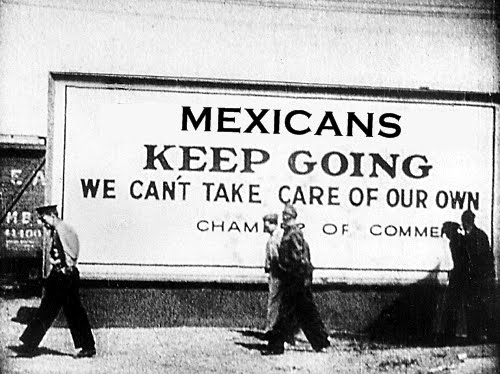
Not surprisingly, emigrating to America raises more social barriers for non-white immigrants than white immigrants.

The first barrier is skin color, but there is also language, education, and most importantly gainful employment. When a Mexican enters the country, all four barriers make their lives hard. If they were raised in Mexico, Urrea suggests they are poor and misogynistic but spiritually tough.

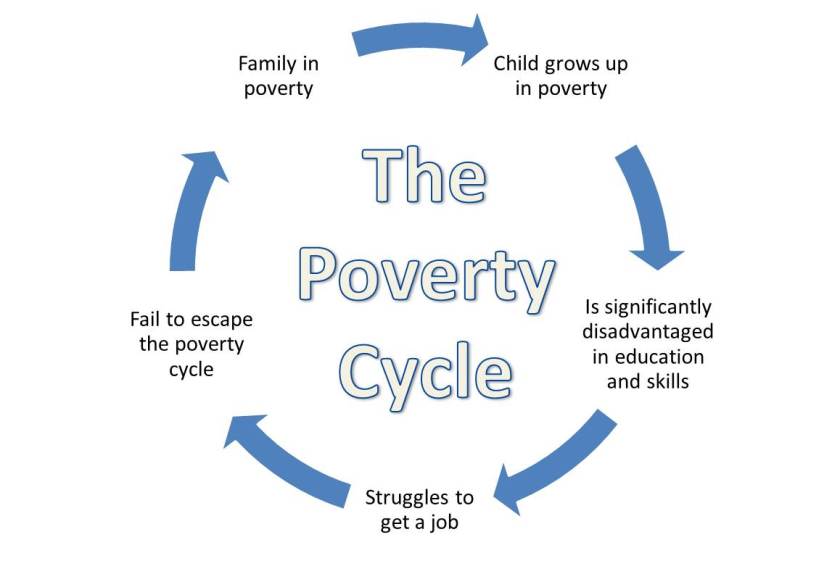
Poverty in Mexico and America comes from low wages and few jobs.

Misogyny lives in most countries of the world, but it is exacerbated by the strong patriarchal nature of families in Mexico. On the other hand, spiritual toughness comes from patriarchal parents (when they are present) because of influences like the Catholic Church in Mexican culture. Urrea explains how some Mexican fathers beat their male children to make them understand life is hard with belief that physical beatings will make them tough. He goes on to suggest Mexican’ girls are raised as bearers of children and companions or servers of men. Mexican fathers set the stage for their sons to be either tough or hopeless. Urrea infers Mexican mothers and fathers insist their children be raised to believe in God because the way people live make heaven or hell life’s only destination.

Urrea paints a picture of being poor and raised in Mexico.

He infers a table is set for many Mexican Americans who use their spiritual toughness and survival experience to get ahead. Women seem relegated to being wives, sex-objects, or mothers, rather than independent, potentially successful human beings. Spiritual toughness may lead to excelling in a job, or at school for men, and a minority of women, to become productive citizens of their new country. Urrea infers the spiritual and physical toughness can take different courses in an immigrant’s life, one is criminal, and the other is not.

Urrea’s story notes some Mexican immigrants choose to join gangs and use their toughness to fight for higher position, more money, and power within a gang.

Education and jobs are one of the ladders, but gang membership and crime become a less difficult path to follow in a foreign culture. Both ladders suffer from macho and misogynistic views of life, but Urrea argues Mexican immigrant life is tempered by the strength of paternalistic family hierarchies and religion.

The main character in “The House of Broken Angels” is Big Angel, the patriarch of a family with many sons, daughters, and grandchildren.

Big Angel is born in Mexico and is raised by a mother whose husband leaves his mother with nothing but a motorcycle which she is compelled to sell to feed her family. Big Angel chooses to leave home. He tries to make a living in Mexico but leaves under suspicious circumstances to join his father in America. Big Angel becomes a self-educated technology programmer through hard work and self-discipline. His offspring in Urrea’s story is about immigrant offspring and their lives in America.

America is shown to be less hospitable than one would hope considering how valuable immigrants have been to its economic growth.

Some like Big Angel choose to stay within the culture of their new homeland with the intent of becoming a positive contribution to society. They take the best lessons of their lives to adjust to a new culture despite unequal treatment. The generations that are related to Big Angel, like all humans, make their own choices in life. Their innate intelligence and life experiences are not the same as Big Angel’s, but they are influenced by his paternal care.

Some listener/readers will use Urrea’s story to argue immigration is bad for America because some choices made by descendants of immigrants have violently robbed, injured, or murdered others.

The fallacy of their argument is that bad actors come from all walks of life. Mexican culture, like all cultures that have survived history, have good and bad qualities. Immigrants treated equitably are more likely to bring positive additions to countries in which they choose to live. That is not Urrea’s story, but he explains how one Mexican immigrant overcame unfair treatment to become a contributor to his adopted country. Big Angel brought something valuable from Mexico to America. Big Angel’s story brought hard work, family, and caring for others as examples of what truly makes America Great.

RAISED FIST

American Democracy will either fail or evolve by choosing to ignore or address the stated purposes of the Constitution.

Books of Interest
 Website: chetyarbrough.blog

Solitary: Unbroken by four decades in solitary confinement. My story of transformation and hope

By: Albert Woodfox

Narrated By: JD Jackson

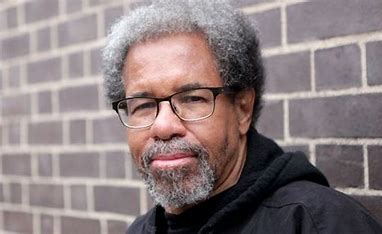
Albert Woodfox, (1947-2022) Author who spent 43 years in solitary confinement in Louisiana’s Angola prison.

Woodfox dies at the age of 75 after being released in 2016.

“Solitary” is about American injustice on many levels. Every societal injustice is magnified by America’s penal system. There is racial discrimination, healthcare disparity, legal system bias, and law enforcement use-of-force to name the most prominent magnifications. Albert Woodfox’s story is a lived life in prison that exposes those levels of societal injustice.

Woodfox’s book is about America’s prison system, but it addresses growing up in the baby-boom generation.

Woodfox, like every human being, is a prisoner of mind but he becomes a physical prisoner in Angola, one of many prisons in America. Woodfox’s tragic life appears emblematic of many poverty-stricken baby-boomer’ lives in the 1960s. His story tells the world what it was, and undoubtedly still is, to live life in America when you are poor, ill-educated, living in a broken home, and/or Black.

Albert is born in Louisiana to a Black father (who retires after 25 years in the Navy) and a loving illiterate Black mother.

When Albert is a young child, his mother is compelled to leave her husband because he becomes a violent abuser after retiring from the Navy. Albert is raised in New Orleans by a single parent. His mother struggles to feed and clothe Albert and his siblings. Albert’s life in New Orleans includes petty theft and the troubles of untethered youth in a home where a single parent is not present because he/she is working to feed and house the family.

After several releases and returns to Angola, in 1971 Albert becomes known as an acolyte of the Black Panthers.

Albert grows up tough and independent but without purpose in his life. He quits school and evolves from petty criminal to armed robber. He first becomes acquainted with the Black Panther movement when he is jailed in New York. Association with the Panther movement changes his life. He is arrested and imprisoned in New York. He becomes a participant in the New York prison riots and adopts much of the Black Panther philosophy, i.e., a belief in Black nationalism, socialism and armed self-defense in the face of white discrimination. Albert began to believe in himself, improving his education by reading, and more importantly, respecting what is right in his life rather than what is expedient.

Woodfox is released from the New York prison system but is remanded to Angola for escaping the Louisiana prison system from an earlier crime.

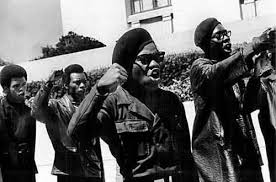
He finds Angola is the same pit of despair it was when he was first imprisoned in Louisiana. Angola remains poorly maintained and continues to treat inmates, particularly Black inmates, inhumanely. However, Albert’s life is changed by the Panther’ philosophy. He begins to feel there is purpose in his life. His purpose becomes uniting prisoners (the Black Panther’ symbol of a closed fist meaning a “coming together” like the 5 fingers of a hand). Black prisoners come together in an effort to improve their treatment and education in prison. He allies himself with another devotee to begin a chapter of the Panther’ movement in the Angola prison.

The Black Panther movement began in 1966 with Huey Newton and Bobby Seale. Their plan was to unify African Americans to challenge police brutality in Oakland, California.

The movement failed because of internal tension, the FBI’s successful effort to undermine the movement, and determined white American resistance. Despite the demise of the movement, the idea of unifying African Americans against white privilege and unequal treatment survived despite the fall of the Black Panther movement. The movement has had a lasting impact on prison reform, community programs to improve education, and health services in poor black communities.

In 1974, Albert Woodfox is tried and convicted for murdering Brent Miller, a prison guard who is a third-generation guard at the Angola prison farm on which inmates worked. There is no concrete evidence to show Woodfox murdered Miller

He is put in solitary and remains in solitary for 40 years where he spends 23 hours a day with 1 hour for prison-yard exercise per day. That one hour per day is reduced to 3 hours a week in his last year of imprisonment. Amazingly, Woodfox survives and after several appeals, delayed and fought by the State of Louisiana, Woodfox is released to die a free man.

“Solitary” is an amazing tribute to the strength and resilience of human beings.

Woodfox becomes a self-educated American despite his horrendous treatment in the American prison system. He, and other prisoners, expose the failure of the American penal system to be more than an incarceration system to separate criminals from the general public. In that exposure, Woodfox shows changes were made in Angola and other prisons but far from turning prison into the rehabilitative need of society.

The fundamental cause of America’s failure is not achieving the stated purpose of equal opportunity for all in the Constitution of the United States.

The inferences one draws from “Solitary” reinforces America’s need to address the root causes of failure in its prison system. All men are created equal. America must improve government policies that assure the health, education, and welfare of its citizens. Woodfox’s story of Angola suggests socialism will cure the ills of American society. The truth seems more to be whether American Democracy will evolve or fail by choosing to ignore or address the stated purposes of the Constitution.

DRAWING THE LINE

A reader/listener will come to their own conclusions about Ms. Fox’s epilogue. Where does one draw the line?

Books of Interest
 Website: chetyarbrough.blog

The Talented Mrs. Mandelbaum” The Rise and Fall of an American Organized-Crime Boss

By: Margalit Fox

Narrated By: Saskia Maarleveld

Margalit Fox (Author, copy editor for the New York Times.)

Fox writes a memoir of America’s equivalent of Fagin in Dicken’s “Oliver Twist”. Mrs. Mandelbaum, like Fagin, created a school of crime for New York City street-dwellers in the mid-nineteenth century. An interesting insight by Fox is how people slip into crime. Mrs. Mandelbaum makes a living for her family in New York by becoming a fence for merchandise collected on New York’ streets. Like any sales business the key was buying low and selling high. Street merchandise is cheaper than store merchandise because of lower overhead and, of course, theft.

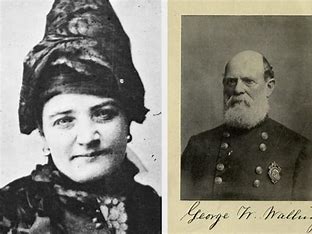
The Chief of Police of New York City at the time (pictured to the far right) considered the criminal Fredericka “Marm” Martha Mandelbaum an admirable businesswoman.

Fox notes the Mandelbaum family emigrated from Germany in 1850. Mrs. Mandelbaum’s husband, Wolf Israel Mandelbaum, made a living as a peddler in Germany. Martha Mandelbaum sees similar opportunity in New York City. She becomes a fence, a kind of peddler, for New York city street’ merchandise. However, Mrs. Mandelbaum recognized that the quality and quantity of merchandise she fenced could be improved by theft. She created a school like Dicken’s Fagin to teach the craft of theft. Her “school” began teaching young acolytes the art of pickpocketing and petty theft. She began building a criminal empire that evolved into financing bigger crimes like fabric store theft, jewelry store theft, and most lucrative of all, bank robbery.

Mandelbaum provided financing for specialized research of banking personnel and bank activity for intended bank robberies. She paid for sophisticated tools needed for the robberies, and then brokered robber’s thefts to buyers.

Mandelbaum grew her business into a million-dollar enterprise. She carefully remained in the background of her lucrative business. She became the “Queen of Fences”. In July of 1984, “Marm” Mandelbaum and her son Julius were arrested by Pinkerton agents and taken into custody. She allegedly punched the arresting officer and protested her innocence but went to trial where she was required to post a $10,000 bond after spending a night in jail. She and her son jump bail and cross the border into Canada. They were detained in Canada but without a law allowing extradition, she and her son could not be returned to the United States.

Mrs. Mandelbaum and her son open a store in Canada after contacting many of her associates in New York to explain her plan to sell merchandise out of this new store location. One presumes her associates continued their criminal ways of acquiring New York merchandise and shipping it to Canada for resale.

Julius J. Mandelbaum (1905-1988, son of “Marm” Mandelbaum died at age 83 in Long Beach New York.)

Fox’s story takes an interesting turn in an epilogue of her memoir about Mrs. Mandelbaum. “Marm’s” daughter, who was 18, died of pneumonia in New York. Mrs. Mandelbaum risked incarceration by surreptitiously returning to New York for a Jewish funeral for her daughter. She is not arrested and successfully returns to Canada.

Fox infers Mrs. Mandelbaum is as much a victim of her time as she was a criminal.

Fox explains in a Jewish family, women have essential roles in managing households, raising children, and contributing to their communities. In some circumstances, Fox notes Jewish wives engage in business while managing the household. Fox suggests Mrs. Mandelbaum simply carries out those duties in her life in New York.

A reader/listener will come to their own conclusions about Ms. Fox’s epilogue. The question that comes to mind is whether some people died as a result of Mrs. Mandelbaum’s financing of illegal activity, including bank and jewelry robberies. Where does one draw the line?

Mother Mandelbaum died without an exact cause of death at age 68. She was given a grand funeral in New York City that drew community elites, politicians, and undoubtedly, criminal associates.

EUGENICS

On the one hand, genetic science may cure the incurable. On the other, genetic science may destroy civilization.

Books of Interest
 Website: chetyarbrough.blog

Why Fish Don’t Exist” A Story of Loss, Love, and the Hidden Order of Life

By: Lulu Miller

Narrated By: Lulu Miller

Louisa Elizabeth Miller (Author, Peabody Award-winning science reporter for NPR.)

Lulu Miller’s “Why Fish Don’t Exist” reveals the flaw in believing intelligence or position are measures of admirability. David Star Jordan is a founding president of Stanford University. He served from 1891 to 1913 after being the Indiana University president from 1884 to 1891. Jordan gained his academic qualification as a recognized ichthyologist (a zoologist who specializes in studying fish species).

David Starr Jordan (1851-1931, Scientist, founding president of Stanford University.)

Miller begins her memoir in admiration of Jordan but ends in vilification. Jane Stanford appointed Jordan as the first President of Stanford. Their collaboration laid the foundation for what became a research powerhouse for engineering, business, humanities, and sciences. Ms. Stanford’s relationship with Jordan is reported as less than harmonious because in the University’s beginnings there were financial difficulties and differences of opinion about faculty.

Jane Elizabeth Lathrop Stanford (1828-1905, American philanthropist and co-founder of Stanford University.)

Jane Stanford rejects an economics professor’s contract renewal because of his politics and his criticism of immigration. (Ms. Stanford’s and her husband’s wealth came from the railroad industry which was hugely benefited by immigration.) It is alleged that she pressured Jordan to refuse the professor’s contract renewal. Five faculty members resigned after the professor’s termination. Ms. Stanford had a reputation for requiring total devotion to her beliefs which, at times, conflicted with Jordan’s management of the University. More significantly, Ms. Stanford’s drive alienates and makes enemies of many people associated with the University.

Ms. Stanford dies in Hawaii in her 70s. The cause of death is attributed by authorities to be poisoning from strychnine.

What makes her death an ongoing mystery is that Jordan hires a medical investigator who argues Ms. Stanford died from natural causes, a heart attack, brought on by overeating. In much of America, Jordan’s hired investigators’ cause of death is accepted. That is, until a book is written by Richard White in the 21st century, that reaffirms the authority’s earlier opinion. Miller does not suggest Jordan had anything to do with Stanford’s murder, but Miller’s inference is that he initiated a cover-up.

In one sense, Miller is Jordan’s character assassin. In another, Miller reveals the dark side of science.

Jordan is shown to believe in eugenics that advocates selective breeding of the human race. Eugenics is a science meant to selectively breed human beings. Miller explains Jordan believes in forced sterilization (which surprisingly exists in the United States until 1981). Eugenics is the same belief held by Adolf Hitler when he tried to exterminate Jews and create an exclusive Nordic or Aryan race. Hitler established laws for forced sterilization, euthanasia, and selective human breeding.

STANFORD UNIVERSITY

Miller’s memoir of David Starr Jordan shows how science is a mixed blessing. Jordan’s remarkable work in zoology and his role as the first President of Stanford is tainted by his expressed belief in eugenics. The threat of eugenics is greater today than in the past. On the one hand, genetic science may cure the incurable. On the other, genetic science may destroy civilization.

DEMOCRACY OR ELSE

“…saving America” will not come from “…ten easy steps” but from one vote at a time.

Books of Interest
 Website: chetyarbrough.blog

Democracy or Else” How to Save America in 10 Easy Steps

By: Jon Favreau, Jon Lovett, Tommy Vietor

Narrated By: Jon Favreau, Jon Lovett, Tommy Vietor

(Left to Right) Jon Favreau, Jon Lovett, Tommy Vietor

The suggestion that “Democracy or Else” comes from “…10 Easy Steps” on “How to Save America…” is an oversimplification of life and politics. Saving America takes hardened objective opinion, personal commitment, appreciation of the difficulty of being a political leader, and most importantly, the wisdom of Jesus Christ. Few, if any humans fit the bill. Voting is the only thing that everyone who believes in American Democratic leadership will agree upon in the author’s “…10 Easy Steps”. The steps are not easy. The authors appear to have committed some time and effort to fulfill some part of the 10 steps.

Many (not most) Americans may be willing to vote but working on a campaign for a candidate who wishes to be elected to public office will always be low on their list of commitments.

Human beings, let alone Americans, are an unruly lot. Making a living, waiting for a hand-out, hating or loving others, and experience of life come first in the minds of most, if not all, human beings. The nuts and bolts of what it takes to become an elected representative in Democracy are way down on the list of humans’ self-interest. American Democracy, like all known forms of government, have winners and losers. Democracy has the best odds for serving the self-interest of its citizens but remains far from the idealistic goals of the U.S. Constitution.

American Presidents have been good and bad throughout history. Only a few have earned the history of “good or great” for America. The checks and balances of American government, the ideals of the Constitution, capitalism, and expanded voting rights have saved American Democracy from tyranny. Anyone who has read this blog, knows there is an opinion about the next President’s election but “…saving America” will not come from “…ten easy steps” but from one vote at a time.

WHAT’S TO BE DONE

America cannot pass essential legislation that fairly addresses the burden and potential benefit of immigration.

Books of Interest
 Website: chetyarbrough.blog

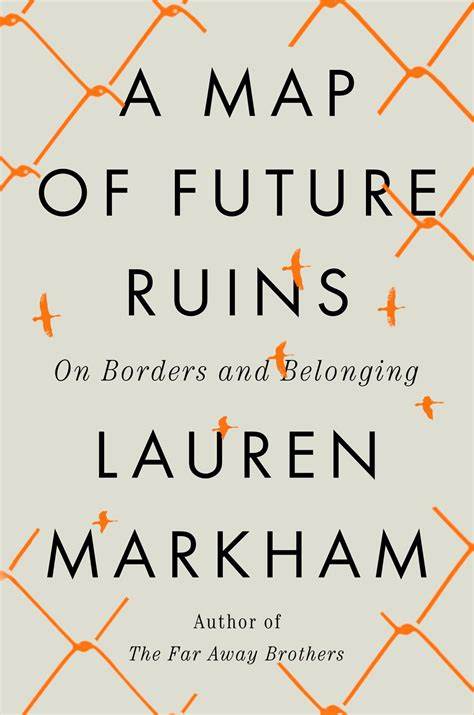
“A Map of Future Ruins” (On Borders and Belonging)

By: Lauren Markham

Narrated by: Gilli Messer

Lauren Markham (Author, reporter on issues about migration and human rights.)

Immigration is a hot subject around the world.

Lauren Markham writes a somewhat disjointed book about immigration to a Greek island between Turkey and Greece.

Lauren Markham offers a report of a fire in a Lesbos refugee camp in the small town of Moria on September 9, 2010. There were no deaths from the fire but the conditions of the encampment and the government’s response to the crises tell of unfair and inadequate treatment of refugees–reminiscent of other countries dealings with unwanted immigrants.

The camp was designed to hold 3,000 people but grew to nearly 13,000. Seventy percent of the migrants were from Afghanistan. A fire of unknown origin destroyed the immigrant’s shelter that gave notice to the world of the inadequate care offered refugees fleeing crime, poverty, and displacement in their home countries.

Turkey and Greece have a storied history of conflict that is reminiscent of the Afghanis flight from Afghanistan. Turkey’s most revered leader, Mustafa Kemal Ataturk, ordered Greeks to leave Turkey in a mass exodus during his reign. Ethnic and religious differences between the Ottoman Empire and Greece came to a boil in 1923. Those differences are reminiscent of the escape of Afghanis from the restrictive life of the Taliban in Afghanistan. Afghanis chose a route from Afghanistan through Iran to Turkey to the Greek Island of Lesbos to escape the Taliban.

Markham shows the initial response of the Greeks was to aid the Afghanis in their flight but as the number of refugees grew, the burden became too great. The conditions of the encampment deteriorated, and the anger of the Greek government escalated. A fire of unknown origin began in the camp. Six Afghanis, two of which were minors under 18 years of age, were arrested and found guilty of setting the fire. Markham shows the evidence for conviction had nothing to do with truth but was manufactured by the Greek Court to find a verdict of guilt.

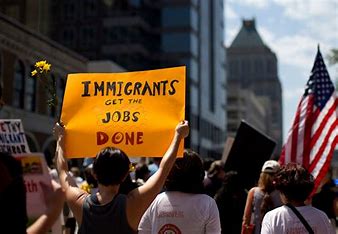
“Dallas, Texas, United States – May 1, 2010 a large group of demonstrators carry banners and wave flags during a pro-immigration march on May Day.”

The inference from Markam’s report is that America’s border state conflicts will, and undoubtedly have, resulted in unjust treatment of emigrants. The irony is that America needs emigrants to meet the needs of its economic future. America seems to be doing as poor a job of addressing immigration as the story of the Afghanis in Moria. America cannot pass essential legislation that fairly addresses the burden and potential benefit of immigration.