It appears to this listener/reader, the rise of authoritarianism in the world today lays at the feet of Marx and, to a lesser extent, von Mises’ economic theories.
Books of Interest Website: chetyarbrough.blog
Human Action: A Treatise on Economics
By: Ludwig von Mises
Narrated By: Jeff Riggenbach
Ludwig von Mises (Austrian-American economist, logician, sociologist, and philosopher. 1881-1973, died at age 92.)
Economics is defined as a social science that studies how individuals, businesses, governments, and societies allocate resources to satisfy the needs and desires of a community of people. Historically, one of the greatest explainers of this social science is Ludwig von Mises. Maturing at a time of the communist revolution, the advance of capitalism and both world wars, von-Mises offers one of the greatest books about economics since Adam Smith. The only economist of greater significance is Adam Smith (1723-1790) because of his origination of the principles of economics. Close behind are Karl Marx (1818-1883), and John Maynard Keynes (1883-1946).
KARL MARX (BORN TRIER, GERMANY 1818-DIED LONDON, ENGLAND 1883)JOHN MAYNARD KEYNES (1883-1946)
Of course, all economists are beholding to Adam Smith with his original conception of the dismal science. Smith conceived of the “invisible hand” of economics that postulated self-interest as the primary contributor to the overall good of society. Von Mises seems to guardedly agree but suggests self-interest’ market pricing can artificially distort distribution of economic resources. Von Mises infers the “invisible hand” is inefficient at the least and may artificially distort prices in the hands of authoritarian governments and business monopolies. Karl Marx suggests the invisible hand would evolve into a production system that would be owned by the public to ensure equality of distribution in an evolutionary economy that passes from capitalism to socialism, and finally communism. Marx argues self-interest will evolve into a common interest for all. Marx’s idea of change in the nature of human beings beggars the imagination.
Smith supported limited government intervention to maintain justice, defense, and public works.
Both Smith and Marx believed in a “labor theory of value” which argues the value of a commodity is determined by the labor required to produce it. Where Smith and Marx depart is in government enforcement of a balance between labor and the cost of goods. Von Mises opposed most forms of governmental intervention in the economy. However, Keynes argues government intervention is necessary during economic downturns. After WWII, Keynes theory became an important part of the American government’s support of European reconstruction.
Von Mises believed in human individualism which carries the risk of authoritarian domination.
Von Mises believed in human individualism while Smith and Keynes support limited government intervention. Marx argues human nature could be shaped by a melding of government dictatorship with societal pressures to support communal goals.
At extremes, von Mises endorses individualism and Marx endorses dictatorship. The middle ground seems held by Adam Smith and John Maynard Keynes that endorse limited government intervention. It appears to this listener/reader, the rise of authoritarianism in the world today lays at the feet of Marx and, to a lesser extent, von Mises’ economic theories.
The length and value of von Mises’ book overwhelms a non-economist listener with his esoteric statistical and lengthy explanations of economic theory. However, comparison with a dilatant’s understanding of other renown economists is enlightening.
Andrew Leigh’s brief history of economics reminds listeners of a threat America faces in the next four years.
Books of Interest Website: chetyarbrough.blog
How Economics Explains the World (A Short History of Humanity)
By: Andrew Leigh
Narrated By: Stephen Graybill
Andrew Leigh (Author, Australian politician, lawyer, former professor of economics at the Australian National University, currently serving as Assistant Minister for Competition, Charities and Treasury and Assistant Minister for Employment in Australia.)
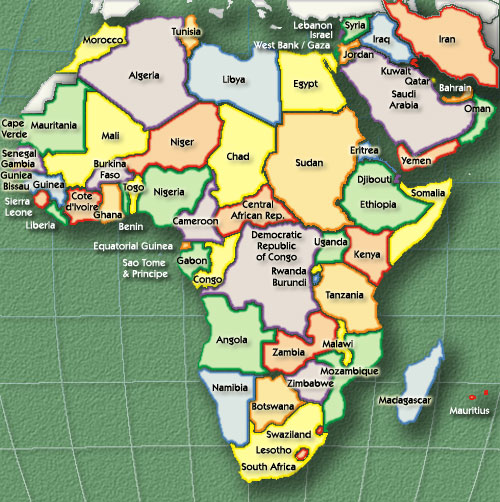
Andrew Leigh offers a bird’s eye view of the history of economics. He provocatively explains why the European continent, rather than Africa (the birthplace of the human race) came to dominate the world. He suggests it is because of economics and the dynamics of the agricultural revolution.
Because Africa offered a more conducive environment for natural food production, Leigh infers natives could live off the fruits and nuts of nature. He infers farming and agricultural innovations (like the plow) were of little interest to Africans.
One may be skeptical of that reasoning and suggest the primary cause is sparse arable land for early African inhabitants. Without arable land, there was little advantage from the agricultural revolution.
Nevertheless, Leigh’s history is a wonderful reminder of great economic theories that improved the lives of an estimated 8.2 billion people on this planet. He touches on the lives of Adam Smith, David Ricardo, John Maynard Keynes, and Milton Friedman. Each made great contributions to the history of western economics.
Adam Smith is considered the father of modern economics. (1723-1790)
Leigh notes Smith was a deep thinker who sometimes neglected the world he lived in by forgetting to properly dress himself or falling into a hole while thinking about economic theories. Some of his key theories were “Division of Labor”, the “Invisible Hand”, “Labour Theory of Value”, “Free Markets and Competition”, and “Capital Accumulation”; all of which remain relevant today. One that seems so important today is “Free Markets and Competition” and the disastrous idea of tariffs that are being promoted by the pending Trump administration.
Smith notes natural resources are not equally distributed in the world. Some countries have more raw material than others, more available labor at a lower cost, and can produce product at lower prices. With free trade, all citizens of the world are benefited by lower costs of goods. With tariffs, product costs are artificially increased when they could reflect actual costs of production. Of course, the producer can increase costs, but the market will find an alternative if the costs become too high.
David Ricardo (1772-1823)
Ricardo’s theory of competitive advantage suggests some countries can produce product at less cost than others. This reinforces the critical importance of free trade. Free trade flies in the face of both the Biden’s passing administration and Trump’s future administration; both of which believe tariffs protect jobs in America. They don’t; because tariffs artificially increase product costs while protecting labor inefficiency that increases consumer prices. Tariffs are a lose-lose proposition. It may affect jobs in the short term but there are many jobs that can be created by government and private companies in human and public service industries. Those investments would offset inefficient product production and ensure future jobs.
John Maynard Keynes (1883-1946)
Leigh notes that Keynes was bisexual and a pivotal figure in modern economics. He believed in the theory of Aggregate Demand meaning that “…spending in an economy is the primary driver of economic growth.” He advocated government intervention when demand was low, and that government should increase spending and cut taxes to increase demand when a recession or depression threatens the health and welfare of the public. Interestingly, Trump believes in reducing taxes but objects to government spending that improves employment. The effect of reducing taxes only increases income inequality and does little for employment because the rich are wary of investing in a weakening economy.
Milton Friedman (1912-2006)
Both Keynes and Friedman believe in government intervention, but Friedman exclusively believes in using only monetarism as a tool. Keynes agrees but had the added dimension of government spending that creates jobs. In contrast, Friedman argues there is a natural rate of unemployment and when government intervenes it creates inflation. He strongly agreed with free markets which suggests he would be against tariffs but at the expense of higher unemployment. The cloying part of that argument is it increases income inequality by making the rich richer, the unemployed and middle-class worker poorer.
Leigh’s book is a brief review of western economics. It glosses over much of the science, but it is highly entertaining and worth listening to more than once. Additionally, Andrew Leigh’s brief history of economics reminds listeners of a threat America faces in the next four years.
Eubanks is wrong to think digitization ensures a future that will create a permanent underclass. The next four years may not show much progress in welfare, but American history has shown resilience in the face of adversity.
Books of Interest Website: chetyarbrough.blog
Automating Inequality (How Hich-tech Tools Profile, Police, and Punish the Poor
By: Virginia Eubanks
Narrated By: Teri Schnaubelt
Virginia Eubanks (Author, American political scientist, professor at the University at Albany, New York.)
At the risk of sounding like a “bleeding heart” liberal, Virginia Eubanks assesses the inefficient and harmful effects of technology on welfare, childcare services, and homelessness in America. Eubanks illustrates how technology largely reduced the cost of Indiana’s welfare. However, cost reduction came from removing rather than aiding Americans in need of help. She shows southern California is better organized in the 2000s than Indiana in their welfare reform movement in the 1990s. However, the fundamental needs of the poor and homeless are shown to be poorly served in both jurisdictions.
In the last chapters of the book, Eubanks looks at Pennsylvania’s childcare services (CCW). She argues her research shows digitization of personal information, societal prejudice, and inadequate financial investment as fundamental causes of America’s failure to help abused children. Eubanks implies the cause of that failure is the high-tech tools of the information age.
Eubanks offers a distressing evaluation of Indiana’s, California’s, and Pennsylvania’s effort to improve state welfare programs.
The diagnosis and cure for welfare are hard pills to swallow but Eubank’s research shows welfare’s faults without clarifying a cure. She clearly identifies symptoms of inequality and how it persists in America. Eubank infers America’s politicians cannot continue to ignore homelessness and inequality. America needs to reinforce its reputation as the land of opportunity and freedom. Eubank implies technology is the enemy of a more equal society by using collected information to influence Americans to be more than self-interested seekers of money, power, and prestige.
Eubank explains how Indiana welfare recipients were systematically enrolled in an information technology program meant to identify who receives welfare, why they are unemployed, and how they spend their money.
She argues this detailed information is not just used to categorize welfare recipients’ qualifications for being on welfare. The purported reason for gathering the information is to help those on welfare to get off welfare and become contributors to the American economy. What Eubank finds is the gathered information is used to justify taking citizens off of welfare, not improve its delivery. Poorly documented information became grounds for denying welfare payments. If someone failed to complete a form correctly, their welfare payments were stopped. The view from government policy makers was that welfare costs went down because of the State’s information gathering improvements. In reality welfare costs went down because recipients were rejected based on poorly understood rules of registration. Indiana did not have enough trained management personnel to educate or help applicants. Welfare applicants needed help to understand how forms were to be completed and what criteria qualified them for aid.
From Indiana State’s perspective, information technology reduced their cost of welfare. From the perspective of Americans who genuinely needed welfare, technology only made help harder to receive.
Eubank notes there are three points that had to be understood to correct Indiana’s welfare mistakes:
information algorithms qualifying one for welfare must be truthful, fair, and accurate,
the information must reflect reality, and
training is required for welfare managers and receivers on the change in welfare policies.
Another point made by Eubank is the danger of computer algorithms that are consciously or subconsciously biased. A biased programmer can create an algorithm that unfairly discriminates against welfare applicants that clearly need help. This seems a legitimate concern, but Eubank misses the point of more clearly understanding the need of welfare for some because of the nature of American capitalism and the consequence of human self-interest. Contrary to Eubank’s argument, digitalization of information about the poor offers a road to its cure not a wreck to be avoided.
WELFARE CATEGORY ELIGIBILITY PERCENTAGES IN INDIANA
Eubank tells the story of a number of Indiana residents that had obvious medical problems making them unemployable but clearly eligible for welfare payments. They are taken off welfare because of mistakes made by government employees’ or welfare recipient’ misunderstandings of forms that had to be completed. From the government’s standpoint Indiana’ welfare costs went down, but many who needed and deserved help were denied welfare benefits. The rare but widely publicized welfare cheats became a cause celeb during the Reagan years that aggravated the truth of the need for welfare in America. The truth, contrary to Eubanks opinion, becomes evident with the digitization of information as a basis for legislative correction.
Eubank notes Skid Row in Los Angeles lost many of its welfare clients with gentrification of the neighborhood. The poor were moved out by rich Californians who rebuilt parts of Skid Row into expensive residences.
Eubank explains a different set of problems in the Los Angeles, California welfare system. The technological organization of the LA welfare system is better but still fails to fairly meet the needs of many citizens. The reasons are similar to Indiana’s in that algorithms that categorize information were often misleading. However, the data-gathering, management, and use of information is better. The more fundamental problem is in resources (money and housing) available to provide for the needs of those who qualify for welfare. It is not the digitization of the public that is causing the problem. Contrary to the author’s opinion, digitization of reality crystalizes welfare problems and offers an opportunity for correction.
Homelessness is complex because of its many causes. However, having affordable housing is a resource that is inadequately funded and often blocked by middle class neighborhoods in America. Even if the technological information is well organized and understood, the resources needed are not available. Here is where the social psychology of human beings comes into play. Those in the middle class make a living in some way. They ask why can’t everyone make a living like they have? Why is it different for any other healthy human being in America? Here is where the rubber meets the road and why homelessness remains an unsolved problem in America.
People are naturally self-interested. One person’s self-interest may be to get high on drugs, another to steal what they want, others to not care about how they smell, where they sleep, look, live, or die. Others have chosen to clean themselves up and get on with their life. Why should their taxes be used to help someone who chooses not to help themselves? Understanding the poor through digitization is the foundation from which a solution may be found.
Traveling around the world, one sees many things. In India, the extraordinary number of people contributes to homelessness. In France, it is reported that 300 of every 100,000 people are homeless. Even in Finland, though there are fewer homeless, they still exist.
It is a complex problem, but it seems solvable with the example of what Los Angles is trying to do. It begins with technology that works by offering a clear understanding of the circumstances of homelessness. A detailed profile is made of every person that is living on the street. They are graded on a scale of 1 to 17 based on the things they have done in their lives. That grade determines what help they may receive. Some may be disqualified because of a low number but the potential of others, higher on the scale, have an opportunity to break the cycle of poverty with help from welfare. It is the resources that are unavailable and social prejudice, not gathered personal digital information, that constrain solutions.
With informational understanding of a welfare applicant, it principally requires political will and economic commitment by welfare providers. There is no perfect solution but there are satisficing solutions that can significantly reduce the population of those who need a helping hand. American is among the richest countries in the world. Some of that wealth needs to be directed toward administrative management, housing, mental health, and gainful employment.
Like all countries of the world, as technological digitization improves, human services will grow to become a major employment industry in the world.
America, as an advanced technology leader, has the tools to create a service economy that is capable of melding industrial might with improved social services.
Eubanks travels to Pennsylvania to look at their child services program.
What Eubanks finds in Pennsylvania is similar to what she found in LA and, to a degree, Indiana. Children who are at risk of being abandoned, abused, or neglected are categorized in a data bank that informs “Child Services” of children who need help. The problem is bigger than what public services can handle but the structure of reporting offers hope to many children that are at risk. Like LA, it is a resource problem. But also, it is a problem that only cataloging information begins to address.
Parents abuse their children in ways that are often too complicated for a standardized report to reveal. Details are important and digitization of personal information helps define what is wrong and offers a basis for pragmatic response.
Computerized reports, even with A.I., are only a tip of the reality in which a child lives. This is not to argue child-services should be abandoned or that reports should not be made but society has an obligation to do the best it can to ensure equality of opportunity for all. Every society’s responsibility begins with childhood, extends through adulthood and old age–only ending with death. Understanding the problems of the poor is made clearer by digitization. Without digital visibility, nothing will be done.
Eubanks gives America a better understanding of where welfare is in America. She is wrong to think digitization ensures a future that will create a permanent underclass. The next four years may not show much progress in welfare, but American history has shown resilience in the face of adversity.
The election results are in, and Trump is our President once again. This is a sad commentary on the will of the American people and the threat America is to world economic comity.
Books of Interest Website: chetyarbrough.blog
People, Power, and Profits (Progressive Capitalism for an Age of Discontent)
By: Joseph E. Stiglitz
Narrated By: Sean Runnette
Joseph Stiglitz (Author, American economist, public policy analyst, received a Nobel Memorial Prize in Economic Sciences in 2001.)
With reservation, Joseph Stiglitz’s book “People, Power, and Profits” is reviewed here. The reservation is because of the risk of succumbing to echo-chamber’ belief. That belief is that corporations and wealthy individuals should not be able to pour as much money as they want into the American election process, that bankers unjustly escaped punishment for the 2008 financial crises, and that Donald Trump should never again be elected President of the United States.
Stiglitz is considered a “New Keynesian” economist which puts him at odds with famous economists like Milton Friedman and Friedrich Hayek. Friedman believes the most effective fiscal policies comes from monetary policy control by the government. Hayek believed in a market economy with as little government intervention as possible. Stiglitz flatly disagrees with Hayek and only agrees with Friedman in that government has a responsibility to intervene in government economic policy. Stiglitz identity as a “New” Keynesian is because, unlike Keynes’ economic theory, there is no waiting for an economic crisis for government to intervene but to intervene now to make future economic crises less likely.
John Maynard Keynes (English, Eton and King’s College graduate, mathematician, economist, 1883-1946, died at age 62.)
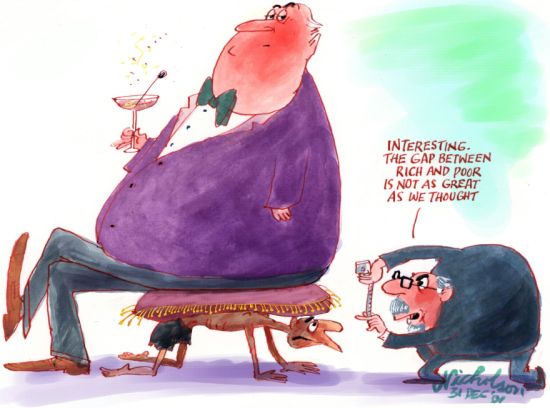
Why I am concerned about listening to Stiglitz’s book about the economy is that I am listening to some things I already believe. I believe the gap between rich, and poor is the greatest threat to, not only American democracy, but all forms of government. Stiglitz may be my echo chamber.
Stiglitz believes in democratic government intervention to ameliorate the wide gap between rich and poor.
Stiglitz has an idealist platform to cure what he views as the solution to narrowing the gap between rich and poor in America. Stiglitz makes five policy recommendations to reduce the gap between rich and poor in America.
Increase taxes on income from capital gains and inheritance.
Use tax revenues to improve public education in ways that equalize costs between the rich and poor.
Refine anti-trust laws to prevent monopolies and promote competition.
Intervene in corporate governance to ensure fairer compensation between management and labor.
Regulate banks to prevent exploitation of the public.
These are defensible polices but they have to survive the give and take political process of American democratic government.
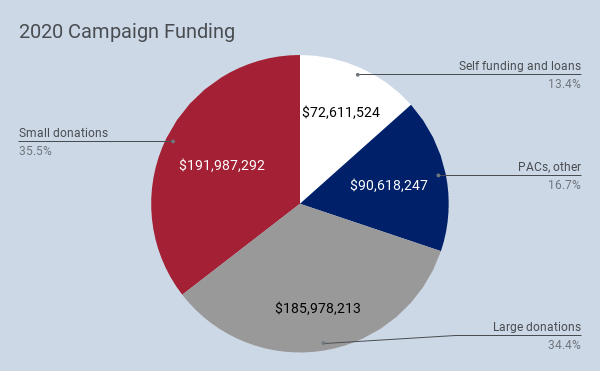
However, that process is unfairly biased by allowing corporations and the wealthy to pour disproportionate amounts of money into the American election process. Contribution by corporations and the wealthy should be limited because candidates are beholding to big financial donors with little concern for the poor.
In the 2020 and 2024 election cycle, big donors contributed from 75 to 78 percent of campaign donations.
The problem with Stiglitz’s book is not in his recommendations but in his vengeful angel’ rhetoric. America is founded on freedom, not revenge. It is the give and take of differences of opinion and “checks and balances” of the Constitution that have made America great. Many mistakes have been made and are still being made by our government but even a horrible President like Trump cannot change the fundamental direction of our democracy.
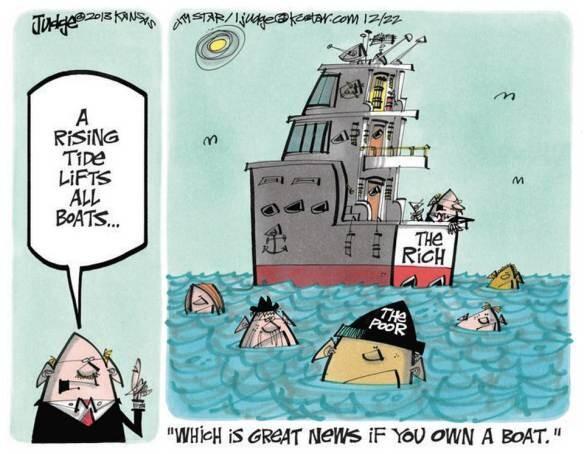
John F. Kennedy’s belief that a rising tide lifts all boats has not provided life vests to the poor in America.
The gap between rich and poor in America must be resolved. Neither Harris nor Stiglitz may be the answer, but Trump is only going to try to resurrect a past that has led our government in the wrong direction. The unconscionable cost of medical services and drugs, extraordinary compensation for executives, regressive taxes, election financing bias, and financial industry greed must be addressed through the American political process.
American democracy’s failures will not be cured, but they must be addressed and ameliorated to remain a beacon for freedom in the world. The election results are in, and Trump is our President once again. This is a sad commentary on the will of the American people and the threat America is to world economic comity.
Tariffs to restrict foreign production is shooting citizens in the foot by artificially increasing the cost of living.
Books of Interest Website: chetyarbrough.blog
Edge of Chaos: Why Democracy Is Failing to Deliver Economic Growth – and How to Fix It
By: Dambisa Moyo
Narrated By: Pamala Tyson
Dambisa Moyo (Zambian-born economist and author with a BS and MBA from Harvard, former World Bank consultant to Europe, Central Asia and Africa.)
“Edge of Chaos” is a revelatory and intelligent analysis of economic rewards and risks of democracies and dictatorships. Fundamentally, Moyo argues failures of government economies are related to societal instability and short-term government economic policies that are disproportionately influenced by monied interests and kleptocratic political leaders. Rich corporations and kleptocratic leaders distort economic opportunity, create chaos while producing and exacerbating economic inequality. She argues America is at the edge of chaos because of a flawed democratic election system that is biased toward short-term rather than long term economic policy.
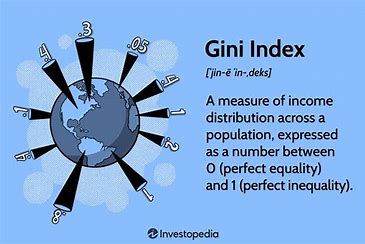
Moyo identifies the Gini index of income inequality to show that there is little difference between the rich and poor in China and the United States despite their government leaders’ differences.
China is a dictatorship while America is a form of democracy. They are nearly the same on the Gini index scale of citizen inequality while South Africa, Zambia and Brazil are at the bottom. Slovenia, the Czech Republic, Slovakia, Belarus and most of the Scandinavian countries show the lowest differences in citizen’ economic inequality. Mayo argues the difference has little to do with their forms of government except in relation to their government policies. In her opinion, China and the United States could improve their citizen’s Gini index position if their government policies would focus on income equality.
Both China and America have relative stability but with different forms of government.
Unquestionably, freedom is the sine non quo (indispensable ingredient) of America, but it is income inequality that causes the chaos Moyo alludes to in her book. That chaos is not overtly apparent in China because of dictatorship but one who has traveled to China feels there is a similar level of discontent, if not chaos, among its citizens over economic inequality.
Moyo’s solution for reducing America’s growing chaos seems difficult but not impossible to implement.
Dambisa Moyo’s solution revolves around the following 8 recommendations.
Make voting compulsory to increase voter participation more representative of the people.
Make election to the House of Representatives a six-year term like the Senate to encourage longer term economic goals but limit the number of terms one can be in office. (Eliminate career politicians.)
Increase the pay of politicians to what successful private sector leaders receive.
Establish policy making agencies that can focus on long-term policies without being threatened by near term election cycles.
Invest in the education of future leaders of the political system.
Encourage public officials to focus on economic diversification with an educated understanding of technological change in the world.
The wealth of the nation should be focused on reduction of economic inequality.
Strategies to manage natural resources should be developed to focus on sustainability.
Fair trade is where America is on the wrong side of history according to the author.
Adam Smith believed in fair trade.
Adam Smith argued for removing trade barriers like tariffs and quotas because of limited natural resources. He explains resources are more efficiently allocated, product production is increased, and economic growth is improved with free trade. As inferred by Moyo, American chaos is partly a result of ignoring Adam Smith’s prescient understanding of economics.
America democracy has journeyed a long way since 1776.
America’s fundamental success came from its emphasis on freedom within rules-of-law organized around the “checks and balances” of three distinct branches of government, i.e., the executive, congressional, and judicial branches. This is the strength of American Democracy that has offered stability. The inference made in “Edge of Chaos” is that America’s stability is at risk if it does not adapt to technological change wrought by A.I. and global interconnectivity.
Technology is changing the nature of American productivity from material products to service. With the help of A.I., America can begin to address many of the service needs of its citizens. From aid to the homeless, to education for service to others, to drug treatment of the addicted, to improved health care for all, the prosperity and income of Americans can be more equitably shared.
Global interconnectivity requires greater acceptance of fair trade as originally described by Adam Smith.
Today’s alleged protection of worker employment by using tariffs to restrict foreign production is shooting citizens in the foot by artificially increasing the cost of living. Re-education for service to the public by using A.I. to make citizens more human-centered offers an alternative to 21st century American chaos.
These are intelligent observations by a very young and well-educated author.
Capitalism is not a partisan issue but a social imperative for both Republicans and Democrats to work together to benefit all Americans.
Books of Interest Website: chetyarbrough.blog
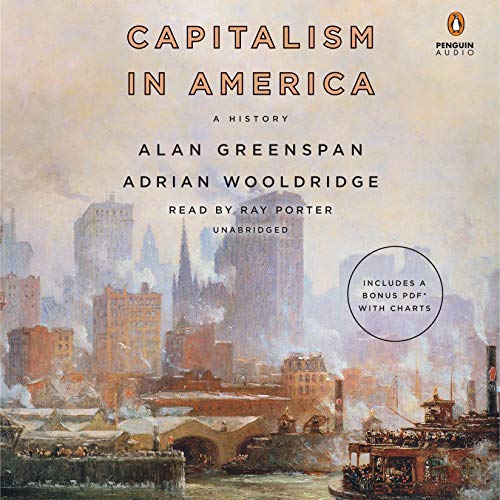
“Capitalism in America” (A History)
By: Alan Greenspan, Adrian Wooldridge
Narrated by: Ray Porter
As one would expect, “Capitalism in America” begins with the British economist, Adam Smith, who defined capitalism in 1776 with “An inquiry into the Nature and Causes of the Wealth of Nations”.
Alan Greenspan (on the left) is an American economist who was chairman of the Federal Reserve from 1987-2006. Adrin Wooldridge (on the right) is a British economist and journalist who wrote for “The Economist”. Wooldridge has a doctorate in philosophy and has co-written several books with Richard Micklethwait, the editor-and-chief of Bloomberg News. One might argue Greenspan has a conservative bias but Wooldridge’s experience as a British journalist gives one a sense of balance in this informative and well-written history of American capitalism.
“Capitalism in America” reveals tumultuous times for the American economy but with positive forward momentum. The public in all countries have experienced hard times from market forces. Some countries, like Israel, India, and the U.K. have experimented with socialism as an alternative to capitalism. Communist countries like Russia and China flirt with capitalism and one may argue–benefited from its market results. The author’s history shows capitalism as the primary reason for America’s economic growth and success. However, that’s getting ahead of their story.
Hamilton, as Secretary of the Treasury, presented a “Report on a National Bank” to President Washinton and the House of representatives in 1790. This report notes that Congress, with its authority to collect taxes, could fund the bank and lend money to the government to pay foreign creditors, public services, and private businesses to grow the economy. Jefferson opposed the idea, but Hamilton’s broad interpretation of the Constitution allowed his idea of a national bank to be created. In 1791 the First Bank of the United States is established in Philadelphia and remained chartered for 20 years. This became a giant step for America’s economic growth.
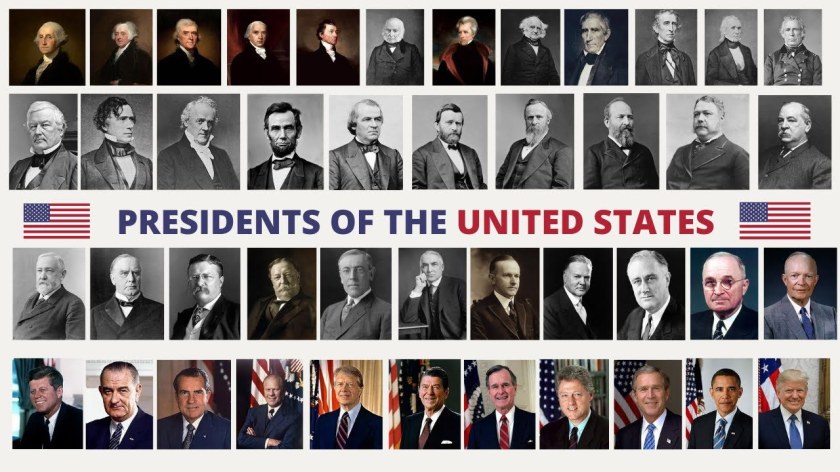
Several future Presidents opposed an American national bank. Of course, Jefferson was one because of his belief in an agrarian future for America. Jefferson’s friend and future President, Madison (the 4th President of the U.S.) opposed the idea of a national bank, and Andrew Jackson (the 7th President of the U.S.) used his power as President to oppose the “Second Bank of the United States” in 1833.
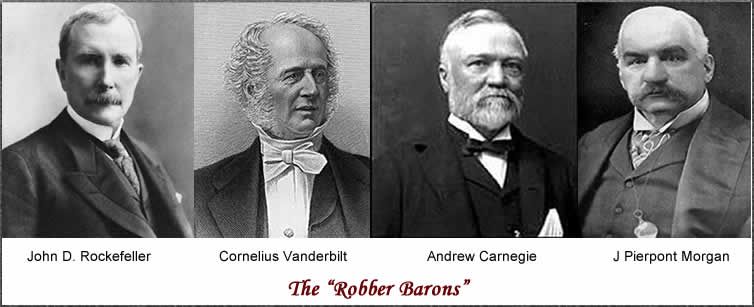
The authors note the successful industrialists of the 19th century capitalized on Hamiltonian creation of an American banking system. They became known as the robber barons of America. Rockefeller, Vanderbilt, Carnegie, and J.P. Morgan used capital to produce oil, expand rail transportation, make steel, and provide bank capital to grow the economy.
And then, WWI drew America into events that roil the course of its economic history.
An American economic boom occurs in the first two years of the war with America choosing neutrality. Exports surged from $2.4 billion to $6.2 billion in 1917. Everything from cotton, to wheat, to automobiles, to food, to machines were exported during those years. After joining the war, 3 million Americans were mobilized. When the war was over, the world and the American economy faltered. Recession (1918-1921) hit the world after the war, though America showed it had become a major world power.
As America recovered from WWI, their prowess as a producer of goods and services led to the roaring 20s and a runaway stock market that eventually crashed at the beginning of the Great Depression (1929-1939).
The authors note President Roosevelt is a great salesman who provides relief to many Americans with government employment programs during the depression. However, the authors note Roosevelt’s inept management delays America’s recovery by instituting price controls that distort market forces. Overt price control is a recurring mistake of national economies. The authors are not saying that price control is a singular cause of America’s continuing economic crisis, but it makes market recovery more difficult and longer to achieve.
The authors explain reparations for WWI’s winners helped set the table for WWII.
Germany’s inability to pay reparations, the growth of Antisemitism, and German inflation led to the rise of Hitler. Though not addressed by the authors, Japan felt threatened by American, Chinese, and Russian influence in Asia that led to Pearl Harbor and America’s entry into WWII.
The point is made that America’s depression before the war is not cured by Roosevelt’s economic intervention. The advent of war mobilized American industry.
The authors suggest market interference delayed recovery from the Great Depression. On the other hand, Roosevelt gave hope to the country with his speeches and employment programs. Citizens underlying faith in America’s ability to overcome hardship, and their response to Pearl Harbor reinvigorated the economy. Industries were retooled to meet the demands of war.
The authors argue mistakes in America’s capitalist history have been made by both Democratic and Republican Presidents who interfered with naturally occurring market forces. From Roosevelt to Nixon to Reagan to Obama to Trump, Presidents who institute price controls and/or tariffs interfere with free trade. America’s capitalist economy suffers from those actions. This is not to argue all legislation and federal action on the economy constitutes capitalist interference. Fundamental human rights that ensure freedom to vote, speak one’s mind, practice one’s own religion, work in industries one chooses, while seeking peaceful resolution of differences, are interferences that sustain capitalism.
When natural market forces are interfered with by business leaders and public legislators, capitalism suffers. An inference one may draw from the authors is that legislated programs that aid Americans who are unable or unwilling to participate in the capitalist economy are an interference with capitalism. That raises legislated issues of emigration, social security, health insurance, education, defense, transportation, veteran’s benefits, housing, environmental protection, occupational safety, and other public benefit programs. This is where there is continuing disagreement among Americans. These are not party issues because both Republican and Democratic leaders have both positive and negative arguments for and against these policies.
There is the law of unintended consequences that plague government policies. Some argue Reagan reinvigorated the American capitalist economy by reducing taxes, cutting government programs, reducing government employment, and busting union strikes. He did those things and government debt skyrocketed to a level greater than ever in the history of America. The gap between rich and poor was set on a path that beggared the poor and enriched business managers without comparable enrichment of labor. Like Roosevelt, Reagan sold ideas that had unintended consequences that were not in the long-term interest of Americans.
Appelbaum infers no American President has found the magic formula for balancing the needs of its citizens with the concept of Adam Smith’s free enterprise.
Books of Interest Website: chetyarbrough.blog
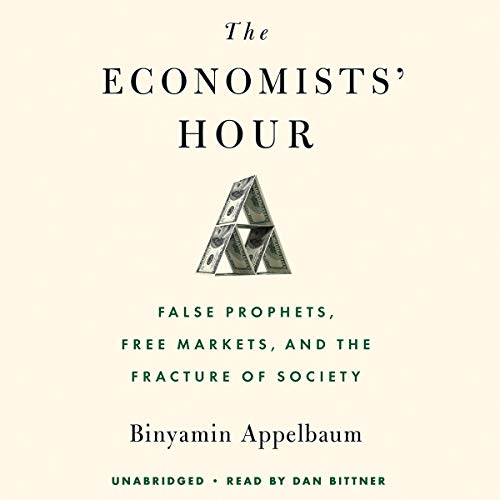
“The Economists’ Hour: False Prophets, Free Markets, and the Fracture of Society“
By: Binyamin Appelbaum
Narrated by: Dan Bittner
Binyamin Appelbaum (Author, winner of a George Polk Award and a finalist for the 2008 Pulitzer Prize, lead writer on economics and business for The New York Times Editorial Board)
Binyamin Appelbaum has written an interesting summary of a difficult but immensely important subject. Economic policy and theory are boring, but they touch every aspect of life. Appelbaum shows economic policy magnifies or diminishes the welfare of every American, let alone every economy in the world.
Adam Smith’s foundational theory of economics.
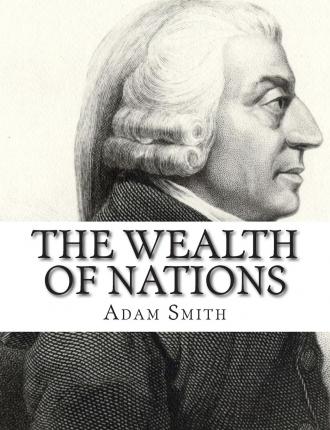
Though only briefly mentioned by Appelbaum, American economic policy begins with Adam Smith (1723-1790), the Scottish philosopher who wrote “The Wealth of Nations”. Smith advocated free trade and argued against parochial maximization of exports and imports that is manipulated by strict governmental regulation meant only to accumulate gold and silver.
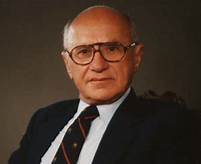
JOHN MAYNARD KEYNES (1883-1946, CONSIDERED FOR NOBEL 3 TIMES FOR DIPLOMACY BUT NEVER AWARDED.)MILTON FRIEDMAN (1912-2006, 1976 NOBEL PRIZE FOR ECOOMIC SCIENCES.)
Appelbaum illustrates how American policy violated the entrepreneurial freedom that Adam Smith advocated. In contrast to Smith, John Maynard Keynes (1883-1946) advocates government intervention whenever there is an economic downturn. Equally interventionist is Milton Freidman’s (1912-2006) belief that government should increase or decrease the money supply for national economic stability. The point seems to be that every economist thinks they have a magic bullet that will cure the ills of a faltering economy.
To be fair, Friedman did believe in free enterprise in regard to nation-state currencies. He argued for a floating currency rate that ultimately led to President Nixon’s abandonment of the gold standard. However, the nature of human beings led to speculation and manipulation of nation-state’ currencies that exacerbated trade tariffs and defeated the policy’s free-enterprise objective.
FRANKLIN ROOSEVELT (32ND PRESIDENT OF THE UNITED STATES, INTHE DEPRESSION, BANKS FAILED, UNEMPLOYMENT AND POVERTY SKYROCKEDTED.GEORGE W. BUSH (43RD PRESIDENT OF THE U.S. 3 MILLION JOBS LOST IN THE 2001 RECESSION)
One concludes from “The Economists’ Hour…”, there is no magic solution for an economy in crises. Neither Franklin Roosevelt, George W. Bush, Barack Obama, or any American President cured what ails an American economy that succumbs to economic crises. Adam Smith would argue an economic crisis is caused by a governments’ interference with free enterprise.
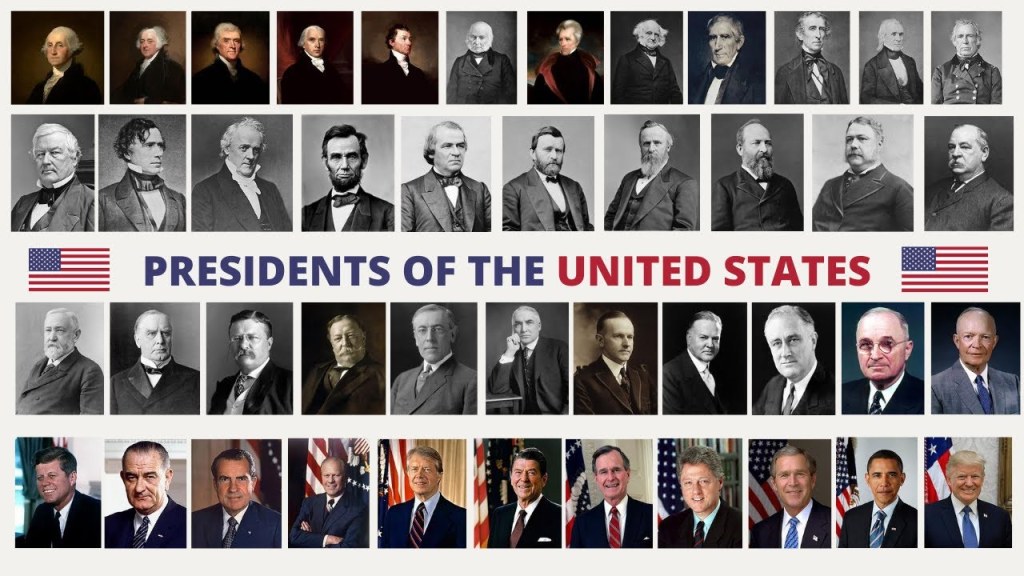
Applebaum explains how every 20th and 21st century President of the United States placed their faith in economists’ economic assessments of their day. All Presidents have found intervention by the government has unintended consequences.
President Nixon adopted Freidman’s monetary policy by imposing a freeze on prices and wages that squeezed the life out of the business economy and beggared the wage-earning public with job loss.
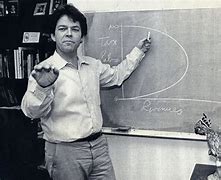
A decade of stagflation (high inflation and slow growth) followed Nixon’s administration. Stagflation is attacked by the Reagan administration with mixed results. A myth from economists like Arthur Laffer grew in 1974. Laffer believes taxation is either too high or too low for any benefit to society. Laffer argued zero tax and maximum taxation are equally harmful and produce economic stagnation and/or collapse.
ARTHUR LAFFER (American economist and author, served on President Reagan’s Economic Policy Advisory Board 1981-1989, Here illustrating the “Laffer Curve”.)
Laffer argued every government that reduces tax revenue decreases the stimulative effect of government spending. On the other hand, he suggested every tax cut increases income for taxpayers that will stimulate business and increase employment while encouraging higher production. He laughably created the “Laffer curve” to imply there is an optimum balance of tax reduction that would stimulate economic growth with proportionate increases in government revenue to provide for better government services. That balance has never been found. President Ronald Reagan experimented with Laffer’s idea, but it fails from unintended consequences. The principal consequence is to increase the gap between rich and poor.
BENEFIT OF TAX REDUCTION
Reagan accelerated a movement for government tax reduction that ultimately reduced income taxes from 70% to 28%. The result of government tax reduction during the Reagan years increased the U.S. budget deficit from $78.9 billion to $1.412 trillion. The benefit of that tax reduction went to the wealthy while school lunches were cut, subsidized housing declined by 8%, and poor families lost $64 a month in welfare payments. In 2023, the budget deficit stood at $1.70 trillion, an imbalance that shows why the “Laffer curve” is sardonically laughable.
President Reagan’s administration (1981-1989) was influenced by Laffer’s curve.
The joke is “There is no perfect balance on the curve because of the nature of human beings.”
Roosevelt, George W. Bush, and Obama choose to follow Keynesian policy. Roosevelt bloated government employment. All three increased the government deficit.
Some suggest the idea of “Cost benefit analysis” (CBA) is recommended to the federal government by two law professors, Michael Livermore and Richard Revesz during the George H. Bush administration but Reagan initiated it with an Executive Order in 1981.
Appelbaum notes that “cost benefit analysis” for government is first used during the administration of Ronald Reagan. However, Bill Clinton reifies its use with an Executive Order in 1993 that required covered agencies to do a CBA on “economically significant” government regulations. Ironically, Clinton was the first President in the post 19th century to balance the budget. Andrew Jackson manages to do it in his term between 1829 and 1837.
An irony of using “cost benefit analysis” is that it required a determination of of a human life’s value. Presidents Nixon, Ford, Carter, and future Presidents use value per statistical life during their administrations. High-income earners were worth $10 million to $15 million, middle-income earners $1 million to $2 million, and low-income earners $100,00 to $200,000. Of course, these values were always litigable. The point is that CBA became a tool for government to regulate the costs of government policies, ranging from military expense to the health, safety, and welfare of American citizens.
The remainder of Appelbaum’s book reflects on the experience of America, Chile, and Taiwan in the 20th century. The implication of his review of economic policy is that those countries that align with the free enterprise beliefs of Adam Smith have made mistakes. However, America’s, Chile’s, and Taiwan’s economic policies seem to have had more economic success when following Smith’s beliefs.
No American President has found the magic formula for balancing the needs of its citizens with the concept of Adam Smith’s free enterprise.
Along with CBA, Appelbaum notes the ongoing controversy is about regulation by government when it tries to balance American health, education, and welfare with Adam Smith’s concept of free enterprise. Appelbaum infers no American President has found the magic formula for balancing the needs of its citizens with the concept of Adam Smith’s free enterprise.
































 REVIEWS AND VIEWS OF LIFE