UNENDING PURSUIT

Science is an unending pursuit of knowledge that is refined and advanced by new techniques of examination.

Books of Interest
 Website: chetyarbrough.blog

“Gene Machine

Author: Venki Ramakrishnan

Narrated By: Matthew Waterson

Venki Ramakrishnan (Author, British-American structural biologist, shared 2009 Nobel Prize in Chemistry with Thomas A Steitz and Ada Yonath.)

“Gene Machine” tells reader/listeners of the discovery of the structure of ribosomes. Ribosomes are elemental cellular organisms (organelles) made up of proteins within living cells. They are genetic factories that process protein within the body. Without ribosomes, life as we know it, would not exist. Ribosomes repair cellular damage, maintain cell structure, and direct chemical processes within the body.

In the 20th century, after years of research, Ada Yonath, Venki Ramakrishnan, and Thomas Steitz discover clues to the structure of Ribosomes. Ramakrishnan story is about the complex process of scientific discovery. He reveals how scientists are motivated by the same desires of all humanity; namely money, power, and/or prestige. This is “the way” of the world, whether its religion, science, or society.

To the lay reader/listener, Ramakrishnan’s story is most interesting because it illustrates science research is more than a quest for knowledge. Curiosity and thrill of discovery are important, but it is the reward of being first and the accompanying money, power, and prestige that are scientists’ greatest reward.

Ramakrishnan somewhat ambivalently acknowledges Ada Yonath is the first scientist to recognize the critical role of ribosomes in genetic engineering. Ms. Yonath pioneers the use of crystallization in studying the elusive ribosome existence. However, Yonath fails to reveal a clear picture of the ribosome because of repeating the same chemical means of freezing the image of the elusive organelle. Ramakrishnan and his team of graduate students manage to come up with a chemistry formula that clears the image enough to make the structure of ribosomes more accurate.

Thomas Steitz helped perfect x-ray crystallography to more clearly map the structure of ribosomes.

Steitz’ work justified his inclusion in the Nobel award. The significance of Ramakrishnan’s story to a non-scientist is his unabashed and self-effacing humility when explaining his role in discovering the structure and purpose of ribosomes.

One wonders if Ramakrishnan harbors an opinion that Yonath’s pioneering of ribosome research is overblown.

Ramakrishnan criticizes Ada Yonath for being too verbose when participating in public conferences by recalling a conference that limited presenters to 15 minutes. Ramakrishnan explains Yonath went on for over 30 minutes despite the audiences expressed discontent. In the end, he acknowledges Yonath’s role in being among the first to suggest ribosome research was important. She was the first to use crystallography to identify its structure. Ramakrishnan notes those two facts justify her Nobel’ selection.

Ramakrishnan suggests winning a Nobel opens doors to opportunities that are unjustified in ways that have little to do with the specific work or a particular discovery.

Ramakrishnan explains much of the public think a winner of a Nobel could talk about any scientific subject with expertise. He notes the Nobel Prize is a great honor but is proffered to scientists that have achieved a finite discovery in a specific discipline, not a general understanding of all science. He goes on to explain how his country of birth (India), the country of England, and one suspects America, wish to claim him as representative of their countries–when, in fact, he is an individual who achieved success by dint of hard work, the help of others, and personal discipline. Ramakrishnan’s story explains how he pursued understanding of crystallography because it could help him achieve a goal. His point seems that the hard work of many scientists, not nationality or Nobel recognition, are keys to successful science research.

Ramakrishnan story is about science as an unending pursuit of knowledge that is refined and advanced by new techniques of examination.

In today’s science research, chemistry of crystallography is made less valuable with the invention of the atom-level microscope that offers direct, firsthand observations of the structure of human organelles like the ribosome. Ramakrishnan suggests science is an eternal search for knowledge.

BELIEF IS NOT ENOUGH

“Believing” is not enough. The nature of humanity needs to change,

Books of Interest
 Website: chetyarbrough.blog

“Minor Feelings” (An Asian American Reckoning)

By: Cathy Park Hong

Lectures by: Cathy Park Hong

Cathy Park Hong (Author, writer, poet, and professor, graduate of Oberlin College with an MFA from Iowa Writers’ Workshop.)

“Minor Feelings” is a mild representation of a social malady that plagues humanity. Ethnic differences, social hierarchy, and political power create and embolden nation-state’ inequality. It seems in the history of the world, with the exception of most Asian and African countries, the white race rules society. This seems odd when only 16% of the world’s population is white.

Hong offers a memoir of her life in America. Born in Los Angeles, California, Hong notes experiencing discrimination between white Americans and Asians.

Hong acknowledges discrimination within, as well as outside, ethnic cultures by recounting her somewhat comic effort to seek help from a Korean therapist for a recurrent facial tic. The therapist said Hong should seek help from someone else without explaining why. Of course, one wonders if that classifies as discrimination or therapeutic professionalism.

Mosaic of children from around the world, including, Kayapo, Indian, Native American, Inuit, Balinese, Polynesian, Yanomamo, Cuban, Tsaatan, Moroccan, Mongolian, Karo, Malagasy, and Pakistani.

All humans have a tendency to generalize ethnic qualities based on human difference. Those differences can range from the obvious to the miniscule but have the common failing of not seeing the humanity of every human being. Hong notes how Asians are generalized by many ethnic groups, including Asians according to Hong, as industrious, intelligent, and hard working without recognizing the individual. Whether generalization about an ethnicity is true or not, the individual’s success or failure is diminished by generalization.

In what was called social studies in the 1960s, I remember our teacher asking if we were prejudiced. No one commented.

Then, the Social Studies teacher asked the class if any of the boys had asked an Asian girl if she had been asked to go to the prom with them. No one answered but I, for one, felt guilty about not even thinking of it. Though the teacher inappropriately asked the question, he demonstrated how America is as ignorant about Asian discrimination in the 1960s as Hong illustrates in “Minor Feelings”. (Parenthetically, the teacher’s question was even more inappropriate and hurtful because the Asian girl was in the class.)

The truth is every nation-state’ political structure, whether white, off-white, or black, discriminates against whomever is not part of the government in power. In China it is the Han, in Russia it is Aryan Russians, in India it is the Indo-Aryans, in Botswana it is the Tswana. Each of these ethnicity’s discriminate against minorities not in power.

This is not meant to diminish the truth of what Wong explains about her life experience. “Minor Feelings” is a difficult book to read or listen to because it offends many Americans who believe they look at every person as an individual. However, “believing” is not enough. The nature of humanity needs to change.

CYCLE OF ABUSE

“The Beauty in Breaking” is about life as an eternal recurrence that offers some peace of mind in a world troubled by its inhumanity.

Books of Interest
 Website: chetyarbrough.blog

“The Beauty in Breaking” (A Memoir)

By: Michele Harper

Narrated by: Nicole Lewis

Michele Harper (Physician, Author, Public Speaker.)

Leaves fall from the tree to expose the bark and bite of life. Michele Harper’s memoir shakes the tree of American life. Relying on the veracity of Harper’s story, she is raised in a family with a physically abusive father who divorces her mother, an art dealer.

Harper notes her paternal father was physically abusive.

After Harper’s paternal father leaves Harper’s mother, Harper notes he offers some financial assistance to Harper in college. Harper explains she passes some of that assistance on to her mother while attending Harvard. Harper earns a BA in psychology. She goes on to acquire a medical degree from a New York university to become an emergency room physician.

Harper’s story touches on the complexity of life as a Black American. She marries a white man while at Harvard, but they divorce at his choice. The failure of their marriage is shown to be hard for Harper, but she is driven to succeed and moves on to educate herself in her chosen field of work.

Harper’s experience of childhood abuse, her personal marriage break-up, and work as a physician in three different emergency room positions, are lessons for life and living.

Her focus is on overcoming her trials to be good at her job even though much is beyond her control. The notion of not knowing what crises you will face in a medical emergency room, let alone a doctor’s experience as a Black American, offers a unique perspective to Harper’s memoir.

Abuse comes in many forms.

There is child abuse that occurs in many homes throughout the world. There is being a minority in a culture controlled by a majority that discriminates against those who are different. There is inequality of opportunity that creates an underclass that is trapped in an eternal cycle of poverty. Harper is denied promotion to Administrator in her first hospital job because she is a woman. Her supervisor notes a woman, let alone a Black woman, has never had the Administrator’ job in that hospital. Misogyny triumphs once again.

Harper chooses to leave the hospital that denied her the promotion.

As an administrator in another hospital Harper sees the consequence of poverty. Poverty seeps into nearly every culture in the world with its accompanying violence, compounded by weak to non-existent gun control laws in the United States. Harper writes about her encounter with a young boy who has his sneakers stolen by a bully at school.

Harper interviews the young Black grade school child who is thinking about getting his shoes back with a gun.

Harper calls a child services employee to explain her concern about the child’s access to a gun at his home. The child service’s person explains she sees this in many children’s homes where poverty is one lost job away from a family being on the street. This young boy’s parents both work to keep the family housed and fed. The social services person explains gun accessibility and violence are common in poor black neighborhoods. Where poverty is a fact of life, child services can only go so far to change what is toxic in a child’s environment. Gun availability is beyond the control of Harper or child service’s employees. The extent of Harper’s intervention is limited to raising the issue with the young boy’s parents–with the hope that they will act to be sure no gun becomes available.

Harper finds a third job as a VA hospital administrator. She interviews a female patient seeking psychological help. In the interview, Harper is told by the patient she had been raped by her supervising sergeant and another soldier in Afghanistan.

She became pregnant and decided to have an abortion. That experience continues to traumatize her life. She seeks help to overcome its affects. Harper becomes the patient’s lifeline for the counseling she needs to overcome her abuse.

There seems no “…Beauty in Breaking” as one nears the end of Harper’s memoir but one begins to realize the “Beauty…” is “…in Breaking” the cycle of abuse.

The cycle can be broken with exposure, rehabilitation, caring, and acting to remove the causes of abuse. Harper’s memoir shows how it is done. Breaking the cycle of abuse is a long, laborious process that begins with people focusing on incidents of abuse and acting to mitigate its causes and consequences. “The Beauty in Breaking” is Harper’s way of exposing abuse and illustrating what can be done about it.

Harper’s ultimate theory for the resolution of human abuse is belief in Lifes’ recurrence. Her theory is that every life is eternal. When one dies, they will be reborn into another life. Harper comes to grips with her life as it is and makes it better through meditation. Her belief about life as an eternal recurrence offers her peace of mind about the people she saves or loses in a hospital emergency room.

UNIONIZATION

Nolan clearly illustrates how important political power is in balancing corporate owner/managers’ disproportionate incomes and privileges with labor.

Books of Interest
 Website: chetyarbrough.blog

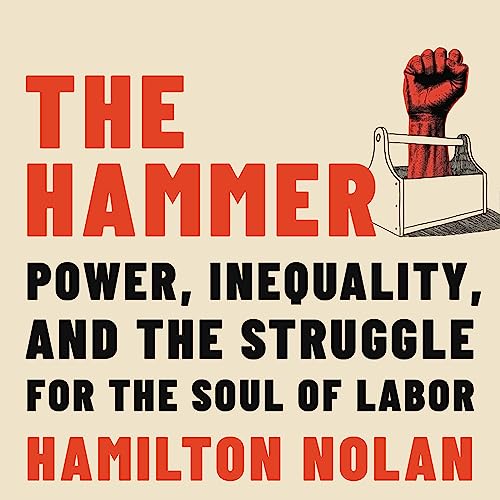
“The Hammer” (Power, Inequality, and the Struggle for the Soul of Labor)

By: Hamilton Nolan

Narrated by: Franklin Pierson

Hamilton Nolan (Author and free-lance Journalist)

“The Hammer” is a paean to unionization. Unions lost much of their political power in the early 1970s. Political power of labor was diminished by State governments, poor labor union management, and a diminishing number of labor union members. Nolan’s argument is workers have to reestablish political power to change their unfair and inequitable relationship with business.

The widening gap between rich and poor is traced to the era of President Reagan when the first deep cuts in corporate taxes occur.

Reagan fought unionization by firing air traffic controllers that sought better wages. Reagan’s supporters believed government social programs were out of control and their cost diminished the power of free enterprise. Much of the American public either agreed or were apathetic. However, as the gap between rich and poor accelerated, Americans began to complain about inequality. With extraordinary income increases for business owners and CEOs, and repressed wages for workers, the need for unionized political power became self-evident. Nolan introduces his book about unionization with a brief biography of Sara Nelson.

Sara Nelson (AFA president of the Association of Flight Attendants.)

Nolan writes about Sara Nelson who became a union member when she worked for United Airlines as a stewardess. Nelson was born and lived in Corvallis, Oregon. She applies for a job with United Airlines in St. Louis. She gets the job but her first paycheck is late. She couldn’t pay her rent. A check is given to her by a union employee to tide her over until her first check is delivered. From that day forward, according to Nolan, Nelson became a supporter of unions. Eventually Nelson becomes the president of the Association of Flight Attendants (AFA).

Liz Shuler (President of the AFL-CIO since 8/5/21.)

Ironically, the first woman President of the AFL-CIO is also from Oregon. Liz Shuler received a bachelor’s degree in journalism from U of O in Eugene, Oregon. She became a union activist after college and worked to organize clerical workers at Portland General Electric. She is elected as the President of the AFL-CIO in 2021 after serving as the first woman Secretary-Treasurer of the organization.

Nolan’s book addresses State conflicts with unionizers and family-income for low-income workers. The first states he addresses are South Carolina and California. Nolan notes South Carolina has become a haven for businesses wishing to avoid unions. South Carolina’ State laws discourage unionization which appeals to businesses wishing to relocate. Nolan notes South Carolina attracts businesses looking to improve profits by reducing labor costs. The consequence of business’s lower labor cost is to reduce South Carolina workers’ standard of living. South Carolina’s workers are among the lowest (19th out of 50 States) paid workers in the U.S. Nolan implies South Carolina’s income inequality is a consequence of the State’s policy of discouraging unionization.

California has the fourth largest income inequality in the U.S.

Nolan notes the cascading negative of unfair compensation for domestic labor. Though California now allows childcare servers to be unionized, their unionization efforts are discouraged by government regulation, as well as the fragmentation of its poorly compensated workers. The consequence of State government regulation keeps wages low and discourages entrepreneurs from starting childcare’ businesses. A compounding negative is created when users of childcare’ service, women in particular, are unable to work in regular work-day jobs. Workers are compelled to stay home to take care of their children, reducing family income and further impoverishing low-income childcare’ workers. It becomes a vicious cycle, hurting entrepreneurs trying to start a childcare service, employees wishing to increase family income, and employers needing more workers.

Nolan expands his argument by noting how service industries in Las Vegas, the State of Florida, New Orleans, and Mississippi are benefited by unionization.

Vacation and gambling meccas like Las Vegas, Florida, New Orleans and Mississippi need service industry employees. These vacation and gambling meccas depend on service quality for visiting tourists. Lack of representation for service employees diminishes employee’ standards of living which indirectly damages the reputation of the entertainment and vacation industry.

In Las Vegas, where Nolan lived for twenty years, the service industry is protected by the Culinary Union.

Nolan notes how strong the Culinary Union has become in Las Vegas and disparages casino owners like the Fertitta’s who have fought unionization. Numerous examples are given to show how union actions have improved the lives of Casino workers, many of which are immigrants from other countries.

Nolan’s argument for the value of unionization is compelling but his encomium for the union movement ignores America’s immigration crises.

The vast need for immigration reform is not being forcefully addressed by unions. Compensation inequity is a noble fight carried out by unionization, but it needs to broaden its role in immigration. Unions need to use their power and influence to change immigration policies to equitably treat a labor force that is sorely needed in America. Unions need to help educate and house legal immigrants, so they do not become a part of America’s growing homelessness. Additionally, unions could use their recruiting expertise to get Americans off the street by providing job training services and gainful employment.

Public perception of unions could be monumentally improved with a program to recruit and indoctrinate the homeless with training for jobs in the 21st century.

There is so much that unions could do to far exceed the minimalist goal noted in Liz Shuler’s plan to add a million union members over the next 10 years. Nolan pitches for Sara Nelson as a more dynamic leader for the union movement. Maybe Nelson would be better than Shuler, but growth, value, and public perception of union members could be monumentally improved with a program to recruit and indoctrinate the homeless with training and jobs for the 21st century.

Whomever the leaders of unionization may be in the future, Nolan clearly illustrates how important political power is in balancing corporate owner/managers’ disproportionate incomes and privileges with labor.

NO NO KNOW

Addiction is a terrifying and destructive disease that requires an addicted person’s self-understanding and their wish to break its cycle of destruction.

Audio-book Review
 By Chet Yarbrough

Blog: awalkingdelight)
 Website: chetyarbrough.blog

The Recovering (Intoxication and its Aftermath)

By: Leslie Jamison

Narrated by: Leslie Jamison

Leslie Jamison (American Author, Harvard graduate, Professor of non-fiction writing at Columbia University’s School of the Arts.)

Leslie Jamison’s memoir is a personal and intimate account of her struggle with addiction and recovery. Jamison recalls her life in an upper middle-class family, interrupted by her parent’s divorce when she is eleven years old. Jamison chooses or is compelled to become an addict. A listener will use the experience of their own lives to argue whether addiction is a choice or environmental predilection.

To some, the course of one’s life is a matter of choice. Others believe life is ordained by a supreme being or fate, something beyond one’s control.

Still others believe life is just a matter of luck and circumstance. The examples of Jamison’s life prove nothing but tell the truth of her own addiction. If one is an addict in recovery, Jamison’s story may give one hope. On the other hand, her life is not your life, her education and intelligence are not yours, nor are her financial circumstances and environment. What one will get out of “The Recovering” is a jarringly truthful perception of Jamison’s experience of the world.

What Jamison shows is addiction is an equal opportunity victimizer, wherever it comes from and whatever its cause.

Jamison refers to the addiction of Amy Winehouse whose song alludes to addiction by saying “No, No, Know” that capsulizes what addiction meant to Winehouse. Jamison reveals what addiction and “Recovering” means to her after years of “…Recovering”.

Amy Winehouse (Famous English singer and songwriter, 1983-2011, died at age 27 from alcohol poisoning.)

Jamison explains addiction is numbing. When one becomes an addict, one is always recovering. Jamison reveals sexual relationships in her years as an alcoholic are sometimes good and desired, sometimes bad and endured. The bad and endured times are an implied condition of her drunkenness. Addiction is lonely. Addiction liberates. Addiction infects. Addiction kills. Addiction is a subject for a writer to write about.

The last chapters of Jamison book are about “The Recovering”. It begins with the chapter titled “Shame”.

Jamison explains working at a bakery in Iowa is an important part of her recovery because of its routine. At that time, Jamison notes her relationship with Dave, a man who becomes an essential partner in her life. These are shown as two fundamental reasons for her drive to become sober.

Dave has his own strengths and weaknesses like any person who chooses to commit themselves to a relationship. Jamison shows her insecurity by secretly peeking at his cell phone to find he is flirting with another woman. The flirtation implies infidelity, which is possible, even in committed relationships. Dave resents the implication, but no person is likely to deny their sexuality. Despite his denial of denial, Dave sticks with her through her beginning struggle for sobriety. A reader/listener realizes how important that personal support is to an addict’s recovery.

“The Recovery” becomes tedious in its remaining chapters for those who have not experienced addiction. However, Jamison’s memoir is a well-reasoned and detailed explanation of why punishment as treatment for addiction is a waste of time and money. Only personal relationships, social, and medical help for the addicted offer a chance for addicts to recover.

Jamison’s book is a condemnation of the “War on Drugs”.

Addiction is a terrifying and destructive disease that requires an addicted person’s self-understanding and the public’s support to break its cycle of destruction. Jamison explains recovery begins with wanting to break addiction’s cycle, but implies the addicted will only succeed with help and commitment of others. In Jamison’s case it is with the help of her then partner, Alcoholics Anonymous, and her commitment to be sober.

HMONG AMONG U.S.

Yang’s father’s diary reveals the wisdom of living life as one chooses, not what others choose–even when the other is your mother or father.

Audio-book Review
 By Chet Yarbrough

Blog: awalkingdelight)
 Website: chetyarbrough.blog

The Song Poet: A Memoir of My Father

By: Kao Kalia Yang

Narrated by: Kao Kalia Yang

Kao Kalioa Yang (Hmong American author. Born in a refugee camp in 1980, graduate of Carleton College (BA)and Columbia University (MFA).)

The essence of Kao Yang’s story is a reminiscence of her family’s life in Laos and then America. Yang is the older of two daughters. She was born after her mother has six miscarriages. They journey to Minnesota after escaping Laos through Thailand. Yang explains how difficult it is for immigrants to survive and thrive in a foreign culture. The story is told by the family’s daughter with an analysis of her father’s diary and her personal experience. Though not clear in Yang’s book, she has four brothers, but Xue is the only son very clearly noted in “The Song Poet”.

Bee Yang is a respected song poet born in a Hmong village in Laos. He passed away on January 14, 2020 in the Midwest.

Kao Kalia Yang’s story reminds of a trip taken to Southeast Asia before the Covid19 pandemic. Our guide in Laos is from a Hmong family. The story of his education in Laos, though it largely took place after America’s war in Southeast Asia, reminds one of Ms. Yang’s story of the Hmong in Laos.

The hardship of the Hmong people is difficult to understand for a white American raised in a rural town in Oregon. The only criticism one may have of the story is the poorly produced audio version of the book. As an audiobook, “The Song Poet…” should have been told by different narrators. Its switchbacks in time, and its story of different family members is difficult to follow because of changes in the sex of who is speaking, particularly when it is either the father or daughter.

Two insightful reminders given in Yang’s book are immigrant value to America and harsh treatment of Hmong by the communists after the war. Because of their support of a failed effort to stop communism in Southeast Asia, Hmong genocide became a goal of the communist regime.

The genocidal effort to eliminate the Hmong in Laos fails but their isolation is evident in the remoteness of their villages. Our guide had to walk several miles each way to get to his school in a larger community. The Hmong had been recruited by the American government to fight the communist’s invasion of Laos. Some Hmong, just as many South Vietnamese opposed communist rule. When America withdrew, some were evacuated to the U.S., just as later in modern history–some Afghani’s, were evacuated. In either effort, America was only marginally successful.

Yang’s story begins with the death of her father in America. He is “The Song Poet”. Her father left a diary of their family’s life and experience in Laos and America. Her father is one of the Hmong that fought Laos’ communist infiltration during the Vietnam war. Her father falls in love with a Hmong woman before Ho chi Minh’s invasion. After six miscarriages, Kao Yang is born. Kao Yang’s sister is born in America in 1993.

“The Song Poet” is a story of hard work and accomplishment with a strong-willed mother, loving father, and Kao Yang in a Hmong village in Laos. Their grandfather is a village shaman who passes that duty to his son.

Shamans are important, highly respected “medicine men” in Hmong society. The Hmong believe in animism (a belief in the soul of plants and animals that animate the material universe).

After communism takes control of Laos, the family falls on hard times. Her father becomes an illegal drug runner when approached by four thuggish Buddhist’s that recruit him to sell drugs. He is not proud of that part of his life but as a Hmong in Laos, after the American war, one did what they had to do to survive.

Yang’s father goes to work in a metals factory.

How they manage to get to America is not revealed but one presumes it was with the help of Americans who understood what the Hmong had done to resist communism in Laos. They manage to buy a small home in Minnesota. Yang’s father dies from inhalation of metal fragments from his work. The industry did not have a policy of protecting their workers which reminds one of coal and uranium workers facing similar risks and their industries slow responses.

Another aspect of Yang’s life is about what it is like to live in a foreign culture. Yang tells a story of her mother shopping at K-mart with her younger sister and not being able to clearly communicate with a store employee about what she needs.

She could not remember the word “light bulbs” and the employee walks off saying, “I don’t have time for this”. This is an entirely believable story because many of us are impatient with people who do not speak English. The irony of the story is that her 7-year-old daughter feels it is her fault, not the American’s, because she knew the word her mother needed to tell the employee but failed to speak up. The irony is for a 7-year-old feeling responsible for an adult’s failure in a world of adults.

Yang’s last chapters explains how each member of the family relates to growing up in America, particularly when your parents come from a different culture.

Xue breaks from his father’s ambitions for him. He leaves home to begin his own life in a way that did not conform to the life of his father’s expectations. Yang’s father’s diary reveals the wisdom of living life as one chooses, not what others choose–even when the other is your mother or father.

VETERANS

Audio-book Review
 By Chet Yarbrough

Blog: awalkingdelight)
 Website: chetyarbrough.blog

Between Two Kingdoms (A Memoir of a Life Interrupted)

By: Suleika Jaouad

Narrated by: Suleika Jaouad

Suleika Jaouad (American author, and motivational speaker.)

Suleika Jaouad offers a guide to veterans of life. Jaouad’s book goes on a little too long, but its message resonates with some who feel challenged by the life they live. “Between Two Kingdoms” is about living and dying. Whether one is a child or adult living through war or peace, Jaouad offers a guide for survival.

Every person faces challenges in their life.

Jaouad contracts leukemia, a frequently fatal cancer that affects the production and function of blood cells. Jaouad recognizes her challenge is a combat between the kingdoms of living and dying. Like any veteran of life, Jaouad’s experience affects her life, even after diagnosis of remission. Jaouad’s recovery from cancer will resonate with the old and young, veterans of war, and every person of any age coping with memories of their experience.

Whether one is in their childhood, twenties, middle age, or seventies, they are living between two kingdoms, i.e., the kingdom of living and the kingdom of dying.

Jaouad’s story is highly personal. The first chapters reflect on a twenty something young woman just beginning her independent life. She has the personal experiences of many young adults making their way in life. Her sexual relationships and personal achievements are similar to many people of her age. What strikes a listener about her self-understanding is its universal applicability. The only difference is in what triggers that self-understanding. Triggers come from the circumstances of life. The trigger may be cancer, the experience of war, the loss of a loved one, a psychological trauma, or physical injury.

Jaouad explains how she psychologically and emotionally copes with her cancer.

In that explanation, a guide is offered to every person who struggles with unexpected traumas in their life. Trauma takes many forms that Jaouad explains may be both physical and mental. She shows the physical consequence of leukemia but also the mental consequence of dealing with it, dying from it, and (in her case) recovering from it. It is in the dealing part that a listener will find the most value.

Jaouad is helped by America’s medical system but a great deal of her ability to cope is based on others’ help.

She is supported by her mother and father, an intimate boyfriend, and patients in the hospital in which she is treated. The boyfriend, also in his twenties, sticks with her through the first years of treatment. The hardship of treatment overwhelms the boyfriend’s capacity to deal with what Jaouad is going through. The relationship breaks down and the boyfriend leaves. As Jaouad begins recovery, after remission, she meets a jazz musician who becomes quite famous. The former boyfriend returns to try and mend their relationship but fails.

Before Jaouad marries, she chooses to see America by traveling with a small dog and lecturing on what she has learned from her leukemia ordeal.

Jaouad has always aspired to be a writer and has kept a diary of her life. She became a professional writer and lecturer.

Jaouad eventually marries the jazz musician. Jon Batiste, former band leader and musician on Stephen Colbert’s late night TV show.

“Between Two Kingdoms” is an enlightening story of Jaouad’s very personal life. Every generation may find something in her book that may help them cope with their lives.

CHOICE

Audio-book Review
 By Chet Yarbrough

Blog: awalkingdelight)
 Website: chetyarbrough.blog

What Are You Going Through

By: Sigrid Nunez

Narrated by: Hillary Huber

Sigrid Nunez (American Author, novelist, editorial assistant at The New York Review of Books.)

Sigrid Nunez’s “What Are You Going Through” resonates with many who are dealing with terminal illness or the infirmity of old age. Nunez creates a story of a friend dealing with the debilitating effects of cancer treatment. The treatment is prolonging her life but at a cost her friend is increasingly unwilling to bare. Her friend has a plan to quit the treatments and either let nature take its course or swallow a pill to end her suffering.

The friend approaches close friends to ask them to live with her for the time she has left with the understanding that she will take the pill at some point during their time together. Her close friends decline but Nunez’s main character, who is a more distant acquaintance, agrees to stay with her until the end.

The author’s subject is about life and choices humans may or may not have a right to make.

Nunez writes a story that leaves the sole choice of living or dying in the hands of women, more particularly a woman who has terminal cancer. It doesn’t seem a coincidence that a woman is the writer, and her subject is a woman’s choice of living or dying. An inference one might draw is that the choice of life is more a woman’s than a man’s decision. Of course, that raises questions beyond “right to die“.

In the main character’s agreement to live with the cancer patient, the author implies those suffering from a fatal illness do have a right to take their own life.

Euthanasia is currently illegal in all 50 states of the United States, but 10 jurisdictions, including Washington D.C., California, Colorado, Oregon, Vermont, New Mexico, Maine, New Jersey, Hawaii, and Washington allow assisted suicide. Presumably, Nunez’s character is in one of the 10 jurisdictions that allow assisted suicide.

Of course, the question left unanswered is assisted suicide a choice that should be left in the hands of an individual.

Obviously, not everyone agrees because most American states do not authorize assisted suicide. Nunez offers no definitive opinion. Her main character is helping a friend make a choice about a cancer patient’s own life, but the author leaves the choice unmade at the end of her story.

At best, Nunez’s story leaves reader/listener’s on their own about a person’s right to take their own life. Maybe that is her point, but it leaves this critic unsatisfied.

HERES TO LIFE

Kieran Setiva’s book may be one of the best of 2022 but like the hope he describes in the last chapter, it’s a mixed blessing.

Audio-book Review
 By Chet Yarbrough

Blog: awalkingdelight)
 Website: chetyarbrough.blog

Title: Life Is Hard (How Philosophy Can Help Us Find Our Way)

Author Kieran Setiya

Narrated by: Kieran Setiya

Kieran Setiya (British Author, Professor of philosophy at MIT.)

In the beginning of Kieran Setiva’s book something seems awry. It is written by a PhD graduate of Princeton who is working as a professor at MIT. What does a philosopher who is admittedly happily married (with one child), working as a professor at a prestigious university know about life being hard? Stick with it, and by the end of the book, Setiva’s point becomes clear and worth more than one listen. The “Economist” calls Setiva’s book one of the best of 2022. Being an acolyte of the magazine, it seems prudent to review “Life is Hard”.

Every life has an individual story. Life is hard for every human being whether rich or poor, educated or illiterate, wise or foolish.

The only difference is some die young, others live to be old, but each find life is hard. Setiva explains he is stricken at 27 with an undiagnosed malady that deprives him of sleep because of recurrent pelvic pain. He learns how to cope with the pain and get on with life. In that learning and his personal education in philosophy, Setiva offers insight to what it means to live life.

Hardship is an equal opportunity malady that strikes every human life.

It just comes in different forms, either physical and/or mental. No sentient human escapes the hardship of life. Each person deals with hardship in different ways and with varying degrees of success. Setiva chooses to get on with his life by tolerating and adapting to his pain. He pursues personal goals, presumably with the hope of growing old.

Setiva tells the fable of Pandora’s box. In the Greek legend, Pandora was created by the gods and given gifts by each of them. One of the gifts is a box which she is told never to open. From curiosity, the box is opened and all the maladies of life escape, save one, i.e., hope. Like the biblical fable of Eve’s apple and the tree of knowledge, life’s hardship becomes a part of human life. (Sadly, these are fables of ancient history and biblical tales that set the table for world misogyny.) The idea of hope is a mixed blessing that helps one cope with life but with a price paid for its failure to eliminate hardship.

Hope is the insight Setiva reveals to one who is faced with hardship in life.

Whether one is a university professor, wealthy industrialist, penniless beggar, or cloistered saint, hardship is a part of their life. Hoping to grow old is all that remains, and its value seems circumspect if not useless. Setiva’s book may be one of the best of 2022 but like the hope he describes in the last chapter, it’s a mixed blessing.

COMPANY BUILDING

Audio-book Review
 By Chet Yarbrough

Blog: awalkingdelight)
 Website: chetyarbrough.blog

Scaling People (Tactics for Management and Company Building

By: Claire Hughes Johnson

Narrated by: Claire Hughes Johnson

Claire Hughes Johnson (Author, former chief operating officer of Stripe, lecturer on management of companies, former technology and operations manager.)

In “Scaling People”, Claire Hughes Johnson offers an insightful and actionable skill-set for both creators and managers of eleemosynary, government, and business organizations. She explains how large and small organizations can become more effective in executing their plans for development.

Johnson suggests every successful organization must have a clear statement of mission. “Mission” statements are the beginning of an entrepreneur’s creation of a company, a non-profits’ purpose, or a government’s departmental objective.

Every effective manager within an organization begins with a clear understanding of mission. Small and large organizations become successful when managers understand their organizations’ mission. The only difference is an entrepreneur’s mission is to prosper and grow a business, a minister’s mission is to ameliorate sin and grow a congregation, a charities mission is to grow and do good for others, and a government agency is to provide public service and grow as needed for those who cannot help themselves.

Johnson explains a manager’s success begins with self-understanding.

Johnson notes the ancient saying inscribed on the Oracle of Delphi in ancient Greece, “know thyself”. Knowing oneself is being aware of one’s nature and limitations. Johnson infers every good manager is a leader because, by definition, managers and leaders lead people.

Johnson works in the high growth industry of technology but her book applies to all organizations whether staid and maintenance driven or growth oriented.

When addressing growth companies, Johnson explains high performers fall into two categories. She classifies the first as “pushers” and the second as “pullers”.

Both are valuable employees but Johnson notes pushers want more money and power while pullers are subject to burn-out. Though their reasons are different, both may leave the organization. The potential cure Johnson suggests is a biannual review, designed in different ways, to motivate them to stay. The pushers should be counseled on what they can do within the company that trains them to take on more responsibility in return for more pay and power. Johnson’s counsel to pullers is to acknowledge their contribution and offer a new challenge that benefits the company and their skill without taxing their life/work balance. Johnson notes this does not always work but it directly confronts, and tries to serve the needs of employees and the organization.

Once a mission is understood by a manger, organizational missions are accomplished with the help of others.

A large part of Johnson’s book is how to make organization’ managers effective leaders of their respective management teams. Johnson explains teams are organized to achieve goals to meet an organization’s mission as a sin quo non of success. Johnson’s book about organizational management is based on her challenging experience as a manager for Google and as the Chief Operating Officer for a successful tech company called Stripe.

Johnson addresses work horses of organizations that at times are low performance employees. Johnson argues their biannual reviews require recognition of measured performance deficiencies with constructive conversation about how they can improve. Johnson suggests it is important to recognize their longevity as employees and their cultural value as longer-term employees. However, if performance does not improve by the next review, a performance plan is written that offers what may be a final opportunity for a low performance employee. If that fails, the employee may be discharged. (Second chances are in the best interest of organizations because of the investment they make in hiring and training employees, let alone continued employment for the worker.)

“Scaling people…”, is about measuring yourself as a manager and others that are a part of a companies’ team. The first step is scaling yourself and your own strengths and weaknesses. That is Johnson’s insight to her own organizational effectiveness. Good managers and leaders build on their strengths. That is why Johnson explains how important it is to know yourself. To Johnson “knowing yourself” is the source of an effective manager’s productivity. By knowing yourself, one can overcome personal weaknesses with people who have complementary skills. The key to success is in team building that achieves an organization’s defined mission.

The hard part of Johnson’s insight is in having self understanding. It is made harder by a willingness to reveal it to others. In that willingness, team cohesion is formed. Team members experience self-understanding’s value by fulfilling an organization’s mission.

Only with self-realization, does one focus on mission with the energy and will needed for organizational success. Achieving an organization’s defined mission requires team work.

A manager/leader needs to focus on strengths and weaknesses of teams in the same way he/she understands their own strengths and weaknesses.

Johnson notes self-understanding is only a beginning. “Scaling people…” requires measurement of performance against goal. Teams have to be monitored, measured, and adjusted to more effectively achieve the organization’s defined mission. Johnson offers a number of tools that can be used to monitor, measure, and adjust a team’s effectiveness.

“Scaling people…” is a great addition to the literature of organizational management. “Scaling people…” is an excellent tool for forward thinking organizations interested in growing and improving their performance.