CHINA AND RUSSIA

Audio-book Review
By Chet Yarbrough

(Blog:awalkingdelight)
Website: chetyarbrough.blog

George F. Kennan: An American Life

By John Lewis Gaddis

Narrated by Malcolm Hilgartner

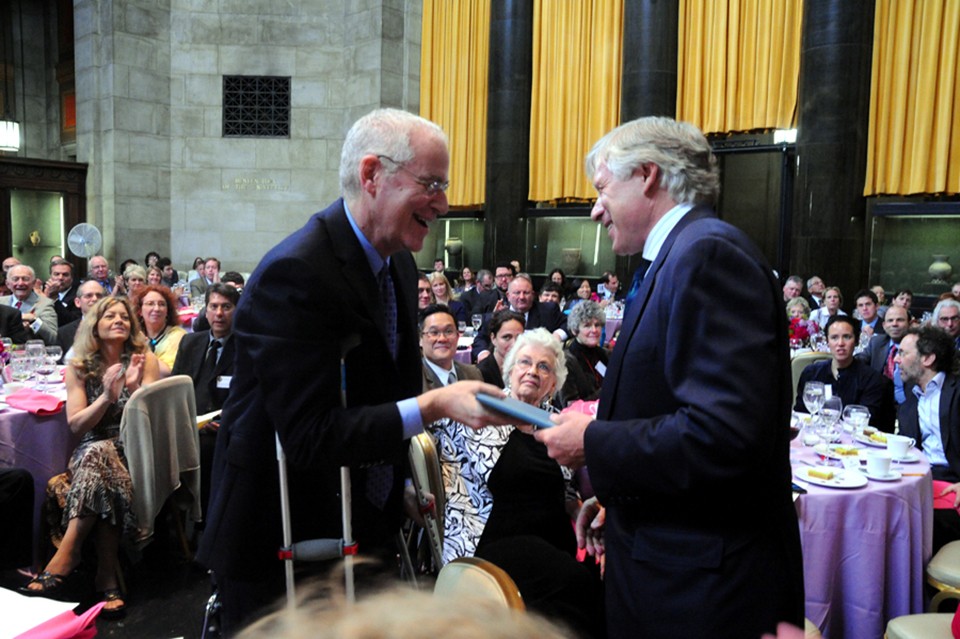
John Lewis Gaddis (Author, Professor of Military and Naval History at Yale.)

When Churchill gave his famous “iron curtain” speech in March 1946, George Kennan already understood the iron curtain’s implication and consequence. Kennan is known as “the father of containment” during the Cold War of 1947-1989.

The relevance of Kennan’s containment policy resonates with today’s American relationship with China. However, its relevance is one of contrast; not similarity. Today, there is no iron curtain that separates China from the rest of the world. The iron curtain has become a cloak. It is a cloak that obscures intent.

The age of the corona virus and China’s decision to delay world notification may or may not have changed America’s response. China’s cloaking of information will haunt the world’s corona virus survivors. Though there is no iron curtain today, secrecy and failure to disclose information fully replaces its physical barrier, and real world effect.

After the war, Kennan insisted on being relieved of duty in Russia and returned home to Wisconsin because President Truman was ignoring Kennan’s recommendations on a “sphere of influence” approach to the U.S.S.R. 

As a deputy head of the Moscow ambassadorship, Kennan sent the famous “long telegram” to the then Secretary of State, James Byrnes, explaining how the Soviet Union should be handled after the end of WWII.  The “long memorandum” makes Kennan famous because it capsulizes what became U.S./Russian foreign policy for the next 30 years.

Kennan recognizes Stalinist Russia’s pursuit of world domination as a Marxian belief of inevitability. With an eastern Russian’ ethos that endorsed persistence and patience (a quality we see in China today) Russia reveals its strength and weakness. 

Kennan recognizes the threat of Russian domination in the 50 s and 60 s. However, he believes it can be managed with patient and persistent opposition by America. Within the limitations of military and economic might, the United States could directly intervene in Russian encroachment when feasible.

When direct confrontation was not feasible, overt cooperation could be undermined based on Machiavellian’ assessment of Russian expansion.  In other words, Russian expansion could be contained and managed by a prudent use of force and guile by the United States. This approach worked with Russia. It is less likely to work with China.

China focuses on international domination through economic growth and influence.

Modern Russia has a similar ambition, but its domination is based on the threat of force and military intervention. Both countries expand their influence but Russia is constrained by a much weaker economy, and the limits of military threat and intervention.

China has little economic constraint on growth of the economy or military because of its growing prosperity, and broadening international influence.

China’s military strength is largely based on deterrent capability; backed by economic growth. Russia’s military growth is based on economic constraint, and the political limits of intervention and force.

Kennan argued Stalinist Russia’s ideology would fail because it is flawed. Kennan believed the gap between truth and lies would limit the U.S.S.R.’s reach and longevity.

Kennan believed that the role of the United States was to contain Russia until it collapsed from the weight of its’ mistaken ideological belief in the unerring truth of collectivism.

There is a strain of collectivist belief in Xi’s Chinese communism but it is tempered by economic freedoms that have improved millions of Chinese lives.

In spite of Xi’s emphasis on communist party rule, the genie of economic freedom has made China more pragmatic and less ideological.

Xi has abandoned his restraint in use of force in Hong Kong demonstrations. One doubts the abandonment of restraint is unending because it is influenced by Chinese communism’s change; a change that began with Deng Xiaoping’s policy of expanding personal economic freedom.

The Stalinist ideology that the collective is more important than the individual evolves in Russia but its evolution retains belief in force (sometimes murder) and intervention as reliable tools for world domination. That belief is Putin’s Achilles heal.
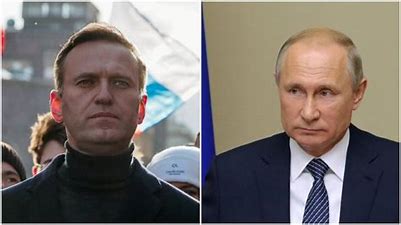
In later years, Kennan’s containment argument for the U.S.S.R. is found to be correct but even he suggests the cost was too high. He believed Russia’s decline could have been accelerated. The flaw in today’s Russia is not in exclusive belief in the collective but in use of force as a first, rather than last, resort.

Putin’s invasion of Ukraine, and intervention in Syria negatively influence world opinion.

In contrast, Xi’s “Road and Belt” initiative positively influences world opinion. (This is not to say all countries are enamored by Chinese largess because it increases their debt, but in many cases China is the financier of last resort.)

A duel, positive effect of Xi’s “Road and Belt” initiative is to create a wider market for Chinese goods. China chooses positive behavioral reinforcement while Russia chooses negative reinforcement (military action, limited energy resource distribution, cyber attacks on voting preferences in other countries) to achieve world influence.
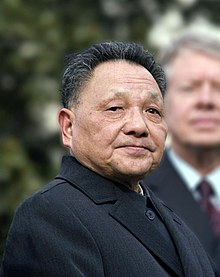
Xi may be more ideologically driven than Putin but he is constrained by Deng’s cracked door which opens the economy to private Chinese entrepreneurs.

Things change and remain the same. George Kennan’s containment policy is reified in 2021, but now it is spoken of in regard to China and the policies of Chairman Xi. A concern one may have–this is not the 20th century. Technology has changed the world. International connectedness, economic interdependence, and environmental degradation require less containment and more cooperation.

Xi’s “Road and Belt” initiative expands China’s influence in the world while Putin’s actions diminish Russia’s influence.

Kennan, born in Wisconsin, went to Princeton after attending Wisconsin’s St. John’s Military Academy.  After receiving his undergraduate degree, rather than going to law school, he joined the newly formed U.S. diplomatic “Foreign Service” and became a vice consul in Geneva, Switzerland.  However, on a chance visit back home, Kennan met William C. Bullitt, the U.S. ambassador to Moscow, and was asked to accompany him to the U.S. Embassy in Russia in 1933.

Because of Kennan’s extraordinary foreign language ability, he became a fluent Russian language expert on Soviet affairs.  He was a student of pre and post-revolutionary Russian’ culture; he used that knowledge to forge an American foreign policy to deal with Russian expansion after WWII; i.e., his prescient grasp of Stalin’s mind, and the Russian culture, allowed the United States to contain the Russian empire within Eastern Europe by limiting American overt action and covert action through confrontation, black-ops, and diplomacy. 
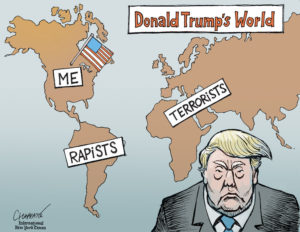
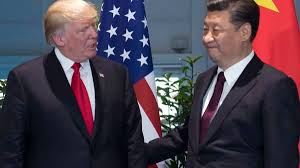
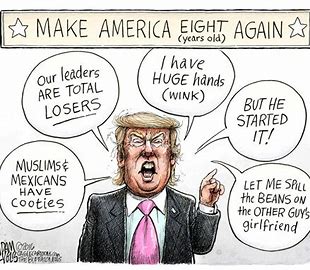
To Trump, international relations should be conducted on a give and take basis; leaving only winners and losers.

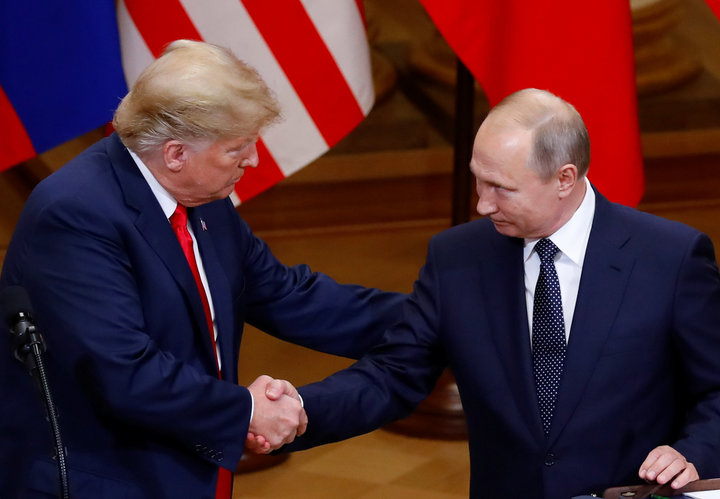
America’s President has no Kennan in mind. Trump looks at international relations as a transaction. Trumps thinks diplomacy is like a business. Government is not a business and governance always suffers when dollars and cents are the only criteria for measurement of success.

President Trump’s nomination of Jon Huntsman Jr. as ambassador to Russia is a case in point. Huntsman spoke Mandarin Chinese which made him a highly credible candidate for a stint as Ambassador to China during the Obama administration. Trump appoints Huntsman to Russia because he is a wealthy Republican business man. One doubts the appointment had anything to do with Huntsman’ understanding of Russia or its language.

Though containment was not entirely successful, Kennan’s assessment of its spread to Yugoslavia and China were recognized as independent power structures. Yugoslavia and China believed in the value of the collective but evolved into less doctrinaire belief in “the many being more important than the one”. Yugoslavia dissolved into different states with different economic principles, and China changed its economic philosophy by acknowledging the importance of one among many.

George Kennan’s biography reinforces a belief that understanding another culture requires emergence in that culture.  Ambassadors that are not fluent in a culture’s language and fail to spend years in that culture’s environment cannot understand what policies America should adopt to protect itself and promote world peace and freedom.  One wishes all American Presidents would recognize that need in Ambassadors representing the United States.

Kennan’s biography reveals the importance of self-interest in foreign policy and how a Machiavellian manipulation of events is essential for a reliable margin of success.  Of course, some American Presidents have taken self-interest and Machiavellian manipulation to an extreme.
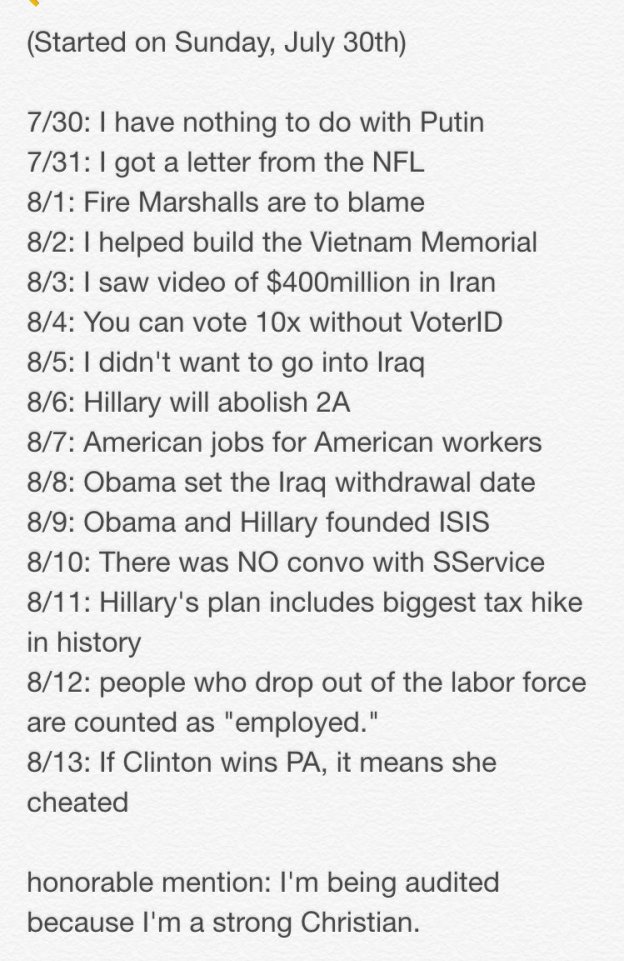
Trump is not the first American President to cross the line of truth and morality but he seems one of the most prolific.

Kennan is revealed as a human being in this biography, not perfectly right or entirely wrong; subject to mistakes, personal biases, and prejudice; but grounded by life in a real, not purely theoretical, world.  Kennan lived through many great events in world history, from WWII to Vietnam. His active professional life gave the United States what it needed most; i.e., perspective and practical diplomatic advice.
Pay Any Price

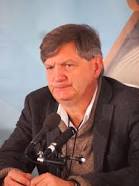
James Risen (Author, American Journalist,).

An act of government that presumes it knows what is good for everyone mocks omniscience.

The GAO (Government Accountability Office) finds President Trump broke the law by delaying Ukrainian military aid.

Today, it is terrorism; yesterday, it was communism, day before yesterday, it was Japanese internment camps.

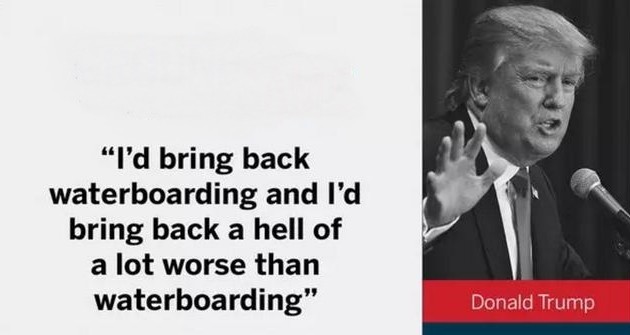
James Risen’s “Pay Any Price” exposes government hubris that tortures suspected terrorists and invades personal privacy to feed human greed and desire for power; all under the guise of protecting America.

Japanese internment during WWII.

Guantanamo tramples human rights; the red-scare of the 1950s breeds mistrust of elected officials, and Japanese internment camps during WWII stain the American’ conscience.

Greed and power are two of the three motivations for endless war.

The third is presumed status which leads to a false sense of omniscience and hubris.

Sadly, 9/11 is not the first or last terrorist event in America’s future but without a measure of human freedom, America loses more than it gains by suspecting everyone is a terrorist.

Government should protect Americans from the greed and power of the few over the many, rather than concoct wasteful government programs that only feed the worst parts of human nature.

President Trump believes he knows best and fails to seek the advice or counsel of those who are in a position to offer a more balanced perspective.

Few, if any, would suggest Qassem Soleimani was not a murderer of Americans. But what price has been paid by the world for Trump’s unilateral decision to have Soleimani assassinated?

There is no question–institutional discrimination exists in the United States, and it victimizes American minorities.

Demonstrations that destroy public property and federal government intervention are equally reprehensible events. Neither serves the goal of achieving equal opportunity for all Americans.

Violence is a consequence of a willingness to “Pay Any Price”.

American Capitalism

Audio-book Review
By Chet Yarbrough

(Blog:awalkingdelight)
Website: chetyarbrough.blog

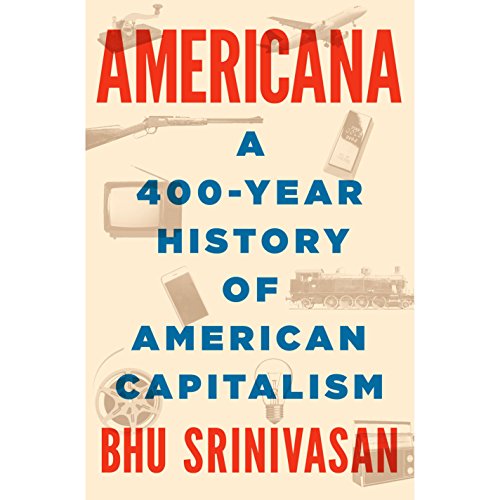
Americana, A 400-Year History of American Capitalism


By Bhu Srinvasan

Narrated by Scott Brick, Bhu Srinvasan

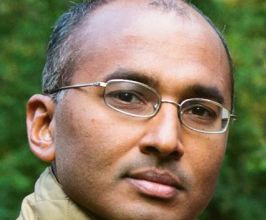
Bhu Srinivasan (Author, American citizen born in India, Emigrated at age 8 to the United States with his mother.)

“Americana” is homage to the muscular success of capitalism in the United States.  It appears it takes someone born outside America to unapologetically endorse the gift of capitalism to the world. It seems Bhu Srinvasan lives the American dream in the 21st century. 

Srinvasan “leans in” by arguing libertarian-ism’s strengths outweigh its weaknesses.  “Americana” speeds through the history of great men (because women’s contribution is largely ignored) who settle America in the 17th century.  With the help of English entrepreneurs willing to risk investment in the voyage of the Mayflower, the egg of American capitalism is hatched. 

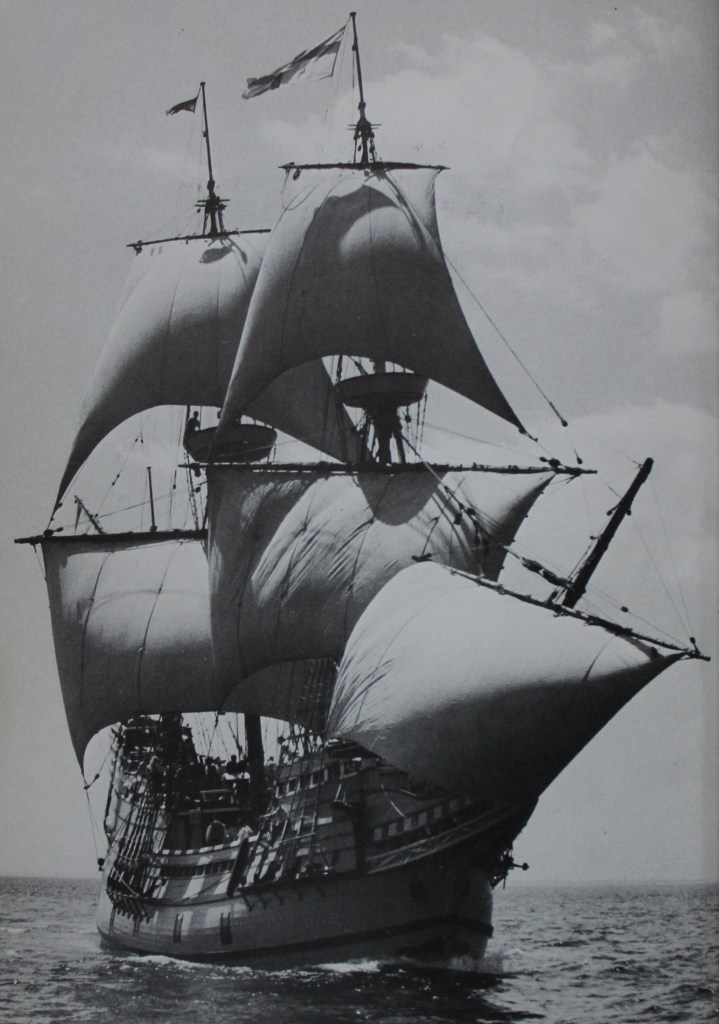
Mayflower Replica

(The Original Mayflower Sailed September 6,1620 and landed on Cape Cod 66 days later, which was 500 miles north of its intended destination in Virginia.)

The investors expect a return on their investment.  They finance the expedition based on an expectation of success from a settlement in Virginia.  The first years of the Pilgrims’ progress is nearly a bust.  The author explains the initial investment is nearly lost but recovered by an agreement among the settlers to buy out their Mayflower investors.  The buyout is a success because the settlers find a ready market for American goods in England; particularly beaver furs which were provided to settlers by native inhabitants.

With growth of the fur trade, new settlers come to America.

The beaver fur business is expanded with new settlers who learn how the Indians ply their trade.  Competition grows and undoubtedly many tribes are shut out of the trade.

This, as in many more stories told by Srinvasan, reminds one of the boon and bane of capitalism.  That is not Srinvasan’s intent, but the effect of competition from acquired knowledge, new technology, and entrepreneurship is repeated many times.  There are winners and losers in the growth of capitalism. What is one life worth?

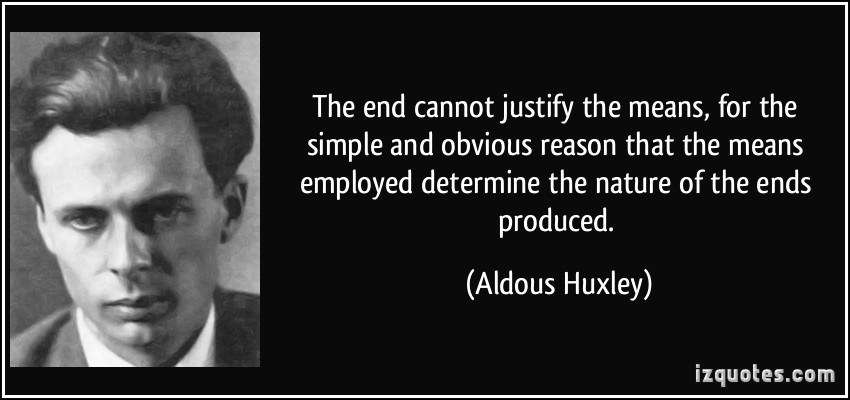
There is an “end justifies means” theme in Srinvasan’s view of America. This is an attitude reflected by President Trump’s suggestion on March 24, 2020 to re-open America in April.  The reality of quality-of-life improvements in America makes Srinvasan’s, and some would say Trump’s view, a worthy subject of contemplation.  America is the most economically successful nation in the modern world.

Srinvasan glosses over issues of slavery, racism, and corporatism. Trump’s suggestion that America should be reopened for business in April of 2020 is a judgement that suggests ends justify means. The spread and human impact of the coronavirus is unknown.

Many of the harsh realities of a transactional economic system bare down on America with exposure to the coronavirus. Do ends justify the means? 

Carnegie, Vanderbilt, Ford, Rockefeller, Morgan, Edison, Westinghouse, Watson, Gates, and Jobs are a few examples given for the success of American Capitalism. 

What is missed is the “blood in the water” from changes wrought by these men of steel, automobiles, energy, finance, communications, transportation, and technology.  With each advance in American ingenuity, there is a general rise in America’s standard of living.  Indeed, Bhu Srinvasan himself is a tribute to the success one can have in 21st century America. But, Srinvasan tells only one side of the story.

Homelessness in America is a disgrace.  Rat infested ghettos in large American cities perpetuate poverty and crime.  A deteriorating education system is gamed by the wealthy who neglect what can be done to help the poorly educated. 

Corporations have a duty to educate people displaced by technology.  Government needs to move beyond the transactional value of health care to provide basic health services to all Americans.  Environmental degradation needs to be abated before the world’s 6th extinction. 

To ignore the price paid by a growing underclass in America, is side-stepped by Srivasan’s “…History of American Capitalism”. 

America capitalism can do better.  We are no longer a struggling economy like that which existed in the days of the Pilgrims and later so-called robber barons.

Srinvasan is an excellent primer on capitalism but that is history; not a prediction of a future where homelessness, a deteriorating environment, a failing education system, inadequate health care, and racial injustice are ignored.

American history shows lower taxes encourage higher production and job creation. What is missed by tax reduction is that it exacerbates income inequality. Tax reduction incentivizes corporate leaders to devalue worker wages to increase profitability. Human self-interest leads to higher income for corporate owners and executives. The consequence magnifies the wealth gap between have and have-nots.

MILITARY INTERVENTION

Audio-book Review

By Chet Yarbrough

chetyarbrough.blog

A Concise History of the Middle East, Ninth Edition

By Arthur Goldschmidt and Lawrence Davidson

Narrated by Tom Weiner

Messieurs Goldschmidt and Davidson have created an insightful overview of the origins and impacts of an area of the world not well known or understood by much of the American public. 

Arthur Goldschmidt Jr. (Author, historian)

Lawrence Davidson (Author, History professor)

History is made up of facts but never the whole truth. Events are reported out of the context of their historical era, a time which can never be fully explained; even by the most knowledgeable historian. 

So, why is understanding the Middle East important? 

In the Middle East, more than a million human lives have been lost from war since 2001.

Since 2001, Iraq, Afghanistan, and Syrian conflicts have killed over 6,700 Americans, nearly 3,000 NATO coalition soldiers, an unpublished number of Russian and Turkish soldiers, 182,000 Iraqis, 111,000 Afghans, and 400,000 to 570,000 Syrians. 

MORE REASONS ABOUND

OIL

From an economic perspective, there is the importance of oil imports from the Middle East.

IRAQ INVASION’S COST

There is the cost of military intervention in foreign countries. The cost is in both lives and international relations.

America’s reputation in the Middle East has fallen dramatically because of our invasion of Iraq. In 2o22 the center of Middle East attention has moved from the slim possibility of democracy to reification of authoritarianism.

The perception of militant interest groups has exacerbated Middle East conflict, largely because of religious difference and economic disparity. Two powers, Saudi Arabia and Iran have replaced America’s pre-Iraq influence in the Middle East. Syria is run by a brutal dictator supported by Russia. The plight of the Middle East is for many to live in poverty under authoritarian leaders interested in power and eternal control, more than their citizen’s general welfare.

RELIGION

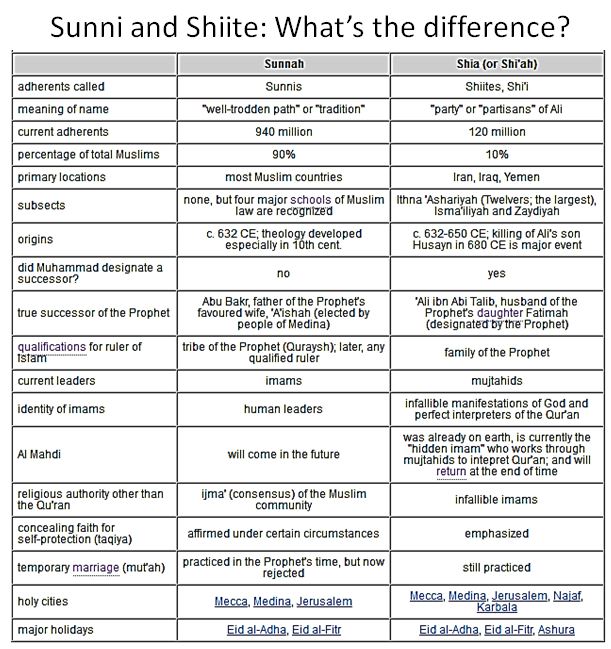
From a religious and cultural perspective, the Muslim religion is the second most common in the world. Iran is principally Shite, while Saudi Arabia and Syria are Sunni.

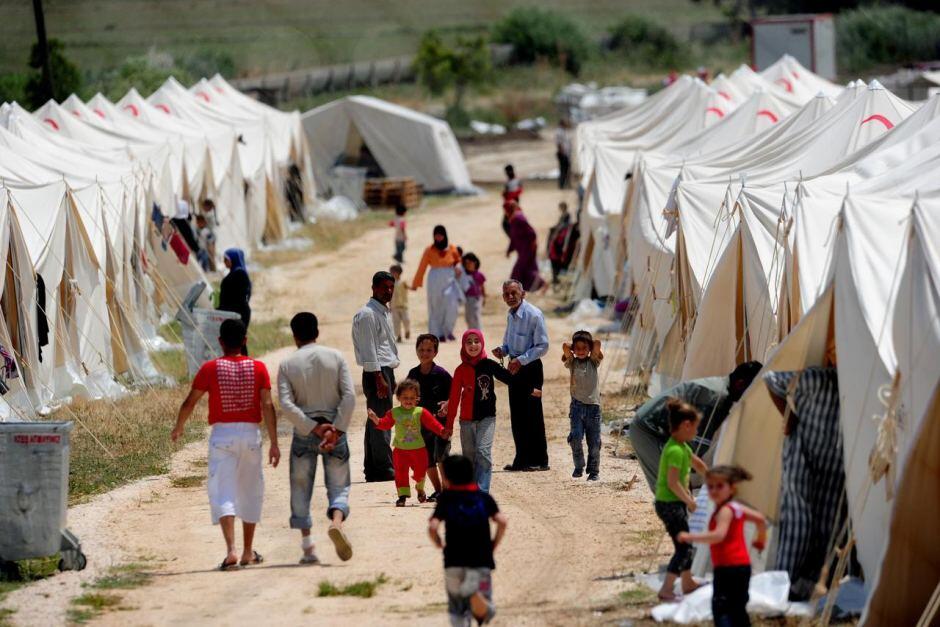
SYRIAN REFUGEES IN TURKEY (Turkey spends $30 billion on Syrian refugees.)

Countries like Turkey are overwhelmed by the cost of housing and feeding refugees from the Syrian war.

From a humanitarian perspective, hundreds of thousands of refugees have been created. Where do they go? How will they live. There are many consequential reasons for a better understanding of the Middle East. 

This audio book provides some history and, more importantly, perspective on religious belief, ethnicities, and secularism in the Middle East; i.e., it explains some of the differences within and among Middle Eastern countries. 

Goldschmidt and Davidson help one understand the difference between a Muslim Sunni and a Muslim Shiite.  Their history gives the listener a better appreciation of the importance of an Imam to a Shiite and what happens in Shiite dominated Iran versus what might occur in a majority Sunni country like Saudi Arabia or Kuwait. Syria is somewhat of an outlier because the Alawite, a minority in the Sunni religion, is in control of the government.

Goldschmidt and Davidson point out that Shiite’ beliefs are evolving because they are Imam’ interpretations of the Koran while Sunni’s beliefs are more static and grounded in literal readings of the Koran. 

The authors reflect on religious conflicts among believers in Islam, the creation and growth of the state of Israel, the secular leanings of Turkey, the Kurdish conflicts between Turkey and Iraq, the history of Iraq and its makeup of Kurds, Shiite, Sunni, and Christian factions.  They report on the Hezbollah and Palestinian movements surrounding Israel which are supported by Iran.  They touch on our 2001 New York tragedy and the hostility of al-Qaeda and its influence on American perception of the Middle East. 

“A Concise History of the Middle East” is an eye opening journey through centuries of border conflicts, colonialism, nation building, and evolving nationalism.

There is little doubt, considering what has happened in Iran (and is presently happening in Saudi Arabia, Egypt, Turkey, and Syria), that there is a growing discontent in the Middle East, a burgeoning desire for freedom; a freedom that is forged by a variety of belief systems, tempered by the will of its indigenous people. 

Goldschmidt and Davidson help one understand that, like America, there are many conflicting beliefs in the Middle East that have led to misconceptions, tragic mistakes, civil wars, and violent actions perpetrated and perpetuated by committed believers and brutal authoritarian leaders. Both believers and authoritarians are either vilified or commended by the passing of time and the distance of recorded history.

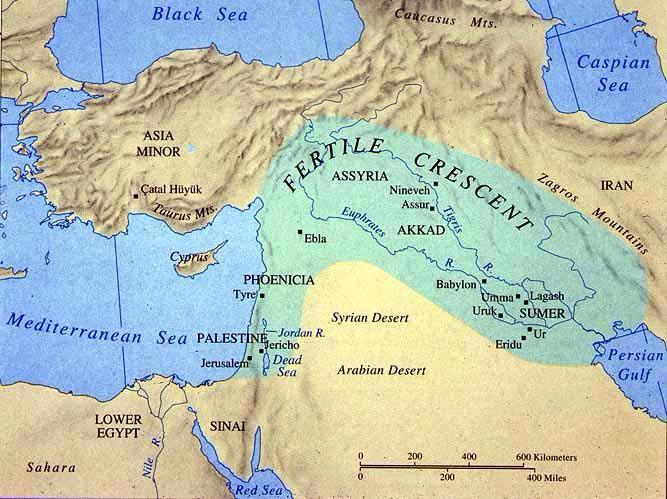
ANCIENT MIDDLE EASTERN MAP

The Middle East is shown as the world power it once was; its devolution into a variety of colonial and/or monarchical nation states; and  its re-growth as an oil producing behemoth.

The Middle East is working its way into the 21st century as a new world power.   One is drawn to the conclusion that this new world power is in a state of creation from a variety of competing Middle Eastern nation states that may or may not survive the 21st century. 

What Goldschmidt and Davidson remind one of is the folly of outside military intervention in countries of which one has little understanding.

Goldschmidt and Davidson’s writing is a gift that makes reports of the Middle East more accessible to the general public.

UNWORTHY BIOGRAPHY

Audio-book Review
By Chet Yarbrough

(Blog:awalkingdelight)
Website: chetyarbrough.blog

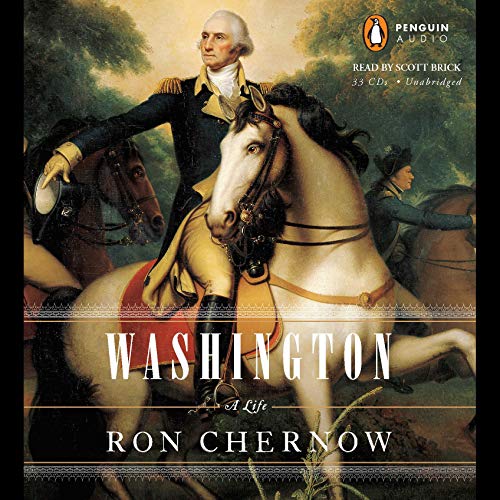
Washington: A Life
By Ron Chernow

Narrated by Scott Brick

Ronald Chernow (American writer, journalist, historian, and biographer, Pulitzer Prize winer.)

Fans of Ron Chernow, other reviewers, most readers, and the Pulitzer Prize panel of judges, obviously disagree with this review; not that Chernow would care.

Chernow is a respected biographer.  He has written biographies of J.P. Morgan, The Warburgs, John D. Rockefeller, Alexander Hamilton, and now “Washington: A Life”, a 2011 Pulitzer Prize winner for biography.

In fairness, Chernow writes better descriptive phrases in “Washington…” but any phrasing unworthy of a Pulitzer Prize winning book should be edited out.

In spite of its Pulitzer standing, some phrasing in “Washington A Life” is amateurish. 

Describing a person as one with “intelligent eyes” lacks clarity and concreteness.  What do “intelligent eyes” look like? 

Much of what Chernow writes is a recitation of facts with little of the color of its era.

Unquestionably, “Washington: A Life” is a well-researched biography of a pivotal hero in America’s history. but it suffers from a common failing of more memorable biographies.    Every fact may be documented but motive is obscure because motive is wrapped in a social and human context that is missing. 

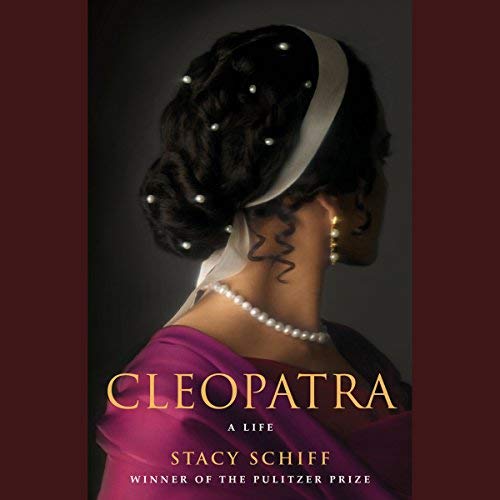
Like the Pulitzer Prize winning history of Cleopatra, Chernow slips into cliché, or a “just the facts” phrasing characteristic of a Dragnet TV detective.

When Chernow strays from the facts, he sounds like an apologist for Washington. Chernow misses the essence of Washington’s rationalization of slavery’s contradiction of humanity.

Washington is plainly a slave holder, albeit less punitive than Harriet Beecher Stowe’s fictional Simon Legree.  But, like Legree, Washington treats his slaves as property to be bought, and sold, and when they escape, tracked down, and punished. 

Chernow writes “Washington rarely whipped his slaves and tried to keep slave families together”.  That makes Washington better than Simon Legree but Washington does not stand above that era’s generally accepted and wrong-headed social mores.  Washington’s “warts” are blurred in Chernow’s biography.

Chernow’s characterization of Washington’s dalliance with Sally Fairfax (a married woman) as a non-sexual infatuation stretches credulity.  Part of Chernow’s evidence is Martha Washington’s acceptance of Sally Fairfax as a personal friend rather than former paramour of George Washington.

Chernow spends a great deal of time explaining how Washington led a life of image that is difficult to penetrate.  As Chernow clearly explains, Washington assiduously represses emotions that boil beneath his facial expression; i.e. Washington could easily don a mask to hide romantic indiscretion.

Putting these negative comments aside, Chernow provides a lot of facts about Washington’s life that are not generally known.  Information about America’s great revolution makes Chernow’s near-1000 page book worth listening to, but far from understanding America’s first President. 

Like Schiff’s biography of “Cleopatra”, a reader/listener does learn a great deal about documented facts of a great historical figure.  But Washington, like Cleopatra to this reviewer, remains a mystery. 

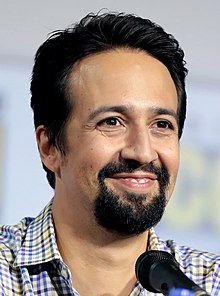
Lin-Manuel Miranda (American composer, lyricist, rapper, singer, actor, playwright, and producer of Broadway Musicals In the Heights and Hamilton)

Chernow needs another Lin-Manuel Miranda to contextualize his uninspiring biography of Washington.

2 + 2 Makes 5

Audio-book Review
By Chet Yarbrough

(Blog:awalkingdelight)
Website: chetyarbrough.blog

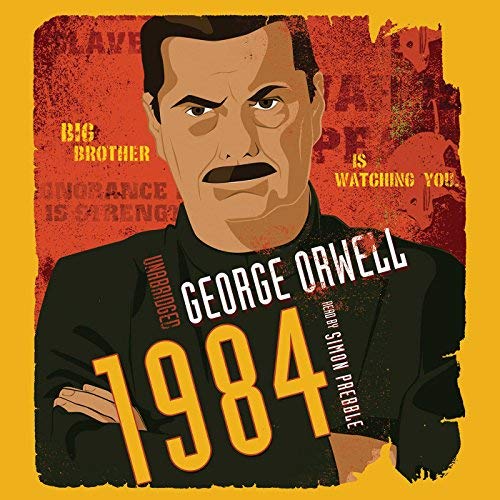
1984


By George Orwell

Narrated by Simon Prebble

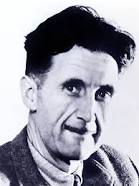
George Orwell (1903-1950, Author born in India, a British Citizen)

Orwell published “1984” in 1949.  Orwell’s vision of totalitarianism, technology, and thought-control match today’s fears and failures in America.

Technology (then and now) is a threat to everyone’s privacy and self-determination.However, technology has a much wider; more intrusive role today than in 1949

Advances in social media through Facebook, Twitter, LinkedIn, and others–with the help of Google, Amazon, and Apple, are encroaching on everyone’s right to privacy and personal thought.

Jingoism, war threats, and propaganda fill newspapers, television reports, and the Internet to influence and manipulate indigenous and exogenous populations. 

7/31/2019-China blames America for Hong Kong demonstrations.

American, Chinese, Iranian, Syrian, Russian and Turkish governments tell the world that their internal turmoil is caused by outside influences.

Truth is hidden by Trump’s divisive diversions and subversions. Trump’s dishonest attack on Georgia’s election process is his latest diversion and subversion of American Democracy.

The Republican party can look to Trump to find why Georgia is now represented by two Democrats in the Senate.

Trump and Erdogan are masters of this art. As Lord Acton noted: Power corrupts and absolute power corrupts absolutely.

Today, it is gangster-ism in Ukraine; yesterday it was abandoning Kurdish allies who fought by the side of Americans in Syria; and today it is “don’t be afraid of Covid19” or Erdogan’s intervention in Armenia.

History reveals murders, imprisonment, and rigged elections caused by malignant use of the internet. Though the victim/hero of “1984” is tortured to say “2 + 2 make 5”, the use of the internet gives forum to lies and hate that make the unwary believe “2 + 2 makes 5”.

Putin’s domination of the media in Russia is quintessential Orwellian disinformation. From saying he is defending the homeland to comparing Ukraine leadership to Nazi Germany, Putin distorts the truth of his personal ambition.

Orwell’s vision of totalitarianism and population indoctrination in “1984” is more direct than today’s media manipulations. Google argues that search-engine’ clicks are meant to customize consumer searches for information, but how far is that from thought control?

The inherent subtlety of social media seduces rather than tortures people into thinking in a particular way. 

People are killed by media manipulation of the truth. Media manipulations cause conflict, but rarely cause death on a mass scale.  (Of course, it is a mass scale to the mother, father, grandparent, sibling or friend who loses someone they love.) Orwell is saying there are no ideological differences between a media-manufactured war and a real war when people die.  Is the American government out of control?

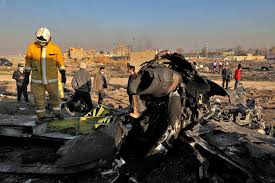
Ukrainian Airlines Crash from Iranian missile launch mistake

Orwell points to media-manufactured wars that are not really wars between nation-states. Thought diversions and public-conflict misinformation spread by the government and the media make indigenous populations endorse, obey, and follow their leaders.

Now we have the economic and health threat of Covid19. What measures must be taken to mitigate the economic destruction and death that it causes? Where is the line drawn between autocratic rule and democracy? With a President acting as king, are America’s “checks and balances” strong enough to protect volitional rights?

With arbitrary hiring and firing of critical government administrators there is reason to doubt more economic destruction and death are not inevitable.

Add private sector big data use to government sector misinformation, and individuals lose both privacy and independence.

Acquisition of nuclear weapons to foment a war is a fiction. It is a fiction designed to manipulate public opinion.

The concern over nuclear proliferation is about fear of mistakes and nuclear accidents; not nuclear war.

This is not to say nuclear proliferation is not a danger to the world. It is a danger, but more because of its use as a political weapon than a tool of war.

The fact is, nuclear accidents occur; for example, Russia’s recent nuclear-weapon’s failure in August 2019.

Iran and North Korea incite their people to expand nuclear weaponry to gain status in the world. It is not an irrational move in the real politic of public affairs. A former Israeli spy master (Meir Dagan) noted on national television that Iran’s government officials are rational; mutual nuclear destruction is not rational.

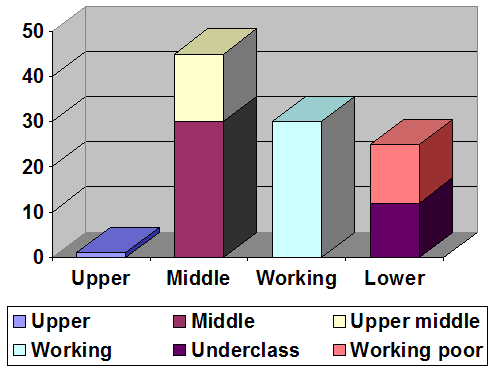
Orwell characterizes nation-state populations as three tiered; e.g. upper, middle, and lower.  The upper class conception is a ruling class that controls a nation; the middle class strives to become a part of the upper class, and the lower class (estimated at 25% in the U.S.) is suppressed by both the upper and middle class to maintain the three tiered structure. 

Orwell suggests the upper class becomes a kind of collective with a particular ideology that usurps capitalist ambition by trading wealth for collective power. This is the concern one has over the widening gap between rich and poor.

Piketty argues that the income gap widens once again, after World War II.  He estimates 60% of 2010’s wealth is held by less than 1% of the population; with a lean toward the historical 90% threshold. 

One might say that the “collective” concept has more relevance in a socialist country but money is power in America so Orwell’s upper class definition is equally relevant in a largely capitalist country.   The difference is a matter of degree; i.e. rather than an oligarchy of socialists, America has an oligarchy of wealthy corporations and multi-millionaires.

Today’s Moneyocracy is the upper class described in “1984” and the “Occupy Wall Street” protesters are Orwell’s revolutionary hero/victims

A striking parallel between Orwell’s “1984” and today is western culture’s 21st century “Occupy Wall Street” movement.  The “Occupy Wall Street” movement has protesters but they cannot articulate actions that can practically actualize their revolution.

All revolutionaries cannot be subverted, imprisoned, or murdered. One might argue Orwell’s “1984” torture of revolutionaries is being replaced by corporate use of private data and government propaganda to achieve the same purpose.

Orwell is as prescient today as he was in 1949.

FREEDOM OF CHOICE

Audio-book Review
By Chet Yarbrough

(Blog:awalkingdelight)
Website: chetyarbrough.blog

East of Eden


By John Steinbeck

Narrated by Richard Poe

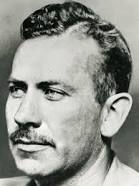
John Steinbeck (1902-1968, Author, Nobel & Pulitzer Prize Winner)

What does Steinbeck’s “East of Eden” have to do with the right to vote? It has to do with freedom of choice. Conservative’s effort to restrict a right to vote is a lie.

The Russian invasion of Ukraine in 2022 is a crisis of this moment. Putin is realizing the mistake he has made. Either through misdirection or a face-saving ploy, Putin is suggesting there be a vote to determine Ukraine’s independence. It is an international mistake not to take Putin’s vote proposal seriously. The only question should be how a plebiscite can be structured for Ukrainians in a war zone.

Now we know, Putin mocks freedom to vote with a gun pointed at your head.

“The Heritage Foundation’s database includes 1,296 ‘proven instances of voter fraud’ out of the hundreds of millions of votes cast going back to 1992. Of those cases identified, 1,120 resulted in criminal convictions. What rational human being would commit voter fraud and how likely is a fraudulent vote likely to change the outcome of a national election?

“East of Eden” is a judgement on the nature of humanity.

In “East of Eden”, every human being has a choice; the choice to be good or evil. An inference in Steinbeck’s “East of Eden” is that individuals choose who they want to be regardless of economic circumstance, or genetic inheritance.

“Black Lives Matter” questions that premise in the face of institutional racism.

Mixing and matching diverse personalities are a part of Steinbeck’s oeuvre.  An audio book listener sinks into the first few chapters of “East of Eden” thinking they know how the story ends.  However, each new character reveals some new facet of humanity that turns and twists the story.

Steinbeck’s anti-hero, Cathy Ames, seems destined for execution; the Trask family for tragedy, the Hamilton family for peace and prosperity, and Chinaman Lee for Saint-hood. What happens is only partly expected.

Steinbeck invents characters that show the best and worst of humankind; without making life a morality play. 

A listener cares what happens to Steinbeck’s characters.  The beauty and transcendence of Steinbeck’s writing informs; sometimes intimidates, those who think they know something about life.

Children of the world are raised in the best and worst conditions of existence.  Children are raised in the happiest families, the saddest families; in enslaved minorities, in blue collar majorities, in one parent, two parent and no parent families. Children die or mature to become someone or no one, but Steinbeck infers chance and choice are theirs to follow. 

Steinbeck raises questions about life and how one lives it.  Steinbeck writes a story showing that becoming oneself is influenced by genetics and environment but not determined by either. In “East of Eden” life’s journey is made of human choices and chances.

The most evil character in “East of Eden” is Cathy Ames.  She comes from a two parent “Ozzie and Harriet” family that owns a relatively successful leather tanning business.  Cathy Ames is loved by her family.  She is an only child that is doted on by her mother and loved by her father.  Cathy Ames chooses to murder her parents, and merry an unsuspecting man.

A good-hearted, trusting man–Adam Trask marries Cathy Ames. The Trasks have two children– twin boys who seem to reincarnate differences in their parents. The boys names are Cal and Aron with each seeming to take a different path in life.

Aron is more like his father. Cal is more like his mother–less trusting, prone to getting in trouble, and intent on finding and understanding the life of his mother.

Cathy Ames shoots her husband after the twin’s birth.  She abandons her wounded husband and newly born children. Cathy chooses to become a prostitute and Madam and lives her idea of the American dream. 

Chinaman Lee is the Trask family’s servant. Lee is an outlier observing the American dream with a philosophical belief that good and evil exist in all human beings. Lee views existence of good and evil as a God-given choice; not a fate or pre-ordination. Lee’s wisdom and philosophical beliefs influence the Trask family sons; particularly as their father’s health deteriorates.

One of the most laudable characters in “East of Eden” is Samuel Hamilton.  He is an Irish immigrant that comes to Southern California, and has a past that touches evil. Hamilton flirts with a “Cathy Ames kind” of relationship, but breaks away from its evil influence to become a sage and seer in Salinas County. 

Hamilton becomes the patriarch of a big family that is poor in wealth but rich in love, respect, and familial affection.  Samuel Hamilton lives a different American dream.

Lee is a cornerstone character in Steinbeck’s story. Lee’s philosophical belief in human choice is illustrated by Cal’s decision to avoid a life lived like his mother. Cal chooses good over evil after finding and recognizing his mother’s poor choices and their consequences.

Freedom of choice is both a human burden and benefit. Steinbeck implies each person chooses their course in life. Their choices are their own responsibility; not genetics, or economic circumstance.

It is ironic. Trump chooses to bargain with Congress on mail-in voting when the unemployed are suffering from hunger and pending homelessness caused by Covid19′ joblessness.

Exception might be taken in poor communities that have no living wage jobs. In light of Steinbeck’s “…Grapes of Wrath”, one might argue there is a false bottom in belief that economic circumstance is irrelevant. One can certainly choose to be good rather than evil, but the consequence of poverty seems to compel evil.

Theft, like selling illegal drugs, is a way of making a living in poor communities that have no jobs. Both illegal enterprises recruit the unemployed by offering jobs, potential wealth, and identity.

Compelled evil is even more starkly reflected in Richard Wright’s “Native Son”. Is evil strictly a choice? Some would argue environment and genetics compel choice.
COLLECTIVIST BELIEF

Audio-book Review
By Chet Yarbrough

(Blog:awalkingdelight)
Website: chetyarbrough.blog

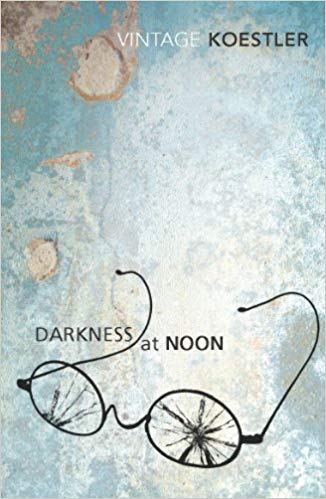
Darkness at Noon

By Arthur Koestler

Narrated by Frank Muller

Arthur Koestler (1904-1983, Author)

Though Stalin is never named in “Darkness at Noon”, Stalin is the “one” that encapsulates a vision of Communism that demands submission by the individual to the collective. 

When a young communist refuses to distribute Stalinist Party’ literature that ignores Nazi attacks on local Communist’ cells, he is expelled from the Party.

In real life, Koestler joined the Communist Party in Germany in 1931.  His resignation from the Party in 1938 is a likely motivation for writing “Darkness at Noon”.

Koestler’s hero is a young communist leader that disagrees with his Russian controller and is expelled from the Party in the 1930s.  The substance of the disagreement is the heart of the story.

The central character of “Darkness at Noon” is Nicholas Rubashov. Rubashov enforces Stalinist’ Communist belief in the collective, but he has doubts. Rubashov is the apparatchik who is ordered to expel a young German’ Communist because he looks at Russian Communism as a personal rather than collective savior.

Imprisonment of Putin’s political rivals, invasion of Crimea, and buildup of Russian troops on Ukraine’s border is reminiscent of Stalinist tactics before and after WWII.

Increasingly, Vladimir Putin exhibits the same drive for power as that characterized by Stalin, particularly in regard to his action in Chechnya and now Ukraine.

Koestler’s hero is characterized as one of the original participants in the 1917 revolution. As he ages, his blind acceptance of Stalin’s Communist belief in the collective waivers.  Rubashov is imprisoned and ordered to sign a confession.  The interrogators, Ivanov and Gletkin, are responsible for getting a signed confession from Rubashov. 

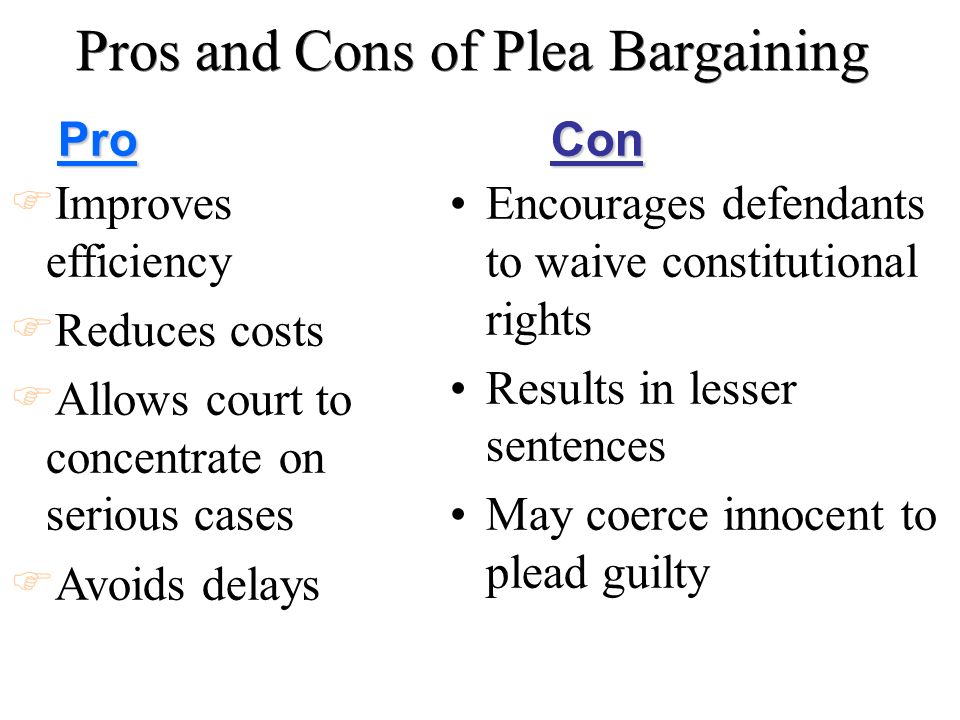
Ivanov, who is a former acquaintance and civil war comrade of Rubashov’s, offers an opportunity for Rubashov to redeem himself. Ivanov suggests that Rubashov confess to a lesser charge to justify incarceration for five years with a chance to return to political power.  Rubashov initially says “no” but Ivanov’s “plea bargain” approach works and Rubashov signs a confession.


However, Ivanov is later removed from power and Gletkin takes charge of Rubashov’s case.  Gletkin argues Ivanov’s approach is a mistake.  Gletkin insists on a complete confession of guilt; i.e. no redemption, only execution.

Much evidence is brought before Rubashov.  The evidence is weak but Rubashov becomes convinced through sleep deprivation, and a clever manipulation of Rubashov’s logic, that he must be executed. Rubashov’s personal feelings of guilt come from his denial of collective good. He reasons–the way he has been judged is the way he has lived his life; therefor his life should be forfeit for the cause; in the interest of the many over the few.

Gletkin might be characterized as a mindless Neanderthal because of his belief in torture, but one of many of his clever manipulations suggests he is diabolically clever.

Gletkin suggests Rubashov was given a watch when he was 7 or 8, which Rubshov acknowledges is probably correct.  Gletkin says he did not have a watch until he was a teenager and that he did not know there were 60 minutes in an hour until then.  No one in his social class looked at time in segments; waiting in line was not characterized by time but by results from waiting in line. 

“Darkness at Noon” implies the end result is what is important; not the means and time that one stands in line. This is a quintessential belief of the “true believer” in Stalinist communism.

WOMEN IN WAR

Audio-book Review
By Chet Yarbrough

(Blog:awalkingdelight)
Website: chetyarbrough.blog

The Unwomanly Face of War–An Oral History of Women in World War II

By: Svetlana Alexievich, Translated by Richard Pevear and Larissa Volokhonsky

Narrated by Julia Emelin, Yelena Shmulenson

Svetlana Alexievich (Author, Belorussian Investigative Journalist, 2015 Nobel Prize in Literature–for her polyphonic writings.)

The author of “The Unwomanly Face of War”, Svetlana Alexievich, suggests women’s deployment in war dates to the Greco-Roman wars.  However, some say Russia is the first nation to deploy women as combat troops.  History shows Russia enlisted women as a fighting force in WWI. 

“The Unwomanly Face of War” notes nearly 1,000,000 women joined the Russian military to defeat the German armies in WWII. 

Alexievich interviews former WWII Russian women as pilots, snipers, mine clearing commanders, and military tank leaders. Some were as young as 13; others in their late teens or early 20’s when they joined. At the time of the interviews, all were in their 50’s or older.   By any definition, these Russian women were combat troops.

This is a particularly timely release of a translation of “The Unwomanly Face of War”.  In western nations, as early as the 1940 s, the role of women in the military has been in transition. 

Most countries recognize the immense contribution “women in war” have made since WWI. However, the WWII veterans in Russia’s battles were not fully recognized until the 1950s.

What Alexievich offers is a peek into what Russian women in combat experienced during WWII.  She identifies similarities and differences military men and women experience in war.  To listeners of Alexievich’s interviews, similarities appear much greater than the differences.

The preeminent common characteristic among combat troops is nationalism.  Whether man or woman, the belief in the sovereignty of one’s country supersedes gender.  The disgust for an invading country and its military is equally reviled. 

Alexievich suggests women feel the atrocity of war more than men because women bare and raise children. She argues women are more nurturing and emotion driven than men. 

However, her interviews recount two events that would equally engage and enrage men as women.    

Two interviews reveal a mother’s decision to sacrifice her children.  One circumstance is for a mother to quiet a crying child by infanticide because of an approaching German troop.  The second is a mother who has her child carry a bomb into a military mess hall to kill the enemy as well as the sacrificed child. How does maternal instinct differ from the worst actions taken by men?

The human response to war seems as brutally evident in women as men.  The trauma of war seems to be absorbed in similar ways.  War experience is something never forgotten, and often repressed.  There seems little difference among the sexes based on Alexievich’s interviews of WWII women veterans.

Another example that seems more of a provisioning than sex difference is the reality of menstruation and how it is to be dealt with in combat circumstances.  With proper provisioning the difference between the sexes seems miniscule.

Another circumstance alluded to is the physical strength differences between the sexes.  The circumstance recalled is a woman tank commander who cannot physically rescue an injured tank soldier because she is unable to lift him out of the tank. 

Pulling dead weight is a limit for men as well as women. Though the average strength differences might be true between all men and all women, brute strength is an extraordinary need in war; not a common requirement. If one person is not enough to move a wounded soldier, he/she gets help.

“The Unwomanly Face of War” addresses the reality of conjugal sex in war.  War is little different than life in the civilized world when it comes to the battle of the sexes.  Alexievich recounts affections that rise between men and women in the field of war.  One can appreciate exaggerated interdependence when one’s life is at stake.  Maybe there is a difference, but the difference seems more of imagination than reality.  Peace has its own way of corrupting the relationship between men and women.  One must question how different the battle between the sexes is in war than in peace. 

Common purpose brings the sexes together in both war and peace. When common purpose is absent, the sexes battle for their personal interests.  What distorts the battle is power.
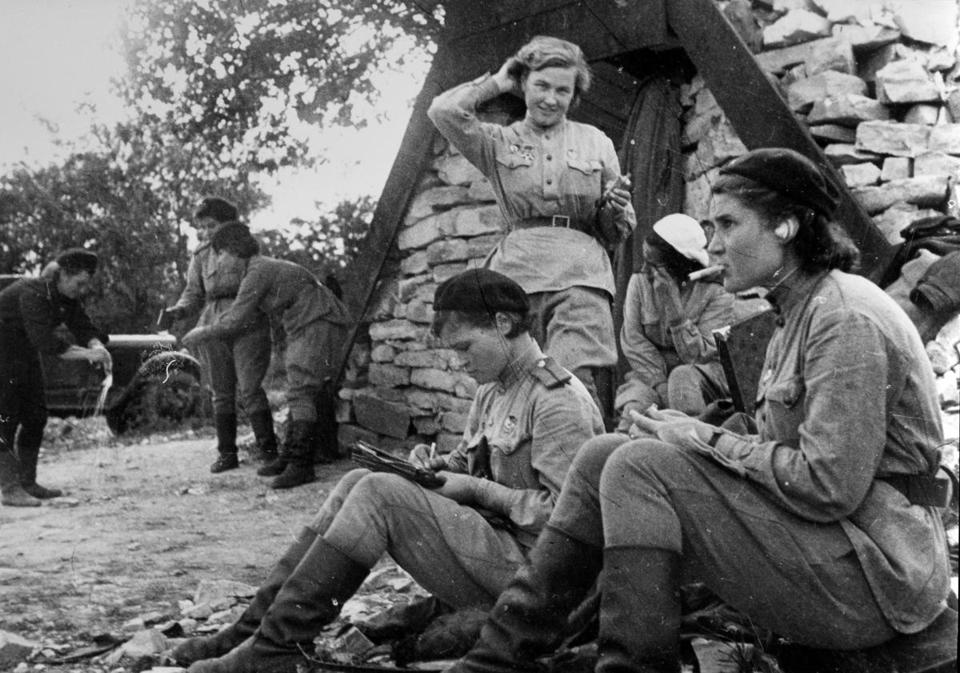

History suggests power more often lies with men than women whether in civilian or military life.  Until there is equalization in power, the potential for fairness among the sexes is unlikely. 

Whether in war or peace, sexual orientation is subject to inequality.  The only remedy is a set of rules and regulations judiciously enforced.

One will draw their own conclusion about the role of women in war after listening to “The Unwomanly Face of War”.  Whether in a time of war or peace, what is incontestable is unequal treatment of women

LONG JOHN SILVER

Audio-book Review
By Chet Yarbrough

(Blog:awalkingdelight)
Website: chetyarbrough.blog

Treasure Island

By: Robert Louis Stevenson

Narrated by Philip Glenister, Daniel Mays, Catherine Tate, Owen Teale

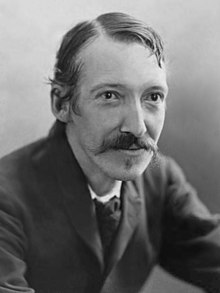
Robert Louis Stevenson (1850-1894, Author died at Age of 44)

Robert Louis Stevenson’s “Treasure Island” is a curious piece of literature that resonates with 21st century calumny.  Humans are not perfect.  There is a bit of Stevenson’s “Long John Silver” in everyone.

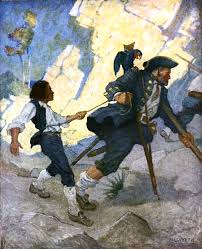
For those unfamiliar with Stevenson’s tale, “Long John Silver” is a pirate who hoodwinks a young boy, a crew of sailors, a doctor, a professional ship’s Captain, and a few others on a voyage to recapture a treasure.  Silver has the “gift of gab”; salted with a lifetime of experience in getting what he wants.

What strikes one about Silver’s character is his ability to see things as they are and change his behavior to suit the circumstance.  If a lie suits his purpose, he lies.  If the truth suits his purpose, he tells the truth.  What he lacks is morality. 

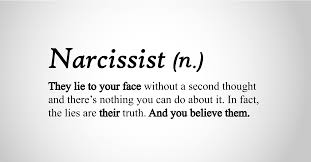
Silver is a narcissist.  He has an egoistic admiration of himself that includes self-flattery, arrogance, and a sharp tongue that cuts like a blade. When confronted with one whom Silver disagrees, he cajoles, belittles, or verbally (sometimes physically) attacks his opposition.

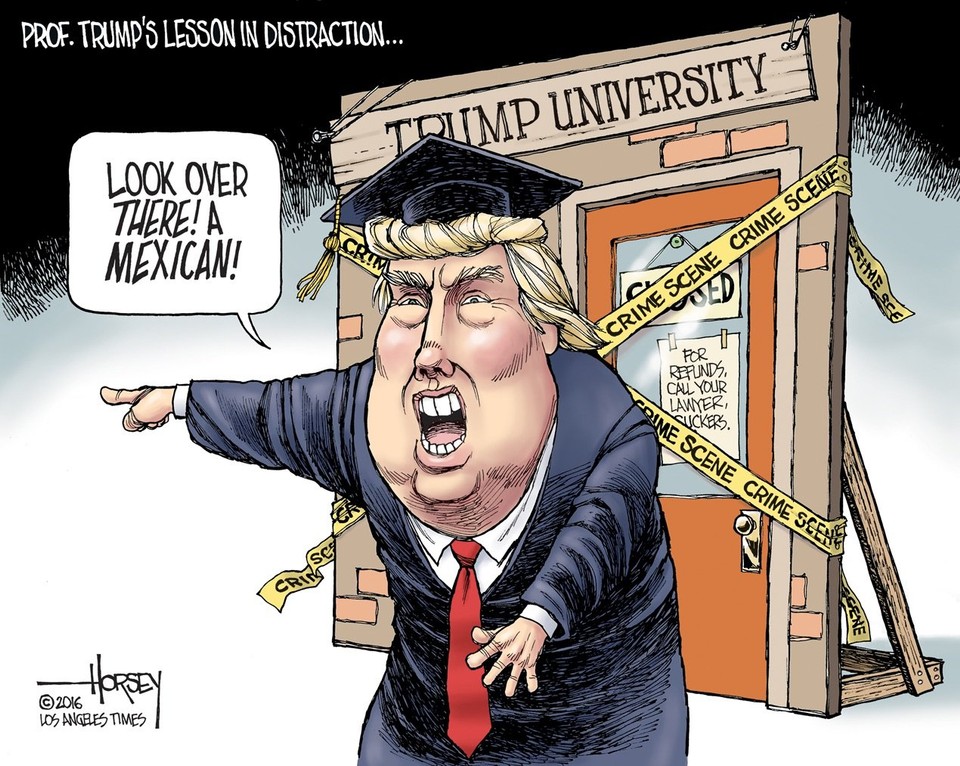
If disagreeing, belittling, and cajoling fail, a narcissist changes the focus of attention with a manufactured distraction.

Putting aside Silver’s narcissistic amorality, he understands a truth about human beings. Silver represents belief that money, power, and prestige rule the high seas and land.  With the skill of a practiced politician, Silver manipulates events to conform to plan. 

The curious piece of Stevenson’s story is Silver’s prediction that Ben Gunn, a stranded buccaneer on Treasure Island, would be cheated out of a share of the treasure even though he played a major part in the treasure hunters’ success. 

Gunn is an anti-hero who has lost his mind because of his isolation on the island.  Gunn is like a modern-day homeless man abandoned by society.

Silver’s plan is to capture the wealth of a buried treasure.  Though not entirely successful, he captures a share of the booty by co-opting Jim Hawkins, a cabin boy with a yearning for the sea.  In the end, Silver escapes the clutches of British authorities who would have convicted him for mutiny, and possibly, attempted murder.

What Silver points out is that the doctor, ship’s captain, and other survivors of “Treasure Island”, will cheat Gunn of his fair share.  Gunn is given 1000 Sovereigns (English pounds) and the rest (hundreds of thousands per person) is distributed to the surviving voyagers.  Silver infers all human beings are pirates. 

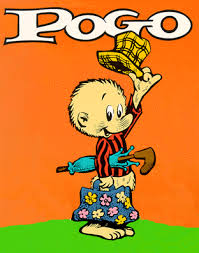
Some pirates wear suits, speak the King’s English, and live in the city; a Pogo version of “We have met the enemy-of-the-people and he is us.”