SUICIDE

“We Are the Nerds” is a story about “Nerdom” and the tragic loss of Aaron Swartz to his loving family and the world of coding.

Books of Interest
 Website: chetyarbrough.blog

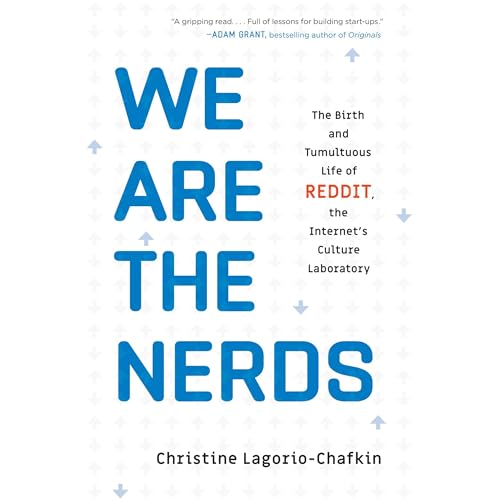
WE ARE THE NERDS (The Birth and Tumultuous Life of Reddit, the Internet’s Culture Laboratory)

Author: Christine Lagorio-Chafkin

Narration by: Chloe Cannon

Christine Lagorio-Chafkin (Author, reporter, podcaster based in New York.)

Relistening to “We are the Nerds” may be reviewed from a perspective of the future of newspapers but that diminishes the tragedy of Aaron Schwarz’s suicide.

The original founders of what became known as Reddit were Steve Huffman and Alexis Ohanian, graduates from the University of Virginia. A third partner, Aaron Swartz, is invited into the company because of his tech experience in creating a company called Infogami which merged with Reddit. With the addition of Infogami, the original founders of Reddit created a parent organization called “Not a Bug, Inc”. Schwartz insists on being called a co-founder because of his contribution to Reddit as a programmer. That insistence rankled Huffman and Ohanian which grew into a resentment that fills the pages of the author’s story.

Steve Huffman on the left with Alexis Ohanian and his wife, Serena Williams, and their daughter on the right.

The author seems to minimize Schwartz’s contribution to Reddit despite the framework he created that made Reddit scale more quickly because of its open access and community-driven cultural impact. Swartz’s contributed code appears to have been an important step in the useability of Reddit by the public. However, in fairness to the original founders, the author infers that contribution pales in respect to the extensive coding and work done by Huffman. The point is that this conflict becomes an irritant that leads to the departure of Swartz from Reddit in 2007, after it was acquired by Condé Nast in 2006. That acquisition made all three original coders millionaires.

Swartz’s life and premature death is a tragic encomium to the story of Reddit’s success as a public forum.

By some measure, Swartz is a brilliant human being, but his intelligence is accompanied by what might be characterized as a self-destructive personality. His ability as a computer nerd is evident in his High School days in Highland Park, Illinois. He goes on to Stanford, but its educational regimen leads him to leave after his first year. He preferred independent learning. Schwartz’s remarkable ability led him to become a research fellow at Harvard University in 2010. He became a self-taught intellectual with an activist belief in academic freedom that eventually led him to rebel against authority. He was arrested in 2011 for allegedly breaking into MIT’s computer network without authorization. He was charged for computer fraud and faced 34 years in prison and a million-dollar fine. At the age of 26, Swartz hung himself and died on January 11th, 2013.

An American mass media company founded in 1909.

Huffman and Ohanian believed Swartz’s contributions to Reddit were less than theirs in creating the company they sold to Condé Nast that made them millionaires. Swartz’s idealism and independence conflicted with the original founders of Reddit who seemed more interested in building a public platform that could make them rich. Though Ohanian believed they sold too soon, all three agreed to Condé Nast’s final offer that made them millionaires.

In retrospect, Ohanian may have been right about the future value of Reddit. Condé Nast spun Reddit out to an independent subsidiary under Advance Publications where it became a 42-billion-dollar success by 2025. Today, Huffman’s net worth is estimated at $1.2 billion as a result of his Reddit shares. Though Ohanian may not have held on to his shares, his net worth is estimated at $150-$170 million. Not bad for two University of Virginia graduates. However, as Plato observed, “The greatest wealth is to live content with little”. Swartz’s life seems to have had little to do with desire for wealth.

“We Are the Nerds” is a story about “Nerdom” and the tragic loss of Aaron Swartz to his loving family and the world of coding.
AMERICAN HOPE

From Fukuyama’s intellectual musing to our eyes and ears, one hopes he is correct about America’s future in the technological age.

Books of Interest
 Website: chetyarbrough.blog

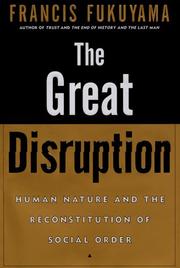
The Great Disruption (Human Nature and the Reconstitution of Social Order)

By: Francis Fukuyama

Francis Fukuyama (Author, political scientist, political economist, international relations scholar.)

Francis Fukuyama argues America is at the threshold of a social reconstitution. Fukuyama believes we are at Gladwell’s “Tipping Point” that is changing social norms and rebuilding America’s social order. He argues the innovation of technology, like the industrial revolution, is deconstructing social relationships and economics while reconstructing capitalist democracy.

The immense power of big technology companies like Amazon, Google, and Facebook have outsized influence on American society. They change the tone of social interaction through their ability to disseminate both accurate and misleading information. They erode privacy and create algorithms tailored to disparate interest groups that polarize society. The media giant’s objective is to increase clicks on their platforms to attract more advertisers who pay for public exposure of their service, merchandise, and brand.

To reduce outsize influence of big tech companies, Fukuyama suggests more technology has an answer.

There should be more antitrust measures instituted by the government to break monopolistic practices and encourage competition with large technology companies. Algorithms created by oversight government organizations can ensure transparency and reduce harmful content to reduce big tech companies influence on society. (One doubts expansion of government agencies is a likely scenario in today’s government.)

On the one hand, technology has improved convenience, communication, and a wider distribution of information.

On the other, technology has flooded society with misinformation, invaded privacy, and polarized society. Technology has created new jobs while increasing loss of traditional industry jobs with automation. Trying to return to past labor-intensive manufacturing companies is a fool’s errand in the age of technology.

Luddites during the Industrial Revolution.

Like the industrial revolution, the tech revolution’s social impact is mixed with a potential for greater social isolation, and job displacement with the addition of wide distribution of misinformation. The positives of new technology are improvements in healthcare product and services, renewable energy, and climate understanding with potential for improved control.

Face-to-face interactions become less and less necessary. Children’s access to technology impacts parental supervision and relationship. Fukuyama suggests setting boundaries for technology use needs to be a priority in American families. Technology can open the door to better education, but it also becomes a source of misinformation that can come from the internet of things. Employers have the opportunity to help with work-life balance by encouraging flexible hours and remote work. (Oddly, that suggestion is being undermined by the current government administration and many American companies.)

Economic growth, access to information, and global connectivity have been positively impacted by technology. However, the concentration of power, misinformation, and surveillance of social media has diminished privacy and eroded individual freedom. There are concerns about technology and how it is good and bad for democratic capitalism.

The good lies in increased efficiency, innovation and creation of new markets, through globalization. However, today’s American government shows how tariffs are a destroyer of globalization. Fukuyama implies A.I. and automation is displacing workers and aggravating economic inequality because it is being misunderstood for its true potential and also being misused. Personal data is used to manipulate consumers in ways that challenge the balance between corporations and consumers.

Fukuyama argues private parties will grow in America to create software that will filter and customize online services.

With that effort control of the influence of big tech companies will be diminished. With decentralization of big tech power and influence, society will theoretically become less polarized and more consensus oriented. The capitalist opportunity for tech savvy startups that diminish influence of big tech companies will re-create diversification like that which the matured industrial revolution gave to new manufacturers. Like Standard Oil and other conglomerates of the industrial revolution, businesses like Amazon, Google, and Facebook will have competition that diminishes their power and influence.

American Government will grow to regulate the internet of things just as it has grown to regulate banks, industries, and social services.

Service to citizens will become a bigger part of the economy as a replacement for manufacturing. Family life will re-invent itself as a force of society because of the time saved from manufacturing product to improve human relationships.

From Fukuyama’s intellectual musing to our eyes and ears, one hopes he is correct about America’s future in the technological age.