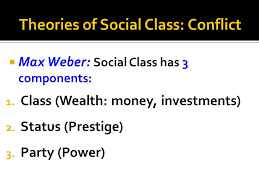
The flaws of society are only magnified by the surreptitious use of private information. McCarten shows human self-interest is unlikely to change in a surveillance driven society. As long as human self-interest revolves around money, power, and prestige, private information should be protected.
Audio-book Review By Chet Yarbrough
Blog: awalkingdelight Website: chetyarbrough.blog
Going Zero: A Novel
By:Anthony McCarten
Narrated by:Marin Ireland
Anthony McCarten (Author, New Zealand writer and filmmaker.)
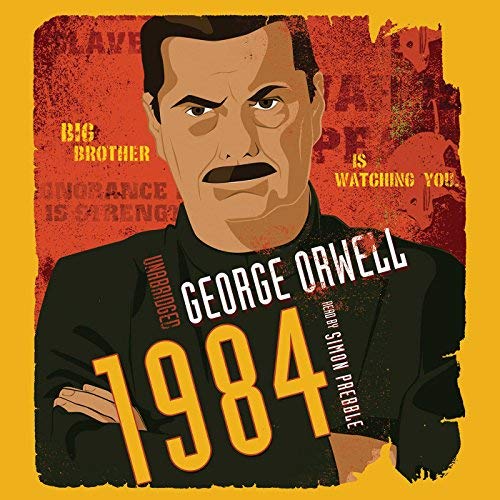
Anthony McCarten creates a fictional story that fits today’s truth about a brave new world revealed by Aldous Huxley in 1932 and reinforced by George Orwell in 1949. https://chetyarbrough.blog/2019/09/08/2-2-makes-5/ The striking revelation and threat in “Going Zero” is that our human desire for recognition drives society to accept the intrusion of government and big business into our lives. The popularity of the former company Twitter, today’s Reddit, internet users, and ubiquitous mobile phone’ users show how addictive recognition has become to the young and old. That need for recognition conflicts with the right to privacy. McCarten shows how important and harmful right to privacy’s loss can become.
McCarten offers a clever story that reveals the danger of unrestricted access to citizen’ information. A highly profitable private tech company offers $3,000,000 to any one of ten pre-selected contestants that can be undetected by a software company’s private surveillance program. A private tech company gains the cooperation of the federal government to use their data base and surveillance technology to help find these ten contestants within a 30-day period. The tech company’s software can mine government’ data and use government’ surveillance equipment to track private citizens. The program is called “Going Zero”. The purported reason for cooperation of the government is to protect citizens from society’s bad actors. The tech company’s interest is in getting a muti-billion-dollar contract for their proprietary software.
Added to McCarten’s fine story is the mystery of a disappeared but unacknowledged agent of the C.I.A. The one person that successfully beats the “Going Zero” contest is the agent’s wife. She only enters the contest to expose the government’s information about her husband.
Both government and business believe they use personal information to serve the public. Government and big business subtlety influence society to believe private information is public information. Government argues knowledge of private information protects society. Big business argues collection and use of private information offers material, social, and/or psychological rewards to the public.
Capitalism is not the problem in America. It is the failure of the S.E.C., the FBI, C.I.A., the President, and congressional legislators to do their job.
A contrary argument is that government and big business would be able to program society by using private information to reward citizens like Palov’s dogs. The questions one may ask oneself: Can bad actors really be identified before they rob, steal, rape, and murder? What are the ramifications of a business that uses private information to tap into subliminal desires of the public? “Going Zero” offers an example of how private information collected by government and big business are a threat to society.
Anthony McCarten’s story shows how important it is to protect personal privacy.
The flaws of society are only magnified by the surreptitious use of private information. McCarten shows human self-interest is unlikely to change in a surveillance driven society. As long as human self-interest revolves around money, power, and prestige, private information should be protected. If there is a counter argument, I would like to hear it.
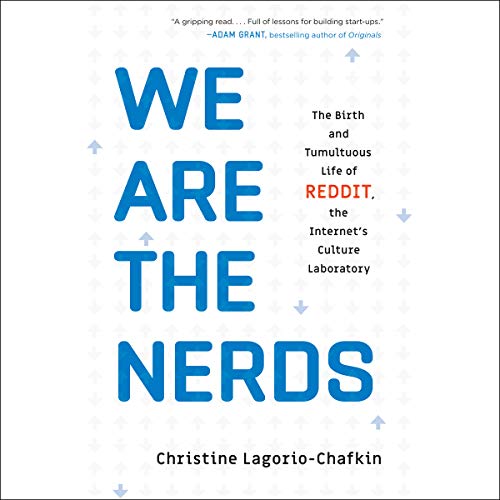
Conscious management of deleterious and harmful content by news media is the hope of humanity’s future. That is the message one may find in Lagorio-Chafkin’s history of Reddit.
Audio-book Review By Chet Yarbrough
Blog: awalkingdelight Website: chetyarbrough.blog
We Are the Nerds (The Birth and Tumultuous Life of Reddit, the Internet’s Culture Laboratory)
By:Christine Lagorio-Chafkin
Narrated by:Chloe Cannon
Christine Lagorio-Chafkin (Author, reporter, senior writer for “Inc” magazine.)
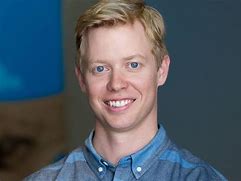
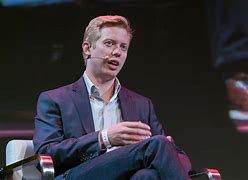
Christine Lagorio-Chafkin offers a detailed history of the internet forum known as Reddit. Founded by Steve Huffman and Alexis Ohanian, with coding help from Aaron Swartz in 2005, Reddit has grown from an idea to a user-based internet newspaper estimated at 57 million daily readers and users as of December 2022. Huffman and Ohanian were roommates and students at the University of Virginia. These two founders are helped by Aaron Swartz, a nerd coding extraordinaire, with coding expertise. These are early days of a yet to be named web site.
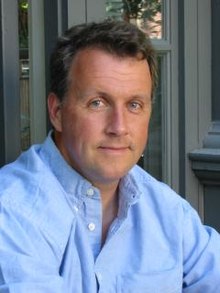
With the help of start-up idea’ consultant Paul Graham, these three young men parlayed their idea into an asset that is purchased in 2006 by Conde-Nast to make the founders millionaires in their early 20s.
In 2018, Advance Publications, the parent company of Conde-Nast, values Reddit at $6 billion. Advance raises $250 million in funding in 2021. From Conde-Nast’s original purchase price of $10 million, one gains some idea of Reddit’s value despite having not made a profit since its inception. Chafkin suggests they are almost there in her book.
Steve HuffmanAlexis OhanianAaron Schultz
Lagorio-Chafkin’ story of these three young men offers insight to a generation that is reminiscent but different from the movers and shakers of the industrial revolution. The industrial revolution might be broken into two periods. The first began in the 17th century when Samuel Slater introduces British industrialization into the textile industry of America. The second occurs after the American Civil War with machine inventions like Eli Whitney’s cotton gin, and du Pont’s improvements in chemistry and gunpowder needed for the War of 1812.
Just as the industrial revolution’s pioneers, the tech revolution pioneers are obsessed with their work.
Their motivations were similar, ranging from fascination with their work to interest in being financially successful. The difference is the work of the industrialist focuses on material productivity while the technologist focuses on idea productivity. Both benefit society but the industrialist looks at material results while the technologist focuses on ideas, and knowledge that can be put to productive use. Both benefit society but from different starting points. The industrial economy is weighted heavily toward material productivity while the tech economy is more heavily weighted toward social and service influence.
Reddit went through several generations of CEOs. Each made changes to the direction of the company. Yishan Wong, a former Facebook employee, began Reddit’s transition from scandal sheet to newsworthiness. His success is limited because of Reddit’s drive for profitability and his manufactured controversy over relocation of its headquarters. Since inception, Reddit has gone through 5 CEOs.
Steve Huffman (2005-2009, 2015-present) (born 1983) 1986 for Swartz and 1983 for Ohanian
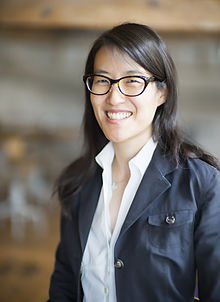
Ellen Pao (2014-2015)
Yishan Wong (2012-2014)
Erik Martin (2010-2014)
Jay Adelson (2005-2009)
Ellen Pao’s tenure as CEO of Reddit is brief but consequential. Pao implemented several changes to the site’s policies, including banning revenge porn and unauthorized nude photos. Pao’s resignation came after a week of intense criticism and harassment from some members of the Reddit community.
Ellen Pao resigned from her position as CEO of Reddit in July 2015. Her leadership was met with controversy and criticism, and she faced backlash from some members of the Reddit community over her policies and decisions. Some users felt her changes were too restrictive and infringed on their freedom of speech. Yes, Ellen Pao filed a gender discrimination lawsuit against her former employer, Kleiner Perkins, in 2012. The case went to trial in 2015 and Pao lost the suit. After leaving Kleiner Perkins, Pao became the CEO of Reddit in 2014, but resigned her position in July 2015.
The principals of Reddit are Steve Huffman and Alexis Ohanian who begin as friends and become estranged as the company grows. In time, they reconcile with Huffman becoming CEO of the company.
Both contribute to the success of Reddit, but Huffman becomes the guiding light for its future as a publicly designed profit-making internet newspaper. Ohanian becomes particularly famous for the woman whom he marries.
Serena Williams and Alexis Ohanian marry in November 2017
The tragic story of Aaron Swartz’s important contribution in the early days of Reddit explains an underlying purpose of a public paper. Swartz is vilified by the American government for downloading private information to the public without corporate or government authorization.
Aaron Schwartz commits suicide. Chafkin notes Swartz’e father argues his son believed in a “right-of-the-public” to know everything there is to know about society. To Swartz’s father, Aaron did not commit suicide but was murdered by the American government as a result of its relentless prosecution.
Fundamentally, “We Are the Nerds” is about an internet generation concerned with greater social self-realization, if not comity. Reddit is a social news aggregation and rating website that offers a forum to the public that broadcasts user’ beliefs and understanding of the 21st century world. It is not about industrial productivity but about people’s social perceptions and beliefs ranging from facts to fiction about the material world.
The purpose of Reddit is not to produce “all the news that’s fit to print” but to reveal all the news that reflects the beliefs of a flawed society.
Reddit, while counseling moderation, allows extreme views of a diverse and self-interested user base. As a public forum, it interviewed the President of the United States (Barrack Obama). On the other hand, Reddit provided a forum for trolls like Michael Brutsch, who broadcasted images of scantily clad underage girls, porn, gore, misogyny, incest, and other societal images of human depravity. There is little social comity in that scenario, but it is a part of human society. Troll behavior is the bane of click-bate oriented internet platforms. Reddit, since the return of Huffman, focuses on eliminating hate-speech and dysfunctional societal contributors to its public forum. Chafkin notes Reddit’s exposure of Russian interference in the election of Donald Trump. It offers evidence of Reddit’s effort to clean-up misleading information and fake news that is the bread and butter of click-bate’ media sites.
To use the oft quoted Star War’s meme–Reddit is trying to follow a “this is the way” principle to give legitimacy to News’ purveyors of the future.
Reddit, like past and present newspaper and television stations are subject to their owner’s conservative, liberal, or independent biases. Owners of media sites like The New York Times, Fox News, CBS, NBC, ABC, CNN, Facebook, Google search, Microsoft search, X, and Amazon have their biases. Conscious management of deleterious and harmful content by news media is the hope of humanity’s future. That is the message one may find in Lagorio-Chafkin’s history of Reddit.
Peter Frankopan, (Author, Professor of Global History at Oxford University, Director of the Oxford Centre for Byzantine Research.)
Peter Frankopan journeys from pre-history to the present to offer perspective on the earth’s global warming crisis. He reviews what is either speculated or known of disastrous world events. Frankopan recalls histories of major volcanic eruptions, earthquakes, tsunamis, droughts, famines, pandemics, and epidemics that have changed the course of history.
In the beginning, one thinks Frankopan is setting up a rationalization to argue global warming is just another world changing crisis that will be managed by humanity.
However, Frankopan is explaining the history of world crises and how humanity dealt with its eternal recurrence. In broad outline, he suggests world crises are dealt with in two ways, i.e., one, with religion or mysticism, and/or two, with adaptation. In every historical crisis, leadership is the presumed key to survival.
Frankopan explains the common denominator for crises that change the world is death.
Just as America and the world recovers from Covid-19, millions have died. We who remain carry on.
Whether a catastrophic event is geological, climatological, or pathogenic, life is a victim. Before history is written, Frankopan offers explanations of what happened to life based on fossilized remains. Causes for death are either geological (like earthquakes), climatological (like volcanic dust that blocks the sun), pathogenic (like the plague or a virus), or manmade (like the nuclear bomb). When written history begins, Frankopan’s evidence of world crises is more precisely explained. (From an objective perspective of any historian’s story, any history of the past is trapped in His/Her’s interpretation of other’s reported facts.)
Frankopan argues life on earth has come and gone through centuries of crises.
The evolution of human beings shows they have managed to ameliorate past crises by meeting them head-on. Humans have overcome crises by adapting to change, whether manmade or environmental. If the past is prologue to life’s survival, global warming’s threat will be met and ameliorated by human response. Just as all crises in world history have ended lives, the same is true of global warming. That does not necessarily mean all human life ends. Frankopan’s history infers life will be changed by global warming but leaves unanswered whether human life will end.
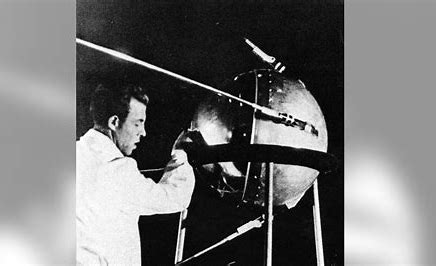
Jumping ahead in Frankopan’s scholarly review of history, the age of Sputnik emphasized the growing importance of science in the ecology of the world.
The Russian Launch of Sputnik in 1957.
Ironically, Russia’s giant step ahead of America in the space race awakened the world to the importance of science. Frankopan notes the hubris of humanity taking center stage with Khrushchev’s comments about humankind’s need and ability to control nature. To Frankopan, control of nature is a turning point in the hubris of humankind. He notes the U.S.S.R. experiments with weather control as a way to improve agricultural productivity. Frankopan suggests the real objective is to realize the potential of weather control as a weapon of war and goes on to explain how America capitalizes on that idea in the Vietnam war.
The irony and hubris of humanity in believing it can control the weather is evident in the despoiling of earth by human ignorance and action.
The profligate use of carbon-based energy for industrial growth far outstrips any science driven effort by humanity to control the weather. World ecology has proven too complex for constructive control by human beings. It is as though the world is being turned back to religion and myth to explain the phenomenon of world existence.
The last two chapters address overwhelming evidence for causes and consequences of late 20th and early 21st century world’ environmental damage.
From deforestation in the Amazon, to automobile increase in China, to waterway dams and aquifer depletion, a listener/reader’s fear and depression are kindled.
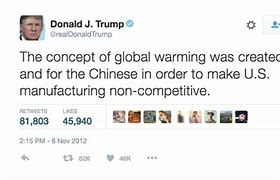
Harvard educated politicians like Ted Cruz and poorly educated Presidents like Donald Trump insist global warming is a hoax. As political power representatives of the wealthiest country in the world, one cannot but be appalled by climate change deniers.
The world’s future is based on an unknown solution to global warming.
Some suggest A.I. is key to solving global warming. Frankopan’s history suggests it is human beings that gave humanity the ability to overcome past crises. A.I. is one of humanities tools. It seems fair to suggest today’s crises will be another difficult chapter in the history of humanity. Judging by Frankopan’s history of human adaptation, global warming may not be humanities last chapter. However, Frankopan warns listerner/readers against the hubristic belief that nature can be controlled by humankind.
Stephen Hawking suggested humanity will not survive another 1,000 years on Earth and that human survival depends on colonization elsewhere in the Solar System. Frankopan seems to infer, humanity does not have that much time.
Frankopan wryly observes global warming is a crisis, but that human life is more likely to end from some other cataclysmic natural event like that which killed the dinosaurs (a meteor strike), a massive underwater volcanic eruption, or nuclear war before global warming kills us all.
One hopes histories past lessons inform a future that includes a place for the youth of this, the next, and future generations. World change brought on by crises have been overcome in the past through human adaptation. It seems reasonable to presume, despite the ignorance of some national leaders, that humanity will survive today’s global warming crisis.
Antonio Damasio (Author, Portuguese American neurologist, Professor at the University of Souther California.)
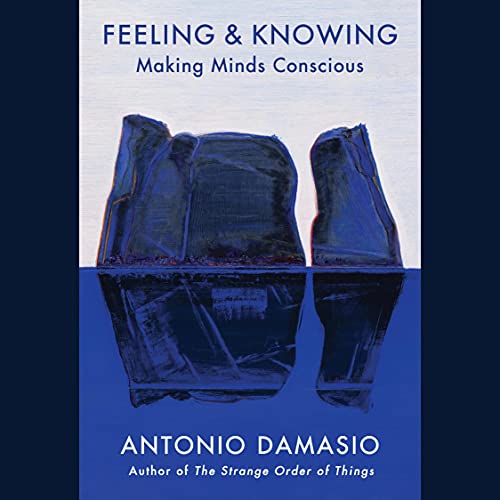
Antonio Damasio refines the definition of consciousness in “Feeling & Knowing”. Damasio offers a more science based, experiment driven, view of consciousness than Helen Thompson’s “Unthinkable…” “Feeling and Knowing” is a shorter version of Anil Seth’s book “Being You” that also addresses consciousness.
Both Damasio and Seth argue consciousness comes from feelings.
Thompson offers a less science driven view of consciousness based on patient interviews that reinforce Damasio’s and Seth’s views. There seems a slight difference between Damasio’s and Seth’s view of consciousness in the belief that emotions or feelings are the source of thought and knowledge origination. Seth argues emotions originate in the organs of the body and inform the brain. Damasio is more circumspect and seems to argue emotions come from the body and brain in a synchronous way.
However, Damasio’s and Seth’s beliefs about consciousness seem entirely compatible. That composite view changes with additional input which suggests consciousness is not a precise representation of reality.
To Damasio, one’s view and understanding of the world comes from feelings processed and imprinted on, and by, the brain. This is not to say that the brain is only a processor but that it works synchronously with the organs of the body.
Damasio emphasizes feelings as the primary knowledge source of the human experience. Damasio’s theory suggests artificial intelligence will always be artificial because it relies on the logic of ones and zeros rather than the dynamic process of emotion interface with brain processing.
If Damasio is correct, for A.I. to become a learning machine, emotion must be a part of its programming.
If emotion can be and is programmed into a machine, there seems a probability that humanity will become servant rather than master of the universe.
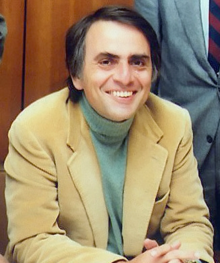
Carl Sagan (1934-1996, Author, University of Chicago entry at 16 years of age, received a Master of Science and Doctor of Philosophy in astronomy and astrophysics in 1960.)
Carl Sagan died from a bone-marrow disease at the relatively young age of 62 in 1996. One generally associates Sagan with his Cosmos series, but his education went far beyond the study of astronomy. His book reflects as much on the philosophy of life as the future of society, science, and technology.
“Women’s Right to Choose”“Right to Life”
Today’s controversial abortion question is forthrightly addressed by Sagan. He suggests “Right to Life” and a “Women’s Right to Choose” are politically and philosophically extreme ends of a rational argument on abortion. “Right to Life” followers insist all life is precious even though humans kill animals for sport and consumption. “Women’s Right to Choose” followers insist birth of a baby in utero is the sole decision of women because their body and life are only theirs to control.
Sagan suggests a baby in utero in the first trimester may be tested for brain activity and if none is found, no personhood is formed. With no brain activity of a baby in utero, the right of a woman to choose is an equal rights decision. However, to Sagan if brain activity is present, life is present, and abortion is murder. Sagan infers a science based national law could be created that avoids the extremist positions of the “Right to Life” and “Women’s Right to Choose” movements.
Sagan notes how computer gaming opens doors to the advance of computer capability and utility.
Nearly 50 years ago, Sagan’s book suggests much of what has happened in the science of brain function and technology. It seems a shorter step from Sagan’s ideas about computer function to what is presently called artificial intelligence. His view of brain and computer function might lead to a machine/brain confluence. It may be that Sagan’s belief in other forms of terrestrial life are secondary rather than primary interests of our human future.
In 1978, Sagan receives the Nobel Prize for nonfiction with “The Dragons of Eden”. In retrospect, it seems a wise decision by the Nobel panel of judges.
Unthinkable: An Extraordinary Journey Through the World’s Strangest Brains
By: Helen Thompson
Narrated by: Helen Thompson
Helen Thompson (British Author, journalist with a bachelor’s degree in Neuroscience.)
“Unthinkable” is a series of interviews of people who have a reputation for seeing the world and their place in it, differently. The author is a journalist.
As an investigative reporter, Helen Thompson elicits human perceptions of the world that are different from what most people perceive.
Thompson argues perception of the world comes from the mind. As synaptic activity of the mind is better understood, she infers what is real or false may become more universally understood.
Though Thomson’s interviews are anecdotal, they suggest the mystery of consciousness holds a key to mental health.
An interesting highlight of Thompson’s investigation is the existence of synesthesia in some people. Synesthesia is a neurological condition where information meant to stimulate one of your senses, actually stimulates more than one of your senses. Thompson notes people who have synesthesia may be able to hear colors, feel sound, or taste shapes. Two people with the same diagnosis may not perceive the world in the exact same way but their brains are stimulated to see more than what most people see, hear, or feel.
Synesthesia may be a mixed blessing in that it can overwhelm one’s senses, but it implies a more multifaceted view of reality.
One of Thompson’s last interviews is of a doctor who has a form of synesthesia that magnifies his empathy for patients. He actually feels some of what a patient is experiencing. Presuming the doctor’s senses are not overloaded by empathy, the patient seems more likely to be better served. If the mind’s neurological pathways for synesthesia can be identified, could empathy become instilled in every thinking being? Possibly, but the question remains whether that would enhance or burden humanity by making people who serve society emotionally drained, tired, and demotivated.
An earlier chapter addresses people who can develop “mind palaces” like the fictional character Sherlock Holmes.
They can recall the minutest details of an incident and compare it with information and experience they have acquired over the breadth of their life. If neurological pathways of a mind palace can be replicated in every human mind, could humans use those pathways to recall what they have learned from past experience and education to solve human problems?
One wonders if that is not the direction of A.I. in the future. This leads to concern of life becoming more machine-like than human with the added dimension of life as machine.
A third story is of the man who believes he is dead. His conception of himself is reinforced by brain scans that show very little neuronal activity though he continues to wake up every morning and function like a human during the day. He has little emotion or hunger and feels comfortable spending the day in a cemetery among those whom he feels are fellow travelers. Through medication, his neuronal activity is re-established, and he becomes more aware of his existence among the living.
A third story is of the man who believes he is dead. This anecdotal story reinforces belief that life is all in the mind.
There are more bizarre stories, but the underlying theme is life is defined by consciousness. Examples are given to show how parts of the brain are interconnected by neurons that pass information to the body about human existence in the world. The inference is that as humanity gains knowledge of how this interconnection works and which parts of the brain control neuronal activity, it will be possible to change human life. The impossible question to answer is whether that change will have good or ill effects on society. Of course, that may be moot if humanity cannot come to grips with the harm that is being done to the world’s environment.
This is a book one may set aside as an anecdotal journey into bizarre human anomalies. On the other hand, it affirms the importance of understanding everyone is part of humanity. It seems search for understanding of consciousness is essential for the continuation of human beings, whether mentally disabled, psychotic, neurotic, or diagnostically normal.
Tim Harford (British Author, Master’s degree in economics, journalist.)
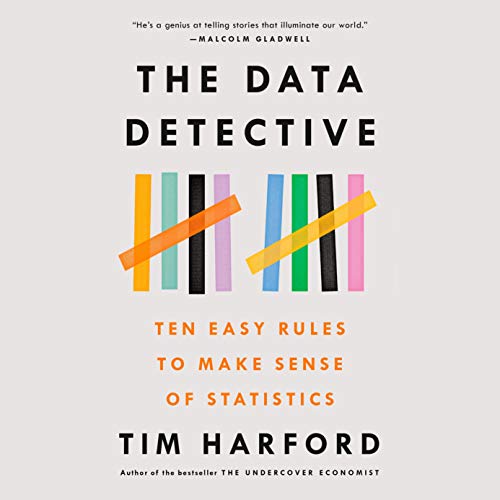
Tim Harford gives listeners a practical application of “Thinking Fast and Thinking Slow” in the art of statistical analysis. Sounds boring, just as the title “The Data Detective” but in this day of media overload Harford castes a warning. Be skeptical of conclusions drawn by statistical data, whether accumulated by business interests, science nerds, or algorithms. Think slow because thinking fast obscures understanding of statistical analysis. Above all, be curious when reading a statistical analysis that either adds or subtracts from your understanding. With that admonition, Harford offers ten ways to question the veracity and truthfulness of statistical analysis.
Harford argues it is important to investigate a writer’s qualifications as an analyst, and the “how, why, and when” data is collected. As the famous economist Milton Friedman said, “Statistics do not speak for themselves.” Or, as Mark Twain made famous, “There are three kinds of lies: lies, damned lies, and statistics.” It appears Harford agrees with Friedman, but not Twain, because he believes understanding a statistical study can reveal possible or at least probable truth.
Dr. Cuyler Hammond and Dr. Daniel Horn were smokers up until they finished their statistical report that correlated smoking with cancer.
Harford gives an example of statistical reports that correctly correlated smoking with lung cancer. Cuyler Hammond’s and Daniel Horn’s 1952 statistical study led to the 1964 Surgeon General report that confirmed cancer’s correlation with smoking. The disheartening story Harford tells is the tobacco industry’s purposeful effort to deny correlation. The tobacco industry’s methods were to suggest other causes, like auto exhaust or other carcinogens, as likely causes of lung cancer. They created doubt, whether true or false, which poisons belief in statistical studies.
Like the cowboy Marlboro smoker demonstrating a healthy image of a smoker, advertising obscures facts. The smoking industry successfully created doubt.
Harford explains personal investigation based on curiosity and detective work is necessary if one is looking for a probability of truth.
American free enterprise is created to produce product, service and jobs while making enough profit to stay in business. Sometimes those goals interfere with truth.
As human nature would have it, some businesses care less about truth than profit. This is not meant as a criticism but as an affirmation of human nature.
Harford explains there are many statistical studies purporting rises in crime, inequality, poverty, and medical health that need to be closely examined for validity. He argues every conclusion drawn from statistical surveys that contradict interest-group’ or individual’ belief should be closely examined. The methodology of a good statistical study must be understood within its era, its compiler’s biases, its stipulated human cohort, its conclusion, and its tested repeatability by others.
Harford challenges the supposition that violence has increased in America. This is undoubtedly music to the ears of elected officials who resist national gun control measures. Harford and the famed psychologist, Steven Pinker, suggest statistical analysis shows violence of earlier history is greater than in the 21st century. Harford acknowledges this is no comfort to the heart-rending reality of a child lost to suicide by gun or the horrendous school shootings of the last 3 years. As Horford explains statistics do not register human grief. Statistics are an impersonal unfeeling view of human life.
Harford does not read statistical surveys as truth but as a roadmap for discovery. He looks at a statistical survey like a detective searching for details. Who are the gatherers of the statistics? How were they collected? Why are they relevant? What period do statistics represent and do they relate the present to the past? Without answers, Harford argues statistical surveys are no better than propaganda.
Harford offers a graphic example of the context needed to clearly illustrate the value of statistical studies. The history of America’s invasion of Iraq and its human cost is dramatically and comprehensively revealed in one statistical picture.
Harford’s story shows how graphics can capsulize a statistical truth that shocks one’s senses. Simon Scarr summarizes a statistical report on deaths from the Iraq war with one graph.
Harford advances his view of the metaverse and its growing role in the world. He gives examples of Target’ and Costco’ algorithms that tells a father his daughter is pregnant, and infers a wife’s husband is cheating. A Target algorithm sends a note to a father about the pending birth of a baby based on his daughter’s purchases at the store. Costco sends a rebuy message for condoms to a wife when she calls and explains they never use condoms. Both stores apologize for sending their notes and say their stores made auto-response mistakes. Harford notes email apologies are a common response of stores that use similar algorithms.
Harford notes the irony of a metaverse that invades privacy with algorithms that can easily mislead or affirm societal trends or personal transgressions.
The last chapters of Harford’s book reinforce the importance of statistical studies by recounting the history of Florence Nightingale’s heroic hospital service in Turkey during the Crimean war (1853-1856). Harford explains Nightingale’s interest in mathematics and association with luminaries like Charles Babbage (an English polymath that originated the concept of a digital programmable computer). Nightingale’s hospital service and interest in mathematics lead her to correlate patient’ diseases with causes. The hospital to which she was assigned by the U. K. was without proper food and water. The hospital was dirty, and disease ridden. She had two objectives. First to have food and water supplied, and second to clean the hospital. Her statistical analysis made her realize cleaning was as important as food and clean water in reducing contagion among her patients. Like the statistical analysis of smoking and cancer changed smokers, Nightingale changed nursing.
Florenvce Nightingale (1820-1910, English social reformer born in Italy, Founder of modern nursing.)
“The Data Detective” is a disturbing book that shows the power of media and how it can mislead as well as inform the public.
This is a disturbing book that shows the power of media and how it can mislead as well as inform the public. With poorly or intentionally misleading statistical studies, opposing interest groups harden their political beliefs.
Harford concludes with an appeal to discordant interest groups to be curious about why they disagree with each other. Reputable statistical analysis can improve one’s belief in probable truth and decrease echo chamber‘ adherence of disparate interest groups.
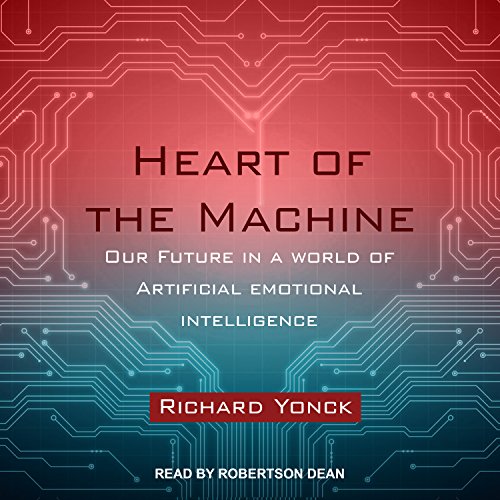
Heart of the Machine (Our Future in a World of Artificial Emotional Intelligence)
Release Date 3/14/17
By: Richard Yonck
Narrated by: Robertson Dean
Richard Yonck (Author, futurist, consultant, TED speaker, MA from London Film School 1981-1983, Attended Univ. of Wa. 1977-1980.)
Richard Yonck argues the next step in technology is to program emotion into machines. As a skeptic, one’s first reaction is to search for information on Yonck’s background. One finds it is eclectic and more literary than science driven.
Yonck notes human learning is intimately connected with emotion. Emotions of parents and offspring arguably shape children’s view of the world as much as genetic inheritance. Yonck explains parents’ and people’s faces become a school from which children learn the characteristics of emotion. Yonck explains emotional signals reinforce human’ memory, belief, and behavior.
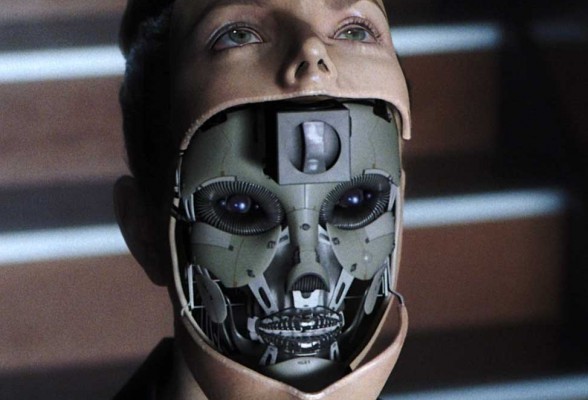
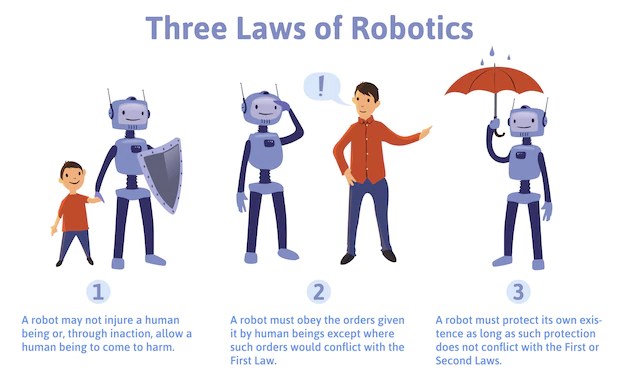
Yonck notes as the growth of facial recognition expands, facial expressions can be programmed into machines to interpret human emotion. The troubling thought is that machines programed with emotions may either negatively react to human facial expression or worse, become unbalanced, like children who act out of anger. With the addition of emotion, machines become capable of learning but also of becoming psychotic just like humans. Yonck suggests a safeguard like Asimov’s three robot rules that argues for programing machines to protect humanity. These rules are meant to deny machines any right to harm humans.
ASIMOV ROBOT RULES
Assimov creates a fourth rule to preserve humanity, but a recurrent theme in his stories show ways in which these rules fail. In the real world, even if the rules were effective, who ensures all machines are programmed with Asimov’s rules?
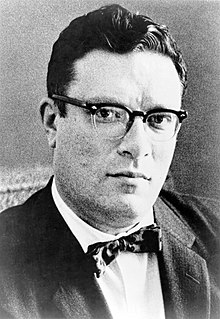
Isaac Asimov (1920-1992, Russian born American author and professor of biochemistry.)
Programming emotions into machines gives them an essential requirement for learning but that learning can be subverted. Human nature accompanies every decision made by human beings, whether a Hitler or Mahatma Gandhi. A non-conforming leader could refuse to program machines with Asimov’s rules. Government leaders could have machines programmed to kill anyone who disagrees with their leadership.
Money, power, and prestige incentivize both good and bad leaders. The same might be said for learning machines.
Putting concern with the history of human nature aside, Yonck notes some benefits from programming emotions into machines. Machines will be able to think and learn on their own with emotion programming. The demographics of countries like China and Japan suggest an aging cohort will hinder economic growth and diminish needed help for relatives of the working population. Much of that help could be provided by programmed intelligent’ machines. Just as happened with the industrial revolution, jobs will be lost, and retraining will be required. But, a benefit will inure to the elderly who need assistance and the working young who do not have the time or inclination to care for the elderly.
Yonck suggests machines will be partners and companions of human beings. Psycho-sexual relationships will develop between machines and humans. Machines will replace work for humans while increasing product research, development, and production. Machines will reduce social inequality by increasing the general wealth of the world. That is a best-case scenario.
A consequence of thinking-machine programming is that machines will either outlast their human companions or break down and be grieved by their survivors. Of course, machine death is not much different than the birth and death of humans. Humans break down (die) and are grieved by those left behind.
Another evolutionary possibility suggested by Yonck is the melding of human mind and machine. He notes a treatment for PTSD (actually approved by FDA) that involves electrical stimulation of a portion of the brain that appears to activate anxiety from recalled traumatic events. Yonck suggests continuing brain research will reveal neuronal pathways of thought and action that can be modified by electrical stimulation. He infers this is a first step in a journey toward a human/machine singularity like the transition from ape to humanoid to homo sapiens in geological history. He suggests a new human/machine society might be the next evolutionary change of humankind.
In the last chapters of Yonck’s book several examples of brain intervention are noted. Two interventions are direct with invasive insertions of wire into the brain and electrical stimulation from skull caps and clothing. A third type of intervention is with drugs. All have mixed results.
Yonck is a TED conference speaker. His writings have a quality of entertainment that makes him interesting if not steeped in science. On balance, Yonck appears more optimistic than pessimistic about the future of A.I. whether emotion programing for machines occurs or not.
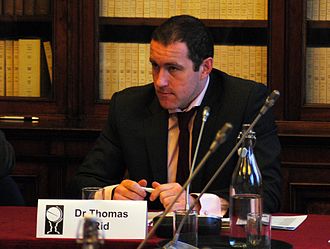
Thomas Rid (Author, political science Professor received Ph.D from Humboldt Univ. of Berlin in 2006.)
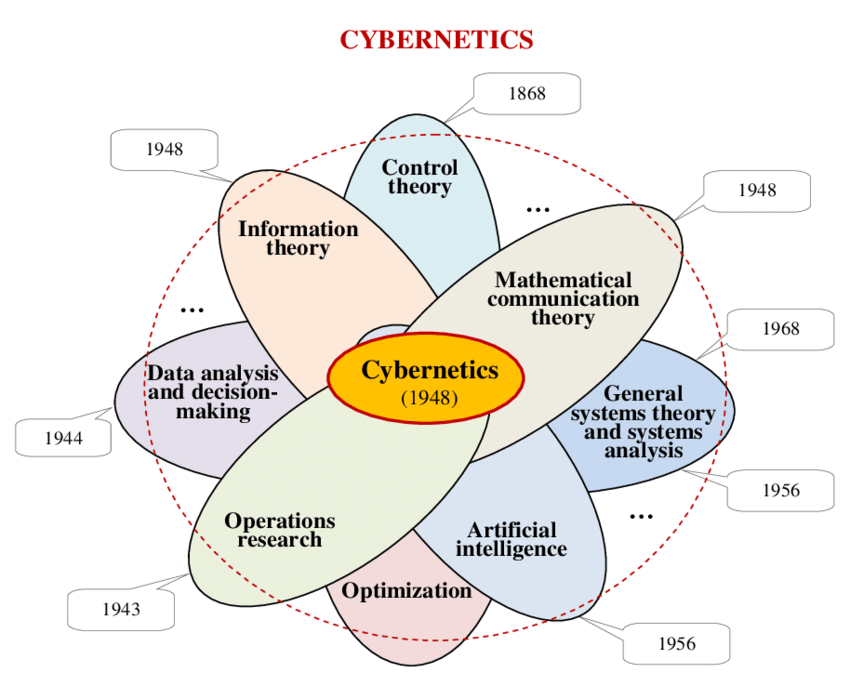
Thomas Rid’s history of the “Rise of the Machines” is a political perspective on society’s adoption of cybernetics (the science of communications and automatic control systems in both machines and living things).
Rid begins his history with the industrial age that created machines and increased worker productivity while displacing and retraining workers to meet the needs of a growing economy.
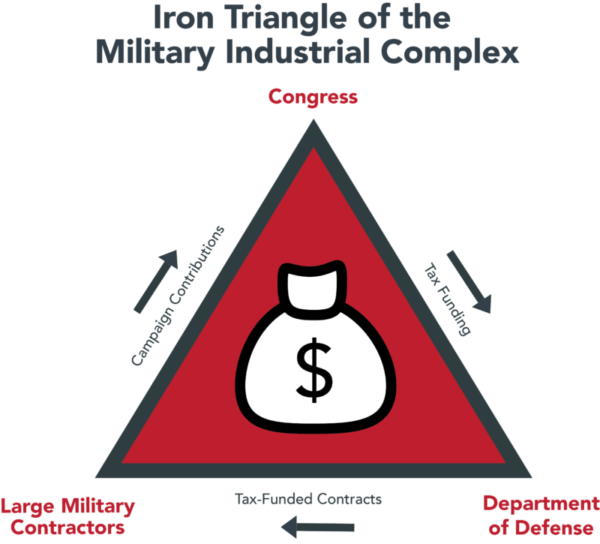
Rid’s history defines the origin and significance of cybernetics. It may be interpreted positively or negatively. Viewing the state of the world today, there is room for praise and criticism. On the one hand “Rise of the Machines” offered opportunities and prosperity, on the other, it promoted murder and mayhem. The irony of both is they come from the same source, military R & D. Like Willie Sutton said about robbing banks, military defense budgets are “…where the money is”.
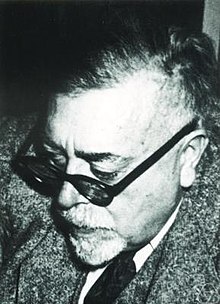
Rid recognizes Norbert Wiener’s formative role in the cybernetic age. Rid notes Wiener develops communications engineering and cybernetic theory during WWII. Rid reminds listeners of the military’s radar refinement and jet pilot cybernetic helmets, long before virtual reality became available to the public. The key to Wiener’s success is experimenters’ recognition of the importance of environmental feedback when designing machines to precisely locate an enemy target or for pilots to engage an enemy plane.
Norbert Wiener (American mathematician and philosopher, 1894-1964.)
Feedback is key to efficient machine performance because it provides information for changed response in the same way humans respond differently when circumstances or environments change.
Rid gives the example of pilot helmet refinement, partly related to ideas of the Star War’s movie.
Darth Vader’s helmet became a model for pilots of newer jet fighters.
The original helmets were unwieldy and uncomfortable. In Vietnam, the rough terrain led to GE research on motorized robots. However, what they found was the rough terrain and swampy land made them too vulnerable for practical use. GE’s research shows limitations but leads to robotic mechanization for repetitive work in fixed environments of industrial production.
Rid digresses with science fictions’ contribution to the advance of cybernetics. Timothy Leery, and Scientology were early endorsers of Wiener’s theory of cybernetics. Timothy Leery extolls the virtues of LSD as an entry to a different reality. One of Leary’s friends is Jaron Lanier who created an early version of virtual reality headwear.
L. Ron Hubbard claims Scientology’s connection to cybernetics. Wiener pointedly objects to Hubbard’s claim and forbids further association of Scientology with cybernetics.
Timothy LeeryL.Ron Hubbard
The first computer is invented in the 19th century by an English mechanical engineer named Charles Babbage. It was an early form of number computation and analysis. It was a century ahead of its time. During WWII, British codebreakers needed to decipher German miliary communications. In 1936, Alan Turing writes a paper “On Computable Numbers…” that leads to employment by the British during WWII to decode German military communications. Turing’s computer decoded Germany’s secret enigma machine’ messages. As a result, Turing becomes known as the father of modern computer science.
The early internet years came in the 1960s from the need for a communications network for government researchers to share information.
That network is called ARPANET, which is financed by the U.S. Department of Defense. It is transformed into the world wide web, now known as the internet. Rid’s book is published in 2016. The potential of cybernetics in war is clearly demonstrated by Ukraine’s ability to resist a much larger and better equipped foreign power.
The role of the military in cybernetics research and development is shown as both critical and essential in Rid’s history.
Though not a subject of Rid’s history, the principal value of free speech is diminished by a cybernetic world that is not properly legislated, adjudicated and enforced by rule-of-law. Internet users have been influenced by media trolls who spew lies and disinformation. Young people kill themselves because of being dissed on the internet. The internet gives voice to hate groups around the world. Gaming is a principal revenue producer in the cybernetic world that patently discounts reality. Human value is discounted by the mayhem of computer gaming.
School children shoot teachers and students with impunity, as though they are creatures in a cyber world.
As late as yesterday, 3/27/23, another school shooting occurs in Nashville, Tennessee. Three adults and three nine-year-old children are killed.
Rid notes cybernetics’ military application both protects and exposes security of nations around the world. Rid writes about an American military intelligence penetration by foreign and domestic hackers during the Clinton administration. Hackers have the tools to disrupt both economic and military operations around the world. Of course, those tools are multiplying. With quantum computing, existing passwords will become obsolete. Intelligence services of all countries are becoming more and more capable of disrupting military or domestic affairs of any foreign power.
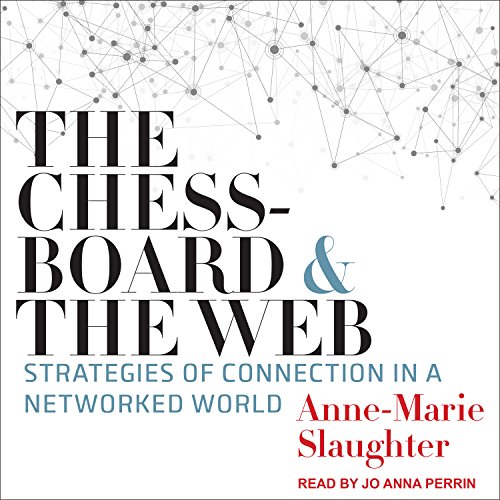
Anne-Marie Slaughter (Author, foreign policy analyst, served as Director of Policy Planning under Hilliary Clinton.)
“The Chessboard and the Web” is not about rebuilding Ukraine. However, Slaughter presents an insightful view of diplomacy that confronts international conflict with an idea that applies to Ukraine’s future.
Ukraine is invaded by Russia in 2022, nearly 5 years after Anne Marie Slaughter’s book is published.
Inevitably, either Ukraine or Russia will sue for peace. Ukraine will survive as an independent nation-state. Neither Ukraine nor Russia will come away from this war with a satisfactory resolution. Ukraine’s challenge will be to rebuild their country within whatever boundary is part of a yet-to-be-determined peace agreement. No one knows what will happen to Putin, but President Zelensky will face the complex task of rebuilding Ukraine.
Slaughter gives several examples of how interconnectedness has changed the course of history in modern times and aided thousands of people impacted by natural disasters and internecine conflicts.
Slaughter argues natural disaster relief and international conflict is more constructively addressed by the interconnectedness of the world wide web.
Slaughter offers examples of how interconnectedness changes the nature of management. Though General Stanly McChrystal is discharged for disrespecting President Obama’s administration, he is instrumental in establishing a rebel fighting force in Afghanistan. McChrystal eliminates Al Qaeda’s leader by creating a web of interconnected Afghan rebels that advise the American military of Al Qaeda’s movements. McChrystal is widely acknowledged as an effective leader and accomplished soldier.
General Stanley A. McChrystal (Commander of the 75th Ranger Regiment in Afghanistan.)
In one way, the world wide web is an unstoppable technological change that invades everyone’s privacy. On the other hand, it offers a tool for cultural understanding, team building, and actionable public policy to deal with natural disasters, war’s destruction and its aftermath.
Slaughter gives the following example: With web interconnectedness, two former Marines create a 38,000-person volunteer group called Team Rubicon that aids Haiti survivors after a 7.0 earthquake.
Either by design or circumstance, Ukraine citizens set up decentralized teams of fighters to repel the Russian army. Ukrainian fighters’ interconnectedness came, in part, from Elon Musk’s satellites. With that interconnectedness, Ukrainians successfully fought off Russia’s invading army. Zelensky is the leader of Ukraine’s defensive effort. But it is individual group leaders, connected by the web, that have successfully defended Ukraine. Zelensky is the President and leader of the country, but he wisely allows respective team leaders to conduct the war against the Russian invaders. That same system can be used to rebuild Ukraine when peace is achieved.
What Slaughter reveals is an idea that should be adopted by President Zelensky to rebuild Ukraine when Putin’s criminal invasion is defeated. Zelensky has done a heroic job of leading his country in war. He shows the capability of being a leader for Ukraine’s reconstruction.
The team leaders of Ukraine’s defense are prime candidates for team leadership when the war is over. President Zelensky knows who the best team leaders have been during the war.
Slaughter is not arguing this is a simple way of rebuilding a country, managing re-construction after a natural disaster, or resolving political crises. Her point is the complexity of international relations, war, and reconstruction can be met by decentralized teams organized around competent leaders using the internet. Their interconnectedness can address complexity based on intimate knowledge and decentralized command. Zelensky would need to establish a financial review process to monitor team results and discipline bad actors, but field decisions would be left to interconnected on-site leaders.
Human nature is what it is, and some leaders will succumb to the lure of money, power, and prestige. However, through careful oversight, theft can be mitigated, and team leaders can be replaced as circumstances demand.
No leadership system, interconnected or not, is full proof. Slaughter’s service in Obama’s government, under the wing of Hillary Clinton, did not eliminate mistakes. The murder of Libya’s leader created a political mess during Clinton’s and Obama’s watch. Syria’s use of chemical weapons killed Syrian civilians. Obama is certainly right to not have invaded Syria for that transgression, but Obama and his red-line comment unnecessarily made America look weak. There were Obama successes. By the same token, re-construction of Ukraine will suffer from mistakes, but Ukraine’s President has shown how mistakes can be corrected. Zelensky acted against corruption by Ukranian team leaders who tried to profit from war material scams.
Slaughter’s last chapters explain the difference between leadership styles of the past and present. In the internet age, wide interconnection of disparate interests suggests a new leadership style, more like being a gardener than a martinet who insists on followers doing it her or his way.
The world wide web and interconnectedness is a two-edged sword. As with all ideas, web interconnectedness can be good or evil. As with any plan for action, there is always potential for unintended consequence. Re-building is going to be a major undertaking for the Ukrainian people and government. Every American hopes the war will be over soon and Ukraine’s reconstruction can begin.