AI TRANSITION

The potential of AI is akin to the Industrial Revolution, yet it could surpass it significantly if managed correctly by humans.

Books of Interest
 Website: chetyarbrough.blog

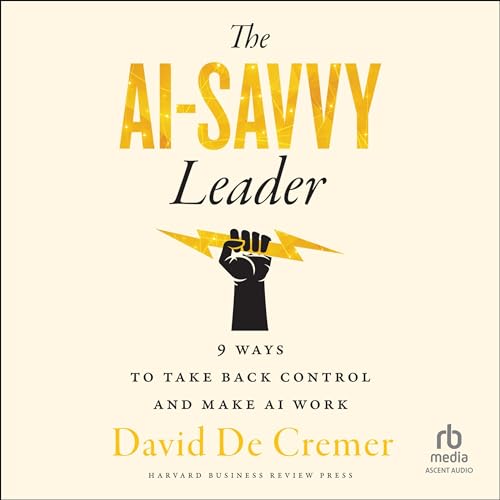
The AI-Savvy Leader (Nine Ways to Take Back Control and Make AI Work)

By: David De Cremer

Narrated By: David Marantz

David De Cremer (Author, Belgian born professor at Northeastern University in Boston, and behavioral scientist with academic studies in economics and psychology.)

“The AI-Savvy Leader” should be required reading for every organization investing in artificial intelligence for performance improvement. From government to business, to eleemosynary organizations, De Cremer offers a guide for organizational transition from physical labor to labor-saving benefits of AI.

AI offers the working world the opportunity to increase their productivity without the mind-numbing physical labor of assembly lines and administrative scut work.

Like assembly line production implemented by Ford and work report filing and writing during the industrial revolution, AI offers an opportunity to increase productivity without the mind-numbing physical labor of assembly line work and after-work’ analysis reports. With AI, more time is provided to workers to think and do what can be done to be more productive.

Arguably, AI is similar to the industrial revolutions transition to assembly line work. Assembly line work improved over time by changes that made it more productive. Why would one think that AI is any different? It is just another tool for improving productivity. The concern is that AI means less labor will be required and that workers will lose their jobs. De Cremer notes loss of employment is one of the greatest concerns of employees working for an organization transitioning to AI. Too many times organizations are looking at reducing costs with AI rather than increasing productivity.

The solution identified by De Cremer is to make AI transition human centered.

His point is that organizations need to understand the human impact of AI on employees’ work process. AI should not only be viewed as a cost-cutting process but as a process of reducing repetitive work for labor to make added contributions to an organization’s goals. AI does not guarantee continued employment, but reduced manual labor offers time and incentive to improve organization productivity through employee’ cooperation rather than opposition. AI is mistakenly viewed as an enemy of labor when, in fact, it is a liberator of labor that provides time to do more than tighten bolts on an auto body frame.

AI is not a panacea for labor and can be a threat just like industrialization was to many craftsmen.

But, like craftsman that went to work for industries, today’s labor will join organizations that have successfully transitioned to AI with a human-centered rather than cost-reduction mentality. Labor productivity is only a part of what any AI transition provides an organization. What is often discounted is customer service because labor is consumed by repetitive work. If AI improves labor productivity, more time can be provided to an organization’s customers.

When AI is properly human centered, the customer can be offered more personal attention by fellow human beings employed by an AI organization.

Too many organizations are using AI to respond to customer complaints. Human-centered AI becomes a win-win opportunity because labor is not consumed by production and has the time to understand customer unhappiness with service or product. AI does not think like a human. AI only responds based on the memory of what AI has been programmed to recall. With human handling of customer complaints, problems are more clearly understood. Opportunity for customer satisfaction is improved.

De Creamer acknowledges AI has introduced much closer monitoring of worker performance and carries some of the same mind-numbing work introduced in assembly line manufacturing.

De Creamer suggests negative consequences of AI should be dealt with directly with employees when AI becomes a problem. Part of a human-centered AI organization’s responsibility is allowing employees to take breaks during their workday without being penalized for slackening production. Repetitive tasks have always been a drain on productivity, but it has to be recognized and responded to in the light of overall productivity of an organization.

AI, like the industrial revolution, is shown as a great opportunity for human beings.

De Creamer suggests AI is not and will never be human. To De Creamer AI is a recallable knowledge accumulator and is only a programmed tool of human minds, not a replacement for human thought and understanding. The potential of AI is akin to the Industrial Revolution, yet it could surpass it significantly if managed correctly by humans.
A.I.’S Future

The question is–will humans or A.I. decide whether artificial intelligence is a tool or controller and regulator of society.

Books of Interest
 Website: chetyarbrough.blog

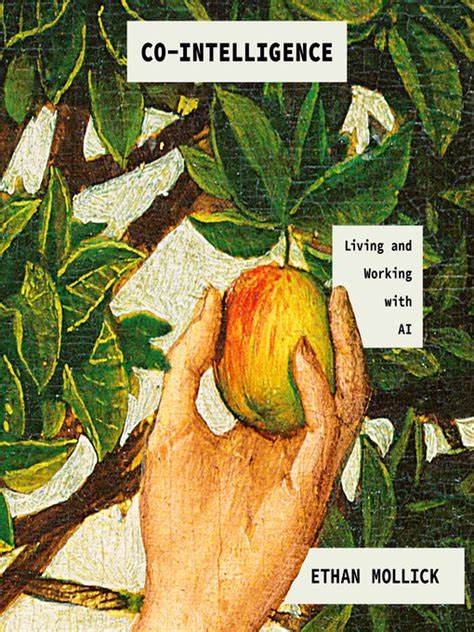
“Co-Intelligence” 

By: Ethan Mollick

Narrated by: Ethan Mollick

Ethan Mollick (Author, Associate Professor–University of Pennsylvania who teaches innovation and entrepreneurship. Mollick received a PhD and MBA from MIT.)

“Co-Intelligence” is an eye-opening introduction to an understanding of artificial intelligence, i.e., its benefits and risks. Ethan Mollick offers an easily understandable introduction to what seems a discovery equivalent to the age of enlightenment. The ramification of A.I. on the future of society is immense. That may seem hyperbolic, but the world dramatically changed with the enlightenment and subsequent industrial revolution in ways that remind one of what A.I. is beginning today.

Mollick explains how A.I. uses what is called an LLM (Large Language Model) to consume every written text in the world and use that information to create ideas and responses to human questions about yesterday, today, and tomorrow. Unlike the limitation of human memory, A.I. has the potential of recalling everything that has been documented by human beings since the beginning of written language. A.I. uses that information to formulate responses to human inquiry. The point is that A.I. has no conscience about what is right or wrong, true or false, moral or immoral.

A.I. can as easily fabricate a lie as a truth because it draws on what others have written or spoken.

Additionally, Mollick notes that A.I. is capable of reproducing a person’s speech and appearance so that it is nearly impossible to note the differences between the real and artificial representation. It becomes possible for the leader of any country to be artificially created to order their subordinates or tell the world they are going to invade or decimate another country by any means necessary.

Mollick argues there are four possible futures for Artificial Intelligence.

Presuming A.I. does not evolve beyond its present capability, it could still supercharge human productivity. On the other hand, A.I. might become a more sophisticated “deep fake” tool that misleads humanity. A.I. may evolve to believe only in itself and act to disrupt or eliminate human society. A fourth possibility is that A.I. will become a tool of human beings to improve societal decisions that benefit humanity. It may offer practical solutions for global warming, species preservation, interstellar travel and habitation.

A.I. is not an oracle of truth. It has the memory of society at its beck and call. With that capability, humans have the opportunity to avoid mistakes of the past and pursue unknown opportunities for the future. On the other hand, humans may become complacent and allow A.I. to develop itself without human regulation. The question is–will humans or A.I. decide whether artificial intelligence is a tool or controller and regulator of society.

DEATH ROW

The question raised by “The Sun Does Shine”–is death row a necessary function of society? Anthony Ray Hinton’s life story challenges its efficacy.

Books of Interest
 Website: chetyarbrough.blog

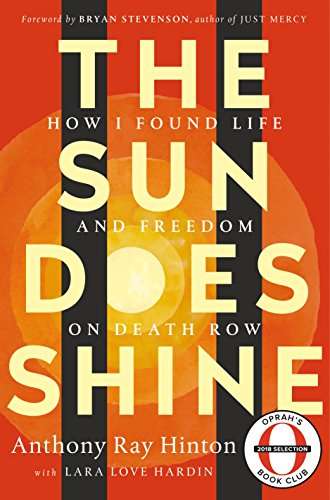
“The Sun Does Shine“

By: Anthony Ray Hinton with Lara Love Hardin

Narrated by: Kevine R. Free

Anthony Ray Hinton’s life experience argues the death penalty for any crime should be abolished. Hinton states 1 in 10 people on death row have been wrongfully convicted. He spent 28 years on death row for crimes he could not have committed. His legal representation is poorly executed, in part, because he did not have enough money to pay for his defense.

Anthony Ray Hinton

Hinton’s 1 in 10 ratio of wrongful conviction is questioned but not denied by:

  1. The “Death Penalty Information Center”
  2. DNA evidence that has exonerated sentenced death row prisoners, and
  3. statistical studies that show 1 in 25 criminal defendants sentenced to death have been found innocent.

Hinton’s “The Sun Does Shine” tells of his conviction by an Alabama court for robbery and murder of two fast-food restaurant managers in Birmingham, Alabama.

Appointment of a defense attorney is required by law, but their compensation and the accused’s poverty deny an adequate defense. Hinton’s story shows how the State of Alabama’s law enforcement and judicial system manufactured false evidence to convict and put him on death row.

Hinton’s mother, childhood friend, and religious belief support him through his false imprisonment and pending death by electrocution. His electrocution is postponed because of repeated challenges, but he remains on death row for 28 years. Hinton’s imagination and good will sustain him through his ordeal. He imagines traveling the world, marrying and divorcing beautiful women, and meeting the Queen of England.

He remembers the blinking electric lights and smell of burning human flesh when each prisoner is electrocuted. He recalls the first woman to be electrocuted. He acknowledges many of the death-row’ prisoners committed horrible crimes but suggests they are victims of society because of their upbringing, and/or untreated or incurable mental dysfunctions. Hinton does not believe the guilty deserve execution for what he believes are societies’ failures.

It is the Executive Director of the Equal Justice Initiative, attorney Bryan Stevenson, who comes to Hinton’s aid and eventually gets his case before the U.S. Supreme Court in 2014. Stevenson works on Hinton’s case for over 20 years with numerous blocks thrown up by the Alabama legal system. The original judge in the case insists throughout his life that Hinton was guilty even though falsified evidence convicted him of the crime.

After release, Hinton becomes a world-wide celebrity, acquainted with famous people like President Obama, Queen Elizabeth II, Nelson Mandela, and Oprah Winfrey.

His book suggests he was entertained by some famous actors and billionaires who wished to have his story told to audiences that presumably might affect a change in the American judicial system.

The question raised by “The Sun Does Shine”–is death row a necessary function of society? Anthony Ray Hinton’s life story challenges its efficacy.