MOST INTERESTING ESSAYS 12/4/25: THEORY & TRUTH, MEMORY & INTELLIGENCE, PSYCHIATRY, WRITING, EGYPT IN 2019, LIVE OR DIE, GARDEN OF EDEN, SOCIAL DYSFUNCTION, DEATH ROW, RIGHT & WRONG, FRANTZ FANON, TRUTHINESS, CONSPIRACY, LIBERALITY, LIFE IS LIQUID, BECOMING god-LIKE, TIPPING POINT, VANISHING WORLD
“The Trial” is a Franz Kafka picture of hell; i.e. a totalitarian nightmare, ruled by bureaucracy and controlled through human despair. “The Trial” is a book to listen to because it mesmerizes when narrated by an artist but numbs when read by an undisciplined mind.
Imagine arbitrary arrests, undefined accusations, and undisclosed trials; i.e. trials operating in obscurity that secretly sentence the accused to mental purgatory or death; add shadows of human beings, dark rooms of judgment, stifling closeness, and oppressive anxiety. This is Kafka’s world in “The Trial”.
There is no lightness in Kafka’s tale; no human redemption. The main character, Ka (in this version of the book), is the only person that seems to seek self-understanding.
All other characters are “other directed”, trying to be what someone else expects them to be by playing whatever role they need to play to survive.
Kafka imagines a country of directionless people, subsumed in a bureaucracy that feeds on itself.
This is a country of directionless people, subsumed in a bureaucracy that feeds on itself. Citizens of this country are either a part of the bureaucracy or they are controlled by its administration.
Control is exercised by creating fear and anxiety. This characterization reminds one of Donald Trump and his current attempt to overthrow over 200 years of American government history.
Trump’s tacit support by the Republican party is a crime against democracy. Patriotic Republicans are diminished by Trump’s abhorrent behavior.
Should Trump be impeached a second time? It’s complicated. On the one hand, incitement by Trump on January 6th is obvious to most Democrats. On the other, Republicans now represent 70,000,000 Americans who think Trump is good for America.
There is no societal objective; there is only bureaucracy’s perpetuation. Lawyers, bankers, judges, business moguls, landlords, artists, servers and assistants of this society, though rarely singled out for terror or torture, are consumed with anxiety from an ever-present threat of arrest. The working public enriches itself by taking bribes to subvert bureaucratic action. The working public’s subversion is not destruction of the bureaucracy but a tacit acceptance of its hegemony.
Ka attempts to break the cycle of bureaucracy’s self-perpetuation. His attempt fails.
The redeeming quality of Kafka’s story is the human desire for freedom that is not extinguished even in the darkest times of a country’s repression. Against all obstacles, Ka insists on freedom. In Ka’s case freedom means death just as it did for many who died in Auschwitz, Dachau, and Treblinka.
Kafka’s hell exists in today’s world just as it did when it was published in 1925.
What value does a 14th century book have for a 21st century person?
GEOFFREY CHAUCER (1343-1400, AUTHOR, POET)
“The Canterbury Tales” is a rhyming entertainment (except for Christian preaching at the tales end) that recalls romantic heartaches, heartbreaks, and belief in divine justice that is as present today as yesterday. The unchanging nature of men’s lust for women and women’s superiority is comically and tragically told and repeated in Chaucer’s travelers’ tales. Though women play a primary focus in “The Canterbury Tales”, belief in Christianity and its power to heal and destroy is a paramount subject.
In the Knight’s tale, two brothers lust for the same woman. They plan to fight each other to the death but are interrupted by the King
In the Knight’s tale, two brothers lust for the same woman. They plan to fight each other to the death but are interrupted by the King. The woman wishes to retain her maidenhood and appeals to her deity to insure continued chastity. The two brothers and the woman have different agendas with each agenda appealed to a different god. The tale progresses with the three appellant deities determining the brothers and woman’s fates. It is an ironic pagan tale of Chaucer’s disbelief in many gods rather than the One.
In Chaucer’s tales, men are shown to be the weaker and dumber sex. Old rich men marry young beautiful women and become cuckolds. Powerful and rich young men choose poor and beautiful women to be their wives and treat them horribly to test their love and loyalty. Male insecurity and desire drive men to make foolish decisions about whom they should marry and how they might measure their worth through earth-bound pleasure. Men foolishly seek revenge at any cost while women seek justice through diplomacy and prudence.
In Chaucer’s tales, men are shown to be the weaker and dumber sex.
THE NUN’S TALE–The incredible power of religion in Chaucer’s time is illustrated in the Nun’s tale of a chaste bride that convinces her betrothed to forego conjugal relations for the sake of eternal life in heaven.
The incredible power of religion in Chaucer’s time is illustrated in the Nun’s tale of a chaste bride that convinces her betrothed to forgo conjugal relations for the sake of eternal life in heaven.
The husband asks for proof of an angel that visits his wife and, if he can see the angel, he agrees to forever forego sex with her. She refers her husband to the Pope.
The Pope convinces the husband to become a Christian; he returns home and sees the angel and agrees to his wife’s demand. The husband then convinces his brother to meet with the Pope and the brother also becomes a Christian. Her husband and his brother are executed because they refuse to obey their Overlord when he insists that they sacrifice to pagan idols.
After the brothers’ execution, the Overload summons the wife. The chaste wife is sentenced to be burned in her house because she also refuses to sacrifice to her Overlord’s deities. The fire fails to kill the wife so the ruler has an executioner sent to cut-off her head. The executioner strikes her neck with an ax three times but is unable to remove her head; a fourth strike is not allowed and she continues to preach her beliefs.
Neither mammon nor the Pope seem the equal of this wife.
PERMITTED PREJUDICE
Prejudice comes through Chaucer’s strong Christian beliefs; i.e. “The Canterbury Tales” endorses Christianity as the salvation of mankind with vilification of Jews which is presumably justified by Christian’ belief in Jewish betrayal of Christ.
It is perplexing to think that much of what Chaucer says about Christian believers remains true today but Chaucer’s understanding of women’s superiority to men in the 14th century seems quite enlightened in the 21st.
Author, Daniel Kahneman, is a renowned psychologist and noble laureate.
There are certain knowns that are known and certain knowns that are unknown. Well, I know I know nothing and Kahneman seems to prove it. Every chapter of Kahneman’s book suggests something one finds hard to believe is true.
Daniel Kahneman is a renowned psychologist and Nobel laureate. He is an American citizen that served in the Israeli military and used his education, research, and experience to write “Thinking Fast and Slow”. His observations explore many aspects of human decision-making.
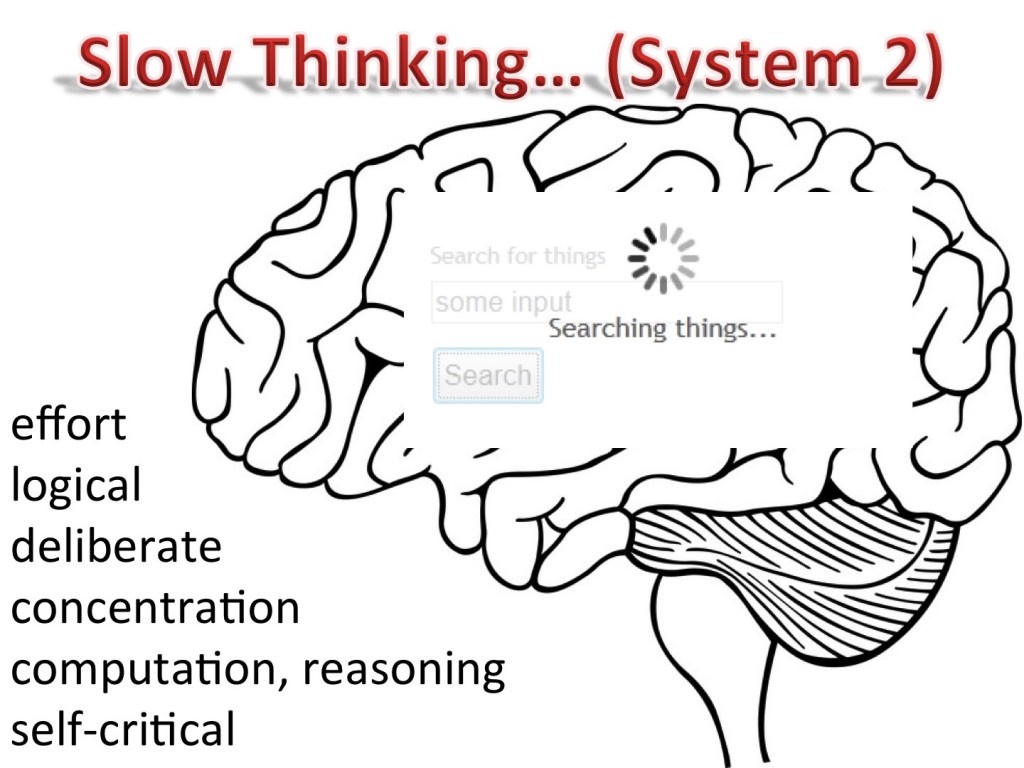
How one runs their business or lives their life is framed by how they think. Kahneman explores two fundamental ways of thinking that reveal human strengths and weaknesses. “Thinking Fast…” is intuitive and easy. It is prejudiced by personal life experience and education. It is activated through an evolved instinct that forms the basis for snap decisions. In contrast, “…Thinking Slow” is a deliberative, calculating, and mind-numbing way of making rational decisions. Kahneman calls these mental functions System 1 and System 2 respectively.
“…Thinking Slow” is undoubtedly prejudiced by Kahneman’s scientific interpretation of “human thought and action”’ but judgment of his observations is the responsibility of the reader or listener; so, caveat emptor.
The more common decision-making tendency of the brain is to use System 1 rather than System 2 when making decisions because it is easier and because, as Kahneman notes, behavioral studies and brain imaging show human brains are lazy (not inclined to use System 2’ thinking because it is more laborious than System 1).
System 1 often leads humans to make incorrect intuitive decisions. System 2 potentially improves probability of making better, or at least more rational, decisions. However, System 1 is important to life and death decisions that require instantaneous action. System 2 requires one to consider options before settling on an action. A current example is the dilemma of choice in regard to social media. Fighting hardly seems logical based on the direction of technology. Flight seems equally illogical for the same reason.
System 1 is important to life and death decisions that require instantaneous action. System 2 requires one to consider options before settling on an action.
FIREMAN NARROWLY ESCAPES FLOOR COLLAPSE ( Using System 1 thinking the fire commander tells his team to get out of a burning house because his mind subconsciously gathers experiential information telling him the floor is about to collapse.)
Kahneman gives a more concrete example with an experienced fire commander. Using System 1 thinking the fire commander tells his team to get out of a burning house because his mind subconsciously gathers experiential information telling him the floor is about to collapse. The fire commander’s system 1 thinking saved his team’s lives.
Kahneman contrasts the value of System 2 thinking by exploring System 1’s habit of unconsciously bench-marking manufactured product pricing to seduce consumers to buy at higher prices; i.e. if a product is priced high, System 1 thinking is willing to pay a higher price.
The “halo” effect caused by System 1’ thinking gives too much weight to a one time “good” interview evaluation of an employee candidate.
Another observation is that employee interviews are often detrimental to the selection of the best job candidate. Kahneman describes the “halo” effect caused by System 1’ thinking that gives too much weight to a one time “good” interview evaluation of an employee candidate. To protect from the “halo” effect, Kahneman suggests that interview questions be structured and an employment process be standardized to give more objective criteria for choosing the best employment candidate. In other words, design an employee selection process based on clearly defined job requirements that are equally measured and fairly weighted for each candidate. Employer hiring solely based on a candidate’s interview is not a good determinant of employee performance.
This brief review is a single drip of sweat in a twenty hour work out. Kahneman undoubtedly exaggerates the import of some scientific studies but his writing engages System 2 thinking. A System 2 person will want to listen to “Thinking Fast and Slow” more than once.
Consider whether “The Last Train from Hiroshima” horrifies more than enlightens. “Last Train from Hiroshima” is not for the faint hearted. It is a gruesome reminder of the horror of war.
Audio-book Review By Chet Yarbrough (Blog:awalkingdelight) Website: chetyarbrough.blog
Last Train from Hiroshima By Charles Pellegrino Narrated by Arthur Morey
Christopher Nolan’s remarkable performance in the movie “Oppenheimer” re-opens the terror of nuclear war. Consider whether “The Last Train from Hiroshima” horrifies more than enlightens. “Last Train from Hiroshima” is not for the faint hearted. It is a gruesome reminder of the horror of war.
CHARLES PELLEGRINO (AMERICAN AUTHOR)
Charles Pellegrino has written a story of Hiroshima and Nagasaki’s bomb survivors. Arthur Morey brings Pellegrino’s words to life. Pellegrino recounts survivor stories; i.e. what they saw, and what happened to them and their families in the aftermath of the world’s first use of a nuclear weapon.
Pellegrino is a wordsmith. He uses words that blow torch images on a listener’s mind. His words capture the horror of nuclear war; the physical and mental effect of a nuclear detonation on human beings.
The aftermath of Japan’s nuclear blasts left thousands of people with few apparent injuries. They wander in a fog of confusion, like ants in long lines following each other, single file to nowhere. They were, as Pellegrino explains, the “ant walkers”.
Hiroshima – Burnt to Ashes
After Nagasaki’s bomb, a young girl walks out of a tubular bomb shelter and sees a shadowy figure that she presumes is an escaped zoo animal. It has rough, blackened, mottled skin, and is crawling on four limbs. It is a human being, exposed to the flash and burn (pika don) of the bomb.
Pellegrino describes the aforementioned crawling man as one of the “alligator people”, a classification that repeats itself on the skins of anyone that survives direct exposure to the bomb’s flash and burn. He tells the story of a “tap dancer” running down a street in Hiroshima; tap, tap, tapping the hard-surfaced street because he has no feet. Pellegrino recounts the story of a father greeting his lost daughter by asking “…do you have feet” because a Japanese aphorism believed ghosts are recognized as apparitions with no feet.
Nagasaki bombing aftermath. Survivors are the “ant walkers”. Days later, the “ant walkers” are stricken with fever, vomiting, loss of appetite, and internal bleeding. Some survive to go through the same symptoms weeks or months later.
The aftermath of Japan’s nuclear blasts left thousands of people with few apparent injuries. They wander in a fog of confusion, like ants in long lines following each other, single file to nowhere. They were, as Pellegrino explains, the “ant walkers”. Days later, the “ant walkers” are stricken with fever, vomiting, loss of appetite, and internal bleeding; some survive to go through the same symptoms weeks or months later; some become crippled for the remainder of their lives; some die after the first onset of sickness; some die years later from leukemia or other maladies traced back to those two fateful August days in 1945.
RADIATION EXPOSURE DAMAGE FROM CHERNOBYL DISASTER IN THE FORMER U.S.S.R.
HIROSHIMA SURVIVOR
The survivor stories in Pellegrino’s book are so vivid that one wonders where real history ends and his imagination begins. Regardless of the veracity of Pellegrino’s survivor facts, his description of nuclear weapon damage and radioactive exposure is verified by later scientific experiments and accidents.
Once again–Iran, Russia, and North Korea threaten peaceful coexistence. “Never again” has been said before. One is left with thought and fear.
Something not mentioned in Pellegrino’s excellent book is that those who survived the bomb were discriminated against because of the fear they had of contamination from those who were victims of the event. It is a reminder of the tragedy of the bombing but more importantly the ignorance of humanity’s discrimination.
Jane Eyre By Charlotte Bronte Narrated by Lucy Scott
CHARLOTTE BRONTE (1816-1855)
“Jane Eyre” replays the tautology of “life is not fair; i.e., it just is”.
Charlotte Bronte’s story comes alive with the voice of Lucy Scott. Lucy Scott becomes Jane Eyre in this audio book presentation.
Bronte’s story emphasizes the importance of having an inner moral compass to guide one to choose between right and wrong
The author, Charlotte Bronte, captures life’s joy and hardship. The story emphasizes the importance of having an inner moral compass to guide one to choose between right and wrong. By making right choices, fulfillment comes from working through good and bad things in life.
Jane is an orphaned girl raised by an uncaring Aunt that feels burdened by her filial obligation. The orphaned girl directly confronts her Aunt’s resentment. To escape further confrontation and embarrassment, the Aunt boards Jane Eyre in an indigent’s school.
Jane is an orphaned girl raised by an uncaring Aunt that feels burdened by her filial obligation.
JANE EYRE becomes a teacher at the school she is sent to by her uncaring Aunt. Later, she is hired by a wealthy landowner to tutor a young girl alleged to be the landowner’s illegitimate daughter.
Jane Eyre is formally educated. She becomes a teacher at the school. Later, she is hired by a wealthy landowner to tutor a young girl that is alleged to be the landowner’s illegitimate daughter. The wealthy landowner is revealed as a man with too many secrets. Jane Eyre, driven by her inner compass, flees to endure new hardship and temptation.
At the end, Jane Eyre returns to marry the wealthy landowner. She finds him blind, chastened, and older, but still in love with the Jane Eyre he had hired as his daughter’s tutor.
One might surmise a future hardship that remains to be revealed; i.e. when Eyre’s husband is ravaged by the inevitable infirmities of old age, Jane will be in the bloom and health of life. Considering the tenor of the story, Jane will deal with her husband’s infirmities and grow into her new role as caregiver with the strength of her convictions.
An ever-present refrain in “Jane Eyre” is that all life decisions and actions have consequences. The many themes that run through Charlotte Bronte’s book are what make it a classic. Every listener will identify with some part of Charlotte Bronte’s story.
Audiobook’s version of “Jane Eyre” is a tribute to Charlotte Bronte’s story telling skill.
Audio-book Review By Chet Yarbrough (Blog:awalkingdelight) Website: chetyarbrough.blog
The Other Brain By R. Douglas Fields Narrated by Victor Bevine
As we grow older, our physical and mental abilities deteriorate. Knowing that decline is the nature of life, the older one becomes, the more grasping one is for new ideas that mitigate life’s inevitable degradation.
R. DOUGLAS FIELDS (AUTHOR Ph.D. IN NEUROSCIENCE)
“The Other Brain”, written by Dr. Douglas Fields (a department head at the National Institute of Health and adjunct Professor of Neuroscience at the University of Maryland) is an expert in the field of cognitive science, i.e., the exploration of how minds work.
DR. THOMAS HARVEY (the pathologist that stole Einstein’s brain and kept it for some twenty years before telling anyone he had it.)
Fields begins with a story of when he is a ten-year old boy requesting a brain to dissect to see how it works. He moves on to tell the story of the pathologist that stole Einstein’s brain and kept it for some twenty years before telling anyone he had it. Einstein’s brain is eventually analyzed to see if there was a physical difference in Einstein’s brain that allowed him to see what others could not.
With this opening, Fields begins an exploration of the brain and how it functions. What he reveals is that Einstein’s brain was different but not because it was any bigger nor had more neurons but that it had more glia cells than the average brain. Until glia cell discoveries were made, the consensus of scientists was that neurological function was singularly based on an electrical impulse, i.e., an impulse transmitted to the brain through neurons via axons and dendrites to command thought and action.
With careful examination of glia cells, scientists found that there is what Fields calls a “second brain”. Glia cells are different from neurons. They do not use the axons and dendrites that transmit electrical pulses to compel performance. Glia cells use a chemical interaction within and between glia that create stimulus and response. The significance of the discovery of glia cells as a chemical alternative to electrical impulse suggests motor and mental function may be improved by other means.
This discovery OF GLIA cells potentially offers alternative ways of treating spinal cord injuries and mental in-capacities caused by diseases that interfere with the neuronal circuits of the brain.
This discovery means that the study of a “second brain” may offer alternative ways of treating spinal cord injuries and mental in-capacities caused by diseases that interfere with the neuronal circuits of the brain. Further, it may offer treatment alternatives for patients suffering from dementia or Alzheimer’s, a growing and feared neurological dysfunction.
Fields explores several glia related cells and their positive and negative functions in the neurological system. It is not a panacea for cure of neurologically impaired patients or aging brains because experiments show glia cells are both curative and destructive in their effect on the neurological system. However, a second brain does open a new field of opportunity for cure. Maybe young brains can be re-booted and old brains rehabilitated.
Dementia gives no comfort to one who is older and have a fear of Alzheimer’s and its consequence for others. Others, who are left to care for the stricken.
Audio-book Review By Chet Yarbrough
(Blog:awalkingdelight)
Website: chetyarbrough.blog
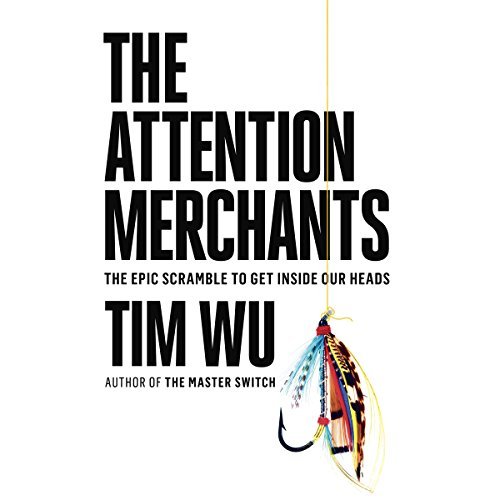
The Master Switch By Tim Wu Narrated by Marc Vietor
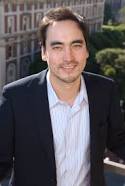
Tim Wu writes about the capitalist drive to acquire a master switch that controls how the public receives information. President Biden has chosen Wu to serve on the White House National Economic Council. It will be interesting to see what influence Wu will have on American technology companies.
TIM WU (AUTHOR, PROFESSOR OF LAW AT COLUMBIA
The first section of “The Master Switch” sets a table for understanding 21st century communication technology. Wu doggedly recounts a history of the communication industry. It will turn some listeners off but stick with it, Wu does have something to say.
“The Master Switch” is written before Huawei technology company became a perceived security and privacy threat. Instead of corporate domination of the internet, Huawei might be a nation-state security and privacy threat. Huawei’s break-through 5g internet system is coveted by many countries in the world.
Some of what Wu reveals is counter intuitive. Steve Jobs’ genius is not as a technical wizard but as a deal maker.
None of these revelations denigrate the spectacular achievements of Jobs and Wozniak or the success of any of the companies mentioned. Jobs is a marketing genius that envisions what the market doesn’t know they want and demands perfection in a product that will serve that market.
STEVE WOZNIAK (Wozniak, is characterized as the real wizard of “Menlo Park” –a few doors down from a similar laboratory occupied by Bill Gates.)
In their early days, one suspects neither genius cared about the power and influence of the internet and the potential of a “Master Switch” controlled by a government, or corporation. A prospect that is both troubling and (probably) inevitable.
Wu is arguing that communication businesses have expanded and contracted like rubber bands; i.e. pulled and snapped by inventors, governments, and business moguls.
From what Wu reports, history favors the likelihood of a “Master Switch” controlled by one of these rubber band pullers.
Wu’s stories of the communication industry suggest that a closed system is more likely to prevail in the shake-out of the internet; i.e. one “switcher” that will control the medium. The Trump administration endorses that philosophy by suggesting the private sector is a better arbiter of control than the government. Wu shows that a closed system tends to perpetuate itself and retard innovation because of a monopolist’s fear of competition.
In today’s political climate, the potential of a closed system looms large. Wu recounts the history of telephony, radio, movie, and television communication businesses that started as open systems but evolved into closed systems due to the acquisitive and greedy nature of mankind.
Wu argues that vertical integration (a closed system) of the communication industry can be discouraged with a check and balance system.
He suggests inventors, manufacturers and government regulators should remain independent (integrated horizontally rather than vertically) to check and balance human nature’s drive for one entity’s control of a “Master Switch”. This seems unlikely in light of an autocratic government like China. China’s outsize involvement and influence on the financing and regulation of a company like Huawei is an unlikely check and balance on sovereign security or privacy.
Wu lauds Google for preaching and practicing open system management of the internet but the history of communication companies reminds the listener that founders and their philosophies mutate. Private industry history of corporate greed in a capitalist society makes one suspect.
A check and balance system for communication or any industry is unlikely to grow based on past experience and human nature.
Free societies over-regulate and then under-regulate. America has always practiced rubber band management. Separation of powers is a temporary construct; not a permanent condition. When conflict begins, human nature takes charge. Mankind is acquisitive, greedy, and human.
Wu is a naive free enterprise philosophizer. History, Ayn Rand, and human nature tell us that the internet will become a closed system.
The public doesn’t understand technology and could care less. “Show me the product and what it can do”. “Show me the money” are humankind’s arbiters of who gets the “Master Switch”.
Ignorance of communication technology is everywhere. Consumers are more interested in what they can get than what they can change.
The general public would rather let someone else make product decisions and vote with their pocketbook when they are dissatisfied. That seems an even greater threat with a company like Huawei that is integrated with an autocratic government.
Wu opens one’s mind but fails to come up with a plan that will change the internet’s future.
Narrated by Jesse Boggs Narrated by Scott Brick & Others
Michael Lewis details the collapse of the real estate industry and Harry Markopolos dissects Bernie Madoff’s multi-billion dollar Ponzi scheme. Both authors reveal mankind’s inherent incompetence and greed. This is the 21st century but we still live in Thomas Hobbes’ 17th century world.
MICHAEL LEWIS (AUTHOR, JOURNALIST)
HARRY MARKOPOLOS (FINANCIAL FRAUD INVESTIGATOR, AUTHOR)
“The Big Short” and “No One Would Listen” reveal the nuts and bolts of how smart and stupid a free society can be. There is plenty of blame for every person involved; both perpetrator and victim. Human nature is an equal opportunity victimizer. Freedom of opportunity beckons good and bad behavior in man.
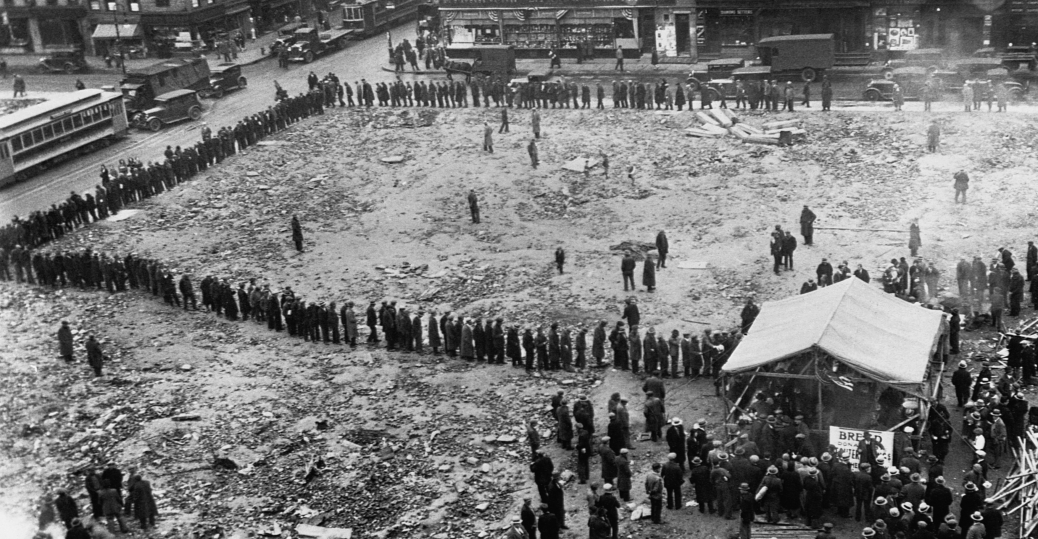
Money lenders like Countrywide and Washington Mutual fed bogus “no doc” mortgages to investment house mathematicians (known as “Quants”) that worked for companies like Goldman Sachs and Merrill Lynch to create derivative (real estate backed) securities. Inept management by Fannie Mae, and Freddie Mac offered mortgage insurance for grossly overleveraged mortgages. Companies like AIG removed investor risk by insuring banks against bad investments. All of these foolish actions coalesced to bankrupt companies and families around the world. Individual lies, bungles, and missteps in the real estate industry created the worst recession since the 1929 stock market crash.
QUANTS–Money lenders like Countrywide and Washington Mutual fed bogus “no doc” mortgages to investment house mathematicians (known as “Quants”) that worked for companies like Goldman Sachs and Merrill Lynch to create derivative (real estate backed) securities.
BERNARD MADOFF (AGE 74) SERVING 150 YEAR PRISON SENTENCE
While this real estate debacle was developing, Bernie Madoff built a 50 to 70 billion dollar empire by making fools of the U.S. Government, European royalty, world wide charities, and working families. Madoff lied, cheated and stole billions of dollars from wealthy investors, charities, and mom and pop businesses with offers of bogus investment returns based on buying from Peter to pay Paul. He paid dividends to earlier investors by taking money from newer investors. As long as people believed in Madoff, or deluded themselves, his wheel of fortune continued to roll. As the real estate market collapsed, old investor money was recalled and new money became unavailable. Madoff’s failure was inevitable.
How could these things happen in a 21st century, democratically elected and governed society? Hobbes would say “how could these things not happen”?
Michael Lewis identifies seers that recognized “Quants” were packaging doomed mortgages into re-saleable financial instruments called derivatives. Victims care little about who the seer heroes were but they were ringing warning bells long before the real estate collapse occurred. Seers by chance and foresight created “The Big Short”; betting on the coming real estate collapse. Seers became rich as the “too clever”, uninformed, or greedy victims became poor.
GOVERNMENT REGULATION-“No One Would Listen” is an indictment of democratic government in free society. His story exposes an inept and failed SEC, an agency created by government to protect investors.
Madoff’s investment lies were exposed in Markopolos’ written “red flag” report to the Security Exchange Commission in the year 2000. The title of the book “No One Would Listen” tells the story. “No One Would Listen” is an indictment of democratic government in free society. His story exposes an inept and failed SEC, an agency created by government to protect investors. The irony is that Madoff did not get caught, he confessed in 2009 because his Ponzi scheme fell apart. along with the collapse of the real estate industry.
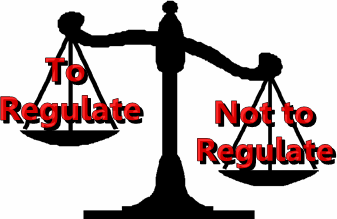
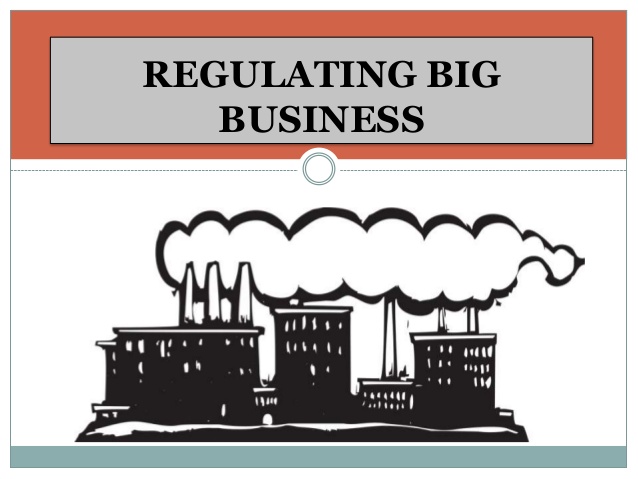
Regulation is not a perfect solution for control of bad actors in a free society. However, no regulation is worse. The forensic reports of Michael Lewis and Harry Markopolos show what happens when efforts to regulate human nature are abandoned. Thomas Hobbes’ “Leviathan” lives to wreck havoc on society.
The narrators of these two books, Jesse Boggs and Scott Brick, are easy to listen to and the author’s forensic stories are valuable to hear.
The review of these books is combined because they are disturbing classics about the nature of man and society. They are alike in regard to their genius, but their stories are difficult to write in one review; let alone two.
“Native Son” was published in the 1940s and “Lolita” in the 1950s but either could have been written earlier or later because their stories are not of the past but of today and tomorrow.
RICHARD WRIGHT (AMERICAN/FRENCH WRITER,1908-1960 WROTE-NATIVE SON)
Story lines have many origins but Wright and Nabokov have tapped into some of the darkest parts of human nature with themes of mayhem, murder, misogyny, and misanthropy. They created characters that reflect human nature; inherent in mankind and affected (or infected) by society.
The main character in Native Son is Bigger Thomas, an impoverished, unemployed, African-American, 20-year-old living in a 1930’s Chicago ghetto. He lives with his mother, sister, and brother in a rat infested one room tenement, owned by a wealthy family that is about to offer him a job.
Bigger Thomas considers himself rich if he has 50 cents in his pocket. However, he does not want to work for a living because he sees it as a dead-end street, controlled by rich white people who will never let him follow any road beyond a limit set by white America. Bigger Thomas’s understanding is shaped by 20 years of living in substandard housing, ghettoized isolation from white society, and an education that did not go beyond the 8th Grade.
Thomas is given an opportunity to work for the owner of the tenement in which he lives. The offer is $35 per week ($10 more than average) to be a chauffeur for the family. Bigger takes the job but on the same night of the day he is hired, he murders his new employer’s daughter. It shocks the listener because the listener’s anticipation is that Bigger Thomas is on his way to breaking the cycle of poverty and becoming a part of the American Dream. But no, he chooses to kill his employer’s daughter.
The shock of the murder is so overwhelming that there is an inclination to stop listening. The shock becomes a Richter scale earthquake when Bigger rapes, bludgeons, and throws his black girl friend down an elevator shaft (while still alive) because she can finger him for the crime. Bigger Thomas is a rapist and a double murderer. What redemption can there be? What is Wright’s point?
WATTS RIOTS 8.11 TO 8.16 IN 1965. MARQUETTE FRYE, AN AFRICAN-AMERICAN MOTORIST ON PAROLE FOR ROBBERY IS PULLED OVER FOR RECKLESS DRIVING. THE RIOTS RESULT IN 34 DEATHS AND 40 MILLION DOLLARS IN ESTIMATED DAMAGES.) The credibility of Wright’s observation is visited in America’s future (25 years later) by the Watts’ riots of 1965, and the 2020 George Floyd Murder by Derek Chauvin.
The answer is difficult and not entirely comprehensible to a privileged majority. But Wright’s story explains that a person who lives a minorities’ life creates an environment that breeds anger, frustration, and violent action; i.e. violent action that can be directed at an ignorant majority, or anyone who threatens one’s inner-directed life.
Bigger Thomas is convicted and sentenced to death. Thomas is defended by a technically persuasive lawyer but prosecuted by a rebel rousing, emotionally righteous, prosecuting attorney who inflames public fear and anger. The prosecutor ignites public condemnation, and effectively dictates a judge’s decision.
Native Son is mostly written and spoken in one and two-syllable words (the only exception is Bigger Thomas’ intellectualized legal defense). Thomas’s defender pricks a listener’s conscious. One begins to feel some sympathy for this terrible criminal.
Peter Francis James’ bass voice brings Richard Wright’s characters to life, but this is not a story to listen to for pleasure. It is a story that improves understanding of discrimination, isolation, and poverty (social ills still evident in the world) and their unintended consequences.
Lolita
By Vladimir Nabokov
VLADMIR NABOKOV (RUSSIAN AUTHOR, 1899-1977, WROTE LOLITA)
An equally reprehensible story is told in Nabokov’s book, Lolita. Lolita burns in your mind like Native Son, with a kindred repulsiveness. Lolita sears your conscience because it speaks like an apology for pedophilia.
Jeremy Irons’ spoken interpretation of Lolita is breath-taking. His voice captures the licentious nature of the main character, Humbert Humbert. He reads Nabokov’s lines with a beautiful alliteration that reveals the poetry in Nabokov’s prose.
The subject is inherently repulsive. The rationalizations of a confessed pedophile who admits his guilt, is difficult, if not impossible, to understand. As with Bigger Thomas’ murder of two women, Humbert Humbert’s seduction of a 12-year-old girl makes the listener want to quit listening. Iron’s skillful narration seductively draws the listener into an intimate appreciation of Nabokov’s prose. But, it’s a life of a truly despicable and tragic human being.
There is no justification for pedophilia though Humbert Humbert makes his plea. Humbert’s observation that pedophilia has been present since time began is not a plausible justification for its continuation. The argument that some psychological trauma in one’s youth takes control of one’s libido is “psycho-babble”. The argument that some 12 year olds are what Humbert Humbert classifies as “nymphet’s” is in the mind of a sick person.
Humbert’s unbalanced mind projects an ignorance of the difference between a child and an adult. The argument that Humbert Humbert truly loved Lolita, even after she is 31 years old, and married to a person of her own age, is preposterous. Based on the character’s own explanation of his child fixation, Humbert’s characterization of love is despicable.
So, what is the point of the book? The best face is that Nabokov reveals the depth of a pedophile’s sickness, some of its causes and consequences, and the utter futility of psychological examination; the worst face is that Nabokov justifies pedophilia based on human nature. For my own conscience, and for respect to a literary genius, I pick the first rather than the second reason for Nabokov’s decision to write this book.
The story is enlightening as well as repulsive. It tells the story of the length that a pedophile will go to satisfy an abhorrent sexual desire. It suggests that a psychiatric examination of an intelligent psychopath is a waste of time. It gives a face to pedophilia and evidence of how it permeates human culture, from advertising, to magazines, to movies. And, it shows, with a character like “Q” (a movie producer), how salacious and jaded a human being can become.
Both of these books are brilliantly written. Native Son is a masterpiece of simple and direct prose that is a literary lesson for aspiring writers. Richard Wright is an efficient user of words to tell a story with brutal clarity.
Both are horrific stories of human nature. Listening to them is enlightening but only our future will demonstrate whether enlightenment leads to improvement in human nature or a repeat of the bestiality we have shown so many times during, before and after the 20th century.
Audio-book Review By Chet Yarbrough
(Blog:awalkingdelight)
Website: chetyarbrough.blog
A Prayer for Owen Meany
By John Irving Narrated by Joe Barrett
JOHN IRVING (AUTHOR, SCREEN WRITER-IN HIS 70TH SEASON OF LIFE)
Like quick sand, every chapter of John Irving’s “A Prayer for Owen Meany” creates a mystery that pulls the listener deeper into its story.
Why is Owen Meany’s voice so high-pitched and single noted? Who is the “lady in red”? Who is Owen Meany’s illegitimate friend’s father? Why do the main characters keep practicing “the shot”?
Why do the main characters keep practicing “the shot”?
What is Owen Meany’s recurring dream? Right foot, left foot, body, and brain; soon you are consumed by Irving’s mysteries.
Joe Barrett’s spoken presentation is terrific because it enhances the written meaning of the story. James Atlas precedes the narration with an interview of John Irving, the author. The Atlas’ interview sets the table for what you are about to hear.
It is an age like today with ministers preaching and not believing, parents teaching right and doing wrong, and children maturing physically and wasting mentally. Owen Meany is an exception, as this story tells the listener.
Irving writes a story about growing up in Anywhere, America where the pious are weak, the rich are intimidating and the children are indulged. It is an age like today with ministers preaching and not believing, parents teaching right and doing wrong, and children maturing physically and wasting mentally. Owen Meany is an exception, as this story tells the listener.
Owen Meany is modeled like the little man in The Tin Drum, a book about a dwarf like German citizen observing the beginning, progress, and ending of the WWII German tragedy. Owen Meany is a stunted American citizen living at the beginning of an evolving Vietnam American tragedy.
The subject of Vietnam is generally understood as an American disaster. It earned its American anti war rebellion.
The subject of Vietnam is generally understood as an American disaster. It earned its American anti-war rebellion. Irving’s story crystallizes the anxiety and frustration of that time. He offers an answer to what we can do when we become anxious and frustrated about things that seem beyond our control. It is not an easy path but redemption for atrocity begins with people of faith who see reality, have an inner moral compass, and act with a relentless commitment to stop senseless acts of war.
The only quibble about Irving’s story is linear time distortion that weaves the story in and out of the past; the movement back and forth is like re-starting a motor that is running smoothly but stalls because of a faulty timing chain.
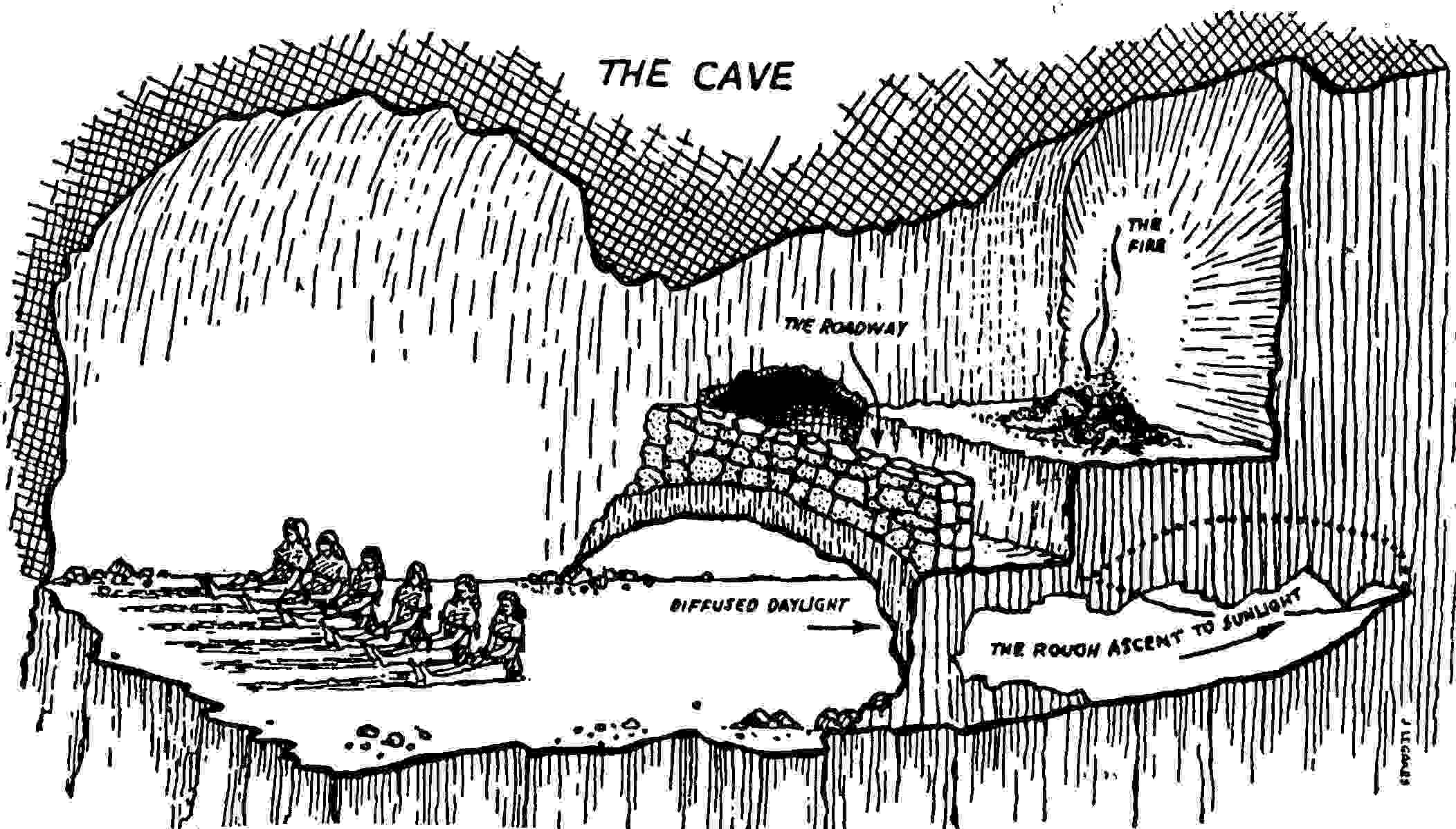
There is more than an anti-war message in the book. It is a tale that tells how most humans live like cave dwelling shadows with little self understanding and no purposeful direction.
There is more than an anti-war message in the book. It is a tale that tells how most humans live like cave dwelling shadows with little self understanding and no purposeful direction. Owen Meany does not live like a shadow of himself. He acts decisively. Owen Meany makes concrete choices; choices that he believes reveal God’s purpose and His pre-ordained plan. It is a matter of Faith to Owen Meany.