Audio-book Review By Chet Yarbrough (Blog:awalkingdelight) Website: chetyarbrough.blog
The Other Brain By R. Douglas Fields Narrated by Victor Bevine
As we grow older, our physical and mental abilities deteriorate. Knowing that decline is the nature of life, the older one becomes, the more grasping one is for new ideas that mitigate life’s inevitable degradation.
R. DOUGLAS FIELDS (AUTHOR Ph.D. IN NEUROSCIENCE)
“The Other Brain”, written by Dr. Douglas Fields (a department head at the National Institute of Health and adjunct Professor of Neuroscience at the University of Maryland) is an expert in the field of cognitive science, i.e., the exploration of how minds work.
DR. THOMAS HARVEY (the pathologist that stole Einstein’s brain and kept it for some twenty years before telling anyone he had it.)
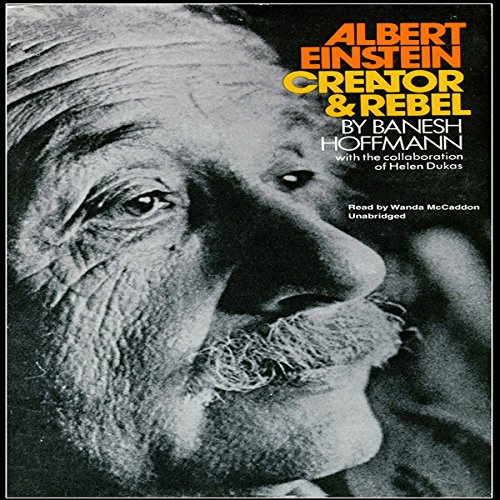
Fields begins with a story of when he is a ten-year old boy requesting a brain to dissect to see how it works. He moves on to tell the story of the pathologist that stole Einstein’s brain and kept it for some twenty years before telling anyone he had it. Einstein’s brain is eventually analyzed to see if there was a physical difference in Einstein’s brain that allowed him to see what others could not.
With this opening, Fields begins an exploration of the brain and how it functions. What he reveals is that Einstein’s brain was different but not because it was any bigger nor had more neurons but that it had more glia cells than the average brain. Until glia cell discoveries were made, the consensus of scientists was that neurological function was singularly based on an electrical impulse, i.e., an impulse transmitted to the brain through neurons via axons and dendrites to command thought and action.
With careful examination of glia cells, scientists found that there is what Fields calls a “second brain”. Glia cells are different from neurons. They do not use the axons and dendrites that transmit electrical pulses to compel performance. Glia cells use a chemical interaction within and between glia that create stimulus and response. The significance of the discovery of glia cells as a chemical alternative to electrical impulse suggests motor and mental function may be improved by other means.
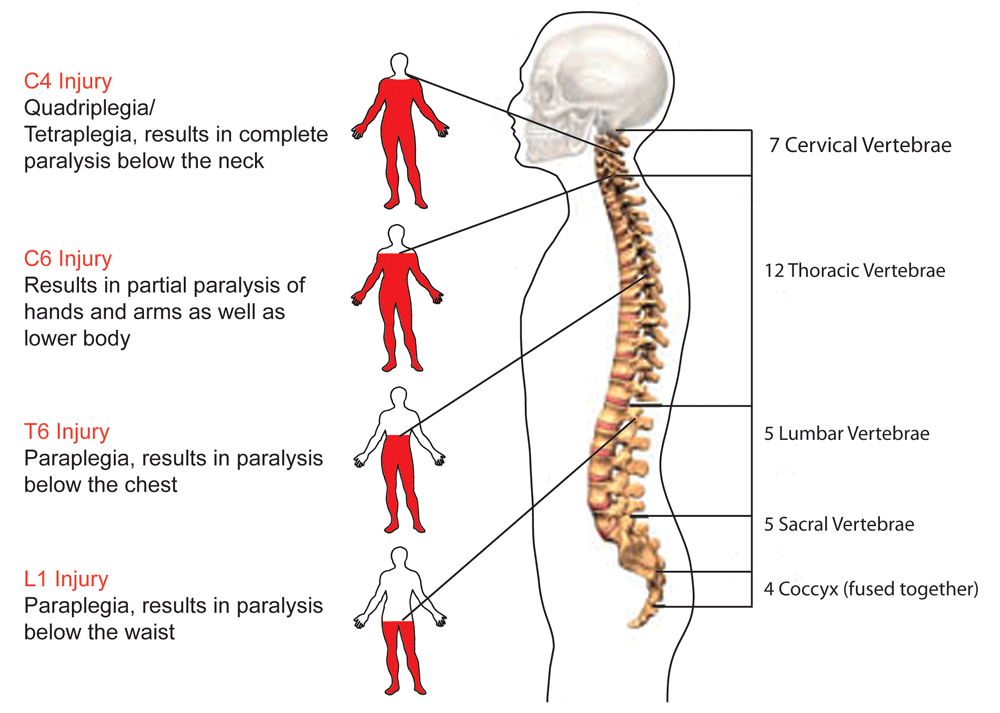
This discovery OF GLIA cells potentially offers alternative ways of treating spinal cord injuries and mental in-capacities caused by diseases that interfere with the neuronal circuits of the brain.
This discovery means that the study of a “second brain” may offer alternative ways of treating spinal cord injuries and mental in-capacities caused by diseases that interfere with the neuronal circuits of the brain. Further, it may offer treatment alternatives for patients suffering from dementia or Alzheimer’s, a growing and feared neurological dysfunction.
Fields explores several glia related cells and their positive and negative functions in the neurological system. It is not a panacea for cure of neurologically impaired patients or aging brains because experiments show glia cells are both curative and destructive in their effect on the neurological system. However, a second brain does open a new field of opportunity for cure. Maybe young brains can be re-booted and old brains rehabilitated.
Dementia gives no comfort to one who is older and have a fear of Alzheimer’s and its consequence for others. Others, who are left to care for the stricken.
Your Deceptive Mind: A Scientific Guide to Critical Thinking Skills
Recorded by: Professor Steven Novella
Produced by: The Great Courses
STEVEN NOVELLA (AMERICAN CLINICAL NEUROLOGIST, ASST. PROFESSOR AT YALE UNIVERSITY SCHOOL OF MEDICINE)
“Your Deceptive Mind” offers lessons for two paradigm shifts occurring in America today. One is gun control; the other is sex discrimination. Professor Steven Novella’s lessons apply to other important issues, but none seem to have the same political momentum for change.
Novella begins by inferring we all deceive ourselves. Novella explains it is caused by the nature of human consciousness. Novella argues that human brains are designed to make coherent sense of remembered experience; not to necessarily recount accurate details of events. We often add facts and change details to improve coherence of our memories.
Memory does not work like a film clip. It is not caste on celluloid that can be replayed as a memory. Memory is re-invented by reconstruction of facts to fit a story that makes sense to the person who remembers.
AR-15 (Type of semi-automatic rifle used in Florida High School shooting.)
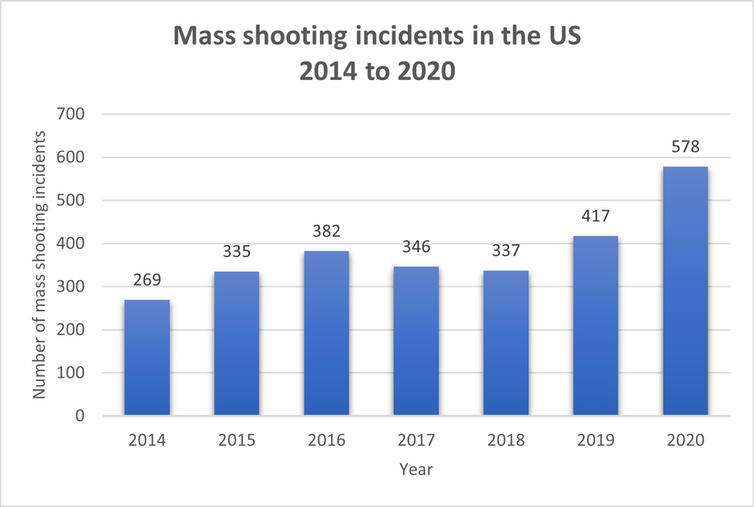
As of April 15, 2021 there have been 148 people murdered and 485 injured in mass shootings. The most recent is at the Indianapolis FedEx facility that killed eight people. One is reminded of William Butler Yeats:
Turning and turning in the widening gyre The falcon cannot hear the falconer; Things fall apart; the centre cannot hold; Mere anarchy is loosed upon the world, The blood-dimmed tide is loosed, and everywhere The ceremony of innocence is drowned; The best lack all conviction, while the worst Are full of passionate intensity.
The 17-people murdered in a Florida high school in 2018 raises the issue of gun control in America one more time. Americans see this incident from three views. One, from the perspective of people who heard it on the news; two from the perspective of people who responded to the event; and three from the perspective of victims. Based on Novella’s assessment of critical thinking, all three views distort reality.
The 17-people murdered in a Florida high school 2018 raised the issue of gun control in America one more time.
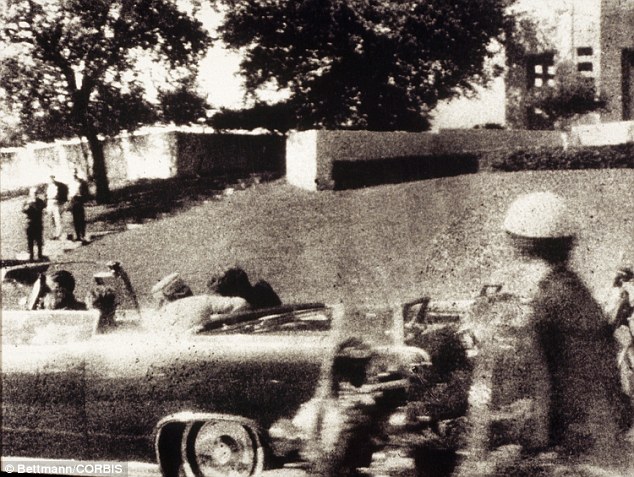
JOHN F. KENNEDY ASSASSINATION – Memory does not work like a film clip. It is not caste on celluloid that can be replayed as a memory. Memory is re-invented by reconstruction of facts to fit a story that makes sense to the person who remembers.
Novella tells a story of a woman accompanying the John F. Kennedy trip to Dallas, Texas. Soon after Kennedy’s death, she explains that she did not see anything that happened. As the years pass, she recalls seeing smoke from a grassy knoll near the shooting. Novella explains that each time she tells the story more details are revealed. No evidence is ever found to suggest a shot is fired from anywhere but the Dallas, Texas book-depository. What she is doing is creating facts to improve the coherence of a memory.
Facts of Florida’s murders and other gun-related incidents are remembered differently. All who heard of, responded to, or are victimized by guns tell different stories. There is no singular consensus on what caused it to happen, who is responsible, or what can be done. Facts seem not to matter. In Florida, seventeen human beings are dead. One person killed them. One automatic weapon is used by a troubled high school student who used a gun designed ONLY to kill people.
Victims of the school shooting ask why America cannot protect their children. A flood of responses is given but each person at the school is influenced by a subjective recollection of events. In many cases, facts are ignored because they do not fit the narrative of the person telling his/her story. It has little to do with facts; i.e. except as those facts fit the re-created memory of a horrific event. Like the woman seeing smoke coming from a grassy knoll, some facts just fit a reconstructed story; not the truth.
Critical thinking skills mean addressing facts, using those facts to create a constructive analysis, a plan of action, and implementation. Seventeen people are dead in Florida from one shooter. They are dead at the hand of a troubled teen. The weapon used is only designed to kill people. Everything else is irrelevant. Those are the facts. That is the truth. What is needed now is constructive analysis, a plan of action, and implementation.
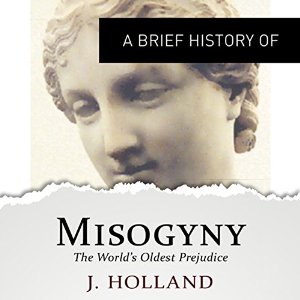
The same can be said of sex discrimination. An example is the King’s law that particularly applies to women who speak insolently. They are to have their mouths scoured with salt; i.e. a law applying only to women slaves. Of course, the law begs the question of why women are slaves.
Novella’s argument that every memory is a subjective recollection may mean testimony of women who are abused and/or discriminated against are misreading the facts of their recollection. However, many facts are independent of recollection.
There is overwhelming evidence; i.e. fact-based films, recordings, physical examination records, and statistical studies that show women are abused and discriminated against all over the world. Those are the facts. That is the truth. What is needed is constructive analysis, a plan of action, and implementation.
Gun control and women’s rights: Has America reached the tipping point for acting on critical thinking? Have we finally reached the threshold for a paradigm shift in gun control and women’s rights? Doubtful.
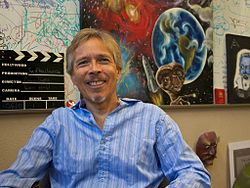
CHRIS IMPEY (BRITISH ASTRONOMER, EDUCATOR, AND AUTHOR)
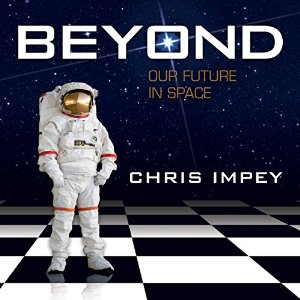
After listening to Chris David Impey’s book, “Beyond: Our Future in Space”, traveling to other worlds seems distant and unachievable. Impey cleverly begins his story about space travel as though the first human to permanently leave earth is born in the 21st century. That novelistic beginning is revisited twice, but the true subject of “Beyond: Our Future in Space” is the physics, astronomy, and observational cosmology of the present day.
One presumes Impey’s purpose is to encourage the possibility of reaching the stars but, by the end of the audiobook, little optimism is left to the listener. The daunting task of overcoming gravity, surviving an inhospitable environment, and leaving the only home humans have ever known, warrants some pessimism. Some minor relief from pessimism is offered with world history’s comparison of human migration across the continents. Impey implies history’s adventurers on earth have something in common with adventurers in space.
One presumes Impey’s purpose is to encourage the possibility of reaching the stars but, by the end of the audio book, little optimism is left to the listener.
The literal common characteristic of adventurers is a gene called DRD4. Impey suggests DRD4 alleles have evolved in 39 population groups that have historically migrated over long distances. These population cohorts are loosely classified as risk takers but, with a 7R variant of this gene, they have a higher incidence of attention deficit hyperactivity disorder (ADHD), schizophrenia, bipolar disorder, and addictive behavior. This observation seems unlikely to inspire confidence in “…Our Future in Space.”
The next difficulty of space exploration noted by Impey is escaping gravity. Current science shows fuel propellant is 80% of the weight of a rocket launch. Without a more efficient source of propulsion, sending thousands of people on earth to another planet is a pipe dream.Impey notes that science is exploring alternatives like sail power, nuclear fission, radiation collection systems, and the physics of teleportation, via spooky action at a distance, but the evidence of success is either solely theoretical or miniscule.
Political will for space exploration has dwindled since the 1960s. American government financing has dropped from nearly 4.5% to well below 1% of the Federal Budget.
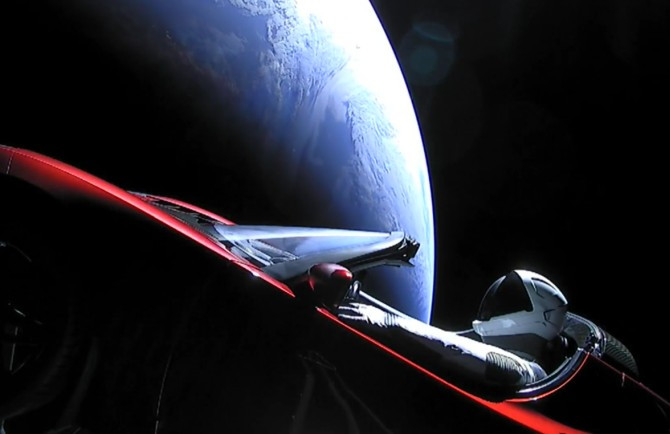
Elon Musk’s Space Exploration (Launching a Tesla into space.)
NASA has nearly been dismantled. Most research and development is being done by one-off entrepreneurs like Elon Musk, Burt Rutan, and Robert Bigelow. Part of the reason for the loss of political support is its cost. Current science shows it costs more than $1,000 per kilogram for human and/or cargo delivery to the space station.
It is encouraging that reusable launch vehicles have potential for reducing that cost but space tourism seems a long way off. Until humans experience space flight, it seems unlikely a Columbus or Matt Damon is waiting in the wings to set sail for Mars.
Elon Musk’s Successful Return of Rockets Launched into Space. It is encouraging that reusable launch vehicles have potential for reducing that cost but space tourism seems a long way off.
Impey makes the case for habitable planets in the cosmos based on current robotic, radio signal, and telescope explorations. He argues there is growing evidence of many planets orbiting stars outside earth’s solar system. From year 2000, the number of exoplanets (those orbiting stars) increased by more than 775 planets.
CURIOSITY-Impey makes the case for habitable planets in the cosmos based on current robotic, radio signal, and telescope explorations.
Impey goes on to explain space voyage and exoplanet living’s physiological effect on any human that chooses to leave earth. There is the detrimental effect of radiation, extreme temperature, lack of water, lack of oxygen, and reduced gravity. All of these space voyage and planetary differences discourage optimism about “…Our Future in Space”.
Quote from astronaut Andrew Feustel– “I don’t think we’ve solved the radiation problem yet and that’s really a function of how fast we can get there. So the faster we can there, the less radiation exposure we have. At the moment it would take a year but we need it to be three months there and three months back.”
However, Impey soldiers on. He revisits the novelistic idea of the first space explorers by noting extensive sociological training, refinement of suspended animation, and psychological profiling to create ideal space voyager teams. Impey notes that several animals have been put in a state of suspended animation and revived; i.e. implying that humans could be put in the same state of suspension for long space voyages.
NANO-ROBOTICS SPACE EXPLORATION As a fall back to the difficulty of human space travel, Impey suggests an alternative to human exploration of exoplanets. He writes about advances in nanorobotics; i.e. miniscule components that can function as human substitutes for exploration of exoplanets.
As a fall back, Impey suggests an alternative to human exploration of exoplanets. He writes about advances in nanorobotics; i.e. miniscule components that can function as human substitutes for exploration of exoplanets. The reduced size of nanorobotics decreases payload weights and increase the speed and distance that can be traveled for space exploration. This still leaves propulsion for great distances an issue but it mitigates human risk. The presumption is, with more information about exoplanets, political will for space exploration will increase. With better funding, the science to support human beings “…Future in Space” will be expanded.
RAY KURZWEIL (AUTHOR,SCIENTIST,INVENTOR,DIRECTOR OF ENGINEERING AT GOOGLE)
Finally, Impey touches on Kurzweil’s singularity and the advance of Artificial Intelligence, where computers equal and/or exceed the capabilities of human beings. In Kurzweil’s world, either AI will explore other planets on its own, and/or AI will meld into the human race to mitigate all the negative consequences of space travel.
Who would have thought that human beings would set sail for a new world when many thought sailing from land meant you would fall off the edge of earth? Maybe that is where space exploration is today. Impey’s fictional character arrives at an exoplanet with her team at the end of “Beyond: Our Future in Space”. Now that is optimism.
Spooky Action at a Distance (The Phenomenon That Reimagines Space and Time and What It Means for Black Holes, the Big Bang, and the Theory of Everything)
Written by:GeorgeMusser
Narration by: William Hughes
GEORGE MUSSER (AUTHOR, CONTRIBUTING EDITOR SCIENTIFIC AMERICAN)
“Spooky Action at a Distance” (also called entanglement) collapses the theory of space just as Einstein’s theory of relativity collapsed time. George Musser argues that experimental evidence suggests neither space nor time have form or matter in an Aristotelian sense.
Aristotle explains the nature of things by suggesting an object perceived by the senses has form and matter. By Aristotle’s definition, both space and time are perceived by the senses; therefore, they have form and matter.
Einstein’s theory (experimentally confirmed) shows that time is relative which denies precise form or matter. Time changes based on an observer’s relative location, and the speed of observer and observed.
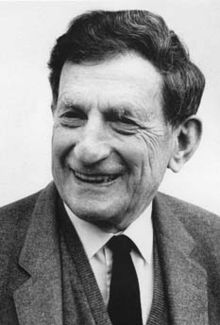
JOHN STEWART BELL (1928-1990) John Stewart Bell and David Bohm note how elemental particles, separated by wide distances, can be manipulated to mimic or oppose each other’s spin.
SIR ISAAC NEWTON (1642-1727) With Newton, all action is presumed to be based on locality with gravitation of the earth causing an apple to fall to the ground
Musser notes that with the advent of quantum theory, in Einstein’s view, the same holds true for space because of the experimental proof of “Spooky Action at a Distance”. John Stewart Bell and David Bohm note how elemental particles, separated by wide distances, can be manipulated to mimic or oppose each other’s spin. It is as though there is no space between two particles because the action occurs simultaneously: in other words, faster than the speed of light. The ramification of this “Spooky Action at a Distance” is that space has no inherent meaning. Both space and time are a fiction created by the senses.
DAVID BOHM (1917-1992, AMERICAN PHYSICIST) With Bell and Bohm, the apple still falls to the ground but it may have nothing to do with gravity but because of an unseen phenomenon; i.e. something that is non-local and unrelated to Newtonian locality’s cause and effect (maybe dark energy or dark matter that connects everything to everything).
Musser broadly explains this phenomenon as the difference between locality and non-locality in the cause-and-effect relationship of existence. With Newton, all action is presumed to be based on locality with gravitation of the earth causing an apple to fall to the ground. With Bell and Bohm, the apple still falls to the ground but it may have nothing to do with gravity but because of an unseen phenomenon; i.e. something that is non-local and unrelated to Newtonian locality’s cause and effect (maybe dark energy or dark matter that connects everything to everything).“Spooky Action at a Distance” calls into question the need of space or proximity. It also raises questions about the speed of light as a limitation in the area of cause and effect; i.e. if “Spooky Action at a Distance” reflects instantaneous change; then cause and effect have no speed limitations. Parenthetically, the idea of inflation at the big bang is replaced by principle of spooky action.
Black holes are also re-imagined with the principle of “Spooky Action at a Distance”. Maybe black holes are the source of new galaxies being formed in other universes. It may be that this is still a cause-and-effect universe but a theory of everything escapes us at the moment because of its undiscovered nature.
LEE SMOLIN (AMERICAN PHYSICIST, GRADUATE OF HAMPSHIRE COLLEGE AND HARVARD UNIVERSITY) Smolin suggested too much research and investment is committed to string theory at the expense of other “theory of everything” ideas.
One of many things that are interesting in Musser’s book is that Einstein may have been ahead of Niels Bohr in appreciating Quantum Theory even though the idea set Einstein on edge. There is hope for an undiscovered truth that will bring the nature of things into a theory of everything that is more predictable than the probabilities of quantum mechanics. This may still be a “cause and effect” universe. Maybe Smollin is right, and too much research and investment is committed to string theory at the expense of other “theory of everything” ideas.
Musser’s story reminds one of research done on Einstein’s brain. The size and number of dendrites and synapses of Einstein’s brain were found to be the same as in normal human brains. However, every human has glia cells in their brain that have a function that does not comport with normal electrical connections but still transmit information to the autonomic and cognitive functions of the brain. Neuroscientists found that the glia cell-count in Einstein’s brain is higher than the average for most human beings. The glia cells were found to be the source of a different mind/body connection that transmitted information in a different way. One wonders, is that why Einstein could see what others could not? Re-imagining is what Musser infers is needed in today’s physics’ departments.
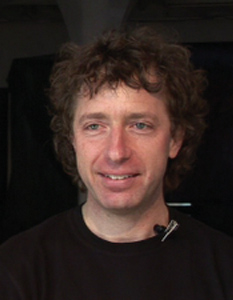
JEREMY NARBY (AUTHOR, PhD ANTHROPOLOGY FROM STANFORD)
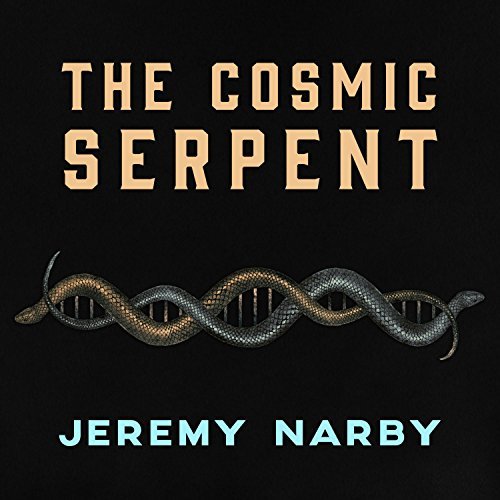
Psychological unease accompanies Jeremy Narby’s erudite speculation about the meaning and origin of life in “The Cosmic Serpent”. The unease comes in two forms. One, is Narby’s seduction by hallucinatory experience. Young people in America are choosing to overdose rather than face today’s perceived reality. The other is Narby’s patterning of observations to create either a true or false belief. It reminds one of the potential of Einstein’s discovery of matter and energy equivalence. Einstein discovered falsifiable evidence of nuclear fission that holds a key to sustainable energy. He also opened the door to Armageddon.
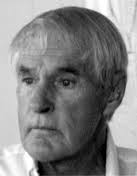
TIMOTHY LEARY (1920-1996)
Narby, like Timothy Leary, is educated at some of the best universities in the world (Leary at Harvard; Narby at Yale). Both have PhDs. Narby has a PhD in anthropology; Leary in Psychology. Few, if any, believe LSD (Leary’s hallucinatory drug of choice) offers insight to the origin and meaning of life. However, like Leary, Narby suggests hallucinatory drugs may be a pathway to understanding.
Regarding hallucinatory experience, Narby does not appear to have slipped into the bizarre behavior of a Timothy Leary; at least not yet. Narby is 59 years old. When Narby did his research, he was in his late 20s and early 30s. “The Cosmic Serpent is published when Narby is still in his 30s. Leary lived to be 76. Each passing year exaggerated Leary’s belief in the therapeutic potential of psychedelic drugs.
Patterning is the human ability to see structure in disparate facts and events. Some say this is the sign of genius. Einstein is said to have formulated a theory of time by riding a train. Einstein’s insight came from thinking (patterning) how time is relative based on a person riding a train and a stationary observer watching the train pass. However, patterning also leads to incorrect conclusions like a person’s recollection of a crime. Human brains are shown to manufacture events and facts to make stories complete rather than necessarily accurate.
SHAMANISM – Narby’s articulate presentation of Peruvian shamanism tempts seekers of knowledge and experience to try something new.
Narby’s articulate presentation of Peruvian shamanism tempts seekers of knowledge and experience to try something new. The temptation comes from different sources. One is genuine interest in understanding more about the world and our place and purpose in it. Another is the desire to believe that there is something more important in life than wealth, power, or position.
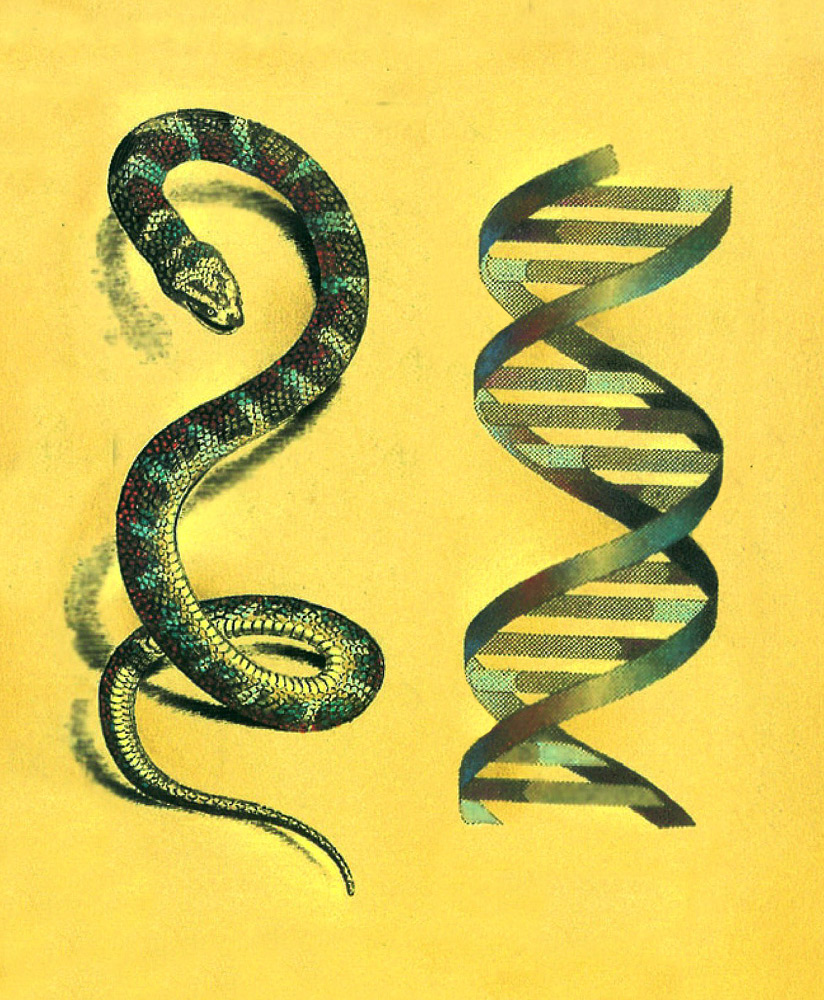
“The Cosmic Serpent” suggests that native cultures around the world offer insight to the origin and meaning of life because of common hallucinatory experiences. Narby suggests the hallucinatory symbol of a winding serpent is evidence of the configuration and importance of DNA; long before Watson’s and Crick’s discovery. The inference is that shamanistic hallucinations are not mere symbols but a truth of life. Narby’s inference is that seekers of life’s truth should listen to the experience of shamans and pursue shamanistic experience through the studied use of their methods.
Narby suggests the hallucinatory symbol of a winding serpent is evidence of the configuration and importance of DNA; long before Watson’s and Crick’s discovery.
Narby argues that the scientific community needs to widen its view of the world. He believes DNA holds the secrets of nature’s existence. The question is whether youth and science should accept the risk of Narby’s patterned belief?
At the least, Narby makes one appreciate the importance of native culture. He may be opening a worthy field of scientific research. On the other hand, Narby may be creating false expectations that offer ignorance and escapism, rather than research and science.
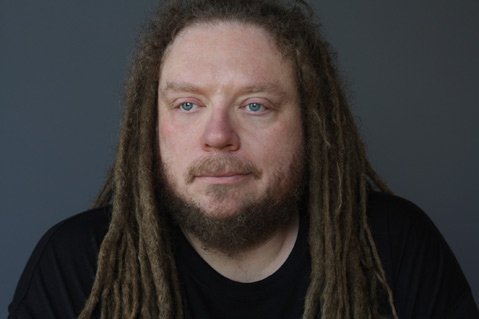
JARON LANIER (AUTHOR, INFORMATION AGE PHILOSOPHER,FUTURIST)
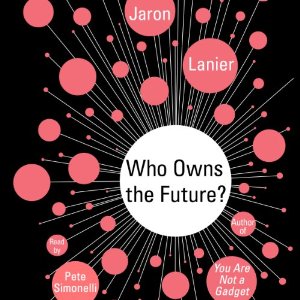
Society is at the threshold of change. Jaron Lanier writes about the information age in “Who Owns the Future”. Just as the industrial revolution, and two world wars mechanized human production, the computer and internet “informationizes” mechanical production. Lanier bluntly explains that human employment will decline in proportion to computerization of production.
Lanier is neither posturing as a Luddite nor abandoning the principles of capitalism. He suggests human beings need to understand their changing role in society. Lanier infers a failure to understand human’ role-change will compel disastrous reactions; i.e. reactions like the Luddites of the Industrial Revolution or socialist, fascist, and communist sympathizers of the post-industrial world.
Luddites during the Industrial Revolution–Workmen take out their anger on the machines.
Lanier argues that automation is replacing jobs at a faster rate today than in the 20th century. Human nature does not change. Money, power, and prestige remain the motive force of human achievement.
Achievement in the past is based on productivity from the work of human hands with the assistance of mechanization. The days of human assistance in mechanization are steadily being reduced by computerization.
Lanier forecasts a future of abundance where the goods of life will be available upon request; without the assistance of human hands. No one knows how far into the future humans must travel to arrive at that age of abundance but Lanier suggests it will happen.
Lanier has an abiding faith in human beings’ ability to adapt and control technological change.
Lanier infers human initiated technology will continue to eradicate disease, and manipulate the atomized world to manufacture the necessities and desires of life. Replication machines will become common household appliances to manufacture diverse products, ranging from food to toothbrushes, to “goop” machines that extrude finished product.
HIGH SPEED GOO KNITTING MACHINE MANUFACTURED BY SONY–PRICED AT $30,000.
Industries will become more automated and less dependent on human employment. Lanier suggests now is the time for society to understand the change. As means of production reduces the need of human hands, the contribution humans make to society will increasingly become information based.
Lanier begins to explain the concept of information monetization. This is something that exists today but is mistakenly understood as something that is free.
Examples are Facebook, Google Search, Amazon.com, Microsoft Windows 10, Apple ITunes, governments, and other organizations that Lanier calls Siren Servers.
Nothing is free. The price humans pay is information about themselves, their needs, desires, habits, interests, etc. Every phone call, every web search, every email, every purchase made tells Siren Servers what product they can sell, what price they can sell it at, and how much money, power, and prestige they can accumulate.
Lanier suggests that the concept of Siren Servers should be expanded to include defined populations, common-interest groups, and individuals. Lanier argues that information humans now give for free be monetized. Every person that produces information that increases another’s money, power, or prestige should be compensated.
Employment continues to be an integral part of living life. Compensation is proportioned based on others’ use of provided information. It does not eliminate unemployment but it offers a more broadly applicable potential for employment. It does not eliminate poverty or extreme wealth, but it offers potential for broadening the middle class. More significantly, it does not demand the impossible; i.e. a change in human nature.
Though not addressed in this book, Lanier does believe there is a circumstance where information should be provided for free.
He argues the experience of Taiwan, in the Covid19′ pandemic, offers an example of free information that helps society. Taiwan created an open platform for Covid19 to allow the general public to enter information about their infection, masks that they are wearing, and where they are located. Of course, a key to their success is testing kits to determine infection. American can learn from this. It offers a pragmatic way of safely returning to work.
There is a slippery slope aspect to Lanier’s idea. The slippery slope is the intrusive requirement of government regulation inherent in any system based on information contribution.
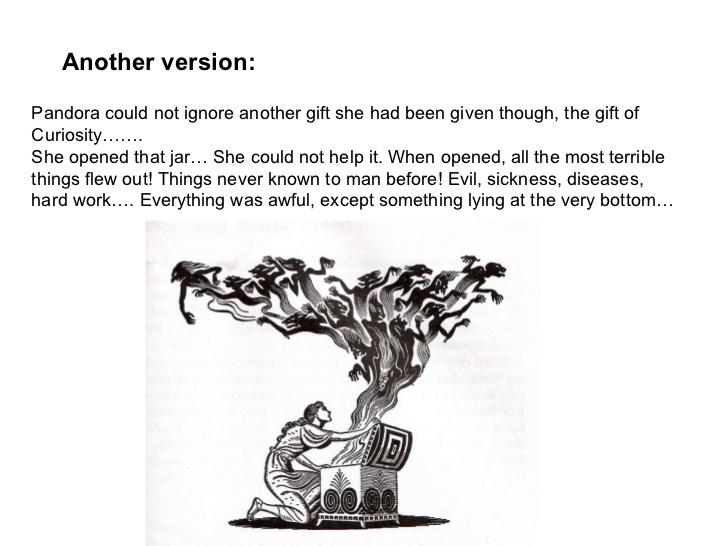
In the case of the Covid19 pandemic, the idea would be for the platform to inform the public; not to be used by a central government to direct people’s decisions. It remains an opened Pandora’s box that only leaves hope.
Congress is asking how far down the road of “1984” should a nation go before becoming a creature of totalitarianism?
If the government is in control, numerous questions rise. Who decides what information is being used by another and what the rate of pay should be? One may argue that is a fault of any economic system but how far down the road of “1984” would a nation go before becoming a creature of totalitarianism?
The point is that human nature does not change. Though Lanier may be absolutely correct in societies’ transition from industrialization to computerization, people remain greedy, power-hungry, and hubristic.
Can democratic capitalism resist totalitarianism in an Information Age? America’s two most current Presidents suggest otherwise.
Both Obama and Trump expanded the potential of “executive action” that bypasses congressional oversight.
Also, Lanier’s age of abundance presumes technology will keep pace with human needs, desires, and habits. Global warming, rare earth monopolies, and population increases suggest otherwise.
“Who Owns the Future” is an insightful view of the modern world. Unlike those who revile modernity and pine for a return to an idealized past, Lanier offers an alternative. Lanier strikes one as a Socratic seer of modernity.
The Body Keeps the Score: Brain, Mind, and Body in the Healing of Trauma
Written by: Bessel van der Kolk, MD
Narration by: Sean Pratt
BESSEL van der KOLK (DUTCH PSYCHIATRIST, SPECIALIZING IN ATTACHMENT, NEROBIOLOGY, AND DEVLOPMENTAL ASPECTS OF TRAUMA’S EFFECTS ON PEOPLE)
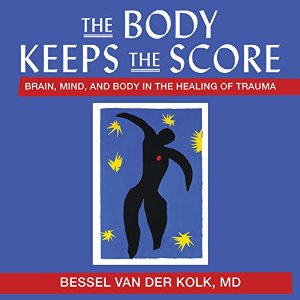
Dr. Bessel van der Kolk argues that trauma has a neurological connection between mind, body, and time. Kolk offers numerous examples of patients who suffer from the trauma of war, rape, accident, and childhood experience to support a belief that “The Body Keeps the Score” and human consciousness pays the price.
In a limited sense, Kolk’s argument is convincing. The limited sense is in one’s definition of trauma. Trauma that clinically demonstrates disconnection between mind, body, and time, as proposed by Kolk, is a credible argument. However, Steven Pinker suggests a part of Kolk’s argument seems overdrawn. Steven Pinker is an American psychologist, cognitive scientist, and linguist. He is a Professor in the Department of Psychology at Harvard University.
Steven Pinker is an American psychologist, cognitive scientist, and linguist. He is a Professor in the Department of Psychology at Harvard University.
Pinker argues that human beings become who they are from genetics and life experience, largely exclusive of parenting. In contrast, Kolk suggests parenting plays a significant role in a child’s consciousness as a mature adult. Kolk argues that the trauma of parental abuse, neglect, and egoistic child’ indulgence form mind-body-time’ disconnects that profoundly affect mature adults. Kolk’s parenting arguments fly in the face of studies cited by Pinker that suggest less than one percent of a parent’s upbringing makes a difference in a child’s adulthood.
This may be a distinction without a difference if one accepts Kolk’s references to experience and sociological studies that show juvenile delinquency is credibly correlated with childhood trauma from incest, neglect of basic human needs like food or water, or hyper-vigilant (smothering) parental attention to children who sometimes just want to be left alone. Presumably, children in that type of hostile environment do not represent the general population.
Modern acceptance of PTSD in veterans of combat reinforces Kolk’s argument. The generally accepted definition of PTSD by the American Psychological Association “…is an anxiety problem that develops in some people after extremely traumatic events, such as combat, crime, an accident or natural disaster.”
What Kolk argues is that trauma often becomes an imprinted mind /body’ experience that disconnects from time. Modern acceptance of PTSD in veterans of combat offers evidence for Kolk’s argument. The generally accepted definition of PTSD by the American Psychological Association “…is an anxiety problem that develops in some people after extremely traumatic events, such as combat, crime, an accident or natural disaster.”
This broad definition is expanded by Kolk in two significant ways. One, those suffering from PTSD are riven with anxiety by a trauma that is stuck in time, i.e., time that stands still. Kolk explains that a PTSD sufferer recalls a past trauma as though it is happening now, and his/her body reacts in the same way it did when the trauma first occurred. The body’s chemical and hormonal reaction is the same as though the past trauma is happening now.
CHILD SOLDIERS OF MEXICO’S DRUG GANGS (Kolk’s second significant expansion is belief that children experience the equivalent of PTSD from parents’ psychological and physical abuse during their children’s childhood.)
Kolk’s second significant expansion is belief that children experience the equivalent of PTSD from parents’ psychological and physical abuse during their children’s childhood. A child’s chemical and hormonal response to recalled childhood trauma repeats itself. In some, time stands still when trauma is recalled, and the body repeats its physiological response. However, evidence is more anecdotal than scientifically measurable.
MASS MURDERERS-Psychiatric interviews rely on patients’ remembrance of things past which are historically unreliable. Sociological surveys cannot be done without the bias of a person or group that designs the questions that are to be asked of the person that answers the survey.
Kolk infers that the psychological maladies of adults can be significantly reduced by better parenting. The difficulty one has in accepting this argument is that documentary proof is in anecdotal evidence from psychiatrist interviews of patients and sociological surveys of defined populations, both of which are inherently biased. Psychiatric interviews rely on patients’ remembrance of things past which are historically unreliable. Sociological surveys cannot be done without the bias of a person or group that designs the questions that are to be asked of the person that answers the survey.
Kolk may be correct but there is enough reservation in the Psychiatric community to deny Kolk’s request for a psychiatric diagnosis of Developmental Trauma Disorder for children.
This is a frustrating issue because there are unquestionably millions of children that are abused and neglected in the world. These children are often not treated for their psychological problems because insurance is not available for un-diagnosed patients. If Kolk is correct, a diagnosis would be a first step in developing a course of medical treatment that is at least partially covered by insurance.
There is also the tangential argument made by psychologists like Steven Pinker that do not believe parenting has much to do with how children grow into adults. Nevertheless, one’s heart goes out to those children that are abused by their parents or are deprived of the basic needs of life.
SCOTT L. MONGOMERY (AUTHOR, AMERICAN GEOLOGIST, AFFILIATE FACULTY MEMBER UNIVERSITY OF WASHINGTON)
DANIEL CHIROT (AUTHOR, PROFESSOR OF RUSSIAN AND EURASIAN STUDIES @ UNIVERSITY OF WASHINGTON.)
“The Shape of the New” is about the power of ideas. Scott L. Montgomery (a geologist and professor) and Daniel Chirot (a winner of a Guggenheim Fellowship for Social Sciences) write about three ideas rarely argued in polite conversation; e.g. economics, politics, and religion.
Montgomery and Chirot capsulize the importance of their subject by paraphrasing Victor Hugo’s line in “Les Miserable”. “One can defeat an army but not an idea”. (The actual quote is: “An invasion of armies can be resisted, but not an idea whose time has come.)
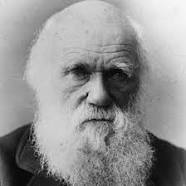
The essence of the author’s augment is that Smith’s, Marx’s, and Darwin’s ideas are seminal beliefs that define the modern world.
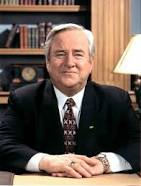
Among others, Montgomery and Chirot profile the ideas of Adam Smith, Karl Marx, Charles Darwin, Alexander Hamilton, Thomas Jefferson, Jerry Falwell, and Sayyid Qutb. Each represents ideas that are part of modern world socioeconomic and religious thought. Smith’s, Marx’s, and Darwin’s ideas largely standalone, but Hamilton, Jefferson, Falwell and Qutb rest on the shoulders of others.
Adam Smith (1723-1790, Scottish economist)
KARL MARX (BORN TRIER, GERMANY 1818-DIED LONDON, ENGLAND 1883)
Marx’s dialectic suggests capitalism is just a phase in an economic cycle that will evolve into communism.
CHARLES DARWIN (1809-1882) FOUNDER OF THE THEORY OF THE ORIGIN OF SPECIES.
Hamilton grasps the importance of centralized control of money and national debt to support mercantilism, and free enterprise. Jefferson tempers Hamilton’s nationalist control with arguments for states’ rights that reflect on concerns raised by Smith, and then Marx, about unregulated economic power.
Jerry Falwell begins the evangelical Moral Majority that decries homosexuality and abortion, and posits belief in salvation only through faith in a Christian God.
SAYYID QUTB (1906-1966, EGYPTIAN AUTHOR,EDUCATOR,ISLAMIC THEORIST,POET,AND LEADING MEMBER OF THE MUSLIM BROTHERHOOD) Qutb (pronounced “kootube), like Falwell and Christianity, believes only in his faith, a Mohammedan God.
Smith’s, Marx’s, and Darwin’s ideas play out in religions and nation-states that deeply influence the modern world.
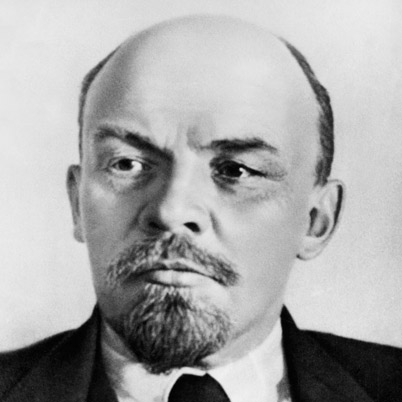
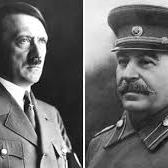
Hamilton, Jefferson, Falwell, Qutb, Lenin, Stalin, Hitler, Mao, and other leaders adopt, adapt, and distort Smith’s, Marx’s, and Darwin’s ideas; figuratively leading humanity to heaven and hell.
What Montgomery and Chirot do is return to original texts of Smith, Marx, and Darwin to show how their ideas penetrate Hamilton’s, Jefferson’s, Falwell’s, and Qutb’s thoughts and actions. As Smith’s ideas are more widely disseminated and read, America’s economic policy changes. The world’s economy evolves.
Falwell and Qutb reflect on unleashed sectarian beliefs consequent to Darwin’s idea of evolution. If there is no God, then what in life is not permitted? Qutb disapproves of Gamal Abdel Nasser’s westernization of Egypt because it violates the Quran and Muslim Arab identity.
Gamal Abdel Nasser 1918-1970 (Egyptian politician, 2nd President of Egypt 1954-1970).
Montgomery and Chirot note that much of the religious right is reactionary. The religious right challenges the socioeconomic belief of Smith’s sectarian vision of the invisible hand. To a Christian, the invisible hand can only be God’s hand. Marx and Darwin’s science only has relevance if it fits God’s plan.
To Qutb, the true path for humankind is through the word of the Koran. The authors question the good works of the evangelical movement when it infringes on human freedom and ignores scientific evidence. On the other hand, the authors note that religion plays an important role in the history of morality. Many question the direction of evangelicals but religions continue to shape morality in good and bad ways.
China’s rapid advance may not be exactly what Marx predicts but it is a kind of capitalist evolution that incorporates some of the tenants of communist centralized control.
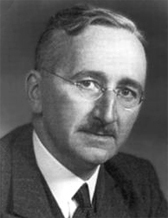
Just as Deng’s and Xi’s interpretation of Marxism distorts communism, Keynes’ and Hayek’s belief in free enterprise distorts Smith’s economics.
Darwin’s view of evolution is morphing into arguments for genetic manipulation to create more perfect human beings. One questions whether this is a step toward Nazism or nirvana.
As Victor Hugo notes, “An invasion of armies can be resisted, but not an idea whose time has come.” Montgomery and Chirot have written an informative and interesting history of “..Big Ideas and How They Made the Modern World”.
In the end, “The Shape of the New” is a tribute to the importance of a liberal education. One may be a genius, but without a liberal education genius is often so narrowly focused, it leads to societal destruction.
ELIZABETH KOLBERT (AUTHOR,AMERICAN JOURNALIST,PROFESSOR AT WILLIAMS COLLEGE)
Homo sapiens are the only species that has the capacity to change events to conform to plan.
Elizabeth Kolbert argues that the fate of life on earth is subject to the randomness of nature’s cataclysmic events and the will of society.
“The Sixth Extinction” recounts the history of five worldwide extinctions. In recounting that history, Kolbert and most scientists suggest there is a pending sixth extinction. The difference between the first five and a presumed sixth is the birth and maturity of humankind.
To some listeners, this story is tiresome. It is tiresome because the future seems so far away. It is tiresome because some think it a hoax. It is tiresome because humans are an adaptive species. It is tiresome because some believe it is God’s plan. It is tiresome because science says extinction is a part of evolutionary science.
TRUMP’S VIEW ON CLIMATE CHANGE:
A fatalist might read Kobert’s book and think it implies a “…Sixth Extinction” is inevitable, regardless of one’s belief. President Trump and other “do-nothings” sing “Be Happy, Don’t Worry”. There is nothing that can be done; so why try?
The truth is– much can be done to abate the consequence of wild fires, hurricanes, and other cataclysmic events.
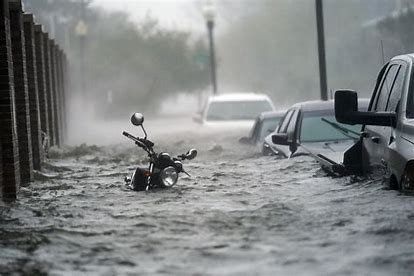
Cities can be hardened against flooding.
Forests can be better managed.
At risk populations can be permanently relocated. It’s a matter of recognition of threat and political will to mitigate environmental consequence.
In spite of, earth’s rising average temperatures, melting icebergs, and seashore flooding, the story of extinction offers no sense of urgency.
Some believe wildlife extinction is a part of the natural order of existence; others, a cataclysm of human-caused events, while coreligionists believe it is a part of “God’s” plan. And finally Kolbert and others believe science will provide a solution for humans to escape extinction.
Kolbert’s book is popular, and is awarded the 2015 Pulitzer Prize for general non-fiction because she writes well and has a point of view that offers hope for the future of humanity. She infers science will provide a plan for humans to escape extinction. On the one hand, Kolbert decries the death of bat species, the acidification of earth’s oceans, and the loss of coral reefs. On the other, she suggests human life prevails because it has shown capacity to change.
The real fear that Kolbert, and many other journalists, scientists, and politicians talk about, is that society will not respond to manmade degradations of earth’s environment soon enough to delay an inevitable “…Sixth Extinction”.
Kolbert infers artificial preservation of endangered species is a fool’s errand in the face of habitat destruction. After all, what is the point of preserving a species in a zoo or in a frozen state of animation if natural habitats are destroyed?
Another way of interpreting Kolbert’s theme is to argue that loss of life’s diversity is a consequence of earth becoming an island of sameness. She calls loss of diversity is an island of sameness because environmental degradation introduces the same bacteria, the same pollutants, and the same adaptive needs to survive.
Biodiversity becomes less possible because of the interconnectedness of continents, consequent to international travel and species introduction to all continents of the world.
One may argue this is the fault of human civilization. That seems wasted intellectualization. The advance of civilization naturally induces loss of biodiversity. But, Kolbert’s theme suggests interconnectedness is only a proximate cause of loss of biodiversity. She argues it does not have to be a cause for a “…Sixth Extinction”.
Kolbert’s argument reminds one of the Serenity Prayer:
“God, grant me the serenity to accept the things I cannot change,
The courage to change the things I can,
And the wisdom to know the difference.”
“The Sixth Extinction” notes that human beings are the only species that shows the capacity to change events to conform to plan.
What humanity needs is the political will to mitigate the causes of human environmental pollution. It is not that a “…Sixth Extinction” will not occur, but human beings need not be the proximate cause.
Wired to Create: Unraveling the Mysteries of the Creative Mind
Written by: Scott Barry Kaufman, Carolyn Gregorie
Narration by: Nick Podehl
CAROLYN GREGORIE (SCIENCE WRITER FOR THE HUFFINGTON POST)
SCOTT BARRY KAUFMAN (AMERICAN PSYCHOLOGIST, AUTHOR, SCIENCE WRITER)
The book “Wired to Create” is an internet sensation. It began as an article in the Huffington Post; written by Carolyn Gregorie. Based on the article, she co-writes a book with psychologist Scott Kaufman. The book is promoted as a loss leader (no charge) to attract customers to Google e-books and other internet savvy vendors. The book’s popularity is in the argument that intelligence is only one characteristic of a creative mind. With IQ as only one characteristic of creativity, the field of human subjects who fit the definition of creative is broadened.
PICASSO’S BULL’S HEAD
Scientists, inventors, artists, sales people, mechanics, technicians, sports stars, and other unnamed categories of people are “Wired to Create”. This is no revelation. It is not unusual to find friends or acquaintances that are able to think in three dimensions, rotate objects in their mind, come up with solutions to complex problems, or create art out of ordinary things. Some of these creative people are great explainers; others are introverted and non-communicative. Some recall events in perfect detail; others only remember broad outlines. Some create art out of nothing; others say nothing about art but build cathedrals.
ST. SERNIN, CATHEDRAL IN TOLOUSE, FRANCE
Kaufman and Gregorie identify some characteristics of creative minds. There is the ability to hold opposing concepts in mind while rendering something never thought of before; i.e. like a work of art that shows planes of a human face from every angle in two dimensions. There is a disruptive quality in a person with a creative mind. That disruption is often seen in school students who cannot sit still, are always talking, and are constantly interrupting class activities. It is the creative teacher who handles the disruption to gain participation of all students, including the disrupter.
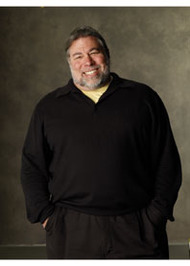
STEVE WOZNIAK
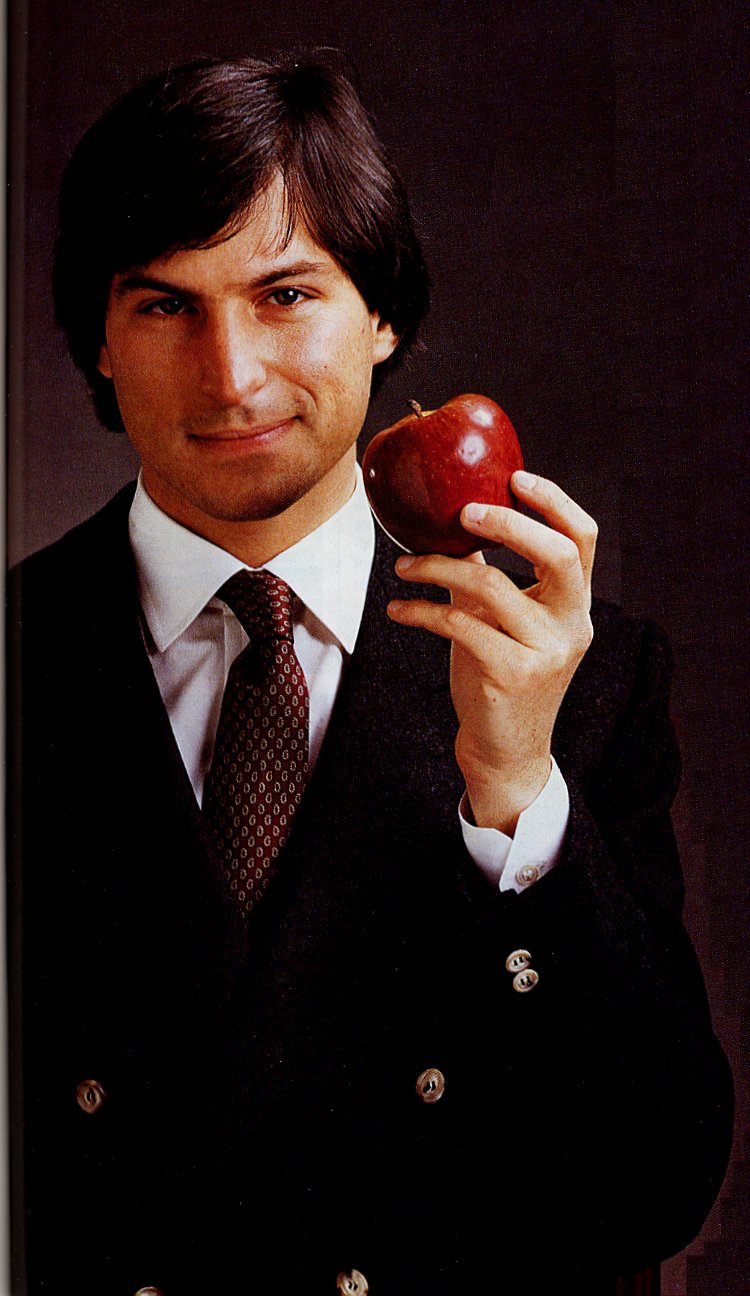
STEVE JOBS (1955-2011)
Kaufman and Gregorie mention famous creative geniuses like Einstein, Edison, Wozniak, and Jobs who exhibit creativity in varied but similar ways. Einstein may rise above the others because of a creative universality but each exhibit a passion and intensity for what they think and do. Edison and Jobs are super salesmen; Wozniak is a tinkerer; Einstein is a conceptualizer. To varying degrees each practices the others’ skills.
“Wired to Create” notes that creativity is not restricted to either introverts or extroverts. Creativity encompasses all sociological categories. Creativity comes from persistence and resilience; driven by passion.
(Competing theories of learning suggest human brain interaction with environment is too complex to measure; i.e. the way the brain reacts when stimulated by the environment is, at best, an evolving mystery.)
THOMAS EDISION (1847-1931, AMERICAN INVENTOR)
The authors note the many failures of creative people; e.g. people like Edison and J. K. Rowling. The authors note that only a handful of Edison’s thousands of patented inventions were successful.
J. K. ROWLING (MOST FAMOUS FOR THE HARRY POTTER SERIES)
Rowling had many publishers turn Harry Potter down until one publisher accepted her work. The tortured personality theory of creativity is addressed by the authors but it is only one of many factors that make people think what they think and do what they do. As noted with Einstein, Edison, Wozniak, Jobs and Rowling not all creative people are aberrantly affected by hyper activity, repeated failure, or intense focus. Kaufman and Gregorie imply some creative people may have tortured personalities but correlation is not causation.
PAUL GAUGUIN (1848-1903, PAINTER, SCULPTOR)
Gauguin is financially unsuccessful as an artist in his lifetime because of the public’s rejection of his work. Gauguin’s paintings are sold for millions today. Kaufman and Gregorie imply creativity is no guarantee of money, success, or happiness. Gauguin’s lack of success may have led to use of drugs but it seems as likely that penury and failed acceptance, rather than misunderstood creativity, is the proximate cause of death. Taking drugs is a malady of the uncreative as well as the creative.
Vincent van Gogh, a contemporary of Gauguin, commits himself to an asylum in which he paints one of his most revered works of art, “The Starry Night”. However, like Gauguin, van Gogh is never financially successful. Gauguin and van Gogh succumb to the stresses of life; not because they are creative but because they are poor and unable to cope with their perceived failure.
VINCENT VAN GOGH (ONE OF MANY RENOWNED SELF PORTRAITS BECAUSE VAN GOGH COULD NOT AFFORD MODELS.)
Kaufman and Gregorie broaden the definition of creativity. However, there seems little revelation in their suggestion that creativity comes from intense interest, average or higher IQs, hard work, and persistence in the face of rejection. Talk of left brain, right brain activity, and frontal lobe brain waves are unconvincing physiological origins of creativity. Play theory seems passé. Competing theories of learning suggest human brain interaction with environment is too complex to measure; i.e. the way the brain reacts when stimulated by the environment is, at best, an evolving mystery. Mysteries of the creative mind remain undiscovered.









 Impey notes that science is exploring alternatives like sail power, nuclear fission, radiation collection systems, and the physics of teleportation, via








 Patterning is the human ability to see structure in disparate facts and events. Some say this is the sign of genius. Einstein is said to have formulated a theory of time by riding a train. Einstein’s insight came from thinking (patterning) how time is relative based on a person riding a train and a stationary observer watching the train pass. However, patterning also leads to incorrect conclusions like a person’s recollection of a crime. Human brains are shown to manufacture events and facts to make stories complete rather than necessarily accurate.






















 In spite of, earth’s rising average temperatures, melting icebergs, and seashore flooding, the story of extinction offers no sense of urgency.







 REVIEWS AND VIEWS OF LIFE