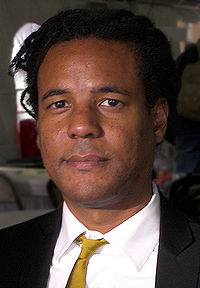
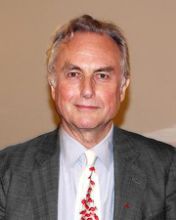
JOSEPTH CONRAD (ENGLISH AUTHOR, 1857-1924)TED KAZYNSKI (UNA-BOMBER, MATHEMATICIAN EDUCATED AT HARVARD AND UNIVERSITY OF MICHIGAN, SERVING LIFE SENTENCE WITHOUT PAROLE)
The uni-bomber, Ted Kaczynski is said to have read The Secret Agent as a coda for his decision to murder and maim innocents. Kaczynski’s craziness and the atrocity of 9/11 are most often referred to in modern reviews of The Secret Agent.
The Secret Agent is about a middle-aged, over weight secret service agent named Adolph Verloc. Verloc lives in England and is a spy for an un-named country. Verloc is called into his employer country’s Embassy to tell him that he is going to be fired unless he provides some actionable service for his pay. Verloc is upset with the news because he is dependent on the income received from the foreign country.
Verloc lives with his wife, mother-in-law, and brother-in-law; none of which know that he is a spy. The brother-in-law is mentally challenged but idolizes Verloc. Despite Verloc’s ownership of a small business, his family depends on his income as a spy. Verloc is a cypher, a character that must mean more than he seems. He seems less than smart. He is selfish. He cares for others but only in proportion to what they can do for him. He has infiltrated an anarchist organization as a principal officer but seems frozen in place. As the story progresses, Conrad never dispels the feeling that this character is too dumb to be a spy.
TED KAZYNSKI (A QUINTESSENTIAL NIHILIST)
The anarchist organization members are made up of nihilistic agents; in particular, a con man named Ossipon and a bomb maker called The Professor. Verloc asks The Professor to make a bomb for him based on a plan suggested by the Embassy that Verloc visited earlier. The plan is to blow up the Greenwich Observatory near London. Verloc chooses to use his mentally challenged brother-in-law to carry the bomb. Once again a reader/listener is confronted with the feeling that Verloc is too dumb to be a spy.
What is to be made of re-publication of and public interest in The Secret Agent? After all, it was published over 100 years ago. Is it a satire that reveals the absurdity of secret service organizations? Is it a primer for terrorist wannabes? Is it a rejection of capitalism? Is it about the vacuity of me-ism (life is all about me)? Does it reveal the secrets of a terrorist’s philosophy? Is it about the aftermath of a terrorist event? It seems the book is partly about all of the above.
U.S. President Donald Trump and Russian President Vladimir Putin shake hands as they hold a joint news conference after their meeting in Helsinki, Finland, July 16, 2018. REUTERS/Leonhard Foeger
It’s relevance today reminds one of the poisoning in 2018 of a defecting Russian spy and his daughter in London. Sergei Skirpal and his daughter are poisoned by a Novichok nerve agent in their home. The bottle in which the Novichok is stored was discarded and picked up by two innocent bystanders who think it is a perfume bottle. Dawn Sturgis, a 45 year old woman, dies in the hospital.
Putin denies ordering the poisoning and suggests the evidence for his denial is that the bunglers who handled the poisoning could not have worked for the Russian spy agency because they are professionals.
The Secret Agent is only marginally interesting because of Horovitch’s narration. However, in light of Putin’s 2018 denial and the murder of Adnan Khashoggi, foreign agent’ bungling is more than an ironic joke.
PRESIDENT TRUMP AND THE CROWN PRINCE OF SAUDI ARABIA (MEETING TO DISCUSS THE MURDER OF ADNAN KHASHOGGI IN 2018)
The story of Colson’s Cora shows how social injustice spreads and how it can only be cured by truth and belief in human equality. Whitehead describes Cora as an abandoned ten-year-old black slave. She is abandoned by her mother who chooses to escape a Georgia slave plantation. Cora’s mother is never recaptured and her legacy haunts her slave master, as well as the daughter she left behind. It is presumed Cora’s mother escapes with the aid of “The Underground Railroad”. Whitehead’s story suggests otherwise.
It seems unreal to believe America treated human beings as property in the ninetieth century.
Colson Whitehead’s story of “The Underground Railroad” shows how ingrained and ugly discrimination is, and how modern belief in ethnic or moral superiority continues to infect America. Another “I can’t breath” murder in Minnesota shows how deep the infection remains.
The existence of “The Underground Railroad” is a euphemistic symbol of a network of abolitionists that secretly aided slaves in escaping their bondage. What Whitehead shows is that “The Underground Railroad” is a “real thing” (a coalition of Americans) created by Americans that abhorred the institution of slavery.
“The Underground Railroad” is a real thing built by Americans that abhorred the institution of slavery.
At the plantation, Cora is left a small patch of ground that was cultivated by her mother. Cora’s protection of that vegetable patch, and what she endures reflect how tough Whitehead makes this extraordinary character. A black overseer builds a dog house on Cora’s plot. She takes a hand axe and destroys it in the face of a man who could crush her with his fist. Whitehead tells a story of Cora being raped by two men as soon as she reaches puberty. The story is told as though it is a “rite of passage” in an environment too evil to comprehend.
Map of the Underground Railroad Routes
If you are a slave, there is no penalty for rape or abuse in the mid-nineteenth century
Whitehead describes some of the laws created on slave plantations. There is no penalty for rape or abuse of a slave whether it comes from owners or fellow slaves. Life’s meaning to a slave owner is what a slave can offer in labor, blind obedience, or monetary value. Slaves are property to be used, abused, or disposed of at the will of their owners.
Whitehead’s depiction of slave life in ninetieth century America is appalling. Cora escapes the Georgia plantation but at the cost of two other slave’s brutal murder. Cora experiences the terror and hope of liberation by being recaptured three times, being victimized by South Carolinian medical practitioners, North Carolinian racists, and Indiana supremacists.
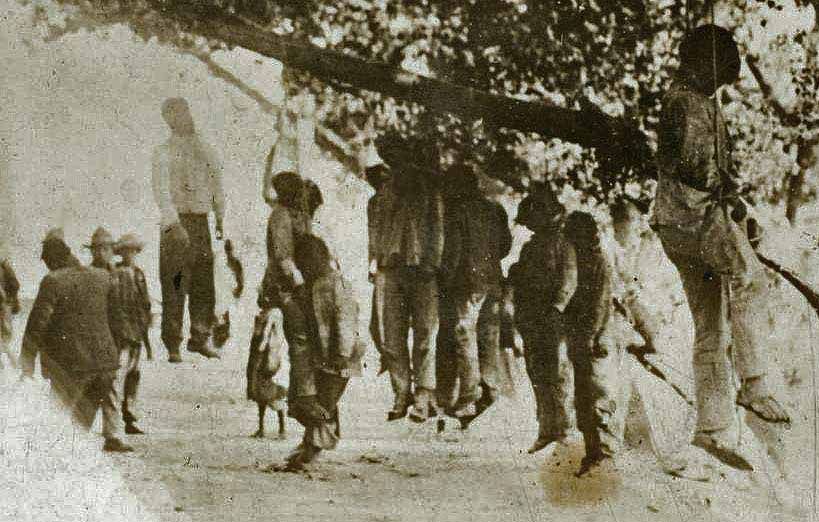
BLACK SLAVES LYNCHED IN AMERICA IN 1882
Whitehead writes of an apocryphally designated “Freedom Trail” in North Carolina where blacks are hung on a byway as a reaction to slave insurrection. (There is a designated “Freedom Trail” in Boston but it represents the American Revolution.) There are credible reports of numerous black slaves hung from trees alongside roads in the south. Great fear among whites is created in the mid-1800’s because of the Turner Rebellion, and John Brown’s raid in Virginia.
BLACK SLAVE OVERSEER
Whitehead also exposes the perfidy of white masters, slave catchers, and black overseers who treat slaves as property and supervise the capture and murder of escaped slaves. Ridgeway is a slave catcher that captures Cora with the help of his obedient and worshiping black companion.
Where is America now? Have 242 years of history changed America’s penchant for overt and covert violence against those who appear different? South Carolina’s Charlottesville’ KKK rally and George Floyd’s murder suggests not.
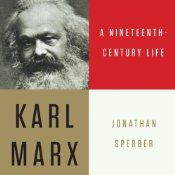
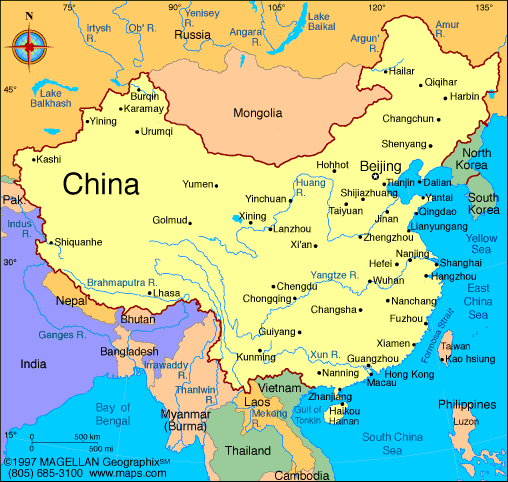
Having just returned from China (more about the trip in a future blog), it seems apropos to revisit Jonathan Sperber’s biography of Karl Marx. In many respects, China’s resurgence as a major economic power suggests Marx may have outlined an economic system with some strengths, but communism and China’s form of communism have catastrophic weaknesses.
Johnathan Sperber has gathered an impressive amount of data in his history of Karl Marx’s life. Sadly, his presentation is not equal to his collection. Unlike biographies done by Robert Caro (who wrote “The Power Broker” about Robert Moses, the land planner of New York, and former President, Lyndon Johnson) or William Manchester (a Winston Churchill Biographer), Sperber fails to bring his subject to life.
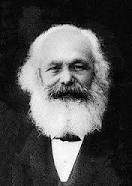
KARL MARX (BORN TRIER, GERMANY 1818-DIED LONDON, ENGLAND 1883)
Marx is considered by some to be one of the three most influential economists that ever lived (Adam Smith and John Maynard Keynes being the other two.) That high praise is not forcefully presented in Sperber’s biography. Sperber offers facts but leaves coherence to the reader.
Marx means something to the 21st century. Some might argue America is reaching a point in the history of capitalism that is foretold by Marx’s theory of socialist economics. As Sperber notes, Marx believed capitalism was a step in the economic evolution of the world, leading to a governmental revolution. Marx believed capitalism would reach a nadir of conflict between haves and have-nots because of social inequity inherent in capitalist economies.
As Sperber notes, Marx lived through and wrote about social conflict created by feudalism and capitalism in the mid-nineteenth century. Marx is raised in Prussia, ruled by a Czar in a feudal economic system. He witnesses growing discontent of feudalistic working-class Russia.
Marx created a theory of economic evolution showing feudalism, capitalism, socialism, and communism as progressive improvements in the lives of all people.
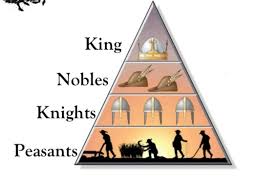
Feudalism grew out of the rule of Kings and Czars with a small aristocracy receiving privileges of wealth and property with the bulk of human civilization indentured to the privileged class.
As the indentured, under-privileged population grew, discontent led to revolution.
In 1776, America broke with English aristocracy to form a “checks and balances” democracy; in 1789, the French population broke with absolute monarchy to form a populist democracy; in 1848, German states rebelled against the aristocratic Prussian confederation of thirty-nine states ruled by an aristocracy and chose various forms of government to establish their own nationalist identities.
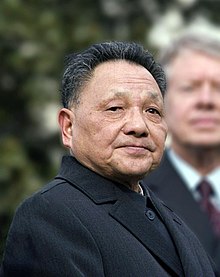
DENG XIAOPING (CHINA’S CHAIRMAN OF THE CENTRAL ADVISORY COMMISSION 1982-1987,) In 1980 Deng Xioping, though maybe not in a revolutionary sense, changed the direction of communism in China.
Each Chinese change in governance led to more liberal, slightly more democratic, and capitalist economies.
Hong Kong is presently in the throes of resistance to China’s encroachment on their semi-autonomous existence. Hong Kongers’ discontent could be seen in traveling to Hong Kong months before today’s demonstrations.
As nations prospered during the industrial revolution, more mercantile economies formed. Aristocracy became broadly defined by wealth rather than inheritance. Parliaments and congresses were created to represent wider population interests.
However, Sperber explains Marx believed that the greatest part of nation-state citizens remained in poor economic condition; even when based on mercantilism. Marx, looked at the economic condition of the world, and noted that transition from feudalism to mercantilism only marginally improved living conditions for the majority of state citizens and, in fact, actually worsened the condition of the young and impoverished who worked long hours for little pay. To Marx, capitalism just exacerbates the mercantile economic condition of the poor.
CHINA IS MOVING 250 MILLION PEOPLE INTO CITIES ACCORDING TO THE NEW YORK TIMES (Housing is un-affordable for a large percentage of new city dwellers. The government of China subsidizes housing for many Chinese that come from rural areas.)
In 2018, it seems China may be reaching a capitalist tipping point where low wages do not cover the cost of living. Though many Chinese have moved from rural areas, wages remain low in comparison to the cost of living. Housing and health coverage is un-affordable for a large percentage of new city dwellers. The government of China subsidizes housing for many Chinese that come from rural areas to mitigate the plight of the poor.
ADAM SMITH (1723-1790, AUTHOR OF -THE WEALTH OF NATIONS) Marx developed the labor theory of value to suggest that classical economic theory suggested by Adam Smith leaves too many people in the gutter.
Marx felt Smith did not properly quantify the value of labor. Marx argued that capital was created to benefit owners at an unfair expense to labor.
Marx believed capitalist aristocracy continued to victimize the working class, trading one form of indenture for another. Marx suggested democracy was an evolution for economies that widened the benefited population but still left most workers underpaid, undernourished, and disadvantaged.
Sperber clearly points out that Marx did not believe that communal ownership of property redressed the inequities of state’ economies; i.e. Marx argued that inequity is caused by capital creation that only benefited ownership and undervalued labor that created capital.
China’s current experience seems to show Marx may have been right to believe communal ownership has little to do with state’ economics because communal ownership remains a dominant factor in China’s extraordinary economic resurgence. Property is not owned by individuals in China. Land is either owned by a collective or by the State.
Though land cannot be owned by Chinese citizens, distribution of capital has been widely increased through rising prices of high-rise condominiums. Many high-rise condominiums are owned by individual Chinese. Some citizens inherited or bought condominiums at such low prices–appreciation made them rich.
The fly in the ointment of their newfound wealth is the price of sale must be agreed upon by the government which creates an artificial bubble that may burst into hyper-inflation, with the potential for a nation-wide economic collapse.
China moves to address a potential economic collapse in an inventive and creative way. What China is doing--is trying to widen their market for goods with an economic growth plan called "Belt and Road". China invests billions of dollars in other countries infrastructure. China is betting that these improvements will create consumers for Chinese manufactured products. A side benefit is that these infrastructure improvements offer employment to Chinese citizens and businesses. (As can be read in news magazines like the Economist and papers like the Wall Street Journal and New York Times, some nations resent China's investments in their countries for various nationalist and economic reasons.)
China is also investing in the world's natural resources to expand their manufacturing capability. The question is whether these long-term investments will pay off in time to stabilize China's construction market. The construction market is where individual Chinese citizens carry their wealth. Condominium prices will reach a limit. In 2018, a 300 square foot condominium sells for over $500,000 in China's larger mainland cities. That is nearing $2,000 per square foot (and Chinese buyers do not own the land). In the United States, most housing is less than $200 per square foot; including the land. Continued wealth distribution in China depends on the success of the "Belt and Road" program.
Marx supported worker unionization’s effort to equalize benefit through a more equitable distribution of capital. He was deeply involved in the “International Workingmen’s Association” (aka First International). Herein lays the evolution of capitalism to socialism and Marx’s belief (and maybe Xi’s belief) in the fairness of economic communism. Modern China seems to be addressing the idea of a more equitable distribution of capital on paper, but the paper is based on what appears to be an unsustainable real estate market.
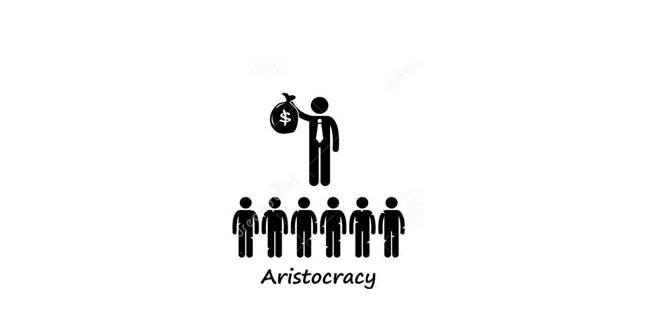
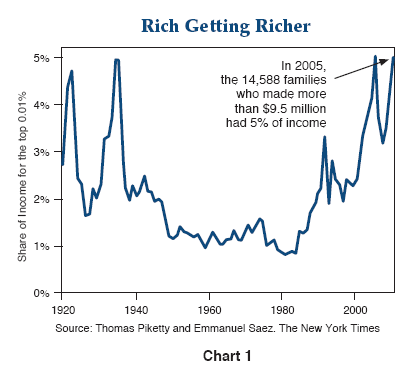
Piketty argues that the income gap widens once again, after World War II. He estimates 60% of 2010’s wealth is held by less than 1% of the population; with a lean toward the historical 90% threshold. Moneyed interests have become the new aristocracy, as repressive and privileged as the Kings and Czars of the mid-19th century.
One can disagree with Marxian theory but the widening gap between haves and have-nots (the 1% and 99%,) is a real-world concern in the 21st century.
Marx’s solution for economic inequity is flawed but the condition he describes in the evolution of economies seems prescient. To most Americans, Marx’s communism is not the answer.
When CEOs of companies are making over 200 times average laborers’ income, there is a glaring problem in the current condition of capitalist economies. Instead of income differences, it is housing value in China. China is on a razor’s edge that may as easily cut their throat as shave their face.
This is a disappointing book because it garners too little interest in the power and influence of Marx’s economic theories. However, it offers insight to what Marx may have had right (the importance of distribution of wealth) and what he had wrong (communal productivity). China is using a different vehicle than America for distribution of wealth but the principle of wealth-distribution addresses what ails all forms of government.
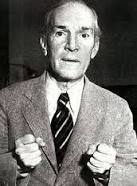
UPTON SINCLAIR, JR. (1878-1968, WINNER OF THE PULITZER PRIZE FOR FICTION)
It seems appropriate to revisit Sinclair’s book in light of the current administration in Washington D.C.
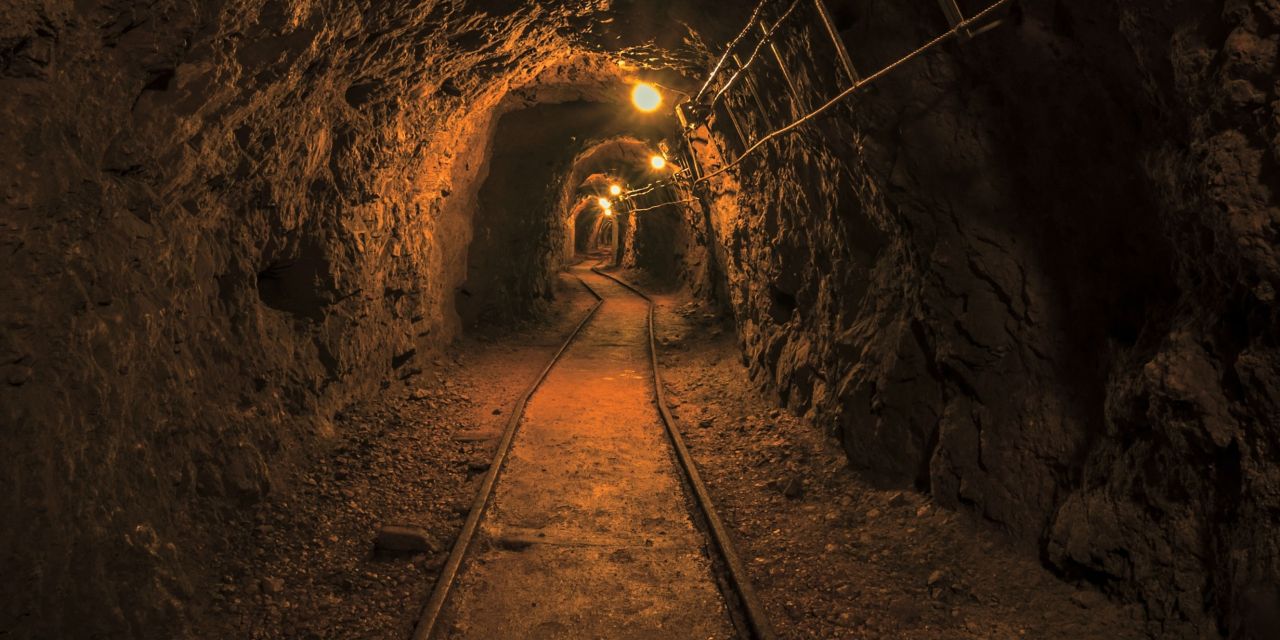
In the era of Trump, it is not meat packing but the coal industry that needs help. Trump’s pandering to the American coal miner offers air without oxygen to an industry that is dying.
Private industry and the American government need to step in and offer a way out for coal industry’ laborers. The Trump administration undervalues American labor by presuming laborers can only be cogs in a machine rather than complete human beings.
Instead of insisting on continuing an industry destined to fail, private industry and government should be offering living-wage transition, and education for new jobs; i.e. jobs that look to a future rather than a past.
Sinclair exposes the dark side of poverty and immigration in the United States. It reminds one of Charles Dickens’ stories of child labor in London but does not offer much warmth or balance. Sinclair’s story offers no respite from utter degradation. There is no respite for the reader to believe there is any redemption for being poor in Chicago in the early 1900s.
“The Jungle” is a grim tale written by Upton Sinclair about the meat-packing industry in early 20th century America.
Lessons of “The Jungle” are reminders of the limits of unregulated capitalism, industry’ greed, and government neglect. Sinclair attacks the meat-packing industry of the 1900’s.
Descriptions are given of spoiled meat ground into sausages; loaded with chemicals for appearance and smell, with too much production to be adequately inspected by too few inspectors. Employees lose limbs and lives in accidents; with corporate lawyers preparing to swindle the uneducated with unfair financial settlements. Wages are too low to offer enough money for shelter and food; let alone any savings, to break the cycle of poverty. Promotion is limited to those who are willing to compromise their morality by feeding a corrupt system that thrives on human exploitation.
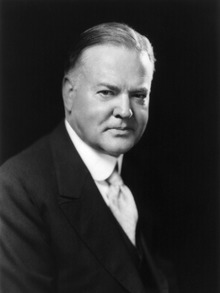
Herbert Hoover is the 31st President of the U. S. when the meat packing industry is at its worst. Like Herbert Hoover, Trump seems to think the strong survive and the poor deserve their fate.
To some, this is the same as today’s stories of the coal industry.
Don Blankenship (Former CEO of the 6th largest coal company in the U.S., Massey Energy)
Convicted on a misdemeanor charge of conspiring to willfully violate mine safety and health standards in 2015. Sentenced to 1 year in prison and fined $250,000.
Images of poverty and what it leads to are still seen in American cities; i.e. people living on the street, begging for a dollar to eat; some drinking the dollar away at a local tavern because it blunts the pain of being poor and offers a haven from a cold winter day. Young people, some children, turning tricks to survive; selling their body because low paying jobs of high volume/low price conglomerates do not pay enough for rent and food.
Hearing of the meat industry–its lax government oversight, greedy corporate owners, and corrupt politicians deeply offends American ideals. Grinding poverty changes a family of ambitious immigrants into cogs in a meat butchering machine that breaks spirits and turns good people into bums and latent criminals.
In Dickens novels, there are some remnants of human joy; even in impoverished London. In Sinclair, the only glimmer of light is small-scale concern for fellow human beings. The early days of the union movement offer some hope. However, even Sinclair’s positive sentiments are corrupted by politics. Sinclair idealizes socialism and touches on early communism.
America still offers the best known vehicle for freedom in a regulated democracy.
Since 1789, America’s relationship to immigrants has been a work in progress.
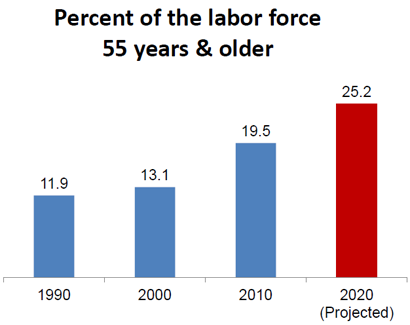
The United States has a growing need for younger workers; not to the extent of countries like Japan, but after 2020 it is increasingly important.
America needs more youth to re-balance its economic growth.
The influx of immigrants generated much of America’s success in the industrial age. Immigrants offer the same opportunity for America in the tech age.
To some immigrants, the avenue out of poverty is crime and immorality, but that has always been true in America’s history. That is why American democracy is founded on rule-of-law. Human nature does not change.
The life cycle for an honest immigrant is grim; arriving poor; staying poor, and dying. American Presidents who only focus on the business of business fail to understand or care about the trials of the poor, the newly arrived immigrant, or the social condition of impoverished communities.
Every country in the world benefits and suffers from the nature of man and the effects of urbanization; none offer Eden. America remains a land of opportunity, but to close our doors to those who want to improve their lives with freedom and honest work is an unconscionable mistake. Demographics are destiny. America’s and many post-industrial economy’s populations need help.
Modern America is not quite so dark but inequality of opportunity still plagues capitalism with wealth, greed, and political corruption hiding the dire condition of the poor.
As long as the poor remain hidden; the rich and middle class will avert their eyes, mutter “get a job”, and think the poor get what they deserve.
America is Constitutionally responsible for the welfare of its citizens.
Those who think the business of government is only business are incorrect. Business is a tool to use in forming a more perfect union; governing with justice, supporting domestic tranquility, providing for a common defense, and promoting the general welfare.
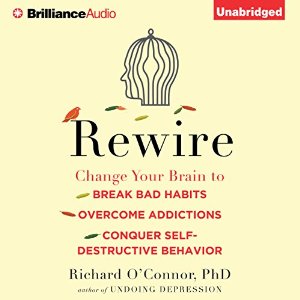
Rewire: Change Your Brain to Break Bad Habits, Overcome Addictions, Conquer Self-destructive Behavior
Written by: Richard O’Connor, PhD
Narrated by: Fred Stella
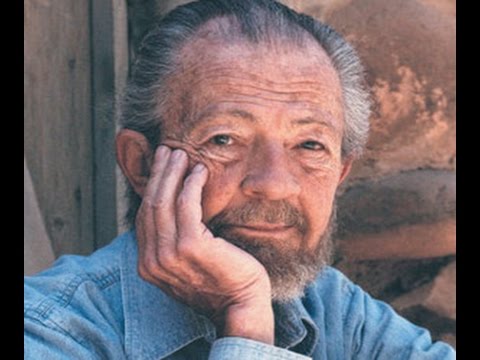
DR. RICHARD O’CONNOR (AUTHOR, CLINICAL THERAPIST)
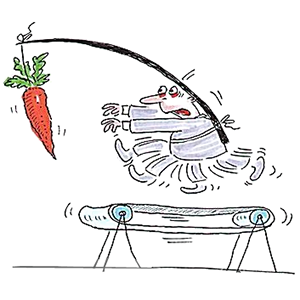
In 1971, Brickman and Campbell coined the term Hedonic Treadmill to explain that people have a baseline level of happiness, regardless of what occurs in their lives. That definition infers winning the lottery, or being diagnosed with cancer have opposite happiness quotients–one joyfully positive; the other horrendously negative. The Hedonic Treadmill theory suggests happiness will return to a baseline level of individual happiness when the initial joy or sorrow subsides.
Toward the end of Richard O’Connor’s book, “Rewire”, the term Hedonic Treadmill is used to infer that America’s materialist predilection is like a psychological cul-de-sac; i.e. a mental trap with only one exit. O’Connor explains, in a different way, that the cul-de-sac is created by life experience that imprints memories that become automatic responses to current events.
O’Connor argues that rational behavior is unconsciously modified by subconscious imprinting from early life experience. The only exit from the cul-de-sac is to leave the way you came, recall how and why you entered, and teach your brain not to take that turn again. This reminds one of David Hawkins expressed belief in “Letting Go”.
More fundamentally, O’Connor infers American society is more materialistic today; and, as a consequence, Americans are more mentally unbalanced than in the past because happiness from material acquisition is a road to nowhere, a Hedonic Treadmill.
O’Connor argues that Americans are more mentally unbalanced than in the past because happiness from material acquisition is a road to nowhere, a Hedonic Treadmill.
Rewire offers a great deal of information about causes and cures for individual mental dysfunction in America. A reader or listener may disagree with O’Connor’s causal analysis but his examples of psychological dysfunction can be seen in one’s self and in others. What makes “Rewire” interesting is O’Connor’s suggested cures, based on thirty years of experience as a therapist.
What makes “Rewire” interesting is O’Connor’s suggested cures, based on thirty years of experience as a therapist. O’Connor endorses the belief that the brain’s functions can be rewired at any age with repetitive practice.
O’Connor endorses the belief that the brain’s functions can be rewired at any age with repetitive practice. As an example, he explains the utility of the 12 step program designed by Alcoholics Anonymous for addicts to avoid being trapped in a mental cul-de-sac. The AA steps are 1) Admit powerlessness, 2) find hope, 3) surrender, 4) take inventory, 5) share your inventory, 6) become ready, 7) ask God, 8) make a list of amends, 9) make amends, 10) continue your inventory, 11) pray and meditate, and finally, 12) help others.
Though AA presumably requires a Supreme Being in their 12 step process, the point of the treatment is to train one’s mind to act differently when confronted with influences that make a person turn into a cul-de-sac rather than back to an individuated baseline happiness.
Though AA presumably requires a Supreme Being in their 12 step process, the point of the treatment is to train one’s mind to act differently when confronted with influences that make a person turn into a cul-de-sac rather than back to an individuated baseline happiness.
O’Connor suggests drugs are sometimes used incorrectly and become part of the patient’s problem.
O’Connor suggests drugs may be used to treat mental illnesses like depression for immediate results but that underlying causes need to be revealed to change longer-term aberrant psychological behavior.
O’Connor notes that drugs are sometimes used incorrectly and become part of the patient’s problem. With knowledge of triggering events for depression or addiction, behavior can be retrained to make the mind react differently.
O’Connor cautions the reader/listener to understand that negative triggers may be ingrained over years and will not disappear without repetitive behavioral training that avoids or consciously assesses negative emotional triggers. The key to success is enough behavioral repetition to make curative responses to triggers for depression, or aberrant behavior, automatic.
O’Connor argues the key to success in rewiring the brain is enough behavioral repetition to make curative responses to triggers for depression, or aberrant behavior, automatic.
O’Connor offers several mental exercises to change how the mind works. Rewire is an insightful book but one wonders if O’Connor is not on the Hedonic Treadmill he criticizes. After all, one presumes the book is only selling to people who can afford it, and read it. Rewire seems unlikely to help all who are on the real American treadmill–those who cannot afford the book, pay a therapist, or practice its contemplative methodology.
Half the Sky: Turning Oppression into Opportunity for Women Worldwide
Written by: Nicholas D. Kristof and Sheryl WuDunn
Narration by: Cassandra Campbell
SHERYL WuDUNN (AMERICAN BUSINESS EXECUTIVE,WRITER,LECTURER,AND PULITZER PRIZE WINNER)
NICHOLAS KRISTOF (AMERICAN JOURNALIST, WINNER OF TWO PULITZER PRIZES)
In “Half the Sky”, Nicholas Kristof and Sheryl WuDunn document endemic misogyny. They report the contempt of men, and prejudice of society toward women. Their assessment of guilt is not limited to gender. Misogyny is argued to have been originated by men, but the author’s stories offer evidence of a level of perpetuation by women.
One might note evidence of women’s tacit acceptance of misogyny with their continued support of Trump despite his boorish treatment and crude comments about women in the Billy Bush’ interview. And, of course, there is the momentous Supreme Court decision regarding women’s equal rights and Roe V. Wade.
Traveling from North American to Europe; to Asia, to the Middle East, to Africa, to South America, Kristof and WuDunn report incidents of girls’ enslavement, the beating of wives and mothers, and societies’ neglect of women in nearly all continents of the world. (Continents missed are undoubtedly participants, but not included.)
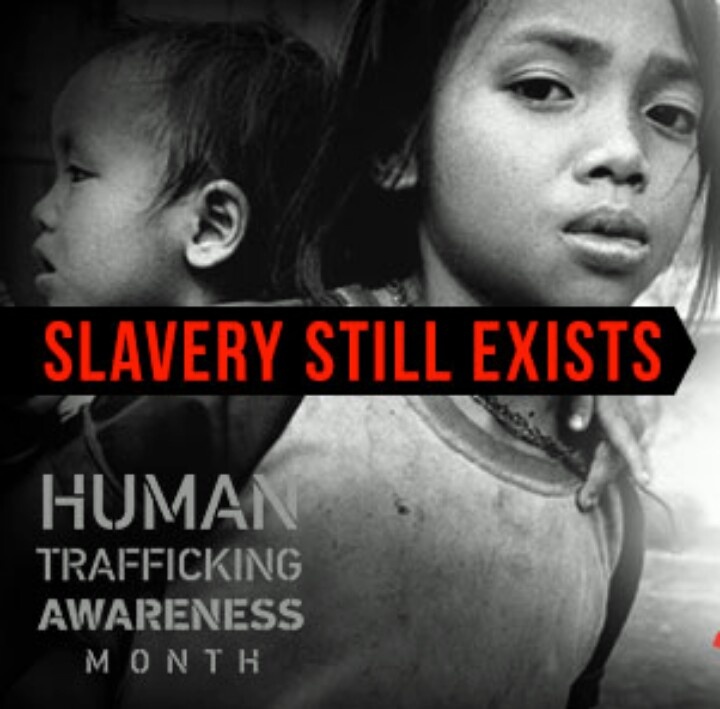
“Half the Sky” is filled with interviews of brothel women in Asia, the Middle East, and Africa. The authors recount young girls’ seduction, abduction, or purchase from families around the world.
Different societies discount the humanity of women. Young girls are so desperate to survive; they believe stories about jobs in other countries and accept human traffickers’ lies. They blindly follow traffickers and leave their families.
In some cases, families are so poor they sell their girl-children for family survival. Prostitution and pornography are growth industries that perpetuate societal misogyny.
Kristof’s and WuDunn’s story is not an academic’s polemic about the original source of misogyny. It is reporters’ descriptions of today’s world of 13-year-old, and younger, girls that are sold, raped, and re-sold into slavery. The authors recount the social stigma of a woman being born in a world dominated by men.
FEMALE SLAVES CALLED COMFORT WOMEN DURING WWII
Male domination corrupts society to reinforce belief that women are property; not human beings, and not “Half the Sky”.
Though women are kidnapped and sold by men into slavery and prostitution, many houses of prostitution are run or owned by women. Though men (most often) make and control income in families, women are more likely to use income for food and shelter while men are more likely to waste income on liquor and prostitutes.
There are a host of ironies in Kristof’s and WuDunn’s observations.
MAO ZEDONG (1893-1976, Ironically, Mao Zedong is estimated to have caused the starvation of 30 to 40 million people between 1959 and 1961, but Mao wrote that women are “Half the Sky” and should be treated as equals.
Sweat shops in Asia are factories of enslavement (see “Factory Girls” review) but offer women their first opportunity to break the cycle of poverty and dependence in China.
Some cultures in Asia, the Middle East, and Africa genitally mutilate females to insure chastity until marriage. Kristof and WuDunn detail the cultural difficulty in eliminating the barbaric practice of removing female genitalia. The rates of female genital mutilation rise as high as 90% in some cultures.
FEMALE GENITAL CUTTING IN MODERN TIMES (The rates of female genital mutilation rise as high as 90% in some cultures.)
There are glimmers of light that infer change in “Half the Sky” but there is very little bright sunshine. Kristof and WuDunn argue that education is the key. They report on successes of men and women fighting for gender equalization and elimination of women’s enslavement and debasement. They write of the much-touted microloan market initiated in South Asia to lend small amounts of money, without collateral, for people wanting to start a business. The authors note several stories of women that took microloans, of as little as $3, and changed their relationship with husbands. Husbands begin to realize women are more than objects of sexual gratification and baby’ producers, i.e., they are equally capable human beings.
Iran’s and Afghanistan’s misogynist views demand veiling of women and deny equal rights. Cultures that continue to discriminate against women deny “Half the Sky” of the equal contribution they make to society.
Two hundred thousand years of gender discrimination is unlikely to be reversed in this century. Kristof and WuDunn infer that each step individuals take to fight misogyny makes a difference.
Progress will be slow because men are still mostly in control and more often think “it is a relief not to be a woman”, rather than how much more a woman can be. By the end of Kristof’s and WuDunn’s book, guilt is not assuaged and equality seems years, if not centuries, away.
AUTHOR–David R. Hawkins died in 2012. He was 85 years old.
David R. Hawkins died in 2012. He was 85 years old. At turns, Hawkins transitioned from agnosticism to atheism to belief in God. This progression seems correlated with education and experience but ends in philosophical belief. In each transition, Hawkins uses his intellect to form a philosophy that has appeal to many in search of life’s meaning.
At times, Hawkins seems beyond reason but each step he takes offers insight to how one may live a more fulfilling life. Hawkins might be broadly characterized as a mystic. Even so, he was a formally educated, practicing physician, and psychiatrist.
Mysticism lies in Hawkins belief in human dualism, a belief dating back to Plato and adopted by many later philosophers.
Hawkins dualism is belief in a distinct separation between mind and body. More precisely for Hawkins, it is a separation between mind and brain.
The power of this cosmic mind can cure all the maladies of humankind, both physical and mental. Hawkins implies this cosmic mind can cure physical disease manifested in the body. If you cannot see; if you cannot hear; if you cannot feel, your condition can be cured by a force of will that engages the cosmic mind.
Hawkins becomes a mystic when he posits belief in a cosmic mind shared by all humanity.
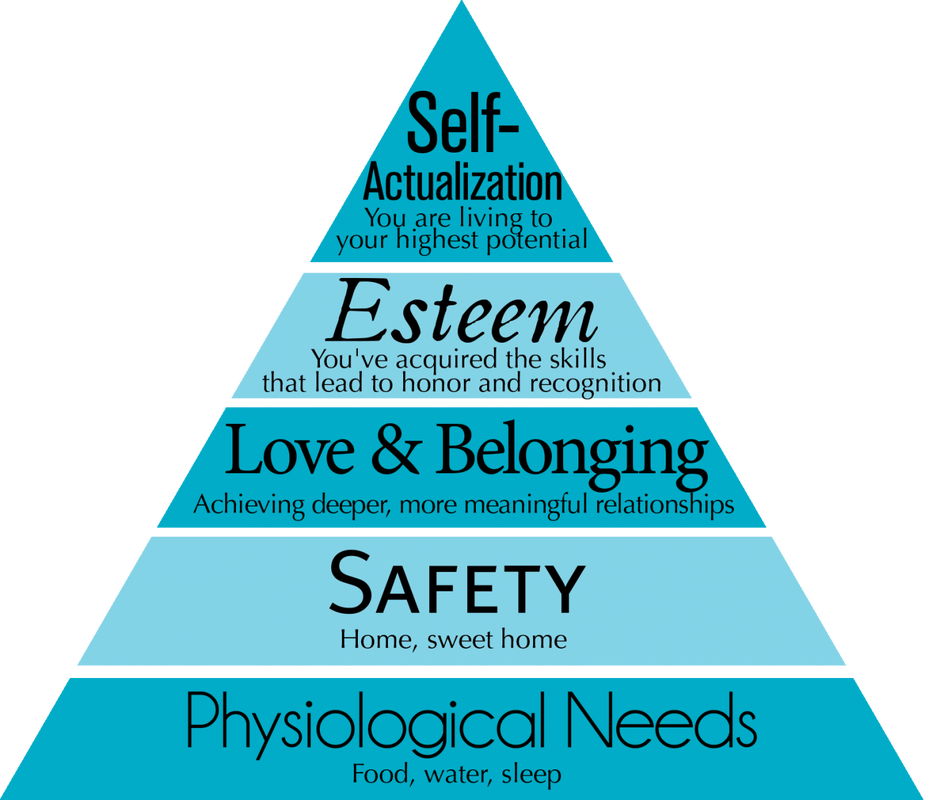
This is a point at which Hawkins loses some believers. However, before one gets to a point of rejection, Hawkins offers wise counsel on how to live life and approach a level of what Abraham Maslow labeled self-actualization.
Abraham Maslow’s self-actualization.
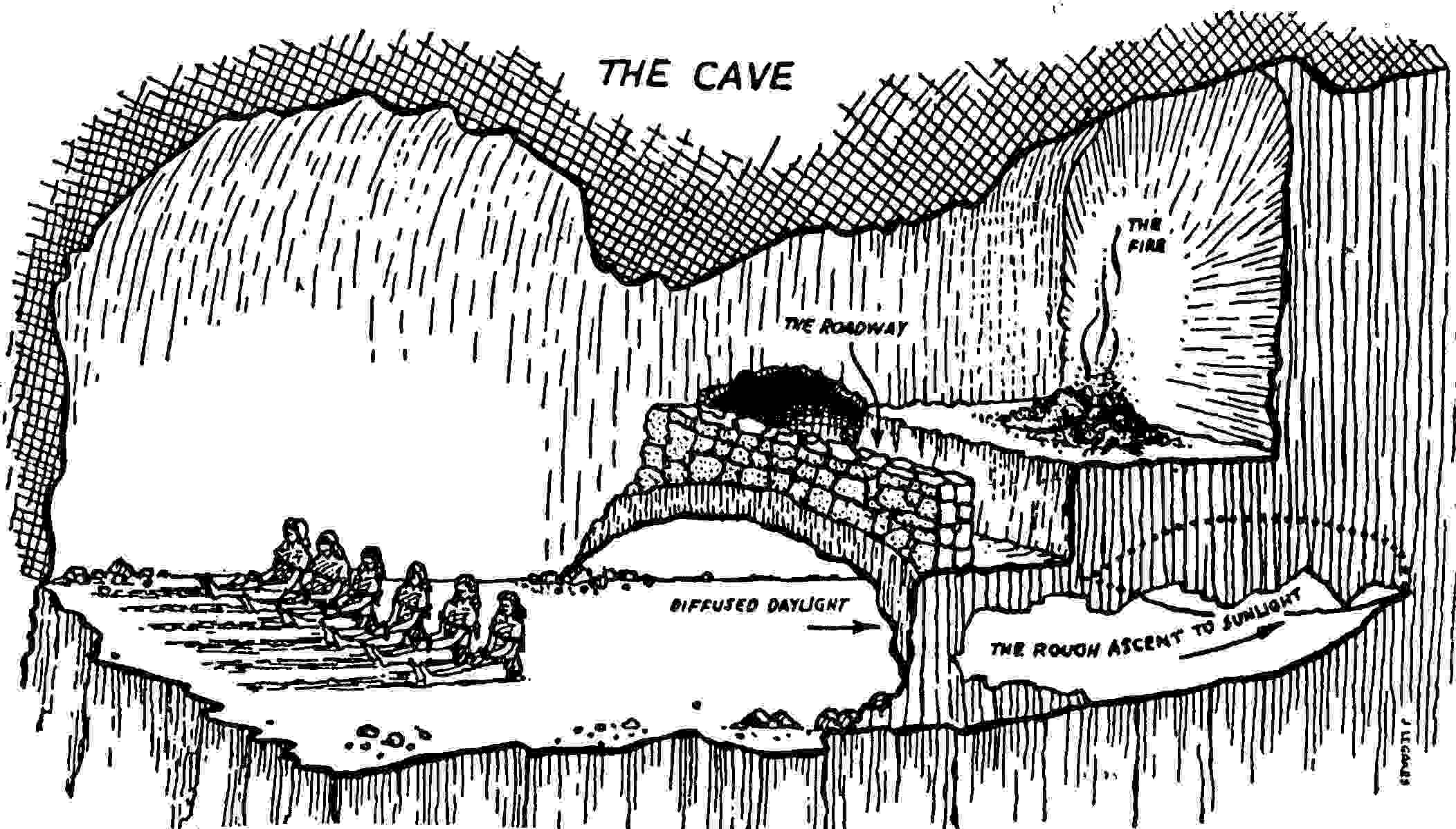
The mind gets trapped in Plato’s cave and only sees shadows of reality. Reality is obscured by what the human mind tells them. The mind’s interpretation of life’s events distorts reality. A child remembers a father’s or mother’s rebuke as an eternal judgement when the reality may have been to protect a child from harm. The shadow is created and remains with the child for the rest of his/her life.
PLATO’S CAVE (Hawkins argues that everything that happens in one’s life is because of the mind’s interpretation of the world.)
To escape the trap of Plato’s cave, Hawkins explains one must use their senses to accept the mind’s perception of reality and continually let it go until its negative power disappears.
An example would be one who gets angry over some event or action and accepts the anger; looks at it, accepts it, uses the mind to understand why there is anger, where it is coming from, and then letting it go. In the process, one finds anger has no meaning other than what one’s mind gave it.
With continual use of this process, Hawkins believes individual minds tap into a cosmic mind that shows the world as it really is; not simply as shadows on a cave wall.
There is wisdom in Hawkins’ perception of life and how one can more constructively deal with its vicissitudes. In this time of Covid 19, “Letting Go” is wise counsel for those troubled by emotional and/or physical trauma. However, the principle of a cosmic mind takes a leap of faith.
This Changes Everything: Capitalism vs. the Climate
Written by: Naomi Klein
Narration by: Ellen Archer
NAOMI KLEIN (CANADIAN AUTHOR, SOCIAL ACTIVIST, FILMAKER)
A change of book titles comes to mind in reviewing Naomi Klein’s book, “This Changes Everything”. A first thought is a title like “Beat the Drum.” On second thought, it is the question “Who Gets to Decide?” Ninety seven percent of “…actively publishing climate scientists” say climate warming trends are likely due to human activity.
Deniers think current weather phenomena are a natural aberration that will be corrected by time. Others are apathetically fatalistic and call global warming a myth. But almost universally, science is saying climate warming is real.
Deniers think current weather phenomena are a natural aberration that will be corrected by time. But almost universally, science is saying climate warming is real.
A “Beat the Drum” title is meant to convey appreciation of Naomi Klein’s studied effort to awaken the general public to the truth of global warming. (She is not a scientist but a writer, researcher, and social activist.) However, the title “Who Gets to Decide?” is meant to convey a monumental weakness in Klein’s spun presentation on solutions for the problems of global warming.
Klein’s argument that global warming is a consequence of capitalism is false. Global warming is a consequence of human nature.
Klein’s argument that global warming is a consequence of capitalism is false. Global warming is a consequence of human nature. To date, democratic capitalism is the only economic form of government that offers a degree of freedom for all Peoples subject to rule of law. Democratic capitalism unleashes the power of human nature, both good and bad. Until some better form of governance is created, the best chance for a global warming solution is captialism. History shows freedom, subject to rule of law, is essential to a deliberative process that will provide best-case solutions to seemingly unsolvable problems.
Capitalism is not the proximate cause of global warming. It is the failure of the E.P.A., the President, and congressional legislators to do their job.
Global warming solutions lie in politics and science; not one or the other, but both.
Global warming solutions lie in politics and science; not one or the other, but both.
Einstein and fellow scientists prove that energy and mass are always equal. That scientific proof leads to Nagasaki and Hiroshima’s atom bombs just as 97% of the scientific community’s proof leads to earth’s climate bomb.
Great Britain, France, Russia, and Germany were worn down by WWII. American democratic capitalism makes the decision to end the war by using the atomic bomb. One may argue that this decision is morally reprehensible but it ended a war that would have continued without definitive action based on the deliberative process of a democratic capitalist country. The same may be said for a pragmatic solution for global warming.
The world is suffering from a global warming war. Eventually, that suffering will create a political consensus for something to be done to combat its consequence. Evidence of something being done is everywhere. By beating the drum Klein is creating sense of urgency about global warming. What is misleading and spun by Klein is discounting of rich entrepreneurs, like Gates, Bloomberg, Branson, and Buffett, who are taking self-interested steps to curb global warming. Yes, they are self-interested steps but self-interest is not inherently bad. Self-interest is in the fight to abate global warming.
Klein suggests that Branson expands his airline to make more money at the cost of further pollution.
Klein suggests Branson expands his airline to make more money at the cost of further pollution. (In truth Branson did sell his airline in 2016.) Branson is a pariah to Klein because of his self-interest in vertically integrating research for alternative fuels for plane travel.
Klein explains Branson is only spending two to four hundred million dollars for research on alternate fuels while having pledged three billion dollars over ten years. One wonders, how many rich have spent one million dollars, let alone two to four hundred, on alternate fuels. Klein infers Branson is all show and no go by reaping publicity benefit while raping the global environment. Whatever Branson’s motive may be, two to four hundred million dollars for a less polluting fuel is better than doing nothing.
Klein vilifies Buffett for buying railroads because they are transporting coal. Klein offers no suggestion that railroads are a more energy-efficient than some other forms of material transportation. Klein infers Buffett made the railroad investment out of self-interest. He probably did but that is not proof of a lack of concern about global warming. Klein infers Buffett’s investment decisions should be dictated by whom? Who gets to decide?
Klein vilifies Buffett for buying railroads because they are transporting coal. Klein offers no suggestion that railroads are a more energy-efficient than some other forms of material transportation.
Because people like Klein are beating the drum, the largest coal producer in the world has lost 95 percent of its stock value. The investing public finds that the industry misleads investors on its liability as a climate polluter. This is democratic capitalism in action.
Self-interest, good and bad, is the nature of human beings. Klein and others need to continue to “Beat the Drum” but decisions on what is to be done will be from a political consensus and action from leaders of the world and the scientific community. It is not what Klein says so much as how she says it. Money, power, and prestige are human nature’s motivations. It will be a matter of competing self-interests that reach a consensus on the preservation of life.
Klein and others should continue to raise awareness and sense of urgency, but it is self-delusion to think human nature will change within the time frame of this world’s declining environment.
In a free society, all realize they have “skin in the game”. Those governments that validate individual freedom offer the best hope for a global warming solution. The answer to the question of “Who gets to decide?” is best left in the hands of nation-states that validate individual freedom. America is one that holds the hope for a solution to global warming, in spite of its democratic capitalist leaning and today’s inept Executive and Legislative branch leadership.
Robert Wright is saying human beings are only replicating machines; without God; without free will, and dependent upon the arbitrariness of natural selection.
The Moral Animal: Why We Are the Way We Are: The New Science of Evolutionary Psychology
By: Robert Wright
Narrated by Greg Thornton
ROBERT WRIGHT (AUTHOR, JOURNALIST)
Robert Wright emboldens Darwin’s theory of evolution in “The Moral Animal”. Wright argues that Darwin infers evolution is biological, an all-inclusive generative theory. Not only is humankind evolving physically through natural selection, it is evolving psychologically.
Wright suggests every human action in life is determined by evolution.
The import of that conclusion is that all life is pre-determined at birth by evolution. Humans, like all others in the animal kingdom have no free will. Life is physically and morally pre-determined by evolution. Unlike Richard Dawkins, Wright wastes no time creating the idea of memes (inherited social customs) as a determinant of behavior. Wright suggests every human action in life is determined by evolution. In other words, Wright is saying “the devil did not make you do it”, and God is only a false construct of human evolution.
Wright argues that all life is based on arbitrary evolutionary changes in reproduction. Physical (genetic) and psychological (motive) changes that reinforce survival are pre-determined controllers of human behavior. Wright’s experimental evidence for physical evolution is research on human remains. His evidence for psychological evolution is advance in biological science.
The discovery of endorphin, serotonin, enzyme, and other chemical interactions that effect human behavior are markers for evolutionary change in human psychological influence and control.
Biological research shows that chemical interactions in the human body effect psychological behavior, just as genetics effect physical being.
Physical and psychological correlation with evolution changes one’s view of civilization and its discontents. It is not only suggests the death of God’s omniscience and control, but the death of free choice. Humans are born programmed; programmed to be good and evil. Humans kill, cheat, lie, and steal. At the same time, humans build cities, create art, love others, and sacrifice their lives for something greater than themselves.
Without God; without free choice, where is morality, where is good will, where is value in living? Wright suggests morality evolves into normative ethics, an ethics of pleasure as long as pleasure’s pursuit does not harm others. Wright’s idea is that humans level their moral behavior using a “tit for tat” penalty/reward system designed by evolution. A precursor of this philosophy is inferred by Epicurus in 4th century BC but evolves into utilitarianism in the 19th century.
Without God; without free choice, where is morality, where is good will, where is value in living? Wright suggests morality evolves into normative ethics, an ethics of pleasure as long as pleasure’s pursuit does not harm others.
Wright argues that humankind historically demonstrated sympathy, empathy, compassion, conscience, guilt remorse, and justice. Whether evolutionary or God-given, these moral beliefs are historically exhibited by civilization.
Civilization benefits from these feelings. Wright argues that penalties for violating rules of doing no harm to others are a part of a “tit for tat” evolutionary psychology that sustains civilization. Whether this idea reflects God, evolution, or free-choice; “tit for tat” offers a morally grounded philosophy that has pragmatic and utilitarian value. It helps humans feel better or worse, depending on their side of the “tit for tat”.
Wright suggests Freud was on to something in the idea of id, ego, and superego. Wright endorses Freud’s suggestion of homo sapient need for social interaction and the libidinous nature of humanity. However, Wright believes Freud took the idea too far when suggesting humans have a death instinct or Oedipus complex. Neither a death instinct nor Oedipus complex makes sense in an evolutionary world where replication of life is the essence of being.
English ethologist, evolutionary biologist and author.
In summary, like Richard Dawkins, Wright is saying human beings are only replicating machines; without God; without free will, and dependent upon the arbitrariness of natural selection.
Privacy, Property, and Free Speech: Law and the Constitution in the 21st Century
The Great Courses Series
Lectures by: Professor Jeffrey Rosen
JEFFREY ROSEN (AUTHOR, AMERICAN ACADEMIC, LEGAL HISTORIAN, PROFESSOR AT GEORGE WASHINGTON UNIVERSITY LAW SCHOOL)
Are Americans more or less free in the 21st Century? Professor Jeffrey Rosen in “Privacy, Property and Free Speech” leaves the question unanswered. However, he clearly frames the question for listeners to draw their own conclusion. It is difficult to give a definitive answer for three reasons. One, new technology redefines freedom. Two, September 11, 2001 redefines security. Three, globalization redefines nationalism.
Technology encroaches on privacy with internet access by the public and private sectors. The public sector continually revises laws regarding the internet. Laws passed by government attempt to regulate internet use, ownership, and censorship by redefining freedom of speech and expression, the freedom of religion, and the freedom from want and fear. Government classifies organizations and decides which can legally access the internet. Government is in the process of defining who can own the internet and how access can be regulated. Government has the power to censor information that it views detrimental to the freedoms historically held by Americans. Control of internet use, ownership, and censorship by the government encroaches on freedom.
Technology encroaches on privacy with internet access by the public and private sectors. Web-based profiling steers the public by profiling individuals and algorithmically congregating personal information.
Professor Rosen addresses the issue of property by lecturing on women’s rights and the right of government to claim eminent domain on property owned privately that can be taken for the public good. In addressing women’s rights, Rosen reviews the history of Roe v. Wade and implies that the judicial system may have acted too quickly by not allowing the States and the general public to fully address the issue. Rosen is equally conflicted by the government’s right to claim eminent domain. He notes how confiscation of private property at fair market value has a spotted history of success when claimed by the government for the public good. In some cases, the taking has resulted in failed projects; in others, like Baltimore’s revitalized harbor, the taking revitalized a neglected and deteriorated landmark. The American judicial system encroaches on the freedom of women to choose and the fifth amendment’s clause that says private property shall not be taken for public use, without just compensation.
Rosen is equally conflicted by the government’s right to claim eminent domain. In some cases, the taking has resulted in failed projects; in others, like Baltimore’s revitalized harbor, the taking revitalized a neglected and deteriorated landmark.
The private sector uses the internet to define consumers. What an internet user purchases becomes a profile factoid used to pander to consumer desires. The detailed profile can affect the price advertised and the personalized pitch made by a retailer. Private sector search engines use consumer profiles to pitch private sector businesses for advertising. Consumer manipulation by the private sector encroaches on freedom. Web-based profiling steers the public by profiling individuals and algorithmically congregating personal information.
Governments have changed the world of travel by invading the privacy of minds and bodies to reduce the chance of a terrorist act. Rosen suggests governments cross the line when citizens are detained or incarcerated for what they think rather than what they do
The Trade Center tragedy redefines security for America and the world. September 11th convinces the world that there are no un-breachable terrorist constraints. Terrorism is like lighting in a storm; i.e. it is a force of nature that can strike anyone at any time. Governments have changed the world of travel by invading the privacy of minds and bodies to reduce the chance of a terrorist act. Rosen suggests governments cross the line when citizens are detained or incarcerated for what they think rather than what they do. The fear one has is that thought becomes grounds for prosecution. To the extent that terrorism is like lightning in a storm, one can only wait for the storm to pass. Invading one’s privacy and arresting citizens for what they think is a slippery slope to totalitarianism.
Despite Brexit and nationalist sentiment of aspirants to the American Presidency, Congress, and Supreme Court, all human beings are citizens of one world. There is less and less room for nation-state nationalism. Encroachment on privacy, property, and free speech are inevitable in the 21st century (and beyond). In reality, freedom’s encroachment is an inherent part of civilization. When the first man and woman joined together as a couple; when the first tribe became a hunting and gathering troop, and when the first hunter-gatherers became part of a farming community, freedom diminished.
Encroachment on privacy, property, and free speech are inevitable in the 21st century (and beyond). In reality, freedom’s encroachment is an inherent part of civilization.
The last lecture in Rosen’s series is about the right to be forgotten. Now, we are citizens of nation-states; tomorrow we will be citizens of the world. With each regrouping, there is a diminishing of freedom. The last bastion of freedom will be “the right to be forgotten”. It will be a programming code designed to volitionally erase one’s identity. This volitional reboot will be with less rather than more freedom because of the nature of becoming part of a larger human congregation.
ALEX JONES (RADIO SHOW HOST AND CONSPIRACY THEORIST)
Professor Rosen offers an excellent and informative outline of America’s history of privacy, property, and free speech. A listener will draw their own conclusions about present and future freedoms from Rosen’s lectures.
As reprehensible as conspiracy theorists like Alex Jones may be, we have to ask ourselves where the line should be drawn between idiocy and doing harm to others.
My view is that freedom has always been thankfully limited.