ORGANIZED RELIGION

Audio-book Review
By Chet Yarbrough

(Blog:awalkingdelight)
Website: chetyarbrough.blog

The Pope and Mussolini: The Secret History of Pius XI and the Rise of Fascism in Europe

Written by: David I. Kertzer

Narration by:  Stefan Rudnicki
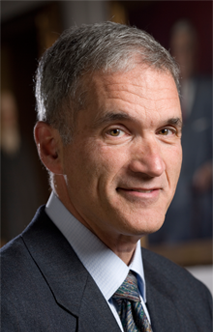
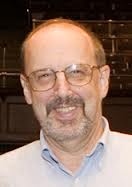
DAVID KERTZER (AUTHOR, ANTHROPOLIGIST, PAUL DUPEE UNIVERSITY PROFESSOR, HISTORIAN SPECIALIZING IN ITALIAN STUDIES)

DAVID KERTZER (AUTHOR, ANTHROPOLIGIST, PAUL DUPEE UNIVERSITY PROFESSOR, HISTORIAN SPECIALIZING IN ITALIAN STUDIES)

David Kertzer reminds society that organized religion is only human.  Religions are subject to the goodness and sins of human nature.  Whether one believes in a Supreme Being or not, actions of organized religion are freighted with human error.

Kertzer is only one of many who have exposed the perfidy of organized religion.  His target, in “The Pope and Mussolini, is the Roman Catholic Church.

Cardinal Ratti becomes Pope Pius XI during the ascension of European Fascism and Nazism in the 1920s and 30s.  Ratti is characterized as a pedantic, conservative, and sometimes bellicose Christian believer in the Roman Catholic Church.  As a religious pedant rather than trailblazer, Pope Pius XI focuses on returning Roman Catholicism to a former time of independence and influence.  No price appears too high; Pope Pius XI’s purchase price paves the way for state Fascism (total control of government and society) in Italy.
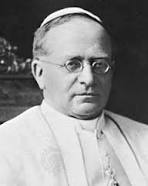
POPE PIUS XI (1857-1939)

POPE PIUS XI (1857-1939) Cardinal Ratti becomes Pope Pius XI.  Ratti is characterized as a pedantic, conservative, and sometimes bellicose Christian believer in the Roman Catholic Church.

Kertzer recounts early 19th century history of the Roman Catholic Church.  The secular government of Italy confiscates Church lands. That taking decimated Catholic wealth, restricted Popes to the Vatican grounds, and reduced Papal control of the Holy See.  More significantly, it reduced the church’s power to influence believers.  After 1860 and until the Lateran Treaty negotiated between Mussolini and Pope Pius XI, the Church is treated as a part of the state of Italy, subject to secular rule.

Pope Pius XI agrees to support the government of Benito Mussolini in 1929 in return for the creation of an independent Papal State in Rome.  Mussolini agrees to pay the church approximately $100 million for formally confiscated church land.  Pope Pius XI acquires for himself and future Popes the right of independent rule, religious interpretation, and Catholic dictation.  In return Mussolini gains the support of the Roman Catholic Church, the dissolution of Catholic political parties, and a title as II Duce, “The Leader” of Italy.   At the stroke of a pen, Mussolini becomes a hero of Italian Catholics (over 90% of the population) and the totalitarian leader of Italy.

BENITO MUSSOLINI (1883-1945, PRIME MINISTER OF ITALY 1922-1943, LEADER OF NATIONAL FASCIST PARTY)

BENITO MUSSOLINI (1883-1945, PRIME MINISTER OF ITALY 1922-1943, LEADER OF NATIONAL FASCIST PARTY)

Kertzer notes there are common goals for Mussolini and Pius XI in the Lateran treaty which separates church from state.  Both covet power.  Both dislike the idea of a Catholic party interfering with religious or state matters.  Both desire elimination of factional interference in government and religion; i.e. Mussolini’s Fascist control of government and the Pope’s control of Church doctrine.

Seeking sovereign independence of the Holy Sea. Pius XI becomes head of state of the smallest state in the world.  $100 million is paid to the church for confiscated land since 1860.

Pius XI is the first Pope to broadcast on radio in the early 1920s.  With the Lateran Treaty of 1929, the Papal State is created; after 58 years of refusal to become part of Italy.  Prisoners in the Vatican before 1929, the Lateran Treaty required elimination of the Catholic Italian Popular Party, a political organization.

DAVID KERTZER “THE RELATIONSHIP OF BENITO MUSSOLINI AND POPE PIUS XI (1922-1939):

An unintended consequence was to reinforce Fascism in Italy.  With the ascension of Pope Pius the XII, the Nazi government is solidified.  The trade-off for the Roman Catholic church  is an increase in international influence.   At the same time, pagan worship of fascism by Church youth groups diminishes the church’s moral stature. 

POPE PIUS XII (1876-1958, FORMERLY CARDINAL PACELLI)

POPE PIUS XII (1876-1958, FORMERLY CARDINAL PACELLI)
Pope Pius XI refuses to excommunicate Hitler, Mussolini gravitates to Nazism, and Pius XII ignores Nazi atrocity.

The Lateran treaty is a slippery slope for both Nazi Germany and the Roman Catholic Church.  Mussolini and Pius XI are blinded by hubris and false piety.

BENITO MUSSOLINI HANGING BY HIS HEALS NEXT TO HIS MISTRESS

Mussolini is shot by his countrymen, hung by his heals for destroying people’s freedom, and losing a war that compromised and betrayed his county.  Pius XI compromises his morals and paves the way for Pius XII, a closet Christian anti-Semite, who becomes a Hitler’ stooge by tacitly endorsing the immorality of belief in ethnic purity.

The closing years of Pius XI’s reign is marked by a closer association with democracies as the Western nations and the Vatican found both were threatened by totalitarian regimes and ideologies of Hitler, Mussolini, and Stalin.  However, with Pius XI’s death and ascension of Pope Pius XII, distinction between totalitarianism and democracy diminishes.

Pope Pius XII—Hitler’s Pope.  FORMER CARDINAL PACELLI Hitler and the roman catholic church: <iframe width=”854″ height=”510″ src=”https://www.youtube.com/embed/2x_MdS88qr8&#8243; frameborder=”0″ allowfullscreen>

***IRONIC SPEECH  POPE PIUS XII SPEAKING ENGLISH TO TROOPS WHO LIBERATED ROME:

Kertzer offers insight to what really happened in Italy in the 1920s, 30s, and early 40s but the story resonates with all organized religions.  Jewish isolation of Palestinians, ISIL’s attempt to resurrect the Caliphate, Muslim repression of Kurds, Taliban Muslim cruelty in Afghanistan, Chinese suppression of Uighurs, and Protestant proselytizing around the world are cut from the same flawed fabric; i.e. the flawed fabric of human interpretation of humanly manufactured texts and religions. 

RELIGIOUS BELIEF

In the name of God, organized religion’s killings continue.  If there is a God, he/she is not evil; i.e. only humans are evil.

BESTSELLER

Audio-book Review
By Chet Yarbrough

(Blog:awalkingdelight)
Website: chetyarbrough.blog

Great American Bestsellers: The Books That Shaped America

Great American Bestsellers

5 Star

Published by: The Great Courses

Lectures by:  Professor Peter Conn

PETER CONN (AUTHOR, VARTAN GREGORIAN EMERITUS PROFESSOR OF ENGLISH, PROFESSOR OF EDUCATION AT THE UNIVERSITY OF PENNSYLVANIA)

Professor Peter Conn prefaces his lectures on “Great American Bestsellers” by noting a bestseller’ label is not necessarily a measure of good or great writing but of popular consumption.

Historically, bestseller has meant high purchase volume for a book; usually, higher than expected.  In the modern age, a bestseller label is often degraded by publishers; i.e. it is used as a marketing ploy rather than a measure of sales volume.

However, by more accurate measure of popular consumption, Conn argues bestsellers shape American culture, either by reinforcing or changing the direction of cultural norms. The books Conn identifies are American bestsellers because they fulfill two criteria.  One, the books Conn selects and reviews are widely purchased.  Two, Conn’s bestseller’ selections arguably reflect or shape American’ belief.

Most books Conn selects are well-known today.  A few, like “The Bay Psalm Book”, “Ragged Dick”, and (at least to me) “The House of Mirth”, are obscure.  Some of Conn’s selections have been reviewed by me in the past; e. g. Thomas Paine’s “Common Sense”, Harriet Beecher Stowe’s “Uncle Tom’s Cabin”, Upton Sinclair’s “The Jungle”, Pearl Buck’s “The Good Earth”,  John Steinbeck’s “The Grapes of Wrath”, Richard Wright’s “Native Son”, and Joseph Heller’s “Catch-22”,  Each of these books profoundly shape my view of America; partly from personal experience, but mostly from an author’s ability to paint pictures of others’ lives.

RIGHTS OF MAN
THOMAS PAINE’S – RIGHTS OF MAN

These lectures are informative.  Thomas Paine’s “Rights of Man” is as relevant today as it was in the nineteenth century.  It became a best seller because it reflected rising discontent with the direction of government.  Todays’ political demonstrations offer similar resentment about elected representatives and an election system (now corrupted by money) that Paine railed against when writing about the rights of man.

uncle tom's cabin
HARRIET BEECHER STOWE’S – UNCLE TOM’S CABIN

“Uncle Tom’s Cabin” is another bestseller that moves modern readers with as much force as it did in the 1850s.  Conn recounts the apocryphal (likely untrue) story of Abraham Lincoln’s welcome for Stowe to the White House—“So this is the little lady who started the great war”.

It is interesting to find that Mark Twain’s “The Adventures of Huckleberry Finn” is criticized for what might be called “Black Samboing”.  The last half of the book reflects a characterization of Huck’s companion, Jim, a runaway slave who compels Finn to choose between what is morally or legally right.  The last half of the adventure makes Jim look like “Black Sambo”; i.e. one who shucks and grins rather than seeks freedom and the right to be treated as a human being.  Twain seems to covet laughter at the expense of truth.

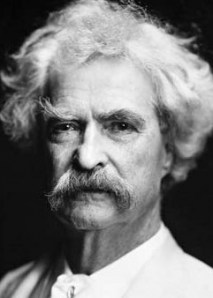
Mark Twain (Samuel Clemens 1835-1910)
It is interesting to find that Mark Twain’s “The Adventures of Huckleberry Finn” is criticized for what might be called “Black Samboing”.

Conn identifies why Twain is a puzzle that confounds critics’ understanding.  On the one hand, Twain is a man ahead of his time; on another he is a huckster seducing his audience with stereotypical and offensive characterizations of the poor and uneducated.  Twain is an acquired taste; i.e. bitter like beer or coffee that either dulls or sharpens one’s senses.

Native Son
Professor Conn tells of Richard Wrights’ hard life and its lessons in “Native Son”.  It is a story of what being Black in America means.

“Native Son”, the first bestseller by an African-American, is a compelling and brutal picture of the consequences of discrimination.  Conn tells of Richard Wrights’ hard life and its lessons in “Native Son”.  It is a story of what being Black in America means.  Many consequences of Wrights’ hard life are still being played out today.

In 24 lectures, Conn surveys many of yesterdays’ bestsellers; some of which have outlived their relevance but many that continue to speak “…volumes about the nation’s cultural climate” (a partial quotation from the publicist of the series).

TO A HAMMER, EVERYTHING IS A NAIL

Audio-book Review
By Chet Yarbrough

(Blog:awalkingdelight)
Website: chetyarbrough.blog

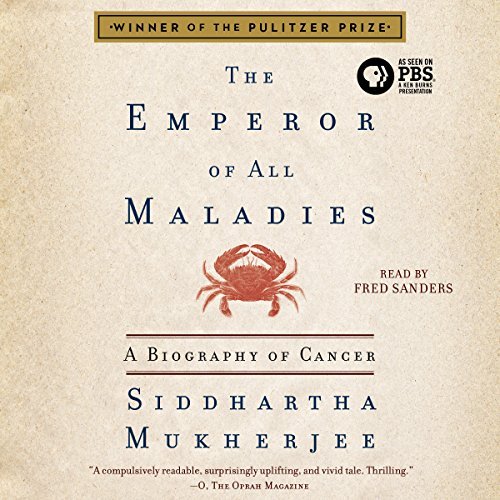
The Emperor of All Maladies, A Biography of Cancer

By Siddhartha Mukherjee

Narrated by Fred Sanders

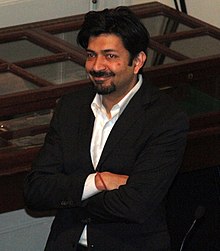
SIDDHARTHA MUKHERJEE (AUTHOR, PHYSICIAN)

Dr. Siddhartha Mukherjee examines the history of cancer in “The Emperor of All Maladies”.

cancer death rates rising

The Centers for Disease Control and Prevention reports heart disease and cancer are the two leading medical causes of death.

At first glance, one thinks–so what?  We are living longer, and everyone dies of something.  However, Mukherjee notes a study showing cancer deaths are rising: i.e. they decrease in one age group only to be offset by increase in another.  The net effect is a rising number of cancer cases.

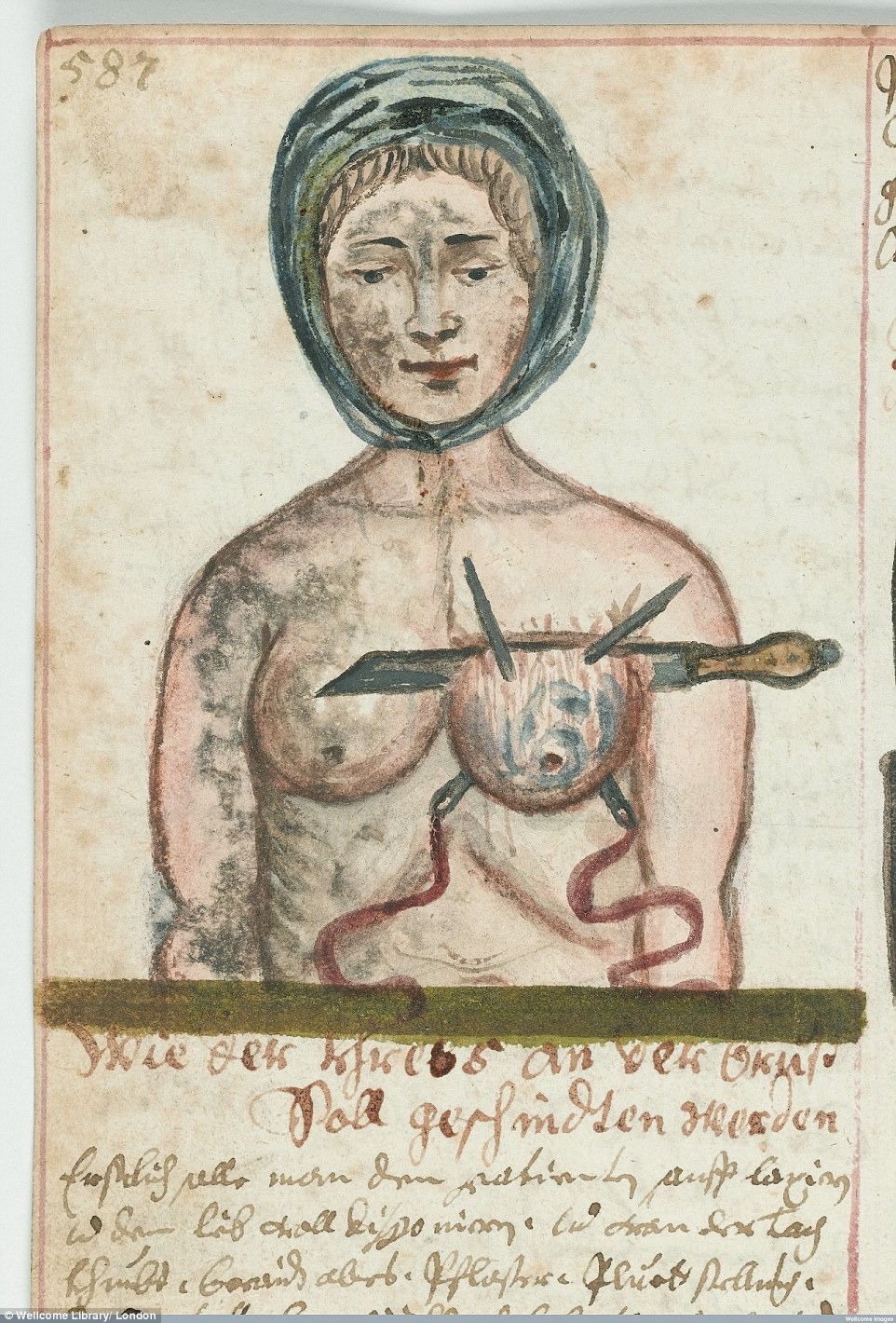
RADICAL MASTECTOMY IN THE 19TH CENTURY

In researching the history of cancer, Mukherjee exposes the arrogance of medical specialization.  Mukherjee shows early attempts to cure cancer were led by surgeons who removed cancerous growth.

Cancer, like the threat of a pandemic, induces fear and panic. Both maladies are unpredictable in the face of a human desire for predictability, health, and well-being. There is no certainty in either diagnosis. All a human can do is persevere. And so it is today with Covid19, the most horrific pandemic since the 1918 flu epidemic.

“The Emperor of All Maladies” reminds one of the saying—”To a hammer, everything is a nail”. 

Cancer, like Covid-19, is a slippery killer.  Thinking Covid-19 is the flu is as misleading as a singular solution for cancer.

COVID-19 affects different people in different ways. Infected people have had a wide range of symptoms reported – from mild symptoms to severe illness.

Symptoms that may appear 2-14 days after exposure to the virus:

  • FeverCough
  • Shortness of breath or difficulty breathing
  • Chills
  • Repeated shaking with chills
  • Muscle pain
  • Headache
  • Sore throat
  • New loss of taste or smell

The world scrambles for a vaccine to treat COVID-19. Fear drives people to desperation.

The public needs to discipline itself when offered an alleged medical treatment without verifiable proof of efficacy by medical science.

Mukerjee recounts the missteps made by medical professionals in their search for a cure to cancer.

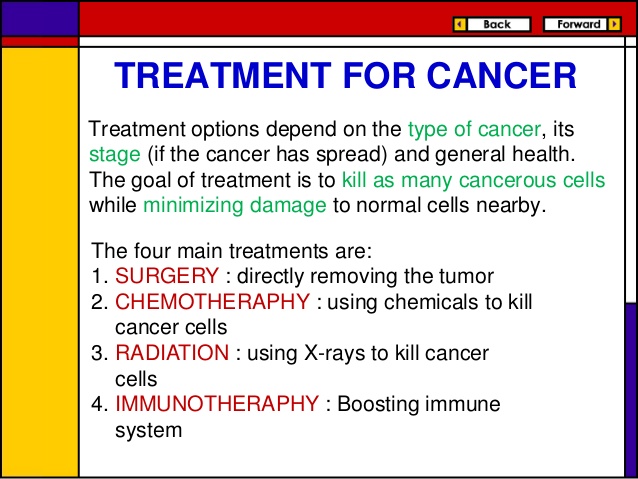
The hammer, in the early days of cancer treatment, is a scalpel wielded by surgeons who cut deeper and deeper into the body until the patient is physically disabled, in limited remission, or laboring toward death.  The surgeon believes he has removed the cancer only to find it returns in weeks or months later.

Surgery works but the scalpel is a hammer that only works when cancer is localized and non-systemic.

Radiation Effects

The next specialty is radiation.  Here the physician replaces the scalpel with focused radiation; another hammer. Radiation cannot kill systemic cancer without killing or diminishing a patient’s health.

CANCER AND CHEMOTHERAPY

Next up is the internal medicine specialist, the oncologist.  This specialty argues that cancer can best be treated with designer drugs to specifically attack or starve cancer cells.  The problem is medicines that kill cancer cells are generally toxic; i.e. they kill both good and bad cells.

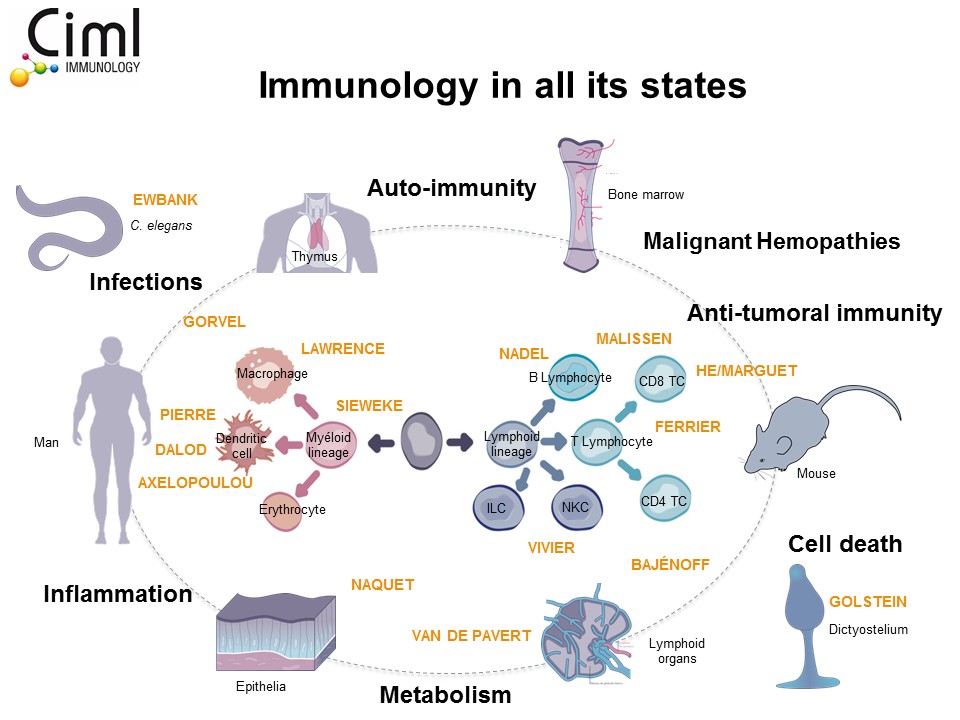
The final specialization is immunotherapy which ranges from bone marrow  and blood antigen enhancement to bone marrow transplantation. The purpose of immunotherapy is to make the body more resistant to cancer cell growth.

Though each specialization advances cancer remission, specialists lauded their own treatments and ignored each other’s accomplishments. 

CANCER AND MULTIFACETED TREATMENT

Specialists were historically proprietary about their treatments.  Some went so far as to distort their results with false clinical studies.  They felt their treatment was the best way of attacking “The Emperor of All Maladies”.

Specialists exclusively pursue their singular research, treatment, and reporting until a few physicians argued all disciplines should be enlisted to cure cancer.

CANCER AND EVOLUTION

The cure begins with physician attention and empathy for the patient.  Mukherjee infers cancer therapy is not for physician self-congratulation.  Hubris is a failing in physicians; just as it is in all human endeavors.  Cancer is an eternal war.  It changes with the environment and life’s evolutionary laws.

Mukherjee’s history explains how the chain of discovery for a cancer cure can be broken at different levels. 

There is physician self-delusion about how effective their treatment is for cancer.  There is the integrity of research studies and how they are conducted.  There is industry and government support of industrial waste production that is proven to be carcinogenic.

The door is opened to interdisciplinary research by philanthropists who created foundations to clinically study causes and cures for cancer.  Mukherjee addresses the continuing need for funding to expand cancer research.  He is not Pollyannaish about the need.  He acknowledges cancer research is not going to be like America’s race to the moon in the 1960s.  There is no definitive goal. The goal is not fixed like a mission to Mars.  Cancer’s etiology evolves.  It is unlikely for there to be a single-bullet solution that will cure cancer. 

Mukherjee expands on the difficulty in curing cancer because of capitalist resistance to scientific research, and discovery. 

MARLBORO MAN

Mukherjee recalls the battle with the cigarette industry when research clearly shows a correlation between cancer and smoking.  The cigarette industry lies to the public about their own studies correlating lung cancer with smoking.

Cigarette industry lobbyists influence legislation that delays concerted action by the government to curb the addictive characteristics of smoking.  Money talks, cancer proliferates.  (This reminds one of the gun lobby and their insistence that guns designed only to kill people are a right that should not be infringed upon.  Though gun use may not be addictive, there is a distinct correlation between the number of deaths in one incident and the proliferation of fully automatic weapons designed only to kill people.)

Mukherjee also recounts the incidence of cancer in England for chimney sweeps that inhaled carbon and asbestos from cleaning chimneys.  Today’s confrontations are carbon, other cariogenic, and environmental contaminants created by industry.

The National Institute of Health reports an estimated 1,735,350 new cancers will be diagnosed in the United States in 2018.  Of that number, 609,650 will die.  Worldwide, NIH reports 14.1 million new cases were identified in 2012.  8.2 million died.  The only killer more prolific than cancer is heart disease, and only by a small margin (In 2009, the CDC reports 610,000 people die every year from heart disease.)

PHYSICIAN HEAL THYSELF

Mukherjee implies all physicians need to step back, abandon their professional bias, and pursue treatments that are based on scientific research, symptoms, and reports of their patients.

Physicians need to listen, do no harm, and when necessary, offer palliative treatment—until, hopefully, a lasting cure is found. When the world is struck by a deadly virus, urgency is admittedly a gamble. Searching for a cure comes from science. When multitudes are dying, no-risk cures are unlikely to be discovered. Those who choose not to be vaccinated are risking more than their own lives when a pandemic strikes.

U.S. HEALTH CARE

Medical research and experimentation is costly. 

Mukherjee’s history shows the weakness and strength of capitalism and human nature in supporting what humanity needs to defeat cancer.  His history should be required reading; particularly for physicians, and researchers, but also for the general public.

ARTISTS’ BAD BOY

Audio-book Review
By Chet Yarbrough

(Blog:awalkingdelight)
Website: chetyarbrough.blog

Caravaggio, A Life Sacred and Profane

CARAVAGGIO


By Andrew Graham-Dixon

Narrated by Edoardo Ballerini

ANDREW GRAHAM-DIXON (ART CRITIC-JUDGE FOR THE TURNER PRIZE, BP NATIONAL PORTRAIT PRIZE,&amp; ANNUAL BRITISH ANIMATION AWARDS)
ANDREW GRAHAM-DIXON (ART CRITIC-JUDGE FOR THE TURNER PRIZE, BP NATIONAL PORTRAIT PRIZE,& ANNUAL BRITISH ANIMATION AWARDS)

Caravaggio is artists’ bad boy of early sixteenth century Italy.  Born in 1571, Caravaggio arrives in the midst of religious turmoil between Catholic nations and the Ottoman Empire. Caravaggio comes to life in Andrew Graham-Dixon’s biography.  Graham-Dixon explores the light and dark of Michelangelo Merisi Caravaggio’s short life.

Graham-Dixon suggests Caravaggio’s life is self-formed by circumstance of history, the political connection of Caravaggio’s family, and a rebellious nature of a boy who loses his father at the age of six. A self-formed life is a description of Caravaggio’s growth to manhood.  It suggests Caravaggio’s artistic ability comes from inner drive more than formal education.  Though Caravaggio is apprenticed to painters in his youth, contribution to his artistic ability is obscured by differences in what Caravaggio paints and what his teacher’s taught.

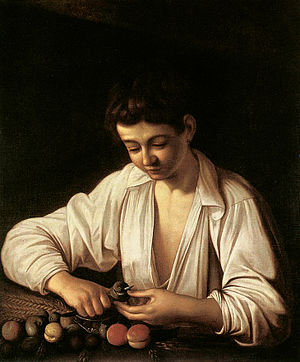
CARAVAGGIO-BOY PEELING FRUIT (THE EARLIST KNOWN WORK 1592-1593)
CARAVAGGIO-BOY PEELING FRUIT (THE EARLIEST KNOWN WORK 1592-1593)

Use of light and shade (chiaroscuro) reflects an early break with what teachers taught and what Caravaggio could do.  In his early work, the beginnings of Caravaggio’s genius are shown. Even though the subject “Boy Peeling Fruit” shows immature dimensional perspective, Caravaggio’s beginning use of light and dark dramatically highlights his subject.  As time passes, Caravaggio skillfully improves chiaroscuro to further dramatize his work.


Graham-Dixon recounts Martin Scorsese’s 1960s comments about Caravaggio’s cinematic sense.  Caravaggio’s paintings tell stories of the bible known by the public but known more symbolically than literally.  Caravaggio’s work dramatizes biblical stories.  The dramatic finger probe of Jesus by Thomas cinematically illustrates Christ has risen from the dead.  From the frown on doubting Thomas’s face to Thomas’s dirty fingers, the biblical story becomes graphically real.CARAVAGGIO-DOUBTING THOMAS

CARAVAGGIO-DOUBTING THOMAS (DETAIL OF THE EXTENDED FINGER, ITS DIRT&amp; REMINISCENT MICHELANGELO SISTINE CHAPPEL HAND)
CARAVAGGIO-DOUBTING THOMAS (DETAIL OF THE EXTENDED FINGER, ITS DIRT& REMINISCENT MICHELANGELO SISTINE CHAPEL HAND) From the frown on doubting Thomas’s face to Thomas’s dirty fingers, the biblical story becomes graphically real.

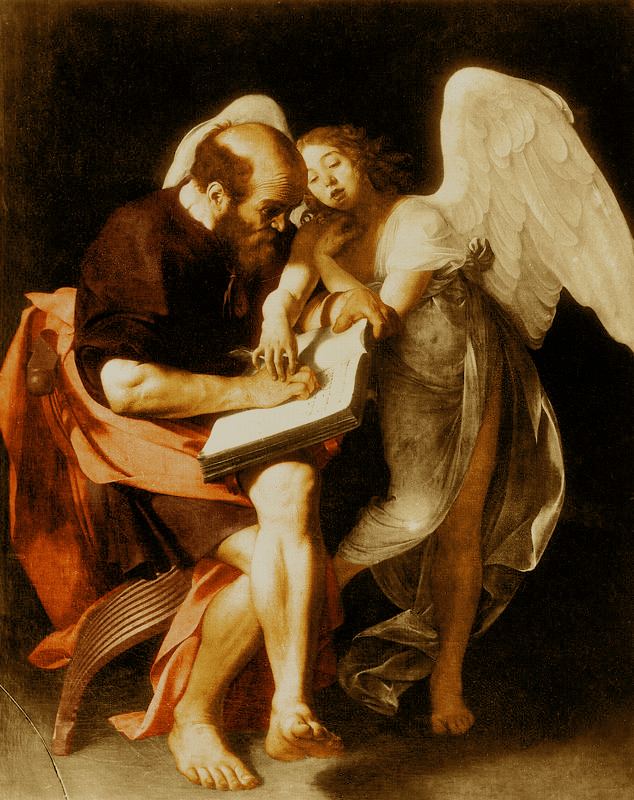
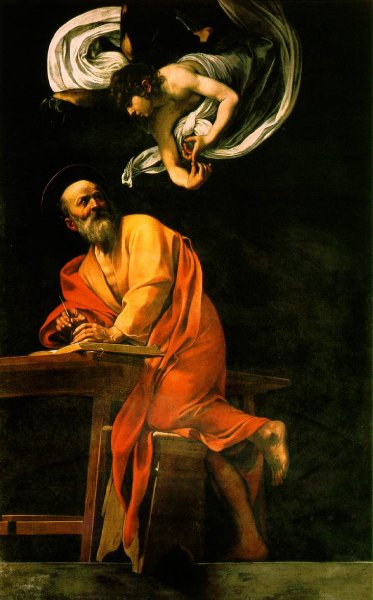
At times, Caravaggio went too far and displeased his benefactor with biblical interpretations that offended social propriety.  In St. Matthew and the Angel, the intimacy of the angel and St. Mathew offended his client.  A second version had to be painted before Caravaggio would be paid.

www.mikeyangels.co.uk
In St. Matthew and the Angel, the intimacy of the angel and St. Mathew offended his client.


CARAVAGGIO-ST MATTHEW AND THE ANGEL-(THE REVISION)

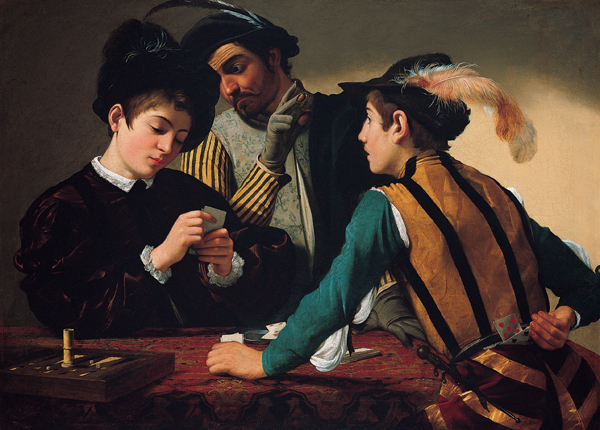
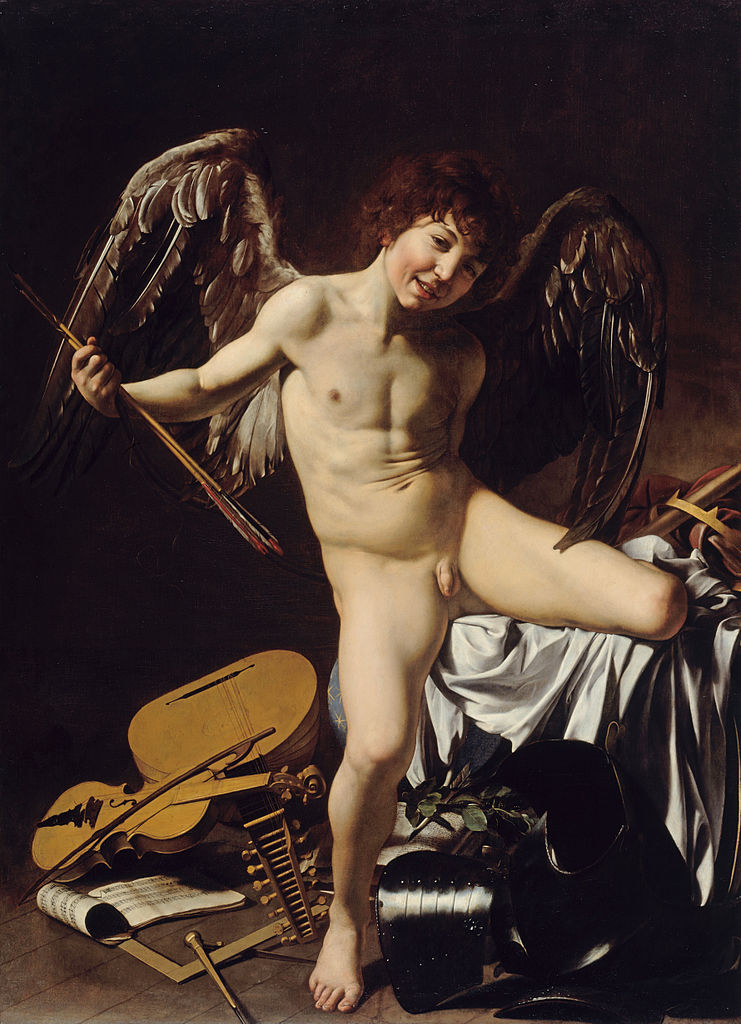
Caravaggio paints from models of working people of his time to make stories of the bible truer to Jesus’s time.  Jesus walks among the poor, the bereft, and sinners of society.  Caravaggio’s characters are workers, prostitutes (courtesans), and gamblers like “The Cardsharps…” or his sexualized “Cupid as Victor”.  He shows the dirty feet of a visitor to “Madonna of Loreto”.

CARAVAGGIO-THE CARDSHARPS AND THE FORTUNE TELLER


CARAVAGGIO-CUPID AS VICTOR (A STORY OF V'S-SENSUALITY OF HUMAN BEINGS)
Caravaggio’s characters are workers, prostitutes (courtesans), and gamblers like “The Cardsharps…” or his sexualized “Cupid as Victor”.

MADONNA OF LORRETO (Below shows the dirty feet of a visitor.)


Graham-Dixon’s infers Caravaggio is a profligate sinner himself.  Caravaggio is described as a person who wears black to obscure his visage at night when he is raising hell with his friends and enemies.  Caravaggio violates the law by carrying a sword without a license; by brawling in local brothels and practicing alleged bi-sexual acts.  Graham-Dixon suggests Caravaggio may have been a pimp to subsidize his income. Graham-Dixon also suggests pimping may have provided models for his art.  Finally, Caravaggio kills a man and is sentenced to death.

Caravaggio is recorded by witnesses and in trials to have a volatile temper.  Though the biographer mentions artist’s behavior was sometimes affected by lead and other contaminants of their paint, Graham-Dixon does not conclude Caravaggio’s behavior is caused by a painter’s occupational hazard.  In 2010, lead poisoning is found in what is believed to have been Caravaggio’s remains.  But Graham-Dixon reports no one really knows exactly where Caravaggio is buried.  Were those remains Caravaggio’s?

KNIGHTS OF MALTA
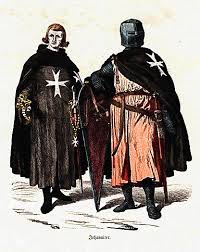
KNIGHTS OF MALTA (Caravaggio made many enemies but no one knows for sure what caused his death.  Graham-Dixon believes a vendetta, by a member of the Knights of Malta, is the proximate cause of Caravaggio’s death.)

Graham-Dixon concludes the biography with an explanation of Caravaggio’s mysterious death.  Caravaggio made many enemies, but no one knows for sure what caused his death.  Graham-Dixon believes a vendetta, by a member of the Knights of Malta, is the proximate cause of Caravaggio’s death. 

Caravaggio, when he tries to become a Knight of Malta to escape the death sentence for an earlier murder, insults one of the Knights.  The insult goes unsatisfied and is compounded by Caravaggio’s abandonment of the Knights of Malta when he thinks he will get a pardon for his crimes from Rome.  Graham-Dixon suggests the insulted Knight catches up with Caravaggio and severely cuts his face.  Several months later, Caravaggio is still recovering from the wounds when notice comes to him–upon return to Rome, he will receive his pardon.

Caravaggio packs his bags and his last three paintings and heads for Rome.  The trip is by ship.  The voyage includes a stop before arriving in Rome.  At the stop, for an unknown reason, Caravaggio is retained by a local sheriff.  The boat sails without him.  When Caravaggio is released, he buys a horse to meet the departed ship at its next port before Rome.  Caravaggio is still recovering from his wounds.  When he arrives at a port, he is sick unto death with fever and exhaustion.  Some days later, he dies at the age of 38.

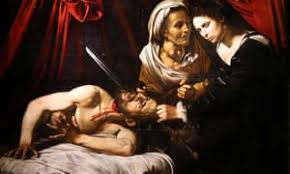
Caravaggio marked a pivot point in the meaning of art.  Painting became more than symbolic representation, i.e., it became a cinematic representation of the real world.  The imperfection of humankind, both physically and spiritually became a part of art’s story about life.  Caravaggio’s art reflects on the violence of life, the imperfection of humankind, the doubts of human belief in God, and the nature of human beings.

CARAVAGGIO (JUDITH BEHEADING HOLFERNES)
CARAVAGGIO (JUDITH BEHEADING HOLFERNES-Caravaggio’s art reflects on the violence of life, the imperfection of humankind, the doubts of human belief in God, and the nature of human beings.)
Newly discovered but unsigned painting by Caravaggio found in a French attic.

Caravaggio’s use of light and dark is the principle challenge to a recently found work of art attributed to, but not signed by Caravaggio.  The objection is related to the use of a brown backdrop that enhances the light and shade characteristic of Caravaggio’s paintings.  The estimate value for the newly discovered version of JUDITH BEHEADING HOLFERNES is $100m.

MURDER MYSTERY

Audio-book Review
By Chet Yarbrough

(Blog:awalkingdelight)
Website: chetyarbrough.blog

Dissolution

dissolution

4 Star Symbol
By C.J. Sansom

Narrated by Steven Crossley

C.J. SANSOM (ENGLISH AUTHOR)

“Dissolution” is a good murder mystery.

This is the first of a series of historical novels about a physically impaired Royal Commissioner/attorney that investigates crimes in the time of Henry the VIII.  The listener is introduced to Matthew Shardlake.

Shardlake is commissioned by Oliver Cromwell to investigate the murder of a fellow Commissioner. Sansom creates the feel and smell of early 16th century life in a Sussex monastery, 50 miles from London.  More interestingly, he reveals a version of Oliver Cromwell and the great upheaval of Roman Catholics at the time of Anne Boleyn’s beheading and King Henry the VIII’s rapacious hunger for Papist wealth.  Sansom writes about social change in the 1530s.  He reveals how that change muddies truth and justice, and exposes good and evil.
“Dissolution” is about Oliver Cromwell’s execution of King Henry’s orders to dissolve the Roman Catholic archdiocese and replace them with an Anglican Catholic hierarchy, responsible to the King of England rather than to the Pope of Rome.  Henry the VIII’s purported goal is to reform the Catholic region in England but the underlying objective is to confiscate Roman Catholic assets to increase the Royal treasury.

King Henry capitalizes on the general population’s disgust with wealth and corruption in the local Archdiocese.  The King commands Cromwell to send investigators (Royal Commissioners) to surrounding monasteries to search for legal means to dissolve their existence.  One of these investigators is murdered; i.e. his head is lopped off in a monastery’ kitchen.  Possible motives for the murder are fear of monastery dissolution, religious difference, sexual exploitation, and/or financial greed.

Leadership of the monastery suggests the perpetrator came from outside but evidence mounts to suggest that the likely villain or villains are within the monastery rather than without. That is the context in which C.J. Sansom places Commissioner Shardlake.

Shardlake’s character is more 21st century than 16th.  Though he believes in God, he suspects religion as a dissembler of truth; i.e. he believes in the word of God but sees that God’s word is distorted by man.  Shardlake, believes in the King’s plan to reform the church but becomes aware of Cromwell’s lies and deceit and begins to question Royal motive.

Shardlake shows himself to be a humanist that abhors physical punishment and abjures unfair treatment of women. His hunchbacked description and reported relationship with Oliver Cromwell reminds one of a conflicted human choosing to overcome adversity by educating himself, rationalizing human frailty, and believing that ends sometimes justify means.  In the course of Shardlake’s investigation, the truths of his internal conflicts are revealed as he solves the murder.

What makes Sansom’s book more than a murder mystery is historical integrity and its larger human context.  The story reveals the Machiavellian reasons for dissolution of the Roman Catholic Church in England.  The Roman Catholic Church was not then, nor is it now, entirely good or entirely evil.  As in all social change, dissolution of any human system of government, any kind of organization, throws both good and evil into the street; what remains is still a balance of good and evil but in a different human organizational form.  Only the future and history reveal whether social change is better or worse.  Evil does not disappear because it is a part of human nature, regardless of social change.

Listeners may be satisfied with “Dissolution” as a mystery, historical novel, or social commentary.

MASOCHIST’S GUIDE TO AFRICA

Audio-book Review
By Chet Yarbrough
(Blog:awalkingdelight)
Website: chetyarbrough.blog

A Primate’s Memoir: A Neuroscientist’s Unconventional Life Among the Baboons

A PRIMATE'S MEMOIR

3 star symbol
Written by: Robert M. Sapolsky

Narration by: Mike Chamberlain

ROBERT SAPOLSKY (AMERICAN NEUROENDOCRINOLGIST, PROFESSOR OF BIOLOGY, NEUROSCIENCE, AND NEUROSURGERY AT STANFORD UNIVERSITY)
ROBERT SAPOLSKY (AMERICAN NEURO-ENDOCRINOLGIST, PROFESSOR OF BIOLOGY, NEUROSCIENCE, AND NEUROSURGERY AT STANFORD UNIVERSITY)

Robert Sapolsky’s “A Primates Memoir” is a masochist’s guide to Africa. (Our 2017 trip to Africa was luxurious in comparison.)  Sapolsky’s trip is what you would expect from a biological anthropologist who sojourns to Africa in the early 80s.  Sapolsky lives in a tent while studying baboons.

AFRICA JULY 2017_7695.JPG
Our stay in Africa is luxurious in comparison to Sapolsky’s in the 1980s.

At the age of 12, Sapolsky appears to know what he wants from life. In his middle-school years, he begins studying Swahili, the primary language of Southeast Africa.

Sapolsky’s career is aimed at understanding Southeast Africa.  Sapolsky’s 1984 PhD. thesis is titled “The Neuro-endocrinology of Stress and Aging”. Presumably, his trip to Africa became the basis for his academic thesis. Sapolsky’s experience in Africa is recounted in “A Primate’s Memoir”.

AFRICA JULY 2017_8101.JPG
Animal preserve in Southeast Africa

While studying Baboons, Sapolsky is exposed to the worst of African society. His memoir of those years touches on the aftermath of Africa’s colonization, Africa’s ubiquitous diseases, its governments’ instability, and its abundant and frequently poached wildlife.

SOUTHEAST AFRICA
SOUTHEAST AFRICA

Robert Mugabe (President of Zimbabwe)
Robert Mugabe (Former President of Zimbabwe)

JACOB ZUMA (FORMER PRESIDENT OF SOUTH AFRICA)

Though some of what Sapolsky writes has  changed, today’s news shows characters like Robert Mugabe, and Jacob Zuma, who are accused of victimizing the poor to enrich themselves.

Some African, and other nation-state leaders around the world, are corrupt.  Many Southeastern African bureaucrats, foreign business moguls, indigenous apartheid promoters, and wildlife exploiters still walk, drive, and bump down streets and dirt trails of this spectacular continent.

Self-interest often conflicts with general economic growth and stability.  Today’s Southeast Africa is great for tourism (one of the three biggest industries) but the poor remain poor, the rich richer, and the middle class nearly non-existent.

AFRICA JULY 2017_7219.JPG
Today’s Southeast Africa is great for tourism (one of the three biggest industries) but the poor remain poor, the rich richer, and the middle class nearly non-existent.

Sapolsky returns to Africa after marrying. He squires his science and marriage partner to revisit a baboon troop he was studying in the 1980s. At the same time, he touches on the cultural norms of a society that seems little changed from his early years in Africa.

Sapolsky recounts the melding of a tragi-comic story of an African who is mauled by a Hyena. In telling the story, he reveals the stoic acceptance of life as it is. However, each time the story of the mauling is told by different people, it changes. The change comes from a blend of truth and fiction that conforms to the tellers’ view of themselves. The essence of the story is that an African man sleeping in a tent is mauled by a Hyena looking for food.

CHANGING STORY
Re-telling of an African story changes with each narration–The change comes from a blend of truth and fiction that conforms to the tellers’ view of themselves..

When the story is told by Masai warriors hired by a company to protect its employees, the victim is saved when the Hyena is speared by the Masai warrior’s courage. When the story is told by the victim, it is a company cook who bashes the Hyena that runs away. When the story is told by a newspaper reporter, the Masai warriors were drunk and not doing their job; the cook bashed the Hyena, and the victim survived. When the story is told by the cook, the victim’s yell brings the cook to the tent; the cook grabs a rock, bashes the Hyena, and the Hyena flees. Finally, when the story is told by the company employer, the victim is not an employee, the Mesai warriors did spear the Hyena, and the employer had no responsibility for the victim.

A cultural interpretation is inferred by these many versions of the same story. Some humans indulge in alcohol to escape reality. Most humans wish to protect an idealized version of their existence. News coverage is sometimes a mix of truth and fiction to make stories more interesting than accurate.

Life is happenstance with each human dealing with its consequence as an end or beginning that either defines, or extends their understanding of life. Truth is in the eye of the beholder. Some people are willing to risk their lives for others. Private companies focus on maximizing profit and minimizing responsibility.  Life is not an either/or proposition despite Kierkegaard’s philosophy.  Humans are good and bad; no one is totally one or the other–not even America’s morally corrupt and ethically challenged leader.

BABOONS
Sapolsky shows that baboon families, like all families, are born, mature, and die within a framework of psychological and physical challenges imbued by culture. All lives face challenge but culture can ameliorate or magnify the intensity and consequence of the challenge.

The overlay of Sapolsky’s memoir is the research and reported evolution of a baboon family in Southeast Africa. He shows that baboon families, like all families, are born, mature, and die within a framework of psychological and physical challenges imbued by culture. All lives face challenge but culture can ameliorate or magnify the intensity and consequence of the challenge.

Sapolsky gives the example of Kenyan “crazy” people who are hospitalized, treated, and fed to deal with their life circumstance. In America, it seems “crazy” people are left to the street. The inference is that Kenyan “crazy” people live a less stressful life than American “crazy” people. This is a positive view of Kenyan culture but there are ample negative views in Sapolsky’s memoir. Rampant poverty, malnutrition, and abysmal medical treatment are Sapolsky’s recollected examples.

Sapolsky’s memoir shows he clearly lives an unconventional life, but it seems a life of purpose. What more is there?


American

Audio-book Review
By Chet Yarbrough

(Blog:awalkingdelight)
Website: chetyarbrough.blog

The True American: Murder and Mercy in Texas

Written by: Anand Giridharadas

Narration by:  Anand Giridharadas

More mass shootings this weekend. Twenty innocents murdered in El Paso and nine in Toledo.

Who are we?  What have we become? A deplorable habit of humans is to classify others as either one of us or one of them.

“The True American” is a news reporter’s story of two Texas murders and a wounding.  The victims are people living and working in 21st century America.  By birth, the three victims are Bangladeshi, Indian, and Pakistani. “The True American” is the story of murder and mayhem that tests Texas’s death penalty.  The facts of the story expose human nature’s habit of “us and them” categorization.

The Texas’ murders could have been anywhere in America. Anand Giridharadas’ book is about “us and them” choices people make every day.

There is a causal link in America’s mass shootings that goes beyond the gun lobby and AK-47s.  Many of these horrific events are motivated by the isolation from Covid19 and “us and them “categories” that make one person different from another.

There is a causal link in America’s mass shootings that goes beyond the gun lobby and AK-47s.  The isolation caused by Covid19 raises social tension. Both guns and Covid19 link Americans to unnecessary death.

Yesterday’s examples of “us and them” in America are shootings in El Paso, Texas and Toledo, Ohio. Other examples of “us and them” mentality are our President’s categorization of illegal Mexican’ immigrants as murderers and rapists, a white man’s slaughter of nine Americans because they are Black, a Muslims’ murder of five soldiers because they are American, and the 2019 Poway synagogue shooting in Califorinia. Then there are this week’s murders of innocents at a parade in Waukasha, Wisconsin.

RAISUDDIN RAIS BHUIYAN (BANGLADESHI AMERICAN-TECHNOLOGY PROFESSIONAL IN DALLAS, TX.)

The focus of Giridharadas’ book is the maiming of Raisuddin “Rais” Bhuiyan. Bhuiyan is an aspiring American émigré from India, who is shot in the face by Mark Anthony Stroman.

Stroman murders two and maims Rais Bhuiyan, because he sees himself as a part of “us” (Americans) and his victims a part of “them” (Arab terrorists).  Ironically, none of the three victims are Middle Eastern.

MARK ANTHONY STROMAN

Like our President’s slander of Mexicans, a white man’s slaughter of Blacks, a Muslim’s murder of soldiers in 2015, and the 2019 murder in a Jewish synagogue, Stroman believes anyone that looks or acts like “them” is not worthy of “us”.

Bhuiyan’s life is worthless to Stroman because he is avenging destruction of the World Trade Center in New York.  To Stroman, Bhuiyan and two un-related Asians are terrorists because of the color of their skin.  Ironically, both Stroman and Bhuiyan, in the beginning of this true story, think in “us and them” terms.  By the end of Giridharadas’ book, Stroman and Bhuiyan realize there is only “we”.

Bhuiyan and Stroman are polar opposites in many ways but the same in some ways.  Bhuiyan is raised in a loving family in India.  Stroman is raised by an uncaring mother and stepfather.  Bhuiyan is strongly supported by his family to get a good education.  Stroman is ignored or abused by his family and drops out of middle school.  Bhuiyan excels in a private India’ school and becomes an elite citizen of Bangladesh’s government Air Force. Stroman is a “lost boy”; in and out of jail, and largely educated by government penal institutions.  Bhuiyan decides to immigrate to America.  Stroman knocks around Dallas, Texas, slipping in and out of jobs and jails.

social isolation

However, Bhuiyan and Stroman are alike in their social isolation.  Bhuiyan arrives in America without friends or family.  Stroman breaks ties with family and makes few friends.  Stroman isolates himself from society with drugs that make him belligerent.  Stroman is prone to relationships with fellow societal misfits. Bhuiyan isolates himself from society by the circumstance of being a stranger in a strange land.  Bhuiyan moves from New York to Dallas because a fellow Asian immigrant offers him a job.  Stroman is a “…True American”.   Bhuiyan is an aspiring “…True American”.

Bhuiyan’s early associations in America are with fellow Bangladeshis with the goal of finding employment.  Stroman’s associations are with outliers of American society with the same goal of finding employment.  Bhuiyan’s effort to find jobs is difficult because of his recent immigration and ethnic isolation.  Stroman’s effort to find lawful jobs is difficult because of his prison record, drug use, and volatile temper.

Stroman is convicted for one of his two Dallas’ murders and sentenced to death.  After ten years of appeal, Stroman’s execution is imminent.  Bhuiyan, in that ten years, continues his journey to become a “…True American.”  In the course of their troubled lives, Bhuiyan and Stroman grow to understand each other’s humanity.

Stroman re-imagined his life as his execution date approaches.  On the face of Stroman’s written and video confessions, Stroman either manipulates the media or has truly recognized the error of his ways. 

Stroman may have grown to understand, humanity is not a matter of “us and them” but a complicated mix of good and evil in every human being.  Ironically, Stroman’s and Bhuiyan’s journey is through religious belief, one as a Muslim; the other as a Christian.

Stroman is executed by lethal injection on July 20, 2011.

WAR’S HARD PART

Audio-book Review
By Chet Yarbrough

(Blog:awalkingdelight)
Website: chetyarbrough.blog

Fives and Twenty-Fives Fives and Twenty-Fives

Written by: Michael Pitre

Narration by:  Kevin T. Collins, Nick Sullivan, Jay Snyder, Fajer Al-Kaisi

MICHAEL PITRE (AUTHOR, FORMER MARINE)

The simple part of any war is having friends and enemies; the hard part is in knowing the difference.  “Fives and Twenty Fives” shows the simplicity and complexity of all wars.  Any veteran of the American military knows that part of basic training is building a team of soldiers to form a comradeship as strong as civilian friendship.  However, the difference between civilian and military friendship is the underlying command and control requirements of military organizations.

The author of “Fives and Twenty Fives” is an ex-Marine.  His novel is about friendship; i.e. more fundamentally about friendship on both sides of a war.

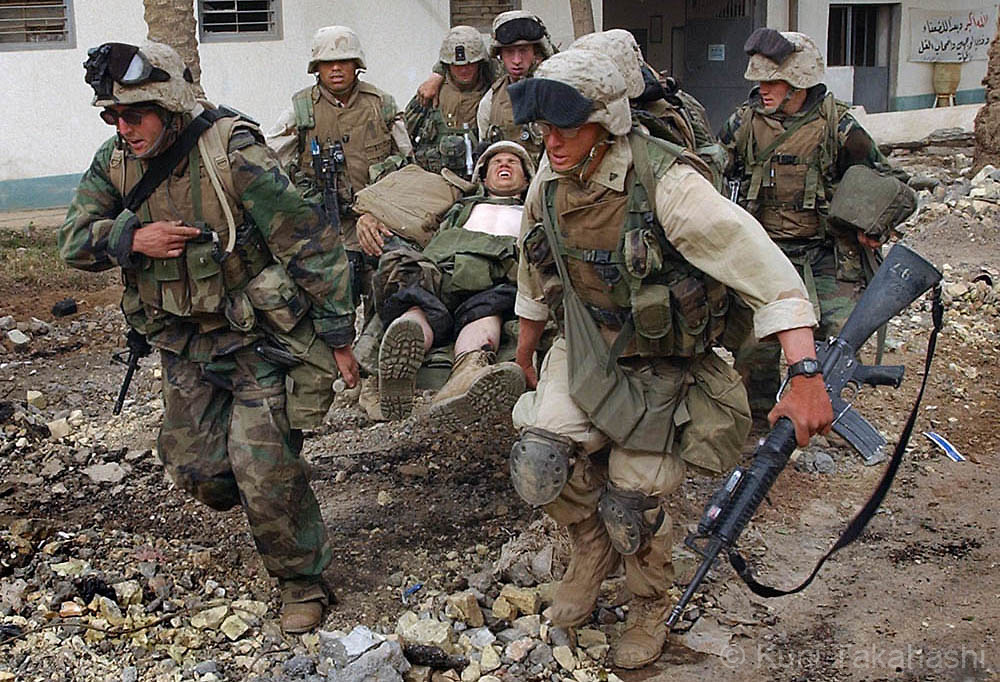
IRAQ INVASION
The author of “Fives and Twenty Fives” is an ex-Marine.  His novel is about friendship; i.e. more fundamentally about friendship on both sides of a war.

IRAQ INTERPRETERS
Unlike the American Civil War, the war in Iraq requires language interpreters.  Most interpreters are in-country natives and have not gone through conventional military basic training.

The theater of war in Michael Pitre’s novel is Iraq.  Unlike the American Civil War, the war in Iraq requires language interpreters.  Most interpreters are in-country natives and have not gone through conventional military basic training.  Command and control is learned by most of these interpreters “on the fly”.  Friendship is earned by experience rather than training.  Pitre introduces Dodge, the Iraqi interpreter, for a Marine team led by Lieutenant Donovan.

Dodge introduces an underlying theme of “Fives and Twenty Fives” in a conversation with Lieutenant Donovan.  Dodge explains that he has no friends because when one chooses friends, the choice entails responsibility and accountability.  Dodge is a Sunni, the religious faction associated with Saddam Hussein.  He speaks fluent English and studies Huckleberry Finn, a book he carries with him everywhere, to better understand American culture.  There are several allusions to the story of Huckleberry Finn that reinforce the theme of friendship; i.e. its implied responsibility and accountability.

US INTERPRETER IN IRAQ DENIED AMERICAN GREEN CARD
During his nearly four years as a translator for U.S. forces in Iraq, Saman Kareem Ahmad was known for bravery and hard work.  However, like one of Pitre’s  main characters, “Dodge”, Ahmad is denied an American green card at the end of the war.

COMPASSION ON THE BATTLEFIED IN IRAQ
COMPASSION ON THE BATTLEFIELD IN IRAQ – It is not exactly clear but Dodge seems to have chosen, by circumstance of war, to support freedom by making friends with a platoon medic that is singularly focused on saving lives.

Dodge’s father led the Agricultural Ministry of Saddam Hussein.  His father became a leader of the resistance to America’s invasion of Iraq.  Dodge loves his father but chooses to stay at an Iraqi university rather than follow him into the resistance.  It is not exactly clear but Dodge seems to have chosen, by circumstance of war, to support freedom by making friends with a platoon medic that is singularly focused on saving lives.

drug use in war
When a platoon soldier is ambushed, Dodge’s medic-friend is restrained by Lieutenant Donovan because he believes the soldier is dead.  After the incident, the medic turns to drug addiction to escape the reality of his friend’s death.

When a platoon soldier is ambushed, Dodge’s medic-friend is restrained by Lieutenant Donovan because he believes the soldier is dead.  After the incident, the medic turns to drug addiction to escape the reality of his friend’s death.  The medic is brought up on charges when the Lieutenant reports him for suspected drug use.  He receives a general discharge which affects his future civilian life.  The Lieutenant chooses not to be the medic’s friend in that arrest incident but meets the medic after the war with a different perspective; maybe not as friends, but as fellow human beings intimately affected by war.

ZINE EL ABIDINE BEN ALI (2ND PRESIDENT OF TUNESIA SENTENCED FOR MONEY LAUNDERING AND DRUG TRAFFICING)
ZINE EL ABIDINE BEN ALI (2ND PRESIDENT OF TUNISIA SENTENCED FOR MONEY LAUNDERING AND DRUG TRAFFICKING) Later in Pitre’s story, a reader listener finds Dodge chooses to become a part of a resistance to the repressive regime of Ben Ali in Tunisia.

Later in the story, a reader listener finds Dodge chooses to become a part of a resistance to the repressive regime of Ben Ali in Tunisia.  Dodge becomes friends with the resistance movement that needs his English-speaking voice to tell the world of Ben Ali’s repression.  Dodge is not a Tunisian but recognizes the human drive to resist oppression, and the need to be part of something greater than oneself.  Dodge chooses to be a friend of the oppressed.

Michael Pitre compels a listener to look at mistakes made by America in Iraq.  It may have been morally right to remove Saddam Hussein.  However, the decision to deny participation by Hussein’s army officers and Hussein’ administrative personnel in government transition was an error of epic consequence.

Vetted Hussein army officers and administrative personnel, with monitored performance measures, might have avoided Iraq’s spiral into chaos.  One considers the value of interpreters like Dodge who are from families that worked in the corrupt Hussein administration.  Dodge appears to have an inner moral compass that could have helped America in its intent to provide a pacific transition from totalitarianism to peace in Iraq.

There are good and bad people in every government.  Undoubtedly, there were some Iraqi Army leaders and Hussein administrators that could have become friends rather than enemies of fellow Iraqis and American’ invaders.   If America’s leaders had been more discriminating and understanding, ISIL may have never risen.  The simple part of any war is having friends and enemies; the hard part is in knowing the difference.

Post script: Now America is leaving Afghanistan.  One hopes those Afghani’s that served NATO and America’s involvement in Afghanistan will not be treated as forgotten friends.  Since Vietnam,  one doubts history will either justify or vindicate American military intervention in other countries.

AI VS. HUMAN INTELLIGENCE

Audio-book Review
By Chet Yarbrough

(Blog:awalkingdelight)
Website: chetyarbrough.blog

The Island of Knowledge: The Limits of Science and the Search for Meaning 

THE ISLAND OF KNOWLEDGE

Written by: Marcelo Gleiser 

Narration by:  William Neenan

MARCELO GLEISER (BRAZILIAN PHYSICIST AND ASTRONOMER, PHYSICS AND ASTRONOMY PROFESSOR AT DARTMOUTH)

MARCELO GLEISER (AUTHOR, BRAZILIAN PHYSICIST AND ASTRONOMER, PHYSICS AND ASTRONOMY PROFESSOR AT DARTMOUTH)

Marcelo Gleiser believes an A.I. singularity predicted by Ray Kurzweil is a myth of science that will be stranded on “The Island of Knowledge”.  His point is that the nature of science, human cognition, and quantum physics make computers incapable of superseding or equaling human intelligence.  The horizon of the unknown will always be present for human beings, even with computational advances.  Gleiser implies that the computer will only be a tool of humankind to explore the unknown.

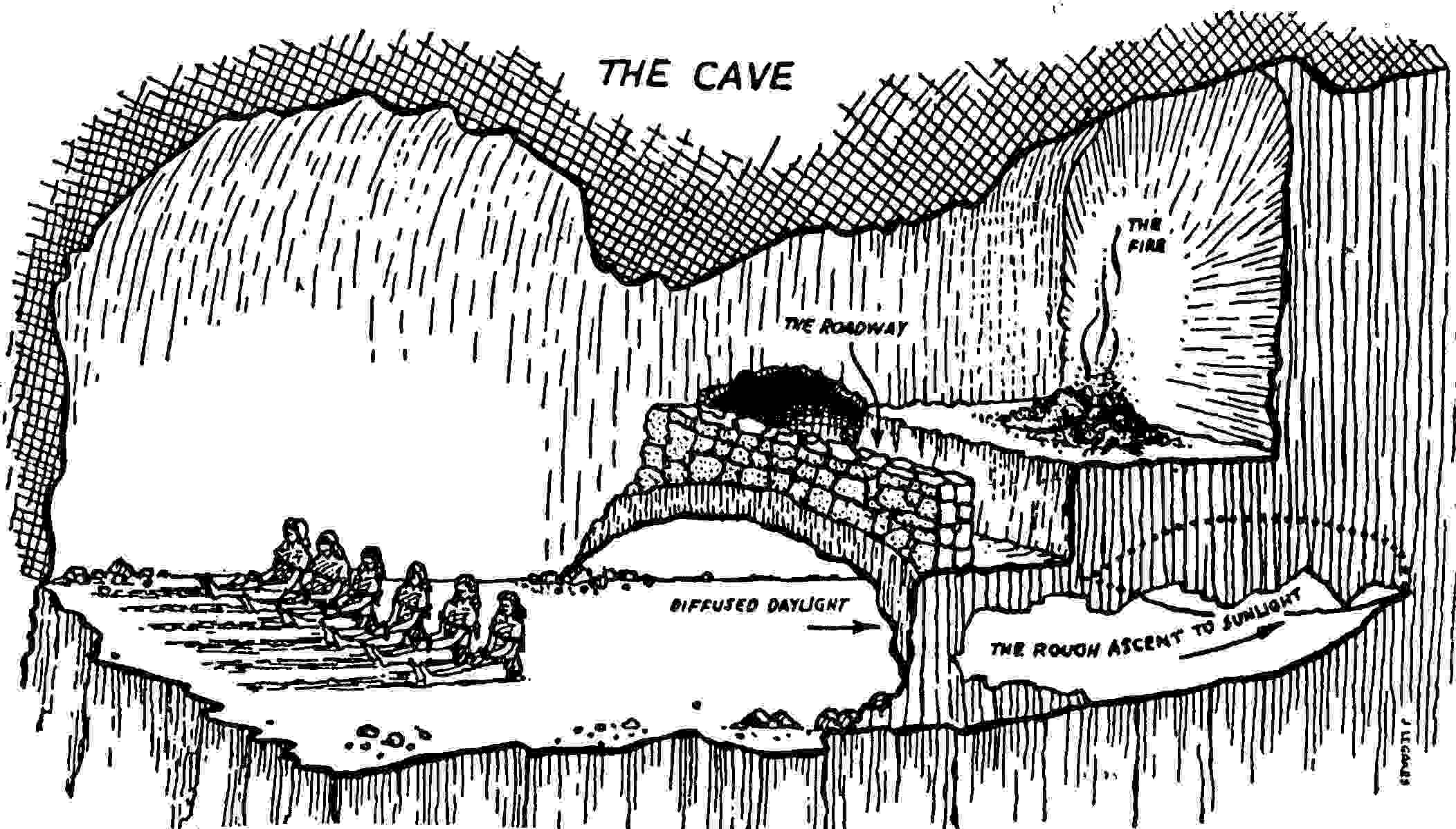
Gleiser notes the nature of science is to explain natural phenomena. Sciences’ explanations create an island of knowledge that is like Plato’s Socratic cave; i.e. a cave for humanity that only reveals shadows of reality.

PLATO'S CAVE

PLATO’S CAVE (Gleiser suggests Sciences’ explanations create an island of knowledge that is like Plato’s Socratic cave; i.e. a cave for humanity that only reveals shadows of reality.

Human beings cannot leave the cave because every scientific discovery only leads to another question about shadows that represent the real thing.  Gleiser prepares one for that conclusion by recounting the history of great scientists like Isaac Newton, James Maxwell, Max Planck, Earnest Rutherford, Albert Einstein, Edwin Schrodinger, Werner Heisenberg, Paul Dirac, and others.  Each of these scientists contributes to “The Island of Knowledge” but each raises more questions about phenomena that remain shadows of nature’s reality.

Gleiser acknowledges that Newton and Einstein sharpen shadowy outlines of nature’s reality but each fails to discover absolute truth.  Newton misses the fundamental truth of time.  Einstein misses the truth of quantum physics.  Newton’s time is relative and Einstein’s presumed certainties are probabilities.

history

Gleiser argues that human cognition is limited by “The Island of Knowledge” because cognition is influenced by the mind’s senses.    For example, history is reported with facts that are selected by the historian.  The facts may be accurate but not all facts of the past are reported and thereby history becomes a shadow of the truth.

In science, experiments do not prove truth; i.e. experiments only eliminate false positives, leaving only another experiment to disprove another presumed truth.  Experiments theoretically get one closer to a truth but the truth remains a shadow because the new truth has to be explored by further experiment.  As Karl Popper notes: “In so far as a scientific statement speaks about reality, it must be falsifiable; and in so far as it is not falsifiable, it does not speak about reality.”

KARL POPPER (1902-1994)

KARL POPPER (1902-1994) Popper suggests there are no verifiable truths; only probabilities.  If so, A.I. (at least) has the potential for improving the odds of factual truth.

THE HOLY GRAIL

Gleiser implies the idea of a Turing Computer that can know the origin of life is as specious as belief in the myth of the Holy Grail.  Gleiser explains that artificial intelligence will never supersede or equal human intelligence because natural phenomena are found to be probabilistic and not defined by yes and no, or ones and zeros.  Artificial Intelligence is a misnomer.

ARTIFICIAL INTELLIGENCE

Finally, Gleiser suggests artificial intelligence will never supersede or equal human intelligence because natural phenomena are found to be probabilistic and not defined by yes and no, or ones and zeros.  Artificial Intelligence is a misnomer in Gleiser’s opinion.

AI is a man-made construct, subject to “The Island of Knowledge” created by human beings.  Gleiser argues there are serious dangers in expansion of AI because it reduces complexity to yes and no answers.  One wonders if Gleiser takes into consideration experiments being conducted with quantum computing.  These experiments are meant to create a neural network that emulates human consciousness but with improved probabilistic calculations.

Gleiser’s implication is that a computer that programs itself becomes a Frankenstein; not a sentient being.  He argues that A.I. creations are likely to disrupt, if not destroy, human life.  He believes A.I. will always be based on shadows of unverifiable truths.

Gleiser implies the idea of a Turing Computer that can know the origin of life is as specious as belief in the myth of the Holy Grail.  He may be right.  Although, Popper suggests there are no verifiable truths; only probabilities.  The Holy Grail is a myth because nothing can ever be absolutly proven.  If so, A.I. seems to have the potential of improving the odds of factual truth.

Gleiser touches on the mysteries of “spooky action at a distance” which challenges Einstein’s dictum that nothing exceeds the speed of light. Gleiser recounts experiments that prove “spooky action at a distance” are real.  

Experiments with “spooky action at a distance” open a new field of inquiry.  This and “string theory” are examples of challenges to belief that human beings will ever have a theory of everything.  A.I. seems a credible tool for further experimentation. whether it is a “Frankenstein” or not. 

Gleiser believes “The Island of Knowledge” is as close as humanity will ever get to a theory of everything and it will always be a shadow of nature’s truth.  Karl Popper would agree.  Gleiser is saying pursuit of truth is important but precise truth is unattainable.  He argues that a final truth will never be found because discoveries of science will only lead to more questions, more experiments, and better tools of measurement. Nature’s truth will always be beyond human understanding; i.e. at best, nature’s truth will only be shadows of reality with sharper outlines.  Humanity may not be capable of escaping the cave to discover the truth of life.

Gleiser is quick to point out that his concept of the human island of knowledge is not meant to discourage scientific exploration.  He believes human beings have an innate desire to understand nature.  Life experience suggests wanting to understand nature is true of all cultures because humanity desires immortality. 

Humans want to think of themselves as the center of the universe; as false as that may be.

OTHER gods

Audio-book Review
By Chet Yarbrough

(Blog:awalkingdelight)
Website: chetyarbrough.blog

The Attention Merchantsthe attention merchants

By Tim Wu

Narrated by Marc Cashman

TIM WU (AUTHOR, PROFESSOR OF LAW AT COLUMBIA )

Not since “The Powers That Be” (published in 1979) has there been a better history of the media industry.  Tim Wu is heir to David Halberstam.  First there were newspapers, then radio, then television, and now the world-wide web.  Wu offers a modern vision of media’s impact on society in “The Attention Merchants”.

Gone are many of the famed “…Attention Merchants” like Bill Bernbach, Neil French, and David Ogilvy.   They were the early influencers; i.e. the copy writers, and agents that created consumer advertising for Sulzberger, Chandler, Hutchins, Paley, and Luce.  They worked for founders of some of the most influential newspaper, radio, television and magazine outlets of the 19th and 20th centuries. They were the “gods” of a newly formed consumer society. Consumers read, watched, and listened to pitches for everything from votes to vitamins to the latest model Cadillac.  Wu shows pitches remain the same, but methods have changed.

DAVID HALBERSTAM'S SEMINAL WORK ON THE MEDIA INDUSTRY (PUBLISHED 1979)
DAVID HALBERSTAM’S SEMINAL WORK ON THE MEDIA INDUSTRY (PUBLISHED 1979)  Gone are many of the famed “…Attention Merchants” like Bill Bernbach, Neil French, and David Ogilvy.  They were the “gods” of a newly formed consumer society. Consumers read, watched, and listened to pitches for everything from votes to vitamins to the latest model Cadillac.

Today’s social, political, and economic consumers are recorded, manipulated, spindled, and controlled by “other gods”.  Modern “…Attention Merchants” are internet entrepreneurs like Amazon’s Jeff Bezos, Google’s Larry Page & Sergey Brin, Microsoft’s Bill Gates & today’s CEO Satya Nadella, Apple’s (now deceased) CEO, Steve Jobs & today’s CEO Tim Cook, Facebook’s Mark Zuckerberg, and Netflix’s Reed Hastings. Television, newspapers, radio, and magazines still capture our attention but not like past “…Attention Merchants”.  Old media are still with us, but computer screens and mobile phones have joined the mix.  Wu shows how the public’s decisions have become less volitional, more manipulated, and addictive as www. sites came into being and technology matured.

INTERNET LOGO
Old media is still with us, but computer screens and mobile phones have joined the mix.  Wu shows how the public’s decisions have become less volitional, more manipulated, and addictive when www. came into being and technology matured.

MARLBORO MAN
Neither smoking or “free” access to information is without harm or cost.  The Marlborough man is dead, and “free” internet information is not free.

Wu recounts how advertising became a critical part of early media’s power, influence, and profit.  Just as advertisers promoted false benefits of smoking in the 20th, internet advertisers promote false benefits of free access to information and entertainment in the 21st century.  Neither smoking or “free” access to information is without harm or cost.  The Marlborough man is dead, and “free” internet information is not free.  “Fake news” has always been in the “…Attention Merchant’s” tool box but Wu shows that a new dimension is created with the rise of “free” information technology.

The internet not only informs the public, i.e., it distracts society, distorts facts, and reveals intimate details of personal lives. Internet users become products, rather than just consumers. Information gathered on consumers is provided to government and sold to private enterprise.

More ominous than media distortion by capitalist manipulators is government-controlled media that distorts truth to justify the Ukraine war.
ukraine bombing

Personal information is used by governments, and private sector businesses to achieve their own purposes.  Power and control become centered on organizations rather than individuals.  Data mining is a new industry. Decisions are less determined by personal being and private belief.  Today, decisions are shaped by a society “under the influence” of government, and private sector’s “…Attention Merchants”.

data mining
Personal information is used by governments, and private sector businesses to achieve their own purposes.  Power and control become centered on organizations rather than individuals.  Data mining is a new industry.

facebook
In this Facebook age, there are few secrets about what one likes and what one is willing to pay for product.

Wu notes how today’s “…Attention Merchants” are different.  Advertisers have always tried to influence individuals.  Advertisers have always told lies or distorted truth to get buyers to buy and believe.  Wu explains the difference.  Now personal information is acquired with confused consent by users of the internet. In this Facebook age, there are few secrets about what one likes and what one is willing to pay for product.

Customers are no longer just consumers.  Wu notes customers have become products.  Customers are sold to the highest bidder without customer awareness or compensation.  Today’s “…Attention Merchants” argue that sales pitches are customized to what the customer wants.  Businesses rationalize access as the customer’s compensation.  Government rationalizes access as a way of staying in touch and understanding the public.  Wu implies both arguments are willful misrepresentations.

consumer's mind
Consumers have less control over their decisions because “…Attention Merchants” use intimate personal information to seduce conscious and unconscious motivation.

There is a cost to voters and consumers because personal information is being sold without pay for product that enriches “…Attention Merchants”, private enterprise, and government.  The product delivered is the personal information that reveals who we are, what we think, what we desire, and what we are willing to pay.  Consumers have less control over their decisions because “…Attention Merchants” use intimate personal information to seduce conscious and unconscious motivation.

The sinister aspect of Wu’s explanation is that “…Attention Merchants” now have tools that exaggerate the impact of “fake news”.  By knowing intimate beliefs of consumers, “…Attention Merchants” are able to create algorithms that funnel “fake news” that feeds what consumer’s may either accurately or inaccurately believe.  Prejudices and discrimination are reinforced.  The worst characteristics of political populism are reinforced.  “The Attention Merchants” expand control of individual thought so that the course of democratic elections, government policies, or business successes can be unduly influenced by false or misleading information.

wikipedia
The positive aspect of the internet is shown by sites created without advertising input; e.g. Wikipedia and some blogosphere creations abjure advertising as a source of compensation.

Wu notes there are glimmers of hope with a growing recognition of the impact of the internet. The internet broadens human understanding of the world. The positive aspect of the internet is shown by sites created without advertising input; e.g. Wikipedia and some blogosphere creations abjure advertising as a source of compensation.

Exposure of blind spots in acquisition of personal data are currently being exposed in congressional hearings with Facebook CEO, Mark Zuckerberg.  At the same time, Russian interference in American elections is being more seriously investigated.

As Marie Currie is to have said— “Nothing in life is to be feared.  It is only to be understood.  Now is the time to understand more, so that we may fear less.”  Of course, one might remember, she died from the radiation she received from her discoveries.  (Ironically, Marie Currie’s death was found not to be from radiation exposure.  In autopsy, her body radiation levels were within normal range.)