SUDAN’S RELEVANCE

Audio-book Review
By Chet Yarbrough

(Blog:awalkingdelight)
Website: chetyarbrough.blog

What Is the What

By: Dave Eggers

Narrated by Dion Graham

As Ronald Reagan famously said in his successful campaign against Jimmy Carter, “There you go again”.

Dave Eggers writes another book about a tragic human event. However, Eggers avoids character controversy like that which followed “Zeitoun”, a story about the Katrina disaster.

Eggers classifies “What Is the What” as a novel, without any claim to source-vetted facts or the integrity of its primary character.

SUDAN IN THE WORLD

SUDAN IN THE WORLD 

“What Is the What” is about Sudan and its 20th century genocidal history. This is a story of the complex religious, ethnic, and moral conflict that exists in Sudan and in all nations peopled by extremes of wealth and poverty.

“What Is the What” is a tautology exemplified by a story of one who has something, knows it, and another that has nothing, and knows not why. 

Valentino Achak Deng, the hero of Eggar’s story, tells of his father. Achak’s father explains the story of “What is the What”.

God offers man a choice of cows or something called the What.  God asks, “Do you want the cows or the What? 

But, man asks, “What is the What”?  God says, “The What is for you to decide.” 

Achak’s father explains that with cows a man has something; he learns how to care for something; becomes a good caretaker of a life-sustaining something, but a man who has no cows has nothing, learns nothing about caring; and only becomes a taker of other’s something.

By mixing truth with fiction, Eggers cleverly reveals the story of Sudan’s “lost boys”, refugees from the murderous regime of President Al-Bashir in Sudan.  At every turn, Achak is faced with hard choices. 

Omar Al-Bashir is deposed in April 2019 after almost 30 years in power.

Omar Al-Bashir, a Muslim Sudanese military leader who becomes President, releases dogs of war by condoning the rape and pillage of indigenous Sudanese by Muslim extremists.  It is partly a religious war of Muslims against Christians but, more fundamentally, it is about greed.

Greed is engendered by oil reserves found in southern Sudan in 1978.  Bashir strikes a match that ignites a guerrilla war.  Eggers reveals the consequence of that war in the story of Achak, one of thousands of lost boys that fled Sudan when their parents were robbed, raped, and murdered.  Bashir’s intent was to rid Sudan of an ethnic minority that held lands in southern Sudan.

Eggers cleverly begins his story with Achak being robbed in Atlanta, Georgia.  But, this is America; not Sudan.

Robbers knock on Achak’s door with a request to use his telephone.  Achak is pistol whipped, tied, and trapped in his apartment while his and his roommate’s goods are stolen.

There is much to be taken from the apartment.  The robbers leave a young boy to guard Achak while they leave to get a larger vehicle to remove the stolen goods.

SUDAN'S LOST BOYS

Achak identifies with the young boy.  Achak recalls his life in Sudan and his escape to America; i.e.the  land of the free; the land of opportunity.  Achak sees the young boy as himself, victimized by life’s circumstances, hardened by poverty, and mired in the “What” (the takers of other’s something).

Eggers continues to juxtapose the consequence of poverty and powerlessness in Atlanta with Achak’s experience in Sudan. Achak’s roommate returns to the apartment to find Achak tied and gagged in an emptied apartment.  He releases Achak.

They call the police to report the robbery and assault.  An officer arrives to investigate.  The police officer listens, takes brief notes, offers no hope for the victims, and leaves; i.e., just another case of poor people being victimized by poor people.

The episode reminds one of the Sudanese government’s abandonment of the “lost boys”.  They are citizens governed by leaders who look to rule-of-law for the rich, and powerful; not the  poor and powerless.  They are leaders of the “what” (takers of other’s something); rather than leaders of all citizens.

Crowded emergency room waiting area.

Achak has been injured in the robbery.  He goes to a hospital emergency room for help.  Achak waits for nine hours to be seen by a radiologist.  He presumes it is because he has no insurance but it is really because he has no power. 

He has enough money to pay for treatment but without insurance, this emergency room puts Achak on a “when we can get around to it” list.  The doctor who can read the radiology film is not due for another three hours; presumably when his regular work day begins.  Achak waits for eleven hours and finally decides to leave.  It is 3:00 am and he has to be at work at 5:30 am.

As Achak waits for the doctor he remembers his experience in Sudan.  When the Muslim extremists first attack his village, many boys of his village, and surrounding villages are orphaned.  These orphans have nowhere to go.  By plan or circumstance the lost boys are assembled by a leader who has the outward-appearing objective of protecting the children.  The reality of the “what” (takers of other’s something) raises its head when the children are recruited by this leader for the “red army” of South Sudan (aka SPLA or Sudan People’s Liberation Army).

SUDAN'S BOY ARMY

The reality of the “what” (takers of other’s something) raises its head when Sudanese children are recruited by this leader for the “red army” of South Sudan (aka SPLA or Sudan People’s Liberation Army).

SUDAN'S 700 MILE WALK

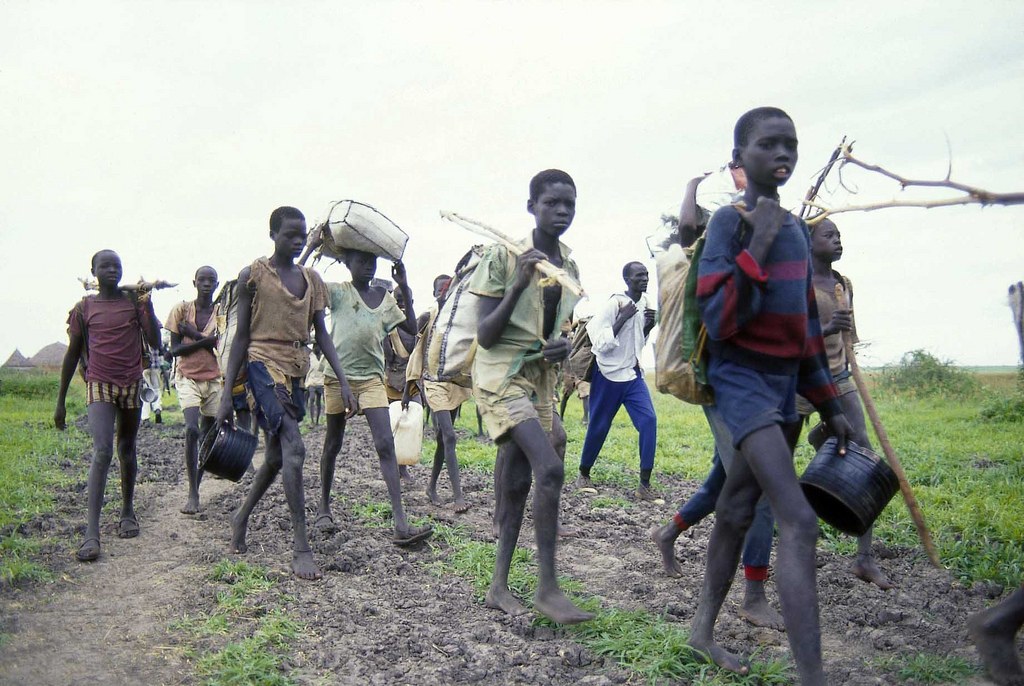
These are boys of 8, 9, 10, 11 years of age.  This army-of-recruits begins a march from South Sudan to Ethiopia, a journey of over 700 miles, gathering more orphans as they travel across Sudan.  Along the way, they become food for lions, and crocodiles; they are reviled as outsiders by frightened villagers and, unbeknownst to Achak and many of the boys—they are meant to become seeds of a revolution to overthrow Al-Bashir’s repressive government.  These children are to be educated and trained in Ethiopia to fight for the independence of South Sudan.  They are led by leaders of the “what” (takers of other’s something).

The lost boys are victims of believers in the “what”.  Achak and other Sudanese’ refugees walk, run, and swim a river to arrive in Kenya, hundreds of miles south of Ethiopia.  Some Sudanese were shot by Ethiopians; some were eaten by crocodiles; some died from disease and starvation.

KENYA'S REFUGEE CAMP

Then, in 1991, Ethiopia’s government changes.  The lost boys, a part of an estimated 20,000 Sudanese’ refugees, are forcibly ejected by the new government.

The Sudanese’ refugees arrive in Kakuma, Kenya.  Achak says Kakuma is a Swahili word for “nowhere”.  In 1992, it becomes home to an estimated 138,000 refugees who fled from several different warring African nations.  The SPLA remains a part of the refugee camp but their recruiting activity is mitigated in this new environment.  The camp is somewhat better organized but meals are limited to one per day with disease and wild animals as ever-present dangers.  Education classes are supported by Kenya, Japan, and the United Nations to help refugees manage themselves and escape their past.

Achak survives these ordeals and reflects on his unhappiness in Atlanta, Georgia.  Achak clearly acknowledges how much better living in America is than living in Africa. However, Achak makes the wry suggestion that Sudanese settlement in America changed his countrymen from abusers to killers of their women.

He suggests Sudanese killing of their women is because of freedom.  He explains freedom exercised by women in America is missing in Sudan.  In Sudan, Sudanese women would not think of doing something contrary to wishes of their husbands.  Achak infers Sudanese women adapt to freedom while Sudanese men feel emasculated.  The emasculation leads to deadly force in Sudanese families; a deadly force that includes murder of wives or girlfriends and suicide by male companions.

AMERICAN DREAM

Eggers successfully and artistically reveals the tragedy of Sudan.  Cultural and religious conflict in the world and American freedom are called into question.  The cultural belief of parts of the Middle East, Africa, and America drive Achak from nation to nation.  Achak, despite misgivings, appears to love America.  But, American democracy is no utopia. Achak realizes no system of government is perfect.  His ambition is to educate himself and his home country.  Achak realizes education is the key to a life well lived.

What is the What?  Ironically, it is more than cows; it is education that combats cultural ignorance and celebrates freedom and equal opportunity for all.

Eggers story implies America needs to re-think its policy on immigration.  We are a nation of immigrants.  Achak’s story highlights what is wrong with America and other parts of the world.  But it also shows the “what” (“the ‘what’ that is for you to decide”) can be made better because it is more than cows.

TO A HAMMER, EVERYTHING IS A NAIL

Audio-book Review
By Chet Yarbrough

(Blog:awalkingdelight)
Website: chetyarbrough.blog

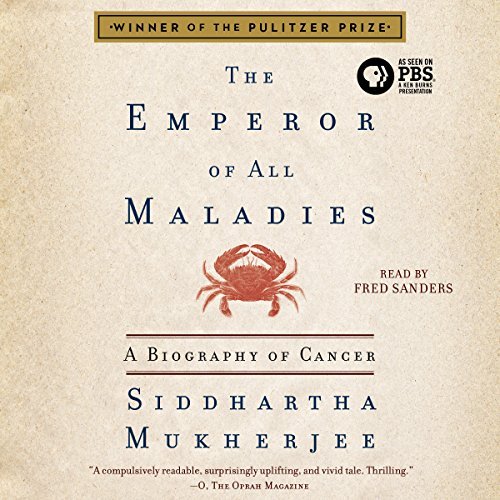
The Emperor of All Maladies, A Biography of Cancer

By Siddhartha Mukherjee

Narrated by Fred Sanders

SIDDHARTHA MUKHERJEE (AUTHOR, PHYSICIAN)

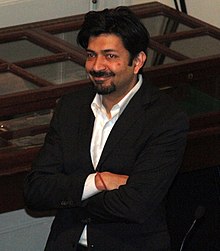
Dr. Siddhartha Mukherjee examines the history of cancer in “The Emperor of All Maladies”.

cancer death rates rising

The Centers for Disease Control and Prevention reports heart disease and cancer are the two leading medical causes of death.

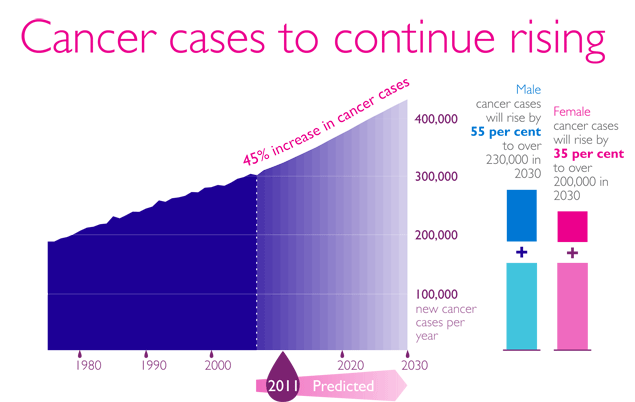
At first glance, one thinks–so what?  We are living longer, and everyone dies of something.  However, Mukherjee notes a study showing cancer deaths are rising: i.e. they decrease in one age group only to be offset by increase in another.  The net effect is a rising number of cancer cases.

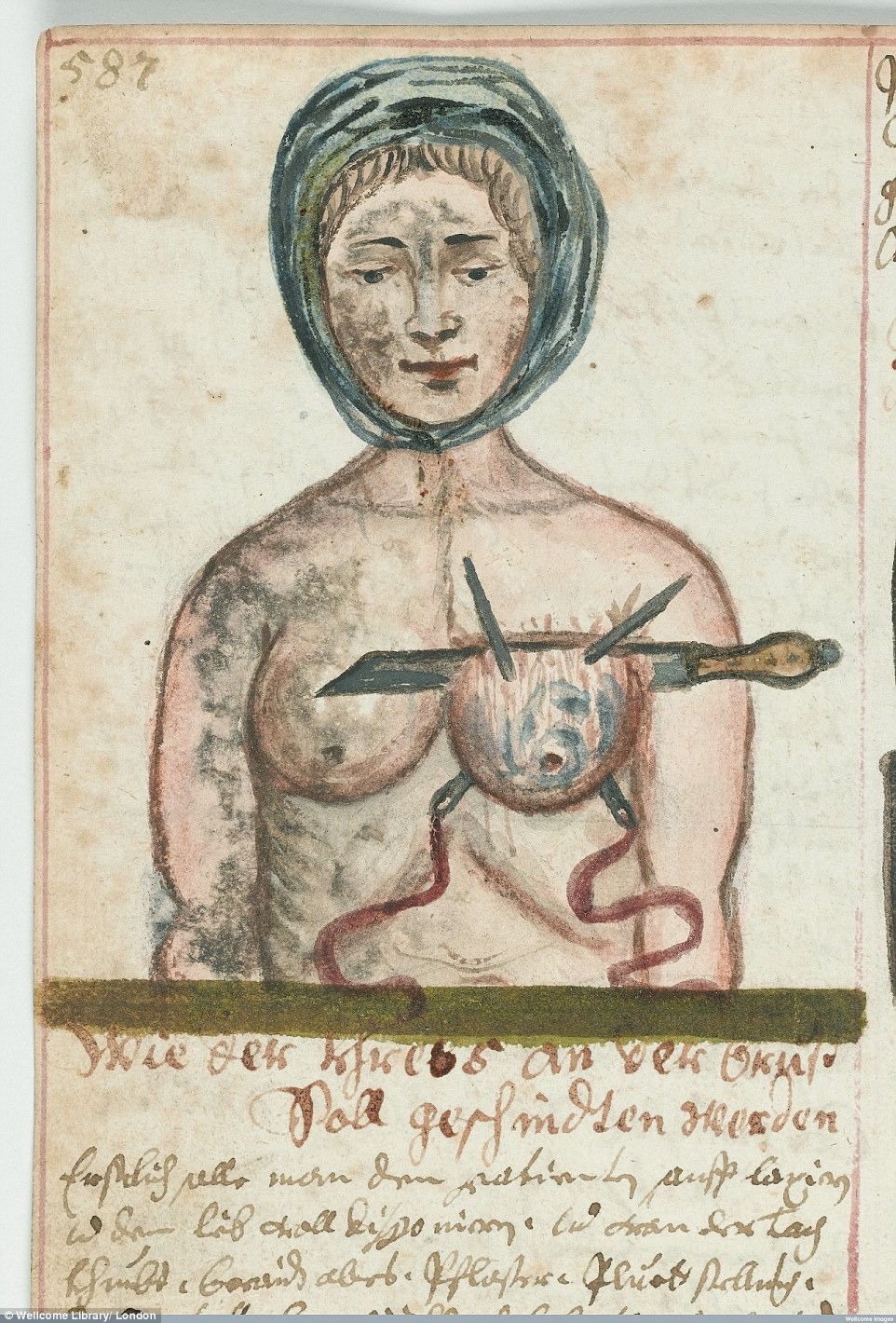
RADICAL MASTECTOMY IN THE 19TH CENTURY

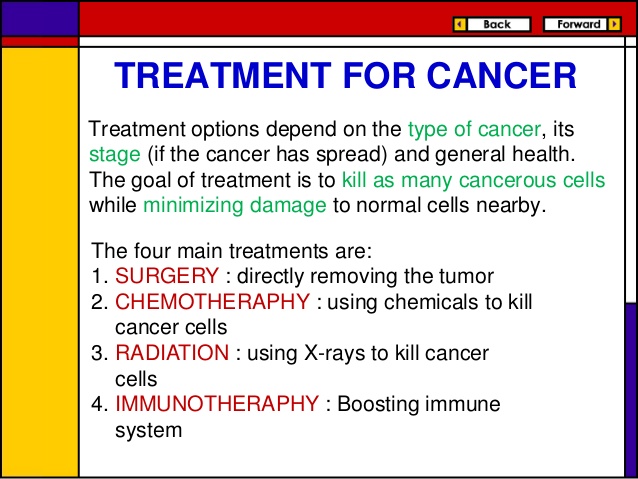
In researching the history of cancer, Mukherjee exposes the arrogance of medical specialization.  Mukherjee shows early attempts to cure cancer were led by surgeons who removed cancerous growth.

Cancer, like the threat of a pandemic, induces fear and panic. Both maladies are unpredictable in the face of a human desire for predictability, health, and well-being. There is no certainty in either diagnosis. All a human can do is persevere. And so it is today with Covid19, the most horrific pandemic since the 1918 flu epidemic.

“The Emperor of All Maladies” reminds one of the saying—”To a hammer, everything is a nail”. 

Cancer, like Covid-19, is a slippery killer.  Thinking Covid-19 is the flu is as misleading as a singular solution for cancer.

COVID-19 affects different people in different ways. Infected people have had a wide range of symptoms reported – from mild symptoms to severe illness.

Symptoms that may appear 2-14 days after exposure to the virus:

  • FeverCough
  • Shortness of breath or difficulty breathing
  • Chills
  • Repeated shaking with chills
  • Muscle pain
  • Headache
  • Sore throat
  • New loss of taste or smell

The world scrambles for a vaccine to treat COVID-19. Fear drives people to desperation.

The public needs to discipline itself when offered an alleged medical treatment without verifiable proof of efficacy by medical science.

Mukerjee recounts the missteps made by medical professionals in their search for a cure to cancer.

The hammer, in the early days of cancer treatment, is a scalpel wielded by surgeons who cut deeper and deeper into the body until the patient is physically disabled, in limited remission, or laboring toward death.  The surgeon believes he has removed the cancer only to find it returns in weeks or months later.

Surgery works but the scalpel is a hammer that only works when cancer is localized and non-systemic.

Radiation Effects

The next specialty is radiation.  Here the physician replaces the scalpel with focused radiation; another hammer. Radiation cannot kill systemic cancer without killing or diminishing a patient’s health.

CANCER AND CHEMOTHERAPY

Next up is the internal medicine specialist, the oncologist.  This specialty argues that cancer can best be treated with designer drugs to specifically attack or starve cancer cells.  The problem is medicines that kill cancer cells are generally toxic; i.e. they kill both good and bad cells.

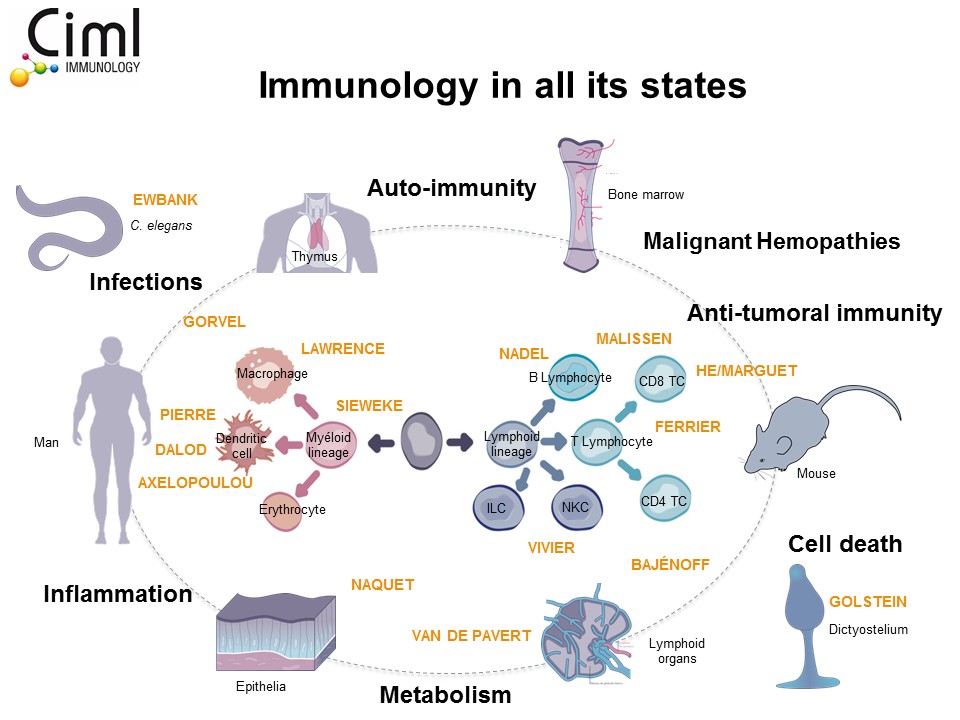
The final specialization is immunotherapy which ranges from bone marrow  and blood antigen enhancement to bone marrow transplantation. The purpose of immunotherapy is to make the body more resistant to cancer cell growth.

Though each specialization advances cancer remission, specialists lauded their own treatments and ignored each other’s accomplishments. 

CANCER AND MULTIFACETED TREATMENT

Specialists were historically proprietary about their treatments.  Some went so far as to distort their results with false clinical studies.  They felt their treatment was the best way of attacking “The Emperor of All Maladies”.

Specialists exclusively pursue their singular research, treatment, and reporting until a few physicians argued all disciplines should be enlisted to cure cancer.

CANCER AND EVOLUTION

The cure begins with physician attention and empathy for the patient.  Mukherjee infers cancer therapy is not for physician self-congratulation.  Hubris is a failing in physicians; just as it is in all human endeavors.  Cancer is an eternal war.  It changes with the environment and life’s evolutionary laws.

Mukherjee’s history explains how the chain of discovery for a cancer cure can be broken at different levels. 

There is physician self-delusion about how effective their treatment is for cancer.  There is the integrity of research studies and how they are conducted.  There is industry and government support of industrial waste production that is proven to be carcinogenic.

The door is opened to interdisciplinary research by philanthropists who created foundations to clinically study causes and cures for cancer.  Mukherjee addresses the continuing need for funding to expand cancer research.  He is not Pollyannaish about the need.  He acknowledges cancer research is not going to be like America’s race to the moon in the 1960s.  There is no definitive goal. The goal is not fixed like a mission to Mars.  Cancer’s etiology evolves.  It is unlikely for there to be a single-bullet solution that will cure cancer. 

Mukherjee expands on the difficulty in curing cancer because of capitalist resistance to scientific research, and discovery. 

MARLBORO MAN

Mukherjee recalls the battle with the cigarette industry when research clearly shows a correlation between cancer and smoking.  The cigarette industry lies to the public about their own studies correlating lung cancer with smoking.

Cigarette industry lobbyists influence legislation that delays concerted action by the government to curb the addictive characteristics of smoking.  Money talks, cancer proliferates.  (This reminds one of the gun lobby and their insistence that guns designed only to kill people are a right that should not be infringed upon.  Though gun use may not be addictive, there is a distinct correlation between the number of deaths in one incident and the proliferation of fully automatic weapons designed only to kill people.)

Mukherjee also recounts the incidence of cancer in England for chimney sweeps that inhaled carbon and asbestos from cleaning chimneys.  Today’s confrontations are carbon, other cariogenic, and environmental contaminants created by industry.

The National Institute of Health reports an estimated 1,735,350 new cancers will be diagnosed in the United States in 2018.  Of that number, 609,650 will die.  Worldwide, NIH reports 14.1 million new cases were identified in 2012.  8.2 million died.  The only killer more prolific than cancer is heart disease, and only by a small margin (In 2009, the CDC reports 610,000 people die every year from heart disease.)

PHYSICIAN HEAL THYSELF

Mukherjee implies all physicians need to step back, abandon their professional bias, and pursue treatments that are based on scientific research, symptoms, and reports of their patients.

Physicians need to listen, do no harm, and when necessary, offer palliative treatment—until, hopefully, a lasting cure is found. When the world is struck by a deadly virus, urgency is admittedly a gamble. Searching for a cure comes from science. When multitudes are dying, no-risk cures are unlikely to be discovered. Those who choose not to be vaccinated are risking more than their own lives when a pandemic strikes.

U.S. HEALTH CARE

Medical research and experimentation is costly. 

Mukherjee’s history shows the weakness and strength of capitalism and human nature in supporting what humanity needs to defeat cancer.  His history should be required reading; particularly for physicians, and researchers, but also for the general public.

NATIONALIZED MEDICINE

Audio-book Review
By Chet Yarbrough

(Blog:awalkingdelight)
Website: chetyarbrough.blog

Do No Harm: Stories of Life, Death, and Brain Surgery

Written by: Henry Marsh

Narration by:  Jim Barclay

HENRY MARSH (BRITISH NEUROSURGEON AND AUTHOR)

HENRY MARSH (BRITISH NEUROSURGEON AND AUTHOR)

An interesting insight offered by Henry Marsh’s memoir, “Do No Harm”, is a contrast between American and British Medicine.  Marsh’s candor about his life and profession surprise his audience and endear his curmudgeonly personality.  The surprise is in Marsh’s profound empathy and personal conflicts over neurosurgical decisions.

Marsh’s endearment comes from explicit “f-word” rants about incompetence, technology, and bureaucracy.  In addition to his rants, Marsh endears himself to an audience by explaining the distinction between a physician’s self-confidence and hubris.  Marsh suggests physicians need understanding and competence; not undue preciousness, and pride-full medical knowledge.  Jim Barclay’s narration perfectly suits the tone of Marsh’s memoir.

Caduces

Marsh is able to enter into medicine with little pre-medical education in the sciences.

Either by dint of a formidable intellect or a quirk of the British education system (maybe both), Marsh takes all his science courses after deciding to become a doctor.  One doubts an American medical school would have considered his application in the 1960 s.

Marsh graduates and begins his career in medicine under the guidance of experienced physicians.  As he acquires experience, he chooses to specialize in neurosurgical medicine under the supervision of a Consulting Neurological Physician.  The Consultant (a neurology physician trainee’s guide) works within the English national health care system as a qualified physician who supervises aspiring neurological physicians.  This consultant chooses cases for trainees; under varying levels of supervision.

Though a neurological procedure may be done by a trainee, the consulting physician is responsible.  This appears to be similar to internships in the United States.  However, an interesting difference is in the insurance for interns.

MEDICAL INTERNSHIP

MEDICAL INTERNSHIPS- English hospitals carry a trust to protect physicians from mistakes made in treating patients.

The UK’s physician-group self-insurance may be a distinction without a difference but, as in all medical insurance systems, mistakes do occur, and patients are harmed. The difference between physician-group self-insurance and American physician’ private insurance raises the specter of limited settlement for egregious mistakes.  On the other hand, it suggests British physicians are more likely to be more forthcoming on mistakes that are made.

Marsh completes his trainee experience and decides to become a Consulting Neurological Physician in the national health care system.  Marsh interestingly reveals several mistakes he and his trainees make during his years of consultancy.  In revealing those mistakes, a listener pauses to think about risks of patients who depend on English’ or American’ medical services.  Marsh’s stories of mistakes reflect on medical training, family apologies, and personal anguish over patient’ quality-of-life and death issues. 

MEDICAL MALPRACTICE IN THE UNITED STATES

Marsh explains, at best a Consultant Surgeon expects to learn from surgical mistakes to avoid repetition. 

The worst, for Marsh, is the apologies to families for the mistakes that are made.  In contrast to Marsh’s way of addressing mistakes, American physicians seem more likely to avoid family apologies; while hiding behind legal and insurance company shields.

MEDICAL TREATMENT-WAITING FOR TREATMENT IN ENGLAND

A more subtle message in Marsh’s book is the failure of the English National Health Service to provide adequate care for the general population; e.g. its long lines of patients who wait for attention when rapidly growing tumors are destroying a patient’s neurological system. 

Doctor/patient ratios in 2016 were 2.6/1,000 people in America. In 2018, the doctor/patient ratio was 2.8/1,000 in the United Kingdom. This raises the question of how long would Americans have to wait in line with a national health care system? Some argue physician assistants could be trained to take care of less serious medical issues. That would spread the burden of patient treatment.

Marsh complains of inadequate bed availability for patients that need operations.  Financing for the National Health Service is inadequate for the number of patients that need help. This seems a likely consequence of an American national health care system.

Marsh notes that he carries private health insurance to supplement his family’s medical needs.  At the same time, he infers private hospital services tend to gouge patients for their medical service; in part, from charges for unnecessary tests and superfluous operations. 

Marsh attacks the bureaucratic nature of the National Health Service that hires hospital administrators who are directed to reduce costs; regardless of patient’ load or patient’ need.  Technological improvements for England’s National Health Service are delayed because of lack of financing, poor administration, and inadequate training. These are maladies that will plague a national health care system in the United States.

U. K. HEATH CARE SYSTEM

Marsh leavens his criticism of England’s national health care by writing of his experience in the former U.S.S.R. (specifically Ukraine) where problems are monumentally greater. 

In the end, America’s effort to improve national health care is tallied in one’s mind against the current English picture painted by Marsh.  For medical patients, the English system seems riskier than the American system.  Doctors in England seem more insulated from medical mistakes.  If doctors are more insulated, they may take more risks; i.e. risks that can lead to patient’ disablement or death.  The American system, if one can afford the service, seems more conservative and less likely to take risks.

It seems England’s national health care offers a level of societal comfort because there is hope for affordable treatment.  On the other hand, Marsh clearly shows how government bollixes National Health Care with inadequate funding and a bumbling administrative system.  Some would say this is why the U. S. should not nationalize health care.

Marsh notes England’s private system has not met the needs of citizens who can afford additional service.  The private system suffers from human nature’s folly; i.e. the lure of wealth at the expense of fairly priced or truly needed medical treatment.

U.S. HEALTH CARE

Marsh suggests the private system suffers from human nature’s folly; i.e. the lure of wealth at the expense of fairly priced or truly needed medical treatment.

Is medical health service a human right or privilege?  One draws their own conclusion about British and American Medicine.  Marsh shows the monumental problems of affordable health care in England. 

A listener of “Do No Harm” infers problems of the British system for medical care will challenge America’s desire for universal health care. Dr. Marsh’s answer seems to revolve around empathy for all human beings; i.e. regardless of whether a country has a nationalized or private health care system.

EXTREME MEDICINE

Audio-book Review

By Chet Yarbrough

(Blog:awalkingdelight)

Website: chetyarbrough.blog

Extreme Medicine: How Exploration Transformed Medicine in the Twentieth Century

By: Kevin Fong

Narrated by Jonathan Cowley

KEVIN FONG (MD, SPECIALIZES IN SPACE MEDICINE IN THE UK)

Though not precisely on point, Doctor Kevin Fong addresses the principle of “right to try” drugs for treatment of terminal patients. In 2018 the House of Representatives of the United States voted a majority for “right to try”.  The Senate rejected it.

Fong, a physician, believes exploration and extreme medicine are linked.  He believes human survival depends on that linkage. Fong’s book, Extreme Medicine, links exploration and medical advance with real-life stories of adventure, discovery; failure and success.  He argues that exploration of the unknown transforms medicine.

Jean Hilliard (Frozen for six hours in January 2018–heart stopped and was clinically dead but recovered with no brain damage.)

Fong begins with a story of frostbite in the early 20th century.  The two edges of subzero weather are revealed; one edge destroys while the other preserves life

FROSTBITE

Fong recounts the life of a mariner that dies from frostbite.  Frostbite slowly saps life from his limbs, his brain, and finally his heart.  Then Fong tells of a skier’s accident in freezing weather that leaves her clinically dead for three hours.  The skier lives; even though more than 20 minutes passed without an operating autonomic system.

It took the ski patrol 20 minutes more to dig Kristin out as she was buried head first in the snow.
“She was completely unconscious,” McAllister said. “She was completely cyanotic, which means she was blue all over. When I got down there I just opened her airway and started to clear her chest of snow. Doing so she spontaneously started breathing on her own.

The mariner slowly succumbs to extreme cold and dies.  The skier rapidly succumbs to extreme cold and lives.   To Fong, this is a trans-formative discovery in medicine.  The skier’s recovery demonstrated the value of rapidly reducing one’s body temperature to arrest deterioration from physical trauma.  Doctors who treated the skier were using extreme medicine to preserve life when history suggests she would never recover.  That extreme medicine became standard operating procedure for certain kinds of traumatic injury.

HEART TRANSPLANT SURGERY

Fong offers several more stories of extreme medical practice.  Extreme medicine may initially kill patients but become life lines to future patients once extreme practices prove successful.  Big examples are heart surgery and organ transplants.  In the beginning, physicians abhorred the idea of cracking a living person’s chest to operate on a human heart.  Fong correlates humankind’s instinct for exploration with doctor’s exploration of medicine.

There seems some truth in that suggestion but there is an ethical difference.  Doctors are taking someone else’s life in their hands.  An explorer of the North or South Pole is choosing to risk his own life in exploration.  As a patient, fear of death is a constant motivation.   As an explorer, fear of death is situational rather than ever-present.

Ethics come into issue in the doctor’s sale of extreme medicine.  Life is always, to quote a book and movie title, a matter of “me before you”.  Doctors are human.  Money, power, and prestige affect their decisions just as they affect all human decisions.  The difference is that the patient has more to lose than the doctor.

CHINESE GENE EDITING DOCTOR

A logical extension of “Extreme Medicine” is the Chinese scientist, He Jiankui, who chooses to be the first to edit the genome of a baby — allegedly to protect the baby from contracting AIDS.

the island of dr. moreau

Dr. He is criticized as irresponsible for using a gene-editing technology called CRISPR that is presently being tested around the world.  The ramification of Dr. He’s genomic editing gives rise to concern over experiments like those conducted by the fictional scientist, Dr. Moreau.

The ethics issue is exemplified by Congress’s rejection of “right to try” legislation.  A patient’s right to choose is a form of extreme medicine with ethical and, many would say, moral significance.

Living life is by nature an exploration.  Human beings that choose to explore advance knowledge.  Knowledge drawn from exploration does transform medicine.  Knowledge transforms everything in life.  Life on earth is finite; with exploration, life is potentially infinite.  However, it is self-deluding to forget the moral and ethical questions raised by “Extreme Medicine”.

KNOWLEDGE AND EXPERIENCE

Audio-book Review
By Chet Yarbrough

(Blog:awalkingdelight)
Website: chetyarbrough.blog

Brain Myths Exploded-Lessons from Neuroscience

Brain Myth's

Recorded by THE GREAT COURSES
By Indre Viskontas

Lecture

INDRE VISKONTAS

(AUTHOR) Indre Viskontas is an Adjunct Professor of Psychology at the University of San Francisco.  With a PhD in Cognitive Neuroscience, Viskontas has done research on neuro-degenerative diseases.

Indre Viskontas covers a broad area of knowledge and experience.  She offers many counter intuitive insights to human behavior and the brain in several recorded lectures.  She explains neuronal and behavioral functions of the brain.

Viskontas explains how and why the brain, though highly complex, and insightful, can be judgmentally weak, misleading, and health adverse.  A human brain can provide extraordinary insight to the nature of things and events while maintaining the body’s autonomic system.  On the other hand, that same brain can create appalling misinformation about things and events, distort the truth, and cause autonomic failures.

From regions of the brain to basic parts of neurons, Viskontas dissects what is known and unknown about brain function. She ties brain anatomy to our limited knowledge of consciousness and human behavior.

Viskontas is one of many myth breakers. She notes, the brain has adapted to its environment, but some functions are inefficient, misdirected, and self-destructive. Brain evolution is a lucky draw informed by circumstances.

The brain is not perfect. She notes that the brain is a part of an evolutionary cycle.  Every cycle of life has the chance of improving or destroying some aspect of the brain’s design.  So far, the brain has adequately adapted to its environment, but some functions are inefficient, misdirected, and self-destructive.  Brain evolution is a matter of luck and circumstance.

Giant dinosaurs adapted in their generation, but most dinosaur species died because their physical evolution could not keep pace with environmental change.  Viskontas notes the human species follows the same evolutionary path.

Luck comes from adaptation to an evolutionary change.  Circumstance comes from the environment that compels change.  Only time will tell whether environmental change becomes too great for human adaptation.

Viskontas shows the perfect brain is a myth because evolution is an arbitrary and imperfect process.  Evolution can produce human gene improvements or replicate destructive gene changes.

Intelligence

Viskontas notes current measurement of intelligence slightly correlates with brain size.  But, size matters little. 

She notes that Einstein’s brain is found to be average in size.  However, it is noted to have some differences; i.e. like the number of glia cells (chemical “information transmission” cells) which were more numerous in Einstein than the average brain.  Also, Einstein’s brain had more interconnection between brain segments than the average brain.  Bigger is not necessarily better.

The Brain Chemistry Effect

Viskontas suggests chemical imbalance as a singular explanation for psychosis is misleading.

The many connections between brain segments suggest chemical imbalance is an oversimplification of psychiatric dysfunction. Viskontas acknowledges the success of drugs to mitigate aberrant behavior but she notes that neurotransmitters affected by a chemical imbalance are only one part of a healthy functioning brain.  Chemicals in the brain are always in flux.  Drug therapy is a scatter shot solution rather than precise treatment for negative psychological symptoms.

Another often-believed myth is that people who are left-brained are logical; while people who are right-brained are creative. 

LEFT BRAIN-RIGHT BRAIN

Viskontas shows that both sides of the brain are activated when creativity or logic are drawn upon. The interconnections and malleability of brain hemispheres suggest logic and creativity come from both hemispheres and can (to a degree) come from one, if the other is damaged.

BRAIN DIFFERENCE MEN AND WOMEN

Viskontas notes that men’s and women’s brains are different. 

However, Viskontas concludes similarities far outweigh differences.  She notes double-blind experiments that show women have better memories than men when emotion is involved.  The region of the brain called the amygdala is larger for men than women.  Viskontas suggests the different sizes may account for differences in sexual behavior.

Parenthetically, she notes there is a medication bias in treatment for men and women because most experiments use men as the subject of investigation for drug trials.  Women are underrepresented in clinical trials.

EYE WITNESS IDENTIFICATION ERRORS

Viskontas and other writers have exploded myths of accurate human memory. 

Human brains are not movie projectors.  Human brains recall memories as stories; not discrete facts.  Memories are recreations of what one has experienced (both in the distant past, near past, and present).  Facts are often added, and stories are embellished when memories are recalled.  The accuracy of memories is highly influenced by an individual’s past and present experience.

Viskontas goes on to explain that life experience creates conscious and sub-conscious bias.  When past experience is added to the memory of an event, the brain recalls memory for continuity, more than truth; i.e., facts change, and incidents are misrepresented, or misunderstood.  Recalled events are biased by experience.

THE FIVE SENSES

We have five senses, but they focus on details that meld into a story that makes logical sense to the person recalling a memory. 

Viskontas notes that our senses mislead us because we do not see everything.  Like historians, we only report the facts we choose to include.  There are always more facts about historical events than can be reported by the most diligent historians.  Some facts are left out that change the accuracy of history.  That is why Ulysses Grant is an incompetent President to some and a great President to others.

HEALTHY OLD AGE

Viskontas sites experiments that show neurons continue to grow throughout one’s life if they stay engaged with society and work on learning new things. Those over 50 need to get out of their cars and walk to the store or the local coffee shop whenever possible or practical.  Stand more; sit less.

Then there is the myth of old age and neuronal decay that begins after 50.  Viskontas sites experiments that show neurons continue to grow throughout one’s life if they stay engaged with society and work on learning new things.  An important caveat is that neuronal growth is improved with exercise.  So those over 50 need to get out of their cars and walk to the store or the local coffee shop whenever possible or practical.  Stand more; sit less.

There are more brain myths exploded by Viskontas, but a final example is the myth that we use only 10% of our brain.  All parts of our brain are interconnected.  Not all parts are necessarily engaged at once, but interconnections suggests 100% of our brain is used at one time or another.

Viskontas’s knowledge and experience suggest memory holds some truth but not all the truth.

INSTITUTIONAL FAILURE

Audio-book Review
By Chet Yarbrough

(Blog:awalkingdelight)
Website: chetyarbrough.blog

Fourth of July Creek: A Novel

By Smith Henderson

Narrated by MacLeod Andrews, Jenna Lamia

SMITH HENDERSON

SMITH HENDERSON (Author, Screenwriter)

On a scale of 1 to 10, with 1 the least trustworthy, a random audience survey marks trust in government as 1. Therein lies the fear of government intervention in the ideals of capitalism. It strikes at the heart of today’s public concern over economic stimulus, the environment, voting rights, equality of opportunity, police reform, and freedom.

Smith Henderson’s Fourth of July Creek is about broken lives and institutional failure.  After two chapters, a listener wonders, “Is this America”?  Henderson vivifies a part of America conditioned by high divorce rates, sexual exploitation, substance abuse, and institutional apathy.

In Henderson’s story Pete Snow is a divorced, alcoholic social worker.  Snow works in child welfare services, covering a large area of Montana. Snow makes a point of saying he is not a cop whenever he is investigating a home with children that are suspected of being neglected. 

Snow is a character that sees the worst side of human nature; i.e. like a cop, Snow is exposed to a world of human’ degradation that fills and empties his life.

Though Snow is careful to distance himself from police, he is mired in the same dark side of humanity. 

Henderson’s point is human apathy grows in some social service jobs because government lacks oversight and public accountability.  The public feels the job is getting done because there is an institution to serve the need. Henderson’s story implies the public is apathetic. The public becomes apathetic because government has a department to do the job. The public might trust but does not verify. (Even more likely, the public is consumed by their own needs and wants and ignores social services that do not directly affect them.)

DONALD TRUMP (REPUBLICAN NOMINEE FOR PRESIDENT OF THE U.S. 2016)

Fourth of July Creek infers that Presidents make no difference when it comes to broken lives of abandoned and abused children.  However, Trump has shown (often in a negative light) that Presidents do make a difference.

Over 400 immigrant children remain separated from their families because of Trump’s enforcement of a flawed immigration policy.

Henderson’s story shows that child welfare services, like many public service jobs, attract employees with good intention who succumb to apathy and routine.  The job becomes a paycheck rather than a calling.  It is not that an employee is necessarily bad or incompetent but public service goals are often not humanly achievable within strict use of institutional rules.  Institutional rules are made by people who often only preserve institutions.  The institution survives whether or not it solves human problems.

The story begins with the case of a single mother, a teenage son, and a pre-school daughter.  The mother and son are brawling with each other.  A cop is at the scene when Snow arrives.  Snow is a case worker for the family.  The mother is a drug addict.  She cannot manage her son for reasons greater than her drug habit.  The solution is to remove the son from the family to live with a relative but the relative does not want the boy. 

Children in Jail

Snow finds a foster family that takes the boy but the boy ultimately runs away after the foster family decides he is too ungovernable.

The boy is caught.  He is placed in something like a reform school.  He is institutionalized.  The boy is abandoned.

In the boy’s mind, Snow betrayed him.  Snow is remorseful but has no realistic alternative.  He cannot find the boy’s mother.  She has moved on.  Even if she had not moved on, Snow finds that the boy’s mother had sexualized her relationship with the son and could not be any part of the boy’s life.  Divorce, sexuality, substance abuse, and institutionalized apathy swallow this American boy’s life.

This sexually abused son is only a small part of Henderson’s story.  The main story revolves around family dysfunction in America.  Child abuse is bred by single parent families, sexual exploitation, substance abuse, and ineffectual public service institutions.  Several families, including Snow’s own family, are battered by divorce, sexual depredation, drug and alcohol abuse, and unavailable or ineffectual public services.

CHILD ABUSE STATISTICS

A deranged woman is married to a man who loves her deeply.  The husband is unable to comprehend or deal with her psychosis.  The husband enables his wife by isolating her and their family in the wilderness.  The children are raised like animals in the forest.  A myth about the family is created by the Bureau of Alcohol, Tobacco, Firearms and Explosives, the FBI, and DEA.  The ATF begins a covert operation to investigate the family.  In the course of the investigation, the husband is betrayed by an undercover ATF agent and becomes a conspiracy-of-government’ believer.

RUBY RIDGE (RANDY WEAVER, SURVIVOR)

RUBY RIDGE (RANDY WEAVER, SURVIVOR)

Snow comes across one of the husband’s sons and begins a case file on the family.  Snow becomes a friend of the son and eventually the husband.  This journey to friendship and understanding reveals a part of Henderson’s theme about American extremism and how it germinates and grows.

Henderson frames a story that captures American government failure.  The book can be listened to as a cautionary tale, a call to action, or just a well written tale of travail.  It is no wonder that government trust is at such a low ebb. The events of January 6, 2021 are a reflection of loss of trust in American government.

At the very least, one comes away with the feeling of how lucky they are to have NOT lived the life of one of Henderson’s characters.  MacLeod Andrews’ and Jenna Lamia’s narration add to the drama of Henderson’s expertly written fiction.

In spite of Henderson’s heart breaking story, America remains among the best places in the world to live. In retrospect, only a small number of U.S. Presidents have managed to restore trust in government. In 2021, a new President has an opportunity to restore that trust.

ADDICTION

Audio-book Review
By Chet Yarbrough

(Blog:awalkingdelight)
Website: chetyarbrough.blog

Infinite JestInfinite Jest

By David Foster Wallace 

Narrated by Sean Pratt

DAVID FOSTER WALLACE (1962-2008)

Great credit is deserved by the publisher and editor of “Infinite Jest”.  It is unlikely that most publishers would stick with “Infinite Jest’s” stream-of-consciousness journey.  It is too long.  As one of Wallace’s characters observes, the explanation has “too many words”.  “Infinite Jest” is disjointed and comes together late in its narrative.  “Infinite Jest” takes fortitude to complete.  It is an excruciating story of a closely examined life.  The author is testing the reader to see if he/she would rather escape than stick with David Foster Wallace’s examined life.

David Foster Wallace frustrates and fascinates readers with several extraordinary but flawed human beings.  The main character in Wallace’s book is Hal Incandenza.  But every created character is a part of who David Foster Wallace is or wants to be.  Wallace’s self-absorption, destructive behavior, and vulnerability seep from every ink-stained page; from every enunciated sentence. His “Infinite Jest” becomes real and complete with his wasted suicide at age 46.

DRUG ADDICT
“Infinite Jest” is about addiction. It argues that modern civilization is jaded by plenty, i.e., movies, sex, drugs, and other distracting entertainments are so plentiful that escape from the trials of life becomes the purpose of life.

“Infinite Jest” is about addiction. “Infinite Jest” argues that modern civilization is jaded by plenty, i.e., movies, sex, drugs, and other distracting entertainments are so plentiful that escape from the trials of life becomes the purpose of life. Human success is redefined.  Escape from conflict replaces drive for money, power, and prestige.  Obsessive/compulsive behavior focuses on immediate gratification.

Hal Incandenza’s father, named “Himself” in Wallace’s book, creates a movie that has the seductive and destructive characteristics of an addictive drug.  The movie becomes a secret weapon of destruction that stimulates the pleasure foci of the brain that destroys human interest in anything other than its replay.  The jest is that pleasures, though ephemeral, are pursued without end and at any cost (including dismemberment and death).  The pleasure of a watched movie leads to self-destruction.

the attention merchants
Wallace’s book suggests a movie (media in general) has the seductive and destructive characteristics of an addictive drug.

In real life, Wallace achieves fame and financial stability with his writing.  Retrospectively, “the jest” is that Wallace’s literary achievement is not enough to sustain his life because continued life demands work rather than Wallace’s chosen escape from reality.  He lives the life and dies the death of his characters in “Infinite Jest”.

Wallace’s main character, Hal Incandenza, is a self-destructive, amateur, world-class tennis player in “Infinite Jest”. (Wallace was a competitive tennis player in real life.)  Himself, Hal’s overachieving and failed-athlete father, is a wildly successful inventor and optics expert. Hal has two brothers.  One is Mario, a middle son of the Incandenza family that reminds one of Dostoevsky’s main characters in “The Idiot”.  The second is Hal’s older brother who is a star punter for a professional football team.  All of the Incandenza characters are aspects of an examined life of David Foster Wallace.

Himself (Hal’s nicknamed father) makes a movie entertainment with a beautiful young woman who is half his age who disastrously couples with Hal’s older brother Orin.  The beautiful young woman is so beautiful that she bargains with Himself to offer her naked image in his film in return for Himself’s abandonment of drugs.  An irony of the bargain is that the beautiful young woman is a drug addict herself (another jest).  Himself chooses to commit suicide by sticking his head into a microwave.  Himself finds it easier to avoid rather than challenge the stresses of life.

stresses of life
Wallace implies in today’s culture; it is easier to avoid rather than challenge the stresses of life.

Playing competitive tennis, writing a book, or making a movie is not as easy as hitting the re-play button for a movie, snorting a line of cocaine, sniffing a bong, or offing oneself.  There is prescient insight here that resonates with today’s growing escapist drug use.

Mario, the younger brother of Hal, is a mentally challenged, strangely insightful, angelic character that reflects an altruistic aspect of life. One wonders if that is a part of what David Foster Wallace wishes himself to be.  Competing, writing, and movie making require thinking, working, creating, with all its pains, disappointments, failures, and ephemeral successes.  As an addict, the experience of drugs, alcohol, sex, gaming, etc. are great pleasures in the beginning, faltering pleasures in the middle, and killers in the end; at least it became so for David Foster Wallace.

CDC WONDER Data for Website_02-04-15.pptx
Increasing drug use and overdosing statistics suggests Wallace knew what he was writing about.

“Infinite Jest” is a brilliant piece of work.  However, it is David Foster Wallace’s view of life.  It is sad that Wallace ends his life because the meaning of life is trivialized by his suicide.

If brilliant minds like Wallace conclude that suicide is a preferred end to life’s journey than perfecting humanity is a delusion.  If society is addicted to entertainment, then Wallace infers suicide is a harbinger of the future.  Are we all becoming addicts?  Increasing drug use and overdosing statistics suggest Wallace knew what he was writing about.
A CLASSIC’S TRUTH

Audio-book Review
By Chet Yarbrough

(Blog:awalkingdelight)
Website: chetyarbrough.blog

The Road to Serfdom

By Friedrich A. Hayek

 Narrated by William Hughes

FRIEDRICH AUGUST von HAYEK (1899-1992)

Hayek wrote “The Road to Serfdom” during WWII.  His observation was that Nazi Germany and its rise to power had a direct relationship with the growth of socialism, a belief that central planning and control are keys to national prosperity. 

Hayek suggests that America and Great Britain suffer a similar strain of belief.  He argues that central planning and control leads to totalitarianism.  “The Road to Serfdom” is a prescient vision of the dangers of socialism.

The dilemma of government is in drawing the line between central planning and public service. It is particularly complicated by what the intent of Article 1, Section 8 of the Constitution meant when it said a part of the purpose of government is to “promote the general welfare”

It seems common that authors of popular, sometimes classic, books are often interpreted by people who have not read them.  Authors like Harriet Beecher Stowe, Richard Wright, Ayn Rand, Vladimir Nabokov, and Friedrich Hayek are frequently commented on but content often becomes a surprise to actual readers.

Friedrich Hayek’s book is frequently lauded by American conservatives and vilified by American liberals. 

classic liberalism

In truth, Hayek is a seer for both ignorant American’ conservatives and liberals; i.e. Hayek is neither a spokesman for modern American conservatism or liberalism but a strong proponent of classic liberalism.

To be clear, today’s conservatism and liberalism are not defined in the same way Hayek defines them in his 1944 publication.  Liberalism in 1944 meant belief in freedom of choice and endorsement of laissez-faire economic principles.  1944 conservatism meant a rejection of the principles of equality with an aristocratic, “rank has privileges”, ideology.

subsidization
Contrary to Hayek’s conservatism, modern conservatives and liberals endorse subsidization of private enterprise.  Subsidization comes from tariffs, tax incentives, and other preferential treatment for private business and industry.

Principles of equality and laissez-fair economic principles are less doctrinaire in the 21st century because American political parties blur the difference.  Modern liberals are closely associated with government regulation and intervention but not necessarily laissez-faire principles. 

Modern conservatives are opposed to government in most forms of regulation and intervention, but only in principle; not in practice.  Modern conservatives, as well as liberals, endorse subsidization of private enterprise.  Subsidization comes from tariffs, tax incentives, and other preferential treatment for private business and industry.

JOHN MAYNARD KEYNES (1883-1946)

Contrary to a wide perception that John Maynard Keynes (a liberal economist in today’s parlance) denigrated “The Road to Serfdom”; Keynes, in fact, praised it.  John Maynard Keynes believed in government intervention when a state’s economy is in crisis.

According to Thomas Hazlett in the July 1992 issue of “Reason Magazine”, Keynes wrote “In my opinion it  (Road to Serfdom) is a grand book…Morally and philosophically I find myself in agreement with virtually the whole of it; and not only in agreement with it, but in deeply moved agreement”. 

Though Keynes praised “The Road to Serfdom”, he did not think Hayek’s economic’ liberalism practical; i.e. Keynes infers that Hayek could not practically draw a line between a safety net for the poor, uninsured-sick, and unemployed (which Hayek endorsed) while denying government intervention in a competitive, laissez-faire economy.

When businesses have an unfair advantage that denies competition, Hayek suggests government regulation is required.

GOVERNMENT REGULATION

Where modern conservatives get “The Road to Serfdom” wrong is where Hayek writes that government has an important role in a nation’s economy that goes beyond a simplistic notion of laissez-faire. 

Where modern liberals misunderstand “The Road to Serfdom” is where Hayek explains that freedom of choice is essential within the bounds of safe pursuit of economic success.  When human safety issues from uncontrolled industrial pollution threatens the safety of society (which most modern scientific opinion calls global warming) Hayek writes government intervention is necessary.

After listening to “The Road to Serfdom”, one cannot help but believe that Hayek would be as appalled by “private” industry’s greed in the 21st century. 

Hayek wrote that big business is not bad in itself but big business that fails to compete on a level playing field because of government subsidy, through tax concession and special treatment, should be regulated by government to ensure fair play.

REGULATING BIG BUSINESS
TRUMP AND CLIMATE CHANGE

In the face of overwhelming evidence to the contrary, Trump denies the reality of global warming.

One is compelled to agree with Hayek when he observes that government programs interfere with free choice when government officials create social programs they think are good for someone else.  Hayek is not saying that government should not care for the poor, work-disabled, or technologically unemployed.  He writes: “Where, as in the case of sickness and accident, neither the desire to avoid such calamities nor the efforts to overcome their consequences are as a rule weakened by the provision of assistance – where, in short, we deal with genuinely insurable risks – the case for the state’s helping to organize a comprehensive system of social insurance is very strong.” 

Hayek goes on to suggest that technological change that causes unemployment warrants government assistance.  The danger Hayek tries to make clear is that government interferes with free choice when social programs try to create false equalities.

BREAD LINES IN NEW YORK 1933
BREAD LINES IN NEW YORK 1933–Hayek is not saying that government should not care for the poor, work-disabled, or technologically unemployed. 

Hayek writes: “Where, as in the case of sickness and accident, neither the desire to avoid such calamities nor the efforts to overcome their consequences are as a rule weakened by the provision of assistance – where, in short, we deal with genuinely insurable risks – the case for the state’s helping to organize a comprehensive system of social insurance is very strong.”

Hayek is acknowledging a role for government.  The role is to regulate private enterprise in those areas where freedom of choice or equal opportunity is infringed upon. 

HEALTH INSURANCE
If insurance is not available to all in a land of prosperity, then government has a role in creating a program that will offer insurance to all. 

Hayek’s only caveat is that the insurance be offered as an affordable, free enterprise, and individual choice, not as an entitlement.

FREE TRADE IDEAL

Hayek opposes government programs that interfere with free competition among similar businesses. 

The weakness of Hayek’s argument is in idealization of humanity; i.e. human nature is that leaders in government and the private sector will drive for advantage.  In the case of one country, that advantage may theoretically be mitigated by impartial government regulation but, in a world of sovereign nations, power is inherently limited.

If China wants to subsidize steel exports, American options are limited to creating import tariffs that further distort market competition. This is the mistaken route that President Trump has taken. Further, Hayek’s idealization presumes that politicians cannot be bribed, human beings are not prejudiced, populations have an equal opportunity to succeed, and humanity is inhumanly perfect when left in a state of grace.

Hayek correctly points out the importance of money as a measure of success in a free society.  However, in today’s America, “Moneyocracy” has become an American form of government.  “Moneyocracy” is the aristocracy of the 21st century that elects public officials, denies equality of opportunity—for education, economic mobility, and employment.

GAP BETWEEN RICH & POOR

The gap between the rich and poor is widening by degrees that may bankrupt America because of an enlarging safety net for the old, the sick, the unemployed, and the unemployable.

 The field of competition for free enterprise is becoming more unequal.  Hayek observes that government intervention slips into socialism when free enterprise is artificially manipulated.  The fear is that America will begin looking for their Hitler to manage a sick economy.

Conservatives that rant against government regulation based on Hayek’s “Road to Serfdom” are as incorrect as liberals that argue Hayek wrote against social government programs for the poor, disabled, and unemployed.

DECRIMINALIZATION

Audio-book Review
By Chet Yarbrough

(Blog:awalkingdelight)
Website: chetyarbrough.blog

flowers in the blood

Flowers in the Blood: The Story of Opium

By: Jeff Goldberg, Dean Latimer, William Burroughs (Introduction

Narrated by Stephen McLaughlin

JEFF GOLDBERG (AMERICAN JOURNALIST, STAFF WRITER FOR THE ATLANTIC)
JEFF GOLDBERG (AMERICAN JOURNALIST, STAFF WRITER FOR THE ATLANTIC, & POLITICAL PUNDIT)

Published in 1981, “Flowers in the Blood” argues for decriminalization of opiates.  The idea remains controversial in 2018, and 2022.  Written by Jeff Goldberg and Dean Latimer, a listener feels misdirected by historical information.

DEAN LATIMER (WRITER FOR THE EVO, AKA EAST VILLAGE OTHER-WENT ON TO EDIT HIGH TIMES)

The feeling of misdirection is reinforced by a languid, seemingly opiated, performance of the narrator, Stephen McLaughlin. It is not that one is seduced by Goldberg and Latimer’s writing, but a listener feels cornered in a room of opium eaters.  Goldberg and Latimer reveal how opium is extracted from a flower to offer a tranquil escape from life’s stresses, with a tantalizing peek at world clarity.  Opiate extraction seems simple; the consequence of use, not.

OPIUM POPPY
Goldberg and Latimer reveal how opium is extracted from a flower to offer a tranquil escape from life’s stresses, with a tantalizing peek at world clarity.  Opiate extraction seems simple; the consequence of use, not.
brave new world
Goldberg and Latimer argue that opiates enhance natural neurotransmitters, like endorphins, to reduce stress and depression caused by living life.  This argument reminds one of a “Brave New World” where every stress in life is characterized as negative.

Goldberg and Latimer argue that opiates enhance natural neurotransmitters, like endorphins, to reduce stress and depression caused by living life.  This argument reminds one of a “Brave New World” where every stress in life is characterized as negative.

Goldberg and Latimer note that refinement of opium into morphine and heroin increases its addictive power.  They extol the pleasure of opiates while cataloging its history of addiction.  Goldberg and Latimer reflect on opium’s effect in altering cerebral states of being.  Their argument seems counter intuitive.

They note its use by artists ranging from Charles Dickens to Elizabeth Barrett Browning.  They infer opiates enhance artist’s abilities.  They realistically identify opiates’ medical benefit, while exposing its potential for addiction.  Goldberg and Latimer suggest opiates enhance artistic sensibility, and temper sociopathic homicidal acts. They begin an argument for legalizing opiates.

OPIATE LEGALIZATION
Goldberg and Latimer extol the pleasure of opiates while cataloging its history of addiction.  Their argument is counter intuitive. They begin a defense for legalizing opiates.

Goldberg and Latimer argue that there are three options.  One, continue jailing narcotic purveyors and users.  Two, legalize opiates and let the free market determine use.  Three, decriminalize opiates and offer treatment to those who become addicted.

Their argument is for number three; they suggest number one (the American standard) is ineffective, and number two would be a disaster in the making.  Goldberg and Latimer argue that America should legalize and regulate opiates and treat those who become addicted.

DRUG TREATMENT AND COUNCILING
America regulates alcohol and tobacco, both proven addictions.  Alcohol and tobacco are regulated by the market, with education on their harmful effects and government taxation to increase prices that affects consumption.  Goldberg and Latimer argue that America should legalize and regulate opiates and treat those who become addicted.

America regulates alcohol and tobacco, both proven addictions.  Alcohol and tobacco are regulated by the market, with education on their harmful effects and government taxation to increase prices that affects consumption.  These regulations have had some success, but people still have the right to drink and smoke to excess.

The option of opiate legalization is troubling because it infers substituting inner-direction of human beings for other-direction by government.  It increases the potential of a “Brave New World” where human choice is no longer individual but collective.

DRUG USERS
Goldberg and Latimer point out that punishing the addicted with prison is a mistake.  Those who succumb to addiction need help; not punishment.

Goldberg and Latimer point out that punishing the addicted with prison is a mistake.  Those who succumb to addiction need help; not punishment.  One can readily accept that argument but opiate regulation by the government is a step too far.  This may be a distinction without a difference but Alcohol and cigarettes are still a private sector choice with government intervention (principally tax increases and education) based on political input.

PHILIP SEYMOUR HOFFMAN (1967-2014)
The loss of Seymour Hoffman in February 2014 was a tragic loss.  Hoffman dies at the age of 46, John Belushi at 33, Kurt Cobain at 27, Billie Holiday at 44, River Phoenix at 23; all from opiate overdoses.  If opiates were legalized, would these artists have been saved—who knows?

The loss of Seymour Hoffman in February 2014 comes to mind.  Hoffman dies at the age of 46, John Belushi at 33, Kurt Cobain at 27, Billie Holiday at 44, River Phoenix at 23; all from opiate overdoses.  If opiates were legalized, would these artists have been saved—who knows?  They chose addiction to escape the insecurity and stress of life.  Their choice is their choice.  Insecurity and stress are facts in every human’s life.  America’s failure is related to treatment, not government control of human choice.

WAR ON DRUGS
With treatment programs, the government will make the objective of addicting users a waste of manufacturer’s and seller’s time.  It may not eliminate illegal drug activity but it will make it less financially viable.

America needs to continue their fight against illegal opiate manufacturers and sellers.  Threat of punishment is not the key but reduction in profitability will drive illegal manufactures out of the market.  With treatment programs, the government will make the objective of addicting users a waste of manufacturer’s and seller’s time.  It may not eliminate illegal drug activity but it will make it less financially viable.  Addiction treatment programs and substance abuse’ education are legitimate roles for state governments.  Opiates should be subject to the same laws that presently govern drug research and development.

Unfortunately, “Flowers in the Blood” fails to nuance legalization of opiates.  It leans more toward influencing uneducated poor, educated middle class, and idle rich to experiment with addictive drugs.  Goldman and Latimer are on the right track with regulation and treatment of addiction, but their book encourages drug experimentation in a culture that needs no encouragement.  Stress is a part of life and being drugged into obliviousness diminishes humanity.

A PHILOSOPHY OF LIFE

Audio-book Review
By Chet Yarbrough

(Blog:awalkingdelight)
Website: chetyarbrough.blog

The Complete Essays of Montaignethe complete essays of montaigne

By: Michel Eyquem de Montaigne, Donald M. Frame (translator)

Narrated by Christopher Lane

MICHEL DE MONTAIGNE (1533-1592)

Michel Eyquem de Montaigne, a sixteenth century philosopher and writer, wrote and re-wrote “Essays”, originally published in the 1580s.  Essay was a new form of writing.  Montaigne’s subject is the philosophy of life and death.

Montaigne writes his collection of essays while cloistered in a château in southwest France.  Donald Frame translates and compiles three volumes of Montaigne’ essays into one book–“The Complete Essays of Montaigne”, first published in 1957.

contemplation
Montaigne, born into a family of wealth, affords the luxury of time for personal reflection and contemplation.

Montaigne, born into a family of wealth, affords the luxury of time for personal reflection and contemplation.  Not surprisingly, Aristotle wrote that life depends upon awareness and the power of contemplation.  In one respect, this quiet life is a contradiction in Montaigne’s philosophy.  Montaigne reflects on history and ancient times to explain how life should be lived when his life seems a shadow of most people’s reality, the reality of a day-to-day fight for survival.  There is reader skepticism about the 1% life of Montaigne versus the 99% life of most people.

Montaigne, with great family wealth and a storied education, becomes a Mayor of Bordeaux.  He draws on a privileged life and recorded lives of great philosophers and leaders to create insight about lives of those that “do”, and have little time, or no time, to contemplate.

ELITISM
Montaigne is modest about his erudition but there is an elitist odor that clings to his self-effacing commentary.

Montaigne suggests the appeal of his essays lies in the middle of the human population.  Montaigne suggests the in-between are those who are not highly intelligent, who are abysmally ignorant; preferentially plebeian, and ordinary.  In other words, people of course nature and manner, like this critic.  In spite of this elitist leaning, the wisdom noted in Monsieur Montaigne’s essays is enlightening.

This is a one thousand page journey with something for everyone.  Montaigne suggests humans need to embrace life and eschew tragic interpretations of death.  Life and death are only stories of being.  Death is inevitable and should not be feared.  Death should be embraced like life; it is merely a final act, a denouement of life; well or poorly lived.  In Montaigne’s opinion there are justifications for ending one’s life volitionally but only for valued reason.

LIFE AND DEATH
Montaigne suggests humans need to embrace life and eschew tragic interpretations of death. Death should be embraced like life; it is merely a final act, a denouement of life; well or poorly lived.

euthanasia
The interpretation of justification and value are lines un-clearly drawn by Montaigne.

Montaigne suggests women may choose to kill themselves rather than be raped.  Men may choose to kill themselves and murder their families to avoid enslavement by an enemy.  The defeated may kill themselves if mortally ill or wounded.  To Montaigne, euthanasia is permissible at death’s door.  Today, the lines are only slightly more clearly drawn and only in a few of the American States (like Washington, Oregon, Montana, Vermont, and California).

EPICURUS (341 BCE-270BCE).jpg died at age 72
EPICURUS (341 BCE-270BCE). Founder of one who believes living life is meant to be the pursuit of pleasure.

Montaigne is Epicurean in the sense that he believes living life is meant to be a pursuit of pleasure.  However, the pursuit of pleasure is not defined by money, power, or prestige.  Those pleasures are diminished by their attainment because they are insatiable human desires.

HUMAN NATURE HANDCUFFS
“Not-needed” things become human’ handcuffs. Life becomes an unending accumulation of things that fail to satiate desire.

When one makes more money than needed to sustain life, he/she buys more of what is not needed.  Those “not-needed” things become human’ handcuffs. Owners worry about losing things; worry about replacing things; worry about keeping up with neighbors. Life becomes an unending accumulation of things that fail to satiate desire.

Power never rests.  Power is always moving like an electron around a nucleus of followers.  Leaders are enslaved by followers.

Leaders worry about followers, worry about competition for position, worry about their place in history; they die alone just like every human being.  Power is an ephemeral pleasure that never rests in one place.

LEADERSHIP
Leaders with power are targets for support or destruction. Power is an ephemeral pleasure that never rests in one place.

Prestige comes from respect of fellow human beings.  It is outside the control of the seekers or the chosen; it is limited by the opinion of others; it changes like the direction of the wind or the habits of the culture within which one lives.

PRESIDENTS 4
Life is not an either/or proposition despite Kierkegaard’s philosophy. Humans are good and bad; no one is totally one or the other–not even America’s challenged leaders.

habit
Montaigne disdains habit because it contains un-grounded reason that distorts nature.

Montaigne attacks cultural shibboleths that are based on unfounded reason.  Because one says the earth is the center of the universe does not make it so but a universe of fiction may grow around a culture of mysticism that defies the natural state of being.  Montaigne insists on skepticism when confronted with culturally reinforced habit that is not bound by nature.

MirrorWhoAmIWoman
To Montaigne, pleasure lies in self-understanding; doing what one is best at; and letting go of life when it fails to improve self-understanding or keeps one from valuing existence.

Pleasure lies in self-understanding; doing what one is best at; and letting go of life when it fails to improve self-understanding or keeps one from valuing existence. Montaigne cites many ancient philosophers like Plato, Aristotle, Epicurus, and Lucretius that reinforce his arguments.

Plato drives the point of virtue as the human characteristic of doing what one is best at doing.  Montaigne notes that both Plato and Aristotle emphasize the importance of education for self-understanding.  Self-understanding inures to the benefit of humankind by revealing to each what they are best at and giving them tools (through education) to be the best they can be.  Montaigne insists on learning; not rote memorization, but clear understanding.  Montaigne argues that it is not reciting what someone has said but understanding what is meant by what is said.  This is a somewhat ironic statement in view of Montaigne’s voluminous quotes from dead philosophers.

EDUCATION
Montaigne infers education opens all doors to self-understanding and the pleasures of a good life and honorable death.

Montaigne reflects on his upbringing and his Father’s drive to educate his son by making Latin Montaigne’s first language, the language of scholarship in the 16th century.  Montaigne did not only live the life of a scholar.  He was elected mayor of Bordeaux before retiring to his cloistered existence as a writer of the “…Essays…”  Montaigne applauds his father for providing him an education and infers that every family is obligated to support education of their children.

Montaigne died from complications of tonsillitis at the age of 59.  Frame’s translation of Montaigne’s essays offers a philosophy of life in a horse-size pill.  It encourages the old but escapes the young because life happens too fast.

As George Bernard Shaw notes, youth is wasted on the young; probably because they are too busy for contemplation.  “The Complete Essays of Montaigne” is an insightful guide for the conduct of life and the acceptance of death.