Graduate Oregon State University and Northern Illinois University,
Former City Manager, Corporate Vice President, General Contractor, Non-Profit Project Manager, occasional free lance writer and photographer for the Las Vegas Review Journal.
A Portrait of the Artist as a Young Man By James Joyce
Narrated by John Lee
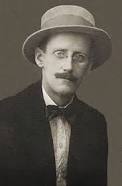
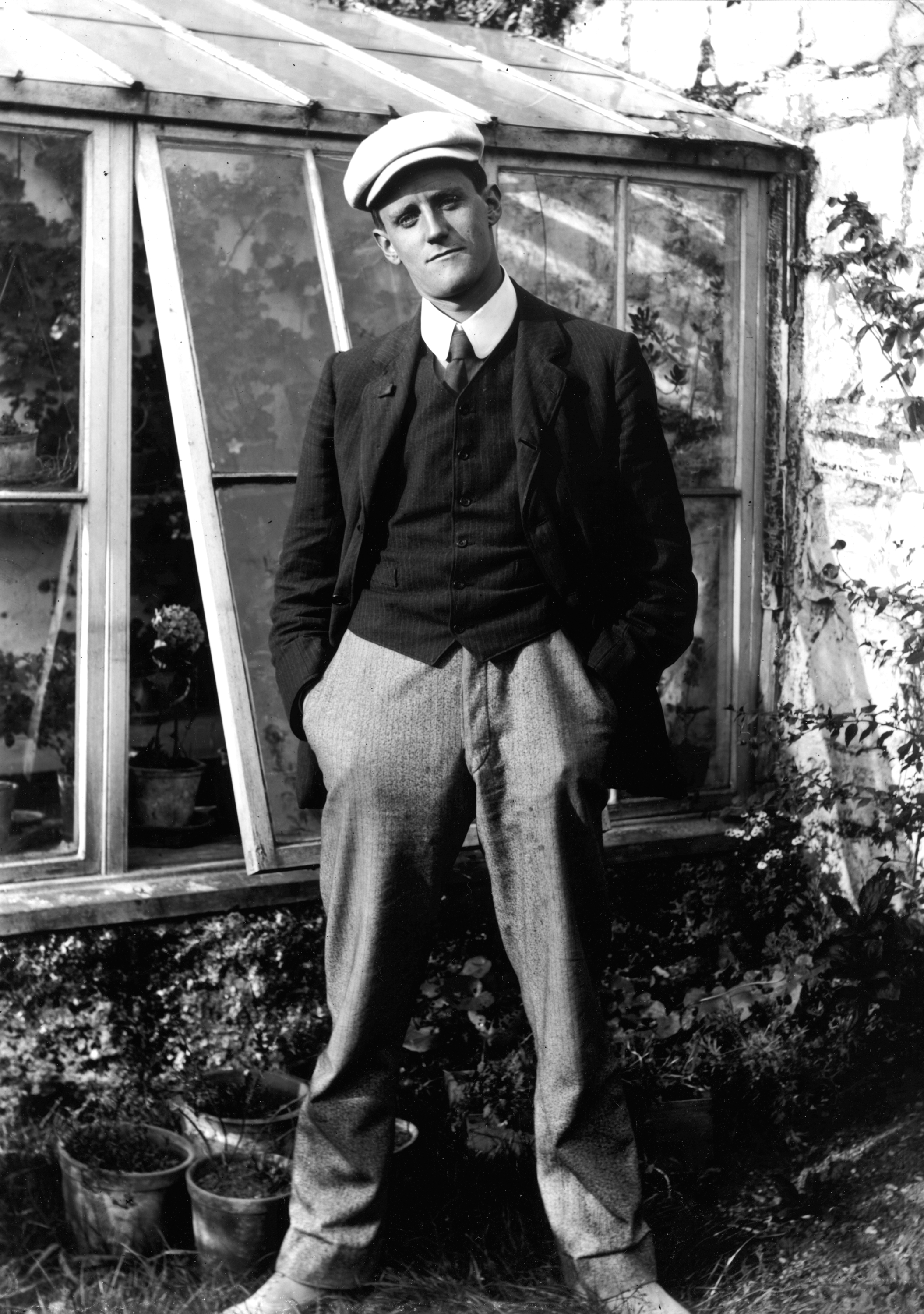
James Joyce (1882-1941, Irish novelist, poet, teacher, and literary critic.)
James Joyce gives us a picture of Catholic Ireland in the early 20th century. He describes an Irish home; i.e. riven with Catholic guilt and ambivalent beliefs about God and Ireland’s place in the Gaelic world.
Joyce’s main character, Stephen Dedalus, is born into an upper middle class Irish family that falls on hard times. Dedalus graduates from a Jesuit school and moves on to college but his life steers away from God and Ireland in his journey to manhood.
Stephen chooses his own path in life but like all humankind he carries the genetics of family and circumstance that compel life’s decisions. Like his father, Stephen is drawn to agnosticism, bordering on atheism, because of worldly pleasures and pains. The pleasures of sexual adventure and the pains of Irish conflict (about religion and statehood) drive Stephen’s escape from Catholicism and his father’s fall from grace.
The fragility of the Catholic Church is evident in James Joyce’s “…Portrait…” Dedalus is portrayed as a top of his class student that is coveted by the Church hierarchy that wants Stephen to become a Jesuit priest.
The strength and allure of the Church at that time is clearly evident in Joyce’s description of the Catholic Priesthood’s power to attract the best and the brightest of its brethren. However, Dedalus, after a day contemplating the Church’s offer, chooses to pursue a broader life.
Even though the Church offers a vocation of prominence and security, Stephen rejects it. The irony of the rejection is that Stephen’s Catholic guilt propels him away from a life of Catholicism. Stephen realizes that he cannot resist worldly temptation.
To Stephen, the mechanism of Catholic forgiveness of sins seems formulaic and inadequate for the purpose of cleansing one’s soul.
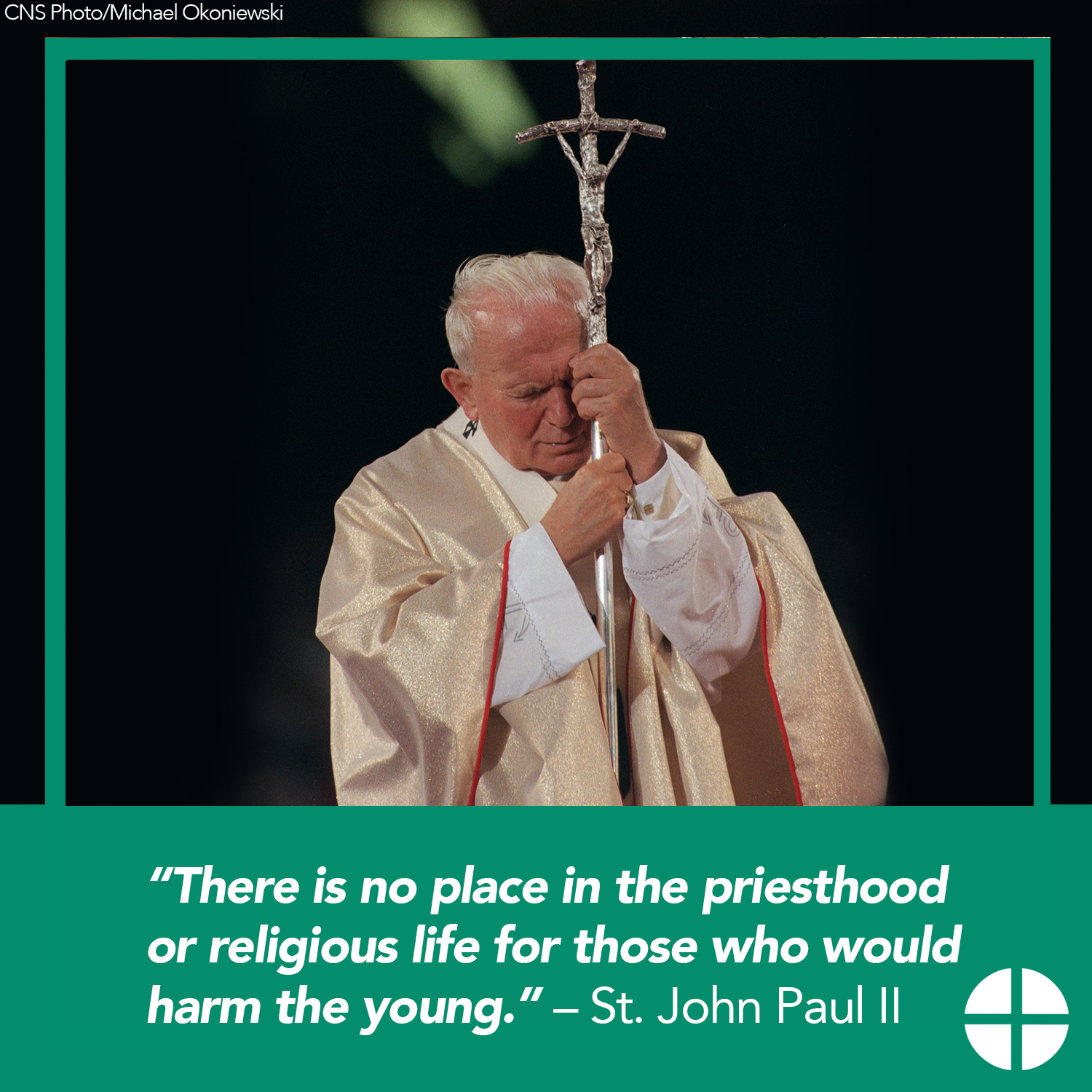
The prescience of Joyce’s insight is fully realized in today’s Catholic Priesthood and its failure to protect Catholicism’s children.
Theodore McCarrick (Former cardinal and bishop of the Catholic Church–disgraced after found to be a pedophile after being appointed by Jean Paul II, ignored by Benedict, and finally revealed by today’s Pope Francis.
And so,
Stephen Dedalus is cast adrift. He is a
teacher and poet; highly regarded by most of his peers and recognized by many
as an intellectual superior. He wishes
to escape Ireland;
to see the world. This is “A Portrait of
the Artist as a Young Man”.
At best,
one sees Stephen Dedalus as a burgeoning Humanist; at worst, a hedonistic life
traveler. A great read; well told by John Lee.
Audio-book Review
By Chet Yarbrough
(Blog:awalkingdelight)
Website: chetyarbrough.com
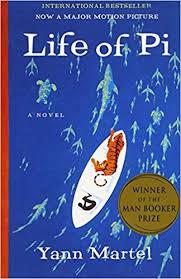
Life of Pi
By Yann Martel
Narrated by Jeff Woodman
Yann Martel (Author, Spanish-born Canadian)
News of Irrfan Khan’s passing reminds all who saw “Life of Pi” or “Slumdog Millionaire” of his gifts as an actor. He died at the age of 53 from a neuroendocrine tumor on April 29, 2020.
Symbolism is a part of “Life of Pi” but it makes little difference to a reader or listener who is looking for an enjoyable fictional adventure. Most listeners will be fascinated and absorbed by Yann Martel’s writing and Jeff Woodman’s narration.
Pi’s father sells his business. He owns a zoo in Mumbai. By ship, he is transporting his family and the zoo animals to North America when disaster strikes.
Martel successfully suspends disbelief in a story about a boy from India who survives a ship wreck in a life boat with a tiger, a zebra, a hyena and an orange orangutan.
As with all ship wreck and life boat stories, the immediate concern is food and water for survivors, of which there is only Pi and four zoo animals.
Survival of the fittest becomes a suspenseful part of the story. The orangutan’s name is Orange Juice. Names for the hyena and zebra fall into the fog of a listener’s memory. The tiger’s name is Richard Parker.
This odd menagerie winnows down to the boy and the tiger but, along the way, one learns something about truth and relationship.
Martel describes Pi’s early life as the son of a zoo keeper and owner in Mumbai, India before a fateful voyage to Canada. By telling of Pi’s early life, Martel creates a background that makes Pi’s successful management of his crowded life boat believable.
Pi is born a Hindu but becomes interested in Christianity and Islam to the extent that each allows him to love God.
Pi’s concatenation of faiths is a foretelling of how Pi handles the loss of his family, survival in a hostile environment, and tolerance for life’s ambiguities.
Fascinating tales of survival of the fittest are followed by an equally interesting story of how Pi gains respect and control of an increasingly hungry and thirsty tiger.
In the course of the story, Richard Parker and Pi find an island populated with meerkats and flesh eating plants. They eventually escape the island, and–well, you have to read the story.
Pi is obviously rescued–after all, he is telling the story.
The Japanese government interviews Pi to determine what happened to the ship that was lost and how Pi survived 227 days on the high seas. Pi tells an incredible story. Naturally, the government officials disbelieve him.
Pi creates another less interesting story. This new story becomes the official record.
A listener is left to believe the unbelievable, in the “Life of Pi” story. Like Trump’s lie about a stolen election–Pi’s report is given by one person when there is no proof and no witnesses.
“Life of Pi” is a fun ticket to entertainment. Many are entranced by Trump for the same reason; however, governing is not about entertainment.
Jerry Z. Muller (Author, professor of history at the Catholic University of America)
Professor
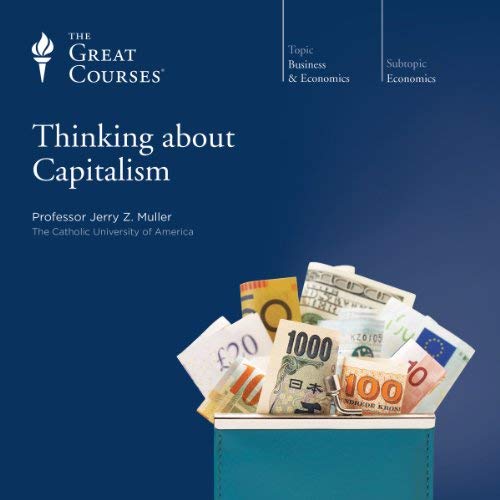
Muller offers an interesting and insightful defense of capitalism. Jerry Muller’s “Thinking about Capitalism” is
an historical account of economic theory.
Muller explores three economic systems: 1) market, 2) command, and 3) mixed. In his journey through the history of economic systems, market (aka capitalism) shines brightest.
Muller notes that capitalism is pummeled by many anecdotes of history. Muller does not deny the excesses of market economies, but Muller suggests capitalism’s benefits far exceed its detriments.
There is nothing new in Joe Manchin’s self-interest in coal investment or representation of a state dependent on the coal industry. The question is whether he is representing his personal interest in wealth and re-election or the common good of the nation.
Adam Smith (1723-1790, Scottish economist)
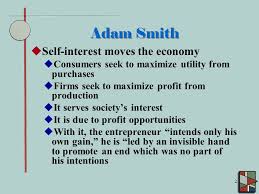
Muller argues capitalism’s storied failures distort its multifaceted values. In the “Wealth of Nations”, a seminal work on capitalism, Adam Smith clearly explains the value of a capitalist (market) economic system based on self-interest. Muller notes Smith’s term “self-interest” is often misinterpreted by the public as greed.
Smith’s definition of self-interest is founded on virtue, i.e., behavior based on high moral values. However, Self-interest comes in many forms.
One person’s self-interest may be altruistic in helping others to feel better about themselves. Another person’s self-interest may be to increase personal wealth to improve their family’s standard of living. And, self-interest may be associated with greed. The fundamental point is that everyone’s self-interest is a motivation that is ungoverned by an outside force. Self-interest is a part of human nature.
In a broader sense, there is some truth in the economic cliché of “a rising tide lifts all boats”. It reflects Adam Smith’s belief in the “invisible hand” that guides one’s life in a market driven economy. Every individual strives for their own self-interest which offers charity to some, employment to others, and individuated incentive to all.
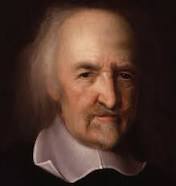
Thomas Hobbes (1588-1679)
Thomas Hobbes notes that human nature is both good and bad. He tempers Smith’s argument for capitalism by suggesting government is necessary to mitigate self-interest that is harmful to the public.
Smith and Thomas Hobbes (author of “The Leviathan) believe self-interest is a universal human characteristic. Smith addresses self-interest as an enlightened Socratic understanding of virtue. Hobbes is less doctrinaire and implies Socratic virtue is not common in the general population.
Smith argues that capitalism takes the essence of human nature’s natural self-interest to advance civilization. This advance is not a smooth upward curve but an improving trend. Bad things do happen in a capitalist society. Hobbes might agree with Smith but only in the context of “rule of law” that mitigates non-virtuous self-interest.
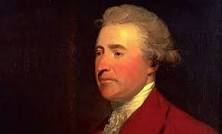
Edmund Burke (1729-1797, Irish statesman)
Muller does not ignore critics of Adam Smith’s “Wealth of Nations”. Edmund Burke is a noted critic who argues that too many social conventions are sacrificed by disparate self-interests. He argues that the French revolution is a potential consequence of an economy driven by self-interest.
The social structure of France is decimated in the 1789 revolution. History shows “the terror” of the French revolution murdered innocents. On the other hand, it reformed an economy that left many behind. Prior to 1789, only the rich owned land, never went hungry, and inherited wealth. In the 18th century, France’s poor are mired in poverty, often hungry, with little chance for advancement.
Justus Möser (1720-1794, German social theorist)
Muller also cites criticism from Justus Möser , a contemporary of Burke, who believed the rise of capitalism (mercantilism) destroys craftsmanship in local economies. With trade from other parts of the country and world, Möser argues insular communities are harmed by prices of similar products replacing local artisan’s goods.
Möser argues mercantilism destroys the fabric of local communities; foments insecurity and social unrest. Muller, in part, agrees with Möser’s argument. However, Muller notes Möser’s argument is right and wrong.
With less money being spent for one thing, more money is available to buy or invest in other things. What Möser ignores is mercantilism’s benefit to consumers and the local economy. Consumers who buy a product for less money have more money to spend or invest in the local economy.
An amendment to criticism of Möser is that the consumers must have enough money to buy product being produced, whether in America or somewhere else.
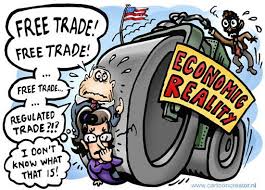
Much of Möser’s argument is the same concern raised by those who support today’s trade war. Trump ignorantly pursues a trade war that weakens Adam Smith’s view of capitalist competition. America needs to adapt to a world economy that is increasingly intertwined.
Möser is right in suggesting free trade creates insecurity in local markets. It also demands adjustments in labor that harm local artisans, but Muller argues there is a net gain in public good and general welfare with free trade.
Max Weber (1864-1920, German sociologist, philosopher, and political economist)
Muller goes on to explain how a confluence of religion and capitalism benefits society with Max Weber’s melding of Protestant Ethic with the Spirit of Capitalism. Weber makes the idea of living aesthetically and putting aside savings as a prudent way of living life in an uncertain environment. Creating wealth became a religious calling to some.
Joseph Schumpeter (1883-1950, Austrian political economist)
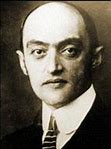
Muller reviews Joseph Schumpeter’s contribution to the theory of capitalism. As a 20th century Harvard Business School professor, Schumpeter lectures on the value of “the invisible hand”. Schumpeter advances the idea of “creative destruction” as a characteristic of capitalism.
Schumpeter outlines the value of entrepreneurs who pursue new ideas, new products, and innovation that replaces dying industries. He trumpets the growth of capitalism as an engine that perpetuates societal benefit. Some argue that today’s American governance discourages new ideas by dwelling on manufacturing at the expense of technological innovation and change.
Muller examines the other two economic systems, i.e., 2) command, and 3) mixed systems. Muller implies they fail to meet the historical successes of market capitalism. A command economic system is autocratic with primary economic decisions made by one ruling agency—like Mao’s communist party, Hitler’s Third Reich, and Stalin’s Great Turn.
Short term economic benefit of a command system economy hugely disrupts society. Economic improvement is evident in the short term, but momentum is lost as the gap between haves and have-nots grows.
In a command economy, the cult of personality takes over and image becomes more important than substance; i.e. who you know becomes more important than productivity.
Muller implies mixed economic systems are a work in progress. They are represented by leaders like President Xi in China, and President Putin in Russia.
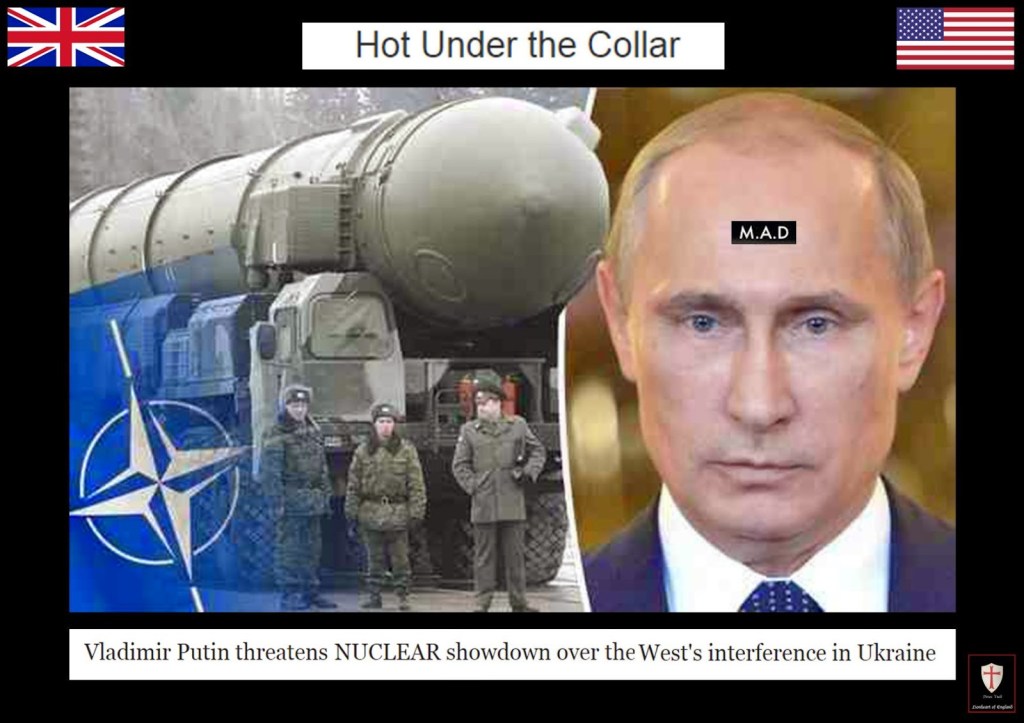
Xi and Putin retain the concept of communist control of the economy but combine command economics with “Smithian” capitalist ideals. However, Putin takes a wrong turn by waging war on an independent country with its own mixed economy ambition.
China’s mixed economic policy began with Deng Xiaoping, but Xi expands its reach.
Both China and Russia have shown economic improvement in the late 20th and early 21st century. Xi’s “Road and Belt” plan is part of a command economy, but it relies on the capitalist market principle of influencing trade between nation-states. China’s long-term success remains to be seen. Whether it will be a more effective form of economic improvement than Adam Smith’s market-based formula is left to history.
Russia, like Xi, uses capitalist influence to grow its economy. Russia, in contrast to China, uses its natural resources (oil distribution), rather than a “Road and Belt” policy to expand its influence. Unfortunately, Putin chooses to waste Russia’s oil wealth on war.
Fundamentally, Muller infers no modern economic system is better than capitalism. One draws that inference by Muller’s cogent explanation of the value of capitalist self-interest. Because Adam Smith’s concept of self-interest is an inborn characteristic of human nature, it will prevail over any known economic system that requires command control.
America has been a successful capitalist country in great part because of checks and balances that mitigate command control qualities of mixed economies. Hobbes assessment of human nature demands some level of command control, even in a capitalist economy.
One might argue that America’s avoidance of near economic collapse in 2008 is evidence of the importance of a mixed economic theory. (Interestingly, a December 18, 2018 “…Economist” article, published under the Schumpeter byline, notes that China’s communist party’s mixed economic system during Trump’s trade war fared better than America’s government regulated free enterprise economy.)
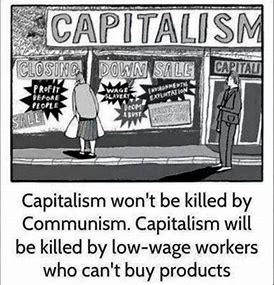
American history shows lower taxes encourage higher production and job creation. What is missed by tax reduction is that it exacerbates income inequality. Tax reduction incentivizes corporate leaders to devalue worker wages to increase profitability. Human self-interest leads to higher income for corporate owners and executives. The consequence magnifies the wealth gap between have and have-nots.
One does not come away from Tim Weiner’s book knowing where the line is drawn between value and scorn for government intrusion in the lives of Americans. This seems particularly relevant today when veracity, political bias, and honesty of the FBI is being seriously questioned
J. Edgar Hoover (1895-1972. 1st Director of the FBI from 1924 to 1972).
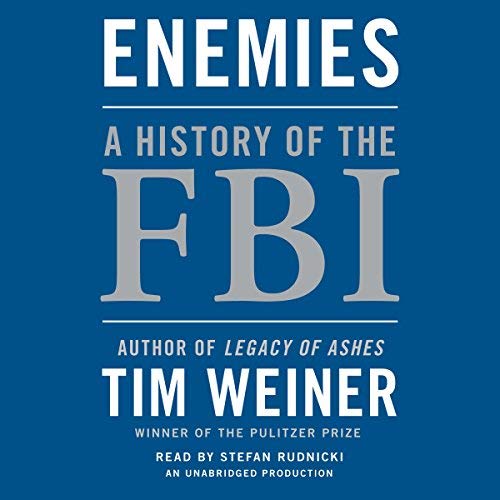
“Enemies…” is about the rise of the F.B.I. and J. Edgar Hoover’s role in the growth of American domestic intelligence.
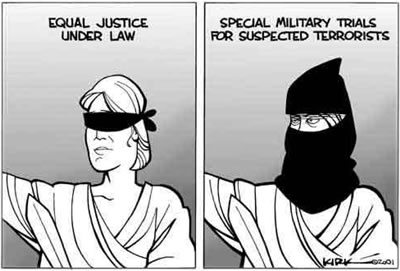
Weiner reports on questionable FBI tactics employed by Hoover. Hoover sets the table for violation of human rights with a power that defies the intent of the American Constitution.
Even though overt American legislation denies the right of the government to arbitrarily investigate private citizens, Hoover throws “habeas corpus” into the trash.
(Habeas corpus is a writ requiring a person under arrest to be brought before a judge or into court, especially to secure the person’s release unless lawful grounds are shown for his/her detention.)
Weiner shows Hoover to lie about wire-tapping and gathering information on private citizens without warrant or judicial review. This is the head of the FBI orchestrating the violation of American law. Hoover creates files that give the F.B.I. secret information about the personal sex lives of elected and government appointed bureaucrats and uses that information to influence elected officials and the American public.
Wiener suggests Hoover’s perception is that communism infiltrates all anarchist’ and most American government-opposition’ movements. Hoover crosses the line between free society and tyranny. He gathers information on individual citizens, union movements, civil rights, and accused domestic terrorists with an unshakable belief in his own perception of reality.
The historical facts of Weiner’s presentation gives context to the American communist beliefs of the 40s, 50’s, and 60’s. Hoover feeds the hysteria of his time.
A reader/listener is intellectually and emotionally torn by recounted beliefs held by some American and British citizens of Marxian communism. Some were willing to foment a social revolution by any means necessary.
Others were simply expressing a personal opinion among friends of the same opinion; not to foment revolution, but to explain what they believe denies equal protection, and/or equal rights in America.
Wiener shows that some actions by the FBI warranted investigation. He notes Klaus Fuchs who gave the Soviet Union secrets of the atomic and hydrogen bombs in the 50s, and the British agent, Kim Philby, who betrays American and British agents of the F.B.I., C.I.A. and British MI-5. (Agents were murdered because of Philby’s betrayal.)
The unfortunate consequence of Hoover’s domination of the F.B.I. is that it evolves into a vehicle of suppression, subject to the whims of one human being’s prejudices. This is particularly apparent in the rise and fall of McCarthyism.
America is a government of checks and balances and when any American agency abandons those criteria of governance, it compromises public freedom.
Every human being is flawed; every human being is subject to the good and bad qualities of human nature. When the F.B.I. or any government agency is dominated by one person, it fails the test of good government. That seems a justifiable critique of Hoover’s career in the FBI.
The American Constitution’s checks and balances are being used to address the FBI’s role in America.
One comes away from Weiner’s book to believe it is unfair to conflate the era of Hoover with the current administration of the FBI.
Serious questions are raised about the veracity, political bias and honesty of today’s FBI. There is the Clinton email investigation, the Trump collusion investigation, the firing of James Comey, and the Andrew McCabe and Peter Strzok dismissals.
“Enemies: A History of the FBI” is a relevant subject for the 21st century because of technology’s potential for exponentially invading personal privacy. Checks and balances through rule of law are a free society’s only protection against human nature’s fallibility.
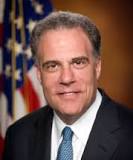
Michael Horowitz (American Attorney, DOJ Inspector General who is tasked with reporting FBI political bias.)
Though Horowitz’s investigative report is not to everyone’s satisfaction, there is little evidence of FBI’ political bias. There is ample evidence of human nature’s fallibility, but it only reminds us of ourselves. Individual FBI careers have been tarnished but there is no institutional political bias.
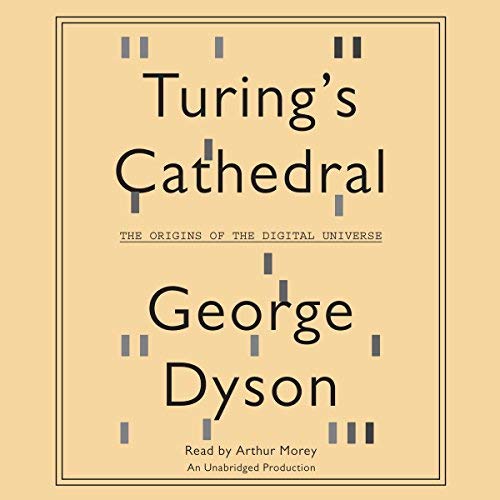
Turing’s Cathedral: The Origins of the Digital Universe
By
George Dyson
Narrated by Arthur Morey
George Dyson (American author, historian of technology.)
The beginning of one of many Faustian bargains between government and science is revealed in George Dyson’s book, “Turing’s Cathedral”. Dyson reveals the genius of Alan Turing and other contributors to the computer age.
Alan Turing (Mathematician, computer scientist, logician, cryptanalyst, philosopher, and theoretical biologist.)
John von Neumann (1903-1957) A Hungarian-American mathematician, physicist, computer scientist, and polymath, joins the American military/industrial complex before it became known as the “complex”.
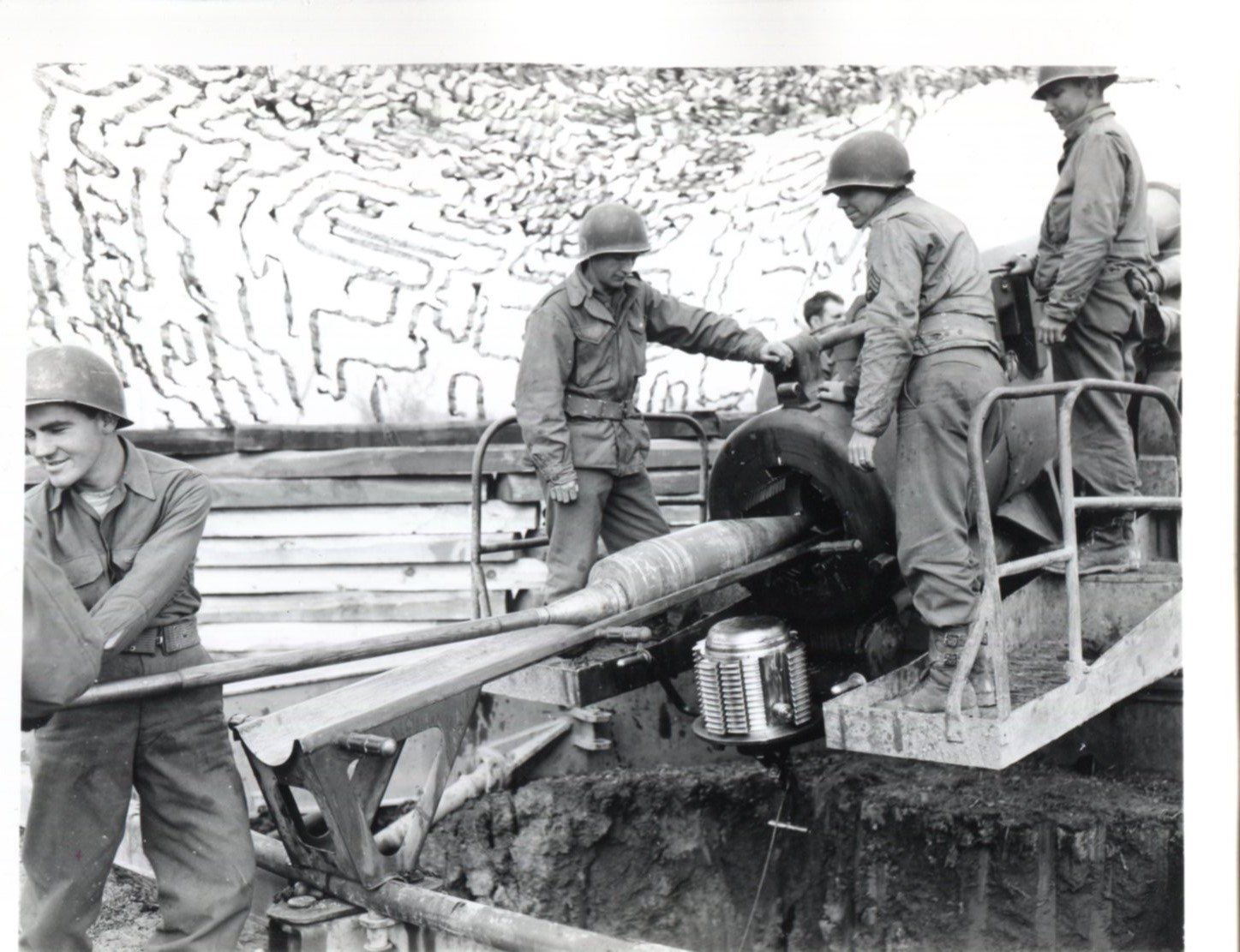
Calculations for ordinance trajectory and explosive impact became increasingly important during WWII.
George Dyson’s book recounts the confluence of military might and computer invention. The military wants more accurate estimates of ordinance trajectory and damage to improve murder rate. Manual calculation was too slow and prone to error.
With government backing, von Neumann is midwife to the birth of the computer generation. Presuming von Neumann knew of Alan Turing’s 1936 paper on mathematical logic, he wrote a paper about a universal computing machine. Hired by the government to improve the accuracy of military ordinance, von Neumann works with Oswald Veblen at the Moore School of Engineering in Philadelphia. Von Neumann, and Veblen expand a math and engineering department that changes the world.
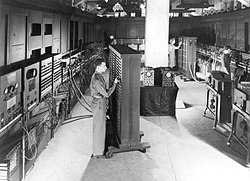
To the right is the Moore School of Engineering in Philadelphia–The fruit of the new department’s labor is a vacuum-tube, wire bound, contraption called ENIAC.
Before Eniac, human calculations could not efficiently or effectively determine the course of a flying howitzer shell, or the measured impact of a flying-fortress’ bomb. What the military needed was a better calculating tool than the single human brain.
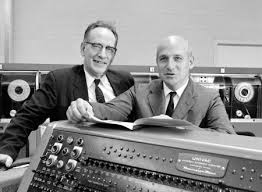
John Mauchly (left) J. Presper Eckert (right)–Mauchly and Eckert were the inventors of the first universal computing machine at the Moore School of Engineering.
(There is a controversy over who created the architecture for this machine because von Neumann came to the Moore School of Engineering after Mauchly and Eckert had already begun work on ENIAC.)
Though this is an historical account of the invention and consequence of computer manufacture, listening to “Turing’s Cathedral” seduces one into seeing war and the military as a primary source of technological advance. Science is shown to advance from growth of the military/industrial complex and the destruction of war.
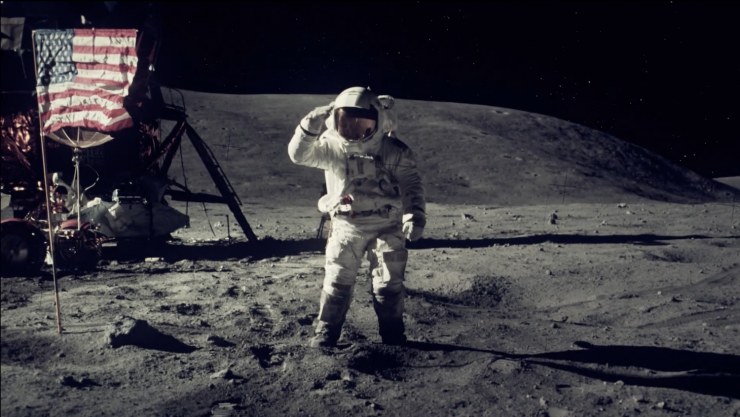
Rocket science grows from Hitler’s pummeling of London during WWII. Nuclear science grows from Truman’s bombing of Hiroshima and Nagasaki. Space exploration grows from a moon shot heavily subsidized by the Kennedy administration. In the foreseeable future, government’ satellite and cyber research grows from late twentieth century advances in software development.
What strikes one’s imagination is how critical government expenditure, particularly the military, is to R and D (research and development) in science.
Interestingly, the requested budget for R and D in 2019 is reduced to $131 billion.
(President Trump is intent on building a wall between Mexico and the U.S.; i.e. not unlike Hadrian’s wall, a first century method of defense. Not what one would call a technological advance.)
One wonders if the computer would ever have been invented without the advance of a horrendously destructive war. At the very least, war accelerated the invention of the computer generation.
The innate brilliance of Philadelphia’s Moore School mathematicians creates more efficient and effective methods of mass murder. One might argue that the Moore School opened a Pandora’s box. Turing’s, von Neumann’s, Mauchly’s, and Eckert’s theories and inventions open a door to artificial intelligence; i.e. an intelligence beyond human understanding that may improve or destroy humanity.
The first hydrogen bomb explodes in 1952. According to Dyson, one person is killed while monitoring the explosion. He is the first victim of the hydrogen bomb that is 50 times more destructive than the bombs that fell on Hiroshima or Nagasaki.
One wonders, without government, without the military, and sadly, without war, would humankind have reached into the universe in the 1960s?
This is an important book, somewhat difficult to track because of its non-linear presentation, but a valuable insight to a giant step in the history of science.
A monumental gap in George Dyson’s presentation of “Touring’s Cathedral” is the effect of the internet and its ability to disseminate information throughout the world with a click.
Instant communication changes the dynamics of society. The computer age and internet offer a platform to rally the best and worst of society.
One cannot help but be troubled by the source of mankind’s twentieth century leaps in scientific discovery. So many scientific advances seem closely tied to perfection and invention of potential weapons of mass destruction. Dyson inadvertently makes a case for war and the military’s efficacy as an engine of science.
“Turing’s Cathedral” opens a door to artificial intelligence, a two edged sword that can defend or destroy humanity. With the internet, the sword is sharpened.
Audio-book Review By Chet Yarbrough (Blog:awalkingdelight) Website: chetyarbrough.blog
Operation
Mincemeat By Ben Macintyre Narrated
by John Lee
Ben Macintyre (British historian, author, and columist for The Times newspaper)
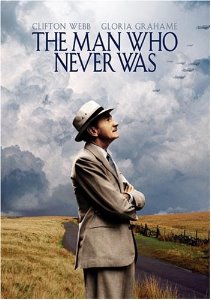
“Operation Mincemeat” is an historical account of “The Man Who Never Was”. It is about the early days of the British Secret Service. It covers a specific operation to mislead the German Axis powers on the planned invasion of Italy in WWII.
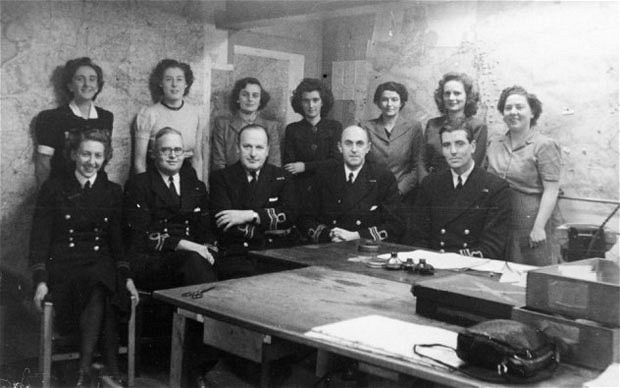
Though this history is enlightening, Macintyre’s account makes the early British Secret Service look like an upper-class boy’s club. The master minds of early British Secret Service espionage, MI5, are pictured as aspiring novelists from privileged, wealthy English families playing a game of war.
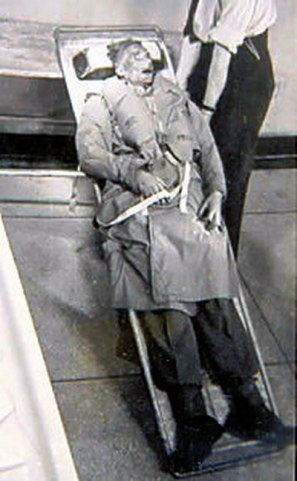
The mission is to drop a dead body in the Mediterranean off the Spanish coast. The body is to carry false documents to mislead the Axis powers.
Ian Fleming (1908-1964, English author, former naval intelligence officer, creator of the James Bond series.
The idea came from a novel written in the 1930s. One of Mi5’s agents, Ian Fleming (author of the James Bond series) recalls the novel and suggests the idea to the “boys club” in 1939.
The details for execution of the plan are fascinating. The difficulty of acquiring a dead body, the creation of forged documents, the personal approval of Winston Churchill, and the bureaucratic arguments over minutiae before the plan could be executed beggar belief.
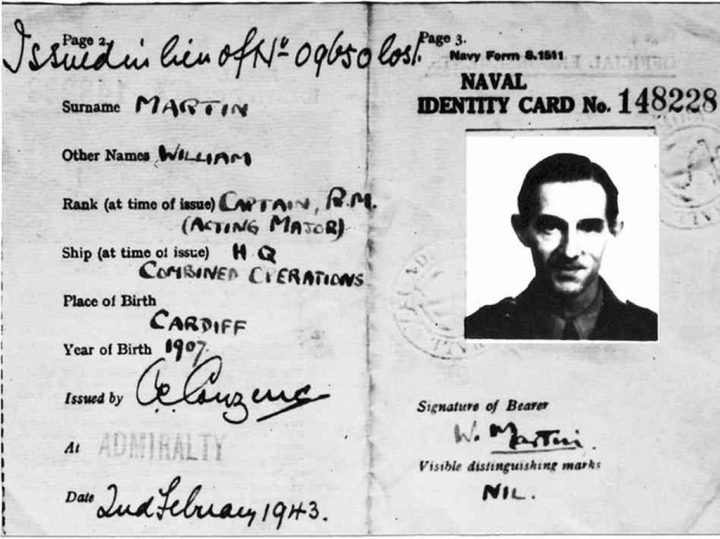
With all that preparation, it is surprising to hear of fundamental mistakes made on planted documents. The picture on the military ID to identify the dead body did not have the right hair line. One of the personal letters placed on the body incorrectly refers to a field commander as though he had knowledge of plans that he could not have had.
In spite of these mistakes, the plan works perfectly and saves hundreds, probably thousands of Allied personnel by convincing Germany to build their defensive forces in Greece rather than Italy where the Allied invasion actually occurs.
Ewen Montagu (1901-1985) There are stories of patriotism and hard work by the British Secret Service but they are diminished by characterization of the early agents. An office dalliance between the prime mover of the Mincemeat operation, agent Montagu, and an office secretary seems tawdry. The book concludes with Montagu’s battle over government declassification of the operation and his fight for publishing rights to the story of the deception.
The author’s characterization of the early days of the British Secret Service is not heroic in the sense one gets from deciphering the enigma code by the Turing team. There are pictures of real heroes in this history but they are soldiers in a real war.
Much of MI5’s depiction in “Operation Mincemeat” is of upper-class rich boys playing war in blacked out offices near Piccadilly; while soldiers and civilians are losing their lives in England and the mainland.
Alexandre Dumas is a French Charles Dickens and a writer of “Dostoyevsky light” stories. The narrator, John Lee. magnifies “The Count of Monte Cristo” characters with an exotic voice that markedly enhances Dumas’s story.
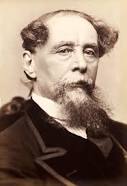
Charles Dickens (1812-1870, English Author and soicial critic.)
Like Charles Dickens, Dumas creates interesting characters. And, like Dostoevsky, he creates emotionally driven protagonists.
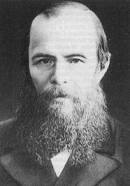
Fyodor Dostoevsky (1821-1881, Russian novelist, essayist, journalist, and philosopher.)
Dumas writes a story of revenge with twists of fate that have Dickens’ coincidences and “Dostoevsky-like” motivations.
The hero is Dante, the wrongfully accused, convicted, and secretly
incarcerated prisoner. The heroine is Mercedes, the love of Dante’s life that
mourns his disappearance on their wedding day.
Dante is unjustly imprisoned for being a Bonopartist based on inadvertent collusion by Danglars, Villifort, and Fernand. They all have different motives for jailing Dante.
The jealous and greedy merchant, Danglars wants to rid himself of Dante because he is a commercial rival. An ambitious, duplicitous, and sycophantic, politician, Villifort, wants to hide his family’s involvement with the Bonapartists. Fernand wants to remove Dante from his wedding to give himself an opportunity to marry Mercedes himself.
(Bonapartism is the political ideology of Napoleon Bonaparte. In government speak, it is a dictatorial executive with a weak and ineffectual legislative body, filled with sycophants.)
Luck and fate mix into Dante’s imprisonment. Dante escapes and becomes fabulously rich. Dante travels the world after his escape and searches for information about people in his life before imprisonment.
A cloak of mystery surrounds Dante as he appears in the lives of his friends and enemies. The cloak is removed at perfect moments in each episode. He endeavors to understand his friends and enemies strengths and weaknesses.
Dante rewards his friends and punishes his enemies. Plans for revenge and exposure of his enemies’ misdeeds are cleverly woven into the story. Each colluding villain is defeated by his own human weakness.
Danglars’ greed becomes his destruction. Villifort’s lies lead to madness. Fernand’s false accusation, and the loss of Mercedes’ love drive him to commit suicide.
The story is a tangled web of relationships, guilts, and crimes that are satisfyingly resolved by the end of the book. Overcoming life’s adversity and justice’s triumph are the appeal of “The Count of Monte Christo”.
Who among Dumas’s three villains in “The Count of Monte Cristo” reminds one of America’s Bonapartist President?
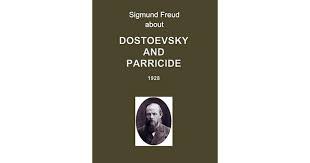
Twenty years before Sigmund Freud’s “…Psychopathology of Every Day Life”, Fyodor Dostoevsky penetrates man’s subconscious to reveal unnamed frames of mind that influence human behavior.
Sigmund Freud was an Austrian neurologist and the founder of psychoanalysis (1856-1939)
All of Dostoevsky’s writing probes the human mind allowing listener/readers to hear unspoken thought and vicariously experience the consequence of singular deliberation.
Human aggression, compassion, love, and hate possess “The Brothers Karamazov”. The origins of these feelings are nakedly exposed in the murder of “The Brothers…” hedonistic father.
One of four brothers is suspected to be a murderer. The oldest brother is a student intellectual,
a middle brother is an effusive pleasure seeker, and the youngest is a pious
seminarian. A lurking illegitimate
fourth son (aged somewhere between the oldest and youngest) adds to
Dostoevsky’s tale of parricide.
The irony of isolated thought and deliberation is that it can lead to genius or horrendous crime. The first might be a Paul Dirac or Volodymyr Zelensky; the second a Ted Bundy or Vladimir Putin.
Theodore Robert Bundy was an American serial killer, kidnapper, rapist, burglar, and necrophiliac (1946-1989) Electrocuted–1989 in a Florida prison.
“The Brothers Karamazov” introduces Ivan Karamazov, an intellectual agnostic. Ivan’s agnosticism and misanthropy contrasts with his younger brother, Alyosha. Alyosha is a character reminiscent of an earlier Dostoevsky’ work (“The Idiot”) who exemplified man’s goodness in a life lived in contemplation and moderation.
“The Brother’s Karamazov” illustrates life’s contrasts with Alyosha, a saintly hero and Ivan, a deluded manipulator of human events. Both live lives of contemplation but one chooses to become a monk; the other an intellectual misfit.
God, free will, lust, innocence, guilt, and responsibility play out in thoughts and actions of the four brothers. If free will exists, where does it begin and end? Are we free? Are we driven by human nature or by God’s plan to become who we are; and to do what we do?
If you teach someone to hate as Ivan teaches Smerdyakov, his illegitimate brother, are you innocent of actions taken by those whom you teach? Does a teacher have any guilt; any responsibility for bad actions of the student?
As an intellectual, Ivan explains he does not believe in God. And later, he denies any responsibility for his father’s murder. His beliefs lead him to despair when he realizes Smerdyakov is the murderer.
Ivan eventually takes moral responsibility for his father’s death. At the end, Ivan seems on the verge of reassessing his belief in God; i.e. an assessment dear to Dostoevsky’s life and a subject espied in all his work.
The question of free will is challenged by the history of the Karamazov family. Every characteristic of the brothers is reminiscent of a part of their father’s strengths and weaknesses.
All of the brothers in varying degrees are molded into who they are by their paternal father and their Holy Father. The evidence of their Holy Father’s role is exhibited by the guilt ridden consciences of everyone but Smerdyakov. Finally, with Ivan’s final acceptance of responsibility for his father’s murder, Dostoevsky concludes an argument against free will.
Fyodor Dostoevsky brilliantly expands the value of literature with his insight into the relationship between thought, instinct, and action. Ivan’s broader intellect, and Smerdyrkov’s lesser intellect informs their actions. Instinct informs Mitya’s action. Religious belief informs Alyosha’s action.
The characters in Dostoevsky’s imagination are incarnations of religious belief. In “…Brothers Karamazov” each character’s life is prescriptive. Life is either designed by genetic inheritance or fulfillment of God’s plan. One suspects Dostoevsky believes the second more than the first.
Michio Kaku valiantly tilts Don Quixote’s lance at physics in writing “Parallel Worlds”. The fictional Quixote quests for knowledge as a knight errant. Michao Kaku pursues knowledge as a renowned physicist. Time will tell if Kaku is a errant physicist or a clarion of knowledge.
This is a book about Physics, the baffling science of mathematics, and those who wish to understand why Newton, Einstein, Bohr, Planck, Michael Green, and Ed Schwarz et al are important to all of us who are confused.
In spite of the abstruse subject, Kaku reveals some understandable break through discoveries in cosmology, and mankind’s pursuit of the Holy Grail. The Holy Grail is a unified field theory that explains everything there is to know about matter and energy in one combinatoric theory.
Physicists continue to search for a theory that will explain how electromagnetic, gravitational, weak, and strong forces follow one fundamental rule of existence.
Einstein’s theory of special relativity, implies predictability. Quantum mechanics exclusively relies on probability. How can these two fundamentally different rules be made into one theory?
Contrary to Einstein’s belief that “God does not play with dice”, God lives in Las Vegas.
On a subatomic level, repeatable experiments show that it is impossible to predict the exact position of an electron. With measurement of either position or energy of an electron, its location or power is changed. Electron movement is unpredictable by any known criteria of measurement.
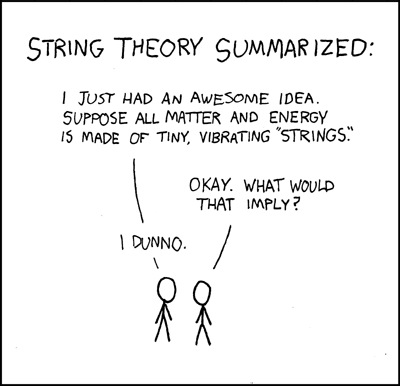
Experimental proof of a theory demands measurement; without measurement, there is no proof. For example, one reason “string theory” is unproven is that the dimension of strings is too minuscule. Technology has not advanced enough for experimental proof. It does not make the theory wrong. It’s simply not experimentally provable.
The God question inevitably raises its head in sciences’ pursuit of a unified field theory. However, putting philosophical discussion aside, Kaku tells the story of Einstein’s unsuccessful pursuit of a unified field theory.
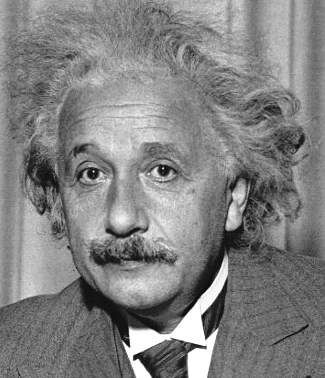
Einstein refuted some of Newton’s laws. Bohr refuted some of Einstein’s speculation. Their research leads to discoveries that only a science fiction writer could conceive. Bohr introduces quantum mechanics to Einstein’s discovery of the interchangeability of energy and mass.
With science pursuing the universe’s origin and its component makeup, only telescopes like Hubble and CERN’s Hadron collider in Europe have made any progress in identifying dark matter or energy.
Smaller and smaller elements of matter and energy are discovered by scientists, but an estimated 75% of the known components of the world are unknown. Dark matter and dark energy make up that 75%. (Discovery of Higgs-bosun in 2012 is the most recent addition to component knowledge.)
Another hope of discovering a UFT in theoretical physics is Ed Schwarz’s and Michael Green’s string theory postulation.
Schwarz’s and Green’s theory provides a more inclusive categorization of the basic elements of the world. Kaku describes string theory in terms of a stringed instrument that changes the character of matter by shortening or lengthening strings.
Just as Einstein’s theory of the curvature of space-time is not proven until Stanley Eddington’s measurement of an eclipse in 1919, Swartz and Green wait for technology to catch up. String theory waits for another Eddington.
When the strings are plucked they resonate at different frequencies. That change in vibration changes the elemental nature of the particle even though the string is fundamentally the same.
String theory, if it proves correct, opens many doors in the sub-microscopic world. It opens to the speculation of possible parallel worlds. Kaku overwhelms listeners with the potential of a scientifically verifiable unified field theory. He suggests the possibility of time travel and space exploration through black holes and white holes.
“Parallel Worlds” ends its exploration of physics with notes of caution and optimism about our world’s progress. The book is semi-understandable (possibly, horribly misleading) but worth reading.
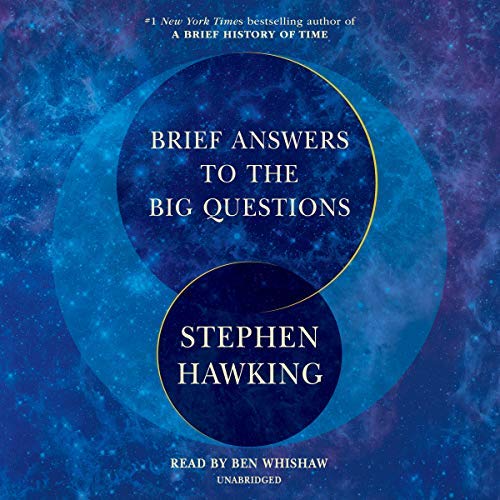
By Stephen Hawking, Eddie Redmayne-foreword, Lucy Hawking-afterword
Narrated by Ben Whishaw
Stephen Hawking (English theoretical physicist, cosmologist, and author)
“Big Answers to Big Questions” is Stephen Hawking’s last book. It is posthumously compiled by others.
Though many books have been written by Hawking, none are as popular as “A Brief History of Time”. However, this compilation of Hawking’s thoughts deserves equal, if not greater, popularity. It is simpler to understand and addresses a wider range of subjects that puzzle human beings.
“Brief Answers…” does not definitively answer the questions that are raised. It does offer a perspective from a person that is one of the great minds of modern science.
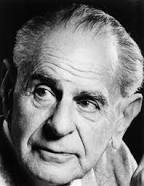
Karl Popper’s dictum is that “He who decides one day that scientific statements do not call for any further test…retires from the game.” By that criteria, Hawking’s “Brief answers…” can only be right or wrong. Even Einstein’s theories are still being tested.
What is the origin of life?
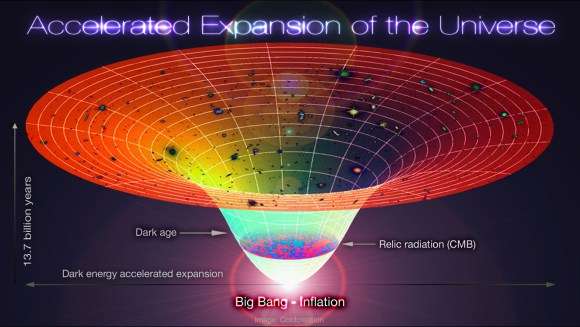
Hawking’s answer is the “Big Bang”. The origin of life begins with the “Big Bang”, a somewhat pejorative term that describes a black hole. This black mass is formed from a consolidation of gaseous and fragmented material that compresses to a point smaller than a pea.
Is there an explanation for something being created from
nothing?
Hawking’s answer is related to the theory of the “big bang”. Time did not exist before the big-bang. The arrow of time is created by the instantaneous expansion of our universe’s compressed black hole. Hawking argues before time there is nothing. The creation of this world came from the physics of compression and its consequence; i.e. inflation, the instantaneous expansion of a black hole.
From that tiny spot in the cosmos, Hawking argues a universe is born. This minute point of compression is postulated by Hawking to expand instantaneously (termed cosmic inflation).
In accordance with Einstein’s law of physics, mass and energy are equivalent and cannot be destroyed. Instantaneous inflation is a changed form of energy and mass with space being its primary constituent. That instantaneous expansion of a black hole made the universe. This universe is made of many galaxies (estimated to be between 200 billion and 2 trillion); of which we are only one, called the Milky Way.
From the big bang, the elements of life are formed. Hawking explains chemical interactions from the explosion lead to the first carbon-based life’ forms. That combination of chemicals evolves into plants, animals, fungi, protists, archaea, and bacteria.
Is the only explanation for the existence of earth an
omniscient and omnipresent God?
The “big bang” is Hawking’s answer; without insisting that there is no God. Hawking’s argument is founded on science that offers a plausible alternative explanation.
What are the greatest threats to life on earth?
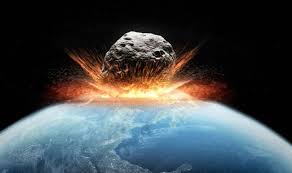
Hawking notes four. One, nuclear war; two, global warming; three over-population, and four—an asteroid collision with earth.
Not surprising to some, Hawking suggests the first two are accelerated by the election of Donald Trump. The third and fourth are another matter.
Does life exist on other planets?
Hawking believes it is probable. However, he believes it unlikely to be humanoid. He suggests the evolution of humankind is a confluence of serendipitous circumstances that are unlikely to be repeated.
How will human beings survive on a world with diminishing
resources?
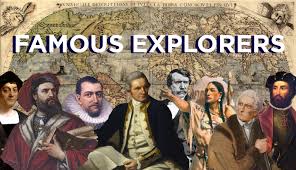
Hawking believes human survival depends on habitation of other planets. He argues that the same thing that motivated Columbus to find a new continent motivates humankind to journey into space.
Through a combination of curiosity (born partly of greed for wealth and power in my opinion) and necessity, explorers expanded their domains. Hawking suggests the same holds true today.
Will humankind visit other solar systems?
Hawking explains the limitations and problems of space travel and habitation. The distances involved in finding a planet like earth are currently too great.
Planets in other solar systems are not reachable with the
energy limitations of current propulsion technology. Long distance space travel is not
insurmountable, but presently it is beyond the capability of experimental
science.
Hawking argues that funding for space travel research needs
to be increased. Planets and moons in
our solar system will require elaborate survival systems to deal with a lack of
water, harsh climate, and unbreathable air. However, planets like Mars offer
some refuge based on technological innovation.
Will a law of nature that explains everything about
everything be discovered?
Hawking believes someone will find a theory that combines quantum theory with the special theory of relativity. The present state of science suggests “God does play dice”, contrary Albert Einstein’s belief. What remains unknown is how the theory of a causal world can be the same as a probabilistic world. Hawking believes the melding of quantum theory and Einstein’s theory will be the answer to the puzzle of existence.
Is Artificial Intelligence a danger to humankind?
Hawking argues that A.I. is potentially dangerous, but also a possible boon to humankind. He believes A.I. will exceed the capability of human reasoning. Hawking argues human beings must responsibly limit actions taken by A.I. that might be detrimental to humankind.
With the advance of genetic engineering (like Crispr), Hawking argues the human genome will be modified. That modification may involve A.I. in ways that enhance human capability. On the other hand, it may destroy human consciousness (whatever that is).
Hawking explains a dire prediction for A.I. is its potential to improve itself at the expense of humans.
Despite the four possible causes for human extinction, Hawking believes the more likely cause of human extinction will be an asteroid collision with earth. Humans, like the dinosaurs, will die in a bang, rather than a whimper.
There are other interesting thoughts from Hawking but a
final question is–what discovery, in Hawking’s opinion, would be the most
valuable to the world? What discovery would
hold the most promise?
Hawking suggests the world’s energy and environmental problems can be addressed by one discovery. The discovery of a method for creating energy from nuclear fusion. Such a discovery would diminish degradation of our environment and improve the odds for interstellar travel.