MOST INTERESTING ESSAYS 2/5/26: THEORY & TRUTH, MEMORY & INTELLIGENCE, PSYCHIATRY, WRITING, EGYPT IN 2019, LIVE OR DIE, GARDEN OF EDEN, SOCIAL DYSFUNCTION, DEATH ROW, RIGHT & WRONG, FRANTZ FANON, TRUTHINESS, CONSPIRACY, LIBERALITY, LIFE IS LIQUID, BECOMING god-LIKE, TIPPING POINT, VANISHING WORLD, JESUS SAYS
Author: chet8757
Graduate Oregon State University and Northern Illinois University,
Former City Manager, Corporate Vice President, General Contractor, Non-Profit Project Manager, occasional free lance writer and photographer for the Las Vegas Review Journal.
“A Little Life” is about the difference between coping and overcoming. Hanya Yanagihara writes of a boy growing to manhood. Though the story is about a boy, it is a universal and gender-less story about child abuse.
Yanagihara draws one into a story like John Irving lures one into “A Prayer for Owen Meany”. One feels captured in a quicksand of feeling and thought about an enigmatic character. Yanagihara creates Jude, an extraordinarily handsome and intelligent man who secretly mutilates unseen parts of his body. The story drags a listener’s thoughts into a dark place. Why is this extraordinary person cutting himself with razor blades? The reader turns a page; the listener listens to the next paragraph; needing to know the answer. Yanagihara slowly develops a backstory that explains something about human nature and why one chooses to punish themselves.
Jude is an abused child, raised in an orphanage run by priests. At 8 years of age, Jude is pimped out by a pedophile, a felon who parades as a priest. His name is Father Luke. This false man-of-God kidnaps Jude and pimps him out as a prostitute while making him believe he loves him and protects him from harm.
Yanagihara’s story drags a listener’s thoughts into a dark place. Why is this extraordinary person cutting himself with razor blades?
Yanagihara’s horrific story is revealed in flashbacks as Jude grows into a successful career as a lawyer. One begins to feel this is a story about many lost boys and girls abused by adults. It is an abuse founded on betrayal of purported guardians’ trust, and exploitative adult motives. But Yanagihara offers more.
Most children suffer from remembrance of things past. Every life copes with intentional, unintentional, true, and false hurts from childhood. Yanagihara fictionalizes a person’s life story to show how extreme those hurts can be. She offers slender hope that someone will cast a line that will rescue them from their sinking despair. The slenderness of hope is inferred by the extra-ordinariness of her main character.
A criticism of “A Little Life” is that the story is too long. It offers revelation but its insight is too long in the making. A most over-used phrase in “A Little Life” is “I am sorry”, a refrain that becomes cloying by the end of the story.
Yanagihara suggests there is a chasm between coping and overcoming life’s hardships.
Yanagihara suggests there is a chasm between coping and overcoming life’s hardships. Yanagihara infers most of life is coping with hardship rather than overcoming real or imagined hurt. Friends, lovers, psychiatrists, and physicians can help one cope with real and imagined hurts; but true overcoming lies in the mind of the traumatized.
What Yanagihara makes blindingly clear is the ugly truth of pedophilia and how sex-trafficking scars children for life. This is a story that needs to be told and understood, but not in so many words. For that criticism of the author, “I am sorry”.
ANDREW GRAHAM-DIXON (ART CRITIC-JUDGE FOR THE TURNER PRIZE, BP NATIONAL PORTRAIT PRIZE,& ANNUAL BRITISH ANIMATION AWARDS)
Caravaggio is artists’ bad boy of early sixteenth century Italy. Born in 1571, Caravaggio arrives in the midst of religious turmoil between Catholic nations and the Ottoman Empire. Caravaggio comes to life in Andrew Graham-Dixon’s biography. Graham-Dixon explores the light and dark of Michelangelo Merisi Caravaggio’s short life.
Graham-Dixon suggests Caravaggio’s life is self-formed by circumstance of history, the political connection of Caravaggio’s family, and a rebellious nature of a boy who loses his father at the age of six. A self-formed life is a description of Caravaggio’s growth to manhood. It suggests Caravaggio’s artistic ability comes from inner drive more than formal education. Though Caravaggio is apprenticed to painters in his youth, contribution to his artistic ability is obscured by differences in what Caravaggio paints and what his teacher’s taught.
CARAVAGGIO-BOY PEELING FRUIT (THE EARLIEST KNOWN WORK 1592-1593)
Use of light and shade (chiaroscuro) reflects an early break with what teachers taught and what Caravaggio could do. In his early work, the beginnings of Caravaggio’s genius are shown. Even though the subject “Boy Peeling Fruit” shows immature dimensional perspective, Caravaggio’s beginning use of light and dark dramatically highlights his subject. As time passes, Caravaggio skillfully improves chiaroscuro to further dramatize his work.
Graham-Dixon recounts Martin Scorsese’s 1960s comments about Caravaggio’s cinematic sense. Caravaggio’s paintings tell stories of the bible known by the public but known more symbolically than literally. Caravaggio’s work dramatizes biblical stories. The dramatic finger probe of Jesus by Thomas cinematically illustrates Christ has risen from the dead. From the frown on doubting Thomas’s face to Thomas’s dirty fingers, the biblical story becomes graphically real.
CARAVAGGIO-DOUBTING THOMAS (DETAIL OF THE EXTENDED FINGER, ITS DIRT& REMINISCENT MICHELANGELO SISTINE CHAPEL HAND) From the frown on doubting Thomas’s face to Thomas’s dirty fingers, the biblical story becomes graphically real.
At times, Caravaggio went too far and displeased his benefactor with biblical interpretations that offended social propriety. In St. Matthew and the Angel, the intimacy of the angel and St. Mathew offended his client. A second version had to be painted before Caravaggio would be paid.
In St. Matthew and the Angel, the intimacy of the angel and St. Mathew offended his client.
CARAVAGGIO-ST MATTHEW AND THE ANGEL-(THE REVISION)
Caravaggio paints from models of working people of his time to make stories of the bible truer to Jesus’s time. Jesus walks among the poor, the bereft, and sinners of society. Caravaggio’s characters are workers, prostitutes (courtesans), and gamblers like “The Cardsharps…” or his sexualized “Cupid as Victor”. He shows the dirty feet of a visitor to “Madonna of Loreto”.
CARAVAGGIO-THE CARDSHARPS AND THE FORTUNE TELLER
Caravaggio’s characters are workers, prostitutes (courtesans), and gamblers like “The Cardsharps…” or his sexualized “Cupid as Victor”.
MADONNA OF LORRETO (Below shows the dirty feet of a visitor.)
He shows the dirty feet of a visitor to “Madonna of Loreto”.
Graham-Dixon’s infers Caravaggio is a profligate sinner himself. Caravaggio is described as a person who wears black to obscure his visage at night when he is raising hell with his friends and enemies. Caravaggio violates the law by carrying a sword without a license; by brawling in local brothels and practicing alleged bi-sexual acts. Graham-Dixon suggests Caravaggio may have been a pimp to subsidize his income. Graham-Dixon also suggests pimping may have provided models for his art. Finally, Caravaggio kills a man and is sentenced to death.
Caravaggio is recorded by witnesses and in trials to have a volatile temper. Though the biographer mentions artist’s behavior was sometimes affected by lead and other contaminants of their paint, Graham-Dixon does not conclude Caravaggio’s behavior is caused by a painter’s occupational hazard. In 2010, lead poisoning is found in what is believed to have been Caravaggio’s remains. But Graham-Dixon reports no one really knows exactly where Caravaggio is buried. Were those remains Caravaggio’s?
KNIGHTS OF MALTA (Caravaggio made many enemies but no one knows for sure what caused his death. Graham-Dixon believes a vendetta, by a member of the Knights of Malta, is the proximate cause of Caravaggio’s death.)
Graham-Dixon concludes the biography with an explanation of Caravaggio’s mysterious death. Caravaggio made many enemies, but no one knows for sure what caused his death. Graham-Dixon believes a vendetta, by a member of the Knights of Malta, is the proximate cause of Caravaggio’s death.
Caravaggio, when he tries to become a Knight of Malta to escape the death sentence for an earlier murder, insults one of the Knights. The insult goes unsatisfied and is compounded by Caravaggio’s abandonment of the Knights of Malta when he thinks he will get a pardon for his crimes from Rome. Graham-Dixon suggests the insulted Knight catches up with Caravaggio and severely cuts his face. Several months later, Caravaggio is still recovering from the wounds when notice comes to him–upon return to Rome, he will receive his pardon.
Caravaggio packs his bags and his last three paintings and heads for Rome. The trip is by ship. The voyage includes a stop before arriving in Rome. At the stop, for an unknown reason, Caravaggio is retained by a local sheriff. The boat sails without him. When Caravaggio is released, he buys a horse to meet the departed ship at its next port before Rome. Caravaggio is still recovering from his wounds. When he arrives at a port, he is sick unto death with fever and exhaustion. Some days later, he dies at the age of 38.
Caravaggio marked a pivot point in the meaning of art. Painting became more than symbolic representation, i.e., it became a cinematic representation of the real world. The imperfection of humankind, both physically and spiritually became a part of art’s story about life. Caravaggio’s art reflects on the violence of life, the imperfection of humankind, the doubts of human belief in God, and the nature of human beings.
CARAVAGGIO (JUDITH BEHEADING HOLFERNES-Caravaggio’s art reflects on the violence of life, the imperfection of humankind, the doubts of human belief in God, and the nature of human beings.)
Newly discovered but unsigned painting by Caravaggio found in a French attic.
Caravaggio’s use of light and dark is the principle challenge to a recently found work of art attributed to, but not signed by Caravaggio. The objection is related to the use of a brown backdrop that enhances the light and shade characteristic of Caravaggio’s paintings. The estimate value for the newly discovered version of JUDITH BEHEADING HOLFERNES is $100m.
This is the first of a series of historical novels about a physically impaired Royal Commissioner/attorney that investigates crimes in the time of Henry the VIII. The listener is introduced to Matthew Shardlake.
Shardlake is commissioned by Oliver Cromwell to investigate the murder of a fellow Commissioner. Sansom creates the feel and smell of early 16th century life in a Sussex monastery, 50 miles from London. More interestingly, he reveals a version of Oliver Cromwell and the great upheaval of Roman Catholics at the time of Anne Boleyn’s beheading and King Henry the VIII’s rapacious hunger for Papist wealth. Sansom writes about social change in the 1530s. He reveals how that change muddies truth and justice, and exposes good and evil.
“Dissolution” is about Oliver Cromwell’s execution of King Henry’s orders to dissolve the Roman Catholic archdiocese and replace them with an Anglican Catholic hierarchy, responsible to the King of England rather than to the Pope of Rome. Henry the VIII’s purported goal is to reform the Catholic region in England but the underlying objective is to confiscate Roman Catholic assets to increase the Royal treasury.
King Henry capitalizes on the general population’s disgust with wealth and corruption in the local Archdiocese. The King commands Cromwell to send investigators (Royal Commissioners) to surrounding monasteries to search for legal means to dissolve their existence. One of these investigators is murdered; i.e. his head is lopped off in a monastery’ kitchen. Possible motives for the murder are fear of monastery dissolution, religious difference, sexual exploitation, and/or financial greed.
Leadership of the monastery suggests the perpetrator came from outside but evidence mounts to suggest that the likely villain or villains are within the monastery rather than without. That is the context in which C.J. Sansom places Commissioner Shardlake.
Shardlake’s character is more 21st century than 16th. Though he believes in God, he suspects religion as a dissembler of truth; i.e. he believes in the word of God but sees that God’s word is distorted by man. Shardlake, believes in the King’s plan to reform the church but becomes aware of Cromwell’s lies and deceit and begins to question Royal motive.
Shardlake shows himself to be a humanist that abhors physical punishment and abjures unfair treatment of women. His hunchbacked description and reported relationship with Oliver Cromwell reminds one of a conflicted human choosing to overcome adversity by educating himself, rationalizing human frailty, and believing that ends sometimes justify means. In the course of Shardlake’s investigation, the truths of his internal conflicts are revealed as he solves the murder.
What makes Sansom’s book more than a murder mystery is historical integrity and its larger human context. The story reveals the Machiavellian reasons for dissolution of the Roman Catholic Church in England. The Roman Catholic Church was not then, nor is it now, entirely good or entirely evil. As in all social change, dissolution of any human system of government, any kind of organization, throws both good and evil into the street; what remains is still a balance of good and evil but in a different human organizational form. Only the future and history reveal whether social change is better or worse. Evil does not disappear because it is a part of human nature, regardless of social change.
Listeners may be satisfied with “Dissolution” as a mystery, historical novel, or social commentary.
By writing–women are human beings first–, Betty Friedan speaks truth to power. Friedan’s theme in The Feminine Mystique attempts to enlighten thick-headed males and doubting women about the equality of human beings. It is sad to realize that such a banal and obvious statement as “women are human beings first” so perfectly exposes the ignorance of prejudice.
Every rational human being has a brain that neurologically functions in the same way; i.e. through chemical and neural interconnection. This is not to suggest that brains are exactly alike; that interconnection is exactly the same, or that genetics do not matter. It is not to suggest that environment does not matter. What Friedan shows is that sexuality, color of one’s skin, and culture are influences that create prejudice while the brain is an infinitely malleable organ that carries the potential for genius as well as stupidity.
What Friedan shows is that sexuality, color of one’s skin, and culture are influences that create prejudice while the brain is an infinitely malleable organ that carries the potential for genius as well as stupidity.
SIGMUND FREUD (1856-1939) Friedan suggests the Oedipus complex and penis envy are male delusions about female sexuality, perpetrated by Sigmund Freud and endorsed by most intellectuals and academicians in the early 20th century.
Friedan suggests the Oedipus complex and penis envy are male delusions about female sexuality, perpetrated by Sigmund Freud and endorsed by most intellectuals and academicians in the early 20th century. The Feminine Mystique, published in 1963, acknowledges Freud’s great insight to the psychology of human beings but derides diagnosis of female hysteria as a valid mental disorder.
Female hysteria disappears from professional psychology schools in the mid-20th century. Friedan suggests female hysteria has little to do with sexuality, women’s menstruation, or change-of-life diagnosis. Her argument is that conversion disorder; hypochondria-sis, depression and anxiety in women are more likely caused by The Feminine Mystique, a false notion of a woman’s “role” in society; i.e. the idea that a woman can only be a spinster, wife, or mother.
Those roles limit the productive capability of half the human race. If a spinster chooses not to have a husband, there is more time to make productive contribution to the world. If a single woman chooses to be a wife, sharing the costs and burdens of domesticity, it leaves ample opportunity for other life interests; the same applies to motherhood. Being denied constructive opportunity drives women to the neuroses of the modern age.
If a single woman chooses to be a wife, sharing the costs and burdens of domesticity, it leaves ample opportunity for other life interests; the same applies to motherhood.
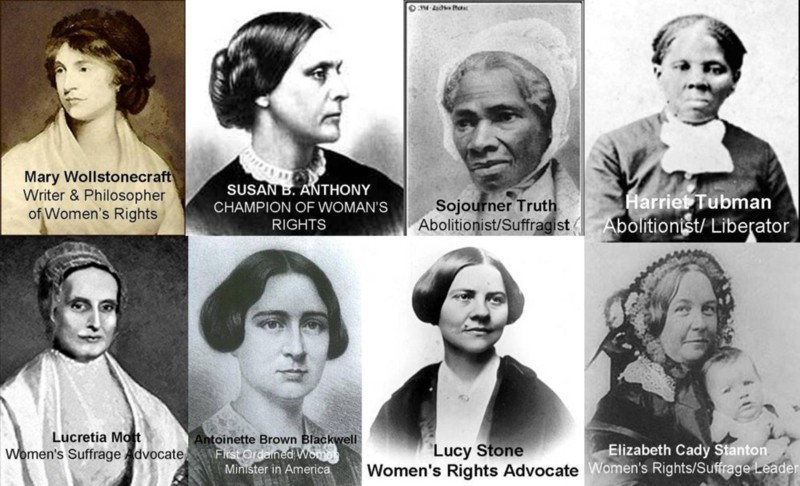
A woman can be a spinster, wife, or mother but she can also be a scientist, a President, a business mogul, or a bum. The Feminine Mystique exposes the false premise that women are primarily breeders and caregivers rather than equals in humanities’ race for money, power, and prestige. What Friedan reveals in The Feminine Mystique is that women can bear children and be equally interested in and capable of excelling in the world of money, power, and prestige. However, women are frustrated by inequality of opportunity caused by The Feminine Mystique which identifies women in a role that should be shared by all members of the human race.
FAMOUS WOMEN IN HISTORY A woman can be a spinster, wife, or mother but she can also be a scientist, a President, a business mogul, or a bum.
SEXUAL PREDATION (WOMEN AS OBJECTS TO FULFILL MALE FANTASIES)
Birthing children is unique to women just as sperm production is unique to men. Beyond these unique capabilities, a world of opportunity is open to both men and women, but men have a culturally and historically defined advantage. Friedan defines men’s advantages by noting false barriers produced by psychologists like Freud that fail to understand they are discounting productive potential of half the human race.
Worse than the existence of barriers to equal opportunity for women, Friedan explains the unconscious conspiracy that pervades American culture. Freidan acknowledges it is not a cabal of men but that it is a pervasive misunderstanding of what a human being is.
Worse than the existence of barriers to equal opportunity for women, Friedan explains the unconscious conspiracy that pervades American culture.
The tragedy is that this misunderstanding becomes self-perpetuating. Advertising trades on sexual innuendo that perpetuates objectification of women; studies like the Kinsey report falsely infer natural sexuality is inhibited in women that have higher education; blame is placed on women for children that become delinquents because they are not always present as homemakers and caregivers.
Advertising trades on sexual innuendo that perpetuates objectification of women.
Rationally, most people realize women are not sex objects. Advertising based on sexual innuendo is unlikely to change. The more ominous concerns raised by Friedan are false correlations suggesting higher education diminishes natural sexuality and that women (mothers) are primarily responsible for what children become as adults. Higher education is the primary hope for breaking the cycle of unequal treatment of women. Children become adults as a result of many things—not only from parenting but from genetics, health, and environment. Mothers are no more to blame than fathers who fail to share the responsibilities of home making and parenting.

Mothers are no more to blame than fathers who fail to share the responsibilities of home making and parenting.
INSTITUTIONAL DISCRIMINATION–Women doing the same job as men in 2010 receive $.81 for every $1 paid to men, a 19% difference.
Freidan’s concern is that women are not treated as equals even though women are approximately equal-in-number to men. Things have changed since 1963 but equality remains a work-in-process. Of the fortune 500 companies in the United States, only 25 have female CEOs. Women doing the same job as men in 2010 receive $.81 for every $1 paid to men, a 19% difference. Though house work is shared more now than in the 1960s, women work 18 hours a week homemaking while men work 10 hours a week (according to a PEW Research Study in 2011); i.e. the greatest burden remains with women. Without meaning to argue that the glass is half empty rather than half full, the revolution exemplified by Friedan’s book is incomplete. Many people continue to fight for equality of all human beings but many men and women continue to resist; to the detriment of society.

The Feminine Mystique should be required reading in high schools. It is as relevant today as it was in 1963.
Do No Harm: Stories of Life, Death, and Brain Surgery
Written by: Henry Marsh
Narration by: Jim Barclay
HENRY MARSH (BRITISH NEUROSURGEON AND AUTHOR)
An interesting insight offered by Henry Marsh’s memoir, “Do No Harm”, is a contrast between American and British Medicine. Marsh’s candor about his life and profession surprise his audience and endear his curmudgeonly personality. The surprise is in Marsh’s profound empathy and personal conflicts over neurosurgical decisions.
Marsh’s endearment comes from explicit “f-word” rants about incompetence, technology, and bureaucracy. In addition to his rants, Marsh endears himself to an audience by explaining the distinction between a physician’s self-confidence and hubris. Marsh suggests physicians need understanding and competence; not undue preciousness, and pride-full medical knowledge. Jim Barclay’s narration perfectly suits the tone of Marsh’s memoir.
Marsh is able to enter into medicine with little pre-medical education in the sciences.
Either by dint of a formidable intellect or a quirk of the British education system (maybe both), Marsh takes all his science courses after deciding to become a doctor. One doubts an American medical school would have considered his application in the 1960 s.
Marsh graduates and begins his career in medicine under the guidance of experienced physicians. As he acquires experience, he chooses to specialize in neurosurgical medicine under the supervision of a Consulting Neurological Physician. The Consultant (a neurology physician trainee’s guide) works within the English national health care system as a qualified physician who supervises aspiring neurological physicians. This consultant chooses cases for trainees; under varying levels of supervision.
Though a neurological procedure may be done by a trainee, the consulting physician is responsible. This appears to be similar to internships in the United States. However, an interesting difference is in the insurance for interns.
MEDICAL INTERNSHIPS- English hospitals carry a trust to protect physicians from mistakes made in treating patients.
The UK’s physician-group self-insurance may be a distinction without a difference but, as in all medical insurance systems, mistakes do occur, and patients are harmed. The difference between physician-group self-insurance and American physician’ private insurance raises the specter of limited settlement for egregious mistakes. On the other hand, it suggests British physicians are more likely to be more forthcoming on mistakes that are made.
Marsh completes his trainee experience and decides to become a Consulting Neurological Physician in the national health care system. Marsh interestingly reveals several mistakes he and his trainees make during his years of consultancy. In revealing those mistakes, a listener pauses to think about risks of patients who depend on English’ or American’ medical services. Marsh’s stories of mistakes reflect on medical training, family apologies, and personal anguish over patient’ quality-of-life and death issues.
Marsh explains, at best a Consultant Surgeon expects to learn from surgical mistakes to avoid repetition.
The worst, for Marsh, is the apologies to families for the mistakes that are made. In contrast to Marsh’s way of addressing mistakes, American physicians seem more likely to avoid family apologies; while hiding behind legal and insurance company shields.
A more subtle message in Marsh’s book is the failure of the English National Health Service to provide adequate care for the general population; e.g. its long lines of patients who wait for attention when rapidly growing tumors are destroying a patient’s neurological system.
Doctor/patient ratios in 2016 were 2.6/1,000 people in America. In 2018, the doctor/patient ratio was 2.8/1,000 in the United Kingdom. This raises the question of how long would Americans have to wait in line with a national health care system? Some argue physician assistants could be trained to take care of less serious medical issues. That would spread the burden of patient treatment.
Marsh complains of inadequate bed availability for patients that need operations. Financing for the National Health Service is inadequate for the number of patients that need help. This seems a likely consequence of an American national health care system.
Marsh notes that he carries private health insurance to supplement his family’s medical needs. At the same time, he infers private hospital services tend to gouge patients for their medical service; in part, from charges for unnecessary tests and superfluous operations.
Marsh attacks the bureaucratic nature of the National Health Service that hires hospital administrators who are directed to reduce costs; regardless of patient’ load or patient’ need. Technological improvements for England’s National Health Service are delayed because of lack of financing, poor administration, and inadequate training. These are maladies that will plague a national health care system in the United States.
Marsh leavens his criticism of England’s national health care by writing of his experience in the former U.S.S.R. (specifically Ukraine) where problems are monumentally greater.
In the end, America’s effort to improve national health care is tallied in one’s mind against the current English picture painted by Marsh. For medical patients, the English system seems riskier than the American system. Doctors in England seem more insulated from medical mistakes. If doctors are more insulated, they may take more risks; i.e. risks that can lead to patient’ disablement or death. The American system, if one can afford the service, seems more conservative and less likely to take risks.
It seems England’s national health care offers a level of societal comfort because there is hope for affordable treatment. On the other hand, Marsh clearly shows how government bollixes National Health Care with inadequate funding and a bumbling administrative system. Some would say this is why the U. S. should not nationalize health care.
Marsh notes England’s private system has not met the needs of citizens who can afford additional service. The private system suffers from human nature’s folly; i.e. the lure of wealth at the expense of fairly priced or truly needed medical treatment.
Marsh suggests the private system suffers from human nature’s folly; i.e. the lure of wealth at the expense of fairly priced or truly needed medical treatment.
Is medical health service a human right or privilege? One draws their own conclusion about British and American Medicine. Marsh shows the monumental problems of affordable health care in England.
A listener of “Do No Harm” infers problems of the British system for medical care will challenge America’s desire for universal health care. Dr. Marsh’s answer seems to revolve around empathy for all human beings; i.e. regardless of whether a country has a nationalized or private health care system.
Audio-book Review By Chet Yarbrough (Blog:awalkingdelight) Website: chetyarbrough.blog
A Primate’s Memoir: A Neuroscientist’s Unconventional Life Among the Baboons
Written by: Robert M. Sapolsky
Narration by: Mike Chamberlain
ROBERT SAPOLSKY (AMERICAN NEURO-ENDOCRINOLGIST, PROFESSOR OF BIOLOGY, NEUROSCIENCE, AND NEUROSURGERY AT STANFORD UNIVERSITY)
Robert Sapolsky’s “A Primates Memoir” is a masochist’s guide to Africa. (Our 2017 trip to Africa was luxurious in comparison.) Sapolsky’s trip is what you would expect from a biological anthropologist who sojourns to Africa in the early 80s. Sapolsky lives in a tent while studying baboons.
Our stay in Africa is luxurious in comparison to Sapolsky’s in the 1980s.
At the age of 12, Sapolsky appears to know what he wants from life. In his middle-school years, he begins studying Swahili, the primary language of Southeast Africa.
Sapolsky’s career is aimed at understanding Southeast Africa. Sapolsky’s 1984 PhD. thesis is titled “The Neuro-endocrinology of Stress and Aging”. Presumably, his trip to Africa became the basis for his academic thesis. Sapolsky’s experience in Africa is recounted in “A Primate’s Memoir”.
Animal preserve in Southeast Africa
While studying Baboons, Sapolsky is exposed to the worst of African society. His memoir of those years touches on the aftermath of Africa’s colonization, Africa’s ubiquitous diseases, its governments’ instability, and its abundant and frequently poached wildlife.
SOUTHEAST AFRICA
Robert Mugabe (Former President of Zimbabwe)
JACOB ZUMA (FORMER PRESIDENT OF SOUTH AFRICA)
Though some of what Sapolsky writes has changed, today’s news shows characters like Robert Mugabe, and Jacob Zuma, who are accused of victimizing the poor to enrich themselves.
Some African, and other nation-state leaders around the world, are corrupt. Many Southeastern African bureaucrats, foreign business moguls, indigenous apartheid promoters, and wildlife exploiters still walk, drive, and bump down streets and dirt trails of this spectacular continent.
Self-interest often conflicts with general economic growth and stability. Today’s Southeast Africa is great for tourism (one of the three biggest industries) but the poor remain poor, the rich richer, and the middle class nearly non-existent.
Today’s Southeast Africa is great for tourism (one of the three biggest industries) but the poor remain poor, the rich richer, and the middle class nearly non-existent.
Sapolsky returns to Africa after marrying. He squires his science and marriage partner to revisit a baboon troop he was studying in the 1980s. At the same time, he touches on the cultural norms of a society that seems little changed from his early years in Africa.
Sapolsky recounts the melding of a tragi-comic story of an African who is mauled by a Hyena. In telling the story, he reveals the stoic acceptance of life as it is. However, each time the story of the mauling is told by different people, it changes. The change comes from a blend of truth and fiction that conforms to the tellers’ view of themselves. The essence of the story is that an African man sleeping in a tent is mauled by a Hyena looking for food.
Re-telling of an African story changes with each narration–The change comes from a blend of truth and fiction that conforms to the tellers’ view of themselves..
When the story is told by Masai warriors hired by a company to protect its employees, the victim is saved when the Hyena is speared by the Masai warrior’s courage. When the story is told by the victim, it is a company cook who bashes the Hyena that runs away. When the story is told by a newspaper reporter, the Masai warriors were drunk and not doing their job; the cook bashed the Hyena, and the victim survived. When the story is told by the cook, the victim’s yell brings the cook to the tent; the cook grabs a rock, bashes the Hyena, and the Hyena flees. Finally, when the story is told by the company employer, the victim is not an employee, the Mesai warriors did spear the Hyena, and the employer had no responsibility for the victim.
A cultural interpretation is inferred by these many versions of the same story. Some humans indulge in alcohol to escape reality. Most humans wish to protect an idealized version of their existence. News coverage is sometimes a mix of truth and fiction to make stories more interesting than accurate.
Life is happenstance with each human dealing with its consequence as an end or beginning that either defines, or extends their understanding of life. Truth is in the eye of the beholder. Some people are willing to risk their lives for others. Private companies focus on maximizing profit and minimizing responsibility. Life is not an either/or proposition despite Kierkegaard’s philosophy. Humans are good and bad; no one is totally one or the other–not even America’s morally corrupt and ethically challenged leader.
Sapolsky shows that baboon families, like all families, are born, mature, and die within a framework of psychological and physical challenges imbued by culture. All lives face challenge but culture can ameliorate or magnify the intensity and consequence of the challenge.
The overlay of Sapolsky’s memoir is the research and reported evolution of a baboon family in Southeast Africa. He shows that baboon families, like all families, are born, mature, and die within a framework of psychological and physical challenges imbued by culture. All lives face challenge but culture can ameliorate or magnify the intensity and consequence of the challenge.
Sapolsky gives the example of Kenyan “crazy” people who are hospitalized, treated, and fed to deal with their life circumstance. In America, it seems “crazy” people are left to the street. The inference is that Kenyan “crazy” people live a less stressful life than American “crazy” people. This is a positive view of Kenyan culture but there are ample negative views in Sapolsky’s memoir. Rampant poverty, malnutrition, and abysmal medical treatment are Sapolsky’s recollected examples.
Sapolsky’s memoir shows he clearly lives an unconventional life, but it seems a life of purpose. What more is there?
More mass shootings this weekend. Twenty innocents murdered in El Paso and nine in Toledo.
Who are we? What have we become? A deplorable habit of humans is to classify others as either one of us or one of them.
“The True American” is a news reporter’s story of two Texas murders and a wounding. The victims are people living and working in 21st century America. By birth, the three victims are Bangladeshi, Indian, and Pakistani. “The True American” is the story of murder and mayhem that tests Texas’s death penalty. The facts of the story expose human nature’s habit of “us and them” categorization.
The Texas’ murders could have been anywhere in America. Anand Giridharadas’ book is about “us and them” choices people make every day.
There is a causal link in America’s mass shootings that goes beyond the gun lobby and AK-47s. Many of these horrific events are motivated by the isolation from Covid19 and “us and them “categories” that make one person different from another.
There is a causal link in America’s mass shootings that goes beyond the gun lobby and AK-47s. The isolation caused by Covid19 raises social tension. Both guns and Covid19 link Americans to unnecessary death.
Yesterday’s examples of “us and them” in America are shootings in El Paso, Texas and Toledo, Ohio. Other examples of “us and them” mentality are our President’s categorization of illegal Mexican’ immigrants as murderers and rapists, a white man’s slaughter of nine Americans because they are Black, a Muslims’ murder of five soldiers because they are American, and the 2019 Poway synagogue shooting in Califorinia. Then there are this week’s murders of innocents at a parade in Waukasha, Wisconsin.
The focus of Giridharadas’ book is the maiming of Raisuddin “Rais” Bhuiyan. Bhuiyan is an aspiring American émigré from India, who is shot in the face by Mark Anthony Stroman.
Stroman murders two and maims Rais Bhuiyan, because he sees himself as a part of “us” (Americans) and his victims a part of “them” (Arab terrorists). Ironically, none of the three victims are Middle Eastern.
Like our President’s slander of Mexicans, a white man’s slaughter of Blacks, a Muslim’s murder of soldiers in 2015, and the 2019 murder in a Jewish synagogue, Stroman believes anyone that looks or acts like “them” is not worthy of “us”.
Bhuiyan’s life is worthless to Stroman because he is avenging destruction of the World Trade Center in New York. To Stroman, Bhuiyan and two un-related Asians are terrorists because of the color of their skin. Ironically, both Stroman and Bhuiyan, in the beginning of this true story, think in “us and them” terms. By the end of Giridharadas’ book, Stroman and Bhuiyan realize there is only “we”.
Bhuiyan and Stroman are polar opposites in many ways but the same in some ways. Bhuiyan is raised in a loving family in India. Stroman is raised by an uncaring mother and stepfather. Bhuiyan is strongly supported by his family to get a good education. Stroman is ignored or abused by his family and drops out of middle school. Bhuiyan excels in a private India’ school and becomes an elite citizen of Bangladesh’s government Air Force. Stroman is a “lost boy”; in and out of jail, and largely educated by government penal institutions. Bhuiyan decides to immigrate to America. Stroman knocks around Dallas, Texas, slipping in and out of jobs and jails.
However, Bhuiyan and Stroman are alike in their social isolation. Bhuiyan arrives in America without friends or family. Stroman breaks ties with family and makes few friends. Stroman isolates himself from society with drugs that make him belligerent. Stroman is prone to relationships with fellow societal misfits. Bhuiyan isolates himself from society by the circumstance of being a stranger in a strange land. Bhuiyan moves from New York to Dallas because a fellow Asian immigrant offers him a job. Stroman is a “…True American”. Bhuiyan is an aspiring “…True American”.
Bhuiyan’s early associations in America are with fellow Bangladeshis with the goal of finding employment. Stroman’s associations are with outliers of American society with the same goal of finding employment. Bhuiyan’s effort to find jobs is difficult because of his recent immigration and ethnic isolation. Stroman’s effort to find lawful jobs is difficult because of his prison record, drug use, and volatile temper.
Stroman is convicted for one of his two Dallas’ murders and sentenced to death. After ten years of appeal, Stroman’s execution is imminent. Bhuiyan, in that ten years, continues his journey to become a “…True American.” In the course of their troubled lives, Bhuiyan and Stroman grow to understand each other’s humanity.
Stroman re-imagined his life as his execution date approaches. On the face of Stroman’s written and video confessions, Stroman either manipulates the media or has truly recognized the error of his ways.
Stroman may have grown to understand, humanity is not a matter of “us and them” but a complicated mix of good and evil in every human being. Ironically, Stroman’s and Bhuiyan’s journey is through religious belief, one as a Muslim; the other as a Christian.
Stroman is executed by lethal injection on July 20, 2011.
Extreme Medicine: How Exploration Transformed Medicine in the Twentieth Century
By: Kevin Fong
Narrated by Jonathan Cowley
KEVIN FONG (MD, SPECIALIZES IN SPACE MEDICINE IN THE UK)
Though not precisely on point, Doctor Kevin Fong addresses the principle of “right to try” drugs for treatment of terminal patients. In 2018 the House of Representatives of the United States voted a majority for “right to try”. The Senate rejected it.
Fong, a physician, believes exploration and extreme medicine are linked. He believes human survival depends on that linkage. Fong’s book, Extreme Medicine, links exploration and medical advance with real-life stories of adventure, discovery; failure and success. He argues that exploration of the unknown transforms medicine.
Jean Hilliard (Frozen for six hours in January 2018–heart stopped and was clinically dead but recovered with no brain damage.)
Fong begins with a story of frostbite in the early 20th century. The two edges of subzero weather are revealed; one edge destroys while the other preserves life
Fong recounts the life of a mariner that dies from frostbite. Frostbite slowly saps life from his limbs, his brain, and finally his heart. Then Fong tells of a skier’s accident in freezing weather that leaves her clinically dead for three hours. The skier lives; even though more than 20 minutes passed without an operating autonomic system.
It took the ski patrol 20 minutes more to dig Kristin out as she was buried head first in the snow. “She was completely unconscious,” McAllister said. “She was completely cyanotic, which means she was blue all over. When I got down there I just opened her airway and started to clear her chest of snow. Doing so she spontaneously started breathing on her own.
The mariner slowly succumbs to extreme cold and dies. The skier rapidly succumbs to extreme cold and lives. To Fong, this is a trans-formative discovery in medicine. The skier’s recovery demonstrated the value of rapidly reducing one’s body temperature to arrest deterioration from physical trauma. Doctors who treated the skier were using extreme medicine to preserve life when history suggests she would never recover. That extreme medicine became standard operating procedure for certain kinds of traumatic injury.
Fong offers several more stories of extreme medical practice. Extreme medicine may initially kill patients but become life lines to future patients once extreme practices prove successful. Big examples are heart surgery and organ transplants. In the beginning, physicians abhorred the idea of cracking a living person’s chest to operate on a human heart. Fong correlates humankind’s instinct for exploration with doctor’s exploration of medicine.
There seems some truth in that suggestion but there is an ethical difference. Doctors are taking someone else’s life in their hands. An explorer of the North or South Pole is choosing to risk his own life in exploration. As a patient, fear of death is a constant motivation. As an explorer, fear of death is situational rather than ever-present.
Ethics come into issue in the doctor’s sale of extreme medicine. Life is always, to quote a book and movie title, a matter of “me before you”. Doctors are human. Money, power, and prestige affect their decisions just as they affect all human decisions. The difference is that the patient has more to lose than the doctor.
A logical extension of “Extreme Medicine” is the Chinese scientist, He Jiankui, who chooses to be the first to edit the genome of a baby — allegedly to protect the baby from contracting AIDS.
Dr. He is criticized as irresponsible for using a gene-editing technology called CRISPR that is presently being tested around the world. The ramification of Dr. He’s genomic editing gives rise to concern over experiments like those conducted by the fictional scientist, Dr. Moreau.
The ethics issue is exemplified by Congress’s rejection of “right to try” legislation. A patient’s right to choose is a form of extreme medicine with ethical and, many would say, moral significance.
Living life is by nature an exploration. Human beings that choose to explore advance knowledge. Knowledge drawn from exploration does transform medicine. Knowledge transforms everything in life. Life on earth is finite; with exploration, life is potentially infinite. However, it is self-deluding to forget the moral and ethical questions raised by “Extreme Medicine”.
(AUTHOR) Indre Viskontas is an Adjunct Professor of Psychology at the University of San Francisco. With a PhD in Cognitive Neuroscience, Viskontas has done research on neuro-degenerative diseases.
Indre Viskontas covers a broad area of knowledge and experience. She offers many counter intuitive insights to human behavior and the brain in several recorded lectures. She explains neuronal and behavioral functions of the brain.
Viskontas explains how and why the brain, though highly complex, and insightful, can be judgmentally weak, misleading, and health adverse. A human brain can provide extraordinary insight to the nature of things and events while maintaining the body’s autonomic system. On the other hand, that same brain can create appalling misinformation about things and events, distort the truth, and cause autonomic failures.
From regions of the brain to basic parts of neurons, Viskontas dissects what is known and unknown about brain function. She ties brain anatomy to our limited knowledge of consciousness and human behavior.
Viskontas is one of many myth breakers. She notes, the brain has adapted to its environment, but some functions are inefficient, misdirected, and self-destructive. Brain evolution is a lucky draw informed by circumstances.
The brain is not perfect. She notes that the brain is a part of an evolutionary cycle. Every cycle of life has the chance of improving or destroying some aspect of the brain’s design. So far, the brain has adequately adapted to its environment, but some functions are inefficient, misdirected, and self-destructive. Brain evolution is a matter of luck and circumstance.
Giant dinosaurs adapted in their generation, but most dinosaur species died because their physical evolution could not keep pace with environmental change. Viskontas notes the human species follows the same evolutionary path.
Luck comes from adaptation to an evolutionary change. Circumstance comes from the environment that compels change. Only time will tell whether environmental change becomes too great for human adaptation.
Viskontas shows the perfect brain is a myth because evolution is an arbitrary and imperfect process. Evolution can produce human gene improvements or replicate destructive gene changes.
Viskontas notes current measurement of intelligence slightly correlates with brain size. But, size matters little.
She notes that Einstein’s brain is found to be average in size. However, it is noted to have some differences; i.e. like the number of glia cells (chemical “information transmission” cells) which were more numerous in Einstein than the average brain. Also, Einstein’s brain had more interconnection between brain segments than the average brain. Bigger is not necessarily better.
Viskontas suggests chemical imbalance as a singular explanation for psychosis is misleading.
The many connections between brain segments suggest chemical imbalance is an oversimplification of psychiatric dysfunction. Viskontas acknowledges the success of drugs to mitigate aberrant behavior but she notes that neurotransmitters affected by a chemical imbalance are only one part of a healthy functioning brain. Chemicals in the brain are always in flux. Drug therapy is a scatter shot solution rather than precise treatment for negative psychological symptoms.
Another often-believed myth is that people who are left-brained are logical; while people who are right-brained are creative.
Viskontas shows that both sides of the brain are activated when creativity or logic are drawn upon. The interconnections and malleability of brain hemispheres suggest logic and creativity come from both hemispheres and can (to a degree) come from one, if the other is damaged.
Viskontas notes that men’s and women’s brains are different.
However, Viskontas concludes similarities far outweigh differences. She notes double-blind experiments that show women have better memories than men when emotion is involved. The region of the brain called the amygdala is larger for men than women. Viskontas suggests the different sizes may account for differences in sexual behavior.
Parenthetically, she notes there is a medication bias in treatment for men and women because most experiments use men as the subject of investigation for drug trials. Women are underrepresented in clinical trials.
Viskontas and other writers have exploded myths of accurate human memory.
Human brains are not movie projectors. Human brains recall memories as stories; not discrete facts. Memories are recreations of what one has experienced (both in the distant past, near past, and present). Facts are often added, and stories are embellished when memories are recalled. The accuracy of memories is highly influenced by an individual’s past and present experience.
Viskontas goes on to explain that life experience creates conscious and sub-conscious bias. When past experience is added to the memory of an event, the brain recalls memory for continuity, more than truth; i.e., facts change, and incidents are misrepresented, or misunderstood. Recalled events are biased by experience.
We have five senses, but they focus on details that meld into a story that makes logical sense to the person recalling a memory.
Viskontas notes that our senses mislead us because we do not see everything. Like historians, we only report the facts we choose to include. There are always more facts about historical events than can be reported by the most diligent historians. Some facts are left out that change the accuracy of history. That is why Ulysses Grant is an incompetent President to some and a great President to others.
Viskontas sites experiments that show neurons continue to grow throughout one’s life if they stay engaged with society and work on learning new things. Those over 50 need to get out of their cars and walk to the store or the local coffee shop whenever possible or practical. Stand more; sit less.
Then there is the myth of old age and neuronal decay that begins after 50. Viskontas sites experiments that show neurons continue to grow throughout one’s life if they stay engaged with society and work on learning new things. An important caveat is that neuronal growth is improved with exercise. So those over 50 need to get out of their cars and walk to the store or the local coffee shop whenever possible or practical. Stand more; sit less.
There are more brain myths exploded by Viskontas, but a final example is the myth that we use only 10% of our brain. All parts of our brain are interconnected. Not all parts are necessarily engaged at once, but interconnections suggests 100% of our brain is used at one time or another.
Viskontas’s knowledge and experience suggest memory holds some truth but not all the truth.
Sean Carroll is a theoretical cosmologist and senior research associate in the Department of Physics at the California Institute of Technology. “The Particle at the End of the Universe”, published in 2012 is focused on the story of Higgs-boson, the widely and incorrectly termed “god particle”. Higgs-bosun is discovered at CERN with the Large Hadron Collider’ experiments done between 2011 and 2013.
The LHC enables scientists to experiment with particle physics at the most minute level in the world; at least, presently possible. The LHC offers a mechanism for proving physics’ theories with experimentation formerly un-available to science. The wonder of the machine is its ability to identify the remains of particles never seen before. It offers the opportunity to see skeletal remains of the elemental particles of life. One presumes many physics theories will be experimentally proven true or false by the LHC. More consequentially, the identification of a Higgs-boson like particle opens a whole new area of science research and theory.
Carroll notes that the LHC is the largest machine in the world with a 17 mile circular tunnel built underground, below several Swiss towns. It was built by the European Organization for Nuclear Research. The LHC is a super cooled vacuum in a tunnel–designed to accelerate protons at near the speed of light for collisions that will reveal the remains of sub-atomic particles. The acceleration is achieved by using giant magnets that accelerate protons trapped in the tunnel. The LHC is in pursuit of the minutest elemental particles of the universe. They are presumably undiscovered because the total energy of known particles does not match the calculated energy of a specific field.
LHC MAP SHOWING CERN SITE–When listeners finish “The Particle at the End of the Universe, they will understand why Higgs-boson is a magnificent discovery and the LHC is worth its nine-billion-dollar expenditure.
Carroll’s explanations of physics and the momentous importance of Higgs-boson are clear and understandable. Early on, one finds Carroll explaining that particle physics is a misleading category of scientific research. Carroll notes that Higgs-boson is not a particle. It is a field. Further, Carroll notes–all that humankind perceives in the world is made of fields, not particles.
With the advent of experimentally proven quantum mechanics, particle physics is transformed into field physics because of uncertainty. Every particle known to science is on the move. In order for one to view a particle—a proton, neutron, electron, etc., it must be frozen in time, which is not its natural state. Every particle exists within a field, a field in which particles are always in motion; always in one place or another.
Among many insights offered by Carroll, is the fundamental categorization of elemental particles. All particles are broken into two categories. One category is Fermion. The second is Boson. Fermions are elemental particles that are composed of matter.
Bosons are elemental particles that are force fields like magnetism.
Electrons, neutrinos, and quarks are fermions, the matter of the universe. Photons, gluons, W bosons, and Z bosons are forces acting on fermions within fields. These elemental particles are massless. All of these particles would remain massless without the Higgs-boson mechanism (field). The Higgs-boson field creates mass out of massless particles.
A useful analogy reported by Carroll explains how a Higgs-boson field creates mass. Imagine two people walking through a room filled with equally dispersed people. The people-filled’ room is the Higgs-boson field. The two people walking through the room are added massless elemental particles. However, one of the two people is famous. The crowd congregates around the famous person to create a mass of people while the less famous person passes through the room (the field) unnoticed.
Carroll explains the experimental proofs of quantum mechanics are the reason Higgs-boson, or something like it, must exist. That is why its discovery was so important. Higgs-boson is the field in which known particles of the universe gain mass. Higgs-bosun is the famous person that walks into the people-filled’ room. Without Higgs-boson or something that works like Higgs-boson, life (matter and energy) would not exist.
Carroll offers other insights—about symmetry, super-symmetry, and breaking symmetry. He touches on dark matter and string theory. All subjects are interestingly presented.
In general, Carroll crystallizes the importance of theoretical and experimental science.
LARGE HADRON COLLIDER
When listeners finish “The Particle at the End of the Universe, they will understand why Higgs-boson is a magnificent discovery and the LHC is worth its nine-billion-dollar expenditure.