
Books of Interest
Website: chetyarbrough.blog
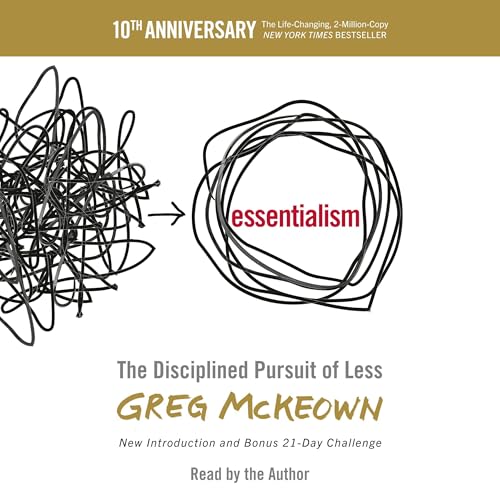
“essentialism” (The Disciplined Pursuit of Less)
Author: Greg McKeown
Narration by: Greg McKeown

Greg McKeown (English author, public speaker, leadership and business strategist.)
McKeown earned an MBA from Stanford University after receiving a BA in communications and journalism at BYU. He reflects on the trials and tribulations of being a manager of events in the modern world where one is faced with psychological overload. Management is the skill of being who you are and getting things done through other people. McKeown explains how to become a more effective and productive manager. It begins with a clear understanding of what self-management is and what may get in the way of that accomplishment.
As a manager of someone else’s business, the job is simpler because the goals are determined by ownership but as a manager of one’s own time it is complicated by poor personal management skill. The idea of “essentialism” is in clearly understanding the goal to be achieved and to understand oneself well enough not to be distracted by what is to be achieved and how to organize and motivate the people who are to accomplish desired results. Once the goal is clearly understood, the end must be what ownership and oneself chooses. If the goal is to manufacture widgets, the steps of manufacturing are labor to produce a product, neither more nor less than what ownership directs. A good manager is not to focus on “more is better” but on the steps of manufacturing with an eye to trade-offs that are a consequence of labor organization and productivity.

The problem from a personal perspective is that company goals are easier to understand because they are determined by others.
Clearly understanding oneself is harder because of self-interest blind spots from being both the observer and observed; not to mention– knowing what actions are required to feel fulfilled as a human being.
The best choice in life is to be who you are, not who you wish to be.

As a manager of others to accomplish a goal, there are times when the response to a worker’s idea is no. This should never be meant to diminish the worker but to keep a worker’s eye on the goals of ownership. A good manager is respectful of a worker who offers ideas but always keeps the goal of ownership in the minds of workers to make it clear that a “no” is not to discourage a worker’s labor or idea for improvement. That which does not focus on achievement of the goal should be eliminated with a “no” but with praise and protection of those who are employed to accomplish ownership’ objectives. With clear understanding of the goal and those actions that benefit its accomplishment, a good manager offers focus to labor and reduces decision fatigue for both manager and worker.

Has capitalism lost its way in America?
There is room for criticism in McKeown’s book from the perspective of labor. As an individual working for a manager, one generally does not have the authority to decline meetings called by a manager. As a worker, one is hired to do a job or task, not to work on their own schedule, or to drop what they are doing at their own discretion. A good manager listens and learns from labor but always keeps in mind the goals of ownership. A good manager looks to labor as seeds for future managers by encouraging self-actualization and promotion but without sacrifice of ownership’s specified goals. Institutional realities cannot be ignored by laborers. McKeown implies everyone is a manager when in fact, from a business enterprise’s perspective, that is not true. Some who think they are managers, are not managers and it is important for a good manager to judge others based on achieving the goals of ownership. A good manager will rise from labor based on doing what they were hired to do, not what they think they are capable of doing. This is not to discourage labor’s advancement but to encourage it through performance in accordance with ownership goals.
Peter Drucker. (A consultant who clearly understood the role, importance, and value of competent managers.)

Peter Drucker is often quoted in this book which is a tribute to McKeown’s management judgement. McKeown also mentions Warren Buffett and the principles that made him a multimillionaire. There is a great deal of good advice in “essentialism” for those who aspire to be managers. As McKeown notes, a manager can fail when he/she becomes overloaded with workplace expectations, poor labor management, ignorance of the digital age, poor organization design, or an organizational culture that demands too much from its employees. Every human being has the potential of choosing their way of dealing with life. Whatever one’s role may be, the best one can hope for is to choose what makes them the best they can be.


