VENGEFUL IDEALIST

The election results are in, and Trump is our President once again. This is a sad commentary on the will of the American people and the threat America is to world economic comity.

Books of Interest
 Website: chetyarbrough.blog

People, Power, and Profits (Progressive Capitalism for an Age of Discontent)

By: Joseph E. Stiglitz

Narrated By: Sean Runnette

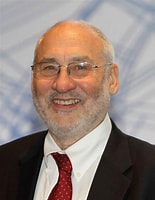
Joseph Stiglitz (Author, American economist, public policy analyst, received a Nobel Memorial Prize in Economic Sciences in 2001.)

With reservation, Joseph Stiglitz’s book “People, Power, and Profits” is reviewed here. The reservation is because of the risk of succumbing to echo-chamber’ belief. That belief is that corporations and wealthy individuals should not be able to pour as much money as they want into the American election process, that bankers unjustly escaped punishment for the 2008 financial crises, and that Donald Trump should never again be elected President of the United States.

Stiglitz is considered a “New Keynesian” economist which puts him at odds with famous economists like Milton Friedman and Friedrich Hayek. Friedman believes the most effective fiscal policies comes from monetary policy control by the government. Hayek believed in a market economy with as little government intervention as possible. Stiglitz flatly disagrees with Hayek and only agrees with Friedman in that government has a responsibility to intervene in government economic policy. Stiglitz identity as a “New” Keynesian is because, unlike Keynes’ economic theory, there is no waiting for an economic crisis for government to intervene but to intervene now to make future economic crises less likely.

John Maynard Keynes (English, Eton and King’s College graduate, mathematician, economist, 1883-1946, died at age 62.)

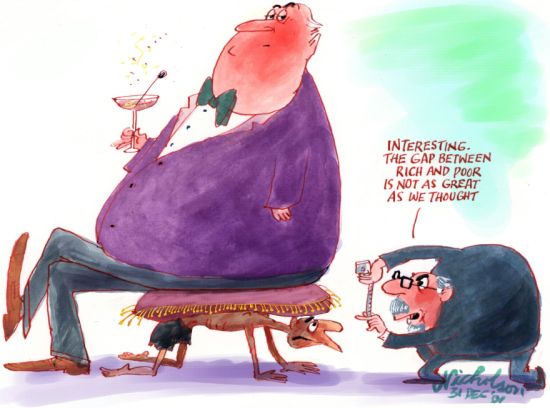
Why I am concerned about listening to Stiglitz’s book about the economy is that I am listening to some things I already believe. I believe the gap between rich, and poor is the greatest threat to, not only American democracy, but all forms of government. Stiglitz may be my echo chamber.

Stiglitz believes in democratic government intervention to ameliorate the wide gap between rich and poor.

Stiglitz has an idealist platform to cure what he views as the solution to narrowing the gap between rich and poor in America. Stiglitz makes five policy recommendations to reduce the gap between rich and poor in America.

  1. Increase taxes on income from capital gains and inheritance.
  2. Use tax revenues to improve public education in ways that equalize costs between the rich and poor.
  3. Refine anti-trust laws to prevent monopolies and promote competition.
  4. Intervene in corporate governance to ensure fairer compensation between management and labor.
  5. Regulate banks to prevent exploitation of the public.

These are defensible polices but they have to survive the give and take political process of American democratic government.

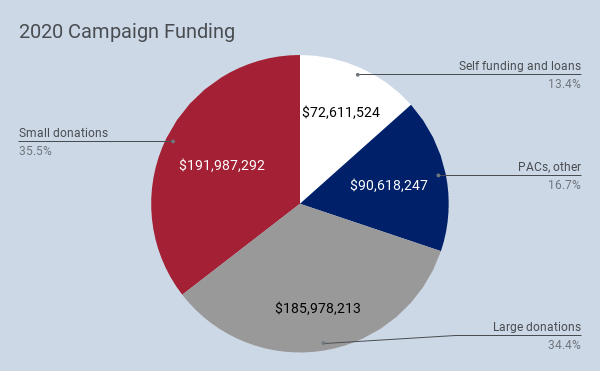
However, that process is unfairly biased by allowing corporations and the wealthy to pour disproportionate amounts of money into the American election process. Contribution by corporations and the wealthy should be limited because candidates are beholding to big financial donors with little concern for the poor.

Small donors driving 2020 presidential race

In the 2020 and 2024 election cycle, big donors contributed from 75 to 78 percent of campaign donations.

The problem with Stiglitz’s book is not in his recommendations but in his vengeful angel’ rhetoric. America is founded on freedom, not revenge. It is the give and take of differences of opinion and “checks and balances” of the Constitution that have made America great. Many mistakes have been made and are still being made by our government but even a horrible President like Trump cannot change the fundamental direction of our democracy.

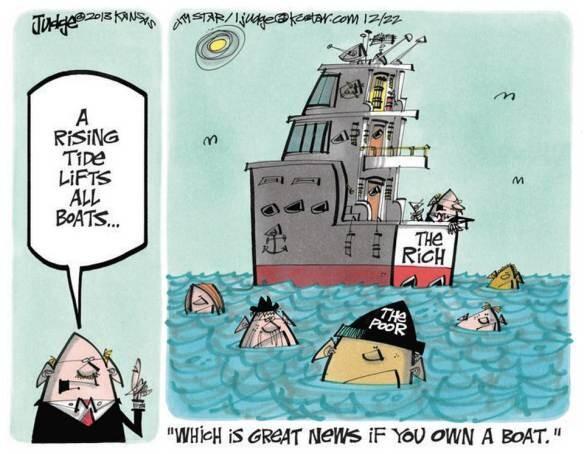
John F. Kennedy’s belief that a rising tide lifts all boats has not provided life vests to the poor in America.

The gap between rich and poor in America must be resolved. Neither Harris nor Stiglitz may be the answer, but Trump is only going to try to resurrect a past that has led our government in the wrong direction. The unconscionable cost of medical services and drugs, extraordinary compensation for executives, regressive taxes, election financing bias, and financial industry greed must be addressed through the American political process.

American democracy’s failures will not be cured, but they must be addressed and ameliorated to remain a beacon for freedom in the world. The election results are in, and Trump is our President once again. This is a sad commentary on the will of the American people and the threat America is to world economic comity.

POLITICAL CHAOS

Tariffs to restrict foreign production is shooting citizens in the foot by artificially increasing the cost of living.

Books of Interest
 Website: chetyarbrough.blog

Edge of Chaos: Why Democracy Is Failing to Deliver Economic Growth – and How to Fix It

By: Dambisa Moyo

Narrated By: Pamala Tyson

Dambisa Moyo (Zambian-born economist and author with a BS and MBA from Harvard, former World Bank consultant to Europe, Central Asia and Africa.)

“Edge of Chaos” is a revelatory and intelligent analysis of economic rewards and risks of democracies and dictatorships. Fundamentally, Moyo argues failures of government economies are related to societal instability and short-term government economic policies that are disproportionately influenced by monied interests and kleptocratic political leaders. Rich corporations and kleptocratic leaders distort economic opportunity, create chaos while producing and exacerbating economic inequality. She argues America is at the edge of chaos because of a flawed democratic election system that is biased toward short-term rather than long term economic policy.

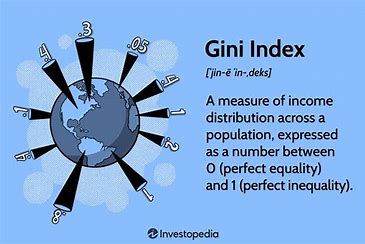
Moyo identifies the Gini index of income inequality to show that there is little difference between the rich and poor in China and the United States despite their government leaders’ differences.

China is a dictatorship while America is a form of democracy. They are nearly the same on the Gini index scale of citizen inequality while South Africa, Zambia and Brazil are at the bottom. Slovenia, the Czech Republic, Slovakia, Belarus and most of the Scandinavian countries show the lowest differences in citizen’ economic inequality. Mayo argues the difference has little to do with their forms of government except in relation to their government policies. In her opinion, China and the United States could improve their citizen’s Gini index position if their government policies would focus on income equality.

Both China and America have relative stability but with different forms of government.

Unquestionably, freedom is the sine non quo (indispensable ingredient) of America, but it is income inequality that causes the chaos Moyo alludes to in her book. That chaos is not overtly apparent in China because of dictatorship but one who has traveled to China feels there is a similar level of discontent, if not chaos, among its citizens over economic inequality.

Moyo’s solution for reducing America’s growing chaos seems difficult but not impossible to implement.

Dambisa Moyo’s solution revolves around the following 8 recommendations.

  1. Make voting compulsory to increase voter participation more representative of the people.
  2. Make election to the House of Representatives a six-year term like the Senate to encourage longer term economic goals but limit the number of terms one can be in office. (Eliminate career politicians.)
  3. Increase the pay of politicians to what successful private sector leaders receive.
  4. Establish policy making agencies that can focus on long-term policies without being threatened by near term election cycles.
  5. Invest in the education of future leaders of the political system.
  6. Encourage public officials to focus on economic diversification with an educated understanding of technological change in the world.
  7. The wealth of the nation should be focused on reduction of economic inequality.
  8. Strategies to manage natural resources should be developed to focus on sustainability.

Fair trade is where America is on the wrong side of history according to the author.

Adam Smith believed in fair trade.

Adam Smith argued for removing trade barriers like tariffs and quotas because of limited natural resources. He explains resources are more efficiently allocated, product production is increased, and economic growth is improved with free trade. As inferred by Moyo, American chaos is partly a result of ignoring Adam Smith’s prescient understanding of economics.

America democracy has journeyed a long way since 1776.

America’s fundamental success came from its emphasis on freedom within rules-of-law organized around the “checks and balances” of three distinct branches of government, i.e., the executive, congressional, and judicial branches. This is the strength of American Democracy that has offered stability. The inference made in “Edge of Chaos” is that America’s stability is at risk if it does not adapt to technological change wrought by A.I. and global interconnectivity.

Technology is changing the nature of American productivity from material products to service. With the help of A.I., America can begin to address many of the service needs of its citizens. From aid to the homeless, to education for service to others, to drug treatment of the addicted, to improved health care for all, the prosperity and income of Americans can be more equitably shared.

Global interconnectivity requires greater acceptance of fair trade as originally described by Adam Smith.

Today’s alleged protection of worker employment by using tariffs to restrict foreign production is shooting citizens in the foot by artificially increasing the cost of living. Re-education for service to the public by using A.I. to make citizens more human-centered offers an alternative to 21st century American chaos.

These are intelligent observations by a very young and well-educated author.

WHO’S LAUGHING

Appelbaum infers no American President has found the magic formula for balancing the needs of its citizens with the concept of Adam Smith’s free enterprise.

Books of Interest
 Website: chetyarbrough.blog

“The Economists’ Hour: False Prophets, Free Markets, and the Fracture of Society

By: Binyamin Appelbaum

Narrated by: Dan Bittner

Binyamin Appelbaum (Author, winner of a George Polk Award and a finalist for the 2008 Pulitzer Prize, lead writer on economics and business for The New York Times Editorial Board)

Binyamin Appelbaum has written an interesting summary of a difficult but immensely important subject. Economic policy and theory are boring, but they touch every aspect of life. Appelbaum shows economic policy magnifies or diminishes the welfare of every American, let alone every economy in the world.

Adam Smith’s foundational theory of economics.

Though only briefly mentioned by Appelbaum, American economic policy begins with Adam Smith (1723-1790), the Scottish philosopher who wrote “The Wealth of Nations”. Smith advocated free trade and argued against parochial maximization of exports and imports that is manipulated by strict governmental regulation meant only to accumulate gold and silver.

Appelbaum illustrates how American policy violated the entrepreneurial freedom that Adam Smith advocated. In contrast to Smith, John Maynard Keynes (1883-1946) advocates government intervention whenever there is an economic downturn. Equally interventionist is Milton Freidman’s (1912-2006) belief that government should increase or decrease the money supply for national economic stability. The point seems to be that every economist thinks they have a magic bullet that will cure the ills of a faltering economy.

To be fair, Friedman did believe in free enterprise in regard to nation-state currencies. He argued for a floating currency rate that ultimately led to President Nixon’s abandonment of the gold standard. However, the nature of human beings led to speculation and manipulation of nation-state’ currencies that exacerbated trade tariffs and defeated the policy’s free-enterprise objective.

One concludes from “The Economists’ Hour…”, there is no magic solution for an economy in crises. Neither Franklin Roosevelt, George W. Bush, Barack Obama, or any American President cured what ails an American economy that succumbs to economic crises. Adam Smith would argue an economic crisis is caused by a governments’ interference with free enterprise.

Applebaum explains how every 20th and 21st century President of the United States placed their faith in economists’ economic assessments of their day. All Presidents have found intervention by the government has unintended consequences.

President Nixon adopted Freidman’s monetary policy by imposing a freeze on prices and wages that squeezed the life out of the business economy and beggared the wage-earning public with job loss.

A decade of stagflation (high inflation and slow growth) followed Nixon’s administration. Stagflation is attacked by the Reagan administration with mixed results. A myth from economists like Arthur Laffer grew in 1974. Laffer believes taxation is either too high or too low for any benefit to society. Laffer argued zero tax and maximum taxation are equally harmful and produce economic stagnation and/or collapse.

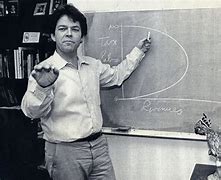
ARTHUR LAFFER (American economist and author, served on President Reagan’s Economic Policy Advisory Board 1981-1989, Here illustrating the “Laffer Curve”.)

Laffer argued every government that reduces tax revenue decreases the stimulative effect of government spending. On the other hand, he suggested every tax cut increases income for taxpayers that will stimulate business and increase employment while encouraging higher production. He laughably created the “Laffer curve” to imply there is an optimum balance of tax reduction that would stimulate economic growth with proportionate increases in government revenue to provide for better government services. That balance has never been found. President Ronald Reagan experimented with Laffer’s idea, but it fails from unintended consequences. The principal consequence is to increase the gap between rich and poor.

BENEFIT OF TAX REDUCTION

Reagan accelerated a movement for government tax reduction that ultimately reduced income taxes from 70% to 28%. The result of government tax reduction during the Reagan years increased the U.S. budget deficit from $78.9 billion to $1.412 trillion. The benefit of that tax reduction went to the wealthy while school lunches were cut, subsidized housing declined by 8%, and poor families lost $64 a month in welfare payments. In 2023, the budget deficit stood at $1.70 trillion, an imbalance that shows why the “Laffer curve” is sardonically laughable.

President Reagan’s administration (1981-1989) was influenced by Laffer’s curve.

The joke is “There is no perfect balance on the curve because of the nature of human beings.”

Roosevelt, George W. Bush, and Obama choose to follow Keynesian policy. Roosevelt bloated government employment. All three increased the government deficit.

Some suggest the idea of
“Cost benefit analysis” (CBA) is recommended to the federal government by two law professors, Michael Livermore and Richard Revesz during the George H. Bush administration but Reagan initiated it with an Executive Order in 1981.

Appelbaum notes that “cost benefit analysis” for government is first used during the administration of Ronald Reagan. However, Bill Clinton reifies its use with an Executive Order in 1993 that required covered agencies to do a CBA on “economically significant” government regulations. Ironically, Clinton was the first President in the post 19th century to balance the budget. Andrew Jackson manages to do it in his term between 1829 and 1837.

An irony of using “cost benefit analysis” is that it required a determination of of a human life’s value. Presidents Nixon, Ford, Carter, and future Presidents use value per statistical life during their administrations. High-income earners were worth $10 million to $15 million, middle-income earners $1 million to $2 million, and low-income earners $100,00 to $200,000. Of course, these values were always litigable. The point is that CBA became a tool for government to regulate the costs of government policies, ranging from military expense to the health, safety, and welfare of American citizens.

The remainder of Appelbaum’s book reflects on the experience of America, Chile, and Taiwan in the 20th century. The implication of his review of economic policy is that those countries that align with the free enterprise beliefs of Adam Smith have made mistakes. However, America’s, Chile’s, and Taiwan’s economic policies seem to have had more economic success when following Smith’s beliefs.

Along with CBA, Appelbaum notes the ongoing controversy is about regulation by government when it tries to balance American health, education, and welfare with Adam Smith’s concept of free enterprise. Appelbaum infers no American President has found the magic formula for balancing the needs of its citizens with the concept of Adam Smith’s free enterprise.