ENTERTAINMENT

Audio-book Review
By Chet Yarbrough

(Blog:awalkingdelight)
Website: chetyarbrough.blog

The Midnight Line

By: Lee Child

Narrated by Dick Hill

Lee Child (British Author of the Jack Reacher novels.)

Let Lee Child entertain you. 

“The Midnight Line” is Child’s latest chapter of the Jack Reacher series.  This is the first Lee Child novel for this reviewer.  Reacher is put at risk by a drug dealer who tells a hit man to be on the lookout for “big foot” or the “hulk”.

Child suggests 6′ 4″ Lawrence Dallaglio (Retired English Rugby Player) is the image of who he thought of as Jack Reacher.

Having seen a Jack Reacher movie, one understands why many Reacher fans are disappointed with Tom Cruise’s billing. The diminutive 5′ 7″ Tom Cruise does not fit Child’s characterization, but Cruise became Reacher in a film from Child’s book, “One Shot”.

In two senses, Lee Child is a spartan writer.  He writes short, clear, precise sentences, and creates a Herculean “spartan like” character.  “The Midnight Line” is a guilty entertainment for mystery and action addicts.

Jack Reacher is a loner.  Reacher is a combat veteran with an investigator’s curiosity.  He is a West Point graduate who left the military after 11 years.   He is a former major in the Military Police. He lives in the moment.  He travels the roads of America without a suitcase and often without a ticket to ride.  He hitchhikes.  He wears one set of clothes until he needs a new set.  He discards the old and buys new. 

The story begins with a tiny ring that Reacher happens to see in a pawn shop.  The ring is from a former cadet at West Point.  From there, the listener hitches a ride with Reacher to South Dakota and Wyoming.

Reacher is a phenom.  Not only because he is big but because he forgets nothing and sees everything.  With remembering and seeing, he intuits what is going to happen next. Whether in a fight or personal crises, Reacher assesses details and sees the future.

Lee Child places Reacher in a story of addictive drug manufacturing, illegal distribution, and human destruction. 

The author’s dialog is short and to the point.  Reacher is almost supernatural but just believable enough that a listener identifies with his heroics.  Child adds mystery to his characters.  His terse sentences makes listeners want to know more. 

“The Midnight Line” is partly about a missing person (a twin of a beautiful woman).  The missing person is a former graduate of West Point that has pawned her ring. Reacher knows something is wrong because he knows how difficult and psychologically rewarding it is to graduate from West Point.

The missing person is involved in an interstate illegal drug trade for reasons that are not clear until the end of Child’s story.  It’s a good guy, bad guy story with twists. 

A listener learns something about the illicit drug business in the United States. How and why it works.  Particularly how it feeds off a culture that insists all human pain must be medicinally treated.  And, how an injured veteran of war, with a distinguished service record, can become an addict.

In the end, “The Midnight Line” is an entertainment.  However, it also says something about addiction–its causes, its consequences, and the amoral businesses that serve it. 

ILLUMINATED MANUSCRIPTS

Audio-book Review
By Chet Yarbrough

(Blog:awalkingdelight)
Website: chetyarbrough.blog

Meetings with Remarkable Manuscripts

By: Christopher de Hamel

Narrated by Christopher de Hamel

Christopher de Hamel is a British academic librarian.  He is an expert on mediaeval manuscripts.  De Hamel takes listeners on an international journey to view ancient illuminated manuscripts.  

De Hamel’s peregrinations are fascinating, in part because of his excellent recitation.  But also because of interesting stories about manuscript’ provenance, purpose, and location.  (A listener’s regret–there are no illuminated manuscript’ plates in the audio book appendix. This review is meant to partially address that regret.)   

Illuminated manuscripts are held for safekeeping in controlled access libraries and museums around the world. These manuscripts are called “illuminated” because they were hand-made with images and script drawn in gold and silver. They were made by Western European scribes between 500 and 1600 CE (common era). 

They vary in size from as large as three feet tall (Codex Gigas with 310 leaves of vellum made from 160 donkeys) to one so small it could fit into the palm of one’s hand; e.g. the “Prayer Book of Claude de France” produced in the 16th century.

De Hamel reviews 12 manuscripts.  The most famous is the “Book of Kels” found in Ireland.  The most interesting might be the “Spinola Book of Hours” because the author plays a role in its discovery and collation.  The “Spinola Book of Hours” is a 16th century manuscript with 88 miniature paintings.  It is presently located in the J. Paul Getty Museum in Los Angeles.

The purpose of ancient manuscripts is to educate and enlighten medieval populations. Just as today, the greatest benefit is to the rich. The rich could afford the manuscripts but the poor were offered limited exposure through the few religious schools that served the poor. Many ancient manuscripts were used to teach the young how to read while educating them in the history of the world and the religion adhered to by royalty.

(The invention of the Guttenberg press in 1440 CE was the beginning of the end of the illuminated manuscript but the art of the handmade manuscript survives into the early 17th century.)

De Hamel tells 13 stories about 12 illuminated and one technically not-illuminated manuscript (the “Codex Amiatinus”). All entertain and inform interested listeners.

The following list shows de Hamel’s chosen manuscripts. An interesting manuscript that reflects on modern times is Tres Riches Heurees du Duc de Berry. It reflects on the Black Plague’s European devastation.

  1. BOOK OF DURROW (7th century book of hours, biblical tales and Virgil/Homeric tales, most well known. Located in Dublin @ Trinity College – is the oldest completed illuminated transcript)
  2. CODEX AMIATINUS (created by missionaries, 8th century, North Umbria creation. Bible.) technically not illuminated-no silver or gold.
  3. LINDISFARNE GOSPELS (Somehow saved) 8th century New Testament, stolen by the Vikings. Contains the gospes of Mark, John, Luke, and Matthew.)
  4. THE BOOK OF KELLS (most famous, 9th century, greatest of any era)
  5. ST. ALBANS PSALTER (12th century, detailed art work)
  6. MORGAN CRUSADER BIBLE (13th century) artistic masterpiece about the Old Testament crusades
  7. WESTMINISTER ABBEY BESTIARY (164 illustrations, 13th century, real and imaginary animals)
  8. THE BOOK OF HOURS OF JEANNE d’Evreux (14th century) life of Jesus.
  9. THE BLACK HOURS (15th century) created in Greece, purchased by Piermont Morgan and housed in the Morgan Museum in New York.
  10. TRES RICHES HEURES du Duc de Berry (15th century, master work, unfinished because of the plague.)
  11. Grimani Breviary (16th century, religious and secular stories, made in Flanders. Over 1600 pages – stories from the bible)
  12. PRAYER BOOK OF CLAUDE DE FRANCE (16th century) fit in the palm of one’s hand. Magnifying glass needed.

AMERICAN CONSCIENCE

Audio-book Review
By Chet Yarbrough

(Blog:awalkingdelight)
Website: chetyarbrough.blog

The Water Dancer

By: Ta-Nehisi Coates

Narrated by Joe Morton

Ta-Nehisi Paul Coates (American author & journalist, winner of the 2015 National Book Award for Nonfiction with–BETWEEN THE WORLD AND ME).

This is Ta-Nehisi Coates’ first book of fiction.  What makes “The Water Dancer” a fiction is its hero’s mystic ability.  He is a water dancer. 

Coates’ story is a history that stains American conscience.  It is about the tragic sequel of slavery.  Slavery is introduced to America in the British colony of Virginia in the 17th century. 

Though Virginia tobacco plantations were first created in the 17th century, Coates story is undoubtedly set in the early 19th when plantations were in decline.  In 19th century Virginia, soil is depleted by poor farming practices and mismanagement.  White property owners turned to sale of their slaves to pay their debts.  The ugliness of slavery is compounded by the breakup of black families and friends that shared a common history.  Though that history is blooded with servitude and violence, Coates illustrates how slaves created close-knit communities. They were close; in-spite of their sorrowful condition.

Just as soil depletion reduced plantation owner’s income, they increased sale of slaves to sustain their standard of living.  Though black slaves had always been treated as property, the crash of the tobacco industry accelerated their sale. 

(Thomas Jefferson is a prime example of an American slavery apologist who sold slaves to reduce debt.) 

Sons, daughters, husbands, and wives were sold to other white slave holders.  Many families were broken apart; some sent to other States after being sold; others escaped to the North. 

Some were caught by slavers.  Coates writes–runaway slaves were sometimes caught and thrown into makeshift prisons and sold back into slavery.  In Coates’ story, prison is a hole in the ground for its hero. Hiram (Hi) is not sold back into slavery but tested for a critical role in the underground.

To compound the humiliation of being caught, Coates writes of slaves who betrayed their own race. Their purpose was to maintain some level of freedom from harsh conditions on the plantation.

Black women were subject to the whims of their owners.  Women could be raped by their owners without repercussion, or sold to the Fancy industry, i.e. brothels.

Coates reveals the depth and breadth of what Philip Roth called a human stain, i.e., broadly known as discrimination.  Slavery may have been abolished in 1865 but its institutionalization lives on in the 21st century.  It is a stain that resists removal.

Murder of a black jogger , Ahmaud Arbery, on February 23, 2020 in Brunswick, Georgia. A white father and son are charged with murder on May 7th, 2020.

Coates’ story reveals much about America, the abolitionist movement, the growth of the underground, and the human toll of slavery.  Coates suggests some wealthy white southerners participated in the underground to salve their conscience.  They were heroes but they hid behind the degradation being felt every day by black Americans subject to an economic system based on slavery.

Coates shows how southern white abolitionists were important to the growth of the underground.  Their role grew out of a first-hand view of human beings being treated as property. 

Elizabeth Van Lew (1818-1900, Richmond, VA Abolitionist.)

Coates fills many gaps in the history of slavery by seeing it through the eyes of extraordinary slaves. 

Harriet Tubman (American abolitionist who rescued an estimated 70 enslaved people. Unknown date of birth; Died in 1913.)

Families were torn apart, men and women were degraded by their enslavement, husbands had to cope with plantation owner abuse of their wives, blacks victimized their own people, and mothers suffered from guilt for the life their children had to live.  These are irremovable stains on the American conscience; for both Black and White Americans–each are stained in their own way.

IT’S THE ECONOMY, STUPID

Audio-book Review
By Chet Yarbrough

(Blog:awalkingdelight)
Website: chetyarbrough.blog

Good Economics for Hard Times (Better Answers to Our Biggest Problems)

By: Abhijit V. Banerjee, Esther Duflo

Narrated by James Lurie

Abhijit Banerjee’s and Esther Duflo’s book, “Good Economics…”, seems like a play book for Bernie Sander’s, and Andrew Yang’s campaigns for President.  It is not, but much of what they write resonates with their campaigns.

These two authors are professors of economics at MIT.  They received a Nobel Prize in 2019 for their work on an “…experimental approach to alleviating global poverty”. Both are obviously well respected for their research and economics acumen.  Professor Barnerjee  is a research affiliate of Innovations for Poverty Action. Professor Duflo specializes in Poverty Alleviation and Development Economics.  Their credentials speak for themselves.

Now, with the election of President Biden, one wonders if Banerjee and Duflo’s ideas will be tested. The leader of the Senate, Mitch McConnell, is quoted as having said “One hundred percent of my focus is on stopping this new administration”.

McConnell’s comment suggests the poor and lower middle class should be left on their own, a kind of Marie Antoinette view of life.

Sadly, this is a somewhat ponderous work for a layman interested in the future of American prosperity.  In the face of supporters of Reaganomics and today’s Trumpist’ “trickle down” economics, a listener hopes for a definitive answer to inequality, rising poverty, and homelessness in the United States.

With the defeat of Trump, a new economic plan is proposed by President Biden. As expected, Republican leadership argues “hands off” on the American economy that appears to be improving without government help.

The concern one may have with a “hands off” approach to a weakened economy is that it offers little hope for those at the bottom of the economic ladder. Those who have a job (namely congress men and women) seem to have little empathy for the poor. It is a view based on belief that the poor are poor because of their failure to take advantage of American opportunity to work and prosper.

Banerjee and Duflo note that a rising tide does not lift all boats.  “Trickle down” economics do not work. 

Banerjee and Duflo cite several studies that suggest there might be a solution, but the scope and conclusions of the studies seem ill-suited for the largest economy in the world.  The authors’ conclusions are based on small social experiments that show mixed results.

On the one hand, self-interest and freedom have made America’s standard of living among the highest in the world.  On the other hand, it seems self-interest and freedom mitigate against fairness in the American economy. 

The problem is self-interest and freedom have brought out the worst in human nature—greed.  Greed has left middle class and poor Americans poorer than they were in the 1960 s and 70 s. 

Banerjee and Duflo cite studies of the Reagan years that show wealth became more concentrated with tax cuts for the rich. 

Human nature gets in the way of understanding what lower income Americans need to survive Covid19. For the President of the United States to say “It is what it is..” reflects on our lack of empathy for a loved-ones’ death caused by the pandemic.

The Senate drinks from the same trough when they argue the economy is getting better. Over 1,000,000 Americans remain unemployed. It is getting better for whom? Certainly not for restaurant workers, small business owners who closed their doors, or the nurses and teachers who are compelled to go to work despite the risks of a deadly virus. (That is not to mention the children who are going back to congested class rooms with potentially catastrophic consequence for their families and others.)

Trump and the Republican party continue to believe the wealthy will reinvest their wealth to benefit the poor and middle class with jobs. 

Job creation benefited the rich after Reagan’s tax cuts.  Wages of workers did not increase but the stock market rose, corporate executive salaries skyrocketed, and dividends to stockholders increased. Workers in the middle class and the poor were left behind.  Banerjee and Duflo argue that tax cuts for the rich are unfair and they exacerbate the gap between the rich and poor. 

The rich get richer; the middle class lives paycheck to paycheck, and the poor remain poor.

Both Banerjee and Duflo infer there is a path to economic equality, or at least fairness.  They argue for incentivizing corporate interests for the common good, disincentivizing executive compensation, modifying the federal tax structure, and subsidizing employment for the unemployed (or those who are soon to become unemployed because of technology).  They argue that taxes should be increased to create public works programs that benefit the general welfare of the nation. 

Banerjee and Duflo go on to suggest a guaranteed basic income (like that proposed by Andrew Yang) should be considered.

Banerjee and Duflo go on to explain how technology reduces jobs.

They argue that America needs to realign their employment objectives.  Service jobs are outgrowing manufacturing jobs. 

Environmental concerns reduce jobs. 

Through a combination of public works projects and improved public services (childcare, elder care, environmental clean-up; etc.) the unemployed, and soon to be unemployed, should be bolstered by a basic minimum wage and retrained to take 21st century jobs. 

A guaranteed basic income is to mitigate the hardship of retraining and leaving areas of the nation that cannot sustain economic growth.

Banerjee and Duflo argue that most Americans associate jobs with identity and self-respect.  Without a job, Americans lose a part of their identity and self-respect.  With a guaranteed basic income, the unemployed will continue to seek employment because of their need for self-respect.  As they become employed, their guaranteed basic income could be reduced in proportion to their rising income.

Without income, people are fearful of leaving the areas they have lived in for most of their lives; e.g. a coal camp in Virginia. 

The authors cite studies that show economic improvement correlates with worker mobility.

There is a great deal to commend Banerjee and Duflo’s ideas. 

Whether the American government is willing to act as a change agent is unlikely without perception of a clear and present danger.  Political change comes with perceived threat.  The current Senate’s discounting of environmental threat to the world does not bode well for change. 

Believing in a “rising tide theory” of economics continues to distort the truth of qualified freedom and unregulated self-interest. Freedom has always been qualified in America. The intent of the founding fathers is to provide freedom for those who do no harm to their neighbors. Unregulated self-interest harms our neighbors.

Banerjee and Duflo offer an economic plan to America, but it is founded on sociological studies that are often small in scope. When the economic theories are tested on broader scales, the conclusions are mixed. Though belief in a guaranteed basic income makes sense in light of the studies shown by Banerjee and Duflo, the impact on American innovation remains unknown. On the other hand, the many jobs the government could create–from public works, to environmental clean-up, to elder care, to medical care, and housing for the homeless–are widely needed in America.

ANTARCTICA

Yarbrough (Blog:awalkingdelight)
Website: chetyarbrough.blog

Argentina, Antarctica, and Brazil 2020

Written by Chet Yarbrough

Landing in Argentina’ sunshine with 70 to 80-degree weather is not unusual in February, but in that same month Antarctica’s temperature reaches its record high.  On February 6, 2020 , where we were, Antarctica reaches 64.9 degrees Fahrenheit; the highest in recorded history. (In 2015, Antarctica reached 63.5 degrees Fahrenheit.)

Some would argue Antarctica’s rise in temperature is a harbinger; others deny the science–like President Trump who suggests science is wrong.

Sailing to Antarctica is not for the feint of heart.  You begin from “The World’s End” in an Argentine town called Ushuaia (pronounced U-swy-ahhh).

Ushuaia is beautiful in February.

To its residents, Ushuaia is beautiful all year round. Residents have grown from 5,000, forty years ago, to an estimated 150,000 today.

However, you must enjoy the cold, its remoteness; winter snow, spectacular scenery, and ski slopes to die for (or from). 

If seasickness plagues you, taking the Drake Passage will test your resolve.  If you begin in Ushuaia, there is no other sea passage to Antarctica. 

In your crossing of the Drake Passage, the grandeur of ice caps, ice bergs, landscapes, and sea creatures are a welcome consolation to wobbly walks on the deck.

Our group reaches the Arctic Circle and is rewarded with an excursion to the top of a lower peak with a spectacular view of an ocean inlet. A research vessel is anchored in the harbor. Several crew members set up the first (to our knowledge) soccer game to be played within the Arctic Circle.

Because our vessel carries less than 500 people, landing is permitted. We landed on this frigid land several times on our journey.

February temperatures in the high 60 s is typical for Los Angeles or Las Vegas, but not at the bottom of the world.

Not that the world will end in a foreseeable future, but catastrophic change is here. Kolbert’s “…Sixth Extinction” seems eminently possible. 

A 24-day excursion to Antarctica convinces most people that global warming is real and present. 

Seabirds, shorebirds, whales, seals, sea-lions, penguins, and landscapes will entertain and astound you.  Stories of others’ tortuous journeys to the south pole make you realize how easy a tourist’s passage to this vast wilderness is today. 

At every excursion from your boat, you are confronted with the hardship earlier travelers must have endured.  At times of the year, Antarctica’s temperature can fall to -70.6 degrees F with an average temperature of 14.0 degrees F.  As predicate of the future, our trip averaged 30 to 36 degrees Fahrenheit.

No humans permanently live on Antarctica. There are no polar bears.  Only penguins, seals, nematodes, tardigrades, and mites can handle the extreme cold.  However, 1,000 to 5,000 people live on science stations from various nations around the globe. 

Antarctica is not a nation-state and is not officially owned by any country.  However, over twelve countries claim rights to a portion of the land. 

A 1961 Antarctic Treaty between governments recognizes there is no indigenous population.  The Treaty formed a pact that allows intellectual and scientific exchange, while banning military activity or mineral prospecting. 

Russia, according to recent newspaper reports, is significantly increasing their exploration of natural resources in Antarctica. Its days of exclusive scientific exploration may be limited. Though America and Russia are thousands of miles from the Antarctic continent, distance and harsh winter conditions are no longer an impediment to economic exploitation.

Interestingly, 11 children were born on Antarctica between 1978 and 1983.  Their parents were from either Argentina or Chili.  The idea was for parents of respective countries to perfect their nation’s right to portions of Antarctica.

The Antarctic Treaty holds such claims in abeyance.  Medical facilities are virtually non-existent in the remote camps of the Arctic Circle. With added recognition of environmental danger to an unborn child, no further births occurred after 1983.

Upon returning to South America, we tour the Iguazu Falls.  It is the highest average water flow fall in the world.  It is taller than Niagara Falls and is twice as wide.  To us, it rivals the beauty and grandeur of Victoria Falls in Africa (between Zambia and Zimbabwe; on the Zambezi River).

The fun at Iguazu Falls is taking a river boat on Iguazu River that takes you under the falls.  It is thrilling and moisturizing (actually, drenching).  You are given a dry bag for your camera and anything you do not want to get wet.

And finally, there is a trip through the rain forest in Argentina’s Iguazu jungle.  Birds, caiman, catfish, trees, and spiders, oh my. 

A little mosquito spray is a must at certain times of the year, but February is not a bad month because of cooler weather.  Our guide explains the importance of the rain forest and its protection of the environment.   

The Argentina rain forest not only absorbs carbon dioxide from the air we breathe, but it is a river of water above the ground.  It nourishes the earth and replenishes underground aquifers.

As the rain forest disappears, the lungs and water filtration system of the world diminishes.  At the end of our trip, we wonder if the “…Sixth Extinction” is not only possible but probable.

Seven continents — what a thrill it is to see how different and interconnected nature is and how fragile and insignificant we human beings are in the world.

HUMANITIES SELF-IMMOLATION

Audio-book Review
By Chet Yarbrough

(Blog:awalkingdelight)
Website: chetyarbrough.blog

Assad or We Burn the Country

By: Sam Dagher

Narrated by Gary Tiedemann

Sam Dagher (Author, senior correspondent for the Wall Street Journal)

Humanity is at war with itself.  Sam Dagher’s examination of Syria and the Assad government exposes the depth of humanities self-immolation.  Bashar Assad’s atrocities in Syria represent the indecency of power and money in the hands of autocratic leaders.  Autocrats are never exactly alike but each is corrupted by money and power.

Bashar Hafez al-Assad (Syrian President since 2000, son of Hafez al-Assad)

Hafez al-Assad (Syrian President 1971-2000.)

For Syria’s atrocities, every country in the world is guilty.  All are guilty because of apathy, support, or complicity. Dagher spares no one.  America, Russia, Turkey, France, Great Britain, Iran, Syrian generals, and indigenous Syrian leaders are complicit in the slaughter of innocents.

Russian atrocity in Syria is being repeated in Ukraine. The probability of further destruction and terror seem inevitable with the introduction of a Russian military commander being identified by the press as “The Butcher of Syria”.

General Alexander Dvornikov (Taking Charge of the Russia’s invasion of Ukraine)

SOME SAY AS MANY AS 500,000 SYRIANS HAVE BEEN MURDERED WITH OVER 11 MILLION NEEDING EMERGENCY AID.

Hafez first son is groomed to takeover after Hafez’s death. Bassel was a Syrian engineer, colonel, and heir apparent but he dies in a car crash before Hafez’s death.

Seated are Hafez and his wife Anisa Makhlouf. From left to right in the back row are Maher, Bashar, Bassel, Majid, and Bushra.

Dagher paints a picture of a feckless son of Syria’s deceased brutal dictator.  Bashar al-Asaad assumes power as President of Syria after the death of his father. He is characterized by Dagher as an effete leader with poor leadership skill who inherits a job for which he is ill qualified. (Bashar graduated from medical school in 1988 and worked as a doctor in the Syrian army. He had little military training.)  

Dagher suggests Bashar inherits money and power with the sole purpose of aggrandizing himself and his family.  Political, military, and economic wealth and power are bequeathed to Assad family members. Syrian money and power rest with relatives ranging from distant cousins to the President.

Dagher notes that Bashar uses his power and position to order imprisonment, torture, and murder of anyone opposing him. Dagher suggests Bashar sleeps with any woman he wants (married or not). In the mean time, he, his wife, and family live in isolated luxury. 

Bashar al-Assad Palace (aka Shaab Palce overlooking Damascus)

With Bashar’s inherited money, power, and position, he rewards his family, bribes his generals, arrests, tortures, and murders his opposition. To complete Dagher’s picture, he notes Bashar fawns on world leaders who socially or militarily support his rule.  

Dagher reports on Bashar’s murder of Syrians.  Bashar is shown as a vengeful leader playing one faction against another to maintain his power and position.  Today’s Putin threatens Ukraine Invasion and may murder many Russians, as well as Ukrainians–just as Bashar murdered his countrymen.

Religion is used as a tool to hide Bashar’s intent to remain in power.  Bashar paints himself as a protector of Christians from Muslim fanatics when his real motive is to cover brutal treatment of Muslim believers.

Bashar is shown to hide behind terrorism preached by Dash (aka ISIS) to justify gassing of his own people.  Dagher shows Bashar’s duplicity when he encourages Russian and Iranian intervention when his own people will not defend his regime.  Every country, including America, has their own agenda in the Syrian war.  Syrian war victims are fertilizer for Bashar’s ambition.

There are many complicit stories about America in Dagher’s exposure of Assad’s cruelty.  President Obama’s red-line statement about use of poison gas with no response from America; President Trump’s support of Russian intervention in a war that uses chlorine bombs to kill Syrian people; Turkey’s support of Bashar in return for repatriation of Kurdish territory; Iran’s intervention in Syria to put down Dash in return for political support from Bashar. Abu Bakr al-Baghdady-once a compatriot of Bashar and then the leader of Dash (Isis).

Though Obama faced a great deal of criticism for his red-line statement in Syria, his decision not to respond militarily was correct. It is up to the Syrian people to decide what they want to do with the Assad administration.

Dagher paints a frightening picture of Bashar and his wife.  It is a picture of self-delusion that endorses murder of their own people.  Bashar and his wife live in luxury while the Syrian people are murdered and starved.  Dagher contrasts Bashar’s wife’s placation of Syrian mothers with Syrian army atrocities. It reminds one of the French Revolution when Louis the XVI, and Marie Antoinette live in luxury while the public starves.

Asma al-Assad is the First Lady of Syria.  Born and raised in London, a graduate in computer science and French literature from King’s College.

Asma supports her husband’s atrocity.  She sees it as a justified means to modernize Syria.  A cynic would suggest her justification has more to do with Assad wealth and privilege than modernization.


Raslan’s faces trial in Koblenz as the first court proceeding against a senior member of the Assad regime. Raslan is one of two Syrians being tried for crimes against humanity. How long before Assad has to face the same fate?

The tragedy of Syria is graphically portrayed in the new television series “Transplant”.

On the one hand it tells the story of highly talented Syrians who are compelled to leave their home country. On the other, it reflects on the hardship faced by immigrants in the U.S. that are struggling to reestablish their lives.

Humanity is at war with itself.  There seems no end to violence in the world.  What is the solution?  Neither real-politic nor “let it be” answer the question.

BULLIES AMONG US

Audio-book Review
By Chet Yarbrough

(Blog:awalkingdelight)
Website: chetyarbrough.blog

The Topeka School

By: Ben Lerner

Narrated by Nancy Linari, Peter Berkrot, Tristan Wright

Ben Lerner is a writer with academic and literary awards that attest to his intelligence and accomplishment. 

“The Topeka School” appeals to those who are blessed with intelligence, raised by accomplished parents, and unburdened by financial insecurity.  It is a story of a child bully that grows into adulthood.

To paraphrase Leonardo da Vinci “…men who desire nothing but material riches are absolutely devoid of wisdom, which is the food and only true riches of the mind.”

“The Topeka School” makes one wonder what makes a child become a bully.  Does affluence have anything to do with it?  Is it because of superior intelligence?  Is it because of genetic pre-disposition?  Lerner creates a boy’s childhood that suggests some bullies do come from the aforementioned. 

Trump’s penchant for bullying is unrequited in spite of being among the most influential leaders in the world.

Adam Gordon is Lerner’s main character in “The Topeka School”.  Adam is a highly competitive youth who excels in public debate because of his innate intelligence, training, and articulateness.  His mother and father are accomplished professionals. 

Unlike Donald Trump, by the end of Lerner’s story, Adam has grown into a responsible adult. 

In a pique of self-righteous indignation, Trump refuses to accept defeat in a race for a second term.

Even as a “Lame Duck”, Trump compounds his self-righteousness by firing and replacing government leaders who have questioned his judgement.

In contrast to America’s Presidential bully, the “Topeka School” hero’s journey involves many experiences that resonate with most boys who grow to manhood.  To a large extent, Adam outgrows his penchant for bullying by resorting to reason rather than force when confronted with opposition.  However, he can still lose his temper when reason and polite argument are ignored. 

“The Topeka School” largely takes place in the 1990 s but is brought current with a reference to family separation actions of ICE; warranted by President Trump. 

Adam and his foreign born wife and two children attend an ICE’ protest. Adam confronts an ICE officer who tells him to have his daughter stop drawing on the sidewalk outside of the ICE office. Adam engages the officer with arguments about public space and the erasable nature of chalk on a sidewalk. Adam handles the confrontation as a mature adult; not a bully.

The structure of “The Topeka School” is disconcerting and may make some reader/listeners put the book down.  The book will lose some who cannot identify with Lerner’s characters because of their social status and accomplishment in life.  The struggles of the Gordon family seem distant from the lives of many people who do not come from families as smart or financially accomplished as those in Lerner’s story.

CARROLL AND FEYNMAN

Audio-book Review
By Chet Yarbrough

(Blog:awalkingdelight)
Website: chetyarbrough.blog

Something Deeply Hidden (Quantum Worlds and the Emergence of Spacetime

By: Sean Carroll

Narrated by Sean Carroll

Sean Carroll is a theoretical physicist.  He explains the science of physics to the general public with unusual clarity for non-scientists.  “Something Deeply Hidden” explains a theory that has the potential for explaining everything about everything.

Carroll touches on the theoretical history of Quantum Mechanics.  He notes the fundamental objection to Quantum Mechanics raised by Einstein and his followers.

Einstein insists that Quantum Mechanics is an incomplete theory of space, time, and motion.  Einstein’s famous quote is “God does not play dice with the universe.”  Carroll agrees. 

Neither Einstein or Carroll are talking about belief in God but belief that there is a deeply hidden secret in Quantum Mechanics that may explain everything about everything.

Carroll recalls the history of the 1927 Fifth Solvay International Conference where quantum theory was discussed by the world’s most notable physicists. 

The confrontation between Niels Bohr and Einstein results in agreement on the truth of Quantum Mechanics as a construct for calculation of space, time, and motion in the sub-atomic world.  The disagreement comes with Bohr’s opinions about Quantum Mechanics.  Einstein suggests Quantum Mechanics is an incomplete description of subatomic unpredictability. 

Carroll explains that Quantum Mechanics has been reinforced as true by every experiment tried since its discovery.  It fulfills Karl Popper’s dictum that a theory of anything must be falsifiable to be called science. 

The many experiments on Quantum Mechanics have proven its validity as a theory of time, space, and motion in the sub-atomic world. 

However, Quantum Mechanics remain a subject that Richard Feynman said no one can clearly explain or understand. 

Carroll accepts Feynman’s and Einstein’s views.  The theory of Quantum Mechanics is not explainable and (as Einstein suggested) it may simply be an incomplete theory.

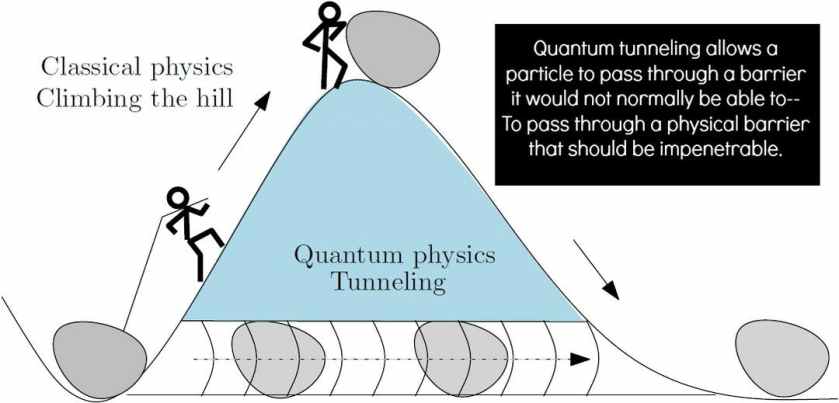
Carroll suggests Quantum Mechanics remains unexplainable because of human inability to observe its truth from what is called a superposition.  We cannot look at Quantum Mechanics outside the realm of personal cognition.

His answer is to acknowledge its truth by adhering to the Schrodinger equation which insists that a cat in a box is both dead and alive.  Carroll argues that scientists waste their time challenging Schrodinger’s equation.  Carroll suggests the cat in the box is both dead (actually Carroll prefers asleep) and alive.

Carroll argues that probability is an essential ingredient of Quantum Mechanics but he explains it is not the “probability” often understood by the public.  Carroll’s view of probability is in knowing our human limitation of not being able to look at nature outside of what we understand as nature.

Humans cannot be in a superposition to see the effect of Quantum Mechanics because humans are trapped in their own sense of space, time, and motion.  Probability, rather than certainty, is a function of a personal observation trap.

What Carroll suggests is other worlds are created because of the nature of Quantum Fields that are the essence of everything that exists in the universe.

Carroll explains particle physics were once considered the holy grail of understanding nature.  Now, there is wide recognition that fields; not particles, are the building blocks of nature.  Every particle vibrates like a string and emits a wave that permeates all space; including a vacuum where no particles exist. 

Empty space is simply a low state of energy with no extant particles within its emptiness (aka a vacuum).  It is not to suggest particles are not important.  They are the source of the waves that permeate space. 

Finding the Higgs-bosun is confirmation of the importance of particles in showing that it is undiscovered glue that holds atoms together.

Carroll’s books are excellent physics primers for non-scientists because they reduce science complexity to understandable examples; at least most of the time.  (Space-time remains a mystery to me; even with Carroll’s valiant effort to explain it.) He may not be right about everything he explains, and a listener/readers’ interpretation of his writing may be wrong, but Carroll’s explanations are fascinating. 

Feynman is said to have had the ability to explain the complexity of physics to the non-scientist. Carroll is today’s Feynman.  

BAD PARENTING

Kevin Wilson (American writer from Sewanee, Tennessee).

Bad parenting is endemic in America. Wilson offers four examples in “Nothing to See Here”.

In the richest country in the world, Americans waste their lives seeking money, power, and prestige at the expense of their children.

The heroine of Wilson’s story is a child raised by a neglectful single parent. The “friend” is an acquaintance from an exclusive and expensive school that the heroine attends because of her superior intelligence.

The two young girls become “friends” in the boarding school. The “friend” is from a wealthy and privileged family. She has great ambition, superior athletic skill, and extraordinary beauty. The “friend” slips into the thrill of drugs and is caught with a bag of cocaine. Her father comes to her rescue by bribing the mother of the heroine with $10,000 to say it was her daughter and not his that had the cocaine.

The young heroine has no say in the matter but she idolizes her “friend” and chooses to go along with the lie. She is expelled from the school, returns to her mother’s home, and works at odd jobs until several years later when she hears from her childhood friend. The heroine is now twenty eight with few prospects in life.

The parenting quality of Wilson’s next two families is revealed when the heroine’s friend calls to ask a favor. The favor is to take care of two children that literally catch on fire when frustrated or angry.

The “friend” marries a rich southerner who divorces his wife and marries the “friend” because she is beautiful and a highly capable manager of her husband’s campaign as a Senator. He is a Senator with interest in becoming a Secretary of State; and maybe future President of the U.S.

However, his ex-wife commits suicide, leaving their two children to her aged parents who are too old and unhealthy to raise the children. His ex-wife home-schooled the twins because of their penchant to catch on fire. The children are isolated from society, and are now being raised by incompetent grandparents.

The rich southerner becomes Secretary of State but chooses to abandon his two children because of their “catch on fire” notoriety. He now has a new wife and son by his second marriage. One presumes the “catch on fire” character of his former wife’s children is a genetic anomaly that came from his ex-wife. However, it turns out–the child of the Senator’s new wife also catches on fire. The genetic anomaly, if that is the cause of the “fire” children, came from the father.

A new favor is asked by the heroine’s “friend”. Please take care of the twins for the rest of your life, and keep them out of the Secretary of State’s daily life. The twins are abandoned by their father and his new wife.

The irony of Wilson’s story is the resurrection of the heroine as a parental surrogate for the abandoned children. She becomes a parent that outshines the four dysfunctional families of the story. At least, we hope so.

A PUNCH IN THE FACE

Audio-book Review
By Chet Yarbrough

(Blog:awalkingdelight)
Website: chetyarbrough.blog

American Carnage (On the front-line of the Republican Civil War and the rise of President Trump)

By: Tim Alberta

Narrated by Jason Culp

Tim Alberta (Author, Politico reporter, contributor to the National Review, National Journal, and Wall Street Journal.)

Alberta welcomes reader/listeners to a grudge match in American Carnage

Alberta details the rise of President Trump. 

In Alberta’s analysis of the rise of Trump, he details Republican discontent with the idea of a Trump nomination.  Some Republicans object to Trump’s rise.  However, there is greater discontent with the direction of American government than the election of a President. 

In the best light, the rise of Trump punches American government in the face; in its worst light, it denigrates the institution of Democracy.

Some Americans will be offended by Alberta’s book. 

Americans might argue Alberta impugns the reputation of the “MAKE AMERICA GREAT AGAIN” President.  In their minds, government deserves a punch in the face.  Trump gives voice to many American workers. Particularly, Americans who have been marginalized by corporate America.

Some say American Democracy needs reform because Americans are being left behind by their political leaders.  Many support Trump for his political speeches identifying that truth.

Others are appalled by Trump’s unfair characterization of American government workers and tacit support of extremists.

Trump is characterized as a “showman” with no moral center who panders to the ugliest instincts of humankind. Democracy judged Trump’s performance in November 2020, but he refuses to acknowledge his defeat. Trump demeans himself and American Democracy by falsely claiming election fraud

Arguably, American government does deserve a punch in the face.  However, even if true, Democracy remains the best form of government in the world.

Alberta implies Trump’s punch to government fails to address the real causes of job loss. Creating a trade war has not, and will not, increase American manufacturing. 

Contrary to Trump’s belief that the balance of trade will improve with increased trade sanctions, America’s balance of trade worsened during his term of office. Other countries are exporting more while America is exporting less.

Reality suggests re-education of workers are what America needs; not trade-wars, and border walls. 

Trump’s ubiquitous tweets offer titillation and news coverage without providing solutions. Technology is displacing manufacturing which means job skills must be changed.  Alberta, in detailing Trump’s rise, shows Trump is more show than go.

In 2008, loss of homes from unscrupulous lenders hurt working Americans who could not fight back. They lost their jobs and could not pay their mortgages.  Countrywide Financial became the face of lenders accused of misleading marketing to sell mortgages to people who could not afford them.

Angelo Mozillo (Former Chairman of the Board and of Countrywide.)

One might argue Obama, Bush, and their administrations manage to keep American out of a deep depression but at the same time–banks and corporate America were bailed out at the expense of most Americans. 

In the 2016 election, Trump capitalizes on worker discontent while Democrats ignore their grievances as something in the past that will be changed in the future.  To every person who lost their home or job, the future is now.

Hillary Clinton and most Democrats, in the previous election, failed to understand how working middle class and lower income Americans felt let down by their government.    One might argue many Trump votes were simply anti-Clinton votes. 

Today, the Republican party is unquestionably standing behind Donald Trump.  He might even be re-elected.  But Alberta illustrates there are Republicans, like Cindy McCain, who decry many of Trump’s racist, misogynistic, and xenophobic comments.  These Republicans will not disappear.  Their time may not be a majority today, but they will carry water in future elections.


Whatever happens in the next election, Democracy will prevail.  Tim Alberta offers many facts that illustrate the resilience of American Democracy.  There are, and always will be, good people on both sides of the political aisle in America.  One hesitates to use that phrase in view of Trump’s ugly remark about the South Carolina conflict between white supremacists and the public.

History shows the Democrats will rise again; and so will Republicans. That is the strength and weakness of Democracy in America.