The Art of Peace (Teachings of the Founder of Aikido)
By: John Stevens-translator for Morihei Ueshiba
Narrated by: Brian Nishii
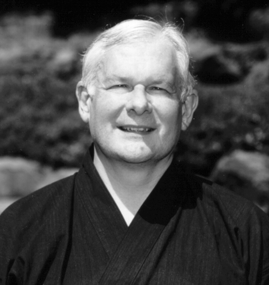
John Stevens (Translator, Buddhist priest and teacher of Buddhist studies and Aikido. Stevens was born in 1947.)
“The Art of Peace” is a brief audio book that recounts the life, and for the skeptical, the myth of Morihei Ueshiba. Ueshiba is the founder of the martial arts technique of Aikido. Though Ueshiba’s life ranges from one of violence to peace, his life leads him to a spiritual and practical acceptance of what is Aikido, “a Japanese form of self-defense and martial art that uses locks, holds, throws and an opponents’ own movements to defeat aggression”.
Moritaka Ueshiba, aka Ueshiba Morihei, aka Tanabe Wakayama (Japanese martial artist and founder of the martial art of Akido.)
Ueshiba was born into a relatively wealthy Japanese family. His father was a farmer and minor politician in a city now known as Tanabe, a city located in Wakayama Prefecture. He was an only son with three siblings. Ueshiba describes himself as a weak, somewhat sickly, child who is encouraged by his father to strengthen his body by learning sumo wrestling, swimming and the discipline of repetition.
Shinto (A religion that originated in 300 BCE Japan, considered a nature religion.)
Ueshiba is largely taught by a Shinto priest, his elementary schoolteacher.
The Shinto priest introduces Ueshiba to religion. Ueshiba quits his formal education after Middle School. After life in Tanabe, “The Art of Peace” tells of Ueshiba’s life as a warrior in the war with Russia in the early 1900s. He is initially drafted but fails his induction because of his small stature. To increase his height to meet the minimum requirements, Ueshiba allegedly suspends himself from the branches of trees with weights on his legs. He is said to have added the half inch needed to qualify for the military. His success as a warrior is implied by his promotion to sergeant by the end of the war.
Ueshiba continues to train in the martial arts with teachers of judo and other martial arts that give him superior skill as a fighter.
Ueshiba develops great skill with mind and sword. “The Art of Peace” recounts an extraordinary feat to dodge bullets. He is simultaneously fired upon by several shooters to illustrate his ability to evade aggression. He manages to anticipate the first shot and move behind the fusillade before any bullets can find their mark. He does this twice, according to Steven’s translation of the book.
The essential message of “The Art of Peace” is that meeting aggression with aggression is a fool’s errand. Ueshiba argues understanding the futility of aggression teaches one to listen, learn, and act in ways that use other’s aggression against themselves.
There is wisdom in Ueshiba’s argument, but it seems to have taken a long life, diligent study, practice, and experience of war, to adopt the principles of Aikido.
“The Art of Peace” seems more a life of an idea than one’s ability to achieve, let alone implement.
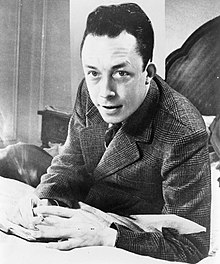
Albert Camus (1913-1960, Author, philosopher, founder of Absurdist philosophy.)
Albert Camus’s short story is similar to Irvin Yalom’s book, “When Nietzsche Wept”. In “A Happy Death” Camus’ reveals the essence of an Absurdist’s view of life while Yalom reveals a Nihilist’s view of life. Yalom’s story is longer, more informative, and artistic but both stories clarify similarity and difference between an Absurdist’ and Nihilist’ view of life.
Camus tells a story of a man who chooses to commit suicide. Yalom tells a story of Nietzsche who bares life and has no intention of committing suicide. Camus’s character commits suicide because he achieved a purpose in life but could not find a comparable purpose in life to replace the one achieved.
In one sense, Yalom’s characterization of Nietzsche suggests Camus’s suicidal character is a “Superman” because he rejects all religious and moral principles. However, by choosing suicide, he is no longer a “Superman” to Nietzsche.
To Camus, he was never a “Superman”. He is an Absurdist who has simply lost his chosen purpose in life because of the randomness of worldly existence. Camus’s character chooses suicide because his chosen purpose in life is taken away from him. His legs are amputated because of a random event of life.
To Nietzsche, life is pointless because there is no meaning to life. To Camus, meaning in life is a human choice, even though, like Nietzsche, he believes there is no God, or moral absolutes.
The answer to life for Camus is not that humans are Superman or Superwoman because there is no God, but that any human man or woman can choose, or not choose, to have purpose in life.
Camus views the world as an absurd place where anything can happen but that does not mean one cannot choose a purpose in life.
Camus notes this character who chooses suicide is different in one other significant way. His chosen purpose in life is to acquire wealth to buy time. He gained wealth. The noted difference reminds one of Montaigne’s essays. Montaigne had the luxury of wealth which gave him time for contemplation.
Camus’s story about Absurdism only begins with the suicide. The person who plans his suicide has a gun to end his life but by someone he chooses. The choice made by the amputee is Camus’s main character, a person wandering through life with no purpose.
The amputee explains he lived a life that earned him two million dollars. It was earned with purpose, by any means necessary. His purpose in life is to become wealthy. He achieves that purpose, but now with no legs, he feels he can no longer pursue that purpose. The main character is given two million dollars to shoot the amputee and make it look like a suicide with a note written by the amputee.
With two million dollars, the main character travels through Europe while contemplating what the amputee has explained about life in an Absurdist world.
The main character realizes he must choose a purpose in life and ignore the truth of life’s randomness. His purpose in life is not entirely clear, but Camus’s point is that to live life in an Absurdist world, one must choose a purpose.
To Camus, in choosing a purpose, one may find peace, a sense of achievement, and possibly happiness. To Nietzsche, life is something to bare and when it’s over, it’s over. To Nietzsche, there is no purpose in life.
It seems Camus believes it is better to be an Absurdist than a Nihilist. That puts a fine point on the question of suicide. A Nihilist like Nietzsche, presumably, would call one who commits suicide a coward. An Absurdist like Camus would suggest suicide is an option.
Optimistically, Camus shows his main character chooses a way of life that might be considered Epicurean, if not hedonist. Money gave him time to choose a purpose in life. His main character nears death and appears at peace with himself.
Will Buckingham (English Author, novelist, philosopher, masters in anthropology, PhD in philosophy from Staffordshire University.)
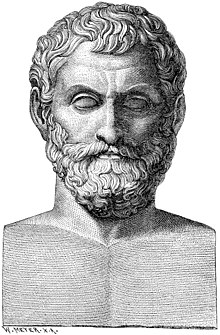
Will Buckingham succeeds in telling the story of philosopher’s big ideas. Buckingham takes listeners on a journey through the ages of philosophy. Beginning in the pre-Julian Roman calendar of 585 BC, Buckingham explains how Thales of Miletus began humanities’ journey from belief in mythology to observation and prediction. Miletus predicted a solar eclipse, presumably based on astronomical observation.
Thales of Miletus (626 to 623 BC to 548 to 545 BC, Pre-Socratic Philosopher known by some as the Father of Science.)
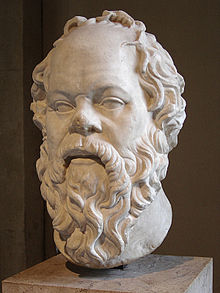
Socrates is believed to have lived from 470 to 399 BC when he chose to take his own life when found guilty of charges of blasphemy and corrupting youth.
Plato (428-423 BC to 348-347 BC, died at the age of 80.)
Socrates could have escaped execution according to Plato’s writing in the “Phaedo” but chose to drink Hemlock tea, the poison of capital punishment.
Socrates denies both accusations against him. Plato writes Socrates mentions the god Asclepius (one of the gods noted for healing) in his last moments of lucidity. The implication of Plato is that Socrates believed in the gods. Socrates flatly denies the corruption of youth for which he is accused.
Buckingham notes what is known of Socrates is only through Plato and Aristotle’s writing which support his innocence by relating stories of Socrates search for truth. An ancient Oracle is said to have told Socrates he was the wisest of all men. By questioning beliefs of those who professed wisdom, Socrates finds others ignorance and understands why the Oracle considers him the wisest “…because I alone, of all the Greeks, know that I know nothing.” It is through dialog with others about belief that Socrates finds other’s ignorance and his wisdom.
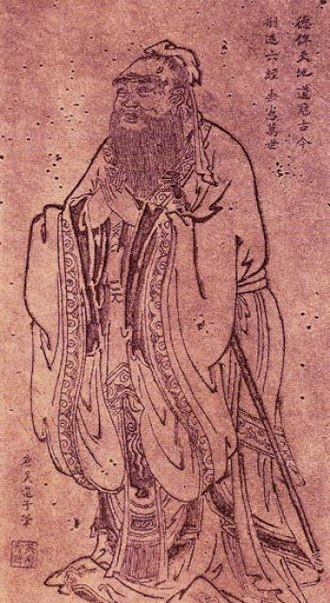
Confucius (551 BCE-479 BCE, died at 71 or 72, Chinese philosopher.)
Before Socrates, Buckingham notes the prominence of Confucius who lived in China, between 551 to 470 B.C.E. Both Socrates and Confucius search for truth.
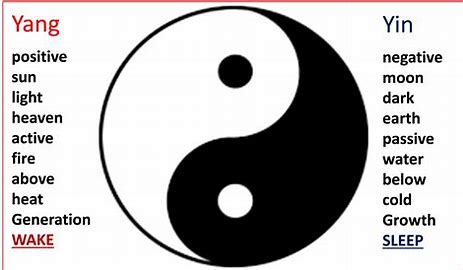
Both are searching for causes of societal chaos. However, where Socrates looks to dialog with others and communication with the gods for help in understanding life, Confucius looks to what is called the DAO, i.e., the “way”, the road, or the path that gives harmony to human nature. In the DAO, there is a yin and yang to life that leads one to a harmonious code of behavior. It is neither based on God or gods but on the search for harmony in life.
Though Socrates and Confucius seek wisdom, their paths are quite different but with similar objectives.
This seems a beginning of a split between gods, God, and human belief. The Greeks pursue the help of gods for earthly harmony. The Chinese search for a path to human harmony within society, exclusive of gods or belief in one God.
Buckingham proceeds to overwhelm listeners with mostly well-known philosophers of history. He does not make a distinction between belief in gods, God, or what is broadly characterized as science.
In coming to grips with the number of philosophers noted, one tends to rely on a perceived societal direction. To this listener, the direction is away from God, toward science.
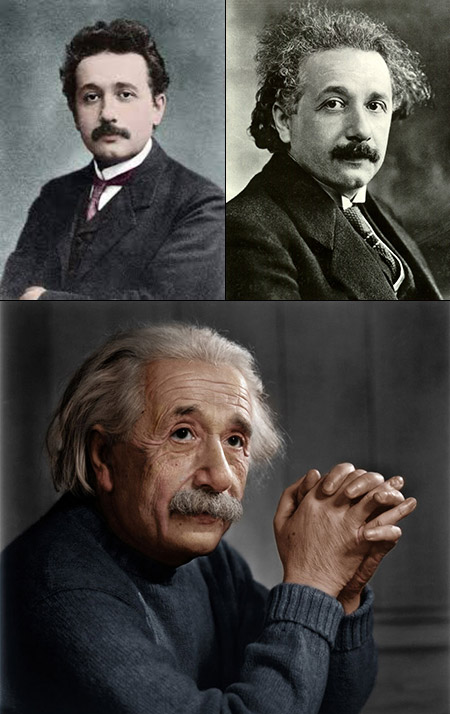
This is not to say that science or philosophy excludes God. There are many famous scientists who claim belief in God. Rene Descartes, Isaac Newton, Galileo Galilei, Albert Einstein, Gregor Mendel, and Charles Darwin, to name a few. The irony of that truth is that each of these scientists made discoveries that weaken one’s belief in God because their discoveries offer insight to the origin of life and living without God.
The list of non-believers is as long or longer. Some say Einstein was an Atheist. There is Daniel Dennett, Michael Shermer, Rosalind Franklin, Sigmund Freud, Stephen Hawking, Richard Dawkins, Richard Feynman, Niels Bohr, Francis Crick, Erwin Schrodinger, John Bell, and so on.
“The Philosophy Book” offers more information about philosophers than one may want to know. Nevertheless, it offers a well written overview of belief, if not wisdom, in the world. One may ask themselves, what’s next? Artificial Intelligence seems to offer our best chance of survival if humanity is on its own.
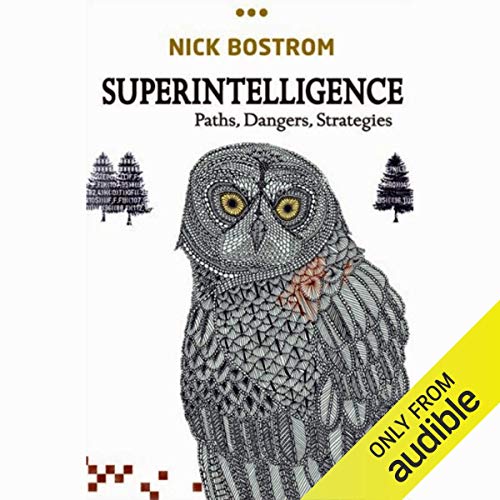
Nick Bostrom (Swedish philosopher at University of Oxford, author.)
Nick Bostrom explains the difference between A.I. potential and human brain limitation. With addition of sentient reasoning, Bostrom explains the incomprehensible leap beyond human brain capability with the advent of artificial intelligence.
Bostrom argues A.I. is approaching an information collection and processing capability with potential for sentient reasoning.
That leap can be viewed with fear and trembling as inferred by Bostrom or it might be seen as a next step in human evolution.
Bostrom’s concern revolves around human brain limitation in setting standards for A.I.’ programming.
Science is at a threshold of brain emulation where A.I. may assume the role of human thought and action.
A machine’s ability to recall billions of facts and historical precedence cannot be matched by the human brain. However, the significance of A.I.’s achievement is delimited by how it may be programmed to have moral, ethical, and normative standards that benefit humanity. The difficulty of that programing is humanity’s continual redefinition and lack of agreement on normative standards.
One may ask oneself how good a job has human evolution done in setting standards for humanity? Have authoritarians like Vladimir Putin, and Donald Trump benefited the world?
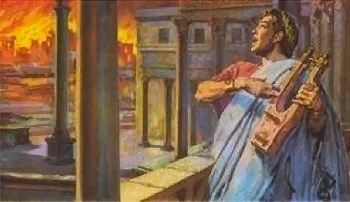
Bostrom notes two fundamental scenarios for human evolution. Both seem more a return to the past than to the future. Bostrom suggests A.I. will become either an oracle or sovereign leader of humanity. As an oracle, one is reminded of Athenian fealty to the Oracle of Delphi. As sovereign, one is reminded of Augustus Caesar, Caligula, Franklin Roosevelt, and Adolph Hitler. Humanity has survived all–both false predictions of the Oracle and atrocities of sovereigns.
Recreated Oracle of DelphiAugustus von Prima Porta (20-17 v. Chr.), aus der Villa Livia in Prima Porta, 1863.Caligula as Rome burned.FRANKLIN D. ROOSEVELT (1882-1945, 32ND PRES. OF U.S.,1933-1945)Adolph Hiter
It is unfair to suggest Bostrom is not revealing the difficulties accompanying the introduction of A.I. to humankind. The reality of advancing intelligence through machine learning far outstrips the ability of any singular past or present scientist, philosopher, or politician. One is intimidated by the shear complexity of programing A.I. and its potential for benefit and harm to humanity.
To understand humanities place in the world, human beings cannot agree on what is moral, amoral, equitable, or unfair in society.
How will input from human beings to an oracle or sovereign A.I. escape the imperfect nature of humankind? Added to that difficulty is A.I.’ potential to ignore the best interest of humanity in the interest of its own self-preservation.
Bostrom’s book is interesting, but he beats the idea of A.I.’s ascendance to death by delving into game theory. Bostrom notes the world’s race to create artificial intelligence has the potential of ignoring safeguards for A.I.’s growth and potential for world domination.
Though abandoning safeguards is quite true as evidenced by the Crispr revolution that opened Pandora’s box of genetic manipulation, evolution of species is a fundamental law of the world’s existence.
A.I. is a step in the evolution of species. Its consequence is unknown and cannot be known because it follows the randomness of genetic selection. Humanity needs to get over it and get on with it. A.I. will either be humanity’s savior or its doom.
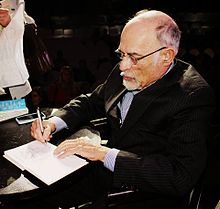
Irvin D. Yalom (Author, Doctor of Medicine, professor of psychiatry at Stanford University.)
“When Nietzsche Wept” was published in 1992. The author Irvin Yalom is now 91 which implies his book was written in his late 50s.
To those who have struggled with understanding Fredrich Nietzsche, Yalom offers brilliant insight to Nietzschean philosophy in a novel set in the formative years of Freudian psychology.
As a psychiatrist by training, Yalom offers insight to the psychology of the male psyche while telling the story of a friendship between Nietzsche and a physician named Josef Breuer.
Interest in philosophy is not essential for appreciating Yalom’s creative mind in “When Nietzsche Wept”. Yalom intersperses historical fact in an imaginative story. Dr. Joseph Breuer is friends with a younger Austrian neurologist named Sigmund Freud. Freud is just beginning to develop his theory of psychological therapy through dialog. Freud’s therapeutic idea is to reveal causes for psychiatric abnormality by talking through the physical and emotional circumstances that lead to psychological imbalance.
Freud’s therapeutic idea is to reveal causes for psychiatric abnormality by talking through the physical and emotional circumstances that lead to psychological imbalance. To Breuer, Freud carries his concept too far by implying a homunculus inside the brain.
What makes Yalom’s story compelling is the opinion given by the author of “talking theory’s” value in psychotherapy. At the same time, Yalom exposes male chauvinism and its harmful societal consequence.
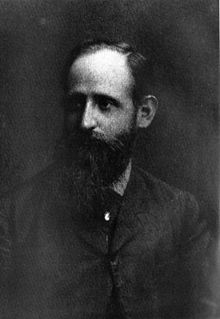
Joseph Breuer (1842-1925, a noted physician in neurophysiology, used the -talking cure- with “Anna O” that laid the foundation of psychoanalysis developed by his protege, Sigmund Freud.)
Josef Breuer is 40 years old. He is married to a beautiful woman. They have children together while Breuer becomes a well-established and renown physician. However, Yalum suggests Breuer is experiencing a mid-life crisis. In his practice, Breuer becomes emotionally attached to a young, beautiful patient who comes to him for treatment of physical discomfort and pain from an unknown cause. When an attack occurs, the patient exhibits pain that is only relieved by physical contact from her attending physician. That physical contact becomes inordinately intimate.
Breuer finds the contact sexually stimulating while clearly understanding it is professionally unacceptable. With his association with Freud, Breuer experiments with talking therapy to ameliorate the patient’s symptoms. He finds the therapy helps but it distorts his objective understanding of patient-doctor relationship.
Breuer begins to believe the patient is becoming emotionally attached to him when she is simply acting out psychologically. In defense against his falsely based infatuation, he assigns the patient to another physician.
In an acting-out psychological way, similar to Breuer’s mistaken perception with his former patient, he is approached by a beautiful 21-year-old woman, a stranger. She asks him to take on a new patient named Fredrich Nietzsche. She explains Nietzsche may commit suicide based on her acquaintance and subsequent rejection of his proposal of marriage. In a sense, Breuer is seduced by his imagination of the beautiful young woman’s approach to him. In fact, the young woman is only acting in accordance with her own agenda.
A listener begins to realize this is a Nietzschean view of the world of human relationship. Every human being has their own agenda. People act in their own self-interest, not in other’s interests. Human self-absorption distorts truth. God is not only dead, but He also never lived. All there is, is one’s will. To Nietzsche, one either becomes a superman or nothing.
Breuer takes Nietzsche as a patient but only on terms acceptable to Nietzsche. Breuer concocts an idea of offering Nietzsche the opportunity to treat Breuer for his mid-life crises. In return, Breuer offers his ministration as a physician. The sessions are based on the undisclosed self-interests of both, rather than the truth of each’s acceptance. What happens is Breuer’s mid-life crises is cured and Nietzsche’s weeping self-realization becomes the story.
This is an over-simplification of a well-crafted novel that has much to say about male egoism, psychotherapy, and inequality of the sexes; not to mention the terrifying implication of Nietzschean philosophy. There is much to unpack in Yalom’s spectacular story.
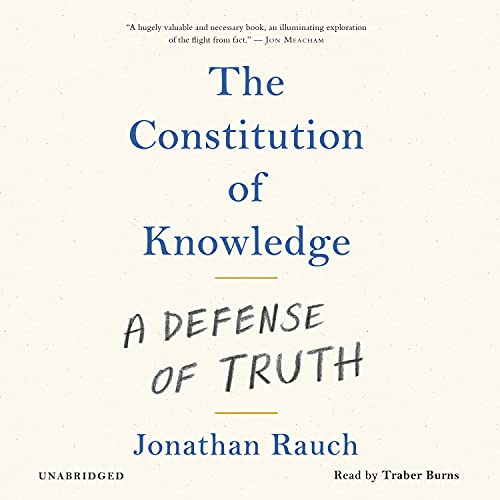
The Constitution of Knowledge (A Defense of Truth)
By Jonathan Rauch
Narrated by: Traber Burns
Jonathan Rauch (American author, journalist, freelance writer for The Economist and senior fellow at the Brookings Institution.)
The structure of knowledge is the subject of Jonathan Rauch’s “…Constitution of Knowledge”. What may come as a surprise to some is Rauch’s argument that knowledge is a social construct, not an inviolable fact or truth. Knowledge grows from tests of society.
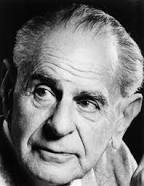
As Karl Popper, a highly respected philosopher of science noted, knowledge can only be found through pursuit of its falsification.
The fear that accompanies Rauch’s argument about knowledge, and Popper’s belief about science’s truth means a lie can be as influential as truth. The two greatest twenty first century examples are Trump and Vladimir Putin.
U.S. President Donald Trump and Russian President Vladimir Putin shake hands as they hold a joint news conference after their meeting in Helsinki, Finland, July 16, 2018. REUTERS/Leonhard Foeger
All human beings lie. The problem is those with preeminent power use the lie to lead others to believe what society’s tests show to be false. The problem is distinguishing a lie from societal truth. A lie is never as evident as it is with Pinocchio’s nose.
Truths should not be based on a singular view of reality. Lies of leadership in recent history have led to tragic interventions by America, France and most recently, Russia in sovereign countries like Vietnam, Iraq, Afghanistan, Syria, and today’s Ukraine.
Rauch both personalizes damage that lies have on individuals and society with his experience as a gay person and combatant against cancel culture, violence, sexism, and racism. Though Rauch’s explanation notes many examples of what is wrong with society, he ends with a degree of optimism about how one can deal with leadership’ lies.
Words matter but if they don’t lead to violence, they can be logically addressed by society and rejected for their distortion of perceived truth. Rauch is careful to explain truth is a perception, not a fact or necessarily a truth. As is shown by science, the human brain does not record facts but recreates events that fit a human’s perception of reality.
What is true is tested in Popper’s theory of facts that are tested by search for falsifiability.
If a tree falls in the forest and a tape recorder records the sound, one is tempted to believe a fact has been found. If that experiment is repeated many times by different people, the falling tree makes noise, whether a human is there or not, is likely to be true. However, it is a sound that remains a perception. The difference is it has been tested many times by society with the same result.
Cancel culture is when there is a public boycott of people or organizations because of an interest group’s belief. If a group’s belief is challenged by perceptions and experience of a broader society, cancel culture can be, at least, ameliorated.
Rauch shows himself to be a free speech believer. One presumes he endorses all free speech if it does not induce or insight violence. This is not to suggest words spoken or written are not harmful, but they are not physically injuring another.
Attacking a person physically for words spoken is reprehensible but attacking an idea is societies’ way of revealing the truth and acquiring knowledge.
After listening to Rauch’s explanation of what knowledge is and how it is acquired, one wishes a signal could be sent when one is knowingly lying, e.g., something like Pinocchio’s nose.
John Kaag, (Author, Professor of Philosophy at UMass Lowell)
John Kaag’s view of romantic love seems slightly askew when taken in the context of his two books, published two years apart. “American Philosophy” is published in 2016 while “Hiking with Nietzsche” is published in 2018. Having listened to both, one finds “Hiking with Nietzsche” belies the conclusion of romantic love characterized in “American Philosophy”.
In “American Philosophy, Kaag professes understanding the harm done to romantic love by male self-absorption and then ignores that realization in “Hiking with Nietzsche”.
Kaag’s male self-absorption is flaunted in “Hiking with Nietzsche”. Kaag seems quite dismissive of his second wife in his “Hiking…” adventure.
Kaag seems mostly in love with himself and his pursuit of philosophy.
Kaag becomes an organizer of a library of first editions for the Hocking family. The descendants wish to donate the volumes to a library of their choosing but the contents must be organized for appraisal purposes.
Kaag ensconces himself in Hocking’s library of 10,000 books with many philosophical “first edition” writings.
The story of “American Philosophy” is about the life and times of William Ernest Hocking and his 400-acre estate in New Hampshire.
William Ernest Hocking (1873-1966, American idealist philosopher.).
400 Acre Hocking Estate in New Hampshire
Kaag accepts the task. The library becomes a refuge from his first marriage which ends in divorce. As Kaag reviews the philosophies of greater and lesser philosophers like Emerson, Royce, Kant, and Hocking, he reflects on his failed marriage. He concludes his failure is self-inflicted.
As Kaag begins cataloging the 10,000 volumes, he is joined by a fellow philosopher (who becomes his 2nd wife) from a university for which they teach.
Hocking library on the 400 Acre Estate.
What Kaag realizes is philosophy looks to the supernatural and, in its pursuit, romantic love suffers. Kaag exhibits eating, sleeping, and drinking disorders that reflect a self-absorption that damages romantic love. This is an ironic realization because it seems Kaag celebrates romantic love but cannot partake of it.
Society treats women as less equal than men. Oddly, Kaag shows understanding without behavioral modification. This seems societies’ tragic flaw.
Women are the equal of men, but society does not treat them equally. The consequence is the loss of romantic love and women’s rightful place in society. The resurrection of the Taliban in Afghanistan, Putin’s militancy, Middle Eastern, Eastern, and Western society show the likelihood of change seems remote, if not unlikely.
Some argue Kaag’s book is a celebration of romantic love, but it is not. Kaag’s story is about male societies’ inability to overcome the history of misogyny. The implication is when women are treated as equal, society will change. Reviewing Kaag’s two books suggests the world is not ready.
David Auerbach (Author, software engineer, writer for various publications.)
David Auerbach wishes not to be categorized. However, Auerbach is an author, ivy league graduate, computer geek, software coder, gamer, philosopher, and more. The point is categorization does not explain the real Auerbach. Auerbach offers a wide-ranging conception of what is real and not real in the world.
Auerbach criticizes categorization because it is fictive. His example is the wrong-headed categorization of sexuality. What social or cultural value can come from such categorization? Auerbach notes at one point Facebook insists users identify their sexual predilection from a list of hundreds of categories.
Auerbach pursues the concept of what is real in “Bitwise”. He fails to clearly define real but identifies what real is not. Real is not simply what the mind’s eye beholds and it is not the mathematics of reproducible experiment. There is a concreteness to real in Auerbach’s belief. However, real remains a mystery because it is to be revealed in a future not yet written.
To Auerbach, real lies somewhere within the triptych of human’ thought, mind, and language.
Auerbach’s philosophical argument for real is partly supported by the evolution of scientific understanding of the world. Newton discovered a partial truth about the physics of moving bodies. Einstein expanded Newton’s partial truth with a more comprehensive understanding of space and time. Einstein’s truth is changing with the discovery of quantum mechanics. All of these discoveries came from the interplay of human’ thought, mind, and language. This triptych gives concreteness to what is real.
SIR ISAAC NEWTON (1642-1727)ALBERT EINSTEIN (1879-1955)
Auerbach questions the advance of software algorithms as a method for finding truth about what is real. An algorithm is only a tool of human’ thought, mind, and language. Auerbach infers there may be a time when a computer becomes more human with the ability to define reality but not until they are more than algorithmic machines. That, of course, raises many more questions.
An algorithm is a set of calculations meant to define reality or conduct problem solving operations when in fact they neither define reality nor solve anything.
A revelation one has from Auerbach’s “Bitwise” is that gamers have become important to a younger generation because algorithms offer insight to the concreteness of existence. One can experiment with life’s outcomes without consequence in the real world.
Auerbach gives the example of a gamers use of a nuclear war game to show how world diplomacy decisions lead to world conflagration. Early versions are refined but remain blunt predictive instruments that only mimic human’ thought, mind, and language.
In his early career, Auerbach’s software experience comes from working with Microsoft. He suggests the stewardship of Balmer diminished Microsoft’s innovative history. Auerbach leaves Microsoft to join Google. He finds Google to be a more cutting-edge software developer by recognizing the value of data gathering and mining.
“Bitwise” is a clarion call to the public. Big Brother is here. It has the face of Google and the power of a nation-state.
The near future is dependent on software coding. The long future is dependent on human’ thought, mind, and language.
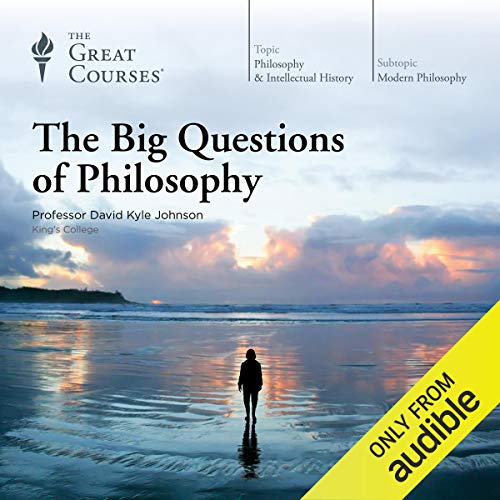
David Kyle Johnson (Lecturer, Associate Professor of Philosophy at King’s College in Pennsylvania)
David Johnson’s first thirty lectures revolve around proof of God, the definition of reason, knowledge, truth, and the existence of free will. Those lectures, though logically consistent, are a slog and may cause listeners to stop listening. However, the last six chapters of Johnson’s lectures are rewarding summaries of government philosophy and the meaning of life.
Johnson questions several arguments about God’s existence by revealing their logic and evidentiary failings. Johnson defines reason, truth, knowledge, and testimony as falsifiable evidence for God’s existence. He challenges arguments about the existence of soul, and what it means to be free. He explains the significance of mind and body, good and evil, and personal identity. Along the way, he defines good and evil with various side trips showing how we “ought” rather than “how” we really live. Johnson’s attacks many, if not all, substantive philosophical arguments for the existence of God. His noted weaknesses of many philosophical beliefs about God, truth, and knowledge are mind numbing.
The first two thirds of Johnson’s philosophical analysis conclude God’s existence is an unverifiable truth, solely dependent on the chimera of faith.
In contrast, Johnson’s summary of government philosophy and the meaning of life are both entertaining, and informative.
There is a good deal of bias in this review because of personal interest. The first thirty chapters may be of more interest to some, but his analysis of the history of economic and political theory remind one of how great it is to be steeped in western culture.
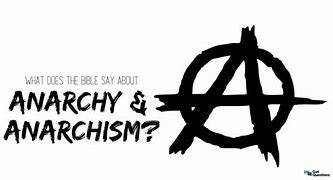
Lecture 31 one asks—Should Government Exist? Johnson suggests the alternative for government is anarchy. He offers three categories of anarchy, i.e., theoretical, serious, and violent. All three question governments’ moral authority.
From an American perspective, the only substantive concern is with the category of serious anarchy. Serious anarchy is Johnson’s category of what is known as Libertarianism in the United States.
Rand Paul, US Senator from Kentucky
The most famous American Libertarians are Ron Paul, Rand Paul, Thomas Sowell, the Koch brothers, Steve Forbes, and Peter Thiel. Essentially, they believe government should be restricted to defense of the country with citizens responsible for their own actions. The only law should be moral law because government-imposed law restricts personal autonomy. There should be no government regulation that infringes on personal autonomy in social, or economic policy.
Lecture 32 asks—What Justifies a Government? Johnson recalls luminaries like Thomas Hobbes, John Locke, and Jean-Jacques Rousseau.
John LockeJean Jaques Rousseau
Hobbes viewed citizens as naturally power hungry and that government is necessary to protect citizens from being harmed by acquisitive neighbors. Locke suggests citizens enter a social contract with a government when they choose to become members of a nation-state and by contract will not be allowed to infringe on a neighbor’s freedom of choce, liberty, or pursuit of happiness. In the case of Locke, laws are passed to protect citizens by a government Republic that represents the will of the people who vote for them. Rousseau agrees with Locke but insists on direct democracy to establish any laws meant to protect citizens. Each of these men influence the founding fathers in writing an American constitution.
Lecture 33 asks—How Big Should Government Be? Johnson summarizes the economic philosophies of Adam Smith, Karl Marx, and John Maynard Keynes who shape much of what American government has become.
JOHN MAYNARD KEYNES (1883-1946)
The economy of America is largely based on Adam Smith’s “Wealth of Nations”. Though many know of Adam Smith, few seem to have closely read “Wealth of Nations” to clearly understand what he said about economic growth. There have been many interpretations of “the invisible hand” that range from an extreme that suggests self-interest is all that matters in an economy to price-controlling when competition is driving businesses into bankruptcy. Neither extreme represents Smith’s belief in “the invisible hand”. Neither self-interest nor competition is all that matters for an economy to grow. Smith tempers self-interest by arguing it cannot be adhered to at the expense of the common good. Smith endorses competition when it lowers prices for the public. However, Smith notes monopolies created from aggressive acquisition of competitors restricts competition and infringes on the common good.
Karl Marx addresses the threat of capitalism making slaves of workers who are undercompensated for their labor that only benefits entrepreneurs who own businesses without fairly compensating their employees.
History has shown the weakness of Marx’s argument. Labor organizes to increase compensation for labor. More than labor costs determine value. There is the willing buyer and seller that determine the cost of any business’s survival. Marx ignores too many other variables when valuing labor without addressing risk to entrepreneurs, the cost of doing business, and the inherent inventiveness of capitalist self-interest.
John Maynard Keynes is a preeminent economic theorist who recognizes the weaknesses of capitalism. Capitalism engenders economic crashes, panics, recessions, and depressions.
Johnson notes Keynesian economic theory ameliorates those threats by deficit spending when “the invisible hand” fails the common good. Johnson suggests Keynes offers a middle ground between Smith and Marx. The inevitable problem is knowing where the line is to be drawn between government overreach and an “invisible hand” which benefits the common good.
The next two lectures address the limits of liberty and societal fairness. America is among the richest countries in the world, but homelessness seems to grow with each passing year. Having traveled some, it appears America is doing a poorer job of dealing with poverty and homelessness than more autocratic countries like China. One picks China as a contrast because it has a population of 1.4 billion versus 320 million in America. The wealth of American citizens far outweighs the wealth of Chinese citizens. U.S. per-capita income is estimated to be 5.78 times higher than China’s.
One sees no homeless people sleeping in parks or on the sidewalks of major cities like Beijing, Hong Kong, or Guangzhou in China. America is not doing a very good job of drawing the line between government outreach and the impact of capitalist self-interest when it comes to homelessness. This is not to argue limits to liberty in China are either better or worse than America’s ineptitude. However, managing homelessness is a distinct societal unfairness in America. This is a national problem that needs to be addressed by American government policy based on the welfare of its citizens.
At the end of Johnson’s lectures, one is reminded of Plato’s fictional writing about the Oracle of Delphi identifying Socrates as the wisest of Greeks.
Socrates (Greek Philosopher, 470 BC to 399 BC.)
Plato writes that Socrates disbelieves the Oracle. He questions scholars of his time to find they know no more than him. However, he concludes “xero katie pou den xero tipota” or “I know something that I know nothing”.
The final chapter of Johnson’s lectures is “What is the Meaning of Life”.
There is no definitive answer. Maybe, it is the number 42, the nonsensical conclusion of the Bible noting “The Duration of Suffering”. (It is also Douglas Adams ironic answer in “The Hitchhiker’s Guide to the Galaxy”.)
Living with the Devil ( A Meditation on Good and Evil)
By: Stephen Batchelor
Narrated by: Stephen Batchelor
Stephen Batchelor (Author, Scottish Buddhist, teacher.)
Stephen Batchelor offers a view of religion and reality in an attempt to move beyond the “let it be” implication of a meditative life. Batchelor places Buddhism in the context of most religions’ beliefs. He explains Buddhism personifies the devil as a master of seven dimensions of heaven.
The devil assigns one of the seven heaven’ disciples to inspire sin in human life. That disciple is Mara who is directed by the devil to seduce Siddhartha, the founder of Buddhism. Mara assumes the visage of a woman but fails to distract Siddhartha from “the way” and, like Christ in Christian belief, Siddhartha becomes a symbol and guide for humanity.
Image of Mara who takes the image of a woman to seduce Gautama Buddha, (Siddhartha).
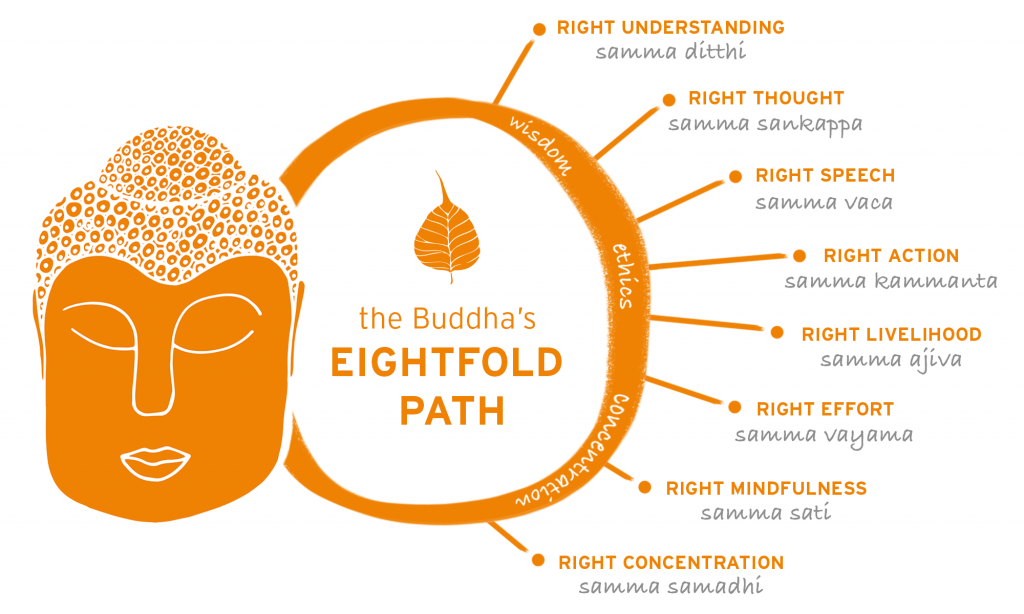
Batchelor explains Buddhism is the door to “the way” which recognizes the devil as a part of life’s yin and yang. Hardship and death are part of life. Those seeking eternal life delude themselves. It is not possible to have life without death. It is not possible to have “the way”, a path without evil because evil defines good by being its opposite. This leads to a “let it be” mentality of those who meditate on “the way”. Batchelor is not condoning the evil of violence, destruction, or death but explains its role in defining “the way”. Therein lies a criticism by some.
Buddhist guidance is described as “the way” by Batchelor.
One presumes, it is the same “way” referred to in the adventures of Disney Studio’s “The Mandalorian”.
Batchelor describes the path that most of humanity takes is deflected in the same way as a human walking with one leg shorter than another. The path of humanity is circular which suggests why history seems to repeat itself. (To paraphrase Mark Twain–history may not repeat itself, but it certainly rhymes.)
One who is not a Buddhist is not comforted by Batchelor’s explanation of “the way” or his acknowledged acceptance of living with the devil. Batchelor, like Buddha, Jesus Christ, and a Divinity, may be correct in their knowledge about human life but it does not give one comfort. It proffers fear that violence and destruction is to be tolerated by humanity because it is a part of living life as a human being.
Batchelor implies homelessness, despair, and human degradation are incurable and acceptable because the devil’s work helps define “the way”.
Accepting Buddhism seems to encourage meditation at the expense of human effort to give succor to those in need. All religions and societies should be focused on social and economic equality for all. Accepting less is failure. “The devil made me do it” is a cop out.