
Books of Interest
Website: chetyarbrough.blog
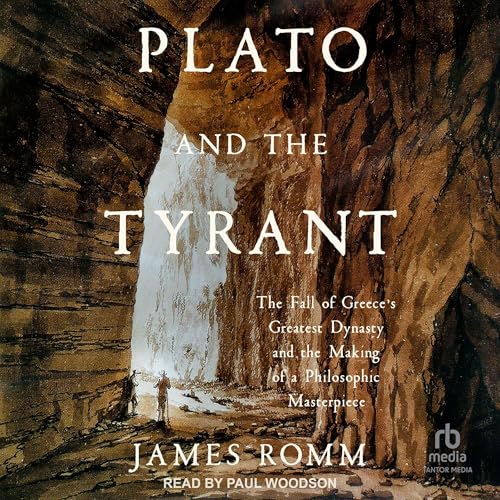
Plato and the Tyrant (The Fall of Greece’s Dynasty and the Making of a Philosophic Masterpiece)
Author: James Romm
Narrated By: Paul Woodson

James Romm (Author, Professor of Classics at Bard College, specializes in ancient Greek and Roman culture and civilization.)
James Romm reviews Plato’s personal correspondence that offers an interesting perspective on “The Republic” as a critique of Dionysius the Elder’s tyrannic rule of the island nation of Syracuse, Sicily, and southern Italy. (Syracuse is a Mediterranean island 620 miles off the coast of Greece.) Some believe there are 13 private letters written by Plato with the most famous and debated letter being number 7. Romm’s book is about these private letters and what they reveal about Plato’s character.
Excerpt of the 7th letter to Dionisius the Elder:
Holding these right views, Dion persuaded Dionysius to summon me; and he himself also sent a request that I should by all means come with all speed, before that [327e] any others13 should encounter Dionysius and turn him aside to some way of life other than the best. And these were the terms—long though they are to repeat—in which his request was couched: ” What opportunities (he asked) are we to wait for that could be better than those that have now been presented by a stroke of divine good fortune?” And he dwelt in detail on the extent of the empire [328a] in Italy and Sicily and his own power therein, and the youth of Dionysius, mentioning also how great a desire he had for philosophy and education, and he spoke of his own nephews14 and connections, and how they would be not only easily converted themselves to the doctrines and the life I always taught, but also most useful in helping to influence Dionysius; so that now, if ever (he concluded), all our hopes will be fulfilled of seeing the same persons at once philosophers and rulers of mighty States. [328b]
By these and a vast number of other like arguments Dion kept exhorting me; but as regards my own opinion, I was afraid how matters would turn out so far as the young people were concerned—for the desires of such as they change quickly, and frequently in a contrary direction; although, as regards Dion’s own character, I knew that it was stable by nature and already sufficiently mature. Wherefore as I pondered the matter and was in doubt whether I should make the journey and take his advice, or what, I ultimately inclined to the view that if we were ever to attempt to realize our theories [328c] concerning laws and government, now was the time to undertake it; for should I succeed in convincing one single person sufficiently I should have brought to pass all manner of good. Holding this view and in this spirit of adventure it was that I set out from home,—not in the spirit which some have supposed, but dreading self-reproach most of all, lest haply I should seem to myself to be utterly and absolutely nothing more than a mere voice and never to undertake willingly any action, and now to be in danger of proving false, in the first15 instance, to my friendship [328d] and association with Dion, when he is actually involved in no little danger. Suppose, then, that some evil fate should befall him, or that he should be banished by Dionysius and his other foes and then come to us as an exile and question us in these words—“O Plato, I come to you as an exile not to beg for foot-soldiers, nor because I lack horse-soldiers to ward off mine enemies, but to beg for arguments and persuasion, whereby you above all, as I know, are able to convert young men to what is good and just and thereby to bring them always into a state of mutual friendliness [328e] and comradeship. And it is because you have left me destitute of these that I have now quitted Syracuse and come hither. My condition, however, casts a lesser reproach on you; but as for Philosophy, which you are always belauding, and saying that she is treated with ignominy by the rest of mankind, surely, so far as it depends on you, she too is now betrayed [329a] as well as I. Now if we had happened to be living at Megara,16 you would no doubt have come to assist me in the cause for which I summoned you, on pain of deeming yourself of all men the most base; and now, forsooth, do you imagine that when you plead in excuse the length of the journey and the great strain of the voyage and of the labor involved you can possibly be acquitted of the charge of cowardice? Far from it, indeed.”
Dionysius the Elder ruled for 35 years and is succeeded by his son, Dionysius the Younger. Dionysius is characterized as a combative, brutal, and authoritarian leader. Plato visited Syracuse many times with the desire to ameliorate the Elder’s style of leadership. Plato’s effort results in the Elder’s selling him into slavery, presumably because of political differences and the Elder’s tyrannical power.

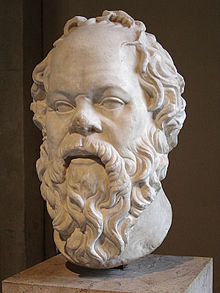
Plato (428/423 BC to 348/347 BC, died near 80 years of age.)
Soon after being sold into slavery by Dionysius the Elder, Plato is rescued by Anniceris who bought Plato out of slavery. Anniceris (aka Annikeris), a wealthy Greek philosopher, apparently recognized Plato’s brilliance. Plato goes on to create his famous academy in Athens. Though the Elder successfully controlled Syracuse and much of Italy during his tyrannic rule, his son, Dionysius II, used similar but less effective tyrannical rule and was eventually defeated. Plato tried to convince Dionysius II of his errors in leadership but fails and is compelled to flee house arrest to return to Athens. (Romm suggests Plato loved Dionysius II in more than a platonic way but was unable to change his tyrannical rule.)
Plato’s ideal republic envisioned a just society led by philosopher-kings. These rulers would rule based on collective good rather than personal gain.

This ideal republic would be built on wisdom, justice, and a strict class structure where there would be rulers, soldiers, and workers. Of course, the weakness in this ideal is human nature. Whether ancient or modern culture, as Lord Acton notes in 1887–power corrupts, absolute power corrupts absolutely. People do not naturally fall into specific classes. Human beings are individually and differently self-interested which ensures conflict. That is why both communism, capitalism, and its socialist leanings work inefficiently in ways that unjustly create haves and have-nots.

At the heart of all known forms of government is power.
There are good and bad leaders in history. The good are those who shaped nations, inspired movements, and changed the course of civilization for the better. The bad are the tyrants, the incompetents, and the cruel. Both the good and bad can be found in the histories of every form of government rule. One can argue Alexander the Great, Napoleon Bonaparte, Abraham Lincoln, and Queen Elizabeth I led forms of government that changed the course of civilization for the better. By the same token, one can argue Dionysius the Elder and Hitler changed the course of civilization in the opposite direction. The common denominator for constructive and destructive leadership is power. The type of government makes little difference. Every form of government has human leaders which may lead in ways contrary to the best interest of those they rule.
Plato’s Republic, Adam Smith’s “…Wealth of Nations”, and Adolph Hitlers’ “Mein Kamph” are ideas directed toward the exercise of power.

“Plato and the Tyrant” offers a perspective that makes one think about the history of Plato and government but does not offer anything new.

The private letters of Plato reveal little new about the consequences of rule by democracies, monarchies, oligarchies, dictatorships, theocracies, or anarchies. The inference of “Plato and the Tyrant” is that all forms of government are like the parable of the cave in “The Republic”, i.e., people only see shadows of life’s truth. Governance will only improve when people crawl out of the cave to see the truth of life.







 REVIEWS AND VIEWS OF LIFE