

Books of Interest
Website: chetyarbrough.blog
Song of a Captive Bird
By: Jasmin Darznik
Narrated By: Mozhan Marno

Jasmin Darznik (Iranian born American author with a BA from the University of California and a PhD in English literature from Princeton.)
“…Captive Bird” is classified as a novel. However, it is loosely based on the life of Iranian poet, Forugh Farrokhzad, who defied the traditions of mid-twentieth century Iranian culture. Today’s Iranian culture would undoubtedly be as anti-Farrokhzad as the 1950’s culture in which she lived.
Forugh Farrokhzad
Iranian poet and painter born in Tehran in 1934, died at age 32 from a car accident in 1967.

If even a small part of Darznik’s novel is based on true events, Forugh Farrokhzad was an extraordinary human being who symbolized the truth of sexual equality. In one of the most patriarchal countries in the world, Ms. Farrokhzad rebelled against a conservative and myopic view of women’s rights.
Jasmin Darznik characterizes Farrokhzad as a trailblazer who believed and lived a life of sexual equality.

The story Darznik tells is of a human being choosing to livelife in whatever way her mind and emotions led. Darznik’s heroine fought the restrictions of women’s inequality in a country riven with militant patriarchy. Farrokhzad’s history is one of rebellion against her father, a colonel in the Iranian army, and the societal taboos of Iran, many of which are resurrected in today’s Iranian government.
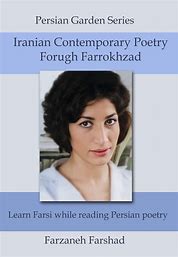
Darznik’s story is of a woman who acts like a free man, chooses her sexual partners, leaves her husband and only child, and seeks fame as a poet in a land renowned for poetry.
Like a man or any human being, Farrokhzad has sexual desires and ambitions to be something more than a footnote in history. Like husbands who leave their children through divorce or separation, Farrokhzad leaves her son. It is the same habit of many absent fathers who may love their children, but choose, like Farrokhzad, to pursue life beyond being a mother or father.
The world is beginning to understand women and men are 99.9 percent the same with fractional differences for conception, and strength.
The desire for sex, money, power and/or prestige are the same for all human beings. What is remarkable about Farrokhzad life is that she seems to have recognized that belief in one of the most patriarchal countries in the world. The way Farrokhzad lived her life, as reflected by the author, shows why men and women should be treated equally.
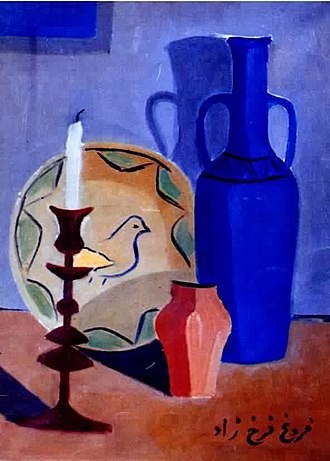
What is not mentioned in Darsnik’s novel is that Farrkhzad was also an artist.
This is a painting done by Farrokhzad despite her principal feminist reputation as a poet in the conservative culture of Iran in the 1950s.
The author’s story suggests Farrokhzad’s father commits her to an asylum after estrangement from her family and her rejection of female inequality. In the asylum, Farrokhzad is heavily sedated and subjected to shock treatments that make her catatonic. She is rescued with her father’s decision to allow her to leave the asylum in the care of a rich Iranian woman. This benefactress is a fellow traveler in Farrokhzad’s belief about women. Farrokhzad eventually recovers from her catatonia and continues her liberated life.
Though the dates Farrokhzad’s real life do not match historical events in Iran, Darznik captures the essence of a remarkable Iranian woman.

The shah of Iran, Mohammad Pahlavi is deposed in 1979. The author conflates the history of the oil industry’s unfair monopolization by Great Britain, the King’s departure and Farrokhzad’s storied life. She tragically dies in a car accident in 1967 at the age of 32. (Some suggest the car accident is suspicious.)
Darznik’s novel is a compelling argument for sexual equality. It is based on a woman who believed and acted on a conviction that men and women are created equal. The author’s story is particularly impactful because the woman she alludes to is born in a country that is among the most patriarchal in the world.









 REVIEWS AND VIEWS OF LIFE