RISE AND FALL

Audio-book Review
By Chet Yarbrough

(Blog:awalkingdelight)
Website: chetyarbrough.blog

Asabiyyah: What Ibn Khaldun, the Islamic Father of Social Science, Can Teach Us About the World Today

Written by: Ed West 

Narrated by:  P. J. Ochlan

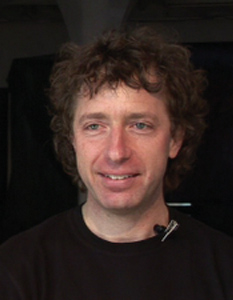
ED WEST (ENGLISH AUTHOR, JOURNALIST, BLOGGER)
ED WEST (ENGLISH AUTHOR, JOURNALIST, BLOGGER)

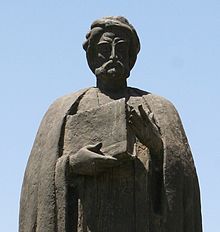
IBN KHALDUN (STATUARY SYMBOL OF ISLAMIC HISTORIAN BORN 1332, DIED 1406 AT 73 YEARS OF AGE.)

IBN KHALDUN (STATUARY SYMBOL OF ISLAMIC HISTORIAN BORN 1332, DIED 1406 AT 73 YEARS OF AGE.)

Ed West offers a brief introduction to the life of an ancient historian.  His name is Ibn Khaldun.  Khaldun describes the first known evolutionary theory of human origin.  West also notes this 14th century scholar creates the first known socio/political theory of the rise and fall of civilizations.

Khaldun explains life’s origin as a aggregation of chemicals and minerals that create organic life and, in turn, evolve into different species. 

DESCENT OF MAN

West notes that Khaldun suggests humankind evolved from monkeys. This is four centuries before Darwin’s “Origin of Species”.

Ibn Khaldun is considered by some to be the first person to write foundational theories for modern sociology, economics, and demography.  West notes that Khaldun explains how nations are formed, maintained, and destroyed by sociological, economic, and demographic forces.

Khaldun offers counsel to the great conqueror, Amir Timur (aka Tammerlane), who plans to resurrect the 13th century Mongol empire built by Genghis Khan.  
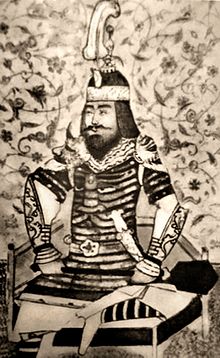
TIMUR (AKA TAMMERLANE, 1336-1405)

TIMUR AKA TAMMERLANE IS COUNCELED BY IBN KHALDUN  (1336-1405–(Timur is said to have caused the death of over 17 million people in the effort.)

West suggests that Khaldun explains how Timur and other rulers, from the Roman empire to Genghis Kahn to Timur successfully conquered great areas of the known world.  His explanation is “Asabiyyah” (aas-sah-bee-ah), a theory that all successful conquerors establish a social environment that creates solidarity among a group of people sharing understanding, purpose, and achievement.

West explains that Khaldun expands “Asabiyyah” to a theory of civilization’s rise and fall.  Humans proliferate based on family affiliations.  Religion widens family relationships to create tribes. Tribes become a congregation of different families with common beliefs.  Tribes come into conflict and eventual settlements that grow into larger groups based on evolved common beliefs. 

At each step of widening common interest, a leader rises from the ranks.  With an accretion of social ties, villages, towns, and cities are formed with a leader at its head.  As the ties that bind continue to expand, nation-states are formed.
RISE AND FALL OF CIVILIZATIONS

Ibn Khaldun’s explanation is “Asabiyyah”, a theory that all successful conquerors establish a social environment that creates solidarity among a group of people through shared understanding, purpose, and achievement.

West shows that Khaldun goes on to explain how civilizations decline. First, Khaldun notes that sons and daughters of great leaders rarely exceed their parent’s leadership success.  Khaldun posits the current social and scientific belief of “reversion to a mean”. 
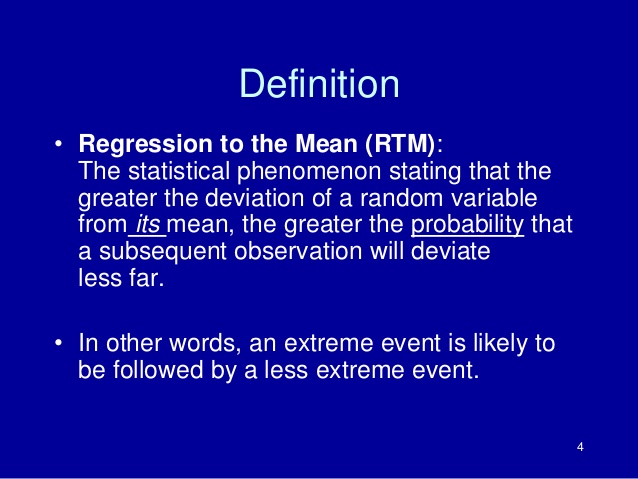
REVERSION TO THE MEAN

Each subsequent offspring of a great leader comes closer to the average of a civilization’s population.  Leadership diminishes in succeeding generations.

Second, Khaldun suggests diminished common beliefs lessen a civilization’s cohesion.  Religious differences rise, economic circumstances change, social groups fracture, family ties reassert themselves as ties that are more important than community.  The example that Khaldun gives is Rome’s decline as a world power. West suggests the same may be said of the United Kingdom’s decline.

AMERICAN DREAM

Has the American Dream become a lie few believe in?  Are elected officials withdrawing to their families at the expense of nation-state’ leadership?

West’s “Asabiyyah” makes one think of America.  Does today’s political conflict reflect diminishment of commonly held nation-state belief?  Is the increasing gap between rich and poor destroying the social fabric of America?  Is the divisiveness of former President Trump a reflection of a nation in decline?

Is nationalism dead, or are we crossing a threshold where the principals of nation-state need to be expanded to include a wider community?  Is the next step reflected by the E.U. or some similar congregation of nation-states?

EUROPEAN UNION

According to West, Khaldun believes nationalism is critically important for a civilization to remain strong.  In the time of Khaldun, there was no vehicle for common beliefs except a leader’s influence over conquered nations. 

Today, there is an internet.  It seems the human family may once again be expanded.  Nation-states may not be prepared for “space-ship-earth” but there may be an interim step.

That interim step was tried during the cold war with the U.S.S.R.  It failed.  The E.U. is facing challenges today.
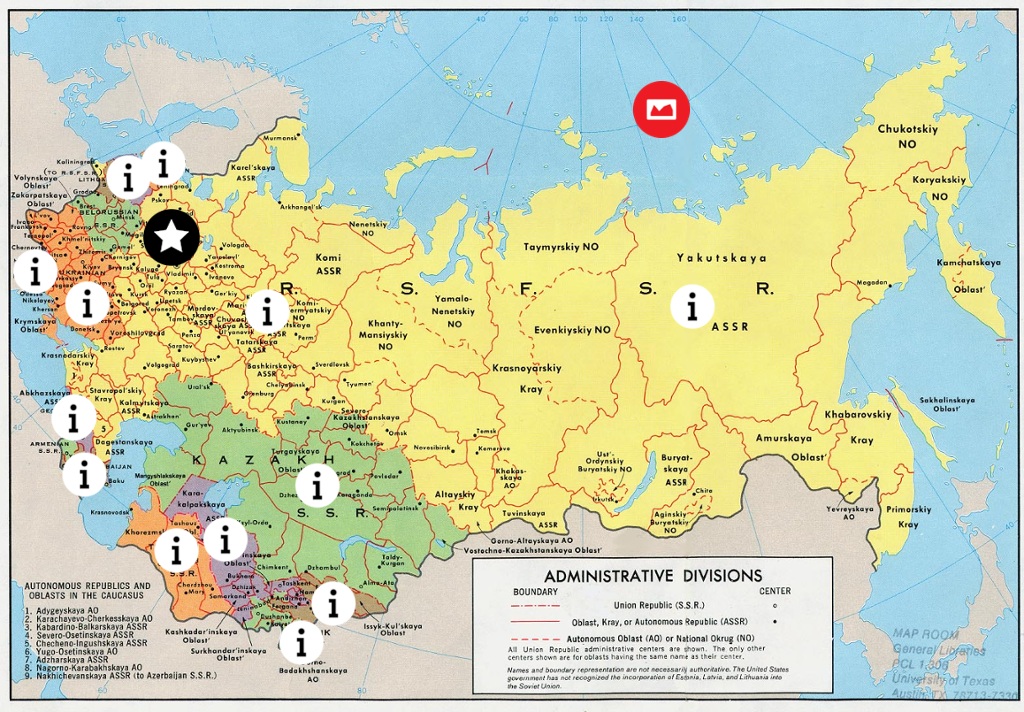
U.S.S.R. BREAK-UP

Trump’s America is regressing from comity to disparity with emphasis on making itself great again.  A leading question today is whether civilizations are competing to be in decline or ascendance?

Of course, leadership is key to any future.  Right now, there seem few leaders that can make civilizations grow beyond their borders. Khaldun seems as relevant today as he was in the 4th and early 5th centuries.

TOTALITARIANISM

Audio-book Review
By Chet Yarbrough

(Blog:awalkingdelight)
Website: chetyarbrough.blog

The Trial

By Franz Kafka, David Whiting (translator)

Narrated by Rupert Degas

FRANZ KAFKA (1883-1924, AUTHOR, NOVELIST)

FRANZ KAFKA (1883-1924, AUTHOR, NOVELIST)

“The Trial” is a Franz Kafka picture of hell; i.e. a totalitarian nightmare, ruled by bureaucracy and controlled through human despair. “The Trial” is a book to listen to because it mesmerizes when narrated by an artist but numbs when read by an undisciplined mind.

Imagine arbitrary arrests, undefined accusations, and undisclosed trials; i.e. trials operating in obscurity that secretly sentence the accused to mental purgatory or death; add shadows of human beings, dark rooms of judgment, stifling closeness, and oppressive anxiety.  This is Kafka’s world in “The Trial”.

There is no lightness in Kafka’s tale; no human redemption.  The main character, Ka (in this version of the book), is the only person that seems to seek self-understanding.  

All other characters are “other directed”, trying to be what someone else expects them to be by playing whatever role they need to play to survive.

BUREAUCRACY

Kafka imagines a country of directionless people, subsumed in a bureaucracy that feeds on itself.

This is a country of directionless people, subsumed in a bureaucracy that feeds on itself.  Citizens of this country are either a part of the bureaucracy or they are controlled by its administration. 

Control is exercised by creating fear and anxiety.  This characterization reminds one of Donald Trump and his current attempt to overthrow over 200 years of American government history.

Trump’s tacit support by the Republican party is a crime against democracy. Patriotic Republicans are diminished by Trump’s abhorrent behavior.

Should Trump be impeached a second time? It’s complicated. On the one hand, incitement by Trump on January 6th is obvious to most Democrats. On the other, Republicans now represent 70,000,000 Americans who think Trump is good for America.

There is no societal objective; there is only bureaucracy’s perpetuation.  Lawyers, bankers, judges, business moguls, landlords, artists, servers and assistants of this society, though rarely singled out for terror or torture, are consumed with anxiety from an ever-present threat of arrest.  The working public enriches itself by taking bribes to subvert bureaucratic action.  The working public’s subversion is not destruction of the bureaucracy but a tacit acceptance of its hegemony.

Ka attempts to break the cycle of bureaucracy’s self-perpetuation.  His attempt fails.

The redeeming quality of Kafka’s story is the human desire for freedom that is not extinguished even in the darkest times of a country’s repression.  Against all obstacles, Ka insists on freedom.  In Ka’s case freedom means death just as it did for many who died in Auschwitz, Dachau, and Treblinka.

FRANZ KAFKA QUOTE

Kafka’s hell exists in today’s world just as it did when it was published in 1925.

KNOWING NOTHING

Audio-book Review
By Chet Yarbrough

(Blog:awalkingdelight)
Website: chetyarbrough.blog

Thinking Fast and Slowthinking fast and slow

By Daniel Kahneman

Narrated by Patrick Egan

DANIEL KAHNEMAN
Author, Daniel Kahneman, is a renowned psychologist and noble laureate.

There are certain knowns that are known and certain knowns that are unknown.  Well, I know I know nothing and Kahneman seems to prove it.  Every chapter of Kahneman’s book suggests something one finds hard to believe is true.

Daniel Kahneman is a renowned psychologist and Nobel laureate.  He is an American citizen that served in the Israeli military and used his education, research, and experience to write “Thinking Fast and Slow”.  His observations explore many aspects of human decision-making.

How one runs their business or lives their life is framed by how they think.  Kahneman explores two fundamental ways of thinking that reveal human strengths and weaknesses.  “Thinking Fast…” is intuitive and easy.  It is prejudiced by personal life experience and education.  It is activated through an evolved instinct that forms the basis for snap decisions.  In contrast, “…Thinking Slow” is a deliberative, calculating, and mind-numbing way of making rational decisions.  Kahneman calls these mental functions System 1 and System 2 respectively.

THINKING SLOW
“…Thinking Slow” is undoubtedly prejudiced by Kahneman’s scientific interpretation of “human thought and action”’ but judgment of his observations is the responsibility of the reader or listener; so, caveat emptor.

“…Thinking Slow” is undoubtedly prejudiced by Kahneman’s scientific interpretation of “human thought and action”’ but judgment of his observations is the responsibility of the reader or listener; so, caveat emptor.

The more common decision-making tendency of the brain is to use System 1 rather than System 2 when making decisions because it is easier and because, as Kahneman notes, behavioral studies and brain imaging show human brains are lazy (not inclined to use System 2’ thinking because it is more laborious than System 1).

System 1 often leads humans to make incorrect intuitive decisions.  System 2 potentially improves probability of making better, or at least more rational, decisions.  However, System 1 is important to life and death decisions that require instantaneous action.  System 2 requires one to consider options before settling on an action.  A current example is the dilemma of choice in regard to social media.  Fighting hardly seems logical based on the direction of technology.  Flight seems equally illogical for the same reason.

FIGHT, FLIGHT, LIGHT
System 1 is important to life and death decisions that require instantaneous action.  System 2 requires one to consider options before settling on an action.

FIREMAN NARROWLY ESACAPES FLOOR COLLAPSE
FIREMAN NARROWLY ESCAPES FLOOR COLLAPSE  ( Using System 1 thinking the fire commander tells his team to get out of a burning house because his mind subconsciously gathers experiential information telling him the floor is about to collapse.)

Kahneman gives a more concrete example with an experienced fire commander.  Using System 1 thinking the fire commander tells his team to get out of a burning house because his mind subconsciously gathers experiential information telling him the floor is about to collapse.  The fire commander’s system 1 thinking saved his team’s lives.

Kahneman contrasts the value of System 2 thinking by exploring System 1’s habit of unconsciously bench-marking manufactured product pricing to seduce consumers to buy at higher prices; i.e. if a product is priced high, System 1 thinking is willing to pay a higher price.

Attention
The “halo” effect caused by System 1’ thinking gives too much weight to a one time “good” interview evaluation of an employee candidate.

Another observation is that employee interviews are often detrimental to the selection of the best job candidate.  Kahneman describes the “halo” effect caused by System 1’ thinking that gives too much weight to a one time “good” interview evaluation of an employee candidate.  To protect from the “halo” effect, Kahneman suggests that interview questions be structured and an employment process be standardized to give more objective criteria for choosing the best employment candidate.  In other words, design an employee selection process based on clearly defined job requirements that are equally measured and fairly weighted for each candidate.  Employer hiring solely based on a candidate’s interview is not a good determinant of employee performance.

This brief review is a single drip of sweat in a twenty hour work out.  Kahneman undoubtedly exaggerates the import of some scientific studies but his writing engages System 2 thinking.  A System 2 person will want to listen to “Thinking Fast and Slow” more than once.

INDICTMENT

Audio-book Review
By Chet Yarbrough

(Blog:awalkingdelight)
Website: chetyarbrough.blog

Tears We Cannot Stop-A Sermon to White America

Written by: Michael Eric Dyson

Narrated by:  Michael Eric Dyson

MICHAEL ERIC DYSON (AUTHOR, BAPTIST MINISTER, PROFESSOR OF SOCIOLOGY AT GEORGETOWN UNIVERSITY)

MICHAEL ERIC DYSON (AUTHOR, BAPTIST MINISTER, PROFESSOR OF SOCIOLOGY AT GEORGETOWN UNIVERSITY)

Michael Eric Dyson is a graduate of Princeton who teaches at Georgetown University.  “Tears We Cannot Stop” is an indictment of white America.  The indictment accuses white Americans of serious crimes stemming from today’s bigotry, neglect, permanent injury, and murder of black Americans. 

Examples of police violence against black Americans, a history of ethnic isolation, forced conformity and denied equal opportunity strongly support Dyson’s accusation.

Each accusation and the evidence gathered by Dyson confront the conscience of every white American.  What he writes rings of truth.  The more Dyson explains, the greater is white America’s guilt.  It is a message missed by white Americans because they do not live the life of black Americans.  White privilege is taken for granted in America because money, power, and prestige are held by mostly white American males.

RODNEY KING (APPEARANCE 3 DAYS AFTER BEATING 3.6.92--KING DIES IN JUNE 2012 @ 47 YEARS OF AGE)

RODNEY KING (APPEARANCE 3 DAYS AFTER BEATING 3.6.92–KING DIES IN JUNE 2012 @ 47 YEARS OF AGE)

The institutionalization of racism makes black Americans afraid.  Out of that fear comes distrust, anger, apathy, and isolation.  Black mothers and fathers fear for their children whenever they leave home.  Regardless of education, fame, or fortune, Dyson notes an honest and law-abiding black American is subject to a different set of social rules.  From birth, black Americans are told by their parents not to disagree with police for fear of being beaten, arrested or shot.

Truth does not matter in a black person’s response to accusation.  Most black Americans live with fear; most white Americans do not.  When stopped by the police, a black American thinks–what can I do; where can I go; what can I say; who can I trust other than myself and my race?   When unjustly accused, black Americans have limited recourse.  Those limits are tinged with frustration, and/or anger.  No wonder some feel disrespected and alone in America.

RUDY GIULIANI (FORMER MAYOR OF NEW YORK CITY)

RUDY GUILIANY (FORMER MAYOR OF NEW YORK CITY) Dyson attacks pundits who suggest black Americans are their own worst enemy.  The white pundit’s argument is they kill each other.  The argument ignores two monumental facts.  One, the toll that poverty and unemployment play in poor communities; and the truth that whites murder whites nearly as often as blacks kill blacks.

Dyson attacks pundits who suggest black Americans are their own worst enemy.  Some white pundit’s argue blacks  kill each other more than whites kill blacks.  The argument ignores two monumental facts.  One, the toll that poverty and unemployment play in poor communities; and two, the truth that whites murder whites nearly as often as blacks kill blacks.

The real difference between black and white victimization is whites have more opportunity in America.  White, mostly male, Americans write the history of America and create the rules for “democratic” governance. 

Dyson encourages white Americans to become more involved with black Americans.  The social disconnect between races promotes ignorance of common goals and aspirations.  Who does not want to live in peace, provide for themselves and their families, raise their children to be better off than themselves?  Part of the difficulty is that there is little trust between black and white Americans as is noted in the following social experiment.

Leaders in America, consciously or subconsciously, treat non-white Americans as “others”.  When humans treat someone as an “other”, they become less human.  Minorities and other nation’s populations become “gooks”, “spics”, “towel heads”, “niggers”; i.e. something identified as less than human.  This human categorization institutionalizes discrimination.  It leads to this American dilemma and to world wars. 

Leaders of America, who are mostly white males, ignore the plight of black Americans.  One wonders how many white Americans thank their God for not being born black.  That is Dyson’s reason for concluding black Americans shed “Tears We Cannot Stop”.

Psychological Unease

Audio-book Review
By Chet Yarbrough

(Blog:awalkingdelight)
Website: chetyarbrough.blog

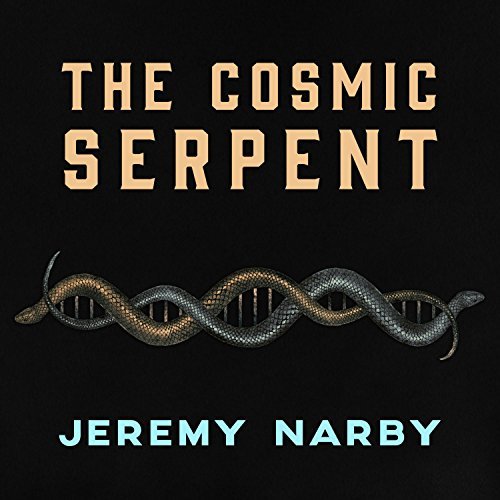
The Cosmic SerpentTHE COSMIC SERPENT

Written by: Jeremy Narby

Narration by:  James Patrick Cronin

JEREMY NARBY (AUTHOR, PHD ANTHROPOLOGY FROM STANFORD)
JEREMY NARBY (AUTHOR, PhD ANTHROPOLOGY FROM STANFORD)

Psychological unease accompanies Jeremy Narby’s erudite speculation about the meaning and origin of life in “The Cosmic Serpent”.  The unease comes in two forms.  One, is Narby’s seduction by hallucinatory experience.  Young people in America are choosing to overdose rather than face today’s perceived reality.  The other is Narby’s patterning of observations to create either a true or false belief.  It reminds one of the potential of Einstein’s discovery of matter and energy equivalence.  Einstein discovered falsifiable evidence of nuclear fission that holds a key to sustainable energy.  He also opened the door to Armageddon.

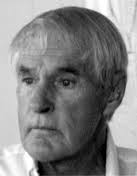
TIMOTHY LEARY (1920-1996)

Narby, like Timothy Leary, is educated at some of the best universities in the world (Leary at Harvard; Narby at Yale).  Both have PhDs. Narby has a PhD in anthropology; Leary in Psychology.  Few, if any, believe LSD (Leary’s hallucinatory drug of choice) offers insight to the origin and meaning of life. However, like Leary, Narby suggests hallucinatory drugs may be a pathway to understanding.

Regarding hallucinatory experience, Narby does not appear to have slipped into the bizarre behavior of a Timothy Leary; at least not yet. Narby is 59 years old.  When Narby did his research, he was in his late 20s and early 30s.  “The Cosmic Serpent is published when Narby is still in his 30s.  Leary lived to be 76.  Each passing year exaggerated Leary’s belief in the therapeutic potential of psychedelic drugs.

MIND PATTERNINGPatterning is the human ability to see structure in disparate facts and events.  Some say this is the sign of genius.  Einstein is said to have formulated a theory of time by riding a train.  Einstein’s insight came from thinking (patterning) how time is relative based on a person riding a train and a stationary observer watching the train pass.  However, patterning also leads to incorrect conclusions like a person’s recollection of a crime.  Human brains are shown to manufacture events and facts to make stories complete rather than necessarily accurate.
SHAMANISM
SHAMANISM – Narby’s articulate presentation of Peruvian shamanism tempts seekers of knowledge and experience to try something new.

Narby’s articulate presentation of Peruvian shamanism tempts seekers of knowledge and experience to try something new.  The temptation comes from different sources.  One is genuine interest in understanding more about the world and our place and purpose in it.  Another is the desire to believe that there is something more important in life than wealth, power, or position.

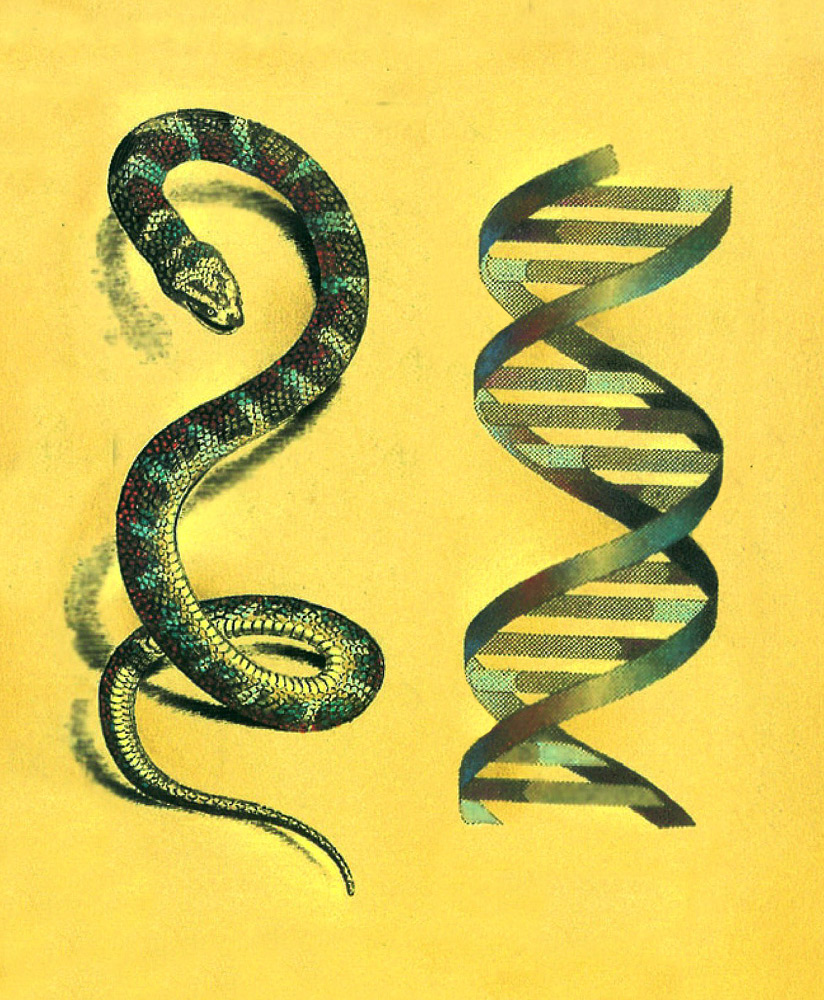
“The Cosmic Serpent” suggests that native cultures around the world offer insight to the origin and meaning of life because of common hallucinatory experiences.  Narby suggests the hallucinatory symbol of a winding serpent is evidence of the configuration and importance of DNA; long before Watson’s and Crick’s discovery.  The inference is that shamanistic hallucinations are not mere symbols but a truth of life.  Narby’s inference is that seekers of life’s truth should listen to the experience of shamans and pursue shamanistic experience through the studied use of their methods.

SNAKE-DNA IMAGE
Narby suggests the hallucinatory symbol of a winding serpent is evidence of the configuration and importance of DNA; long before Watson’s and Crick’s discovery.

Narby argues that the scientific community needs to widen its view of the world. He believes DNA holds the secrets of nature’s existence.  The question is whether youth and science should accept the risk of Narby’s patterned belief?

At the least, Narby makes one appreciate the importance of native culture.  He may be opening a worthy field of scientific research.  On the other hand, Narby may be creating false expectations that offer ignorance and escapism, rather than research and science.

TRAUMA’S EFFECTS

Audio-book Review
By Chet Yarbrough

(Blog:awalkingdelight)
Website: chetyarbrough.blog

The Body Keeps the Score: Brain, Mind, and Body in the Healing of TraumaThe Body Keeps the Score

Written by: Bessel van der Kolk, MD

Narration by:  Sean Pratt

BESSEL van der KOLK (DUTCH PSYCHIATRIST, SPECIALIZING IN ATTACHMENT, NEROBIOLOGY, AND DEVLOPMENTAL ASPECTS OF TRAUMA'S EFFECTS ON PEOPLE)

BESSEL van der KOLK (DUTCH PSYCHIATRIST, SPECIALIZING IN ATTACHMENT, NEROBIOLOGY, AND DEVLOPMENTAL ASPECTS OF TRAUMA’S EFFECTS ON PEOPLE)

Dr. Bessel van der Kolk argues that trauma has a neurological connection between mind, body, and time.   Kolk offers numerous examples of patients who suffer from the trauma of war, rape, accident, and childhood experience to support a belief that “The Body Keeps the Score” and human consciousness pays the price.

In a limited sense, Kolk’s argument is convincing.  The limited sense is in one’s definition of trauma.  Trauma that clinically demonstrates disconnection between mind, body, and time, as proposed by Kolk, is a credible argument.  However, Steven Pinker suggests a part of Kolk’s argument seems overdrawn.  Steven Pinker is an American psychologist, cognitive scientist, and linguist.  He is a Professor in the Department of Psychology at Harvard University.

Steven Pinker
Steven Pinker is an American psychologist, cognitive scientist, and linguist.  He is a Professor in the Department of Psychology at Harvard University.

Pinker argues that human beings become who they are from genetics and life experience, largely exclusive of parenting.  In contrast, Kolk suggests parenting plays a significant role in a child’s consciousness as a mature adult.  Kolk argues that the trauma of parental abuse, neglect, and egoistic child’ indulgence form mind-body-time’ disconnects that profoundly affect mature adults.  Kolk’s parenting arguments fly in the face of studies cited by Pinker that suggest less than one percent of a parent’s upbringing makes a difference in a child’s adulthood.

This may be a distinction without a difference if one accepts Kolk’s references to experience and sociological studies that show juvenile delinquency is credibly correlated with childhood trauma from incest, neglect of basic human needs like food or water, or hyper-vigilant (smothering) parental attention to children who sometimes just want to be left alone.  Presumably, children in that type of hostile environment do not represent the general population.

PTSD
Modern acceptance of PTSD in veterans of combat reinforces Kolk’s argument.  The generally accepted definition of PTSD by the American Psychological Association “…is an anxiety problem that develops in some people after extremely traumatic events, such as combat, crime, an accident or natural disaster.”

What Kolk argues is that trauma often becomes an imprinted mind /body’ experience that disconnects from time.  Modern acceptance of PTSD in veterans of combat offers evidence for Kolk’s argument.  The generally accepted definition of PTSD by the American Psychological Association “…is an anxiety problem that develops in some people after extremely traumatic events, such as combat, crime, an accident or natural disaster.”

This broad definition is expanded by Kolk in two significant ways.  One, those suffering from PTSD are riven with anxiety by a trauma that is stuck in time, i.e., time that stands still.  Kolk explains that a PTSD sufferer recalls a past trauma as though it is happening now, and his/her body reacts in the same way it did when the trauma first occurred.  The body’s chemical and hormonal reaction is the same as though the past trauma is happening now.

CHILD SOLDIERS OF MEXICO'S DRUG GANGS
CHILD SOLDIERS OF MEXICO’S DRUG GANGS (Kolk’s second significant expansion is belief that children experience the equivalent of PTSD from parents’ psychological and physical abuse during their children’s childhood.)

Kolk’s second significant expansion is belief that children experience the equivalent of PTSD from parents’ psychological and physical abuse during their children’s childhood.  A child’s chemical and hormonal response to recalled childhood trauma repeats itself.  In some, time stands still when trauma is recalled, and the body repeats its physiological response.  However, evidence is more anecdotal than scientifically measurable.

MASS MURDERERS
MASS MURDERERS-Psychiatric interviews rely on patients’ remembrance of things past which are historically unreliable.  Sociological surveys cannot be done without the bias of a person or group that designs the questions that are to be asked of the person that answers the survey.

Kolk infers that the psychological maladies of adults can be significantly reduced by better parenting.  The difficulty one has in accepting this argument is that documentary proof is in anecdotal evidence from psychiatrist interviews of patients and sociological surveys of defined populations, both of which are inherently biased.  Psychiatric interviews rely on patients’ remembrance of things past which are historically unreliable.  Sociological surveys cannot be done without the bias of a person or group that designs the questions that are to be asked of the person that answers the survey.

CHILD ABUSE STATISTICS

Kolk may be correct but there is enough reservation in the Psychiatric community to deny Kolk’s request for a psychiatric diagnosis of Developmental Trauma Disorder for children. 

This is a frustrating issue because there are unquestionably millions of children that are abused and neglected in the world.  These children are often not treated for their psychological problems because insurance is not available for un-diagnosed patients.  If Kolk is correct, a diagnosis would be a first step in developing a course of medical treatment that is at least partially covered by insurance.

There is also the tangential argument made by psychologists like Steven Pinker that do not believe parenting has much to do with how children grow into adults.  Nevertheless, one’s heart goes out to those children that are abused by their parents or are deprived of the basic needs of life.