PRACTICAL PHYSICS

Audio-book Review
By Chet Yarbrough

(Blog:awalkingdelight)
Website: chetyarbrough.blog

Physics for Future Presidents: The Science Behind the Headlines

PHYSICS FOR FUTURE PRESIDENTS

4 Star Symbol

By Richard A. Muller

Narrated by Peter Larkin

RICHARD A. MULLER (PROFESSOR OF PHYSICS @ UNIVERSITY OF CALIFNIA, BERKELEY)
RICHARD A. MULLER (PROFESSOR OF PHYSICS @ UNIVERSITY OF CALIFORNIA, BERKELEY)

“Physics for Future Presidents” suggests understanding of practical physics is critical for future Presidents.  Richard Muller’s argument is that Presidents need to know some physics to comprehend the utility of everything from energy, to manned space flight, to satellite surveillance, to terrorist use of nuclear bombs.  Muller is not arguing that future Presidents need to understand the science of physics but the practical limitations of manned space flight, carbon-based energy, satellite intelligence, and weapons of mass destruction (WMD).

Muller begins his book with the modern world’s effort to understand and contain terrorism.  Muller’s book seems apropos based on President Trump’s effort to limit science research, discount CIA and FBI intelligence, and denuclearize North Korea.

TRUMP AND KIM MEETING
President Trump’s effort to limit science research, discount CIA and FBI intelligence, and denuclearize North Korea.

Muller explores the possibility of a terrorist organization building a nuclear bomb and detonating it in the middle of an American City.  He looks at the possibility from three perspectives.  One, difficulty in acquiring fissionable material; two, difficulty of building a nuclear device and three, difficulty in delivering a weapon of mass destruction to a desired location.

Surprisingly, Miller suggests a greater danger is terrorist attack by private planes, loaded with highly flammable fuel.  Or, for a terrorist organization to use chemical and biological agents that directly or indirectly infect population centers.

CHEMICAL ATTACKS
Surprisingly, Miller suggests a greater danger is terrorist attack by private planes, loaded with highly flammable fuel.  Or, for a terrorist organization to use chemical and/or biological agents that directly or indirectly infect population centers.
9.11.01TRADE CENTER ATTACK
Muller reasons a future terrorist attack (with 1000s killed) will be like 9/11, but with a private plane filled with fuel (not a nuclear bomb) flown into a major entertainment event.

Miller believes practical physics will determine the next world terrorist attack.  Miller argues that the simplest plan will have the greatest impact.  (Of course, there is also the implied psychology of terrorism.)  Muller reasons a future terrorist attack (with 1000s killed) will be like 9/11, but with a private plane filled with fuel (not a nuclear bomb) flown into a major entertainment event.

There are a number of counter-intuitive insights in “Physics for Future Presidents”.  Muller believes manned space flight is a waste of money.  He argues that most of the greatest innovations in science have come from unmanned space flight.  Weather satellites, spy satellites, entertainment satellites, global positioning satellites, drones, exploration of planets and the solar system have all come from unmanned space flight.  Muller believes there is a time for manned space flight but not now.  It is too dangerous and produces little new-science.  He implies America should primarily invest in unmanned space flight.

CURIOSITY--FIRST -SELFIE- IN 2015 ON MARS
CURIOSITY–FIRST -SELFIE- IN 2015 ON MARS (Muller believes there is a time for manned space flight but not now.  It is too dangerous and produces little new-science.  He implies America should primarily invest in unmanned space flight.)
DR. STRANGLOVE
Dr. Strangelove- Richard Muller, at times, seems to stand at the side of fictional character Dr. Strangelove.(Movie titled “How I Learned to Stop Worrying and Love the Bomb)

Richard Muller, at times, seems to stand at the side of fictional character Dr. Strangelove.  He describes historical information about radiation poisoning from nuclear bombs and accidents.  Muller notes that statistical deaths from war (the Nagasaki and Hiroshima bombing), Three Mile Island, and Chernobyl show that deaths from nuclear radiation is small in comparison to terrorist events initiated by simple, practical, and conventional physics.

Muller argues that nuclear power can be used as a fail-safe source of energy by using the latest technology for nuclear power plants.  The latest technology (actually first used in the 1960s by Germany) is a pebble bed reactor (PBR).  It is considered safe because it does not rely on water cooling of the nuclear core in the event of an accident.

PEBBLE BED REACTOR IN WEST GERMANY
PEBBLE BED REACTOR IN WEST GERMANY – Muller argues that nuclear power can be used as a fail-safe source of energy by using the latest technology for nuclear power plants.  The latest technology (actually first used in the 1960s by Germany) is a pebble bed reactor (PBR).  It is considered safe because it does not rely on water cooling of the nuclear core in the event of an accident.
YUCCA MOUNTAIN NUCLEAR WASTE DEPOSITORY NEAR LAS VEGAS, NEVADA
YUCCA MOUNTAIN NUCLEAR WASTE DEPOSITORY NEAR LAS VEGAS, NEVADA (Richard Muller believes Yucca Mountain is an adequately safe repository for nuclear waste that should be reopened.)

This is unlikely to be a popular book in Las Vegas, Nevada. Among other controversial subjects, Richard Muller believes Yucca Mountain is an adequately safe repository for nuclear waste that should be reopened.  His argument largely rests on the science of probability.  Muller infers that natural radiation in Colorado is as toxic as the probability of radiation leaks from stored nuclear waste at Yucca Mountain.
Muller argues that revision of nuclear construction standards in the United States would make construction of pebble bed reactors less expensive than conventional American nuclear facilities.  The added benefit is a safer energy source that reduces the need for carbon based energy supplies that increase global warming.  A large part of Muller’s argument for the use of more nuclear power is based on the generally accepted scientific belief that global warming exists and is most likely caused by human activity.

GLOBAL WARMING
A large part of Muller’s argument for the use of more nuclear power is based on the generally accepted scientific belief that global warming exists and is most likely caused by human activity.

Muller spends a great deal of time explaining that global warming is not a 100% certainty but, in probability terms, is highly likely and largely related to carbon-based energy use.  He notes that use of carbon-based energy is likely to increase with China and India’s continued economic growth.  Muller creates a sense of urgency in creating other sources of energy.  He strongly urges increasing motor vehicle mileage requirements but questions the viability of battery operated vehicles.  Muller believes the costs of battery replacement will drive consumers back to carbon-based energy models.

ELON MUSK ROLLS THE DICE AGAIN BY PURCHASING SOLAR CITY, THE LARGEST SOLAR CONVERSION COMPANY IN THE U.S.
ELON MUSK ROLLS THE DICE AGAIN BY PURCHASING SOLAR CITY, THE LARGEST SOLAR CONVERSION COMPANY IN THE U.S.–Muller sees potential in solar and wind energy production but believes conservation will do more short-term good than any new source of energy.

Muller sees potential in solar and wind energy production but believes conservation will do more short-term good than any new source of energy.  He clearly sees that the cost of energy is the primary driver of technological innovation.  As long as oil and coal are less expensive than other sources of energy, they will remain the primary source of power.  With that realization, Muller insists on technological innovation in conservation because it motivates the consumer to become a part of the energy-crises’.  Consumer’ participation is guaranteed by savings received from use of more energy-efficient devices.

The key to the world’s future is energy.  Muller believes the short-term solution is conservation.  He believes long-term solution revolves around nuclear fission and fusion.  Fusion is a longer term prospect but offers an infinite source of energy.  Fission is shown to work now, with probabilities of failure that can be improved upon.

This circles back to the critical importance of storing nuclear waste.  Muller notes that the fragmented system of nuclear storage in the United States is a bigger risk to the environment than having it located in a limited number of specifically designed storage locations.  Yucca Mountain fits Muller’s criteria for safe storage of nuclear waste.  He acknowledges that nuclear accidents may occur but the probability of an accident at Yucca Mountain is less than the probability of accident at other relatively unsecured and fragmented sites.

PROBABILITYThe physics that Muller insists Presidents must understand is that scientific proof is a matter of probability; not absolute certainty.  Muller warns Presidents to not be misled by cherry-picking fact finders that have objectives that are not related to practical physics.  Even if there is no certainty in science, knowing probabilities offer a basis for informed decision.


TODAY’S LUDDITES

Audio-book Review
By Chet Yarbrough

(Blog:awalkingdelight)
Website: chetyarbrough.blog

The Glass Cage-Automation and Us

By: Nicholas Carr

Narrated by: Jeff Cummings

NICHOLAS G. CARR (AMERICAN WRITER-FORMER EDITOR OF HARVARD BUISNESS REVIEW)

NICHOLAS G. CARR (AMERICAN WRITER-FORMER EDITOR OF HARVARD BUSINESS REVIEW)

The Glass Cage, written by Harvard alumnus Nicholas Carr, ironically places him in the shoes of an uneducated English textile artisan of the 19th century, known as a Luddite.

Luddites protested against the industrial revolution because machines were replacing jobs formerly done by laborers.  Just as the Luddites fomented arguments against mechanization, Carr argues automation creates unemployment and diminishes craftsmanship.

WORKMEN TAKE OUT THEIR ANGER ON MACHINES DURING THE INDUSTRIAL REVOLUTION. (Just as the Luddites fomented arguments against mechanization, Carr argues automation creates unemployment and diminishes craftsmanship.)

Workmen take out their anger on the machines

Carr carries the Luddite argument a step further by inferring a mind’s full potential may only be achieved through a conjunction of mental and physical labor.  Carr posits the loss of physical ability to make and do things diminishes civilization by making humans too dependent on automation.

There is no question that employment was lost in the industrial revolution; just as it is in the automation age, but jobs have been and will continue to be created as the world adjusts to this new stage of productivity.

INDUSTRIAL REVOLUTION

Unquestionably, the advent of automation is traumatic but elimination of repetitive industrial labor by automation is as much a benefit to civilization as the industrial revolution was to low wage workers spinning textile.

The Covid19 pandemic of 2020 will accelerate world’ transition to automation. Though this book is written earlier than the pandemic’s economic consequence, corporations are reevaluating the necessity for office buildings to conduct their business. More and more employees will work from home.

Employment adjustment is traumatic.  The trauma of this age is that work with one’s hands is being replaced by work with one’s brain.  The education of the world needs to catch up with socio-economic change; just as labor did in the 20th century.  To suggest humans do not learn when they cannot fly a plane, build a house, or construct an automobile with their own hands is a specious argument. 

Houses and cars have not been built by one person since humans lived in caves and iron horses replaced carriage horses.  Houses and cars were built by teams of people who worked with their hands but only on specific tasks.  Those teams of people were managed by knowledge workers.

ASSEMBLY LINE WORK

Service and education for society are the keys to the transition from industrialization to automation.

QUANTS

Automation of tasks reduces the mind numbing, low pay work of laborers.  Automation turns manual labor into the development and education of people who design hardware and software to execute tasks that result in more safely flown planes, new houses, new cars, new refrigerators, so on and so on.

Carr suggests that airplane pilots should be given more control over automated planes they fly despite the facts he quotes that clearly show plane crashes kill fewer people today than ever in history.  They are bigger, faster, and more complicated to fly.  The argument that pilots need to learn how to fly a jumbo jet when automation fails is like telling a farmer to pull out his scythe to harvest the wheat because the thresher quit working.

Carr’s argument is that pilots have forgotten how to fly because automation replaced their skill set.  To state the obvious, planes are not what they were 100 or even 10 years ago.

WRIGHT UNPOWERED AIRCRAFT

One might argue that Boeing’s 737 Max mistakes are evidence that Carr is correct in suggesting planes have become too complicated, but it ignores the reality of mistakes have always being made by humans. Humans are preternaturally motivated by self-interest.

Boeing’s leaders made mistakes in not fully analyzing and disclosing risks of 737 changes, and in not adequately training airline pilots on the safety features of the plane.

Carr raises a morality argument for not saving life when an automated machine makes a decision rather than a human being.  One can suggest an example of how an automated machine is more likely to make the right decision than a human.

For example, presume a driver-less car is programmed to save its occupant when an injured bicyclist is laying in the street around a blind curve. A fast moving automated car with a family inside, with mountain cliffs on both sides of the road, will drive over the bicyclist without conscience.  The bicyclist is dead but the car passengers are alive.   If the car is driven by a person, both the cyclist and the family are likely dead. 

THINKING SLOW
Carr’s argument is that humans need to make their own intuitive decisions.  As pointed out by Daniel Kahneman in “Thinking Fast and Slow”, the primary “think fast” mode in humans is intuition, which is often wrong.
Without doubt, many automation errors (e.g., the 737 Max) have been and will be made in the future, but to suggest automation is not good for society is as false as the Luddites arguments about industrialization.

This period of the world’s adjustment is horrendously disruptive.  It is personal to every parent or person that cannot feed, clothe, and house their family or themselves because they have no job.

Decrying the advance of automation is not the answer.  Making the right political decisions about how to help people make job transitions is what will advance civilization.

MAR’S ROVER

Audio-book Review
By Chet Yarbrough

(Blog:awalkingdelight)
Website: chetyarbrough.blog

Mars Rover Curiosity: An Inside Account from Curiosity’s Chief Engineer

Written by: Rob Manning, William L. Simon

Narrated by:  Bronson Pinchot

This antenna-tailed super dog, and a Rover named Opportunity, are in the news this month.  After analysis of elemental particles by Curiosity, organic molecules are discovered.  An astro-biologist at Utrecht University in the Netherlands suggests life may have existed or originated on Mars.

Curiosity is a mechanical, one-eyed, six wheeled, antenna-tailed super dog.  It can stiff the air, drill rocks, analyze elemental particles, roam a countryside at a snail’s pace (300 feet per hour), and talk to humans.  Its language is in 1s and 0s.  It speaks to Earth from Mars across 49 million miles of space with a message that continues to amaze and encourage human exploration of the universe.

Curiosity Rover Animation:

Sadly, it was reported on February 13, 2019–that an earlier Mars Rover died. It was called Opportunity. Curiosity, according to a “Life Science” article, cannot repair Opportunity because of time and distance.


A slightly earlier Mars Rover called Sprit, a twin of Opportunity, died on March 20, 2010.

However, like the movie musical “Don’t Cry for Me Argentina”, we should not mourn their loss. Both of these earlier rovers outlast their expected lives. In addition to “Curiosity”, more is yet to come. On this Thursday, 2.19.2021 @ 3:55 pm EST, a new rover named “Perseverance” is scheduled to land in the Jerzero Crater of Mars.

PLANETS AROUND OUR SUN

Robert Manning, in collaboration with William Simon (a ghost writer), reflects on the technological feat of creating and delivering a robotic laboratory to the fourth rock from the sun.

Curiosity launched on November 26, 2011 to arrive on Mars August 6, 2012.  It landed on the Aeolis Palus plain, a crater that may be an ancient lake bed.  Robert Manning, in collaboration with William Simon (a ghost writer), reflects on the technological feat of creating and delivering a robotic laboratory to the fourth rock from the sun.  Manning heads a team of NASA scientists and engineers to design the latest land rover, called Curiosity, to explore Mars.

The first 12 months of Curiosity’s First Year on Mars:

In June 2018, Curiosity continues to explore Mars and deliver information on the history of earth’s mysterious neighbor.

What Curiosity is Discovering:

Curiosity is meant to search for artifacts of life on Mars while testing the potential for colonization of another planet.  To date, no definitive answers are given but Manning’s story suggests most of the building blocks of life were at one time present on Mars.  Now, it appears Manning’s story is tentatively confirmed.

Life on Mars?:

The primary atmospheric conditions of Mars are made of carbon dioxide and some water vapor as opposed to nitrogen, oxygen, argon, and other elements of earth.  The average temperature on Mars is 81 degrees Fahrenheit versus 57 degrees on Earth (a misleading metric because of the huge extremes on Mars).  Mars gravity is only .375 that of Earth which has significant ramification for sustainability of human life on the planet.

No indisputable historical evidence of life on Mars has been discovered but the existence of fluctuating amounts of methane in the atmosphere may mean Mars is geologically active and holds the potential for microscopic life.  Methane contains hydrogen and carbon but, with little discovered oxygen, there is limited chance of any life form representative of earth; at least, that is larger than a microbe.

mar's landing sites

“Mars Rover Curiosity” and “Perseverance” are a tribute to NASA and its organizational skill in achieving a land mark experiment in human exploration.  In listening to Manning’s story, one feels they are on the edge of a continent in the 15th century, planning to sail to an unexplored place to find answers about what there is beyond imagination.

“Mars Rover Curiosity” is a tribute to NASA and its organizational skill in achieving a land mark experiment in human exploration.  In listening to Manning’s story, one feels they are on the edge of a continent in the 15th century, planning to sail to an unexplored place to find answers about what there is beyond imagination.  NASA’s contribution to science and a possible future for humanity seems inferred by Manning’s story; particularly in light of current scientific evidence for Earth’s global warming.

Curiosity’s exploration (though only a mechanical creation of NASA) reminds one of Marco Polo, Vasco da Gama, Christopher Columbus, Magellan, Cortes, and Neil Armstrong in their discovery of new continents.

WAR’S HARD PART

Audio-book Review
By Chet Yarbrough

(Blog:awalkingdelight)
Website: chetyarbrough.blog

Fives and Twenty-Fives Fives and Twenty-Fives

Written by: Michael Pitre

Narration by:  Kevin T. Collins, Nick Sullivan, Jay Snyder, Fajer Al-Kaisi

MICHAEL PITRE (AUTHOR, FORMER MARINE)

The simple part of any war is having friends and enemies; the hard part is in knowing the difference.  “Fives and Twenty Fives” shows the simplicity and complexity of all wars.  Any veteran of the American military knows that part of basic training is building a team of soldiers to form a comradeship as strong as civilian friendship.  However, the difference between civilian and military friendship is the underlying command and control requirements of military organizations.

The author of “Fives and Twenty Fives” is an ex-Marine.  His novel is about friendship; i.e. more fundamentally about friendship on both sides of a war.

IRAQ INVASION
The author of “Fives and Twenty Fives” is an ex-Marine.  His novel is about friendship; i.e. more fundamentally about friendship on both sides of a war.

IRAQ INTERPRETERS
Unlike the American Civil War, the war in Iraq requires language interpreters.  Most interpreters are in-country natives and have not gone through conventional military basic training.

The theater of war in Michael Pitre’s novel is Iraq.  Unlike the American Civil War, the war in Iraq requires language interpreters.  Most interpreters are in-country natives and have not gone through conventional military basic training.  Command and control is learned by most of these interpreters “on the fly”.  Friendship is earned by experience rather than training.  Pitre introduces Dodge, the Iraqi interpreter, for a Marine team led by Lieutenant Donovan.

Dodge introduces an underlying theme of “Fives and Twenty Fives” in a conversation with Lieutenant Donovan.  Dodge explains that he has no friends because when one chooses friends, the choice entails responsibility and accountability.  Dodge is a Sunni, the religious faction associated with Saddam Hussein.  He speaks fluent English and studies Huckleberry Finn, a book he carries with him everywhere, to better understand American culture.  There are several allusions to the story of Huckleberry Finn that reinforce the theme of friendship; i.e. its implied responsibility and accountability.

US INTERPRETER IN IRAQ DENIED AMERICAN GREEN CARD
During his nearly four years as a translator for U.S. forces in Iraq, Saman Kareem Ahmad was known for bravery and hard work.  However, like one of Pitre’s  main characters, “Dodge”, Ahmad is denied an American green card at the end of the war.

COMPASSION ON THE BATTLEFIED IN IRAQ
COMPASSION ON THE BATTLEFIELD IN IRAQ – It is not exactly clear but Dodge seems to have chosen, by circumstance of war, to support freedom by making friends with a platoon medic that is singularly focused on saving lives.

Dodge’s father led the Agricultural Ministry of Saddam Hussein.  His father became a leader of the resistance to America’s invasion of Iraq.  Dodge loves his father but chooses to stay at an Iraqi university rather than follow him into the resistance.  It is not exactly clear but Dodge seems to have chosen, by circumstance of war, to support freedom by making friends with a platoon medic that is singularly focused on saving lives.

drug use in war
When a platoon soldier is ambushed, Dodge’s medic-friend is restrained by Lieutenant Donovan because he believes the soldier is dead.  After the incident, the medic turns to drug addiction to escape the reality of his friend’s death.

When a platoon soldier is ambushed, Dodge’s medic-friend is restrained by Lieutenant Donovan because he believes the soldier is dead.  After the incident, the medic turns to drug addiction to escape the reality of his friend’s death.  The medic is brought up on charges when the Lieutenant reports him for suspected drug use.  He receives a general discharge which affects his future civilian life.  The Lieutenant chooses not to be the medic’s friend in that arrest incident but meets the medic after the war with a different perspective; maybe not as friends, but as fellow human beings intimately affected by war.

ZINE EL ABIDINE BEN ALI (2ND PRESIDENT OF TUNESIA SENTENCED FOR MONEY LAUNDERING AND DRUG TRAFFICING)
ZINE EL ABIDINE BEN ALI (2ND PRESIDENT OF TUNISIA SENTENCED FOR MONEY LAUNDERING AND DRUG TRAFFICKING) Later in Pitre’s story, a reader listener finds Dodge chooses to become a part of a resistance to the repressive regime of Ben Ali in Tunisia.

Later in the story, a reader listener finds Dodge chooses to become a part of a resistance to the repressive regime of Ben Ali in Tunisia.  Dodge becomes friends with the resistance movement that needs his English-speaking voice to tell the world of Ben Ali’s repression.  Dodge is not a Tunisian but recognizes the human drive to resist oppression, and the need to be part of something greater than oneself.  Dodge chooses to be a friend of the oppressed.

Michael Pitre compels a listener to look at mistakes made by America in Iraq.  It may have been morally right to remove Saddam Hussein.  However, the decision to deny participation by Hussein’s army officers and Hussein’ administrative personnel in government transition was an error of epic consequence.

Vetted Hussein army officers and administrative personnel, with monitored performance measures, might have avoided Iraq’s spiral into chaos.  One considers the value of interpreters like Dodge who are from families that worked in the corrupt Hussein administration.  Dodge appears to have an inner moral compass that could have helped America in its intent to provide a pacific transition from totalitarianism to peace in Iraq.

There are good and bad people in every government.  Undoubtedly, there were some Iraqi Army leaders and Hussein administrators that could have become friends rather than enemies of fellow Iraqis and American’ invaders.   If America’s leaders had been more discriminating and understanding, ISIL may have never risen.  The simple part of any war is having friends and enemies; the hard part is in knowing the difference.

Post script: Now America is leaving Afghanistan.  One hopes those Afghani’s that served NATO and America’s involvement in Afghanistan will not be treated as forgotten friends.  Since Vietnam,  one doubts history will either justify or vindicate American military intervention in other countries.

AI VS. HUMAN INTELLIGENCE

Audio-book Review
By Chet Yarbrough

(Blog:awalkingdelight)
Website: chetyarbrough.blog

The Island of Knowledge: The Limits of Science and the Search for Meaning 

THE ISLAND OF KNOWLEDGE

Written by: Marcelo Gleiser 

Narration by:  William Neenan

MARCELO GLEISER (BRAZILIAN PHYSICIST AND ASTRONOMER, PHYSICS AND ASTRONOMY PROFESSOR AT DARTMOUTH)

MARCELO GLEISER (AUTHOR, BRAZILIAN PHYSICIST AND ASTRONOMER, PHYSICS AND ASTRONOMY PROFESSOR AT DARTMOUTH)

Marcelo Gleiser believes an A.I. singularity predicted by Ray Kurzweil is a myth of science that will be stranded on “The Island of Knowledge”.  His point is that the nature of science, human cognition, and quantum physics make computers incapable of superseding or equaling human intelligence.  The horizon of the unknown will always be present for human beings, even with computational advances.  Gleiser implies that the computer will only be a tool of humankind to explore the unknown.

Gleiser notes the nature of science is to explain natural phenomena. Sciences’ explanations create an island of knowledge that is like Plato’s Socratic cave; i.e. a cave for humanity that only reveals shadows of reality.

PLATO'S CAVE

PLATO’S CAVE (Gleiser suggests Sciences’ explanations create an island of knowledge that is like Plato’s Socratic cave; i.e. a cave for humanity that only reveals shadows of reality.

Human beings cannot leave the cave because every scientific discovery only leads to another question about shadows that represent the real thing.  Gleiser prepares one for that conclusion by recounting the history of great scientists like Isaac Newton, James Maxwell, Max Planck, Earnest Rutherford, Albert Einstein, Edwin Schrodinger, Werner Heisenberg, Paul Dirac, and others.  Each of these scientists contributes to “The Island of Knowledge” but each raises more questions about phenomena that remain shadows of nature’s reality.

Gleiser acknowledges that Newton and Einstein sharpen shadowy outlines of nature’s reality but each fails to discover absolute truth.  Newton misses the fundamental truth of time.  Einstein misses the truth of quantum physics.  Newton’s time is relative and Einstein’s presumed certainties are probabilities.

history

Gleiser argues that human cognition is limited by “The Island of Knowledge” because cognition is influenced by the mind’s senses.    For example, history is reported with facts that are selected by the historian.  The facts may be accurate but not all facts of the past are reported and thereby history becomes a shadow of the truth.

In science, experiments do not prove truth; i.e. experiments only eliminate false positives, leaving only another experiment to disprove another presumed truth.  Experiments theoretically get one closer to a truth but the truth remains a shadow because the new truth has to be explored by further experiment.  As Karl Popper notes: “In so far as a scientific statement speaks about reality, it must be falsifiable; and in so far as it is not falsifiable, it does not speak about reality.”

KARL POPPER (1902-1994)

KARL POPPER (1902-1994) Popper suggests there are no verifiable truths; only probabilities.  If so, A.I. (at least) has the potential for improving the odds of factual truth.

THE HOLY GRAIL

Gleiser implies the idea of a Turing Computer that can know the origin of life is as specious as belief in the myth of the Holy Grail.  Gleiser explains that artificial intelligence will never supersede or equal human intelligence because natural phenomena are found to be probabilistic and not defined by yes and no, or ones and zeros.  Artificial Intelligence is a misnomer.

ARTIFICIAL INTELLIGENCE

Finally, Gleiser suggests artificial intelligence will never supersede or equal human intelligence because natural phenomena are found to be probabilistic and not defined by yes and no, or ones and zeros.  Artificial Intelligence is a misnomer in Gleiser’s opinion.

AI is a man-made construct, subject to “The Island of Knowledge” created by human beings.  Gleiser argues there are serious dangers in expansion of AI because it reduces complexity to yes and no answers.  One wonders if Gleiser takes into consideration experiments being conducted with quantum computing.  These experiments are meant to create a neural network that emulates human consciousness but with improved probabilistic calculations.

Gleiser’s implication is that a computer that programs itself becomes a Frankenstein; not a sentient being.  He argues that A.I. creations are likely to disrupt, if not destroy, human life.  He believes A.I. will always be based on shadows of unverifiable truths.

Gleiser implies the idea of a Turing Computer that can know the origin of life is as specious as belief in the myth of the Holy Grail.  He may be right.  Although, Popper suggests there are no verifiable truths; only probabilities.  The Holy Grail is a myth because nothing can ever be absolutly proven.  If so, A.I. seems to have the potential of improving the odds of factual truth.

Gleiser touches on the mysteries of “spooky action at a distance” which challenges Einstein’s dictum that nothing exceeds the speed of light. Gleiser recounts experiments that prove “spooky action at a distance” are real.  

Experiments with “spooky action at a distance” open a new field of inquiry.  This and “string theory” are examples of challenges to belief that human beings will ever have a theory of everything.  A.I. seems a credible tool for further experimentation. whether it is a “Frankenstein” or not. 

Gleiser believes “The Island of Knowledge” is as close as humanity will ever get to a theory of everything and it will always be a shadow of nature’s truth.  Karl Popper would agree.  Gleiser is saying pursuit of truth is important but precise truth is unattainable.  He argues that a final truth will never be found because discoveries of science will only lead to more questions, more experiments, and better tools of measurement. Nature’s truth will always be beyond human understanding; i.e. at best, nature’s truth will only be shadows of reality with sharper outlines.  Humanity may not be capable of escaping the cave to discover the truth of life.

Gleiser is quick to point out that his concept of the human island of knowledge is not meant to discourage scientific exploration.  He believes human beings have an innate desire to understand nature.  Life experience suggests wanting to understand nature is true of all cultures because humanity desires immortality. 

Humans want to think of themselves as the center of the universe; as false as that may be.

OTHER gods

Audio-book Review
By Chet Yarbrough

(Blog:awalkingdelight)
Website: chetyarbrough.blog

The Attention Merchantsthe attention merchants

By Tim Wu

Narrated by Marc Cashman

TIM WU (AUTHOR, PROFESSOR OF LAW AT COLUMBIA )

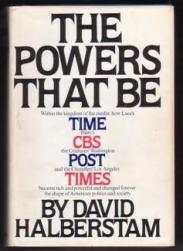
Not since “The Powers That Be” (published in 1979) has there been a better history of the media industry.  Tim Wu is heir to David Halberstam.  First there were newspapers, then radio, then television, and now the world-wide web.  Wu offers a modern vision of media’s impact on society in “The Attention Merchants”.

Gone are many of the famed “…Attention Merchants” like Bill Bernbach, Neil French, and David Ogilvy.   They were the early influencers; i.e. the copy writers, and agents that created consumer advertising for Sulzberger, Chandler, Hutchins, Paley, and Luce.  They worked for founders of some of the most influential newspaper, radio, television and magazine outlets of the 19th and 20th centuries. They were the “gods” of a newly formed consumer society. Consumers read, watched, and listened to pitches for everything from votes to vitamins to the latest model Cadillac.  Wu shows pitches remain the same, but methods have changed.

DAVID HALBERSTAM'S SEMINAL WORK ON THE MEDIA INDUSTRY (PUBLISHED 1979)
DAVID HALBERSTAM’S SEMINAL WORK ON THE MEDIA INDUSTRY (PUBLISHED 1979)  Gone are many of the famed “…Attention Merchants” like Bill Bernbach, Neil French, and David Ogilvy.  They were the “gods” of a newly formed consumer society. Consumers read, watched, and listened to pitches for everything from votes to vitamins to the latest model Cadillac.

Today’s social, political, and economic consumers are recorded, manipulated, spindled, and controlled by “other gods”.  Modern “…Attention Merchants” are internet entrepreneurs like Amazon’s Jeff Bezos, Google’s Larry Page & Sergey Brin, Microsoft’s Bill Gates & today’s CEO Satya Nadella, Apple’s (now deceased) CEO, Steve Jobs & today’s CEO Tim Cook, Facebook’s Mark Zuckerberg, and Netflix’s Reed Hastings. Television, newspapers, radio, and magazines still capture our attention but not like past “…Attention Merchants”.  Old media are still with us, but computer screens and mobile phones have joined the mix.  Wu shows how the public’s decisions have become less volitional, more manipulated, and addictive as www. sites came into being and technology matured.

INTERNET LOGO
Old media is still with us, but computer screens and mobile phones have joined the mix.  Wu shows how the public’s decisions have become less volitional, more manipulated, and addictive when www. came into being and technology matured.

MARLBORO MAN
Neither smoking or “free” access to information is without harm or cost.  The Marlborough man is dead, and “free” internet information is not free.

Wu recounts how advertising became a critical part of early media’s power, influence, and profit.  Just as advertisers promoted false benefits of smoking in the 20th, internet advertisers promote false benefits of free access to information and entertainment in the 21st century.  Neither smoking or “free” access to information is without harm or cost.  The Marlborough man is dead, and “free” internet information is not free.  “Fake news” has always been in the “…Attention Merchant’s” tool box but Wu shows that a new dimension is created with the rise of “free” information technology.

The internet not only informs the public, i.e., it distracts society, distorts facts, and reveals intimate details of personal lives. Internet users become products, rather than just consumers. Information gathered on consumers is provided to government and sold to private enterprise.

More ominous than media distortion by capitalist manipulators is government-controlled media that distorts truth to justify the Ukraine war.
ukraine bombing

Personal information is used by governments, and private sector businesses to achieve their own purposes.  Power and control become centered on organizations rather than individuals.  Data mining is a new industry. Decisions are less determined by personal being and private belief.  Today, decisions are shaped by a society “under the influence” of government, and private sector’s “…Attention Merchants”.

data mining
Personal information is used by governments, and private sector businesses to achieve their own purposes.  Power and control become centered on organizations rather than individuals.  Data mining is a new industry.

facebook
In this Facebook age, there are few secrets about what one likes and what one is willing to pay for product.

Wu notes how today’s “…Attention Merchants” are different.  Advertisers have always tried to influence individuals.  Advertisers have always told lies or distorted truth to get buyers to buy and believe.  Wu explains the difference.  Now personal information is acquired with confused consent by users of the internet. In this Facebook age, there are few secrets about what one likes and what one is willing to pay for product.

Customers are no longer just consumers.  Wu notes customers have become products.  Customers are sold to the highest bidder without customer awareness or compensation.  Today’s “…Attention Merchants” argue that sales pitches are customized to what the customer wants.  Businesses rationalize access as the customer’s compensation.  Government rationalizes access as a way of staying in touch and understanding the public.  Wu implies both arguments are willful misrepresentations.

consumer's mind
Consumers have less control over their decisions because “…Attention Merchants” use intimate personal information to seduce conscious and unconscious motivation.

There is a cost to voters and consumers because personal information is being sold without pay for product that enriches “…Attention Merchants”, private enterprise, and government.  The product delivered is the personal information that reveals who we are, what we think, what we desire, and what we are willing to pay.  Consumers have less control over their decisions because “…Attention Merchants” use intimate personal information to seduce conscious and unconscious motivation.

The sinister aspect of Wu’s explanation is that “…Attention Merchants” now have tools that exaggerate the impact of “fake news”.  By knowing intimate beliefs of consumers, “…Attention Merchants” are able to create algorithms that funnel “fake news” that feeds what consumer’s may either accurately or inaccurately believe.  Prejudices and discrimination are reinforced.  The worst characteristics of political populism are reinforced.  “The Attention Merchants” expand control of individual thought so that the course of democratic elections, government policies, or business successes can be unduly influenced by false or misleading information.

wikipedia
The positive aspect of the internet is shown by sites created without advertising input; e.g. Wikipedia and some blogosphere creations abjure advertising as a source of compensation.

Wu notes there are glimmers of hope with a growing recognition of the impact of the internet. The internet broadens human understanding of the world. The positive aspect of the internet is shown by sites created without advertising input; e.g. Wikipedia and some blogosphere creations abjure advertising as a source of compensation.

Exposure of blind spots in acquisition of personal data are currently being exposed in congressional hearings with Facebook CEO, Mark Zuckerberg.  At the same time, Russian interference in American elections is being more seriously investigated.

As Marie Currie is to have said— “Nothing in life is to be feared.  It is only to be understood.  Now is the time to understand more, so that we may fear less.”  Of course, one might remember, she died from the radiation she received from her discoveries.  (Ironically, Marie Currie’s death was found not to be from radiation exposure.  In autopsy, her body radiation levels were within normal range.)

ADDICTION

Audio-book Review
By Chet Yarbrough

(Blog:awalkingdelight)
Website: chetyarbrough.blog

Infinite JestInfinite Jest

By David Foster Wallace 

Narrated by Sean Pratt

DAVID FOSTER WALLACE (1962-2008)

Great credit is deserved by the publisher and editor of “Infinite Jest”.  It is unlikely that most publishers would stick with “Infinite Jest’s” stream-of-consciousness journey.  It is too long.  As one of Wallace’s characters observes, the explanation has “too many words”.  “Infinite Jest” is disjointed and comes together late in its narrative.  “Infinite Jest” takes fortitude to complete.  It is an excruciating story of a closely examined life.  The author is testing the reader to see if he/she would rather escape than stick with David Foster Wallace’s examined life.

David Foster Wallace frustrates and fascinates readers with several extraordinary but flawed human beings.  The main character in Wallace’s book is Hal Incandenza.  But every created character is a part of who David Foster Wallace is or wants to be.  Wallace’s self-absorption, destructive behavior, and vulnerability seep from every ink-stained page; from every enunciated sentence. His “Infinite Jest” becomes real and complete with his wasted suicide at age 46.

DRUG ADDICT
“Infinite Jest” is about addiction. It argues that modern civilization is jaded by plenty, i.e., movies, sex, drugs, and other distracting entertainments are so plentiful that escape from the trials of life becomes the purpose of life.

“Infinite Jest” is about addiction. “Infinite Jest” argues that modern civilization is jaded by plenty, i.e., movies, sex, drugs, and other distracting entertainments are so plentiful that escape from the trials of life becomes the purpose of life. Human success is redefined.  Escape from conflict replaces drive for money, power, and prestige.  Obsessive/compulsive behavior focuses on immediate gratification.

Hal Incandenza’s father, named “Himself” in Wallace’s book, creates a movie that has the seductive and destructive characteristics of an addictive drug.  The movie becomes a secret weapon of destruction that stimulates the pleasure foci of the brain that destroys human interest in anything other than its replay.  The jest is that pleasures, though ephemeral, are pursued without end and at any cost (including dismemberment and death).  The pleasure of a watched movie leads to self-destruction.

the attention merchants
Wallace’s book suggests a movie (media in general) has the seductive and destructive characteristics of an addictive drug.

In real life, Wallace achieves fame and financial stability with his writing.  Retrospectively, “the jest” is that Wallace’s literary achievement is not enough to sustain his life because continued life demands work rather than Wallace’s chosen escape from reality.  He lives the life and dies the death of his characters in “Infinite Jest”.

Wallace’s main character, Hal Incandenza, is a self-destructive, amateur, world-class tennis player in “Infinite Jest”. (Wallace was a competitive tennis player in real life.)  Himself, Hal’s overachieving and failed-athlete father, is a wildly successful inventor and optics expert. Hal has two brothers.  One is Mario, a middle son of the Incandenza family that reminds one of Dostoevsky’s main characters in “The Idiot”.  The second is Hal’s older brother who is a star punter for a professional football team.  All of the Incandenza characters are aspects of an examined life of David Foster Wallace.

Himself (Hal’s nicknamed father) makes a movie entertainment with a beautiful young woman who is half his age who disastrously couples with Hal’s older brother Orin.  The beautiful young woman is so beautiful that she bargains with Himself to offer her naked image in his film in return for Himself’s abandonment of drugs.  An irony of the bargain is that the beautiful young woman is a drug addict herself (another jest).  Himself chooses to commit suicide by sticking his head into a microwave.  Himself finds it easier to avoid rather than challenge the stresses of life.

stresses of life
Wallace implies in today’s culture; it is easier to avoid rather than challenge the stresses of life.

Playing competitive tennis, writing a book, or making a movie is not as easy as hitting the re-play button for a movie, snorting a line of cocaine, sniffing a bong, or offing oneself.  There is prescient insight here that resonates with today’s growing escapist drug use.

Mario, the younger brother of Hal, is a mentally challenged, strangely insightful, angelic character that reflects an altruistic aspect of life. One wonders if that is a part of what David Foster Wallace wishes himself to be.  Competing, writing, and movie making require thinking, working, creating, with all its pains, disappointments, failures, and ephemeral successes.  As an addict, the experience of drugs, alcohol, sex, gaming, etc. are great pleasures in the beginning, faltering pleasures in the middle, and killers in the end; at least it became so for David Foster Wallace.

CDC WONDER Data for Website_02-04-15.pptx
Increasing drug use and overdosing statistics suggests Wallace knew what he was writing about.

“Infinite Jest” is a brilliant piece of work.  However, it is David Foster Wallace’s view of life.  It is sad that Wallace ends his life because the meaning of life is trivialized by his suicide.

If brilliant minds like Wallace conclude that suicide is a preferred end to life’s journey than perfecting humanity is a delusion.  If society is addicted to entertainment, then Wallace infers suicide is a harbinger of the future.  Are we all becoming addicts?  Increasing drug use and overdosing statistics suggest Wallace knew what he was writing about.

A CLASSIC’S TRUTH

Audio-book Review
By Chet Yarbrough

(Blog:awalkingdelight)
Website: chetyarbrough.blog

The Road to Serfdom

By Friedrich A. Hayek

 Narrated by William Hughes

FRIEDRICH AUGUST von HAYEK (1899-1992)

Hayek wrote “The Road to Serfdom” during WWII.  His observation was that Nazi Germany and its rise to power had a direct relationship with the growth of socialism, a belief that central planning and control are keys to national prosperity. 

Hayek suggests that America and Great Britain suffer a similar strain of belief.  He argues that central planning and control leads to totalitarianism.  “The Road to Serfdom” is a prescient vision of the dangers of socialism.

The dilemma of government is in drawing the line between central planning and public service. It is particularly complicated by what the intent of Article 1, Section 8 of the Constitution meant when it said a part of the purpose of government is to “promote the general welfare”

It seems common that authors of popular, sometimes classic, books are often interpreted by people who have not read them.  Authors like Harriet Beecher Stowe, Richard Wright, Ayn Rand, Vladimir Nabokov, and Friedrich Hayek are frequently commented on but content often becomes a surprise to actual readers.

Friedrich Hayek’s book is frequently lauded by American conservatives and vilified by American liberals. 

classic liberalism

In truth, Hayek is a seer for both ignorant American’ conservatives and liberals; i.e. Hayek is neither a spokesman for modern American conservatism or liberalism but a strong proponent of classic liberalism.

To be clear, today’s conservatism and liberalism are not defined in the same way Hayek defines them in his 1944 publication.  Liberalism in 1944 meant belief in freedom of choice and endorsement of laissez-faire economic principles.  1944 conservatism meant a rejection of the principles of equality with an aristocratic, “rank has privileges”, ideology.

subsidization
Contrary to Hayek’s conservatism, modern conservatives and liberals endorse subsidization of private enterprise.  Subsidization comes from tariffs, tax incentives, and other preferential treatment for private business and industry.

Principles of equality and laissez-fair economic principles are less doctrinaire in the 21st century because American political parties blur the difference.  Modern liberals are closely associated with government regulation and intervention but not necessarily laissez-faire principles. 

Modern conservatives are opposed to government in most forms of regulation and intervention, but only in principle; not in practice.  Modern conservatives, as well as liberals, endorse subsidization of private enterprise.  Subsidization comes from tariffs, tax incentives, and other preferential treatment for private business and industry.

JOHN MAYNARD KEYNES (1883-1946)

Contrary to a wide perception that John Maynard Keynes (a liberal economist in today’s parlance) denigrated “The Road to Serfdom”; Keynes, in fact, praised it.  John Maynard Keynes believed in government intervention when a state’s economy is in crisis.

According to Thomas Hazlett in the July 1992 issue of “Reason Magazine”, Keynes wrote “In my opinion it  (Road to Serfdom) is a grand book…Morally and philosophically I find myself in agreement with virtually the whole of it; and not only in agreement with it, but in deeply moved agreement”. 

Though Keynes praised “The Road to Serfdom”, he did not think Hayek’s economic’ liberalism practical; i.e. Keynes infers that Hayek could not practically draw a line between a safety net for the poor, uninsured-sick, and unemployed (which Hayek endorsed) while denying government intervention in a competitive, laissez-faire economy.

When businesses have an unfair advantage that denies competition, Hayek suggests government regulation is required.

GOVERNMENT REGULATION

Where modern conservatives get “The Road to Serfdom” wrong is where Hayek writes that government has an important role in a nation’s economy that goes beyond a simplistic notion of laissez-faire. 

Where modern liberals misunderstand “The Road to Serfdom” is where Hayek explains that freedom of choice is essential within the bounds of safe pursuit of economic success.  When human safety issues from uncontrolled industrial pollution threatens the safety of society (which most modern scientific opinion calls global warming) Hayek writes government intervention is necessary.

After listening to “The Road to Serfdom”, one cannot help but believe that Hayek would be as appalled by “private” industry’s greed in the 21st century. 

Hayek wrote that big business is not bad in itself but big business that fails to compete on a level playing field because of government subsidy, through tax concession and special treatment, should be regulated by government to ensure fair play.

REGULATING BIG BUSINESS
TRUMP AND CLIMATE CHANGE

In the face of overwhelming evidence to the contrary, Trump denies the reality of global warming.

One is compelled to agree with Hayek when he observes that government programs interfere with free choice when government officials create social programs they think are good for someone else.  Hayek is not saying that government should not care for the poor, work-disabled, or technologically unemployed.  He writes: “Where, as in the case of sickness and accident, neither the desire to avoid such calamities nor the efforts to overcome their consequences are as a rule weakened by the provision of assistance – where, in short, we deal with genuinely insurable risks – the case for the state’s helping to organize a comprehensive system of social insurance is very strong.” 

Hayek goes on to suggest that technological change that causes unemployment warrants government assistance.  The danger Hayek tries to make clear is that government interferes with free choice when social programs try to create false equalities.

BREAD LINES IN NEW YORK 1933
BREAD LINES IN NEW YORK 1933–Hayek is not saying that government should not care for the poor, work-disabled, or technologically unemployed. 

Hayek writes: “Where, as in the case of sickness and accident, neither the desire to avoid such calamities nor the efforts to overcome their consequences are as a rule weakened by the provision of assistance – where, in short, we deal with genuinely insurable risks – the case for the state’s helping to organize a comprehensive system of social insurance is very strong.”

Hayek is acknowledging a role for government.  The role is to regulate private enterprise in those areas where freedom of choice or equal opportunity is infringed upon. 

HEALTH INSURANCE
If insurance is not available to all in a land of prosperity, then government has a role in creating a program that will offer insurance to all. 

Hayek’s only caveat is that the insurance be offered as an affordable, free enterprise, and individual choice, not as an entitlement.

FREE TRADE IDEAL

Hayek opposes government programs that interfere with free competition among similar businesses. 

The weakness of Hayek’s argument is in idealization of humanity; i.e. human nature is that leaders in government and the private sector will drive for advantage.  In the case of one country, that advantage may theoretically be mitigated by impartial government regulation but, in a world of sovereign nations, power is inherently limited.

If China wants to subsidize steel exports, American options are limited to creating import tariffs that further distort market competition. This is the mistaken route that President Trump has taken. Further, Hayek’s idealization presumes that politicians cannot be bribed, human beings are not prejudiced, populations have an equal opportunity to succeed, and humanity is inhumanly perfect when left in a state of grace.

Hayek correctly points out the importance of money as a measure of success in a free society.  However, in today’s America, “Moneyocracy” has become an American form of government.  “Moneyocracy” is the aristocracy of the 21st century that elects public officials, denies equality of opportunity—for education, economic mobility, and employment.

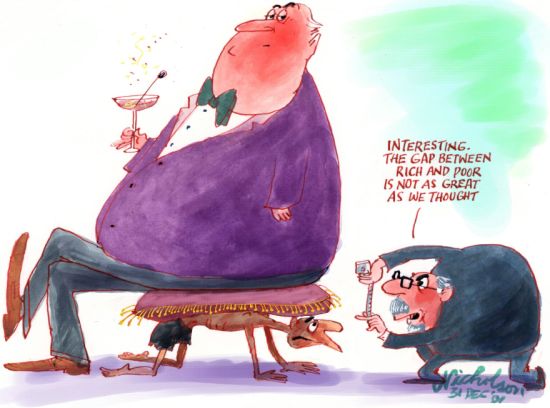
GAP BETWEEN RICH & POOR

The gap between the rich and poor is widening by degrees that may bankrupt America because of an enlarging safety net for the old, the sick, the unemployed, and the unemployable.

 The field of competition for free enterprise is becoming more unequal.  Hayek observes that government intervention slips into socialism when free enterprise is artificially manipulated.  The fear is that America will begin looking for their Hitler to manage a sick economy.

Conservatives that rant against government regulation based on Hayek’s “Road to Serfdom” are as incorrect as liberals that argue Hayek wrote against social government programs for the poor, disabled, and unemployed.

A HACKING OBSESSION

Audio-book Review
By Chet Yarbrough

(Blog:awalkingdelight)
Website: chetyarbrough.blog

Ghost in the Wiresghost in the machine

By Kevin Mitnick, William Simon

Narrated by Ray Porter

KEVIN MITNICK (AUTHOR, IT CONSULTANT, FORMER HACKER)
KEVIN MITNICK (Author, Computer Information Consultant, Former Hacker)—John Waters is supposed to have said, “Without obsession, life is nothing”.  Kevin Mitnick, in the span of 20 years, was convicted four times for computer hacking (exploiting computer system weaknesses).

John Waters is supposed to have said, “Without obsession, life is nothing”.  Kevin Mitnick, in the span of 20 years, was convicted four times for computer hacking (exploiting computer system weaknesses).

Mitnick’s assisted autobiography infers that hacking became Mitnick’s obsession.

“Ghost in the Wires” is a semi-believable story of an extraordinary white-collar criminal that alleges he never financially benefited from spying on people and stealing proprietary software programs from dozens of major corporations and government agencies.  His modus operandi was the lie (euphemistically called social engineering) a telephone, and a computer; all of which he used to hack.

TELEPHONE
Mitnick would “socially engineer” (lie to) company employees.  The employee would release proprietary information without understanding what they were doing.  Mitnick then used that information to steal software or spy on corporate activities.

Mitnick is a quintessential conman.  When he chose an objective like stealing credit information from TRW or making uncharged calls on PacBell’s communication system, he would telephone the “targeted” company.  Mitnick would tell the soon-to-be-victimized; he was a company employee and needed access to their software systems to correct a problem at a branch office.

He would “socially engineer” (lie to) company contacts, who would trustingly release proprietary information.  The contact would release proprietary information without understanding what they were doing.  Mitnick then used that information to steal software or spy on corporate activities. , and allegedly, not use that information to benefit himself.  Mitnick generally criticizes Americans for being too trusting.

Mitnick obsessively researched his target.  He would learn the lingo of the corporation, identify a real employee, assume his identity, and then begin his telephone con with a person that would have access to proprietary information.  Mitnick argues that he was thrilled by the chase and the acquisition of unauthorized information.  He would store the stolen information on remote computer systems that he either hacked into or purchased as rented space.  Mitnick said he never used the information to benefit himself but only pursued it for the joy of hacking.  Really?

human research
Mitnick obsessively researched his target.  He would learn the lingo of the corporation, identify a real employee that he would become, and then begin his telephone con with a person that would have access to proprietary information.

information thief
Mitnick is obviously smart and articulate but wants a listener to believe he lived on $28,000 per year for 2 out of 10 years of life, moved cross-country at least 4 times in 8 years, lost $11,000 cash, borrowed $5,000, went to college, and never lived on the street.

Mitnick is a good storyteller but there are glaring weaknesses in his story.  Mitnick is obviously smart and articulate but wants a listener to believe he lived on $28,000 per year for 2 out of 10 years of life, moved cross-country at least 4 times in 8 years, lost $11,000 cash, borrowed $5,000, went to college, and never lived on the street.  One wonders how he lived and traveled on such a meager income, duping the world and not taking a cent of illegal gotten gains.

Mitnick seems incredibly gullible to believe one of his fellow hackers was not working for the FBI; long before he found corroborating evidence.  Mitnick seems always surprised by the betrayal of his “friends” but keeps going back to the well of friendship.  Is this personal naiveté or social engineering of those who read or listen to his story?

Finally, the competence of the FBI seems exaggerated when Mitnick is caught by a simple search done by Shimomura, a security consultant, when he found that Mitnick was somewhere in Raleigh, North Carolina.  Shimomura simply screened all telephone communication in Mitnick’s area.  Shimomura pinpointed addresses of anyone on the phone for more than 30 minutes at one time.  Mitnick was the only person that fit that criterion.

HACKING
The advent of the internet suggests hackers of the world are capable of doing considerably more damage today than when Mitnick practiced his obsession, e.g., Russian interference with the American election process.

Mitnick’s story makes one uncomfortable on two levels. One, Mitnick reveals tools used by criminals and others who can invade our privacy. And two, one wonders if he/she is being socially engineered by a consummate liar. After all, Mitnick escaped prosecution for 15 years.

The advent of the internet suggests hackers of the world are capable of doing considerably more damage today than when Mitnick practiced his obsession, i.e., Russian interference with the American election process being a prime example.

STEVE WOZNIAK
STEVE WOZNIAK

In the forward to Mitnick’s book, he is praised for his affability by Steve Wozniak (former founder of Apple). One would believe the praise is in part because of Wozniak’s belief in open system software but also because of Mitnick’s software coding expertise and suspect affability.

In Mitnick’s afterword, it appears Mitnick’s life as a criminal made him both famous and financially secure.  One wonders, how much more Mitnick could have accomplished without breaking the law.  After all, Waters implies life is something if you are obsessive.  Without doubt, Mitnick is that.

KNOWLEDGE

Audio-book Review
By Chet Yarbrough

(Blog:awalkingdelight)
Website: chetyarbrough.blog

Philosophy of Science

By: Professor Jeffrey L. Kasser

Narrated by Professor Kasser Lecture Series

DR. JEFFREY L. KASSER (ASSISTANT PROFESSOR OF PHILOSOPHY AT COLORADO STATE UNIVERSITY)

DR. JEFFREY L. KASSER (ASSISTANT PROFESSOR OF PHILOSOPHY AT COLORADO STATE UNIVERSITY)

This is a tough audiobook to adequately summarize.  Dr. Jeffrey Kasser offers evidence for the value and advance of human knowledge through philosophy and science.  Kasser explains that philosophy is the beginning of what becomes a scientific world view.  Kasser attempts to drag skeptics out of Socrates’ cave with a “36 lecture” series titled “The Philosophy of Science”.

Kasser recounts the history of science from a world controlled by fickle gods to a world of cause and effect.  Then, in the early twentieth century, Kasser notes that science reveals a world of probability.  Kasser reports on views of science changed by philosophers like Karl Popper, Paul Feyerabend, and Bas van Frassen.

KARL POPPER (1902-1994)

KARL POPPER (1902-1994) Popper suggests science cannot be proven but only falsified.  His point is that only infinite experimentation can prove the truth of a scientific theory.

Infinity, by definition, is boundless; therefore, science offers limited truth in so far as no one can reach an infinite number of experiments to prove a theory.

PAUL FEYERABEND (1924-1994)

PAUL FEYERABEND (1924-1994)

Feyerabend argues that scientific method is a constraint rather than exploratory tool of science. To Feyerabend, when science begins with hypothesis, research is restricted and experimentation becomes biased by pre-conceived or experienced perception.

Bas van Fraasen (Philosopher)

Bas van Fraassen suggests that, at best, science can only reveal approximate truth about the physical world.  His view lends itself to quantum physics where cause and effect become probabilistic rather than definitive.

These three philosophers, as well as several others noted by Kasser, steer science to a category of understanding called logical positivism.  Logical positivism is argued to be the primary focus of what is called good science.  Logical positivism suggests that science must be based on direct experience and logic; within limitations like those argued by Popper, Feyerabend, Frassen, and others.

However, Kassen suggests even logical positivism is challenged by the realization that acts of analysis, particularly measurement of results, distort reality.

Distortion comes from the act of measurement and the bias of human cognition.  In other words, experiments done by different scientists with the same results remain only qualified scientific truths.  Experimentation, even accompanied by logic, becomes suspect.  Observational measurement and human perception are critically important to science but, by nature, both measurement and perception taint objective truth.

Kasser explains the truth of science lays in experiment designed to disprove hypothesis.  Logic generates hypothesis.  Hypothesis is tested for falsity through experiment.  Experiment requires measurement.  Science experiment is influenced by measurement and human perception which raises doubt about results of tested hypothesis.

SIR ISAAC NEWTON (1642-1727)

SIR ISAAC NEWTON (1642-1727) Kasser notes that Newton’s laws infer a cause-and-effect world

Newton’s laws work in the macro world.  We no longer believe rocks fall to the ground because they live there.  Newton’s laws of motion suggest that a bowling ball and a basketball will fall at the same rate of speed, even though their mass is different.  This is experimentally and logically provable.  If a rock, bowling ball, or basketball are picked up and dropped, they will fall to the ground.  If they are in a vacuum, they will fall to the ground at the same rate of speed.

In the micro world, components of atoms that combine to form what we see as bowling balls and basketballs cohere to each other in a way that does not conform to Newton’s laws.  The components of atoms operate in accordance with quantum mechanics which shows that elements of atoms in bowling balls and basketballs do not follow Newton’s laws of motion.  The orbital planes of atomic elements like quarks and leptons appear and disappear; i.e. they do not follow a predictable pattern of action.  

PROBABILITY

Cause and effect in the macro world is replaced by probability in the micro world.

None of this is to suggest that Newton’s laws are false or that quantum mechanics are anything more than an expansion of Newton’s laws.  However, at this stage of scientific discovery, the two laws are not compatible even though both laws are experimentally confirm-able.  Attempts have been made to unify these laws.  String theory is the present day most studied hypothesis but it fails the criteria of null hypothesis because of today’s instrumental and cognitive limitations.

Philosophy and science are integral to the advance of human civilization.  We are still looking at shadows of reality but Kasser infers philosophy and science are the best hope for Socrates’ spelunkers.