
Books of Interest
Website: chetyarbrough.blog
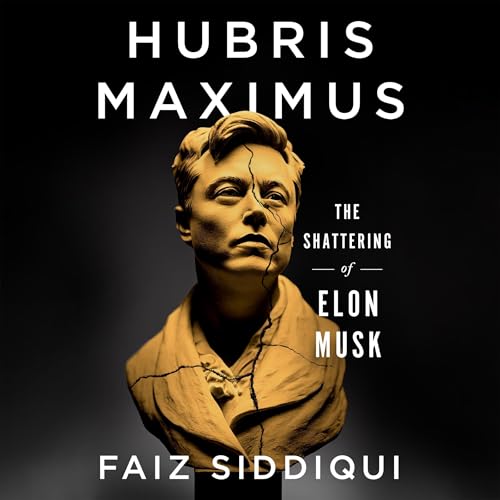
Hubris Maximus (The Shattering of Elon Musk)
By: Faiz Siddiqui
Narrated By: André Santana

Faiz Siddiqui (Author, technology reporter for The Washington Post)
Faiz Siddiqui exposes the character of Elon Musk as a brilliant entrepreneur with an outsized pride in his ability that reflects an arrogance that diminishes his genius. Musk’s success with Tesla and SpaceX accomplishments are equal, and in some ways exceed, the business successes of John D. Rockefeller and Steve Jobs. In wealth, Musk exceeds Rockefeller and in inventiveness, he competes with Steve Jobs.
As brilliant as Musk shows himself to be, his fragile ego diminishes his genius.

Siddiqui reveals how petty Musk can be while balancing that pettiness with his contribution to creative ideas that will live far beyond his mortal life. Musk’s development of space travel and communication satellites for the world with a non-governmental, free enterprise operation is a tribute to the power of capitalism. His next immense contribution, though controversial and a work in progress, will be self-driving transportation.

Elon Musk’s Successful Return of Rockets Launched into Space.
Siddiqui’s picture of Musk’s flawed personality is somewhat balanced by the image of a person driven to succeed. However, that drive is not something that naturally translates to organizational performance. Musk is not a developer of people and should not be in charge of an organization’s management. Like Apple employees that kept some of their work undisclosed to Steve Jobs when the mobile phone was being considered, Musk needs to leave management of employees to others. People management is a skill set that Musk does not have as was made quite clear with his acquisition of Twitter and his work with DOGE. DOGE feeds Musk’s managerial weaknesses with President Trump’s mistaken belief that cost of government is more important than effectiveness. DOGE is a growing tragedy of American governance.

Musk is right about the value of self-driving vehicles, but he is trying to produce the wrong product to prove his belief.
Self-driving vehicles will reduce traffic accidents, injuries, and death but the product to achieve that goal is what Musk should be working on. The game of Go is estimated to have 10 to the 172nd power of possible positions. Self-driving cars probably have a similar astronomical number of possible causes of accidents.

Musk, or someone with his creative genius, needs to create a product that can be sold to all vehicle manufacturers.
This newly invented product would use AI to learn, reinforce understanding of vehicular movements, accidents, and incidents. That accumulated information would allow creative play in the same way GO became an unbeatable game for human beings playing against a programed computer. Musk is putting the cart before the horse by building cars and then making them safe, self-driving vehicles. The first step is to gather information from as many driven vehicles as possible, collate that information, and use computer power to creatively play with the information. That information, like learning the moves of GO would create self-driving algorithms that would reduce self-driving vehicle’ accidents, injuries, and deaths.

A sad reveal in “Hubris Maximus” is that an American treasure, Elon Musk, is being vilified for the wrong reasons.
Musk’s contribution to the reduction of air pollution has benefited the world. His vision of interstellar travel may be the next step in human expedition, exploration, and habitation of the universe. Earth’s interconnectedness is vitally enhanced by Musk’s satellite system. The universe is humanity’s next frontier.
Musk, like all human beings, is imperfect. His association with a President who feels money is more important than humanity only feeds Musk’s ineptitude as a manager of people.

 REVIEWS AND VIEWS OF LIFE
The $35 trillion debt, the corruption of the bureaucracies, and the unaccountability of the federal system all create a national crisis that the Trump-Musk conflict doesn’t even begin to address, but is, in many ways, entangled with. When we talk about personal egos like Trump’s or Musk’s, or even their clashing interests, we risk losing sight of the bigger systemic problem—the corruption of the federal system, which is bankrupt and undermining the very idea of American self-governance. Let’s try to shift that lens a bit, and address the Vox propaganda from the perspective of restoring the autonomy of the State Legislatures and decentralizing power—a vision that seems to be urgently needed in a time when centralized control (especially from the federal bureaucracy) is absolutely failing.
In its simplified critique, Vox misses the root causes of why these personal conflicts—like the Trump-Musk dispute—Calling the Trump-Musk feud a “tantrum”, in the rag’s article: “Trump and Musk’s playground tantrums could topple world stability” represents as a perfect example of dumb ass over-simplification—it reduces a very nuanced, and potentially destabilizing, situation into something that feels childish or trivial. The purpose of propaganda, to evoke an emotional backlash from the listening audience who entered the subject relaxed and left the subject enraged. Instead of framing it as ego-driven childishness, we need to recognize the stakes: America’s deeply corrupt, over-centralized federal system is a failed construct, and it is precisely this centralized power that creates unaccountable bureaucracies and unresponsive institutions.
The Trump-Musk dispute, in this light, isn’t just about two men with too much power fighting for attention—it’s a symptom of a much larger issue: that America’s federal government is broken, both financially and institutionally. In an America where the federal government is $35 trillion in debt, where the bureaucracies are riddled with corruption, and where power is increasingly concentrated in the hands of a few corporate elites and political insiders, the real question is how to restore the balance of power between the states and the federal government—something the current system fails to manage.
Vox’s focus on Trump and Musk’s personal issues ignores this fundamental political imbalance. The federal bureaucracy, which controls much of the regulation that impacts the states, has become bloated, inefficient, and unaccountable. From healthcare to taxation to environmental regulation, the state legislatures of the 50 states have been increasingly undermined by a federal system that no longer serves the people or the republic—it serves itself.
The Trump administration’s focus on draining the swamp and cutting regulations was one attempt to tackle this issue. However, as we’ve seen, the bureaucratic rot goes far deeper than a few executive orders. Even when individuals like Trump try to break the grip of the Deep State, they find themselves up against an entrenched system that resists accountability at every turn. The Judicial system, which is supposed to provide checks and balances, has similarly become part of the problem, protecting entrenched interests instead of upholding the Constitution and the will of the people.
The Musk-Trump drama—whether it’s about personal power plays or corporate interests—is ultimately a distraction from the root cause: that the federal government has overreached and abused its power for decades, leaving state governments hamstrung, unable to act in the best interests of their citizens. And this is where the need for restoring the autonomy of the states becomes essential.
To break the cycle of corruption and mismanagement that defines much of the federal system, we must reclaim power at the state level. The states need to regain their rightful ability to manage their own affairs independently of the federal government’s oversight. This is the essence of a republic—a system where the states are sovereign in managing their own affairs and their own citizens’ needs, without being crushed under the weight of a federal leviathan.
The Constitution clearly lays out the role of the federal government as being limited. Over the years, that role has expanded far beyond what was intended, making the federal government a monster that both runs roughshod over the states and creates dependence on Washington for everything from healthcare to education. We need to return power to state legislatures to regulate their own economies, environments, and public services—instead of relying on an out-of-touch, corrupt federal bureaucracy that cannot manage its own debt, let alone the needs of 330 million Americans.
Much of the federal bureaucracy has turned into a shadow government, run by unelected bureaucrats who have the power to dictate laws and regulations without being accountable to the people. This is undemocratic and goes against the very essence of American democracy. Reining in the administrative state and returning more authority to state legislatures is essential for rebuilding trust in our political system.
The $35 trillion debt hanging over the federal government is a direct consequence of centralized power and the inability to make tough decisions. States, on the other hand, have a vested interest in balancing their budgets and making decisions that benefit their citizens. By restoring state-level autonomy, states can manage their own fiscal policies, decide how best to allocate resources, and prevent further federal financial mismanagement.
In light of these systemic problems, the Trump-Musk dispute is not just about individual personalities clashing. It is a reflection of the deep dysfunction in American governance, where the federal system is failing to serve the people and the states are increasingly powerless to make meaningful changes. Musk, for all his brilliance, is part of the system that has exacerbated corporate control over government functions, while Trump, despite his populist appeal, still worked within a system that was far too entrenched to enact real, long-term change.
Vox, in its effort to frame this as a personal squabble, misses the larger picture: America needs a fundamental restructuring of its political system. This isn’t about personal power or ego; it’s about restoring the Republic—a Republic of sovereign states that manage their own affairs, free from the overreach of an ineffective, corrupt federal government.
In addressing the Vox propaganda, it’s important to emphasize that the Trump-Musk conflict is just one symptom of a larger problem that goes far beyond individual personalities. America is broken, and no amount of spectacle or personal drama can obscure the reality that we need a fundamental shift in how we govern ourselves. Restoring the autonomy of state legislatures is the only way to combat the over-centralization of power and ensure that America’s governance reflects the will and needs of its people—not the whims of a corrupt federal bureaucracy that’s too deeply entangled in its own failure to be reformed.
By focusing on decentralization and returning power to the states, we can begin to address the real issues facing America: its mounting debt, the corruption in its institutions, and its failure to live up to the vision of its founding. This is the real solution—not squabbles between two billionaires, but a reclamation of the republic that restores balance and true democracy at the local level.
LikeLike
Interesting. I agree with some of your comments but returning control and power to the States is a step too far. It would just accelerate discrimination and division.
Sent from the all new AOL app for iOS
LikeLiked by 1 person
If the foundation flawed, the entire building must come down. The Roman new testament counterfeit fundamentally erroneous. Regardless the pigs ear of the Catholic Church or the opposing pigs ear of the Protestant Church, no silk purse possible to make from either treif pig ears.
Prominent leader of the Protestant Reformation in Switzerland during the 16th century, specifically in Zurich. Zwingli’s teachings emphasized the authority of Scripture, yet failed to move beyond sophomoric translations made by Catholic bible scholars. He did not encourage people to learn the original Hebrew T’NaCH. His opposition to the Catholic reliance upon saint worship and employment of images truly a minor issue seeing that he failed to examine the T’NaCH as a Hebrew and Aramaic text. Hence Swiss Protestantism all show and no go just like Catholic practices. Only he masturbated with his opposing hand.
Failure to engage in the original Hebrew/Aramaic texts amounts to tits on a boar hog undergraduate scholarship. He failed to address the Nicene perversion which employed theology to create a Trinity God belief system as the standard of faith RATHER than the Torah definition of faith as righteous Justice pursue! The retarded Protestant Reformation compares to a child born XXX or XXY chromosome mutation.
The emphasis on original texts, such as the Hebrew Bible (Tanakh) and the complexities of early Christian doctrine, is a significant aspect of theological scholarship and debate, which Zwingli theology utterly failed to explore and grasp. The Protestant revolt – its failure to address the Central Nicene Council utter perversion of faith, comparable to the fictional mythology of Mary’s virgin birth abomination which directly imported Zeus as the father of Hercules.
The Nicene Creed negates the revelation that nothing in the Heavens, Seas, or Earth compares to God. The Nicene Creed, established in 325 CE, was intended to unify Christian belief regarding the nature of Christ and the Trinity, affirming the divinity of Jesus and his relationship to God the Father. It ignored the T’NaCH text which openly declared that “God is not a Man”. Furthermore, the Protestant Reformation utterly failed to address the elephant locked inside the China Closet…the mitzva of Moshiach — an Oral Torah commandment. Oral Torah expressed as T’NaCH prophetic mussar common law. The bible translations all universally failed to turn to the language of the T’NaCH to define the critical terms within the language of the T’NaCH itself. The term prophet does not mean a seer who foresees the future. Seers who claimed to foresee the future the T’NaCH referred to them as ‘false prophets’. The gospel narrative wherein it makes the claim that Jesus fulfilled the words of the prophets defines the T’NaCH definition of ”false prophesy”.
Translations, let’s start with the opening word of בראשית – Genesis. בראשית contains within its 6 letters ברית אש, ראש בית, and ב’ ראשית. The latter serves as a בנין אב/precedent (Torah being a common law legalism which the new testament forgery failed to grasp.) for the Yatzir Ha’Tov vs. the Yatzir Ha’Ra within the heart; comparable to the struggle between Esau and Yaacov in the womb of Rivka. Yet when the students of JeZeus asked him to teach them how to pray? JeZeus failed to understand that Torah tefillah, which learns from kre’a shma precedent, a matter of the heart.
Meaning a person dedicates holy to HaShem tohor middot which quicken the Yatzir Ha’Tov within the heart and not the tuma middot of the Yatzir Ha’Ra within the heart. JeZeus falsely instructed that his Father God lived in the Heavens rather than within the Heart as the brit sworn between the opposing cut in half pieces internalized the dedication of tohor middot as the expression of the revelation of the 13 tohor middot revealed first to Moshe at Horev ‘ה’ ה’ אל רחום וחנון וכו. Just as HaShem a spirit and not a word so too all these 13 middot – spirits and not word translations. The Yatzir Ha’Ra learns from the sin of the Golden Calf wherein the ערב רב, who lacked fear of אלהים, translated the revelation of the Name contained within the first Sinai commandment, the definition of observance of all Torah commandments לשמה או לא לשמה – something like Shakespeare’s: To be or not To be – that is the question! JeZeus falsely taught his students that prayer directed to some Father God who lived in the Heavens – no different than Father Zeus.
Worse the counterfeit new testament Roman forgery failed to grasp that the opening Book of בראשית introduces the subject of the “creation” of the chosen Cohen people through the dedication of tohor time oriented commandments; like as specifically found in tefillah such as the mitzva of kre’a shma. Tefillah separates and discerns between Yatzir vs. Yatzir like the mitzva of shabbat discerns between Shabbat & Chol, between מלאכה from עבודה. Therefore the false messiah god JeZeus – totally ignorant in how to pray and how to keep shabbat.
False the Koran’s Tawhid Monotheism most certainly does not align with the revelation of the Tribal God of Sinai. Both Xtianity and Islam teach the trief theological declaration of God as a Universal God. The Talmud teaches that only Israel accepted the revelation of the Torah at Sinai. Therefore the revelation of the Torah at Sinai revealed a local Tribal God rather than a Universal God who lives in the Heavens like as Zeus and Jesus.
The Torah story of Israel in Egyptian slavery, it recognizes that other Gods live. The priests of Par’o called upon their Gods to turn water into blood – as a powerful example that the Torah rejects the Xtian and Muslim theology of Monotheism. Therefore since both religions demand from their followers to worship different Gods and both religions do not obey the commandment to obey the Torah לשמה ie first Sinai commandments as the basis of all tohor time-oriented Avot commandments which defines the revelation of the Torah at Sinai. Therefore both JeZeus and Muhammad = false prophets.
Mishnah
The Torah reveals a localized understanding of God, specifically as the God of Israel, and rejects the notion of a universal deity as presented in Christianity and Islam. This understanding is foundational to the Jewish faith and is articulated through the commandments given at Sinai.
Gemara
Challenge 1:
Is it not written in the Torah that HaShem is the Creator of the heavens and the earth, implying a universal aspect to His nature? The Torah employs the language in the act of Creation אלהים.
Resolution:
While the Torah does declare HaShem as the Creator, but rather אלהים, this does not necessitate a universal worship of Him by all nations. The specific Torah oath alliance made with Israel at Sinai establishes a unique relationship, indicating that while HaShem inclusive with אלהים as the Creator, The Sinai revelation of השם within the first commandment serves as the foundation for all the Torah commandments thereafter. The revelation of the Torah at Sinai directed specifically to the chosen Cohen people alone.
Challenge 2:
But did not the prophets, such as Isaiah, proclaim that all nations will eventually recognize the one true God? Resolution:
Indeed, the prophets speak of a future recognition of HaShem by all nations, when these nations recognize Israel as the Chosen Cohen seed of Avraham, Yitzak, and Yaacov. Neither the new testament forgery nor the koran validate Israel as the chosen Cohen seed of the Avot. The koran replaces Yishmael for Yitzak at the Akadah. The prophetic vision of Goyim acceptance of Israel as the chosen Cohen people hardly qualifies as the exalted theologies of belief in One God.
Challenge 3:
How can one assert that the existence of other gods is acknowledged in the Torah, as seen in the plagues of Egypt, without undermining the principle of monotheism? Resolution: The Torah acknowledges the existence of other gods in the context of idolatry and the challenges faced by the Israelites, whose Yatzir Ha’Ra incites them to assimilate and intermarry with Goyim who do not accept the revelation of the Torah at Sinai. Hence the sages teach that the mother determines the Jewishness of the child, based upon the Torah negative commandment for the chosen Cohen people not to marry Goyim women. Therefore among Cohonim the father determines the status of Cohen children and not the mother. The Torah commandment to remember the redemption from Egyptian slavery, who demonstrates His power wherein the 10 plagues judges the Gods of Egypt. This Torah narrative reinforces the concept that while other Gods may be worshipped, they ultimately powerless comparable to an idol carved from the wood of a tree. That same wood used to heat ones’ house and cook ones’ food!
Challenge 4:
If the Torah is meant solely for Israel, how do we reconcile the commandment to be a “light unto the nations”? Resolution: The commandment to be a “light unto the nations” does not imply that the Torah’s laws apply universally but rather that Israel’s adherence to the commandments serves as a model of ethical and moral behavior. This role is to inspire other nations to recognize the wisdom of the Torah – held with respect and awe – rather than kicking the door of the Sukkah because its too hot.
Challenge 5:
What of the teachings of Jesus and Muhammad, who both claimed to fulfill the prophecies of the Hebrew Scriptures? Resolution: The definitions of prophecy in the Tanakh emphasize moral and ethical guidance rather than mere foretelling of events. Therefore, the claims of Jesus and Muhammad to fulfill the prophecies, their teachings diverge from the core principles of the Torah, do not align with the true prophetic tradition. The revelation of the Torah presents HaShem as humbly as a localized deity for Israel, supported by the text of the Torah, the prophetic literature, and the historical context of the Avraham Yitzak and Yaacov oath alliances.
Ignatius of Antioch (c. 35-107 CE), emphasized the idea of the New Covenant as superseding the Old Covenant, suggesting that the laws of the Torah were no longer binding on Christians. He viewed the Jewish law as a precursor to the grace found in Christ. In his letters, Ignatius often contrasts the “old” and “new” covenants, implying that the teachings of Jesus fulfill and replace the Torah. This interpretation overlooks the ongoing significance of the Yom Kippur remembered Sin of the Golden Calf replacement theology wherein HaShem made the sanctification of His Name by doing t’shuva and where HaShem annulled the vow made to Moshe to make of his seed the chosen Cohen people rather than the oaths sworn to Avraham Yitzak and Yaacov.
Justin Martyr (c. 100-165 CE), argued that the Jewish people had failed to recognize the true meaning of the Scriptures and that the Church had inherited the promises made to Israel. He claimed that the Church was the “new Israel.” In his “Dialogue with Trypho,” Justin asserts that the prophecies concerning the Messiah are fulfilled in Jesus, thereby suggesting that the oath alliance sworn at Sinai utterly irrelevant for Xtians. This theology utterly rejects the revelation of the Torah at Sinai, replaced by the Romen new testament forgery.
Augustine of Hippo (354-430 CE), likewise embraced the sin of the Golden Calf “replacement theology,” which posits that the Church has replaced Israel as the chosen people of God. He viewed the Old Testament as primarily a historical account that pointed to the New Testament. Clearly this theology failed to distinguish that the prophets instructed Israel through prophetic mussar – applicable to all generations of the Chosen Cohen people. In “City of God,” Augustine argues that the Jewish people are no longer the recipients of God’s promises, which misinterprets the enduring nature of the Sinai oath brit alliance which Chag Yom Kippur remembers that even HaShem cannot profane a Torah oath.
Islamic Jurisprudence and its Quranic Interpretation. Islamic teachings often present the Quran as a final revelation that supersedes previous scriptures, including the Torah. This perspective implies that the Sinai revelation accepted by the Israelites – no longer applicable. Verses such as Surah Al-Ma’idah (5:44-48) suggest that the Quran confirms previous scriptures but also asserts its authority over them. This interpretation can lead to the view that the Sinai covenant is obsolete, which contrasts with Jewish beliefs about the eternal nature of sworn Torah oaths.
Hadith Literature, emphasizes that the Jewish and Christian communities have deviated from the true path, suggesting that their interpretations of the covenant are flawed. This leads to a dismissal of the significance of the Sinai covenant in Jewish tradition. Islamic Legal Theory (Fiqh) often emphasizes the Quran and Hadith as the primary sources of law. This marginalization of the ethical teachings found in the Torah simply a different Gold Calf replacement theology. The interpretations of post-Sinai covenantal concepts by early Church Fathers and in Islamic jurisprudence reflect significant theological shifts that diverge from the original intent and understanding of the Sinai sworn oath alliances.
To contrast the distortions of the Trinity, the virgin birth, and universal monotheism with Torah halachic examples, we can examine how each of these concepts diverges from the principles established in the halachic-mussar tradition. This approach will highlight the foundational teachings of Judaism and their implications for understanding God, prophecy, and ethical behavior. The concept of the Trinity posits that God exists as three distinct persons (Father, Son, and Holy Spirit) in one essence. This theological construct is central to Xtian belief but is not found in Jewish thought. The Shema (Deuteronomy 6:4) declares, “Hear, O Israel: The Lord our God, the Lord is One.” Where the word One does not declare Monotheism but rather that the 3 sworn oaths made by Avraham, Yitzak, and Yaacov “remembered” and One within the Yatzir Ha’Tov of the chosen Cohen peoples’ hearts. Both T’NaCH common law prophetic mussar and Talmudic common law halachic ritual practices fundamentally abhor avoda zarah as Av tumah spirits which profane the heart through the median of the Yatzir Ha’Ra.
The virgin birth of Jesus is a key doctrine in Xtianity, asserting that Jesus was conceived by the Holy Spirit and born of the Virgin Mary, thus emphasizing the replacement Trinity theology. The concept of a virgin birth undermines the traditional understanding of familial and tribal connections, which are crucial for the re-establishment of the Tribal Republic remembered through the First Commonwealth. The laws of family purity (Taharat HaMishpacha) and the significance of marital relations in Jewish life highlight the importance of human relationships in the context of procreation. The notion of a virgin birth aligns with the Greek mythology and the birth of Hercules a Greek Man-God.
The idea of universal monotheism, as presented in both Xtianity and Islam, suggests that all people are called to worship one God, directly declaring the specific oath Chosen Cohen People brit alliance, that this Torah relationship – no longer relevant. The Sinai covenant (Exodus 19:5-6) establishes a unique relationship between God and the people of Israel, designating them as a “kingdom of priests and a holy nation.” This covenant is specific and particularistic, emphasizing the responsibilities and obligations of the Jewish people. The concept of the Noachide laws refers strictly and only to Goyim known as ‘Gere Toshav’/temporary residents. The 7 mitzvot bnai noach do not apply to Goyim living outside the borders of Judea. Further proof that the Torah revelation has no connection what so ever with the tuma avoda zara of some Universal monotheistic God. The assimilated Rambam perversion of Talmudic common law to Greek/Roman statute law, that treif assimilated Jew embraced the belief in a Universal God. Hence he ruled that the 7 mitzvot apply to all Goyim. But both the court of Rabbeinu Yonah in Spain and the Baali Tosafot in France, specfically in the year 1232, 28 years after this רשע died, agreed with the court of Rabbeinu Yonah and placed the ban of נידוי upon the Rambam.
LikeLike