
Books of Interest
Website: chetyarbrough.blog
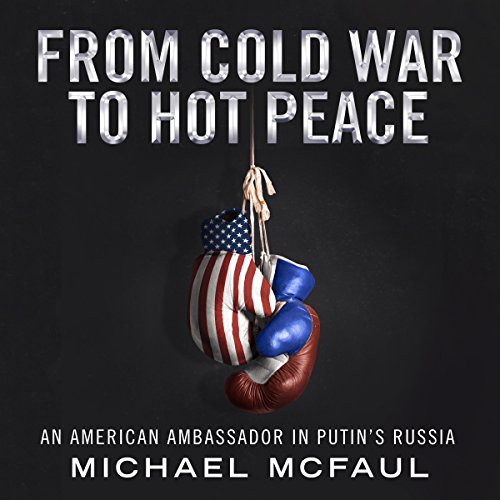
From Cold War to Hot Peace (An American Ambassador in Putin’s Russia)
By: Michael McFaul
Narrated By: L. J. Ganser

Michael McFaul (Author, American academic and diplomat, ambassador to Russia 2012-2014, former Professor of International Studies at Stanford.)
Not since George Kennan’s brief time as Ambassador to Russia in 1952 has an American ambassador been denied access to Russia. Michael McFaul became the second in 2016. McFaul joins the pre- and post-Obama election to become Obama’s ambassador to Russia from 2012 to 2o14. McFaul writes this book to explain his experience in the Obama administration, his understanding of Russia, and his tenure as Ambassador to Russia.
Interestingly, Condoleezza Rice recommends McFaul should join Obama because she was sure he, rather than McCain, would become the next President of the United States.

McFaul follows Rice’s recommendation and joins Obama’s campaign. Mcfaul’s grasp of Russian foreign affairs is insightful and relevant based on his personal experience. McFaul lived in Russia for a period of time when Gorbachev and Yeltsin attempted to liberalize Russia’s autocratic government. McFaul’s time living in Russia, his understanding of Russian language, and his study of Russian history at Stanford make his opinion in “From Cold War to Hot Peace” important.

Gorbachev’ biography shows he experienced the autocratic rule of Stalin’s U.S.S.R. as a young boy and found the courage to open the door to citizen’ freedom.
Mikhail Gorbachev was 22 when Stalin died. His ideal was to maintain the U.S.S.R. but with a system of government that rejected totalitarianism while freeing its citizens to improve their way of life. However, the shock of newfound freedom appeared an economic change too difficult and unfairly remunerative for the U.S.S.R. to survive as one hegemon.
A fundamental ingredient of independence is freedom.

When countries controlled by the U.S.S.R. were offered freedom, they looked to forms of democracy rather than autocracy. Gorbachev’s inability to accelerate economic growth to improve the lives of his country’s citizens doomed his goal to create a freer society within the U.S.S.R. Compounding his failure, Boris Yeltsin usurps Gorbachev’s power by arguing he has a better way of accelerating Russia’s economy to keep the U.S.S.R. together.

Boris Yeltsin talked the talk of democratic government but because of his inability to coopt the underlying authoritarian habits of former KGB operatives, he lost control of the government.
Yeltsin’s rise undermined the influence of Gorbachev, encouraged the departure of U.S.S.R.’ member countries, and gave an opening to Vladimir Putin, a former KGB officer. The KGB changed to the FSB in 1991 (along with Russia’s Foreign Intelligence Service) to become the right and left hand of Putin’s power and influence in the new Russia.
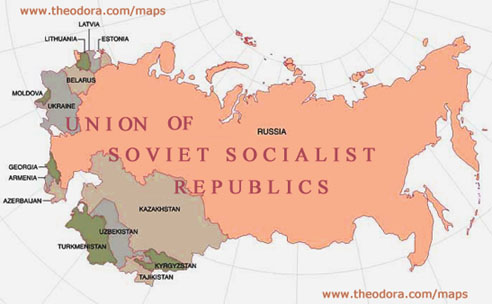
Fifteen countries leave the U.S.S.R. in 1991.
- Estonia: August 20, 1991
- Latvia: August 21, 1991
- Lithuania: March 11, 1990
- Armenia: September 21, 1991
- Azerbaijan: October 18, 1991
- Belarus: August 25, 1991
- Georgia: April 9, 1991
- Kazakhstan: December 16, 1991
- Kyrgyzstan: August 31, 1991
- Moldova: August 27, 1991
- Russia: December 12, 1991
- Tajikistan: September 9, 1991
- Turkmenistan: October 27, 1991
- Ukraine: August 24, 1991
- Uzbekistan: September 1, 1991
Gorbachev effectively ended the cold war, but McFaul argues the cold war turned into a “…Hot Peace”. Gorbachev was the last leader of the Union of Soviet Socialist Republics. His effort to democratize Russia fails even though he fully champions Valdimir Putin to become president of Russia in 2000.
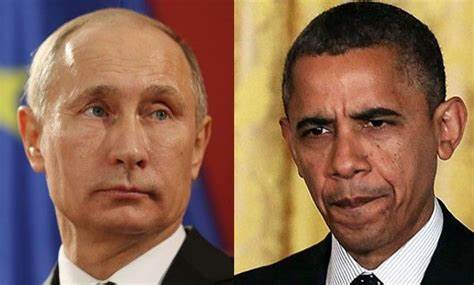
Putin took control of Russia as Prime Minister under Yeltsin in 1999. He later effectively became President of Russia for life.
McFall explains Obama became President of the United States in 2o09. Obama revised America’s relationship with Russia with what became known as the U.S./Russia “Reset” policy.
Obama’s “Reset” policy had some early positive effects. The relationship between America and Russia arguably improved despite their significant political differences. When they disagreed, they agreed to disagree. There were halting steps toward nuclear bomb limitation and greater cooperation on America’s actions in Afghanistan when the Taliban had shown support for Osama bin Laden after 9/11.
Putin rose to the presidency in 2011 and has remained effectively in control of Russia since 1999. Though not argued by McFaul, Putin’s intimate understanding of Russia’s secret service has given him the power to exercise dictatorial control over Russia. The history of U.S.S.R. since the 1917 revolution has been maintained by a secret service used to jail, torture, and murder any opposition to leadership of Russia. Today, that autocratic leader is Putin. There seems little reason to believe kleptocratic control of a massive secret service apparatus will be overcome without revolution. Every Russian knows of the threat the secret service has to any opposition to Putin who controls and has an intimate relationship and understanding of the organizational capabilities of the former KGB.

Gorbachev’s legacy is hope for a better form of government in Russia. Change is possible just as Gorbachev’s history as the secretary of the Communist Party from 1985 to 1991 proved.
One is inclined to believe change will come to Russia from a disaffected communist party leader who rises in the party and taps discontented Russians looking for change. If all one’s life is lived and raised in Russia, a Russian born change-agent like Gorbachev may, once again, be born
As one completes McFaul’s book, the threat of masculine blindness in world leaders is made clear. Leadership entails a power that corrupts leaders who think they know what is best for their citizens. Autocracies concentrate that power in singular human beings. Without checks and balances, autocratic beliefs inevitably lead to conflict and mutually assured destruction, Donald Trump notwithstanding.
 REVIEWS AND VIEWS OF LIFE