PHYSICS

Becker does not tell listener/readers anything new about reality in his book, but he outlines the difficulty Physics is having in trying to discover “What is Real”. For this reviewer, Einstein remains the sun around which Physics’ scientists revolve.

Books of Interest
 Website: chetyarbrough.blog

What is Real (The Unfinished Quest for the Meaning of Quantum Physics)

AuthorAdam Becker

Narrated By:  Greg Tremblay

Adam Becker (Author, science writer with a PhD in astrophysics from the University of Michigan and a BA in philosophy and physics from Cornell.)

This is an excellent story about the meaning of quantum physics even though the answer remains elusive. Becker does a great job of revealing the personalities of great physicists of the twentieth century, i.e. Niels Bohr, Albert Einstein, Erwin Schrödinger, David Bohm, Werner Heisenberg, John von Neumann, Hugh Everett III, John Bell, and to a lesser extent, Paul Dirac, and Grete Hermann.
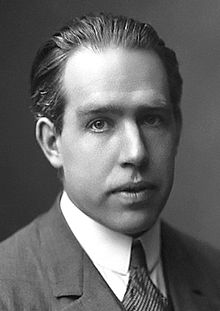
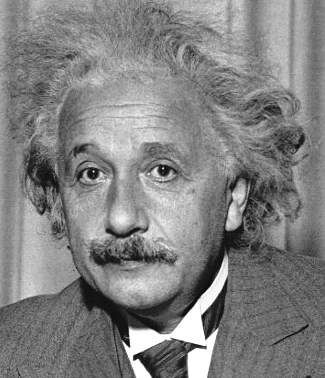
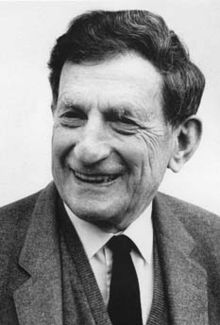
Bohr is shown to be a brilliant person who gathers the luminaries of physics around him like a queen bee to a beehive. Surprisingly, Becker notes Bohr’s abstruse and convoluted verbal and written explanations of physics cloud his brilliance but fascinate and inform young scientists. In contrast, Einstein appears like a sun that physics’ luminaries revolve around. Einstein never accepts the idea of quantum physics that implies we live in a probabilistic world. David Bohm is a brilliant physicist exiled for his political beliefs but importantly theorizes the Pilot-wave theory for quantum physics that suggests wave collapse is immeasurable and therefore meaningless. If true, the “cause and effect” world insisted upon by Einstein is correct. Surprisingly, Einstein demurred but the theory is being resurrected by Logical Positivist today.
Though Heisenberg creates the idea of Quantum theory that argues for a probability world, he becomes a Nazi science leader who fortunately fumbles the mathematics that could have created an atom bomb for Germany during WWII.

As a protege of Bohr, the theory of a Quantum world takes hold of scientists. John von Neumann is shown as a mathematical genius who challenges Bohm’s Pilot-wave theory because quantum mechanics appears to work and is proven by experimentation. Bohm argues, like Einstein, that the universe is fundamentally knowable and deterministic, not probabilistic. Hugh Everett III is taken under the wing of John Wheeler who is Everett’s PhD advisor at Princeton. Everett is characterized as a brilliant student who takes the idea of the disappearance of a collapsed quantum particle not as a collapse but an entry into another world, another dimension of reality.

Having read and partly understood many books about physics, Becker’s history is most entertaining because of added information about physicists’ personalities and disagreements, along with their personal trials and tribulations.

An added benefit is a little more understanding of physics that is offered to dilatants of science like this science ignoramus.
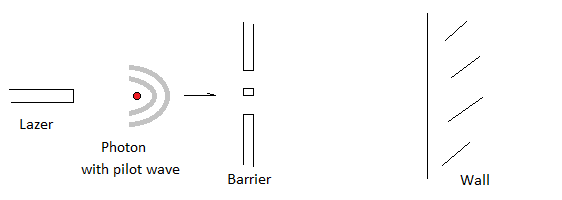
Pilot Wave Theory suggests the collapsing wave shown by quantum experiments is of no concern and that it should be ignored as a factor for non-predictability.

Putting aside collapsing waves in theoretical physics, the pilot wave theory, also known as Bohmian mechanics, was the first known example of a hidden-variable theory, presented by Louis de Broglie in 1927. Its more modern version, the de Broglie–Bohm theory, interprets quantum mechanics as a deterministic theory, and avoids issues such as wave function collapse, and the paradox of Schrödinger’s cat by being inherently nonlocal. This nonlocal experimental proof violates Einstein’s physics beliefs.

The surprising reveal in Becker’s history is the growing belief in Logical positivism which suggests the argument for quantum mechanics is flawed.

As one goes back to Bohm’s Pilot-theory. The surprising reveal in Becker’s history is the growing belief in Logical positivism which suggests the argument for quantum mechanics is flawed. The inability to measure both position and momentum is not proof of the theory because it is not an observable phenomenon. In a backward sense it implies Einstein is still the sun around which physics scientists orbit. An irony is that Becker believes Einstein would not want to be considered a Logical Positivist.

John Stewart Bell (1928–1990) was a Northern Irish physicist whose work reshaped the foundations of quantum mechanics.

Bell is best known for formulating Bell’s Theorem, a landmark result that showed how quantum mechanics predicts correlations between entangled particles that no local hidden-variable theory can explain. In one sense, that theory suggests as Einstein believed, that there is an undiscovered theory that will return physics to a cause-and-effect world. However, belief in non-locality is something Einstein could not accept. He refused to believe in “spooky action at a distance”. Bell was born in Northern Ireland. His fascination with science led him to CERN in Geneva where he worked on foundational questions in quantum theory.

Bell’s work laid the groundwork for quantum information science, including quantum computing and cryptography.

Bell came from a modest background and rose to prominence through sheer intellectual brilliance. He worked at CERN in Geneva, where he pursued foundational questions in quantum theory as a kind of “hobby” alongside his main work in particle physics. His 1981 paper “Bertlmann’s Socks and the Nature of Reality” used a quirky analogy to explain quantum entanglement and the Einstein–Podolsky–Rosen paradox.
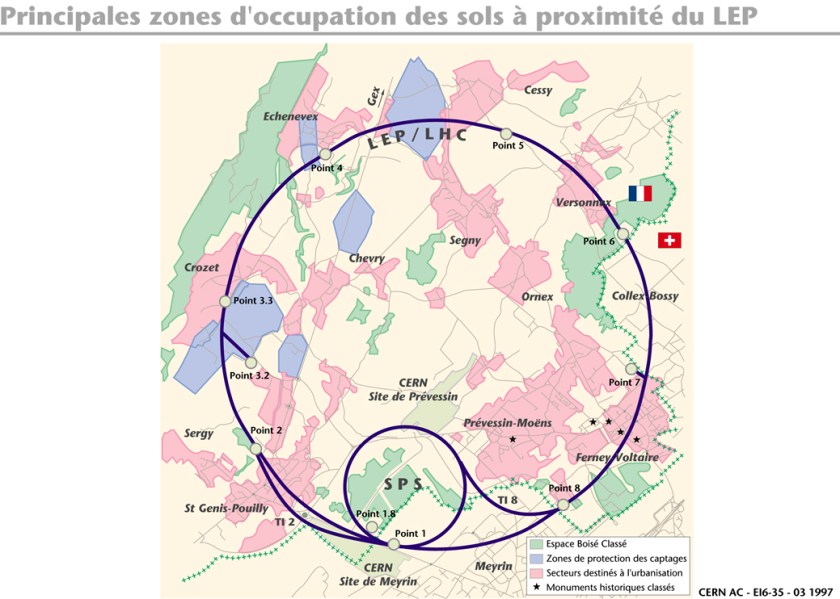
LHC MAP SHOWING CERN SITE

Bell wasn’t just a theorist—he was a philosopher of physics in the deepest sense, asking what quantum mechanics tells us about the nature of reality itself. Bell derived mathematical inequalities—called Bell inequalities. He believed that any local hidden-variable theory must obey these inequalities. However, quantum mechanics predicts violations of these inequalities under certain conditions. Bell is reintroducing the belief that quantum particles are fundamentally probabilistic and interconnected in ways that defy classical intuition. The universe doesn’t follow the rules of local realism. Quantum mechanics is correct, but it’s weird—deeply weird and challenges Einstein’s belief that physics are a local phenomenon that will be predictable based on an undiscovered truth.

Logical positivism and Bell’s Theorem intersect in a fascinating way. Bell’s Theorem challenges some of the foundational assumptions that logical positivists held about science, meaning, and reality. Because of “spooky action at a distance”, his theory defies Einstein’s belief in locality and reintroduces the concept of unpredictability which Einstein refuses to believe.

As a philosopher, Hermann (19o1-1984) had a particular interest in the foundations of physics. In 1934, she argues for a conception of causality with a revised view of quantum mechanics. Her work reinforces Einstein by returning Quantum Physics to predictability and causality. Hermann concludes–despite experiments that showing quantum mechanics are probabilistic, the theory is wrong because of a misunderstanding of nature. This seems like a cop-out supporting Einstein’s belief that there are some undiscovered laws of physics.

Becker does not tell listener/readers anything new about reality in his book, but he outlines the difficulty Physics is having in trying to discover “What is Real”. For this reviewer, Einstein remains the sun around which Physics’ scientists revolve.


THEORY & TRUTH

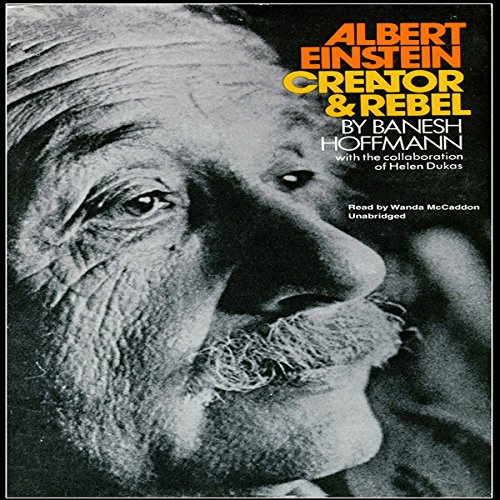
Without a doubt, Einstein was the premier scientist of the 20th century just as Newton was of the 17th. Though their characters were quite different, their thoughts and contributions to the physics of life on earth and in the universe remain world changing.

Books of Interest
 Website: chetyarbrough.blog

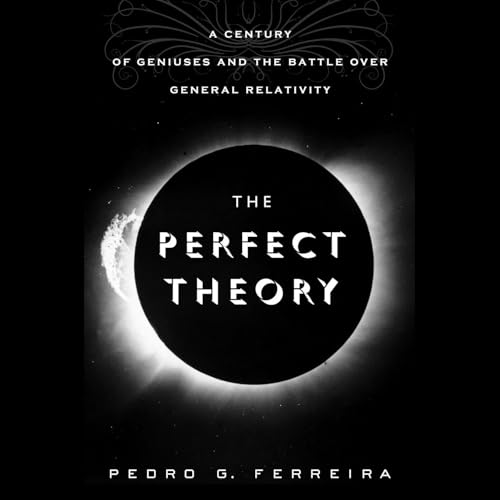
The Perfect Theory (A Century of Geniuses and the Battle over General Relativity)

Author: Pedro G. Ferreira

Narrated By:  Sean Runnette

Pedro Ferreira (Anglo-Portuguese cosmologist, professor at the University of Oxford with expertise as theoretical cosmologist and astrophysicist.)

“The Perfect Theory” is a history of physics that revolves around Albert Einstein’s brilliant discoveries in the early 20th century. Einstein believed in general relativity that included gravity and acceleration which he argued is caused by the curvature of spacetime. Einstein implies the equality of mass and energy is a precursor to the proof of general relativity. Ferreira argues that post twentieth century physics’ theories have only contrasted and expanded Einstein’s first discovery of the equivalence of energy and mass, which is a part of a “…Perfect Theory”. Einstein’s theory seems perfect in the sense that it is a foundational theory from which most discoveries about physics have been based. This seems hyperbolic with the experimental proof of Quantum Dynamics (a science theory describing the behavior of particles at atomic and subatomic scales), but the idea of a Quantum world seems only a tentative expansion, rather than refutation of Einstein’s “…Perfect Theory”.

What Ferreira shows is how Einstein‘s general theory of relativity shaped modern theories of cosmology.

Though Einstein believed the universe was an eternal existence, that never expanded or contracted, he had to create a cosmological constant to make that theory work. He began moving away from that belief in the 1930s. Edwin Hubble’s theory of an expanding universe led to the “Big Bang Theory” that turned what Einstein suggested was a vindication of his discomfort with the idea of arbitrarily devising a cosmological constant to make his vision of the universe work. (Interestingly, Einstein remained skeptical of the Big Bang model of the universe’s creation when its expansion was proven.) Edwin Hubble proved through observation and calculation that the universe was expanding rather than static. Later science discovery of “dark energy” is thought to be the engine for expansion which ironically revives the theory of Einstein’s cosmological constant.

Edwin Hubble (1889-1953, American astronomer.)

John Wheeler and Roger Penrose in the 1960s confirmed the existence of black holes based on Einstein’s concept of regions of the universe that would have such strong gravity pull that nothing could escape its attractive force. The belief that nothing could escape was challenged by Stephen Hawking who argued that black holes emit radiation and eventually evaporate. Nevertheless, it is Einstein’s early work that initiated further investigation and theory modification.

Einstein predicted gravitational waves that were not confirmed until 2015 by LIGO’s (Laser Interferometer Gravitational-Wave Observatory) detection. Einstein had predicted gravitational wave existence in 1916 but was uncertain whether they were physically real or just mathematical affects based on his thought experiments about massive accelerating objects, like orbiting planets.

LIGO (Located @ Hanford in the Tri-Cities of Richland, Kennewick, and Pasco in Washington State.)

Ferreira’s book explains how important Einstein’s legacy is in today’s understanding of the Universe, its creation, and possible future.

The most significant curve ball thrown at Einstein’s “…Perfect Theory” of the universe is Quantum Mechanics. Though he grudgingly acknowledged the experimental proof of Quantum Entanglement, he remained skeptical of quantum mechanics and its philosophical implications. The proven predictions of quantum mechanics shake the foundation of what Einstein believed about the universe. Quantum mechanics suggests the universe’s existence, whether it began with a Big Bang or not, is a matter of probability, not predictable certainty. Einstein’s theories were based on a belief in a clockwork universe–where cause and effect would explain everything about the physics of existence.

Though Einstein did not believe in a personal God, he believed in order, harmony, and rationality in a world that has a cause for every effect.

Twenty first century physics’ research owes more to Einstein than any other scientist in history. It is not that Einstein was or is infallible, but his theories are the foundation of physics research. His idea of a static universe may have been wrong, but the story of dark energy makes one wonder if his cosmological constant might have been right. Einstein was skeptical of the Big Bang theory as the origin of the universe despite it being the belief of most scientists today. Though he resisted quantum mechanics unpredictability, he acknowledged its experimental proofs with the caveat that there is an undiscovered law that will return predictability to the physics’ world. What Pedro Ferreira credibly argues is that Albert Einstein provided “The Perfect Theory” to explore truth and falsehood of the physics of the universe.

Without a doubt, Einstein was the premier scientist of the 20th century just as Newton was of the 17th. Though their characters were quite different, their thoughts and contributions to the physics of life on earth and in the universe remain world changing.

UNDERSTANDING SCIENCE

The immense downside of an unpredictive future is the many setbacks that will occur because of inept political leadership. Science is not an answer. It is only a tool for understanding.

Books of Interest
 Website: chetyarbrough.blog

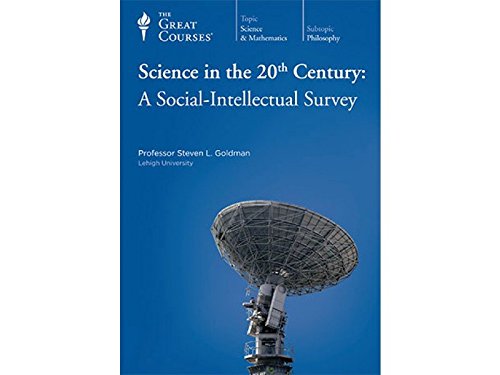
Science in the 20th Century (A Social-Intellectual Survey)

By: The Great Courses

Narrated By: Steven L. Goldman

Professor Steven L. Goldman.

Goldman’s review of 2oth century science identifies the fundamental change that has occurred in today’s perception of reality. One wonders if Albert Einstein was wrong about the predictability of science. Even at the end of Einstein’s life, he believed quantum mechanics was just a step in scientific research and not a basis for the truth of reality. Einstein insisted there was an undiscovered law about the nature of reality that would return life to predictability. The details of Goldman’s “Science in the 20th Century” infers otherwise.

Unpredictability of life’s existence is reinforced by Professor Goldman’s summary of scientific discoveries.

What is true of physics in the world, seems true for all the sciences. Whether reviewing the physical, biological, algorithmic, social, or applied sciences, unpredictability exists. Every science seems as unpredictable for the same reason as noted in the science of the quantum world. One cannot identity both position and momentum of an atomic particle at the same time. By the same measure, popularly elected representatives or authoritarian dictatorships cannot be measured by their position and direction of action. One can see a leader’s position but not measure their direction until the direction is past. Who would have thought Hitler would be the instigator of WWII? World leaders today are just as unpredictable. Citizens cannot measure leader’s positions and direction in advance. Citizens can only see one or the other at a specific point in time–never both position and direction at the same time.

What Goldman’s history of science implies is that if we live in a world of quantum mechanics, all life is, always has been, and always will be, unpredictable.

The solace in this possible truth is that, though there is still immense societal conflict and inequality in the world, science has improved society.

  • Technology has improved communication, transportation and daily life.
  • Vaccines, antibiotics, and surgical operations have drastically improved helath and life expectancy.
  • The world population has become more literate and has greater access to education than ever before.
  • Equality and justice show some progress in human rights, gender equality and social inclusion.
  • Enviornmental awareness has improved to combat climate change which has led to renewal energy innovations and conservation initiatives.
  • The world has increased connectivity to improve cultural exchange, economic collaboration and shared global interests.

Science is not an answer. It is only a tool for understanding.

The immense downside of an unpredictive future is the many setbacks that will occur because of inept political leadership. From the perspective of quantum mechanics, one hopes leadership means do not justify humanity’s end.

SCIENCE

Scientific discovery revealed the theory of evolution, the germ theory of disease, the laws of motion and universal gravitation, the theory of relativity, the discovery of DNA, drugs to cure disease, and quantum mechanics that imply future unpredictability. This is the daunting message of Goldman’s lectures.

Books of Interest
 Website: chetyarbrough.blog

Science in the 20th Century (A Social-Intellectual Survey)

By: The Great Courses

Narrated By: Steven L. Goldman

Professor Goldman received a B.S. Degree in Physics from Polytechnic University of New York and received a Master of Arts and PhD in Philosophy from Boston University.

Professor Goldman offers lectures on transformative scientific discoveries of the 20th century. He begins with great discoveries in physics by Newton, Einstein, Curie, Bohr, Planck, Heisenberg, Dirac and others who broaden a listener’s understanding of the universe, Earth, life, and humanity. He melds science into philosophy which gives a generalist an appreciation of genius and its limitations. From the limitations of microscopes, thermometers, spectroscopes, barometers, and galvanometers, Goldman draws lines between science’s experimentally reproducible facts and philosophy’s speculation.

Newton and Einstein had different understandings of the universe. Newton understood gravity as a force between two masses, subject to earth’s gravitation. Einstein redefined Newton’s gravity as a power exerted throughout the universe and between planets rather than one planet we call earth. Einstein proves the power of gravity is based on forces beyond earth though Newton’s interpretation is predictive of most physics’ phenomena on earth, it fails to predict the effects of time, space, and energy in the universe. Einstein’s discoveries lead to a theory of General Relativity where mass and energy are equal to each other and interchangeable. Newton viewed space and time as absolute while Einstein viewed them as relative. Newton’s physics were simpler to understand while Einstein’s required advanced mathematics that took into consideration the warping of space and time. To Newton, the speed of gravity was a constant while to Einstein, the only constant was the speed of light. To Newton two occurrences could occur simultaneously but Einstein recognized simultaneity is impossible. Any distance between the two occurrences will always be observed at the speed of light which means they cannot have happened at the same time because they cannot be in the same place. The speed of light controls the observation of action. Two occurrences cannot occupy the same space therefor they cannot happen simultaneously.
Professor Goldman explains the many utilitarian uses of great scientific discoveries from so many scientists that names become too numerous to be recalled.

However, without their discoveries, humanity would not have entered the age of Artificial Intelligence and the reality of information as an energy source in the world; not to mention the many scientific discoveries that have improved the lives of 8.2 billion people. (Another side of that story is the number of people killed by WMD, undiscovered cures for disease, and earth’s pollution by humanities use of known and yet to be known discoveries.)

Without fossil fuels, renewable energy, and nuclear power, humanity would still be living in caves, subject to nature’s choice. The importance of information is why we read books, listen to lectures, rely on remembrance of things past, and choose the course of our lives. As Shakespeare noted in The Tempest, “What’s past is prologue”.

Scientific discovery revealed the theory of evolution, the germ theory of disease, the laws of motion and universal gravitation, the theory of relativity, the discovery of DNA, drugs to cure disease, and quantum mechanics that imply future unpredictability. This is the daunting message of Goldman’s lectures.

ENTROPY, TIME, & LIFE

As one gets older, the principle of entropy takes on a personal meaning. Getting older may make one wiser but not smarter.

Books of Interest
 Website: chetyarbrough.blog

The Great Courses: “Mysteries of Modern Physics: Time” 

By: Sean Carroll

Lectures by: Sean Carroll

Sean Michael Carroll (American theoretical physicist and philosopher specializing in quantum mechanics, cosmology, and philosophy of science.)

Sean Carroll presents scientists’ views of time, entropy, and life. There are instances of his lectures that are too obscure for this reviewer, but for physicists the lectures are undoubtedly clearer and more concise than for this seeker of understanding.

Carroll explains there are four physical dimensions in the world. There is length, width, depth, and a fourth dimension called time. The first three are easy to understand because they are physical characteristics while time is not. Time cannot be seen, touched, or tasted.

Time is a fourth dimension measured by calendars and clocks that divide the past and present into days, hours, minutes, and seconds. Carroll notes knowledge of length, width, and depth are of the past and present while time points to an unknown future as well as the present and past. Einstein refined the definition of time by renaming it space time which combines physical dimensions with observers’ perception of events, i.e., where and when observations occur and where the observer is located. The significance of Einstein’s space time is that the location and traveling speed of the observer affects the perceived time of events. Carroll’s attention is about time as an arrow that only points forward. Carroll explains how events of the present and past can be defined while the future is unknown. An extended meaning of the arrow of time is that it seems unlikely (though not impossible according to Carroll and the current state of physics) that we can physically return to a past.

There is a significant distinction between entropy and loss of energy. Energy is always conserved but it may not be useable for work. Entropy is about increased disorder and randomness of energy states. Carroll defines entropy as a characteristic of matter in the world which is in a state of molecular disorder, randomness, and uncertainty. This definition is reinforced by the discovery of quantum mechanics which experimentally illustrates probabilities rather than certainty at atom-level interactions. (Einstein never accepted quantum mechanics as a truth of life but only a step of discovery in physics. Einstein believed there would be a discovery that incorporates quantum mechanics in an ultimately predictive physics world.) Carroll notes a theory that explains gravity along with the proof of quantum mechanics holds a key to whether Einstein is wrong when he suggested God does not play with dice.

An interesting note by Carroll is that transition from low to high entropy has an interesting effect in an experiment with two separate enclosures that are connected. One has gas molecules in it while the other does not. There is a hole between the enclosures through which molecules can enter. Over time the two boxes will have the same amount of gas through a process of equilibration. This reinforces the idea of conservation of energy while demonstrating energy transformation.

Transformation of energy is exhibited in animal life by its eventual death, but Caroll explains it equally applies to all matter in the universe. The idea of entropy is reinforced by the arrow of time that only points in one direction.

At an atomic level, all matter transforms over time.

Entropy does not mean loss of energy. Energy is always conserved but it may not have a useful work purpose. The second law of thermodynamics, postulated by Rudolf Clausius in the 1850s, explains that heat always flows from hotter to colder through the process of entropy. For example, a low-level heat energy may not serve a work purpose, but it still conserves energy balance. Raising the heat on a cube of ice transforms its molecules from a frozen state to water to steam which conserves energy that can generate working steam molecules to power an engine.

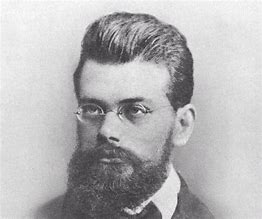
Much of Caroll’s lectures are an examination of Ludwig Boltzmann’s theory of statistical mechanics and kinetic theory. Much of Boltzmann’s contribution revolves around the concept of entropy and a detailed understanding of the behavior of particles in gases, liquids, and solids. He performed experiments that proved the conservation of energy and the equilibration of atoms and molecules as an observable phenomenon.

Boltzmann speculated that in the beginning of the universe, the chaotic activity of its beginning transformed into a lower state of entropy to create what we see in the world.

Ludwig Edward Boltzmann (1844-1906, Austrian physicist and philosopher.)

Boltzmann’s idea came before the theory of the Big Bang. The idea of the Big Bang actually presumes less entropy rather than more before the creation of the universe. Boltzmann’s idea is that the universe began in chaos (high entropy) to form what became known as a Boltzmann brain (low entropy), a thought experiment where a highly advanced brain formed in a void, from which the universe evolved. The Boltzmann brain is like the singularity of the Big Bang where cosmic dust condensed into a low entropy state and then exploded into our universe.

The origin of the universe may, in one sense, come from either a Boltzmann brain or a Big Bang. Both suggest the universe began in a low entropy state.

However, the Big Bang seems more reliably built on evidence by the measurement of an expanding universe with proven remnants (cosmic radiation) from a massive explosive event. Either theory implies the potential for a multiverse that began from a low entropy theory of our universe’s origin.

At this point in Carroll’s lectures, one’s head begins to hurt. He addresses the many ramifications of the origin of life. As one gets older, the principle of entropy takes on a personal meaning. Getting older may make one wiser but not smarter.

ENERGY MATTERS

The boon for composite material is their utility for work and play. Their bane is disposal and their effect on the environment.

Books of Interest
 Website: chetyarbrough.blog

“The Nature of Matter: Understanding the Physical World” (The Great Book Lectures)

By: David Ball

Narrated by: Professor David W. Ball

Professor David W. Ball (Professor of Chemistry and Chair of Chemistry Dept. at Cleveland State University, received Masters and Doctoral Degrees from Rice University,

Professor Bell offers a definition and description of matter in the universe. He carries on much of what is explained by Pollock in “Particle Physics”. Bell explains how physics particles form matter with the addition of energy, Bell reifies and expands Pollock’s history of physics. Though there is significant overlap in their presentations, Bell offers a more detailed understanding of matter with its component particles and the role of energy in what humans hear, feel, smell, and see.

Two facts about matter expanded by Bell are about energy’ component’s and structure’s interactions among and within atoms. Though Pollock alluded to the structure of matter and fully explains energy’s importance at the atomic level, Bell expands explanation of electrons and the way they provide energy within and between atoms.

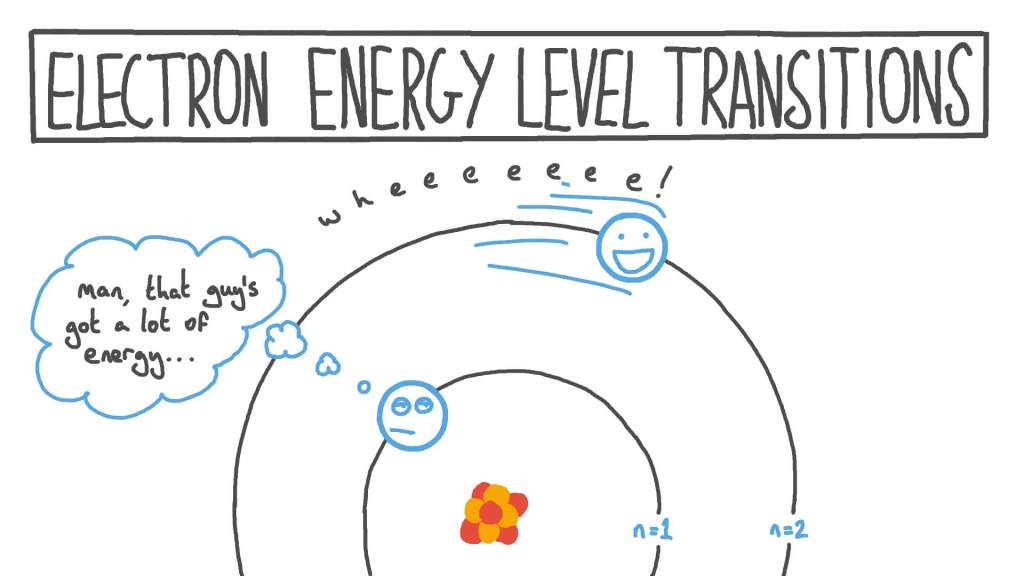
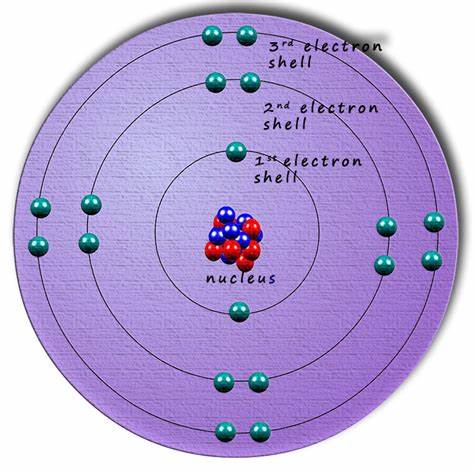
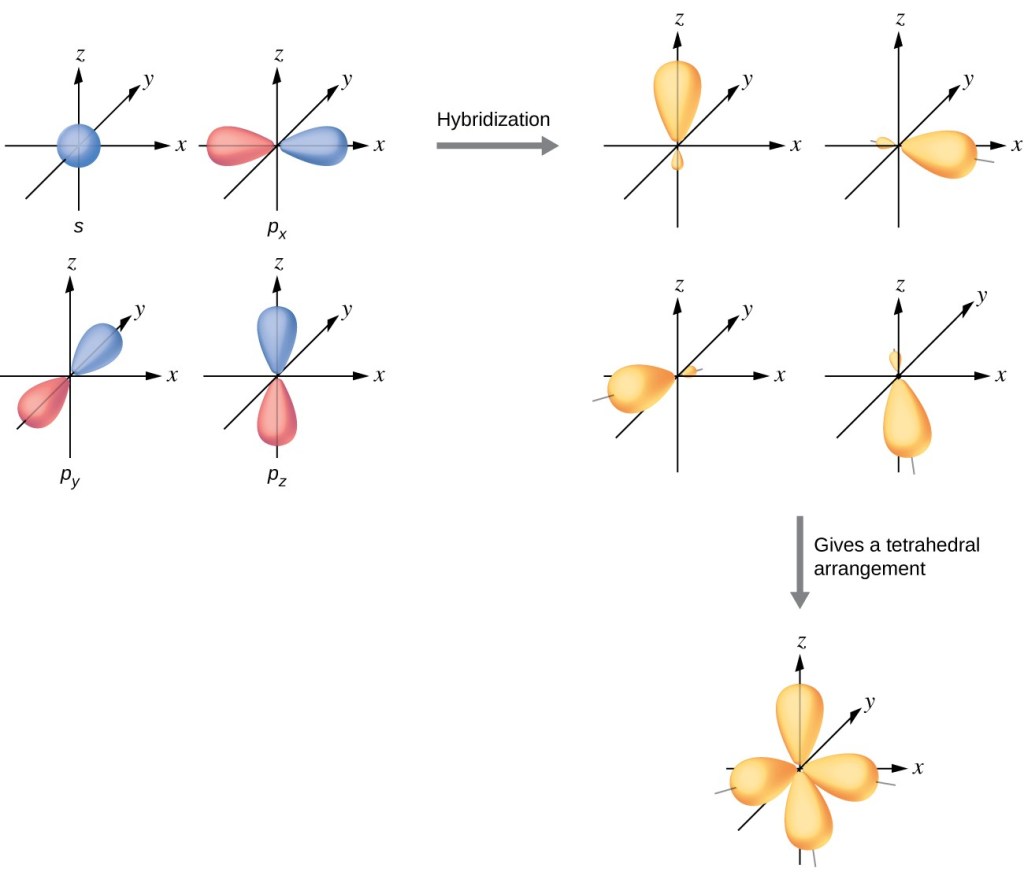
The structure of revolving electrons generate energy in different orbits around the nucleus of an atom. Initially, those orbits were thought to be like planets revolving around the sun but were found to be located within shells around the nucleus in three different orbits. These shells come in three categories. One is spherically symmetric (called the S orbital), the second is dumbbell-like with two lobes along specific axis’s (called P orbitals), and the third (which are also called P orbitals) follow a preferred direction that is not spherical. These shells are important because their reactivity and bonding play a critical role in the formation of matter.

Ball explains electron arrangement around the nucleus of an atom determine chemical properties and behavior of molecular interactions. Electrons are the wave feature of Quantum Mechanics that confound an ordered world of cause and effect postulated by Albert Einstein. What is made a little clearer by Ball is that color is an integral part of energy at the atomic level. Electron energy has discrete and precise energy levels that are arranged around the nucleus of an atom.

Without light particles (protons), energy would not exist. Ball notes electron energy is fundamentally affected by light.

Light or photons are the source of discrete energy levels called quanta that do different things–1) generate absorption, 2) cause transition between shell levels, 3) generate fluorescence, and/or 4) penetrate an atom’s dense nucleus to change mass to energy.

Ball explains why carbon is the most important element in the periodic table. Carbon’s importance is signified by its absence or presence in matter. Matter is either organic or inorganic with carbon being the measure of its classification. The astounding realization is that as a percentage of the earth’s elements, carbon is only 0.032% of our environment. (In contrast, the 3 largest fundamental elements on earth are oxygen at 46.6%, silicon is 27.7%, and Aluminum is 8.1%.) It is a reminder that earth’s living things (organic matter) are dependent on carbon, a miniscule percentage of our environment.

Without carbon, there would be no life (as we know it) on earth.

Ball’s chapter on water is an enlightening exploration of its reputation as a universal solvent with various uses and characteristics when boiled or frozen. Water’s dissolving and heat-storing capability are thoughtfully explained. Pollution is touched upon with explanations about what is being done and needs to be improved to preserve the world’s environment.

Ball explores prosthesis and material questions and solutions for the creation of body parts.

From dental fillings to tooth implants, to artificial hips, knees, hearts, arteries and breast implants, Ball explains how biochemistry and materials are critical to their manufacture and utility. He suggests the future will include brain implant enhancements and increases in human longevity.

In “Resistance is Futile”, Ball explains the value of superconductivity.

The current reality of world’ electrification is that 30% of its beneficial power is lost in transmission. Material qualities of our wired world inhibit electrical power conductivity. That 30% loss can be reduced by hugely lowering the temperature of transmission material, with the idea to invent a superconductive material that does not require super-cooled temperatures. Success in finding that material remains a work in progress. No one has found a superconductivity material that does not require super-cooled temperatures. However, Ball notes discovery would be an immense energy saver for the world.

In contrast to “Resistance is Futile” Ball notes “Resistance is Useful”.

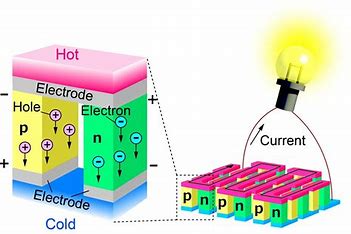
Ball explains how resistance creates heat in a semi-conductor that can be translated in a wired circuit to trigger a directed instrumental behavior or action. With the design of circuit boards with semi-conductors (specifically transistors), one could initiate or complete a series of tasks. From automating machines to creating powerful laptop computers, semi-conductor manufacture grew into an immense industry. As the complexity of tasks increased, the size of semi-conductors decreased. Gordon Moore proposed Moore’s law that suggested transistor’ size (a form of semi-conductor) in integrated circuits would become smaller and double every two years. Moore’s Law is not precisely true, but miniaturization, performance, and integration remain semi-conductor manufacturing’ goals.

The last lectures address composites and their component assembly in everything from concrete to fiberglass to tires.

These composites are formed from different materials based on their elemental properties that provide valuable materials to society. They are formed by atomic level interactions between elemental properties. Composite materials are noted as a boon and bane of society. The boon is their utility for new products for work and play. Their bane is disposal and their effect on the environment.

PHYSICS STANDARD MODEL

Was Einstein right when he said, “God does not play dice with the universe.”

Books of Interest
 Website: chetyarbrough.blog

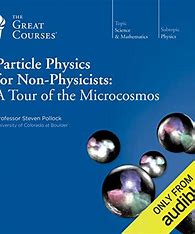
“Particle Physics for Non-Physicists: A Tour of the Microcosmos” (The Great Book Lectures)

By: Steven Pollock

Narrated by: Professor Steven Pollock

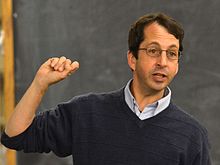
Steven J. Pollock (American professor of physics, 2013 U.S. Professor of the Year.)

Professor Pollock attempts to explain particle physics to non-physicists in this lecture series. The explanation details the contributions of many brilliant physicists and scientists that are generally well-known to most who wish to have a better understanding of physics beyond its mathematic proofs. Parenthetically, Pollock’s history shows few contributions to physics by women, a sad reflection on world society that ignores half the world’s intelligence.

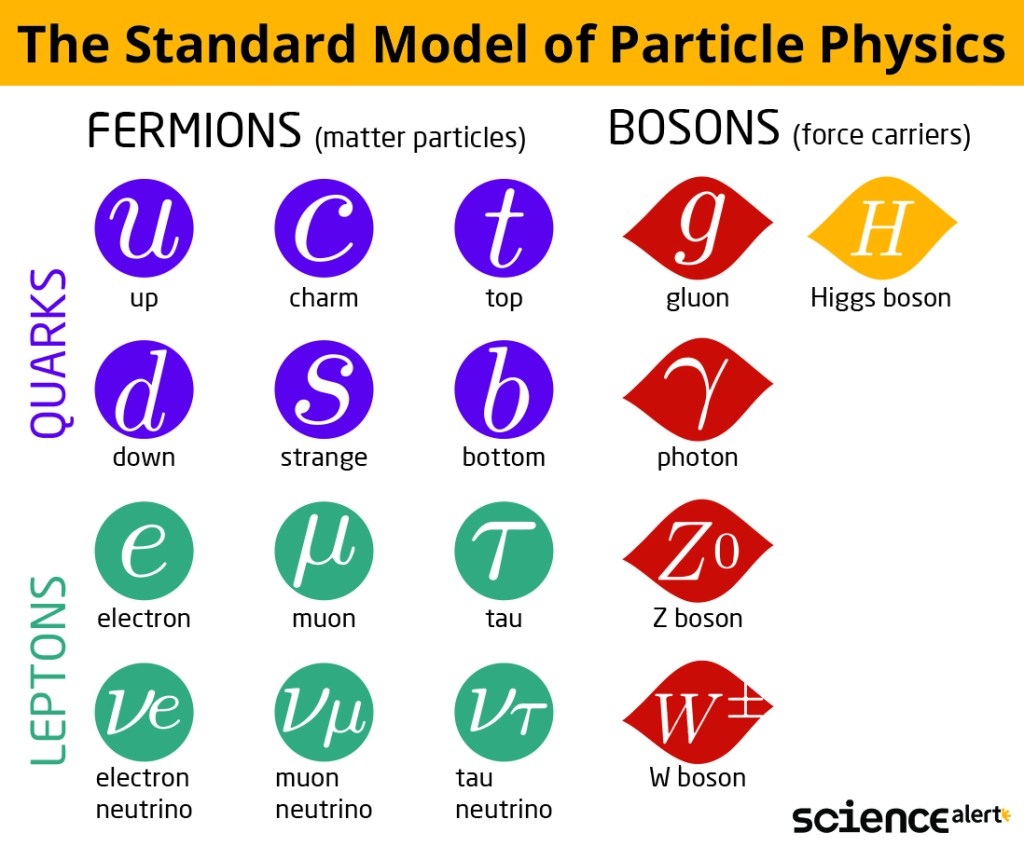
Particle physics is about the most elemental ingredients of the universe. Pollock notes the known elemental particles are either bosons or fermions which have been identified through various methods of breaking down the structure of the atom. Examples of bosons are photons, gluons, and bosons. Examples of fermions are electrons, quarks, and neutrinos.

Pollock explains fermions are the elemental particles that make up the matter of what we see. Bosons are the forces of the subatomic world that manipulate fermions. Pollock believes the standard model of physics has largely been determined and that there are unlikely to be any fundamental changes to that model. That conclusion reminds one of Lord Kelvin in 1900 who suggested “There is nothing new to be discovered in physics now.” In contrast, Albert Einstein noted “The more I learn, the more I realize how much I don’t know.” One wonders if Pollock is leaning toward a Kelvin perception of the standard model of physics by discounting Einstein’s observation about knowledge.

Higgs boson gives mass to what humans see in the world by combining the forces and matter of the sub-atomic world.

Pollock explains the evolution of research in identifying new elemental particles. Pollock notes the Higgs-Boson, the latest particle identified with the Large Hadron Collider in Geneva in 2021, suggests the same tool will lead to further particle discoveries. He explains how the LHC is the latest method for revealing unknown elemental particles by bombarding atoms with proton beams and heavy ions to discover the elemental ingredients of nature. The LHC’s ability to generate a high enough velocity to break the atom into its constituent parts remains a work in progress. Interestingly, Pollock expresses some reservations about the experimental proof of Higgs-Bosun because of the LHC’s unreliable replication of the Higgs-Bosun results. The LHC is shut down for an upgrade that will presumably prove or disprove the Higgs-Bosun discovery.

Will LHC and linear accelerator experiments find more fundamental particles for the standard model of physics? Was Einstein right when he said, “God does not play dice with the universe.” Pollock implies not.

Pollock, like many physicists, believes quantum mechanics are the way the world works at an atomic level and infers the distinction is like the difference between Newtonian and Einsteinian physics. Newton’s world of physics is about earth and its existence while Einstein’s view is of the universe. Both were right within their fields of analysis, but each assumed life exists in a deterministic universe.

It seems Pollock chooses to accept the atomic level of the world operates probabilistically while the macro world operates deterministically because both show experimental proof of difference. Einstein believed the difference would be resolved by further knowledge, i.e., knowledge that explains how there can be a difference between particle physics and Newton/Einstein’ physics that reasons both are ultimately deterministic.

WHAT IS REAL

The significance of Becker’s book is in his explanation of Bell’s theory that disagrees with Einstein’s theory of locality.

Blog: awalkingdelight

Books of Interest
 Website: chetyarbrough.blog

“What is Real” The Unfinished Quest for the Meaning of Quantum Physics

By: Adam Becker

Narrated by: Greg Tremblay

Adam Becker (Author, American astrophysicist, philosopher with BA’s from Cornell, and a PhD in the philosophy of physics from University of Michigan.)

Adam Becker explains a mystery that surrounds the concept of quantum mechanics. The theory of quantum mechanics continues to confound Einstein’s disagreements about quantum physics. No one, including Albert Einstein’s and Niels Bohr’s discussions, has fully agreed on the fundamentals of quantum mechanics. There are theories about quantum mechanics but proof about “What is Real” remains a mystery.

Becker explains in broad terms the Copenhagen interpretation of quantum mechanics. The Copenhagen interpretation came from the work of Niels Bohr, Werner Heisenberg, and Max Born. Study of the sub-atomic world is based on the Copenhagen mathematical theory created in 1925-1927. The theory argues quantum mechanics is inherently probabilistic, not deterministic. (The term probabilistic is only reference to a collapse or disappearance of an expected proton when sent through a split screen. It is not suggesting that quantum physics results are not reliable tools. Quantum physics has been found to be a reliable, accurate, and dependable tool for the desired effects when applied in the tech world.)

Interestingly, Becker suggests Werner Heisenberg tried to cover up his support and belief in Nazism. Becker suggests Heisenberg’s ineptitude as a manager of the research and experimentation process is the cause of Germany’s failure, not any sympathy for holocaust victims.

Einstein argues the only reason quantum mechanics appears probabilistic is because of an undiscovered fundamental law about the sub-atomic world. Einstein believes all physics theory must obey the law of locality which postulates physics laws must be based directly on related and surrounding causes.

Becker notes John Stewart Bell experimentally proves Einstein is wrong and that quantum effects violate the principle of locality.

Bell’s proof is mathematical and based on experiment. His calculations and experiment show two light particles can have spin characteristics that correlate with each other at a distance, non-locally. This quantum entanglement is dubbed “spooky action at a distance” by Einstein. Einstein, Boris Podolsky and Nathan Rosen argue entanglement (“spooky action at a distance”) is not proof of non-locality. Einstein believes there is an undiscovered cause for the appearance of non-locality’s entanglement. The argument against locality is called the EPR paradox after its theorists’ last names. Bell proves through experiment that “spooky action at a distance” is real and that the Copenhagen interpretation of quantum mechanics is wrong.

John Stewart Bell (1928-1990)

Bell’s theorem verifies that “spooky action at a distance” is no paradox by proving that quantum mechanics reflect a non-local phenomenon.

Hugh Everett, a physicist who studied under John Wheeler, published a paper with the idea that non-locality is evidence of another reality, another world with the same people experiencing a different course of life. The collapse or disappearance of a quantum particle is evidence of another reality, another world. For example, an incident of a near drowning would be survival in another reality that simultaneously exists in a different world.

Hugh Everett (1930-1982, died at age 51)

Hugh Everett proposed a many worlds theory of quantum mechanics based on Bell’s theorem of non-locality.

Everett was a student of physics professor John Wheeler who had worked with Niels Bohr.

John Wheeler (1911-2008)

Wheeler became an early supporter of Everett’s many worlds theory.

Wheeler popularized the terms “black hole”, quantum foam”, “neutron moderator”, and “it from bit”. He participated in the Manhattan Project during WWII and worked at the Hanford Site where he helped Dupont build a nuclear reactor in Richland, Washington. Wheeler became skeptical of the many worlds’ hypothesis in later years because of what he called its “metaphysical baggage”.

The significance of Becker’s book is in his explanation of Bell’s theory that disagrees with Einstein’s theory of locality. Einstein presumes missing variables will explain “spooky action at a distance”. Becker notes most physicists still believe in the Copenhagen theory of quantum mechanics despite Bell’s theory and proof that quantum mechanics allow for non-local affects. All the answers for “What is Real” proposed by Becker seem to contradict themselves or lack common sense. However, they still may be true or valid. They are just unproven or unobservable by repeated experiment.