
Books of Interest
Website: chetyarbrough.blog
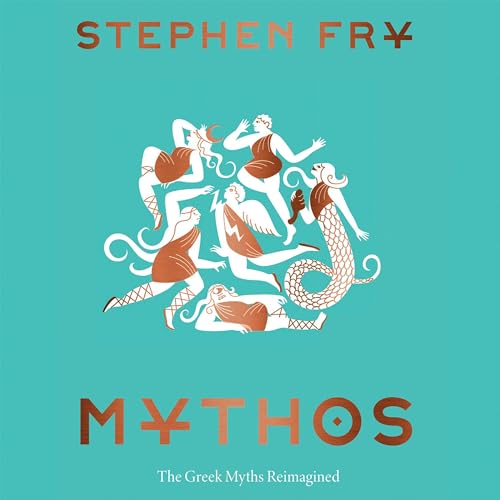
Mythos (The Greek Myths Reimagined.)
Author: Stephen Fry
Narrated By: Stephen Fry

Stephen Fry (Author, British actor and comedian.)
Most reader/listeners are familiar with the Greek gods associated with Zeus and some with his domicile on the island of Crete. It seems odd that Crete would be his chosen home unless one has been there and seen the beautiful island, walked the hills. and felt the warm breeze from the Mediterranean Sea. Stephen Fry fascinates his audience with cultural tales of Greece that meld the myths of gods before and after the birth of Zeus. His writing and narration are like a dramatic, terrifying, unfolding movie in one’s mind.

The origin of life myth is that earth and sky are married in human forms named Gaia (earth) and a father, born of Gaia, named Uranus (sky). They are the calm and storm of human life that is yet to be created. Gaia, the source of life, prophesizes the loss of power by Uranus at the hands of one of his children. To avoid the prophesy, when two of their offspring are ferocious beasts, Uranus forces them back into Gaia’s body to keep himself safe. Gaia is outraged by his cruelty and forges a sharpened sickle and chooses Cronus, a later son, to use it to kill Uranus. Cronus accepts Gaia’s order and attacks Uranus who defends himself but is castrated rather than killed by the first swing of the weapon. That castration severs Uranus’ rule of the cosmos with the dispersal of his privates and sperm that become today’s universe. He no longer rules the cosmos.
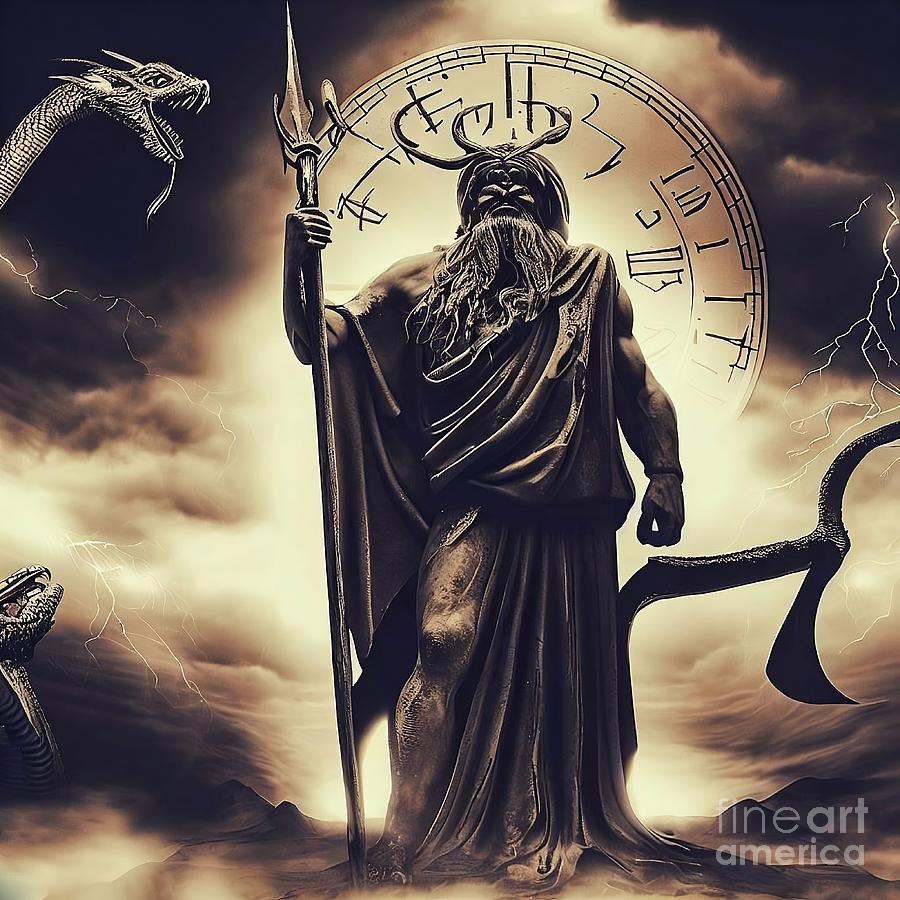
Cronus, the son of Gaia is the God of Time in Greek Mythology.
Cronus now becomes ruler of the universe but is also prophesized to fall at the hands of his offspring. Cronus marries Rhea, the sister of Gaia. Cronus knows of the prophesy and chooses to eat every child born by Rhea to avoid his fate. Rhea secretly wraps a stone in a blanket when she births Zeus and Cronus swallows the stone thinking another who might kill him is gone. Of course, Rhea is angry because of her lost children in Cronus’s stomach. Zeus plans to have Cronus drink a specially prepared potion that will cause Cronus to vomit up the siblings he has swallowed. Zeus imprisons Cronus after the freed siblings are returned to life. This begins the rise of the Olympian’ gods with Zeus as their leader.

One of the many gods of Zeus’s time is Athena, the goddess of wisdom and power. Athena’s father was the Titan of wisdom. Zeus had swallowed Athena’s father because of a fear that a child would be born that would surpass him as the all-powerful leader of the gods. There is a story of Athena’s birth from a blow to Zeus’s head because of a headache that would not go away. Athena bursts full grown out of Zeus’s head.
Fry explains Zeus is now becoming bored with his all-powerful life. He and Prometheus, another child of the gods, discuss creating mortal human life as a way of providing a new source of adventure and entertainment for the gods. These created humans become toys of the gods. Zeus and Prometheus search for the best source of clay to create humanity. Prometheus explains Zeus must provide some spit to create these new forms of life. So, humanity is formed from the spit of Zeus and the clay of earth. Prometheus is an artist who is described as a god of forethought and crafty counsel.
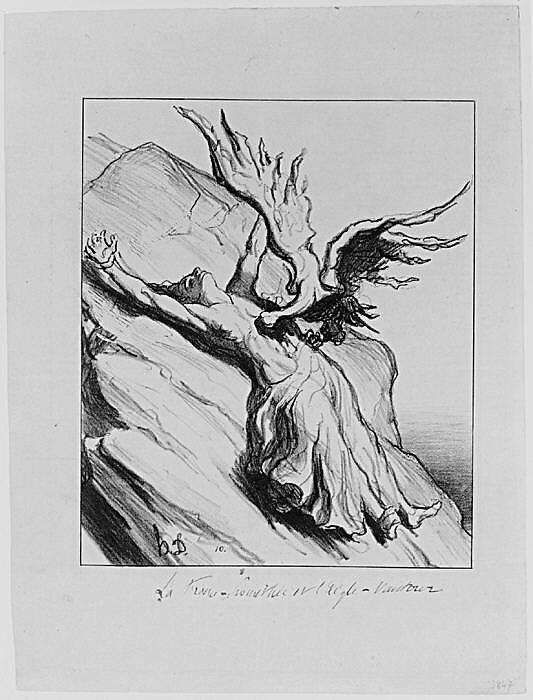
Prometheus and the Vulture.
However, Prometheus exceeds his authority by giving fire from the gods to man. Zeus is incensed and punishes Prometheus by chaining him to a rock. An eagle is initially planned to tear Prometheus apart every day to feast on his liver, but Zeus decides an eagle is too majestic for the task and turns the fowl to a buzzard. This occurs every night because of Prometheus’s immortality. Zeus treats people as toys for his amusement because he is incensed by their arrogance for having a power that only gods were to have. At this point, there are no female humans. With the creation of women, Zeus becomes threatened by humankind from increased procreation and capabilities that might grow to compete with the power of the gods.

Zeus (Leader of the Olympus gods.)
Zeus asks other gods to create woman, in part to complicate human life, which is a myth one could argue sets the table for gender inequality. The first woman is Pandora. This newly created woman is given a jar by Zeus and told not to open it for any reason without telling her what is inside the jar. She marries Prometheus’s brother and buries the jar under a sundial. However, her curiosity which is a “gift” given to her by Hermes, overturns the sundial, digs up the jar, opens it and releases the evils of life on the world. The only thing remaining in the jar is hope.
Before the invention and advance of science, Fry’s reminders of mythological beliefs level up to the brilliance of science in the world. One doubts life will ever be fully explained by science. One leans on the hope left in Pandora’s jar to arrive at a time when all human beings are treated equally.




 REVIEWS AND VIEWS OF LIFE