Good and bad luck accompanies every life but what happens in the end comes from what we have done in the past.
Books of Interest Website: chetyarbrough.blog
“The Twelve Lives of Samuel Hawley” (A Novel)
By: Hannah Tinti
Narrated by: Elizabeth Wiley
Hannah Tinti (American author, magazine editor, won the Alex Award for “The Good Thief”.)
Hannah Tinti writes a story about the life of a 21st century American outlaw, Samuel Hawley. He lives a peripatetic life as a robber, former convict, and part time collector for fellow criminals. When acting as a robber, he has few scruples about acting outside the boundaries of civil society. Hawley is a meticulous and practiced gun owner who wanders through America carrying the scars of bullets and a life of violence.
The woman he marries is alleged to have drowned in an accident but is believed by a grandmother to have been murdered by Hawley.
Hawley’s daughter, Loo, doubts the truth of her maternal grandmother’s claim but is faced with reports of her mother being an excellent swimmer, unlikely to be drowned as an accident.
Tinti leads the listener/reader to a conclusion about the drowning that on the one hand seems possible but on the other inconsistent with the complicated history of an American outlaw. Hawley’s moral center is at an extreme end of societal norms but within the boundary of truth and rightness. That truth and rightness suggests he could not have drowned his wife.
The dynamics of childhood are broken when either a father or mother are missing. Each parent contributes something to a child that is different when either are absent. Single parents become both bread winner and nurturer of a child when there is an absent parent. Hawley is a criminal who loves his daughter, idolizes his lost wife, and carries on with a life into which he was born. The peripatetic life of Hawley continues after the death of his wife. Now he is faced with raising a daughter on his own. They travel across the country, never truly becoming a part of one place or another.
The daughter becomes like her father in knowledge and love of guns and their use in America.
She emulates her father’s character by choosing to be in control of what she sees as a transactional world. It is the world her father has experienced and passes on to his daughter. Tinti shows Hawley deeply loves his daughter, grieves and idolizes his lost wife, but only views life as a societal transaction.
What we do in our lives have consequences. Good and bad luck accompanies every life but what happens in the end comes from what we have done in the past. Maybe life is just a transaction.
Reflecting on “Blood Brothers”, a listener understands America is a long way from the ideal of equality. Being equal does not mean everyone can be the greatest heavy-weight boxer in the world. Equality means every citizen can choose to be the best version of themselves without being repressed by the society in which they live.
Audio-book Review By Chet Yarbrough
Blog: awalkingdelight Website: chetyarbrough.blog
Blood Brothers (The Fatal Friendship Between Muhammad Ali and Malcolm X)
By:Randy Roberts Johnny Smith
Narrated by: David Drummond
Randy Roberts (Professor of History at Purdue)Johnny Smith (Asst. Professor of History specializing in Sports at Georgia Tech.)
Randy Roberts and Johnny Smith offer a nuanced and well-written view of Muhammed Ali, his fame, his skill as a heavy weight boxing champion, and figure head for the Nation of Islam (NOI). The author’s juxtapose Ali and Malcolm X as “Blood Brothers” who shed light on the unquestionable value and horrendous harm religious belief can impose on society.
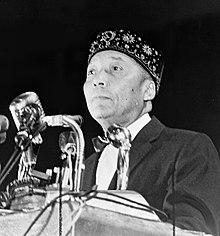
Roberts and Smith show human nature is an unconquerable beast that both leads and misleads humanity. The maturity and personal growth of Muhammed Ali and Malcolm X is revealed in “Blood Brothers”. They both become members of NOI, an American faction of Islam, that preaches Black America can only be equal through separation from non-black people. Elijah Muhammed, a self-proclaimed Messenger of Allah, creates a fellowship of Black Muslims (NOI) who insist on a Black American nation, independent of American governance. Elijah Muhammed insists–in order to become democratically free and equal to non-Black American citizens, an independent Black American nation must be formed.
What Roberts’ and Smith’s history shows is NOI’s flaw is in belief that separate can ever be equal based on race, religion, or color.
Though self-worth and pride can be immeasurably enhanced by exclusionary race, religion, or difference what is missed is the truth of human nature. Human nature is riven with self-interest based on money, power, and/or prestige. Elijah Muhammed and other leaders of religion are human. Religious leader’s self-interest drains the life out of Divinities force. In one sense, NOI offers a sense of pride and equality for Black Americans but in another, it creates further discrimination and inequality with separation and distinction from others.
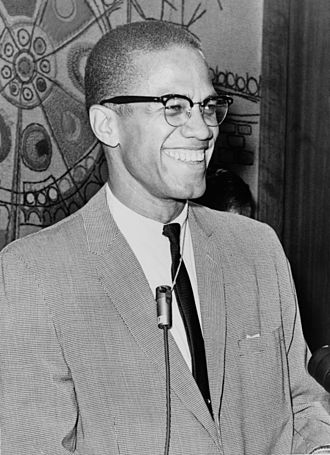
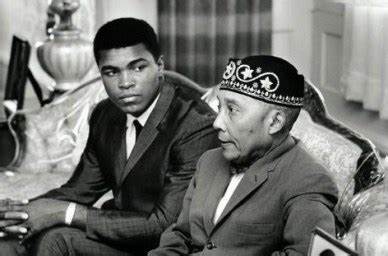
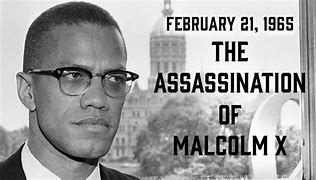
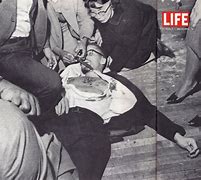
Malcolm X assassinated in 1965Ali and Elijah Muhammed
Roberts’ and Smith’s story of Malcolm X, and to a lesser extent, Muhammed Ali’s friendship, show how religion can bring people together, but also tear them apart. Malcolm X evolves from an intelligent street punk to an insightful leader of the Muslim religion. Malcolm becomes a favorite of NOI until he challenges its leader (Elijah Muhammed) for abandoning what he believes is a fundamental tenant of the faith, marriage chastity. Malcolm X exposes extra-marital affairs of Elijah Muhammed as evidence of the leader’s fall from faith. As his disaffection grows, Malcolm X begins to believe separate cannot be equal and that NOI’s belief in separation of the races is a violation of a faith that says Allah or God created all humankind.
Elijah Muhammad (Leader of NOI 1934-1975, Born in 1897 as Elijah Robert Poole, Died at age 77 in 1975.)
Malcolm X is a teacher of Ali before his break with the leader of NOI. Malcolm X appeals to Ali’s innate ability as a fighter and doggerel actor for truth and justice. Ali is put in the position of following Malcolm’s differences with Elijah Muhammed or staying within the Nation of Islam. The authors infer Ali looks at Elijah Muhammed as the father he wishes he had while Malcolm X as a brother who has been led astray.
To the authors, the assassination of Malcolm X by NOI’s followers is inferred by Ali to be a threat to his life if he forsakes NOI’ beliefs. When Elijah Muhammed dies, some years after Malcolm’s assassination, Ali revises his view of NOI and leans more toward the teachings of his former friend, Malcolm X. Ali moderates NOI’s anti-white sentiment.
Reflecting on “Blood Brothers”, a listener understands America is a long way from the ideal of equality. Being equal does not mean everyone can be the greatest heavy-weight boxer in the world. Equality means every citizen can choose to be the best version of themselves without being repressed by the society in which they live.
Francis Spufford (Author, received the 2017 Desmond Elliot Prize and Costa Book Award for “Golden Hill”, the author’s first novel.)
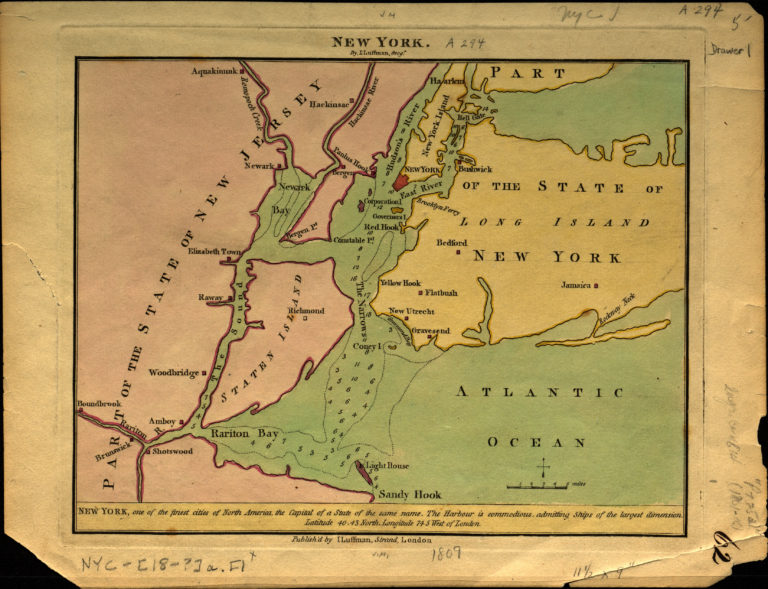
Francis Spufford captures a listener’s interest in “Golden Hill” with the idea of an Englishman sailing from London to New York City in 1746. New York City has a population of maybe 20,000, while London is a city of 630,000 to 740,000. What would a young Englishman with a 1,000-pound Bill-of-Exchange want in traveling from London to New York city? In today’s dollars 1,000 pounds would be over $127,000. The hero’s reason for leaving London for New York is not given until the end of Spufford’s story.
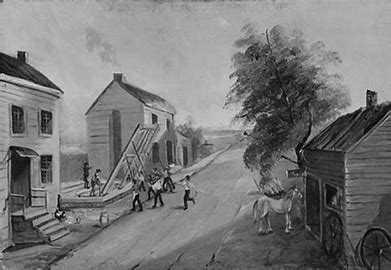
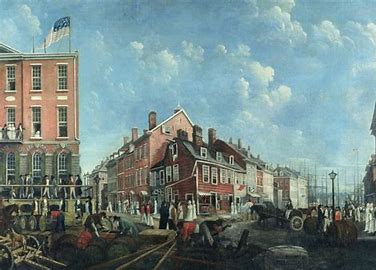
This is New York city in the 18th century. One could walk around the city in a day with its circumference less than a square mile.
This is a fascinating beginning to a story that gets bogged down by too many incidents that are mystifying until the last chapters of the book. The incidents are relevant to what it must have been like in 1746 but some listeners will become impatient for answers that could have been explained earlier.
New York City in 1746 is a mecca for protestants from many parts of the world. Spufford implies many New Yorkers are Dutch, a prominent ethnic group in wealthy New York.
Spufford’s hero is found to have a deep understanding of the theatre and its impact on an audience if an actor’s parts are well played. He attends a bad play that has an actress who, in spite of her poor lines, shows talent he recognizes. His appreciation of her acting leads to an unforeseen tragedy. This becomes a clue to the traveler’s perception of others and how unintended consequences impact one’s life. He seems to walk through life as though the City of New York is his stage. He plays his part, but his acting chops end with a mixed review.
Spufford’s hero appears to be accepted by the influential citizens of the city. At least, until it appears the Bill-of-Exhange is not going to be honored. The hero is thrown into debtors’ prison.
Debtors’ prison is an interesting place to write about. Spufford reflects on its barbarity in a confrontation with a fellow prisoner. The Bill of Exchange is eventually honored, and the hero is released. The next chapters address the repatriation of the hero to the Poo Bahs of the town and a woman of interest becomes more enamored with the traveler. The profile of the woman is somewhat unbelievable because of her implied business influence in a time when women have even less power than today.
The hero attends a party set up by leading members of the city that is, in part, to apologize for his mistreatment and to carry out whatever his mission is in the city. An interesting historical point of the apology is that America is primarily a barter system of exchange. Even though the traveler’s security is in English pound sterling, any negotiation for exchange is in goods, not cash. This is fine for the traveler’s purpose, but it reflects a point in American history that is often forgotten. There is no full faith and credit of a bank with gold or some other form of value to back-up American currency.
An interesting point Spufford reminds listeners of is the American’ anti-Catholic sentiment of the time.
One realizes how important Protestantism is in the foundation of America. The hero is almost killed by a mob that believes the traveler is a papist. Some historians have noted Protestantism is one of the deepest biases of early American citizens.
The reason for the hero’s appearance in New York is explained at last. To avoid discouragement of listeners, the purpose of the hero’s journey is not disclosed. “Golden Hill” is an interesting commentary on the tenor of an historic time, and it reveals some founding principles that trouble America to this day. The criticism of Spufford’s story is that it is too clever by half with a denouement too long in its revelation.
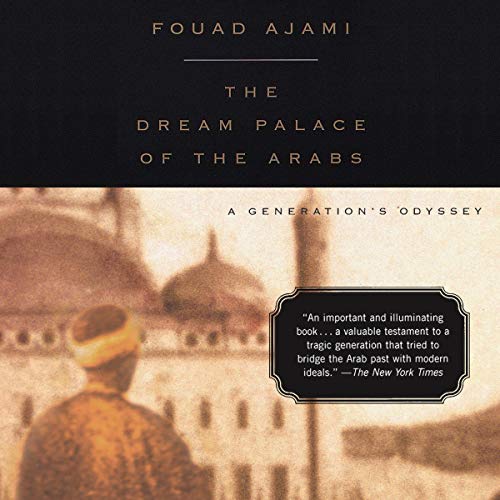
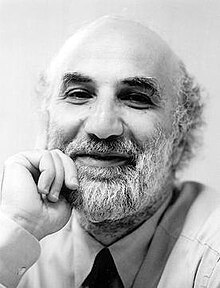
Fouad Ajami (Author, Lebanese-born American University Professor, former senior fellow at Stanford University’s Hoover Institution.)
Fouad Ajami offers a glimpse of Arab history in “The Dream Palace of the Arabs”. It is a glimpse because of Ajami’s personal view of Arab history as an Americanized Lebanese Christian. This is not to minimize his scholarly review but to contextualize objectivity, a weakness of all chroniclers of history.
A few years ago, having met and talked to a professor raised in Lebanon, the disruption of his homeland’s current internecine conflicts mystifies understanding.
The amount of detail offered by Ajami is difficult for a listener because of the many nuances of his enlightening history of the Middle East. The complicated mixture of different religions and Arab identities overwhelm a listener’s thoughts. Putting aside that concern, Ajami’s book is a treasure of facts and information a reader/listener will appreciate.
Arab culture is steeped in language as has been noted by other historians and writers.
One remembers the remarkable international, cosmopolitan, and sophisticated reputation of Lebanon. Some of Lebanon’s troubles are explained by Ajami. Lebanon, like Ajami’s history of the Middle East, is a complex ethnic, religious, and political country. Like the youthful history of America, the ancient history of the Middle East is riven with conflict. Ajami explains Arab identity often conflicts with religious differences in the Middle East.
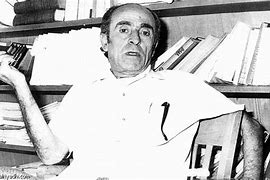
Khalil Hawi (Poet, 1919-1982, Lebanese poet,)
Ajami often refers to the beauty of Arab poetry and its reflection on and understanding of the complex relationship between being an Arab, a Muslim, a Christian, some other religion, and/or part of a particular familial sect. Ajami writes of Kahlil Hawi, one of the most famous Lebanese poets of the 20th century. Hawi commits suicide in 1982. Some say it was because of his resentment of other Arab government’s silence about the Israeli invasion of Lebanon in the so-called “Operation Peace of Galilee”, led by former Israeli Prime Minister Ariel Sharon.
Nizar Qabbani (1923-1998, Syrian diplomat, poet, writer and publisher.)
Ajami also recalls Nizar Tawfiq Qabbani, a Syrian diplomat, poet, writer, and publisher. Qabbani wrote about Arab empowerment against foreign imperialism and dictatorship.
Naguib Mahfouz (1911-2006, Egyptian Novelist.)
Ajami refers to Naguib Mahfouz Abdelaziz Ibrahim Ahmed Al-Basha, an Egyptian writer who won the 1988 Nobel Prize in Literature. He is more colloquially known as Mahfouz and is known for realist literature and existentialism.
Money is power and, as Lord Acton said, power corrupts.
Ajami’s references to Arab poets are not a mere side story. The poets offer insight into the tumultuous history of the Middle East. Ajami also addresses the impact of oil’s discovery on the political nature and culture of the Middle East. He argues the discovery and wealth of oil changed Middle Eastern culture that took on a more aggressive government posture toward modern borders, many of which were created by foreign governments.
Ajami addresses Saddam Hussein and his invasion of Kuwait.
He explains Saddam Hussein denied the history of borders among some Middle Eastern nations. Ajami notes Hussein looked at Kuwait’s oil riches as something due Iraq for its longer role as an independent nation. Of course, many Middle Eastern borders were changed by foreign powers. Ironically, Iraq only became an independent nation in 1932, Kuwait in 1961. The attempt by ISIS and Abu Bakr al-Baghdadi to create their own autocratic state out of existing bordered countries is another example of Arab leaders’ desire to rule the Middle East.
Anwar Sadat (1918-1981, President of Egypt 1970-1981, Assassinated.)
Ajami argues the assassination of Sadat reflects Arab discontent with ancient Middle Eastern countries history. Ajami acknowledges Sadat’s death is seen by some as a penalty for American influence in the Middle East. Many Arabs felt Sadat was an out-of-control authoritarian ruler in Egypt. Sadat’s imperial control was increasingly rejected by Egyptian citizens. Sadat’s peace agreement with Israel may have been a last straw.
Ajami believes Sadat became isolated from Middle Eastern intellectuals which made many more ambivalent about his leadership. There was a growing feeling that Sadat had abandoned his people, particularly poor and disaffected Egyptians.
On the other hand, Ajami notes Sadat’s assassination reinforces ISIS’ objective of consolidating Middle Eastern countries into one power bloc. Middle Eastern conflicts are shown to be more than differences in religions. The drive for independence from the West and consolidation of Middle Eastern political interests is an on-going movement.
Hosni Mubarak takes and holds the title of Egyptian President for 30 years after Sadat.
For a brief time, Mohammed Morsi and the Muslim Brotherhood ruled Egypt. After one year, the Brotherhood was overthrown by the military. The military intervened because they felt the Brotherhood did not have the experience needed to operate as a governing body.
The Muslim Brotherhood lasted for one year when the former military officer, Abdel Fattah el-Sisi, took power.
Having visited Egypt (if our guide is a believable measure of El-Sisi’s acceptance) governance improved. However, as tourists, we were told not to walk freely in the city without accompaniment. There was a tourist-bus bombing around the Egyptian pyramids when we were there. There is little doubt that conflict between secular and religious leadership in Egypt remains.
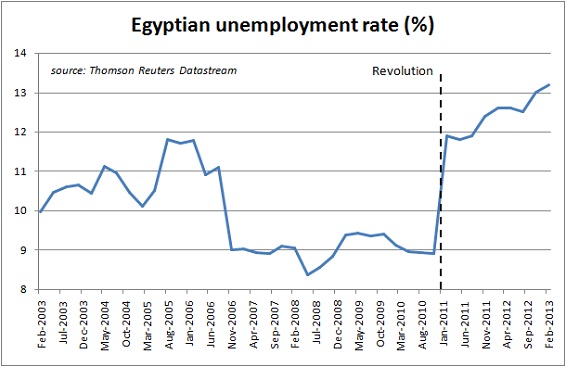
An insight Ajami offers about Egypt is its immense population growth and the impact it has had on governance. Employment for those who immigrated, some of which were highly educated, could not keep up with population growth.
Ajami infers discontent with Mubarak is only partly related to his authoritarianism. One might argue that the characteristic of power is that it corrupts fair and equal treatment of the governed. Governance, whether secular or religious, seems increasingly unmanageable in Egypt– causing citizen discontent before revolution, later, and now. One wonders how long El-Sisi, or any leader will be able to govern Egypt with the challenge of its population growth and high unemployment.
Religion will continue to roil the Middle East because equal opportunity and economic poverty leave few options to its citizens. Citizens often turn to religion when faced with insurmountable problems.
The last chapter of Ajami’s book eviscerates the Israeli/Palestinian “Declaration of Principles” agreement of 1993. It was a land for peace agreement. In retrospect, Ajami notes the agreement offered little peace and no lasting benefit for peace between Israel and Palestine. He notes the widening gap in economic growth between Israel and Palestine and adjacent countries like Jordan. Ajami notes Israel holds all the cards in the deal because Palestine only falls deeper into poverty and down a blind alley of dysfunctional statehood.
If human leaders cannot ameliorate the hardship of life, citizens are often left with only hope, faith, and belief in religion. Arabs, like all people of the world, are on their own. Their customs and beliefs are what they are because of the circumstance of their lives. Belief and hope in religion will evolve based on what works to reduce human hardship. One may turn to religion or secularism with each to play their part in human survival. The key is in the freedom to choose, without fear or favor, those aspects of religion or secularism that serve human peace and happiness.
This is your very first post. Click the Edit link to modify or delete it, or start a new post. If you like, use this post to tell readers why you started this blog and what you plan to do with it.























 REVIEWS AND VIEWS OF LIFE