Invisible Man, Got the Whole World Watching: A young Black Man’s Education
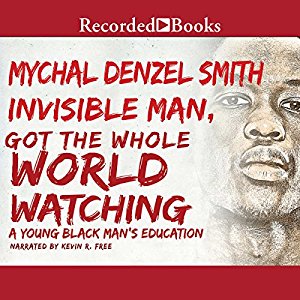
Written by: Mychal Denzel Smith
Narrated by: Kevin R. Free
MYCHAL DENZEL SMITH (AUTHOR)
Mychal Smith’s book is difficult to listen to for a white liberal; i.e. the difficulty is more because of what Smith sees than what he does not see. The necessary truth of what Smith sees is that being black, female, homosexual, or any color but white disadvantages citizens who live, work, and love in America. Smith correctly notes that Barrack Obama did not change that truth. But, for a liberal, Smith’s criticism of Obama is heart-rending.
No singular person will ever unwind history’s discrimination. That Obama is black and became the first black president of the United States proves being human is the best one can be.
Smith’s expectation is superhuman. No singular person will ever unwind history’s discrimination. Obama is an extraordinary human being by any standard of measurement. That Obama is black and became the first black president of the United States proves being human is the best one can be. Martin Luther King’s “arc of justice” still bends toward freedom and equal opportunity for all; despite the world’s, let alone Obama’s, failings.
The nature of humankind is an evolutionary work in progress. Sadly, evolution is a chancy proposition that moves human nature both backward and forward. Maybe, humanity will never get to a state of freedom and equal opportunity, but Obama’s “audacity of hope” is better than anger, and fear.
MALCOLM X (1925-1965, Malcolm X’s life experience and intelligence led him to believe all people are human beings.)
Smith cites Malcolm X as his ideal of black resistance but fails to note that Mr. Little evolved to believe separate but equal is a fiction. Malcolm X broke from the Nation of Islam because of its belief in Black separatism and superiority. Malcolm X’s life experience and intelligence led him to believe all people are human beings.
TRAYVON MARTIN
In being human, there is good and bad in every race, color, and creed. None of this denies Smith’s recognition of the questionable murder of Trayvon Martin, or the Jena Six debacle in Jena, Louisiana where a white high school student is beaten by five black teenagers. Both incidents are riven with racial hatred, lack of justice, and human failing.
Smith gravitates to violent lyrics to say the anger of rap artists appeals to his inner frustration. Smith recounts the considered statements of Kanye West when President Bush fails to conscientiously respond to the Katrina disaster in New Orleans. (West suggested Bush did not care about black people.) Ironically, Kanya West appears to support President-Elect Donald Trump who was sued for discrimination under the fair housing laws of the United States.
Ironically, Kanye West appears to support President-Elect Donald Trump who was sued for discrimination under the fair housing laws of the United States.
There are many incidents that Smith recognizes as the failure of white America to treat minorities fairly. At the same time, Smith is introspective in acknowledging some of his own human failings. He writes of his fears, his desire to be a great writer, and his earlier life failure to understand how important women’s rights are in the black community. He writes of his father’s concern over his sexuality and how gender discrimination has some of the same hatred, lack of justice, and human failing as black discrimination.
Listening to Mychal Denzel Smith is difficult because his observations explain why he, if not most, black Americans are disgusted with white America. It makes a white person feel guilty because white Americans are the majority; and, as a majority, white (particularly male) America has the bulk of the country’s money, power, and prestige. Until all people are humans first, there seems little reason to believe there is much hope for the “arc of justice” to bend toward freedom and equal opportunity for all.
Hope is not enough for black American’s suffering today. That is Mychal Smith’s message–too many blacks are being murdered; too many blacks are denied equal opportunity; too many blacks are jailed, and too many black families are broken.
What Smith fails to fairly acknowledge is who is at fault. All of us share the blame. Human beings must recognize the humanity of all human beings. If evolution is not the answer, then human will (in a Nietzschean sense) must come to America’s aid.
This is a story for those who have reached a certain age. Though written by a man, it is narrated by a woman. In some respects, that is a weakness. Having been written by a man, it may distort the measure of a woman’s life. However, Jonathan Evison offers an excellent representation of what life and death looks like to a man. The mistakes some men make in life are legion, both as a parent and husband.
Evison speculates on an afterlife that says humans either die into nothingness or go to a place of peace and reconciliation. Those are the only options in Evison’s story.
The options are extreme but can be ameliorated by a gate keeper’s decisions about life’s led. However, if you violate rules for a personal appearance to those left behind, you are doomed to the first extremity, nothingness. Evison’s husband’ and father’ character chooses to violate the rules; in part because of his many guilt’s for living a selfish life. It seems a penance he must pay to his wife, mistress, and children.
What makes Evison’s story good is the truth of what foolish, selfish men do in their lives. Though life is ephemeral; either temporal or spiritual, many mistakes are made, both moral and ethical.
Harvey Weinstein charged with rape and sexual misconduct on May 25th 2018.
There is the horrid obsession of men with little girls described in Nabokov’s “Lolita”. There is the vacuous life of Richard Ford’s main character in “The Sportswriter”.
There is Russell Banks’ depiction of a morally bankrupt man/boy who prostitutes himself in “Lost Memory of Skin”.
Putting aside these extreme examples, Evison tells a story of the more common variety of male transgressions. His observations ring true to listeners of a certain age.
Most men will see themselves in aspects of Evison’s story; not the extremes of Nabokov, Ford, and Banks but less than what a moral person should be.
Men who cheat on their wives. Men who use work as an excuse for family neglect. Men who fail to take responsibility for helping raise their children. Men who demean their wives because they undervalue their contribution to life’s fulfillment. Men who neglect their wives because of self-absorption.
Evison notes many faults in the lives of women in his story but having been written by a man, his objectivity is suspect. On the other hand, women do cheat on their husbands. Women do neglect their children. Women do drink out of boredom with house work and social isolation. Women do demean their husbands because they undervalue their contribution to life’s fulfillment. Women do neglect their husbands because of self-absorption.
Joe Biden (Candidate for President of the United States.)
Evison touches every human being’s faults in “This is Your Life, Harriet Chance”. No one is exempt from human failing.
Being of a certain age makes Evison’s story enlightening and entertaining. Enlightening because a listener knows they are not alone. Entertaining because a listener will enjoy Evison’s perspective on life’s journey.
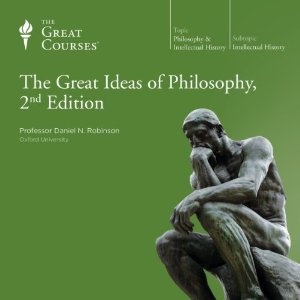
DANIEL N. ROBINSON (DISTINGUISHED PROFESSOR EMERITUS OF PHILOSOPHY AT GEORGETWON UNIVERSITY)
A conclusion that might be drawn from Professor Robinson’s history of philosophy is–Amy Coney Barrett’s religion cannot be a basis for dismissal from U.S. Supreme court nomination. To Robinson, a judge’s deliberation is based on living life in a world where science and religion are compatible.
God is not dead in Professor Daniel N. Robinson’s erudite and entertaining survey of “The Great Ideas of Philosophy”. Robinson’s choice and interpretation of philosophical ideas infers there is no contradiction of science in religion except in ignorant interpretation of one or the other.
In Robinson’s “Great Courses”, science and religion represent a marriage of necessity. Atheists, religious scholars, skeptics, and scientists may be appalled but Robinson implies nothing in religion or science contradicts creation, evolution, free will, or an omniscient and omnipresent God. Robinson concludes that it is beyond the ken of the human mind to approach an experimentally provable explanation of a prime mover; i.e. a source from which something came from nothing.
Robinson reviews the course of philosophy from the ancient Greeks to selected present-day philosophical ideas. He argues that science and religion explicate and complement knowledge of existence. Early heroes of philosophy range from Homer to Hippocrates to Aristotle. With storytelling and explanations of Stoic and Epicurean ideological movements, Robinson lays the foundation for philosophy’s growth.
Robinson recounts Homer’s tragic and triumphant stories of ancient wars, the medical philosophy of Hippocrates, and the testaments of Plato’s politics and Aristotle’s science. He credibly and creatively builds the foundation of philosophy. These great intellects pursue explanations for the unknown origin and nature of things and beings. Each pillar rising from the foundation reveals more questions than answers but inevitably point toward life’s purpose and understanding. Robinson argues that Aristotle is the first to develop a concept of scientific investigation through experimentation.
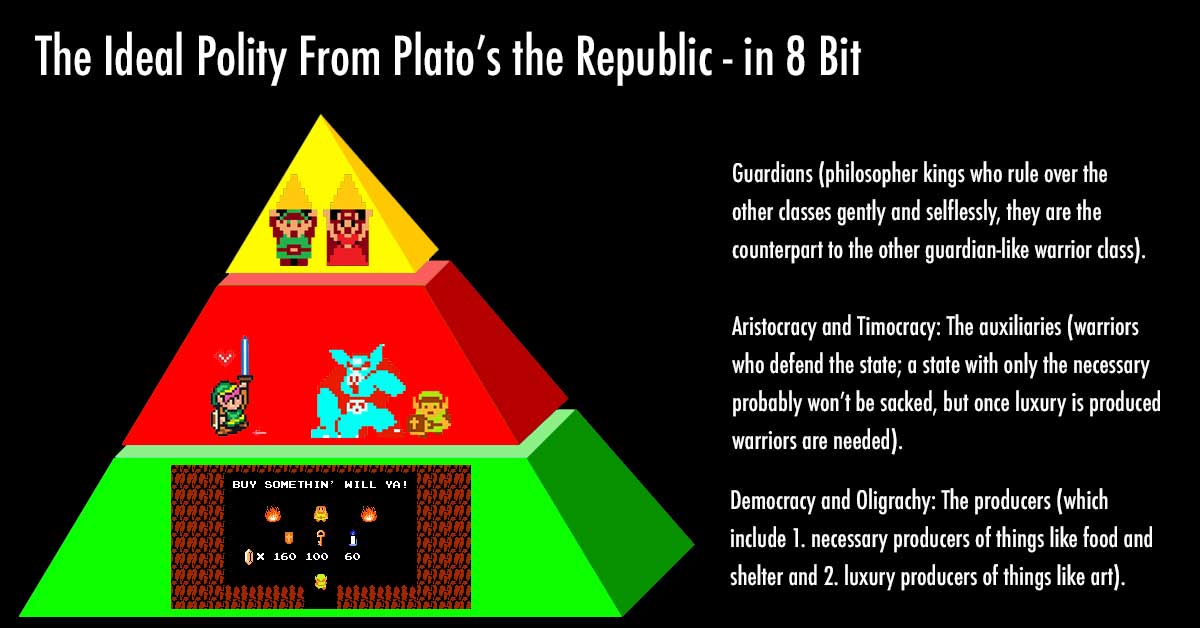
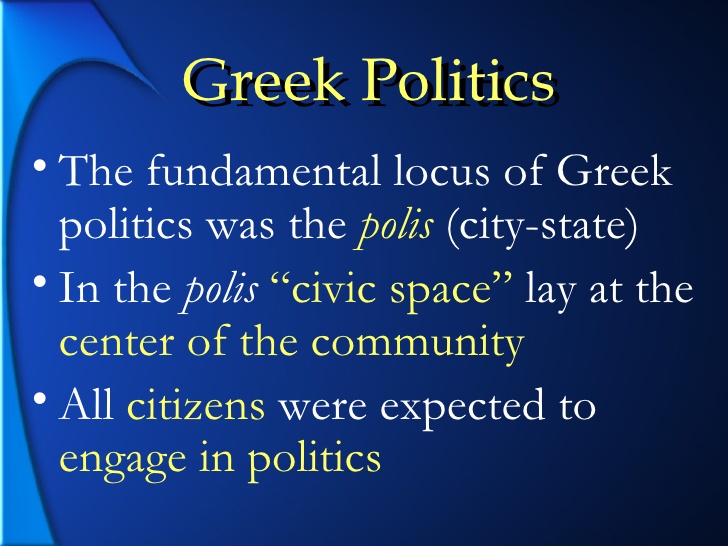
Aristotle owes some of the idea of science to Plato’s conceptualization of human nature in an idealization of a perfect city-state, or polis. One of “The Great Ideas of Philosophy” begins with Plato’s “Republic”. The scientific principle of Plato’s “Republic” is in investigating something bigger (the polis in this instance) to understand the nature of individual beings. It is a method of science for understanding the details of nature’s order by investigating a singular life within a social framework of something bigger. A city-state, the polis, is defined and idealized in Plato’s book.
Plato explains some citizens are born as warriors, as builders, as merchants, as slaves, and a few as philosopher Kings; each contributes to the well-being of a city-state. The whole is greater than its parts but each part is benefited by the whole. Every individual in a city-state, like every organ in the body, has a purpose based on what he/she does best. Plato’s “Republic” categorizes members of the Polis into functional groups based on virtue. Virtue is defined as being the best at what one does in their category of birth.
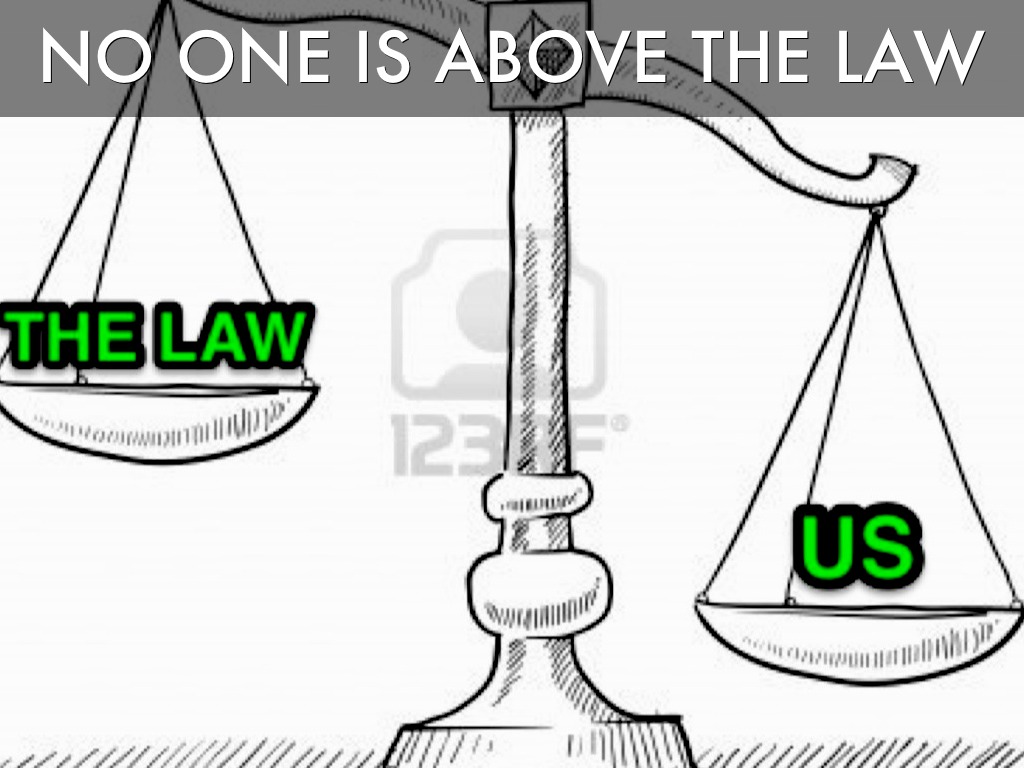
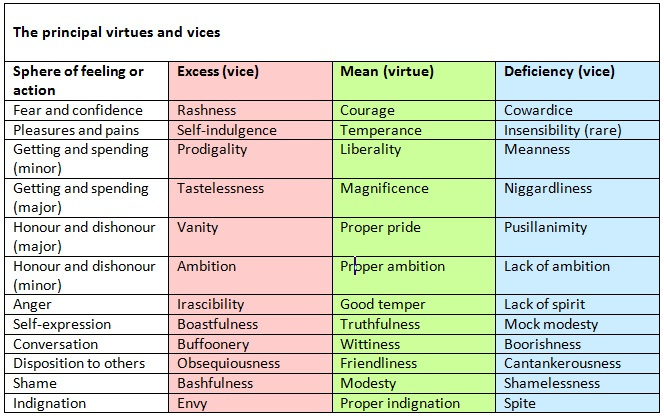
Robinson notes that the Socratic method of investigation comes from stories written by Plato. These stories are a precursor to Stoic philosophical development. Plato’s story of Socrates’ choice of death and his idealization of government in “The Republic” remove passion from decision-making. Virtue comes from dispassionately assessing the human condition and responding with a wisdom based on belief in justice, rule-of-law, and temperance. Aristotle expands on these ideas in the “Nicomachean Ethics”.
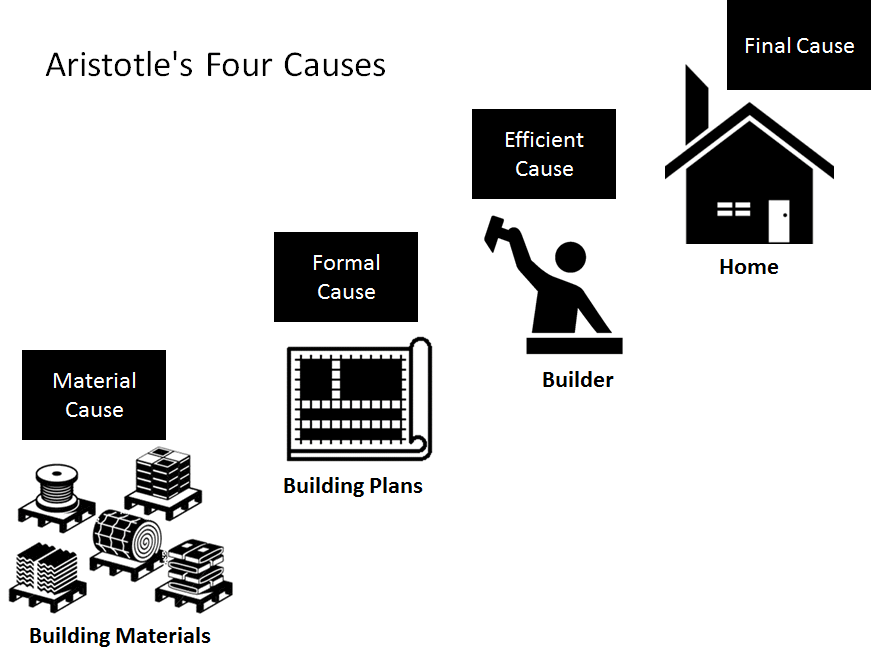
PRINCIPLES OF THE NICOMACHEAN ETHICS
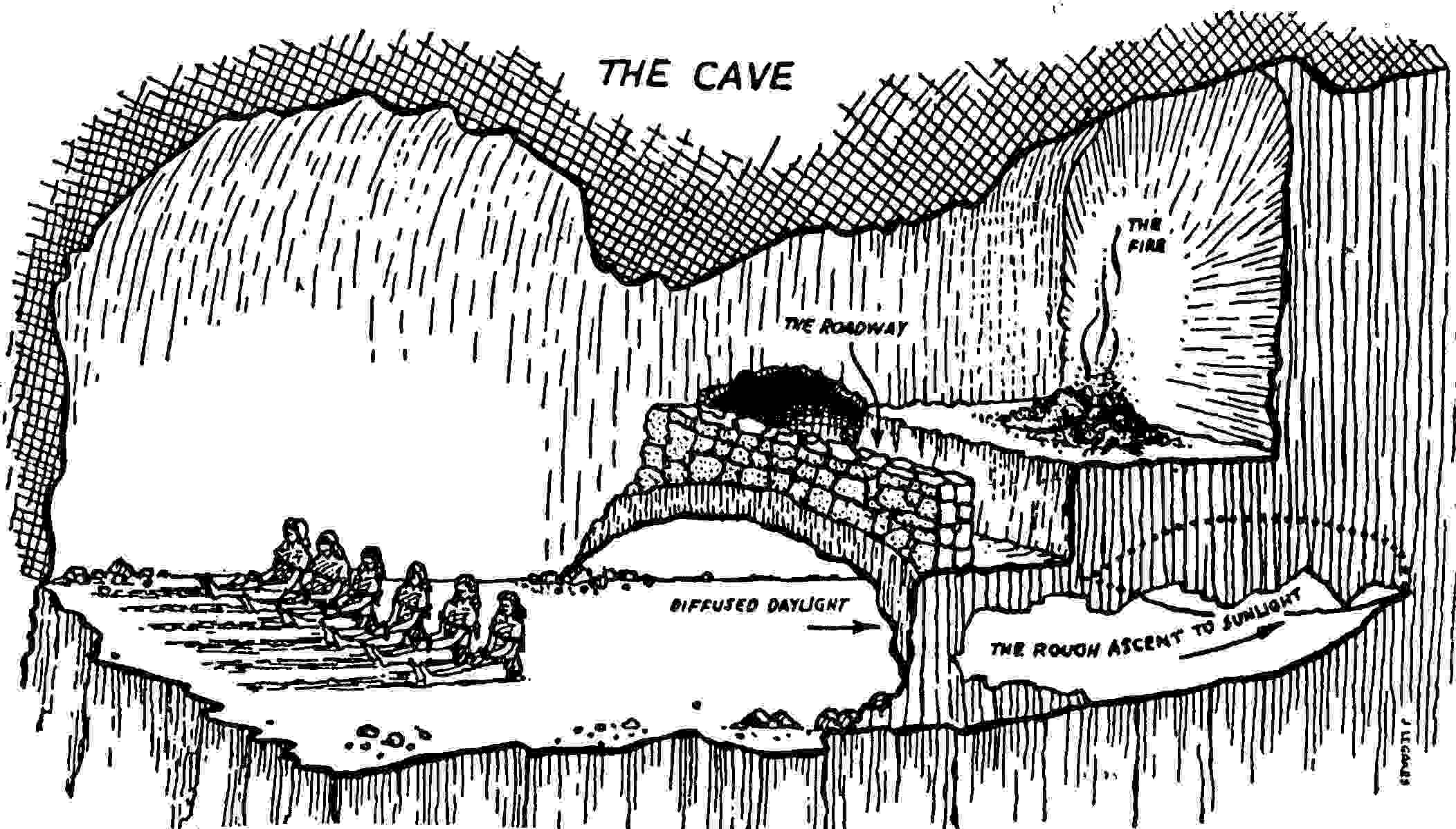
Plato’s parable of the cave in which humankind is chained; facing a wall and seeing only shadows of reality, exemplifies the difficulty of clearly knowing the truth of nature. Only in removing those chains can one begin to see and understand reality. As Plato’s story goes, those who see the truth are unable to convince those who remain in the cave. It is a story that is repeated in history as science progresses with fits and starts because of resistance from those who remain chained. Science progresses as experimental proof removes the doubts of the cave dwellers. However, Robinson notes that even when the truth is experimentally proven, doubt remains. He notes Karl Popper’s observation that infinite experimentation is impossible; therefore truth, at best, is a probability; not a certainty.
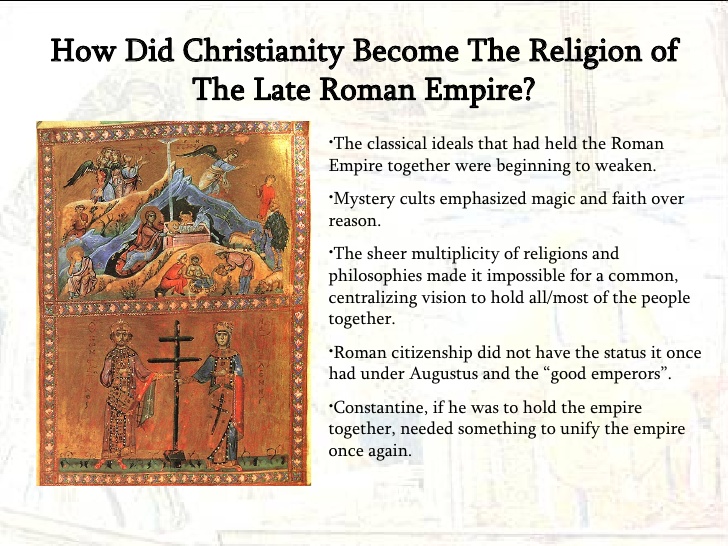
Robinson explains that the Stoic movement provides a bridge for religion to enter the secular life of the Roman Empire. The principles of Christianity provide a foundation for law within the Roman Empire. In offering a philosophical basis for dispassionate adjudication, Christianity becomes an essential part of Roman hegemonic influence.
The discipline of religion and law leads to the creation of the university, a citadel of teaching. The great religions of the world gravitate to this form of political and educational influence. Inquiring minds are stimulated in this environment.
The principles of scientific investigation reappear with a stoic influence that moves humanity to a more secular view of life and its purpose. Soon, the so-called Renaissance displaces the so-called Dark Ages. Robinson takes issue with these categories of history because he finds growth of human understanding in both eras. He also finds violation of human rights in both eras.
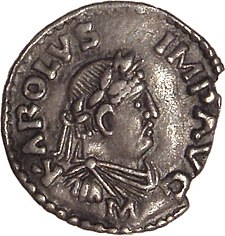
CHARLEMAGNE IMAGE (REIGN 12.15.800 TO 1.28.814, BORN 768, DIED 814)
The Frankish Emperor Charlemagne is noted as a prominent leader during the “Dark Ages”. He sets the stage for a modern Europe. The Magna Carta is created to reduce the monopolistic power of European monarchs.
Robinson suggests the seeds for Enlightenment are sewn during the “Dark Ages”. Influential monks like Benedict of Nursia became a model for most Western monasteries that dictated the lives of congregations. Giant strides in science and math were made in the Islamic world during the “Dark Ages”. Art and literature flourish during the rule of Charlemagne. The Agricultural Age and the development of community settlements is born in the “Dark Ages”.
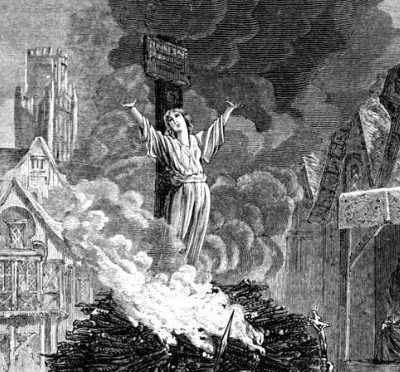
The brutality of the “Dark Ages” does not disappear in the Renaissance. Though the Renaissance is characterized by great leaps in knowledge from men like Francis Bacon, Machiavelli, Galileo, Bruno, Montaigne, Hobbes, and others; witches were burned at the stake for being agents of the devil.
WITCH BURNED AT THE STAKE
Witch hunting and condemnation aside, these early Renaissance men set the stage for Descartes, Newton, Locke, Hume, Voltaire, Thomas Reid and others. Many of these Renaissance men are deeply religious; however, they explain the world and human nature in scientific terms.
The mysteries of life explained by religious fiat are systematically replaced by “I Think; Therefor I Am”, “We build too many walls and not enough bridges”, “The end of law is not to abolish or restrain, but to preserve and enlarge freedom”, or “There is no greater impediment to the advancement of knowledge than the ambiguity of words.”
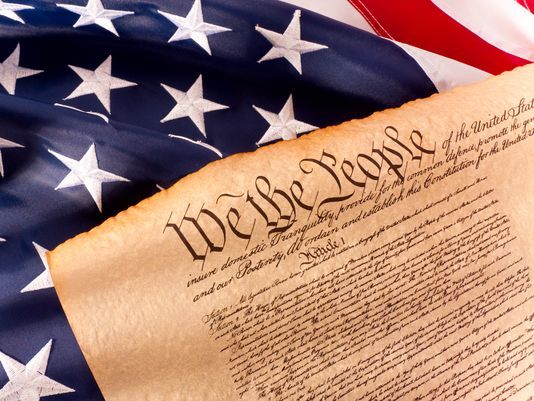
Robinson suggests that the American Constitution is a document created from the progress of Philosophy that began with the Greeks and evolved through social experimentation; founded on religion and science.
He particularly refers to the Federalist Papers and the participation of Madison, Hamilton, and to a lesser extent, Jay in writing the Papers to convince the American public of the need for democratic government.
Washington’s and Jefferson’s contribution to the establishment of an American government is founded on the tenants of religion and science. Religion inculcated morality and ethics for equality and justice for all. Science inculcated past social experiments to create a government of checks and balances.
Robinson offers more contemporary philosophical change wrought by Kant, Hegel, William James, Wittgenstein, and Turing but all revolve around two essential philosophical ideas. One, know thyself, and two, recognize we are chained to a cave wall; with little hope of finding truth accepted by all.
These lectures are biased toward western civilization but they offer insightful commentary on where western progress came from; what it is, who shaped it, and where it may go.





 Hope is not enough for black American’s suffering today. That is Mychal Smith’s message–too many blacks are being murdered; too many blacks are denied equal opportunity; too many blacks are jailed, and too many black families are broken.







 REVIEWS AND VIEWS OF LIFE