AMERICANIZATION

Blog: awalkingdelight
 Website: chetyarbrough.blog

“Girl Decoded, A Scientist’s Quest to Reclaim our Humanity by Bringing Emotional Intelligence to Technology”

By: Rana el Kallouby with Carol Colman

Narrated by: Rana el Kallouby

Rana el Kallouby (Author, Egyptian-American computer scientist and entrepreneur, founder and former CEO of Affectiva, Executive Fellow at Harvard Business School.)

Rana el Kallouby offers an autobiographical story of her personal journey from Egypt to America and her evolution from scientist to CEO of a facial recognition tech company. Though Kallouby’s story is personal, her experience shows what determination and commitment is required to start a tech company and grow it into something more than an idea. Of course, the underlying story is about American assimilation.

Egyptian women protesting inequality.

Growing up in Egypt in the 20th century, Kallouby experiences an upper middle-class life with a father who taught tech coding and a mother who works as a computer programmer for a bank. These were years of upheaval in Egypt and the Middle East for both men and women. Many educated Egyptian’s hired themselves out to work in other countries that needed technological help in business and finance. Women in the workplace in Egypt were less common than in the U.S. Kallouby’s mother chose to be both a housewife and a working mother who inspired her daughter to be more than a barer of children, homemaker, and companion to a husband.

Part of Kallouby’s early education is in Kuwait while her father works for the government.

She and her parents are there when Iraq invades Kuwait and when Gaddafi sets fire to the Kuwait oil fields when his invading army is ejected by American forces. Kallouby’s family returns to Egypt where Rana continues her education at the American University of Cairo. She earns a BA and Master of Science degree, and is subsequently admitted to Cambridge to pursue a Ph.D.

The tech experience of Kallouby’s parents lead her to an interest in coding.

That interest evolves into an idea about modern communication and its reflection in face behavior. The growing popularity of the internet diminishes personal contact that gives emotional context through facial expression. Kallouby begins spending a great deal of time coding facial expressions with the idea of creating recognition software to give more clarity to human communication.

Hosni Mubarak (1928-2020, Fourth President of Egypt.)

As a young Egyptian woman and as a devout Muslim, Kallouby chooses to marry a fellow Muslim who has his own tech business in Cairo. They buy a house and eventually have two children, a boy and a girl. As she commutes between Boston and Cairo, President Hosni Mubarek resigns under political pressure fomented by the Muslim Brotherhood. Mohammed Morsi is elected in 2012 as the new leader of Egypt. Morsi becomes Egypt’s President because of his religious background and support by the Muslim Brotherhood. Because of Morsi’s inexperience as a government leader and its troubled economy, Egypt’s military re-takes control of the government under Abdel Fattah el-Sisi in 2014. Though little is said by Kallouby about these events, her life’s journey continues.

Kallouby becomes obsessed with the idea of coding facial expressions.

That single-minded focus leads to further education in England and the U.S. After receiving a master’s degree, Kallouby chooses to seek a PhD at Cambridge with facial recognition as her thesis. Because of her chosen thesis, Kallouby’s education and drive lead her to an MIT lab in Boston.

This begins Kallouby’s Americanization which carries good and bad consequences.
Kallouby’s single-minded focus is two-edged. As a devout Muslim, she marries a fellow Muslim in Egypt. The person she marries is in the tech industry. He manages his own business in Egypt.

Kallouby’s travels between Egypt, England, and the U.S. create a growing disaffection in their marriage.

Though they manage to have two children, the strain of separation leads to divorce. The good that comes from Kallouby’s focus and ambition is evidenced by her success in being a co-founder of Affectiva. She did not do it alone and was aided by Dr. Rosalind Picard (the other founder), both of which were researchers at the MIT Media Lab. The bad is the personal price Kallouby pays in a divorce from her Egyptian husband and the hardship of being a single mother with two children.

Kallouby’s journey illustrates the great value of immigration to America.

Immigration comes with a personal price, but America is blessed by those who have the will and drive to make a better life for themselves and others. Kallouby’s story shows how religion, nationality, and personal ambition add to America’s prosperity. Kallouby became an Egyptian American with a foot in each country. Both Egypt and America are better for it.

PRICE OF FREEDOM

Mandela’s biography and today’s conflict between Hamas and Israel makes one ask oneself–Is a tenuous and ephemeral peace worth the death of innocents?

Audio-book Review
By Chet Yarbrough

Blog: awalkingdelight
 Website: chetyarbrough.blog

Long Walk to Freedom

By: Nelson Mandela

Narrated by: Michael Boatman

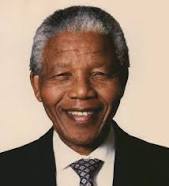
Nelson Mandela, (1918-2013, Died at age 95, South African anti-apartheid activist and politician, President of South Africa 1994-1999)

Nelson Mandela’s autobiography details the life of a remarkable and important leader of South Africa’s revolt against apartheid. Mandela began as a pacifist resister of white repression. However, his autobiography shows a change in belief from passive resistance to violence. (Mandela’s evolution from pacifist to belief in violence for social change is a reminder of the evolution of Malcolm X , the rise of the Black Panthers in America, and the Hamas and Israeli conflict in Palestine and Israel.)

Factions of the world today, like Mandela’s thought and action in the mid-20th century, believe in the utility of violence and terror for social change. The state of Israel, the territory of Gaza, and many countries of the world, like India, Lebanon, Iran, Hong Kong, Sudan, Libya, America, and others have political factions that believe they can change their societies with violence and terror. The conundrum of violence and terror is whether they proffer social gain or loss. The truth of gain or loss from violence and terror is being tested by the Hamas faction of Palestine and the conservative followers of Netanyahu in Israel.

The likelihood of a young African boy raised in a small village becoming President of South Africa beggars the imagination.

Mandela’s autobiography explains how it happened. There are 11 officially recognized tribes in South Africa. Mandela was born into the Thembu royal family, a subgroup of the Xhosa people. He explains his father, though not literate or formally educated, is a leader in his village. Mandela notes that his father had four wives and travelled between villages to spend time with each wife. When his father was away, his birth mother took care of him, but his father, as well as his mother, seem to have had great influence on his life. Mandela tells of walks with his father and the conversations his father has with other village members that mold Mandela’s beliefs and ambition in life.

Mandela notes his mother guides him to an important change in his life. When his father dies, his mother moves to a bigger village where he comes under the care of a regent of the Thembu tribe.

Mandela is effectively adopted into the royal Thembu family and moves into their palace. His ambition seems stimulated by that association and inspires him to become a formally educated South African.

Mandela receives a BA degree from Fort Hare in Alice, South Africa in 1943. He studied law at the University of Witwatersrand in Johannesburg. At that time, Mandela did not receive a law degree but was able to practice law because of a two-year diploma in law as an add-on to his BA. (When imprisoned, he studies, passes his University of South Africa’ law classes, and receives an LLB in 1989.) Mandela chooses to use his two-year diploma in law to become an advocate for Black liberation in South Africa. After graduation and his beginning practice of law, he is counseled by some to abandon politics to avoid arrest and intimidation by the government. However, Mandela chooses to join the African National Congress (ANC) in 1943. He becomes the co-founder of the youth league of ANC in 1944.

In his early ANC years, Mandela emphasized passive resistance like that practiced by Mahatma Gandhi in India. ANC had been formed in 1912 as a South African native congress but grew to become a multi-racial organization including all races and ethnic groups in South Africa. Mandela notes that the communist party was interested in being part of ANC’s role in liberating South Africans from apartheid. Mandela expresses reservation about the CPSA (the Communist Party of South Africa) but acknowledges its help in raising funds for an ANC army that was to be organized by Mandela as a militant resistance force to overcome apartheid. CPSA influence and ANC association became a part of the movement.

As a politician, Mandela had no experience in armed resistance. It is interesting that he is chosen to form the first ANC terrorist cell.

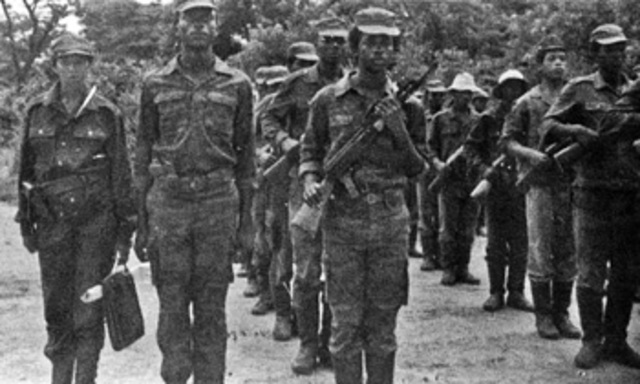
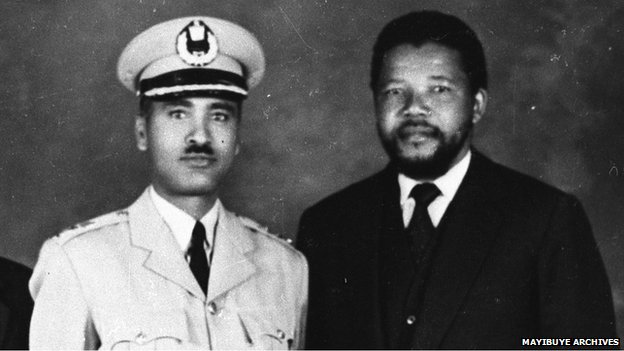
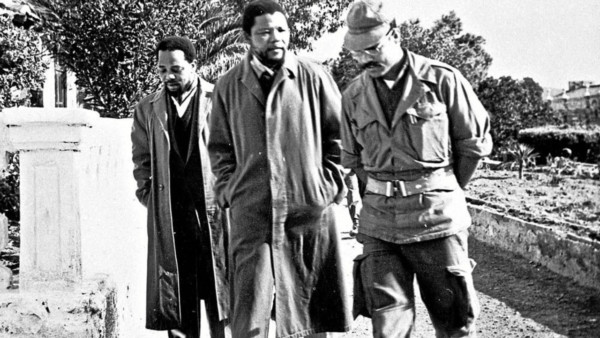
Mandela grows to believe political recognition requires violent resistance but also a personal ability to persuade others to join the ANC’ movement either financially or physically. Mandela is trained in Ethiopia by Col Fekadu Wakene on how to plant explosives and manage a volunteer army.

Col Fekadu Wakene taught South African political activist Nelson Mandela the tricks of guerrilla warfare – including how to plant explosives before slipping quietly away into the night. (BBC Africa by Penny Dale)

Ironically, Mandela is arrested in 1961 after only one action by his gathered volunteer army in December 1961. Whether the action is at the order of Mandela is not revealed but the resistance blows up an electricity sub-station. Mandela is arrested and serves 27+ years in prison for organizing the volunteer army which became known as Umkhonto we Sizwe (Spear of the Nation). Three years of trial led to a guilty verdict.

Mandela was arrested and charged with high treason along with his collaborators. The Rivonia Trial turned Mandela into a symbol of the struggle against apartheid.

The last chapters of Mandela’s autobiography is about his incarceration on Robben Island and Pollsmoor Prison and the conditions of his imprisonment. While in prison, Mandela continues his education to become a licensed attorney.

In the first two years at Robben Island, Mandela and his co-conspirators are restricted to their cells. Methodist religious services were eventually allowed but sermonizing about reconciliation offended Mandela and his fellow prisoners. Though much of what some ministers preached were offensive to the imprisoned, Mandela approves of one minister who looks at his religion through the lens of science as well as faith.

Mandela and his co-conspirators remain at Robben Island for 18 years before being transferred to Pollsmoor Prison in Cape Town. This is a significant improvement in their incarceration because of cell accommodations and food quality. However, his co-conspirators are separated from Mandela. Mandela is released in 1990, over 29 years after arrest.

Mandela explains a door is opened to the government of South Africa by Kobie Coetsee (1931-2000, died at age 69), the South African minister of justice and prisons.

In 1985, Botha was President of South Africa. Botha offered release to Mandela if he would unconditionally renounce violence against the government. Mandela refused and Botha denied Mandela’s release.

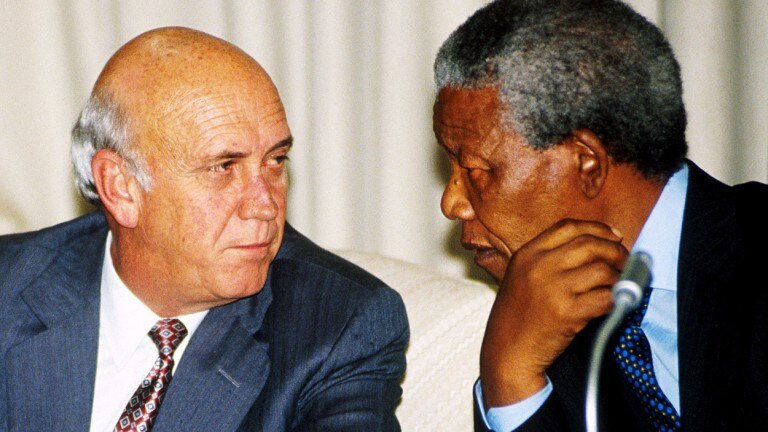
When F. W. de-Klerk became President of South Africa, after being Minister of National Education, a possibility for Mandela’s release was reopened.

Later, Mandela negotiated with de-Klerk to have his co-conspirators released from Robben Island and Pollsmoor. Further, Mandela negotiated with de-Klerk to have South Africa’s apartheid policies eliminated. President de-Klerk agreed, and Mandela was released in 1990. Both de-Klerk and Mandela receive the Nobel Peace prize for their negotiated peace agreement.

The last three-hour section of Mandela’s autobiography is about freedom and Mandela’s election as President of South Africa. The price of peace is high because violence seems a requirement for good-faith negotiation between opposing parties. Mandela’s biography and today’s conflict between Hamas and Israel makes one ask oneself–Is a tenuous and ephemeral peace worth the death of innocents?

(There is a brief interview with the author who aided Mandela in completion of his autobiography. It took two years of interviews and research to complete Mandela’s story.)

A FORENSIC’S LIFE

Forensic science is a valuable tool in the search for truth, and hopefully, justice.

Audio-book Review
 By Chet Yarbrough

Blog: awalkingdelight)
 Website: chetyarbrough.blog

The Nature of Life and Death

By: Patricia Wiltshire

Narrated by: Patricia Wiltshire

Patricia Wiltshire (Welsh Author, forensic ecologist, botanist and palynologist.)

Patricia Wiltshire details the magic of forensic analysis while revealing the history of her life. Wiltshire bluntly and forthrightly reveals as much about her life as she does about the details of victims of crime. Her forensic analysis aids law enforcement in indicting and arresting murderers and rapists. Wiltshire explains her forensic evidence often leads to admissions of guilt or, at least, a trail of evidence for courts to judge.

Wiltshire’s gathering of evidence is gruesome and will be off-putting to some but, as she notes, the body is a chemical construct that lives, dies, and returns to the earth from which it came.

Wiltshire’s belief is that there is no heaven or hell but only being and nothingness for a life that is either well or poorly lived. Wiltshire intersperses facts of her life that help one understand why she became a scientist who eschews God but appreciates life. The implied view Wiltshire has is that society is comprised of humans who think and act rationally and irrationally, with good and bad intent.

Wiltshire reflects on a tumultuous relationship with her mother, the care of her grandmother, and the philandering nature of her father. Her remembrances give weight to why she became a scientist and why she views life as a journey filled with both hardship and satisfaction, if not necessarily joy.

Wiltshire eventually reconciles with her mother and notes, before her mother’s death, that her mother loves and respects her accomplishment. Wiltshire reflects on the hardship of her deceased grandmother and how much of an influence both had on her chosen profession.

The evidence gathered by a competent forensic scientist from a dead and discarded body are precisely explained by Wiltshire. Because of her education as a palynologist (one who studies pollen grains and other spores), Wiltshire shows that human hair, a nasal swab, and the remains of intestine, gut, and internal organs can lead to the location, cause, and details of a victim’s death. With that evidence, the law may be led to the perpetrator of the crime.

A cautionary point made by Wiltshire is that law enforcement must not bias their search for evidence to corroborate presumed guilt. The objective of forensic investigations is to reveal truth, not to confirm preconceived notions of guilt.

The collection of evidence from a deceased human requires an objectivity and dissociation that makes Wiltshire’s book enlightening but brutal.

Wilshire’s biographic notes help explain how she is able to cope with life and an important profession. Her story may not be every book-listener’s cup of tea, but it clearly explains how forensic science is a valuable tool in the search for truth, and hopefully, justice.