
Books of Interest
Website: chetyarbrough.blog
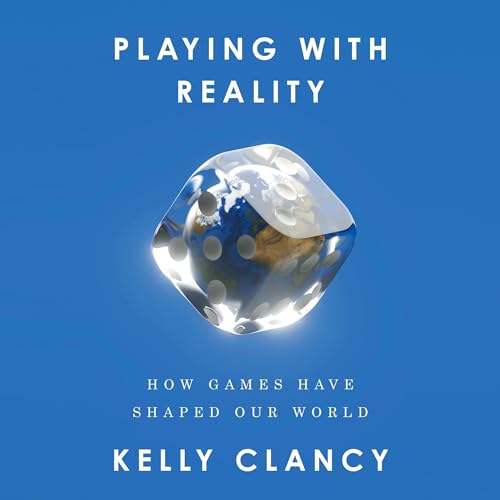
“Playing with Reality”
By: Kelly Clancy
Narrated By: Patty Nieman

Kelly Clancy (Author, graduate of MIT in physics with a Ph.D. in biophysics from U.C. Berkley.)
Kelly Clancy has a distinct point of view as a scientist. Her understanding of game theory and the mathematics of probability may steer reader/listeners away from her interesting book. “Playing with Reality” is less like playing and more like hard work, at least in the first chapters. Clancy begins by defining game theory and its permutations. Then she explains how it is a flawed tool for understanding human behavior. As one gets through the first chapters of her book, a reader/listener realizes Clancy is offering more than gaming theory history.

Clancy offers a detailed history of the growth of computer technology through the use of gaming programs designed to educate, entertain, and enrich private companies, public conglomerates, and individuals.
Clancy reveals the growth of chess playing gaming programs like Deep Thought, Big Blue, and Deep Blue to expose the battle line between human and artificial intelligence. Clancy is a skeptic of gaming technology–with a warning.

Clancy’s skepticism lies in mistaking game-theory’ studies as proof of predictive human behavior.
Clancy notes human behavior is not predictable for many reasons; one of which is human irrationality, and another is a human’s sense or understanding that he/she is being manipulated for prescribed responses. For example, in the first instance, a person may be irrationally afraid of all snakes even though there are no poisonous snakes in their State. In the second instance, a person who knows the theory of something like the “Prisoner’s Dilemma” can choose to modify their behavior and respond based on knowledge of previous experimental studies.
John von Neumann (1903-1957, Hungarian American mathematician, physicist, computer scientist, engineer and polymath.)

The troubling part (the warning) revealed by Clancy is that brilliant people like John von Neumann, an intellectual giant of the twentieth century, can have bad ideas. Clancy notes von Neuman considered preemptively nuking the Soviet Union because he reasoned it would (and it did) successfully create a nuclear bomb soon after America’s bombing of Nagasaki and Hiroshima. Neuman presumably considered this a rational option based on game-theory thinking.

Today, one wonders what Russia’s leader is capable of with nuclear weapons if he considers them just another tool of war.
Clancy notes Putin, like the President of the United States, is legislatively authorized to unilaterally choose to use nuclear weapons to protect what they believe is a threat to their countries. The gaming industry and the growth of A.I. are not the problem. Human nature is the problem. There are not enough checks and balances to keep well intentioned Presidents or bad actors from making bad decisions.
Clancy shows how the computer gaming industry has obscured the tragic consequence of violence by returning murdered life in a game back to life so they can play the game again. The game is not real, but the lesson is that gun violence is ok because it is just a game that can be replayed. Computer gaming has become a gateway to violence in the world. Easy access to guns is a problem in America but guns are instruments of violence, not the cause of violence. Among the causes are, poor education, poverty, mental dysfunction, and gaming that distorts reality.
Political position and power are dangerous in the face of human irrationality, a not uncommon characteristic of intelligent, ill-informed, or uncaring political leaders. In this age of computer drones and face recognition, three American citizens, one Iranian citizen, and an Egyptian’ Al Quada leader were killed by drone strikes at the order of American Presidents.





These murders may or may not have been justified but they exemplify the danger of gaming, face recognition, and the future of artificial intelligence. Clancy tempers her assessment of gaming in the last chapters of her book, but some will come away from her positive comments with a sick feeling in their stomach.
The near assassination of former President Trump is a harbinger of a world unduly influenced by today’s technology and media influence.

 REVIEWS AND VIEWS OF LIFE