
Books of Interest
Website: chetyarbrough.blog
The History of Money (A Story of Humanity)
Author: David McWilliams & 1 More
Narration by: David McWilliams

David McWilliams (Author, Irish economist, former Central Bank of Ireland and UBS economist.)
McWilliams has created an interesting history of the origin of money. It began with agricultural production of grain somewhere between 3000 and 2000 BCE and evolved into an abstract representation of physical properties. Somewhere around 2500 BCE, Sumerians introduce the idea of interest on money over time. They create a lending system for farmers and traders so they can borrow against an unknown future. This became the engine for investment and economic growth.

Around 600 BCE, coins are minted to provide portability of money.
McWilliams believes portability of money originated in western Turkey among people who lived on the Aegean Sea. McWilliams’ source of information is Herodotus. Herodotus was a Greek historian and geographer in Turkey who became identified as the “Father of History” by the Roman orator, Cicero. Because money became portable, trades and markets around the known world could be expanded. The key to the success of “money” is trust in its value by society. Once the value of coin was accepted, coin became abstracted to paper as a representation of coins’ value. McWilliams explains this began in medieval times and continues through today.
The power of information technology.

However, in the 20th and 21st century McWilliams notes money becomes digital currency which turns paper currency into information. This fascinating history explains how money evolved from physical assets to coin to paper and now to digital currency with societal trust and imagination. McWilliams explains money power became less physical and more conceptual with the emergence of collective trust. Conceptual transition came gradually but accelerated with Guttenberg’s printing press and religious beliefs in indulgences that could be sold to the public to assure entry into heaven. Even with the protestant reformation and the end of indulgences, trust in money continued to grow.

McWilliams explains expansion of money power came from trust in issuers and the authenticity of tokens backed up by societal support.
Societies’ trust is reinforced by the rise of record-keeping, writing, and enforceability of promises. Society accepted belief that money would remain valuable in the future. With societal acceptance lending, savings, and investments expanded. Societal trust in money made the world go round. What is interesting about McWilliams’ concept of money is that without trust, money’s transition to information is challenged by the invention of crypto currency. He argues crypto currency is a gambling phenomenon because it does not rely on societal support. Support relies on its singular cryptographic information. Furthermore, McWilliams notes it requires a level of technological understanding on the part of its users which discourages social trust.
The Ishango bone shows notches carved into it that purportedly show the value of accounting or numerical thinking.

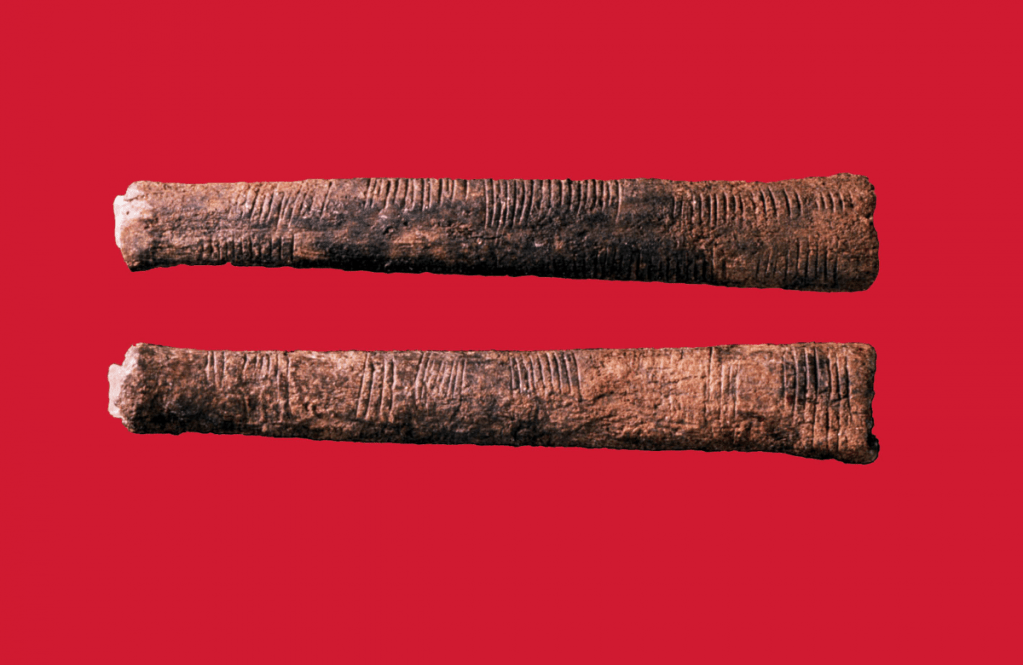
McWilliams traces the origin of money to the Ishango bone (discovered in the 1950s) that dates to 18,000 BCE on the Congo River in Africa.
In contrast to the complicated creation and use of Crypto currency, McWilliams notes the success of M-Pesa which has achieved societal trust in Kenya. M-Pesa is a digital wallet that lives on a mobile phone’s SIM card. This digital wallet can store money, send and receive payments, withdraw and deposit cash–all on a mobile phone, without internet access. This idea offers a model of financial services without ever opening a bank account. It avoids reliance on a creator of crypto currency or the banking industry with an app-based wallet like Apple Pay or PayPal.
The obvious irony of McWilliam’s history of money is that it began in Africa and its newest successful iteration comes from the same continent.
 REVIEWS AND VIEWS OF LIFE