
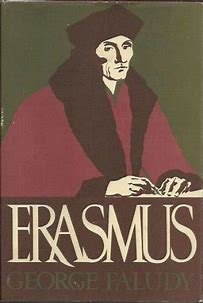
Books of Interest
Website: chetyarbrough.blog
ERASMUS
By: George Faludy

György Bernát József Leimdörfer aka George Faludy (1910-2006) Author, Hungarian poet and translator.
George Faludy’s biography of Erasmus was published in 1970. A few years ago, I purchased a paperback edition of Faludy’s book because of an interest in a 16th century “man of the cloth” (an ordained Catholic priest) who became a devotee of Francesco Petraca (better known as Petrarch who is considered the father of humanism). Erasmus was born in 1466 and died in 1536. He believed in the value, dignity, and potential of human beings. Petrarch had been dead for a hundred years when Erasmus became a proponent of humanism at a time when Catholic’ Indulgences were challenged by Martin Luther. Luther’s Ninety-Five Theses led to a schism in the church leading to the establishment of Protestantism.
Martin Luther (1483-1546)
Luther’s Ninety-Five Theses led to a schism in the church leading to the establishment of Protestantism.

It is hard to imagine how Erasmus managed to become a leader in reforming the Catholic Church with his humanist beliefs. Erasmus walks a fine line between the schism fomented by Martin Luther and his belief in reform. Erasmus wrote the famous work “The Praise of Folly” that was a satirical critique of societal and ecclesiastical practices of the Catholic church without joining the movement started by Luther. On the one hand, Erasmus agreed with Luther on the importance of faith and the perfidy of “indulgences” sold by the Church. Indulgences were to raise money with alleged religious guaranties for a Catholic’s admittance to heaven. On the other, Erasmus insisted on faith in God and reform, not abandonment of the Catholic church. Erasmus’s academic and scholarly review and interpretation of religious texts convinced him that the Church only needed reform, not schism.

Faludy carefully explains the tumultuous relationship between Erasmus and Luther that at times seemed to break but survived their fundamental disagreement on reform versus schism.
Erasmus acknowledged many misrepresentations of religious text with an unwavering belief in the divinity of their origin. As one who is skeptical about the divinity of religious texts, it is encouraging to read of this highly respected scholar’s belief in their truth. Faludy’s biography of Erasmus may not change an agnostic’s mind about God, but it will give one pause because of Erasmus’s reported research of original religious works in Greek, Latin, and other languages, i.e., a skill beyond most peoples’ capabilities.
Faludy does not write of Erasmus as a saintly person but as a well-educated and diligent scholar.
A surprising note by Faludy is that Erasmus suffered from syphilis which suggests something less than perfection in Erasmus’s character. However, Faludy’s note is not corroborated by any other information known to this reviewer.


Faludy suggested the most popular books written by Erasmus were “The Praise of Folly” and “Colloquies” which are similar in that they offer humorous and insightful stories of the human condition. One leaves Faludy’s biography of “Erasmus” with the thought that these two should be read, particularly because of the time in which we live today.

 REVIEWS AND VIEWS OF LIFE