
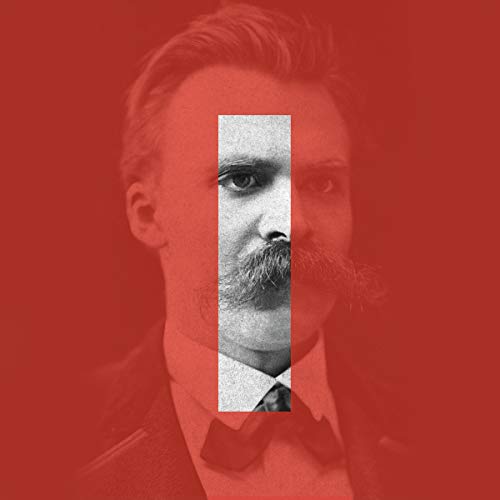
Audio-book Review
By Chet Yarbrough
Blog: awalkingdelight)
Website: chetyarbrough.blog
I Am Dynamite! A Life of Nietzsche
By: Sue Prideaux
Narrated by: Nicholas Guy Smith
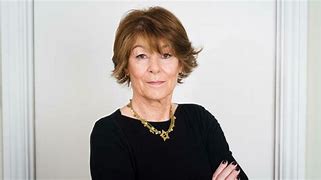
Sue Prideaux (Anglo-Norwegian author, also wrote “Edvard Munch: Behind the Scream”)
Friedrich Nietzsche’s life and philosophy is dissected by Sue Prideaux in “I Am Dynamite!”.
Friedrich Nietzsche (1844-1900, died at age 55.)
As inferred by Prideaux’s title, Nietzsche blows up a number of traditional religious and secular beliefs while battling physical and mental disorders in a complicated and contradictory life.

Nietzsche’s life is one of physical illness that seems to teeter on the edge of madness. In addition to his father’s history of early death from a brain ailment at 35, Nietzsche’s health is challenged by dysentery and diphtheria in 1870 when he is 26.

Nietzche’s last 11 years of life were spent in German and Swiss asylums or in his mother’s and sister’s care in Naumburg.
Some suggest he died from what is called dormant tertiary syphilis at 55 in Weimer Germany, less than 30 miles from Naumburg. Nearing the end of Prideaux’s biography, in Chapter 21, Nietzche’s plunge into madness is completed. One cannot help but think Nietzche’s philosophy and writing is hugely impacted by his ability to cope with recurrent illnesses.
- The Birth of Tragedy (1871)
- Early Greek philosophy & other essays (1872)
- On the Future of our Educational Institutions(1873)
- Thoughts Out of Season(1874)
- Human, All Too Human(1875)
- The case of Wagner-Nietzsche, Contra Wagner, Selected aphorisms(1876)
- The Dawn of Day(1881)
- The Joyful Wisdom(1882)
- Thus Spoke Zarathustra(1883)
- Beyond Good and Evil(1883)
- The Genealogy of Morals(1884)
- The Will to Power(1885)
- Twilight of the Idols/The Anti-Christ (1886)
- Ecce Homo(1888)
- The Antichrist(1895)
By Prideaux’s account, Nietzsche is an excellent pianist.
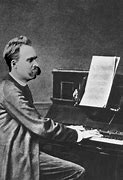
She notes his school mates gather around Nietzsche at the piano, particularly during violent weather events, because of his exuberance and creativity in playing well-known classical, as well as his own, music compositions. In his early life, Nietzsche becomes a close friend of German composer, Richard Wagner.

Nietzsche denies both religion and Socratic rationalism (a method of systematic doubt in pursuit of truth) by arguing individuals have a right to determine life’s value and meaning, without resort to religion or tradition.
Nietzsche believes too many false assumptions come from Socratic rationalism. In Socratic rationalism, Nietzsche is saying societal religion and tradition distort the pursuit of truth. To Nietzsche, human beings are on their own. That is the major philosophical point of his philosophy. His famous aphorism is “God is dead”. Morality and the reality of life is a function of man, not God, history, or tradition.
While seemingly destined for a religious life, born to a Lutheran pastor and teacher, Frederich Nietzsche chooses atheism and particular beliefs that offend his family.
Nietzsche believes conscience humans can become Supermen or Superwomen, surrounded by followers, if they have superior ability to choose that role in life. Some argue history reinforces that truth with the rise of leaders like Augustus in Rome, Jesus in Bethlehem, Genghis Kahn in Asia, Hitler in Germany, and other male leaders in history. Early in Nietzsche’s life he might have included women, like Cleopatra in Egypt, but as he aged his view of women changes. (History shows Nietzsche is ambivalent about women as “Super”, which remains a prejudice to this day.)
“Super” does not mean either being right or wrong. A “Superhuman” overcomes worldly influences by recognizing they are their own master.
Super” is meant to connote one who goes beyond God or societies’ good and evil to create value through a Super’s leadership and action in accordance with his/her beliefs. Obviously, the ugliness of this view is in its consequence to human resistors to the “Super” human that chooses a path contrary to the best interests of society or the individual.
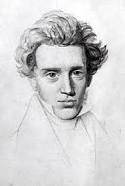
Soren Kierkegaard (1813-1855, existentialist philosopher died at age 42.)
If, as Nietzche infers, humans are on their own, Kierkegaard’s “fear and trembling” is not before God.
To Nietzche,”fear and trembling” is before the Superman, one who rises above the pettiness of self-interest to rule in the best interests of all. To Nietzsche, the human being is alone. One may either take a path to follow the Superman or become their own Superman.
Prideaux offers a comprehensive picture of a man on a mission. His mission is to disabuse human belief in a Supreme Being or societal tradition to solely rely on one’s own consciousness because that is all there is to life.

Nietzsche is shown by Prideaux to be opposed to antisemitism by breaking his close relationship with his sister and the famous composer, Richard Wagner, who was among the most famous antisemites of that era.
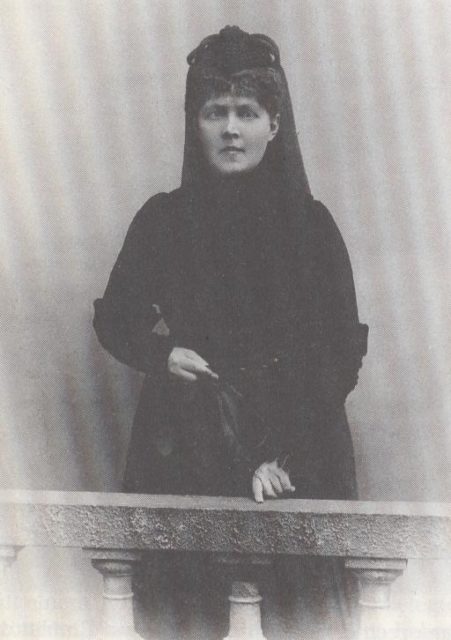
The ugly consequence of Nietzsche’s belief in the “Superhuman” is exemplified by his sister (Therese Elisabeth Alexandra Nietzsche, born in 1846, died in 1935 at age 89) who distorts her brother’s philosophy and endorses antisemitism and Adolph Hitler.
Prideaux’s biography offers details of Nietzsche’s life that allow reader/listeners to make up their own mind about Nietzschean philosophy. Prideaux shows Nietzschean philosophy is indeed “…Dynamite!”.
Nietzsche’s last decade of life is a journey into madness.

Though lovingly cared for by his mother, he is victimized by his sister who controls and distorts his contribution to philosophy. One presumes Nietzsche’s philosophy is either right or wrong, but its insightful truth lies in the horrors of history and the consequence of forsaking God and human tradition.

 REVIEWS AND VIEWS OF LIFE
https://mail.google.com/mail/u/0/#inbox/WhctKKZPCQBBcPlVGqJVxtVnqcvVGzKjZmstBxWGgBqxBtLRgLZxssZkqnGtXMKDBbmXXCl
(New York Jewish Week) — Congregants lined up in the morning cold outside the Stephen Wise Free Synagogue in the Upper West Side as the dawn broke Tuesday. Many of them held signs in support of Israel as well as supplies for the long day ahead as they boarded a large tour bus headed for Washington, D.C.. “This is an important act of unity and solidarity,” Rabbi Dalia Samansky told the passengers as the bus slowly made its way toward the March for Israel rally at the National Mall, as tens of thousands of other Jews from around the country headed toward the event.
A liberal Jewish cantor, Daniel Singer, then played a rendition of “Tefilat haderech,” or “A prayer for the road,” on an acoustic guitar. The congregants said they were inspired to make the long, trafficky trip to the rally to support the hostages held by Hamas, publicly back Israel, and take a stand against antisemitism as anti-Jewish discrimination surges in New York and elsewhere amid the fallout from the war. After event organizers announced a historic turnout of nearly 300,000 people at the rally, the participants said the event had bolstered their spirits and made a powerful statement in support of Jewish solidarity and Israel’s cause.
The group of marchers included amazingly, even some Stephen Wise Reform Jewish synagogue members, who occasionally even attend public services. The contingent ranged in age from high schoolers to the elderly. But also included several family groups. Reported that lady “Rabbi”, Ammiel Hirsch, of Stephen Wise Reform said: “I’m joining because I see the scary rise of antisemitism and I’ve been talking to people, and it’s just heartbreaking.” Despite the fact that Liberal Judaism has a long tradition of disgrace which actually encourages Jewish assimilation and intermarriage. And has an anti-Israel platform that more closely resembles to that of Neturei Karta.
Assimilated Reform, Maxine Albert, now sings a different tune: “People are telling me that they’re not wearing anything that identifies them as Jewish.” “It scares me and I want to stand up,” she added. Ms “rabbi” Rabbi Samansky said the rally came as many congregants felt increasing pressure over their support for Israel, as many activists clamor for Israel to accept a ceasefire with Hamas and the memory of the terror group’s Oct. 7 atrocities fade from the public discourse. Many of the congregants also felt isolated and abandoned by their former allies on the left due to the lack of a condemnation for antisemitism, Samansky added.
“A lot of our congregants are really struggling with their own place in the world, their own place in the social justice world that they have believed and been a part of for so long, while also dealing with their fear of being Jewish right now,” she said. “More and more congregants are saying, ‘Should I wear my star? Should I have my mezuzah be so prominent?’” “It’s so important to be at this [rally] to say we have a right to be Jewish, we have a right to be proud to be Jewish, we have a right to support Israel, and Israel has a right to be proud and to defend itself,” she said.
Several congregants said that the defaced and ripped up hostage posters around New York City were a reminder of the hostility around them, and some compared the tense atmosphere in the city to the rising antisemitism in prewar Europe. A number of attendees also cited the hostile atmosphere on college campuses as a worrying harbinger for the future. “When I was growing up, it was [shortly] after the Holocaust, so antisemitism wasn’t considered to be mainstream. It had to be hidden,” said Joyce Goldwyn-Spencer. Now, she said, “so much time has passed and they have the excuse of using Israel, blaming Israel.” “I think there is a sense of awakening,” said congregant Debra Warren, saying some U.S. Jews had become aware of “the Jew hatred that’s probably been simmering under the surface that’s now bubbled above the surface.”
Alas, these Reform Liberal Judaism “rabbis”, fail to connect the dots between Jewish assimilation and intermarriage – to the return of mass Jewish antisemitism. The Reform platform which promotes “Social Justice”, but dismally fails to warn the Jewish people that assimilation and intermarriage violates the 2nd Sinai commandment. Jewish worship of avoda zarah, the Prime First Cause of antisemitism in the world today.
The congregants firmly backed Israel’s need to defeat Hamas while mourning the Palestinian victims. But continue to blame Jerusalem, (Not in our Name, sorry excuse) for the toxic Dhimmi/Jewish discourse surrounding the conflict. The ignorance of the Israeli government for its lack of nuance, refusal to surrender and transform the 6 Day ’67 War into a national defeat before victorious Arab armies, (according to the words of Nasser). The poor understanding of radical right-wing Government over “complex issues” at play. The Liberal Jewish demand to divide both Israel and Jerusalem into two separate states and make a forced population transfer of Jewish settler populations living in Samaria.
After the five-hour drive, the Reform synagogue’s bus pulled into a parking lot at FedEx Field in North Englewood, Maryland, some nine miles east of the National Mall. The congregants spilled onto the asphalt to join throngs of other Jews and allies; the Stephen Wise group mostly broke apart as they mixed in with the thousands who made their way to the rally via shuttle, subway, taxi and on foot.
The masses in attendance at the rally included secular Jews and non-Jews, Haredim, school groups in matching shirts and Israelis navigating the crowds in Hebrew. Youths from the Chabad movement manned a tent, putting tefillin on passersby and handing out yellow balloons to high schoolers as young men wearing kippot danced in a circle nearby. Many in the crowd, framed on the lawn between the White House and the Washington Monument, carried U.S. and Israeli flags and photos of hostages.
The crowd fell silent as families of the captives spoke, with some in the audience breaking into tears. The crowd size — likely the largest Jewish gathering in U.S. history — was a powerful message for the congregation. Several assimilated Reform congregants said the support from public officials and non-Jews inspired confidence, despite the growing antisemitism plague. “I never thought that we would need to do this [protest] but the time is now so I’m glad to be there,” said Reform congregant Michael Sherman, adding that he was cheered by “Jews putting arms around each other, helping each other — secular, Orthodox.”
On the way back to the parking lot, young Israelis and Haredim alighted on the subway together as a group of high schoolers sang. The Stephen Wise delegation boarded the bus back to New York, and the cantor, Singer, played “Oseh Shalom” as two teenagers passed out bags of chocolate chip cookies to the weary congregants. “This isn’t 1939. We’re not going to stay silent in the face of antisemitism. We are going to stand up, we are going to protect ourselves and be proud of who we are,” Samansky said. “We’re determined to continue speaking out and being present and reminding the world that we are here and we have the right to be here.” The complete and utter silence over the disaster of Jewish assimilation and intermarriage – the elephant in the china closet – totally ignored.
LikeLike